Ezra 4:8

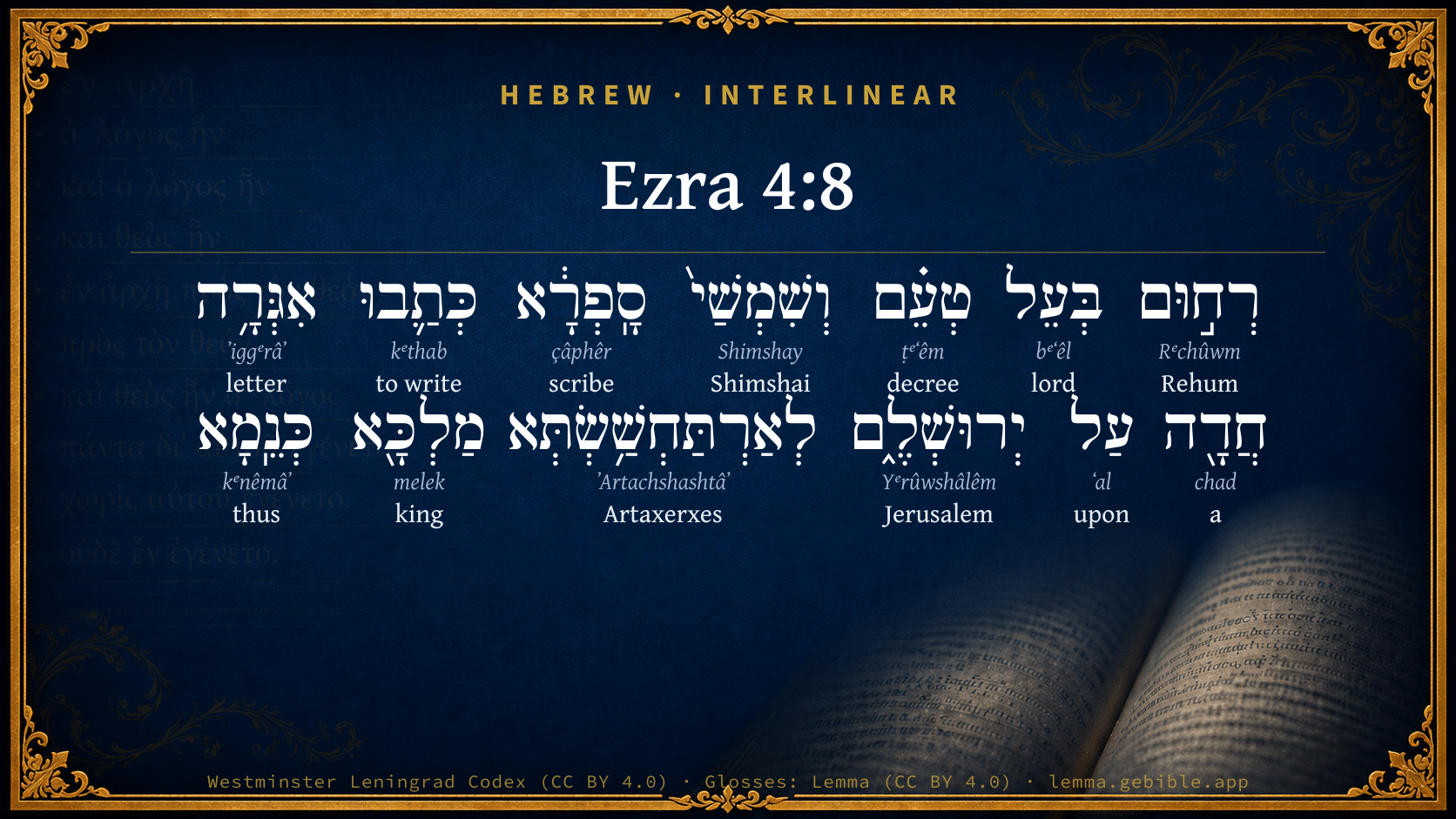
Hebrew (Westminster Leningrad Codex) Ezra 4:8 appears in the Hebrew Old Testament. The text above is from the Westminster Leningrad Codex. Each word links to its Strong’s number, a concise gloss, and parsing drawn from the Open Scriptures Hebrew Bible morphology. Click any word for its full Brown-Driver-Briggs (BDB) entry.
Download image
Cite this verse

Ezra 4:8 (World English Bible). Public Domain. Lemma interlinear Bible study tool, https://lemma.gebible.app/v/ezra/4/8.

Show BibTeX & RIS
BibTeX
RIS
English Translation
Rehum the chancellor and Shimshai the scribe wrote a letter against Jerusalem to Artaxerxes the king in this sort:
World English Bible · Public Domain
Highlights
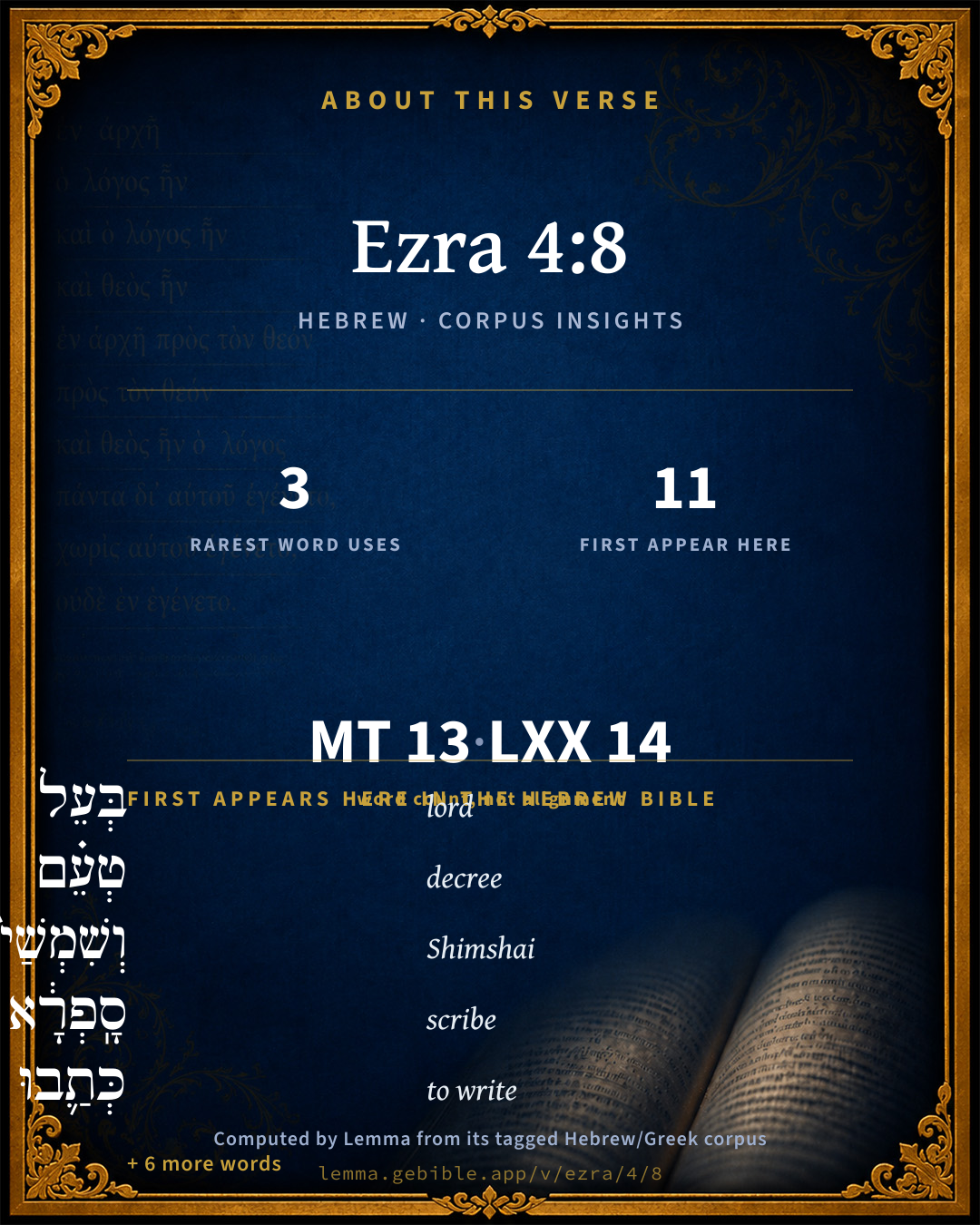
  • 11 first appearances in the Hebrew Bible
Full analysis ↓
Download a study sheet

One document with this verse’s original text, its word-by-word gloss line, the meaning frame, cross-references with their text, attributed commentary, and full source and license credits — printable, and it pastes into notes with its structure intact.

This verse Autodidact and up

Study sheet (.html) Plain text (.txt)

A passage Seminary Student

Up to 50 verses in one chapter. A passage sheet keeps up to 6 commentary sources and 12 cross-references per verse, in the order this page ranks them, and says so on the sheet whenever that leaves anything out. Ask for a single verse and you get the Autodidact verse sheet above.

Everything on this page stays free to read, with no account — the sheet is a download of what is already on screen, not access to it.

Want to remove ads? Support Godless Engineer
Compare translations 3

The same verse in 3 English versions, stacked beneath the original-language interlinear above. Click any original word for its lexicon entry.

Each is an independent rendering of the whole verse — the interlinear is not word-aligned to these translations.

Highlighted words mark where these versions differ — a whole-verse word diff, not a word-by-word alignment.

  • World English Bible Public Domain
    Rehum the chancellor and Shimshai the scribe wrote a letter against Jerusalem to Artaxerxes the king in this sort:
  • King James Version Public Domain
    Rehum the chancellor and Shimshai the scribe wrote a letter against Jerusalem to Artaxerxes the king in this sort:
  • unfoldingWord Literal Text CC BY-SA 4.0
    Rehum, a lord of decree, and Shimshai the scribe wrote one letter against Jerusalem to Artaxerxes the king as follows:

unfoldingWord Literal Text — © unfoldingWord, licensed CC BY-SA 4.0. Word-aligned USFM3 via Door43 (git.door43.org/unfoldingWord/en_ult).

Versions to compare (up to 4)

3 of 4 selected

Show all 18 translations

Every available English version of this verse, each an independent rendering of the whole verse.

  • World English Bible Public Domain
    Rehum the chancellor and Shimshai the scribe wrote a letter against Jerusalem to Artaxerxes the king in this sort:
  • Berean Standard Bible Public Domain
    Rehum the commander and Shimshai the scribe wrote the letter against Jerusalem to King Artaxerxes as follows:
  • Majority Standard Bible Public Domain
    Rehum the commander and Shimshai the scribe wrote the letter against Jerusalem to King Artaxerxes as follows:
  • King James Version Public Domain
    Rehum the chancellor and Shimshai the scribe wrote a letter against Jerusalem to Artaxerxes the king in this sort:
  • American Standard Version (1901) Public Domain
    Rehum the chancellor and Shimshai the scribe wrote a letter against Jerusalem to Artaxerxes the king in this sort:
  • Revised Version (1885) Public Domain
    Rehum the chancellor and Shimshai the scribe wrote a letter against Jerusalem to Artaxerxes the king in this sort:
  • Geneva Bible (1599) Public Domain
    Rehum the chancelour, and Shimshai the scribe wrote a letter against Ierusalem to Artahshashte the King, in this sort.
  • Douay-Rheims (1899) Public Domain
    Reum Beelteem, and Samsai the scribe wrote a letter from Jerusalem to king Artaxerxes, in this manner:
  • Young's Literal Translation Public Domain
    Rehum counsellor, and Shimshai scribe have written a letter concerning Jerusalem to Artaxerxes the king, thus:
  • Literal Standard Version CC BY-SA 4.0
    Rehum counselor, and Shimshai scribe have written a letter concerning Jerusalem to Artaxerxes the king, thus:
  • Unlocked Literal Bible CC BY-SA 4.0
    Rehum the commander and Shimshai the scribe wrote this way to Artaxerxes about Jerusalem.
  • unfoldingWord Literal Text CC BY-SA 4.0
    Rehum, a lord of decree, and Shimshai the scribe wrote one letter against Jerusalem to Artaxerxes the king as follows:
  • Darby Bible Public Domain
    Rehum the chancellor and Shimshai the scribe wrote a letter against Jerusalem to Artaxerxes the king after this sort:
  • World Messianic Bible Public Domain
    Rehum the chancellor and Shimshai the scribe wrote a letter against Jerusalem to Artaxerxes the king as follows.
  • Webster's Bible Public Domain
    Rehum the chancellor and Shimshai the scribe wrote a letter against Jerusalem to Artaxerxes the king in this sort:
  • Free Bible Version CC BY-SA 4.0
    Rehum the officer in command and Shimshai the scribe wrote a letter to King Artaxerxes condemning Jerusalem stating,
  • Bible in Basic English Public Domain
    Rehum, the chief ruler, and Shimshai the scribe, sent a letter against Jerusalem, to Artaxerxes the king;
  • JPS Tanakh (1917) Public Domain
    Rehum the commander and Shimshai the scribe wrote a letter against Jerusalem to Artaxerxes the king in this sort —

Literal Standard Version (2020), Covenant Press — licensed CC BY-SA 4.0. Text via the HelloAO Bible API (eBible.org). Unlocked Literal Bible (unfoldingWord) — licensed CC BY-SA 4.0. Text via the HelloAO Bible API (eBible.org). unfoldingWord Literal Text — © unfoldingWord, licensed CC BY-SA 4.0. Word-aligned USFM3 via Door43 (git.door43.org/unfoldingWord/en_ult). Free Bible Version, Dr. Jonathan Gallagher — licensed CC BY-SA 4.0. Text via the HelloAO Bible API (eBible.org).

Word by word

More ways to search: Search by grammar → Find every occurrence → Compare this word →

Practice this passage: Drill this verse → Learn its vocabulary →

About this verse

These counts appear in no published source. They are computed here, from the morphology-tagged text and Lemma’s own curated glosses. What Lemma adds →

13
words
13
distinct lemmas
Historical
section

Notable vocabulary

The rarest word here is בְּעֵל lord H1169 — appearing just 3 times in the whole Hebrew Bible.

First appearance in Scripture

These words make their first canonical appearance in the Hebrew Bible here (11 in total — showing 8):

  • בְּעֵל lord H1169
  • טְעֵ֗ם decree H2942
  • וְשִׁמְשַׁי֙ Shimshai H8124
  • סָֽפְרָ֔א scribe H5613
  • כְּתַ֛בוּ to write H3790
  • אִגְּרָ֥ה letter H104
  • חֲדָ֖ה a H2298
  • עַל upon H5922

Shared distinctive vocabulary

בְּעֵל lord H1169 occurs in 3 verses of the Hebrew Bible. Also found in:

Grammatical profile

  • 2 nouns
  • 9 adjectives
  • 2 particles

Hebrew & Septuagint length

In English translation the verse runs 19 words from the Hebrew and 16 from the Septuagint (LXX English) — closely comparable.

A rough comparison of the two English renderings, which tokenize alike — not a word-level alignment.

Word counts can differ between the Hebrew and the Greek without any difference in meaning — e.g. the Hebrew direct-object marker אֵת has no separate Greek word, and Greek often adds the article ὁ.

In the original languages it is 13 Hebrew tokens and 14 Greek tokens — but the two are counted differently (Hebrew bundles its prefixes and suffixes into one token; the Greek is in lemma form), so that isn’t a like-for-like length.

Cross-references

4

Topical passages linked to Ezra 4:8 in the Treasury of Scripture Knowledge — connected by theme and wording, ordered by reader-vote popularity; previews shown in the World English Bible.

  • Ezra 4:9 then [wrote] Rehum the chancellor, and Shimshai the scribe, and the rest of their companions, the Dinaites, and the Apharsathchites, the Tarpelites, the Apharsites, the Archevites, the Babylonians, the Shushanchites, the Dehaites, the Elamites,
  • 2 Samuel 8:17 and Zadok the son of Ahitub, and Ahimelech the son of Abiathar, were priests; and Seraiah was scribe;
  • 2 Samuel 20:25 and Sheva was scribe; and Zadok and Abiathar were priests;
  • 2 Kings 18:18 When they had called to the king, there came out to them Eliakim the son of Hilkiah, who was over the household, and Shebnah the scribe, and Joah the son of Asaph the recorder.

Cross-references courtesy of OpenBible.info (CC BY 4.0).

Hebrew and Greek witnesses Masoretic Hebrew ↔ Greek Septuagint

The same verse in the two great witnesses to the Old Testament, shown verse-for-verse.

These are two independent witnesses, not word-aligned to each other, and the Septuagint is shown in lemma (dictionary) form.

Hebrew Ezra 4:8 Masoretic · Westminster Leningrad Codex

רְח֣וּם בְּעֵל טְעֵ֗ם וְשִׁמְשַׁי֙ סָֽפְרָ֔א כְּתַ֛בוּ אִגְּרָ֥ה חֲדָ֖ה עַל יְרוּשְׁלֶ֑ם לְאַרְתַּחְשַׁ֥שְׂתְּא מַלְכָּ֖א כְּנֵֽמָא

Rehum the chancellor and Shimshai the scribe wrote a letter against Jerusalem to Artaxerxes the king in this sort:

World English Bible · Public Domain

Greek LXX Ezra 4:8 Septuagint · lemma form

ραουμ βααλταμ καί σαμσαι ὁ γραμματεύς γράφω ἐπιστολή εἷς κατά ἰερουσαλήμ ὁ αρθασασθα βασιλεύς

Reum the chancellor, and Sampsa the scribe wrote an epistle against Jerusalem to King Arthasastha, saying,

LXX2012 (modern English Septuagint) · Public Domain

In the Septuagint this is one book — Esdras B (2 Esdras): Ezra is chapters 1–10, Nehemiah 11–23.

On this verse, The Cambridge Bible for Schools and Colleges discusses the Septuagint’s reading. Read the note in Commentary ↓

Hebrew: Westminster Leningrad Codex (CC BY 4.0). Greek: Septuagint (public domain); English from LXX2012 (modern English Septuagint) (Public Domain). How the Septuagint differs from the Hebrew →

Commentary

Notes on Ezra 4:8 from classic Christian and Jewish commentators (each source and its license shown beneath its notes). The classic Christian expositions comment on the surrounding passage and are grouped to its opening verse, so a note may address several verses; the Jewish commentaries on the Tanakh (Rashi and others) are per-verse, so they appear only where the commentator wrote on this verse.

Lemma curates 59 commentaries, every one of them public domain or Creative Commons licensed, each selected and text-cleaned for this edition rather than reprinted as found. About our sources →

The Cambridge Bible for Schools and Colleges

gen. ed. J. J. S. Perowne

8. At this verse begins the first long section (Ezr_4:8 to Ezr_6:18) written in the Aramaic language (see Introd.), which the Compiler has probably extracted bodily from Aramaic records.

Ezr_4:8 introduces briefly the description of the letter of accusation against the Jews sent by Rehum and Shimshai.

Rehum the chancellor and Shimshai the scribe] Rehum was probably the chief official of the Samaritan community. The name is considered by some to be of Persian origin, and a contraction of some longer Persian name, e.g. Rheomithres, which is found in Arrian. It appears also in Jewish lists (see Ezr_2:2; Neh_3:17; Neh_10:25), but that need not exclude its foreign origin.

the chancellor] Literally ‘the lord of judgement’. Sayce suggests ‘lord of official intelligence’, the Aramaic word for ‘judgement’ being practically identical with the Assyrian word ‘dhem’, used of the official reports sent to the king by provincial rulers. Here the title apparently belongs to the chief officer of the district.

In the LXX., Syr. and Vulg. the title not being understood appears as a proper name; 1Es_2:16 makes the same error ‘Rathumus and Beeltethmus’.

Shimshai] Perhaps the same name as the Persian ‘Sisamnes’.

the scribe] i.e. the governor’s secretary. Each governor of a Persian province was attended by this official (Herod. III. 128), who acted as a check upon the governor as well as for administrative purposes.

The Cambridge Bible for Schools and Colleges (gen. ed. J. J. S. Perowne; Cambridge University Press, 1878–1918) — public domain. Text from a community e-Sword module.

Trapp's Complete Commentary

John Trapp

Ezr 4:8 Rehum the chancellor and Shimshai the scribe wrote a letter against Jerusalem to Artaxerxes the king in this sort:

Ver. 8. Rehum the chancellor] Or, president of the council. It is of the Chaldee termination; the whole history also following to Ezr 6:19, is Chaldee, transcribed, as some think, out of the rolls and registers of the Chaldees, and here inserted.

John Trapp, A Commentary or Exposition upon All the Books of the Old and New Testament (1647–1656) — public domain. Text from a community e-Sword module.

Joseph Benson's Commentary

Ezr 4:8-9. Rehum the chancellor and Shimshai the scribe wrote a letter, &c. — These two, as it was their office, put into writing, or drew up, a letter, agreeable to what had been resolved on in a council of the great men, or governors, mentioned in the foregoing verse. The Dinaites, &c. — These nine nations came out of Assyria, Persia, Media, Susiana, and other provinces of that vast empire; who, with one consent, joined in this letter or petition.

Joseph Benson's Commentary on the Old and New Testaments (1811–1818) — public domain. Text from a community e-Sword module.

Geneva Bible (1599)

Geneva Bible translators

Or, counselor.

Geneva Bible (1599) marginal notes — public domain. Text via Bolls.life.

Adam Clarke's Commentary

Verse 8. Rehum the chancellor] With this verse the Chaldee part of the chapter begins; and the same language continues to the end of Ezr 6:18. These men wrote to Darius in their own language; and the king in the same dialect returns an answer, chap. v. This circumstance adds authenticity to what is written: so scrupulous was the inspired penman, that he not only gave the words which each spoke and wrote, but he gave them also in the very language in which they were conceived and in the character peculiar to that language.

Adam Clarke's Commentary on the Bible (1810–1826) — public domain. Text from a community e-Sword/MySword module.

Ellicott's Commentary for English Readers

(8) Rehum the chancellor.—The lord of judgment, the counsellor of the Persian king, a conventional title of the civil governor.

Shimshai the scribe—The royal secretary.

A Bible Commentary for English Readers, edited by Charles John Ellicott (1878–1897) — public domain. Text from a community e-Sword module.

John Gill's Exposition

Then wrote Rehum the chancellor, and Shimshai the scribe, and the rest of their companions,.... who all signed the letter; namely, the governors of the following nations:

the Dinaites, the Apharsathchites, the Tarpelites, the Apharsites, the Archevites, the Babylonians, the Susanchites, the Dehavites, and the Elamites; which were colonies from several parts of Chaldea, Media, and Persia, and were settled in the several cities of Samaria, as several of their names plainly show, as from Persia, Erech, Babylon, Shushan, and Elimais; some account for them all, but with uncertainty; according to R. Jose (k) these were the Samaritans who first were sent out of five nations, to whom the king of Assyria added four more, which together make the nine here mentioned, see Kg2 17:24.

(k) Pirke Eliezer, c. 38.

John Gill's Exposition of the Whole Bible (1746–1763) — public domain (CC PDM 1.0). Text via the HelloAO Bible API.

Albert Barnes' Notes on the Bible

The chancellor - literally, “Lord of judgment;” the title, apparently, of the Persian governor of the Samaritan province. Every Persian governor was accompanied to his province by a “royal scribe” or “secretary,” who had a separate and independent authority.

Albert Barnes' Notes on the Bible (1834–1885) — public domain. Text from a community e-Sword/MySword module.

Haydock's Catholic Bible Commentary

Beelteem. Syriac, "the son of Baltam." The term designates the office of Reum, "the master of reason," president of the council, treasurer, &c. (Calmet) --- Protestants, "chancellor." --- From. Protestants, "against." (Haydock) --- Hebrew, "concerning."

George Leo Haydock (1774–1849), Haydock's Catholic Family Bible and Commentary, 1859 edition — public domain. Excludes Psalms (Douay-Rheims chapter numbering differs from Protestant) and Deuterocanonical books (Catholic canon only).

Whedon's Commentary on the Bible

Daniel D. Whedon

8. The chancellor — Hebrew, Lord of counsel, that is, a royal counsellor. He seems to have been the Persian governor and judge of the district of Samaria, and of the colonists mentioned in the next verse. The Sept. and Vulg. take the word as a proper name — Baaltam.

The scribe — Probably the secretary of the governor, or chancellor, and the one who translated this letter against Jerusalem into the Aramaean language.

In this sort — The two following verses (9-10) are to be regarded, not as an exact transcript, but a running paraphrase, giving the sentiment and general form of expression at the beginning of the letter. The introduction to the letter was in this sort, or after this manner. Hence the repetition in Ezr_4:11, after which follows what we may regard as an exact copy.

Daniel D. Whedon (gen. ed.), Commentary on the Old and New Testaments (1874–1909) — public domain. Text from a community e-Sword module.

The Pulpit Commentary

Rehum the chancellor. Literally, "the lord of judgment." It may be conjectured that Rehum was the sub-satrap (uJposatraphv, Xen.), of the province of Samaria. And Shimshai the scribe. Or "secretary." Herodotus tells us that in every Persian province the governor had a secretary attached to him, who was appointed by the crown, and acted as a check upon his nominal master (Herod., 3:128). The position assigned to Shim-shai in this chapter (see especially vers. 9, 17, 23) is such as might be expected under these circumstances.

The Pulpit Commentary (1880–1919), ed. H.D.M. Spence-Jones & Joseph S. Exell — public domain. Text from a community e-Sword module.

Rashi

Rabbi Shlomo Yitzchaki (Rashi)

Rehum was the secretary Rehum was the secretary and the master of words to compose the epistle.

and Shimshai was the scribe And Shimshai was the scribe: he is Shimshai the son of Haman. So it is customary to mention the scribe and the secretary together because they need each other; one composes and dictates, and the scribe writes, as it says (I Kings 4:3): “Eliphoreph and Ahiah, the sons of Shisha, scribes, Jehoshaphat, the son of Ahlud, the secretary,” and in another place it says (Isa. 36: 22): “And Eliakim, the son of Hilkiah etc. and Shebna the scribe, and Joah, the son of Asaph the secretary, came.”

they wrote a letter These two, Rehum and Shimshai, wrote the letter as Mithredath Tabeel had commanded them, and they all were dwellers of the cities of Samaria.

about Jerusalem about the building of the Temple, which is in Jerusalem.

as is stated Aram. כְּנֵמָא, as is stated, and that is similar to the expression of the Gemara: “as we wish to say further.”

Rashi on the Tanakh — English translations: “The Judaica Press complete Tanach with Rashi, translated by A. J. Rosenberg” (CC BY 4.0); “Pentateuch with Rashi's commentary by M. Rosenbaum and A.M. Silbermann, 1929-1934” (public domain); “The Metsudah Tanach series, Lakewood, N.J” (CC BY 4.0); and “The Book of Joshua, Metsudah Publications, 1997” (CC BY 4.0). Text via Sefaria.

Lesson kit

Teaching starters — assembled from the data on this page, not authored interpretation. Every prompt links to the verse data it draws on. Edit before teaching.

Ezra, in the Historical, opens this verse with 13 words (13 distinct Hebrew lemmas). Its most distinctive word is bᵉʻêl (“lord”). A historical commentator’s framing appears above. Read the whole chapter for the surrounding context.

Discussion questions

  1. How does “lord” (bᵉʻêl) shape what this verse is saying?
  2. 11 words here appear for the first time in Scripture. What is being introduced at this debut?
  3. Ezra 4:9 shares the word «lord» with this verse. How do the two illuminate each other?
  4. These translations render this verse differently; the difference is in the English rendering, not the original. What questions does that raise?
  5. Reading how The Cambridge Bible for Schools and Colleges and Trapp's Complete Commentary read this verse, where do the two commentators agree and where do they part?

Things to notice

Reading settings

Reading text

Shown beneath each verse's original-language words.

Old Testament
Old Testament edition

Read the OT as the Masoretic Hebrew (MT) or the Greek Septuagint (LXX).

English shown for the Greek Septuagint (in the Hebrew ↔ Greek comparison).

Comparing translations? Open the Compare panel on any verse page to stack up to four side by side.