Daniel 5:9

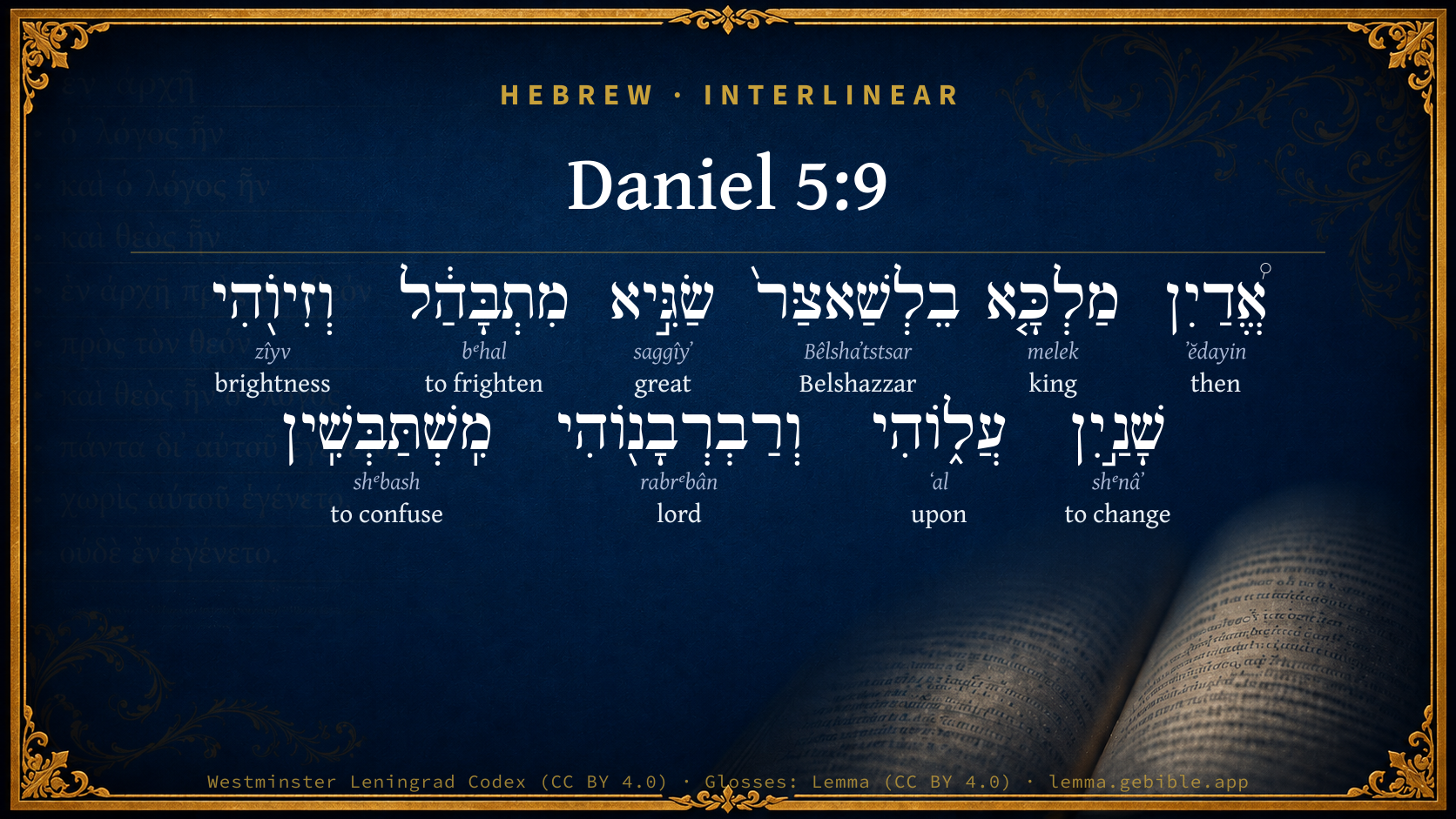
Hebrew (Westminster Leningrad Codex) Daniel 5:9 appears in the Hebrew Old Testament. The text above is from the Westminster Leningrad Codex. Each word links to its Strong’s number, a concise gloss, and parsing drawn from the Open Scriptures Hebrew Bible morphology. Click any word for its full Brown-Driver-Briggs (BDB) entry.
Download image
Cite this verse

Daniel 5:9 (World English Bible). Public Domain. Lemma interlinear Bible study tool, https://lemma.gebible.app/v/daniel/5/9.

Show BibTeX & RIS
BibTeX
RIS
English Translation
Then was king Belshazzar greatly troubled, and his face was changed in him, and his lords were perplexed.
World English Bible · Public Domain
Highlights
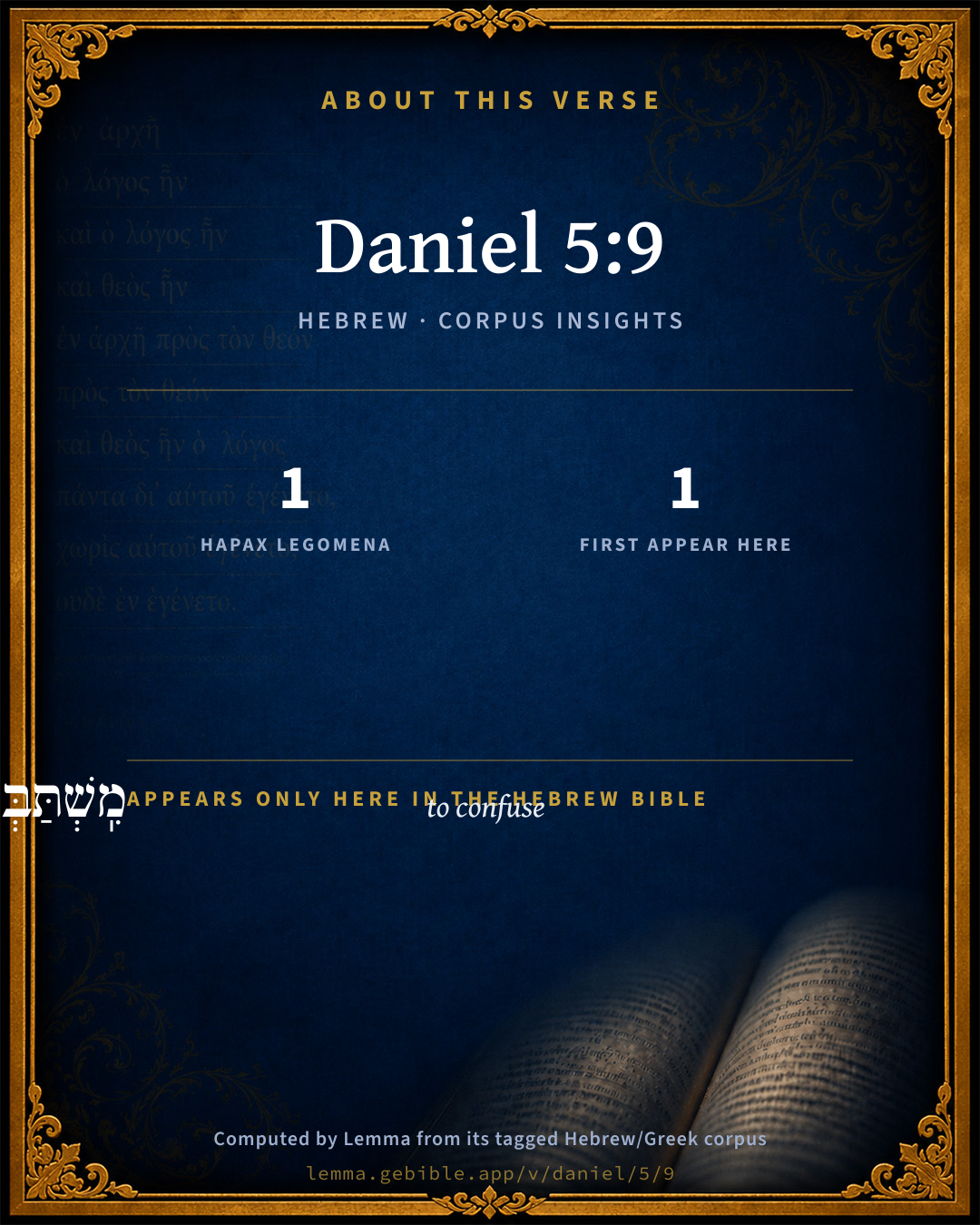
  • 1 hapax legomenon — only here in the Hebrew Bible
  • 1 first appearance in the Hebrew Bible
Full analysis ↓
Download a study sheet

One document with this verse’s original text, its word-by-word gloss line, the meaning frame, cross-references with their text, attributed commentary, and full source and license credits — printable, and it pastes into notes with its structure intact.

This verse Autodidact and up

Study sheet (.html) Plain text (.txt)

A passage Seminary Student

Up to 50 verses in one chapter. A passage sheet keeps up to 6 commentary sources and 12 cross-references per verse, in the order this page ranks them, and says so on the sheet whenever that leaves anything out. Ask for a single verse and you get the Autodidact verse sheet above.

Everything on this page stays free to read, with no account — the sheet is a download of what is already on screen, not access to it.

Want to remove ads? Support Godless Engineer
Compare translations 3

The same verse in 3 English versions, stacked beneath the original-language interlinear above. Click any original word for its lexicon entry.

Each is an independent rendering of the whole verse — the interlinear is not word-aligned to these translations.

Highlighted words mark where these versions differ — a whole-verse word diff, not a word-by-word alignment.

  • World English Bible Public Domain
    Then was king Belshazzar greatly troubled, and his face was changed in him, and his lords were perplexed.
  • King James Version Public Domain
    Then was king Belshazzar greatly troubled, and his countenance was changed in him, and his lords were astonied.
  • unfoldingWord Literal Text CC BY-SA 4.0
    Then King Belshazzar was greatly alarmed, and his color changed, and his noblemen were perplexed.

unfoldingWord Literal Text — © unfoldingWord, licensed CC BY-SA 4.0. Word-aligned USFM3 via Door43 (git.door43.org/unfoldingWord/en_ult).

Versions to compare (up to 4)

3 of 4 selected

Show all 18 translations

Every available English version of this verse, each an independent rendering of the whole verse.

  • World English Bible Public Domain
    Then was king Belshazzar greatly troubled, and his face was changed in him, and his lords were perplexed.
  • Berean Standard Bible Public Domain
    Then King Belshazzar became even more terrified, his face grew even more pale, and his nobles were bewildered.
  • Majority Standard Bible Public Domain
    Then King Belshazzar became even more terrified, his face grew even more pale, and his nobles were bewildered.
  • King James Version Public Domain
    Then was king Belshazzar greatly troubled, and his countenance was changed in him, and his lords were astonied.
  • American Standard Version (1901) Public Domain
    Then was king Belshazzar greatly troubled, and his countenance was changed in him, and his lords were perplexed.
  • Revised Version (1885) Public Domain
    Then was king Belshazzar greatly troubled, and his countenance was changed in him, and his lords were perplexed.
  • Geneva Bible (1599) Public Domain
    Then was King Belshazzar greatly troubled, and his countenance was changed in him, and his princes were astonied.
  • Douay-Rheims (1899) Public Domain
    Wherewith king Baltasar was much troubled, and his countenance was changed: and his nobles also were troubled.
  • Young's Literal Translation Public Domain
    then the king Belshazzar is greatly troubled, and his countenance is changing in him, and his great men are perplexed.
  • Literal Standard Version CC BY-SA 4.0
    then King Belshazzar is greatly troubled, and his countenance is changing in him, and his great men are perplexed.
  • Unlocked Literal Bible CC BY-SA 4.0
    Then King Belshazzar was greatly alarmed and the look on his face changed. His noblemen were perplexed.
  • unfoldingWord Literal Text CC BY-SA 4.0
    Then King Belshazzar was greatly alarmed, and his color changed, and his noblemen were perplexed.
  • Darby Bible Public Domain
    Then was king Belshazzar greatly troubled, and his countenance was changed in him, and his nobles were confounded.
  • World Messianic Bible Public Domain
    Then King Belshazzar was greatly troubled, and his face was changed in him, and his lords were perplexed.
  • Webster's Bible Public Domain
    Then was the king Belshazzar greatly troubled, and his countenance was changed in him, and his lords were astonished.
  • Free Bible Version CC BY-SA 4.0
    This made King Belshazzar even more frightened and his face grew even paler. His nobles also were in panic.
  • Bible in Basic English Public Domain
    Then King Belshazzar was greatly troubled and the colour went from his face, and his lords were at a loss.
  • JPS Tanakh (1917) Public Domain
    Then was king Belshazzar greatly affrighted, and his countenance was changed in him, and his lords were perplexed.

Literal Standard Version (2020), Covenant Press — licensed CC BY-SA 4.0. Text via the HelloAO Bible API (eBible.org). Unlocked Literal Bible (unfoldingWord) — licensed CC BY-SA 4.0. Text via the HelloAO Bible API (eBible.org). unfoldingWord Literal Text — © unfoldingWord, licensed CC BY-SA 4.0. Word-aligned USFM3 via Door43 (git.door43.org/unfoldingWord/en_ult). Free Bible Version, Dr. Jonathan Gallagher — licensed CC BY-SA 4.0. Text via the HelloAO Bible API (eBible.org).

Word by word

More ways to search: Search by grammar → Find every occurrence → Compare this word →

Practice this passage: Drill this verse → Learn its vocabulary →

About this verse

These counts appear in no published source. They are computed here, from the morphology-tagged text and Lemma’s own curated glosses. What Lemma adds →

10
words
10
distinct lemmas
Prophets
section

Notable vocabulary

1 hapax legomenon — a word that appears only here in the entire Hebrew Bible:

  • מִֽשְׁתַּבְּשִֽׁין to confuse H7672

First appearance in Scripture

This word makes its first canonical appearance in the Hebrew Bible here:

  • מִֽשְׁתַּבְּשִֽׁין to confuse H7672

Shared distinctive vocabulary

וְזִיוֺ֖הִי brightness H2122 occurs in 6 verses of the Hebrew Bible. Also found in:

Grammatical profile

  • 2 nouns
  • 7 adjectives
  • 1 particle

Hebrew & Septuagint length

In English translation the verse runs 18 words from the Hebrew and 18 from the Septuagint (LXX English) — the same length.

A rough comparison of the two English renderings, which tokenize alike — not a word-level alignment.

Word counts can differ between the Hebrew and the Greek without any difference in meaning — e.g. the Hebrew direct-object marker אֵת has no separate Greek word, and Greek often adds the article ὁ.

Cross-references

12

Topical passages linked to Daniel 5:9 in the Treasury of Scripture Knowledge — connected by theme and wording, ordered by reader-vote popularity; previews shown in the World English Bible.

  • Daniel 5:6 Then the king's face was changed in him, and his thoughts troubled him; and the joints of his loins were loosened, and his knees struck one against another.
  • Daniel 2:1 In the second year of the reign of Nebuchadnezzar, Nebuchadnezzar dreamed dreams; and his spirit was troubled, and his sleep went from him.
  • Isaiah 13:6–8 Wail; for the day of Yahweh is at hand; as destruction from the Almighty shall it come.
  • Isaiah 21:2–4 A grievous vision is declared to me; the treacherous man deals treacherously, and the destroyer destroys. Go up, Elam; besiege, Media; all the sighing of it have I made to cease.
  • Jeremiah 6:24 We have heard the report of it; our hands wax feeble: anguish has taken hold of us, [and] pangs as of a woman in travail.
  • Job 18:11–14 Terrors shall make him afraid on every side, And shall chase him at his heels.
  • Psalms 18:14 He sent out his arrows, and scattered them; Yes, great lightning bolts, and routed them.
  • Psalms 48:6 Trembling took hold of them there, Pain, as of a woman in travail.
  • Jeremiah 30:6 Ask now, and see whether a man does travail with child: why do I see every man with his hands on his loins, as a woman in travail, and all faces are turned into paleness?
  • Daniel 10:8 So I was left alone, and saw this great vision, and there remained no strength in me; for my comeliness was turned in me into corruption, and I retained no strength.
  • Matthew 2:3 When Herod the king heard it, he was troubled, and all Jerusalem with him.
  • Revelation 6:15 The kings of the earth, the princes, the commanding officers, the rich, the strong, and every slave and free person, hid themselves in the caves and in the rocks of the mountains.

Cross-references courtesy of OpenBible.info (CC BY 4.0).

Hebrew and Greek witnesses Masoretic Hebrew ↔ Greek Septuagint

The same verse in the two great witnesses to the Old Testament, shown verse-for-verse.

These are two independent witnesses, not word-aligned to each other, and the Septuagint is shown in lemma (dictionary) form.

Hebrew Daniel 5:9 Masoretic · Westminster Leningrad Codex

אֱ֠דַיִן מַלְכָּ֤א בֵלְשַׁאצַּר֙ שַׂגִּ֣יא מִתְבָּהַ֔ל וְזִיוֺ֖הִי שָׁנַ֣יִן עֲל֑וֹהִי וְרַבְרְבָנ֖וֹהִי מִֽשְׁתַּבְּשִֽׁין

Then was king Belshazzar greatly troubled, and his face was changed in him, and his lords were perplexed.

World English Bible · Public Domain

Greek LXX Daniel 5:9 Septuagint · lemma form

τότε ὁ βασιλεύς καλέω ὁ βασίλισσα περί ὁ σημεῖον καί ὑποδεικνύω αὐτός ὡς μέγας εἰμί καί ὅτι πᾶς ἄνθρωπος οὐ δύναμαι ἀποἀγγέλλω ὁ βασιλεύς ὁ σύγκριμα ὁ γραφή

And king Baltasar was troubled, and his countenance changed upon him, and his nobles were troubled with him.

LXX2012 (modern English Septuagint) · Public Domain

On this verse, The Pulpit Commentary discusses the Septuagint’s reading. Read the note in Commentary ↓

Hebrew: Westminster Leningrad Codex (CC BY 4.0). Greek: Septuagint (public domain); English from LXX2012 (modern English Septuagint) (Public Domain). How the Septuagint differs from the Hebrew →

Commentary

Notes on Daniel 5:9 from classic Christian and Jewish commentators (each source and its license shown beneath its notes). The classic Christian expositions comment on the surrounding passage and are grouped to its opening verse, so a note may address several verses; the Jewish commentaries on the Tanakh (Rashi and others) are per-verse, so they appear only where the commentator wrote on this verse.

Lemma curates 59 commentaries, every one of them public domain or Creative Commons licensed, each selected and text-cleaned for this edition rather than reprinted as found. About our sources →

Trapp's Complete Commentary

John Trapp

Dan 5:9 Then was king Belshazzar greatly troubled, and his countenance was changed in him, and his lords were astonied.

Ver. 9. Then was king Belshazzar greatly troubled.] In the midst of his feast he was thus damped and cast into his dumps; according to that of Amos, {Amo 8:10} "I will turn your feasts into mourning, and all your songs into lamentation." Yet find we not in him any sign of true remorse. "Whoredom and wine and new wine had even taken away his heart," {Hos 4:11} robbed him of himself, and laid a beast in the room.

John Trapp, A Commentary or Exposition upon All the Books of the Old and New Testament (1647–1656) — public domain. Text from a community e-Sword module.

Ibn Ezra

Rabbi Abraham ibn Ezra

[Daniel 5:9] Were dismayed (מִֽשְׁתַּבְּשִֽׁין - mishtabshin): [This is] according to its literal meaning (כְּמַשְׁמָעוֹ - k'mashma'o); like a person who does not know what to do.

Ibn Ezra on the Tanakh — English translations: “Sefaria Community Translation” (CC0 1.0 (public-domain dedication)); “Yalkut, Sifsei Chachomim Chumash, Metsudah Publications, 2009” (CC BY 4.0); and “Commentary of Ibn Ezra on Isaiah - trans. by M. Friedlander, 1873” (public domain). Text via Sefaria.

John Calvin's Commentaries

Now, with regard to the writing itself, God could not be a free agent unless he possessed the power of addressing one man at one time, and a number of men at another. He wished King Belshazzar to be conscious of this writing, while the magi were all as unable to read it as if they were blind. And then, with reference to the interpretation, their perplexity need not surprise us. For God spoke enigmatically, when he said Mene, Mene, and then Tekel, that is weighed, and Peres, divided. If the magi could have read these words a hundred times over, they could never either conjecture or comprehend their true meaning. The prophecy was allegorical, until an interpreter was divinely ordained for it. So far as the mere letters are concerned, there is no reason why we should be surprised at the eyes of the magi being blinded, since God pleased it to be so, and wished to cite the king to his tribunal, as we have already said. The Prophet says, The king was frightened, his countenance was changed, and the princes also were disturbed The publicity of the event ought to have increased the sense of God’s judgment, for, as we shall afterwards see, King Belshazzar himself was slain that very night. Cyrus entered while the Babylonians were feasting, and enjoying their luxuries in security. So remarkable an example of God’s justice might have been instantly buried in that drunken revel, had it not been rendered conspicuous to many bystanders. Hence Daniel repeats, The king was disturbed, after he saw no prospect of either aid or advice from his magi and astrologers. He says also, his princes were astonished, because not only the king ought to be troubled but the whole Court, and the report ought to flow forth not only through the city, but to foreign nations, since there is no doubt that Cyrus was afterwards informed of this prophecy; for he would not have courted Daniel so much, nor honored him so remarkably, unless this occurrence had been made known to him. It afterwards follows:

John Calvin's Commentaries (1540-1563) — public domain. Text from the Calvin Translation Society English edition (1840s-50s) via the Christian Classics Ethereal Library (ccel.org). Calvin's coverage is partial (roughly two-thirds of the Bible); uncommented books and verses are honest gaps, never fabricated. The 19th-century editor's footnotes and remarks are omitted so the notes are faithfully Calvin's own voice.

Ellicott's Commentary for English Readers

(9) The terror of Belshazzar and his lords is caused by the impression that the inability of the wise men to read the inscription is the portent of some terrible calamity.

A Bible Commentary for English Readers, edited by Charles John Ellicott (1878–1897) — public domain. Text from a community e-Sword module.

The Cambridge Bible for Schools and Colleges

gen. ed. J. J. S. Perowne

9. greatly troubled] greatly alarmed,—a climax upon Dan_5:6.

and his brightness was changed upon him] ‘upon’ in accordance with the principle explained on Dan_2:1.

were astonied] were confused or (R.V.) perplexed.

The Cambridge Bible for Schools and Colleges (gen. ed. J. J. S. Perowne; Cambridge University Press, 1878–1918) — public domain. Text from a community e-Sword module.

John Gill's Exposition

Then was King Belshazzar greatly troubled,.... A second time, and perhaps more than before; since he had conceived some hope that his wise men would have informed him what this writing was, and the meaning of it; but finding that they were nonplussed by it, it gave him still greater uneasiness:

and his countenance was changed in him; again; very likely, upon the coming in of the wise men, he had a little recovered himself, and became more composed and serene; which appeared in his countenance; but, upon this disappointment, his countenance changed again, and he turned pale, and looked ghastly:

and his lords were astonished; were in the utmost consternation and confusion, when they understood that the writing could neither be read nor interpreted; neither the dignity of their station, nor their numbers, nor their liquor, could keep up their spirits; so that the king had not one with him, to speak a comfortable word to him, or give him any advice in this his time of distress; they were all in the same condition with himself.

John Gill's Exposition of the Whole Bible (1746–1763) — public domain (CC PDM 1.0). Text via the HelloAO Bible API.

Albert Barnes' Notes on the Bible

Then was king Belshazzar greatly troubled - Not doubting that this was a Divine intimation of some fearful event, and yet unable to understand its meaning. We are quite as likely to be troubled by what is merely “mysterious” in regard to the future - by anything that gives us some undefined foreboding - as we are by what is really formidable when we know what it is. In the latter case, we know the worst; we can make some preparation for it; we can feel assured that when that is past, all is past that we fear - but who can guard himself, or prepare himself, when what is dreaded is undefined as well as awful; when we know not how to meet it, or how long it may endure, or how terrific and wide may be the sweep of its desolation?

And his countenance was changed in him - Margin, “brightnesses.” See the note at Dan 5:6.

And his lords were astonied - Amazed. The Chaldee word means to perplex, disturb, trouble. They were doubtless as much perplexed and troubled as the king himself.

Albert Barnes' Notes on the Bible (1834–1885) — public domain. Text from a community e-Sword/MySword module.

Matthew Poole's English Annotations

The second time, because his hopes in his wise men made him ashamed, and God would give him so much grief as he had pleasure in his luxury.

His lords were astonied: these were associates in sinning, and therefore must share in his consternation: so far were they from comforting him.

Matthew Poole's English Annotations on the Holy Bible (1683–1685) — public domain. Text from a community e-Sword/MySword module.

The Pulpit Commentary

Then was King Belshazzar greatly troubled, and his countenance was changed in him, and his lords were astonied. This verse presents signs also of being a repetition. The last clause appears to be the original form of the mysterious clause at the end of the sixth verse according to the Septuagint; the word mishtabsheen, which occurs here, seems to have been read mishtabhareen, from rhbv (shab"har), "to be glorious," in the ittaphel; this becomes "to boast one"s self," as in the Targum of Pro_25:14, also the Peshitta of the same passage; also 2Co_12:1. And this is the word used by Paulus Tellensis to translate kaucwntai. The Septuagint has a verse here that has no equivalent in the Massoretic text, "Then the king called the queen about the sign, and showed her how great it was, and that no one had been able to declare to the king the interpretation of the writing." This verse avoids the repetition we find in the Massoretic text, and explains the presence of the queen in a much more plausible way than the received text does. In the Massoretic text it is the noise and tumult that pierces the women"s apartments, and brings out the queen-mother; though not impossible, this is unlikely. The action of the king, as given in the Septuagint, is very probable. The wise men are baffled by this mysteriously appearing inscription. What is to be done? Belshazzar calls his mother, the daughter of Nebuchadnezzar, as she at least possibly was, to see if she knows anything in the past that might be a guide in such a matter. He not only shows her the sign, the inscription, but shows how great it was, by telling of the hand that had come out of the darkness, and had written it. Theodotion and the Peshitta agree with the Massoretic text. While the repetition is obvious, it is also true that the failure of all the wise men in Babylon to read the writing, as the Massoretic text has it, would increase the trouble of the king, and this trouble would naturally spread to the courtiers.

The Pulpit Commentary (1880–1919), ed. H.D.M. Spence-Jones & Joseph S. Exell — public domain. Text from a community e-Sword module.

Keil & Delitzsch

C. F. Keil & F. Delitzsch

By this not only was the astonishment of the king heightened, but the officers of state also were put into confusion. "In משׁתּבּשׁין lies not merely the idea of consternation, but of confusion, of great commotion in the assembly" (Hitzig). The whole company was thrown into confusion. The magnates spoke without intelligence, and were perplexed about the matter.

Not only was the tumult that arose from the loud confused talk of the king and the nobles heard by those who were there present, but the queen-mother, who was living in the palace, the wife of Nebuchadnezzar, also heard it and went into the banqueting hall. As soon as she perceived the cause of the commotion, she directed the attention of her royal son to Daniel, who in the days of his father Nebuchadnezzar had already, as an interpreter of dreams and of mysteries, shown that the spirit of the holy gods dwelt in him (Dan 5:10-12).

Keil & Delitzsch — Biblical Commentary on the Old Testament (1861–1891) — public domain (CC PDM 1.0). Text via the HelloAO Bible API. (Old Testament only.)

Rashi

Rabbi Shlomo Yitzchaki (Rashi)

became very frightened Aram. שַּׂגִּיא מִתְבָּהַל, extremely frightened.

were perplexed They were confused.

Rashi on the Tanakh — English translations: “The Judaica Press complete Tanach with Rashi, translated by A. J. Rosenberg” (CC BY 4.0); “Pentateuch with Rashi's commentary by M. Rosenbaum and A.M. Silbermann, 1929-1934” (public domain); “The Metsudah Tanach series, Lakewood, N.J” (CC BY 4.0); and “The Book of Joshua, Metsudah Publications, 1997” (CC BY 4.0). Text via Sefaria.

Lesson kit

Teaching starters — assembled from the data on this page, not authored interpretation. Every prompt links to the verse data it draws on. Edit before teaching.

Daniel, in the Prophets, opens this verse with 10 words (10 distinct Hebrew lemmas). Its most distinctive word is shᵉbash (“to confuse”). A historical commentator’s framing appears above. Read the whole chapter for the surrounding context.

Discussion questions

  1. The word shᵉbash carries the sense “to confuse.” How does it shape the verse?
  2. 1 word here appears nowhere else in the Hebrew Bible. Why might the author reach for such rare wording?
  3. This is the first place “to confuse” appears in Scripture (first appears here). What does its debut here establish?
  4. How does Daniel 2:31, which shares the word «brightness», read alongside this verse?
  5. The translations on this page render this verse differently — a whole-verse word diff, not a word-by-word alignment. What might account for the different wordings?
  6. Compare how Trapp's Complete Commentary and Ibn Ezra read this verse. Where do they agree or differ?

Things to notice

  • 1 word in this verse appears nowhere else in the Hebrew Bible.
  • 1 word makes its first canonical appearance in Scripture here.
  • These translations choose different wording for 10 words in this verse.
  • 10 distinct Hebrew lemmas span 10 words in this verse.

Reading settings

Reading text

Shown beneath each verse's original-language words.

Old Testament
Old Testament edition

Read the OT as the Masoretic Hebrew (MT) or the Greek Septuagint (LXX).

English shown for the Greek Septuagint (in the Hebrew ↔ Greek comparison).

Comparing translations? Open the Compare panel on any verse page to stack up to four side by side.