Daniel 2:12

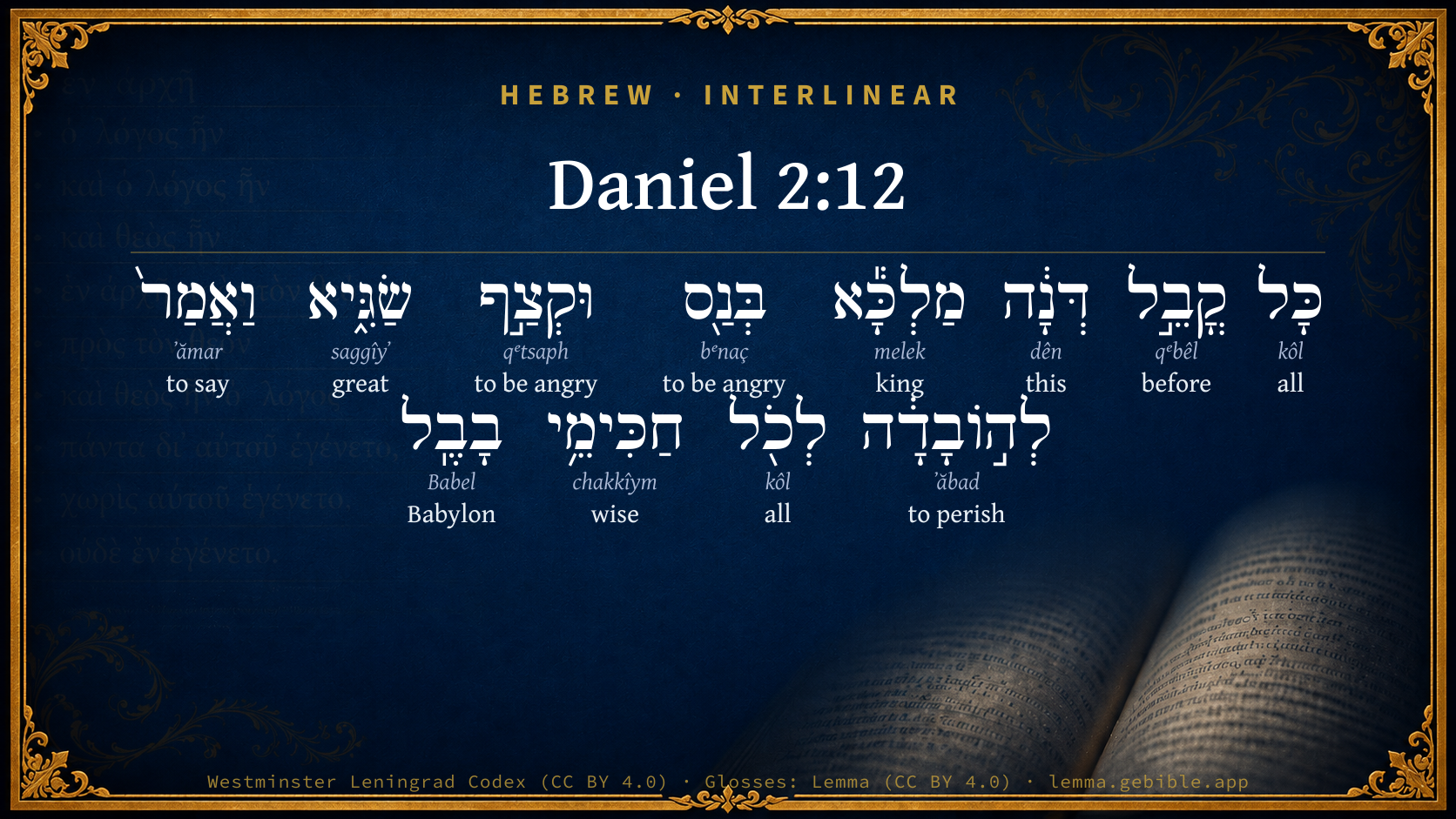
Hebrew (Westminster Leningrad Codex) Daniel 2:12 appears in the Hebrew Old Testament. The text above is from the Westminster Leningrad Codex. Each word links to its Strong’s number, a concise gloss, and parsing drawn from the Open Scriptures Hebrew Bible morphology. Click any word for its full Brown-Driver-Briggs (BDB) entry.
Download image
Cite this verse

Daniel 2:12 (World English Bible). Public Domain. Lemma interlinear Bible study tool, https://lemma.gebible.app/v/daniel/2/12.

Show BibTeX & RIS
BibTeX
RIS
English Translation
For this cause the king was angry and very furious, and commanded to destroy all the wise men of Babylon.
World English Bible · Public Domain
Highlights
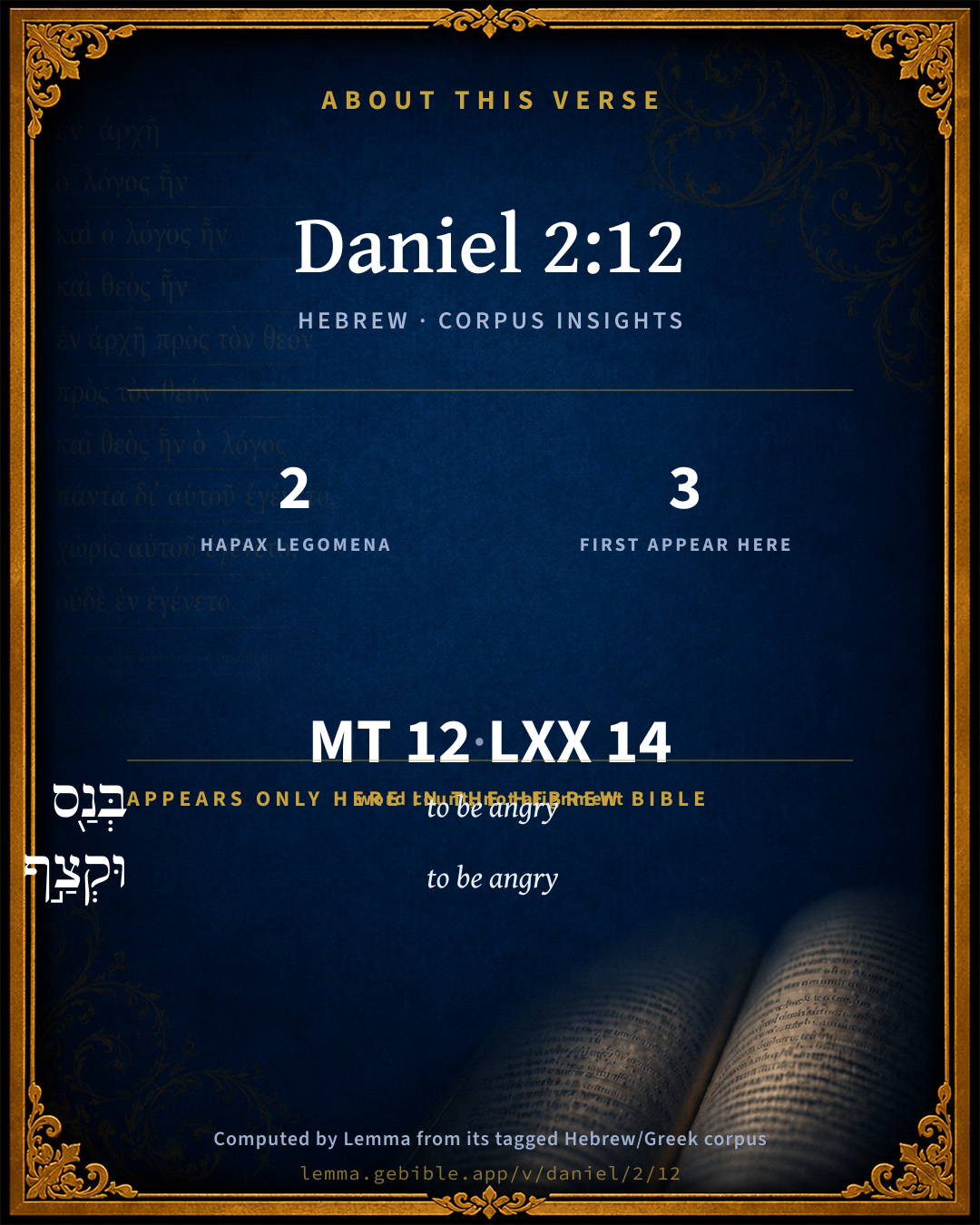
  • 2 hapax legomena — only here in the Hebrew Bible
  • 3 first appearances in the Hebrew Bible
Full analysis ↓
Download a study sheet

One document with this verse’s original text, its word-by-word gloss line, the meaning frame, cross-references with their text, attributed commentary, and full source and license credits — printable, and it pastes into notes with its structure intact.

This verse Autodidact and up

Study sheet (.html) Plain text (.txt)

A passage Seminary Student

Up to 50 verses in one chapter. A passage sheet keeps up to 6 commentary sources and 12 cross-references per verse, in the order this page ranks them, and says so on the sheet whenever that leaves anything out. Ask for a single verse and you get the Autodidact verse sheet above.

Everything on this page stays free to read, with no account — the sheet is a download of what is already on screen, not access to it.

Want to remove ads? Support Godless Engineer
Compare translations 3

The same verse in 3 English versions, stacked beneath the original-language interlinear above. Click any original word for its lexicon entry.

Each is an independent rendering of the whole verse — the interlinear is not word-aligned to these translations.

Highlighted words mark where these versions differ — a whole-verse word diff, not a word-by-word alignment.

  • World English Bible Public Domain
    For this cause the king was angry and very furious, and commanded to destroy all the wise men of Babylon.
  • King James Version Public Domain
    For this cause the king was angry and very furious, and commanded to destroy all the wise men of Babylon.
  • unfoldingWord Literal Text CC BY-SA 4.0
    Because of this the king was angry and very furious, and he gave an order to destroy all the wise men of Babylon.

unfoldingWord Literal Text — © unfoldingWord, licensed CC BY-SA 4.0. Word-aligned USFM3 via Door43 (git.door43.org/unfoldingWord/en_ult).

Versions to compare (up to 4)

3 of 4 selected

Show all 18 translations

Every available English version of this verse, each an independent rendering of the whole verse.

  • World English Bible Public Domain
    For this cause the king was angry and very furious, and commanded to destroy all the wise men of Babylon.
  • Berean Standard Bible Public Domain
    This response made the king so furious with anger that he gave orders to destroy all the wise men of Babylon.
  • Majority Standard Bible Public Domain
    This response made the king so angry and furious that he gave orders to destroy all the wise men of Babylon.
  • King James Version Public Domain
    For this cause the king was angry and very furious, and commanded to destroy all the wise men of Babylon.
  • American Standard Version (1901) Public Domain
    For this cause the king was angry and very furious, and commanded to destroy all the wise men of Babylon.
  • Revised Version (1885) Public Domain
    For this cause the king was angry and very furious, and commanded to destroy all the wise men of Babylon.
  • Geneva Bible (1599) Public Domain
    For this cause the king was angrie and in great furie, and commanded to destroy all the wise men of Babel.
  • Douay-Rheims (1899) Public Domain
    Upon hearing this, the king in fury, and in great wrath, commanded that all the wise men of Babylon should be put to death.
  • Young's Literal Translation Public Domain
    Therefore the king hath been angry and very wroth, and hath said to destroy all the wise men of Babylon;
  • Literal Standard Version CC BY-SA 4.0
    Therefore the king has been furious and very angry, and has said to destroy all the wise men of Babylon.
  • Unlocked Literal Bible CC BY-SA 4.0
    This made the king angry and very furious, and he gave an order to destroy all those in Babylon who were known for their wisdom.
  • unfoldingWord Literal Text CC BY-SA 4.0
    Because of this the king was angry and very furious, and he gave an order to destroy all the wise men of Babylon.
  • Darby Bible Public Domain
    For this cause the king was irritated and very wroth, and commanded to destroy all the wise men of Babylon.
  • World Messianic Bible Public Domain
    Because of this, the king was angry and very furious, and commanded that all the wise men of Babylon be destroyed.
  • Webster's Bible Public Domain
    For this cause the king was angry and very furious, and commanded to destroy all the wise men of Babylon.
  • Free Bible Version CC BY-SA 4.0
    This made the king extremely angry, and he ordered all the wise men of Babylon executed.
  • Bible in Basic English Public Domain
    Because of this the king was angry and full of wrath, and gave orders for the destruction of all the wise men of Babylon.
  • JPS Tanakh (1917) Public Domain
    For this cause the king was angry and very furious, and commanded to destroy all the wise men of Babylon.

Literal Standard Version (2020), Covenant Press — licensed CC BY-SA 4.0. Text via the HelloAO Bible API (eBible.org). Unlocked Literal Bible (unfoldingWord) — licensed CC BY-SA 4.0. Text via the HelloAO Bible API (eBible.org). unfoldingWord Literal Text — © unfoldingWord, licensed CC BY-SA 4.0. Word-aligned USFM3 via Door43 (git.door43.org/unfoldingWord/en_ult). Free Bible Version, Dr. Jonathan Gallagher — licensed CC BY-SA 4.0. Text via the HelloAO Bible API (eBible.org).

Word by word

More ways to search: Search by grammar → Find every occurrence → Compare this word →

Practice this passage: Drill this verse → Learn its vocabulary →

About this verse

These counts appear in no published source. They are computed here, from the morphology-tagged text and Lemma’s own curated glosses. What Lemma adds →

12
words
11
distinct lemmas
Prophets
section

Notable vocabulary

2 hapax legomena — words that appear only here in the entire Hebrew Bible:

  • בְּנַ֖ס to be angry H1149
  • וּקְצַ֣ף to be angry H7108

First appearance in Scripture

These words make their first canonical appearance in the Hebrew Bible here:

  • בְּנַ֖ס to be angry H1149
  • וּקְצַ֣ף to be angry H7108
  • חַכִּימֵ֥י wise H2445

Shared distinctive vocabulary

לְה֣וֹבָדָ֔ה to perish H7 occurs in 6 verses of the Hebrew Bible. Also found in:

Grammatical profile

  • 3 verbs
  • 1 noun
  • 6 adjectives
  • 1 conjunction
  • 1 particle

Verb forms

  • וּקְצַ֣ף Qal · Perfect
  • וַאֲמַר֙ Qal · Perfect
  • לְה֣וֹבָדָ֔ה Hiphil · Infinitive Construct

Repetition

A word recurs within this verse — often emphatic in Hebrew:

Hebrew & Septuagint length

In English translation the verse runs 20 words from the Hebrew and 16 from the Septuagint (LXX English) — closely comparable.

A rough comparison of the two English renderings, which tokenize alike — not a word-level alignment.

Word counts can differ between the Hebrew and the Greek without any difference in meaning — e.g. the Hebrew direct-object marker אֵת has no separate Greek word, and Greek often adds the article ὁ.

In the original languages it is 12 Hebrew tokens and 14 Greek tokens — but the two are counted differently (Hebrew bundles its prefixes and suffixes into one token; the Greek is in lemma form), so that isn’t a like-for-like length.

Cross-references

12

Topical passages linked to Daniel 2:12 in the Treasury of Scripture Knowledge — connected by theme and wording, ordered by reader-vote popularity; previews shown in the World English Bible.

  • Daniel 3:13 Then Nebuchadnezzar in [his] rage and fury commanded to bring Shadrach, Meshach, and Abednego. Then they brought these men before the king.
  • Psalms 76:10 Surely the wrath of man praises you. The survivors of your wrath are restrained.
  • Daniel 3:19 Then was Nebuchadnezzar full of fury, and the form of his visage was changed against Shadrach, Meshach, and Abednego: [therefore] he spoke, and commanded that they should heat the furnace seven times more than it was wont to be heated.
  • Matthew 2:16 Then Herod, when he saw that he was mocked by the wise men, was exceedingly angry, and sent out, and killed all the male children who were in Bethlehem and in all the surrounding countryside, from two years old and under, according to the exact time which he had learned from the wise men.
  • Job 5:2 For resentment kills the foolish man, And jealousy kills the simple.
  • Proverbs 16:14 The king's wrath is a messenger of death, But a wise man will pacify it.
  • Proverbs 19:12 The king's wrath is like the roaring of a lion, But his favor is like dew on the grass.
  • Proverbs 20:2 The terror of a king is like the roaring of a lion: He who provokes him to anger forfeits his own life.
  • Proverbs 27:3–4 A stone is heavy, And sand is a burden; But a fool's provocation is heavier than both.
  • Proverbs 29:22 An angry man stirs up strife, And a wrathful man abounds in sin.
  • Daniel 2:5 The king answered the Chaldeans, The thing is gone from me: if you don't make known to me the dream and the interpretation of it, you shall be cut in pieces, and your houses shall be made a dunghill.
  • Matthew 5:22 But I tell you, that everyone who is angry with his brother without a cause shall be in danger of the judgment; and whoever shall say to his brother, 'Raca!' shall be in danger of the council; and whoever shall say, 'You fool!' shall be in danger of the fire of Gehenna.

Cross-references courtesy of OpenBible.info (CC BY 4.0).

Hebrew and Greek witnesses Masoretic Hebrew ↔ Greek Septuagint

The same verse in the two great witnesses to the Old Testament, shown verse-for-verse.

These are two independent witnesses, not word-aligned to each other, and the Septuagint is shown in lemma (dictionary) form.

Hebrew Daniel 2:12 Masoretic · Westminster Leningrad Codex

כָּל קֳבֵ֣ל דְּנָ֔ה מַלְכָּ֕א בְּנַ֖ס וּקְצַ֣ף שַׂגִּ֑יא וַאֲמַר֙ לְה֣וֹבָדָ֔ה לְכֹ֖ל חַכִּימֵ֥י בָבֶֽל

For this cause the king was angry and very furious, and commanded to destroy all the wise men of Babylon.

World English Bible · Public Domain

Greek LXX Daniel 2:12 Septuagint · lemma form

τότε ὁ βασιλεύς στυγνός γίγνομαι καί περίλυπος προςτάσσω ἐκἄγω πᾶς ὁ σοφός ὁ βαβυλωνία

Then the king in rage and anger commanded to destroy all the wise men of Babylon.

LXX2012 (modern English Septuagint) · Public Domain

On this verse, The Pulpit Commentary discusses the Septuagint’s reading. Read the note in Commentary ↓

Hebrew: Westminster Leningrad Codex (CC BY 4.0). Greek: Septuagint (public domain); English from LXX2012 (modern English Septuagint) (Public Domain). How the Septuagint differs from the Hebrew →

Commentary

Notes on Daniel 2:12 from classic Christian and Jewish commentators (each source and its license shown beneath its notes). The classic Christian expositions comment on the surrounding passage and are grouped to its opening verse, so a note may address several verses; the Jewish commentaries on the Tanakh (Rashi and others) are per-verse, so they appear only where the commentator wrote on this verse.

Lemma curates 59 commentaries, every one of them public domain or Creative Commons licensed, each selected and text-cleaned for this edition rather than reprinted as found. About our sources →

Trapp's Complete Commentary

John Trapp

Dan 2:12 For this cause the king was angry and very furious, and commanded to destroy all the wise [men] of Babylon.

Ver. 12. For this cause the king was angry and very furious.] A cutting answer may mar a good cause. {Pro 15:1} See on Dan 2:9.

And commanded to destroy all the wise men of Babylon.] So rash is rage, it is no better than a short madness. Sed de vita hominis nulls potest esse satis diuturna cunctatio, saith the orator. {a} In case of life and death nothing should be determined without mature deliberation; for, like as Saturn, the highest of the planets, hath the slowest motion of them all; so, saith one, {b} should princess which sit in their high thrones of majesty, be most considerate in their actions.

{a} Cicero.

{b} Willet.

John Trapp, A Commentary or Exposition upon All the Books of the Old and New Testament (1647–1656) — public domain. Text from a community e-Sword module.

The Biblical Illustrator

Joseph S. Exell

Dan_2:12

The king was angry.

Anger

Anger, Dr. Cox observes, is

(1) undignifying;

(2) unreasonable;

(3) destructive of that just and useful influence to which we should aspire, and for which everyone is naturally capacitated by his position in society;

(4) usually makes a rapid progress;

(5) is productive of great unhappiness;

(6) is a most guilty passion.

It is remarked by Robert Hall: Vindictive passions surround the soul with a sort of turbulent atmosphere, than which nothing can be conceived more opposite to the calm and holy light in which the blessed Spirit loves to dwell.

The Biblical Illustrator, edited by Joseph S. Exell (c. 1880s–1900s) — public domain. Text from a community e-Sword module.

Joseph Benson's Commentary

Dan 2:12-13. For this cause the king was angry and very furious, &c. — The king, in his rage and fury, probably did not think of sending for Daniel, which made Daniel try to get admission to the king, Dan 2:14, to prevent his own destruction, as well as that of the other wise men. And they sought Daniel and his fellows to be slain — Though, as it appears, they had not been summoned with the wise men of Chaldea. This was extremely unjust to Daniel and his companions; for it is highly probable they would have received no share of the gifts, and rewards, and great honour, which the other wise men would have received could they have told the king’s dream, therefore they ought not to have been involved in their punishment. But those concerned in the execution of the decree, being armed with power, did not attend to the voice of justice: absolute power, indeed, too seldom does.

Joseph Benson's Commentary on the Old and New Testaments (1811–1818) — public domain. Text from a community e-Sword module.

Tyndale Open Study Notes

Tyndale Open Resources

2:12 The king was furious because contradicting or refusing the king’s command was an offense punishable by death. The king was supposed to be treated as divine, so they were violating protocol in saying that he was not. The king’s sages were also supposed to have a connection with the divine, but they admitted that they did not. The offense to the king was so severe that he ordered that all the wise men of Babylon be executed. The king’s rage foreshadows 11:11-35.

Tyndale Open Study Notes — © Tyndale Open Resources, licensed CC BY-SA 4.0. Text via the HelloAO Bible API.

Ibn Ezra

Rabbi Abraham ibn Ezra

[Daniel 2:12] Kol kovel denah (כָּל־קֳבֵל דְּנָה - Because of this): [Regarding the word] became angry/provoked (benas - בְּנַס) - [this means] "with rage" (b'zaʿaf - בְּזַעַף) [which is its] Aramaic equivalent/translation (Targum), and [it is related to the Hebrew] “and they look troubled/angry” (v'hinam zoʿafim - וְהִנָּם זוֹעֲפִים) [Daniel 1:10].

[Daniel 2:12] chakkimei Vavel (חַכִּימֵי בָבֶל - wise men of Babylon): They are the ones mentioned at the beginning [Daniel 2:2].

Ibn Ezra on the Tanakh — English translations: “Sefaria Community Translation” (CC0 1.0 (public-domain dedication)); “Yalkut, Sifsei Chachomim Chumash, Metsudah Publications, 2009” (CC BY 4.0); and “Commentary of Ibn Ezra on Isaiah - trans. by M. Friedlander, 1873” (public domain). Text via Sefaria.

Jamieson, Fausset & Brown

Robert Jamieson, A. R. Fausset & David Brown

Daniel and his companions do not seem to have been actually numbered among the Magi or Chaldeans, and so were not summoned before the king. Providence ordered it so that all mere human wisdom should be shown vain before His divine power, through His servant, was put forth. Dan 2:24 shows that the decree for slaying the wise men had not been actually executed when Daniel interposed.

Jamieson, Fausset & Brown — Commentary Critical and Explanatory on the Whole Bible (1871) — public domain (CC PDM 1.0). Text via the HelloAO Bible API.

John Calvin's Commentaries

The former denunciation was horrible, but now Nebuchadnezzar proceeds beyond it; for he not merely threatens the Chaldeans with death, but commands it to be inflicted. Such an example is scarcely to be found in history; but the cause of his wrath must be noticed, since God wished his servant Daniel to be brought forward and to be observed by all men. This was the preparation by which it became generally evident that the wise men of Babylon were proved vain, through promising more than they could perform; even if they had been endowed with the greatest wisdom, they would still have been destitute of that gift of revelation which was conferred upon Daniel. Hence it happened that the king denounced death against them all by his edict; for he might then perhaps acknowledge what he had never perceived before, namely, that their boasting was nothing but vanity, and their arts full of superstitions. For when superstition fails of success, madness immediately succeeds, and when those who are thought and spoken of as remarkably devout, perceive their fictitious worship to be of no avail, then they burst forth into the madness which I have mentioned, and curse their idols, and detest what they had hitherto followed. So it occurred here, when Nebuchadnezzar suspected imposture in so serious a matter, and no previous suspicion of it had entered his mind; but now, when he sees through the deception, in so perplexing a case, and hi such great anxiety, when left destitute of the advice of those from whom he hoped all things, then he is a hundredfold more infuriated than if he had been previously in a state of perfect calmness. It afterwards follows: —

John Calvin's Commentaries (1540-1563) — public domain. Text from the Calvin Translation Society English edition (1840s-50s) via the Christian Classics Ethereal Library (ccel.org). Calvin's coverage is partial (roughly two-thirds of the Bible); uncommented books and verses are honest gaps, never fabricated. The 19th-century editor's footnotes and remarks are omitted so the notes are faithfully Calvin's own voice.

Ellicott's Commentary for English Readers

(12) This order to massacre the wise men extended apparently only to those who were resident in the city of Babylon, where they had a fixed habitation. Though Daniel had been already trained in their schools, he had not as yet been appointed “a wise man.” However, being a student, his death was implied in the general order, which, as appears from Dan_2:13, had already begun to be executed.

A Bible Commentary for English Readers, edited by Charles John Ellicott (1878–1897) — public domain. Text from a community e-Sword module.

The Cambridge Bible for Schools and Colleges

gen. ed. J. J. S. Perowne

12. wise men] of those versed in occult arts, as Gen_41:8; Jer_50:35 (of Babylon), and several times in the sequel (cf. p. 15). Similarly wisdom, Isa_47:10 (of Babylon), and ch. Dan_1:17; Dan_1:20.

The Cambridge Bible for Schools and Colleges (gen. ed. J. J. S. Perowne; Cambridge University Press, 1878–1918) — public domain. Text from a community e-Sword module.

John Gill's Exposition

For this cause the king was angry, and very furious,.... Not only because they could not tell his dream, and the interpretation of it; but because they represented him as requiring a thing unreasonable and impossible, which had never been done by any potentate but himself, and could never be answered but by the gods: this threw him into an excess of wrath and fury; which in those tyrannical and despotic princes was exceeding great and terrible:

and commanded to destroy all the wise men of Babylon; not only those that were now in his presence, but all others; concluding from this instance that they were an useless set of men, yea, deceivers and impostors.

John Gill's Exposition of the Whole Bible (1746–1763) — public domain (CC PDM 1.0). Text via the HelloAO Bible API.

Albert Barnes' Notes on the Bible

For this cause the king was angry - Because they failed in explaining the subject which had been referred to them. It is true that his anger was unjust, for their profession did not imply that they would undertake to explain what he demanded, but his wrath was not unnatural. His mind was alarmed, and he was troubled. He believed that what he had seen in his dream foreboded some important events, and, as an arbitrary sovereign, unaccustomed to restrain his anger or to inquire into the exact jusrice of matters which excited Iris indignation, it was not unnatural that he should resolve to wreak his vengeance on all who made any pretensions to the arts of divining.

And very furious - Wrought up to the highest degree of passion. Chaldee, “Much enraged.” It was not a calm and settled purpose to execute his threat, but a purpose attended with a high degree of excitement.

And commanded to destroy all the wise men of Babylon - That is, all who made pretensions to this kind of wisdom; all who came under the wellknown denomination of “wise men,” or “sages.” He had called that class before him Dan 2:2; he had demanded of them an explanation of his dream; he had been assured by the leading men among them, the Chaldeans Dan 2:10-11, that they could not recall his dream; and, as he supposed that all who could be relied on in such a case had failed, he resolved to cut them off as impostors.

Where Daniel was at this time is not known. It would seem, however, that from some reason he had not been summoned before the king with the others, probably because, although he had shown himself to be eminently endowed with wisdom Dan 1:20, he had not yet made any pretensions to this kind of knowledge, and was not numbered with the Magi, or Chaldeans. When, however, the decree went forth that “all” the “wise men of Babylon” should be slain, the exhibition of wisdom and knowledge made by him Dan 1:18-20 was recollected, and the executioners of the sentence supposed that tie and his companions were included in the general instructions. Whether the word “Babylon” here relates to the city of Babylon, or to the whole realm, there is no certain way of determining. Considering, however, the character of Oriental despotisms, and the cruelty to which absolute sovereigns have usually been transported in their passion, there would be no improbability in supposing that the command included the whole realm, though it is probable that most of this class would be found in the capital.

Albert Barnes' Notes on the Bible (1834–1885) — public domain. Text from a community e-Sword/MySword module.

Matthew Poole's English Annotations

Tyrants are inexorable, and they rule according to their will, and being crossed they are furious, and that brings forth death; the wrath of such is the roaring of a lion.

Matthew Poole's English Annotations on the Holy Bible (1683–1685) — public domain. Text from a community e-Sword/MySword module.

The Pulpit Commentary

For this cause the king was angry and very furious, and commanded to destroy all the wise men of Babylon. The Septuagint rendering differs little in sense from the above, but in words it does considerably, "Then the king, becoming gloomy and very grieved, commanded that they lead out,all the wise men of Babylonia." The main thing to be observed is the softening of the meaning in the hands of the Septuagint translator. This is so great as to suggest that he read hlz; wOhl; instead of hdbwOhl. The aphel of lza is not used in Chaldee, but is used in Syriac. Theodotion"s rendering is, "Then the king in anger and wrath commanded to destroy all the wise meal of Babylon." The Syriac has a shade of difference, "Then was the king vehemently enraged, and in great fury commanded to destroy all the wise men of Babylon." It is evident that Theodotion read snb (benas), "was angry," as if it were the preposition b and the Syriac noun sn (has), "anger." He also must have inserted the preposition before pxq (qetzaph), "wrath;" in this he is followed by the Peshitta. The Septuagint is freer in its rendering in this verse, and one cannot argue anything from it. The probability seems to be that sn; (nas) is used as a noun, and that the Targamic verb was formed from the mistake of a scribe dropping the preposition before pxq (qetzaph). If we are correct in this, we have an additional evidence that the original languagge of Daniel was not Chaldee, but Syriac, or, at all events, Eastern Aramaic. As a grammatical note, we direct attention to the form hdbwhl, where the a of the root has totally disappeared before the h of the haphel, the equivalent in Biblical Aramaic of the Chaldee and Syriac aphel with its preformative a. Professor Bevan says that this distinction is only a matter of orthography. Are we to deduce that Professor Bevan has a cockney disregard for h"s? The writer now drops reference to special classes of wise men, and names them generally hakeemin. The king is unconvinced of the truth of these wise men (hakeemin), or rather he is convinced that they are traitors and deceivers. They are either concealing from him the knowledge they have, and are, therefore, traitors to him; or the gods have withdrawn from them, and therefore they must have been untrue to the gods. On both these grounds Nebuchadnezzar thinks them worthy of death. He at once issues the decree that all the wise men in the city of Babylon should be slain. If the LXX reading of Dan_2:2 be correct, he had only summoned the Chaldean wise men. If all the wise men of Babylon were ordered to be slain, the punishment is extended beyond the offence. Possibly he argued, "If even my fellow-countrymen, the Chaldeans, are traitors, much more will the Babylonians be so." So far as words go, it is doubtful whether this decree applies to the province of Babylonia, as the Septuagint translator thinks, or merely to those in the city. But cruel and furious as was the young conqueror, he was scarcely likely to order the wholesale massacre of those who, in Sippara and Borsippa, had neither refused to do what he wished, nor by implication called him an unreasonable tyrant, as had the wise men in Babylon.

The Pulpit Commentary (1880–1919), ed. H.D.M. Spence-Jones & Joseph S. Exell — public domain. Text from a community e-Sword module.

unfoldingWord translationNotes

Door43 World Missions Community

angry and very furious

These words mean basically the same thing and emphasize the intensity of his anger. AT: "incredibly angry" (See: Doublet)

all those in Babylon

"all the men in Babylon"

So the decree went out

The decree is spoken of as if it was alive and able to go out by itself. AT: "So the king issued a command" or "So the king gave a command" (See: Personification)

all those who were known for their wisdom were to be put to death

This can be stated in active form. AT: "the soldiers were to kill all of the men who were known for their wisdom" (See: Active or Passive)

so they could be put to death

This can be stated in active form. AT: "in order to kill them" (See: Active or Passive)

translationWords

king

anger

Babylon

wise

decree

Daniel

unfoldingWord translationNotes — © Distant Shores Media and the Door43 World Missions Community, licensed CC BY-SA 4.0. Source: git.door43.org/Door43/en_tn.

Rashi

Rabbi Shlomo Yitzchaki (Rashi)

In view of this in view of this reply.

in great wrath and anger Aram. מַלְכָּא בְּנַס וּקְצַף שַּׂגִיא. The king was in great wrath and anger.

(בְּנַס) means in wrath. (Gen. 40:6): “And behold they were angry (זעַפִים), and Onkelos renders: נסִיסִין.

and ordered to destroy Aram. וַאֲמַר לְהוֹבָדָה. About this “vav” of וַאֲמַר, Menahem and Dunash disputed. Menahem (p. 46) forced himself to make the “beth” of בְּנַס, a radical and did not interpret בְּנַס וּקְצַף as nouns, but as an expression of a verb: was greatly wroth and angry and ordered to destroy. The “vav” in וַאֲמַר forced him to interpret it this way. Dunash (p. 9) says that it is impossible for the “beth” to be a radical, but it is a noun, and he interpreted it in this manner: with great wrath and anger he ordered to destroy, and the “vav” there is superfluous, like the “vav” of (Ps. 76:7): “chariot (וְרֶכֶב) and horse.” But I say that the “vav” is not forced to be superfluous, but so is its interpretation: מַלְכָּא בְּנַס וּקְצַף שַּׂגִּיא, the king was in great wrath and anger, and he ordered in his wrath to destroy them. Accordingly, this is an elliptical verse.

Rashi on the Tanakh — English translations: “The Judaica Press complete Tanach with Rashi, translated by A. J. Rosenberg” (CC BY 4.0); “Pentateuch with Rashi's commentary by M. Rosenbaum and A.M. Silbermann, 1929-1934” (public domain); “The Metsudah Tanach series, Lakewood, N.J” (CC BY 4.0); and “The Book of Joshua, Metsudah Publications, 1997” (CC BY 4.0). Text via Sefaria.

Lesson kit

Teaching starters — assembled from the data on this page, not authored interpretation. Every prompt links to the verse data it draws on. Edit before teaching.

Daniel, in the Prophets, opens this verse with 12 words (11 distinct Hebrew lemmas). Its most distinctive word is bᵉnaç (“to be angry”). A historical commentator’s framing appears above. Read the whole chapter for the surrounding context.

Discussion questions

  1. How does “to be angry” (bᵉnaç) shape what this verse is saying?
  2. This verse holds 2 words here found nowhere else in the Hebrew Bible. What might the rare words draw attention to?
  3. 3 words here appear for the first time in Scripture. What is being introduced at this debut?
  4. Jeremiah 10:11 shares the word «to perish» with this verse. How do the two illuminate each other?
  5. “all” occurs 2× in this one verse. What is the effect of the repetition?
  6. These translations render this verse differently; the difference is in the English rendering, not the original. What questions does that raise?
  7. The verb «וּקְצַ֣ף» is Qal Perfect. How does its form color the action?
  8. Reading how Trapp's Complete Commentary and The Biblical Illustrator read this verse, where do the two commentators agree and where do they part?

Things to notice

  • 2 words in this verse appear nowhere else in the Hebrew Bible.
  • 3 words make their first canonical appearance in Scripture here.
  • This verse counts 12 Hebrew ↔ 14 Greek words.
  • These translations choose different wording for 5 words in this verse.
  • “all” occurs 2× in this single verse.

Reading settings

Reading text

Shown beneath each verse's original-language words.

Old Testament
Old Testament edition

Read the OT as the Masoretic Hebrew (MT) or the Greek Septuagint (LXX).

English shown for the Greek Septuagint (in the Hebrew ↔ Greek comparison).

Comparing translations? Open the Compare panel on any verse page to stack up to four side by side.