Daniel 5:8

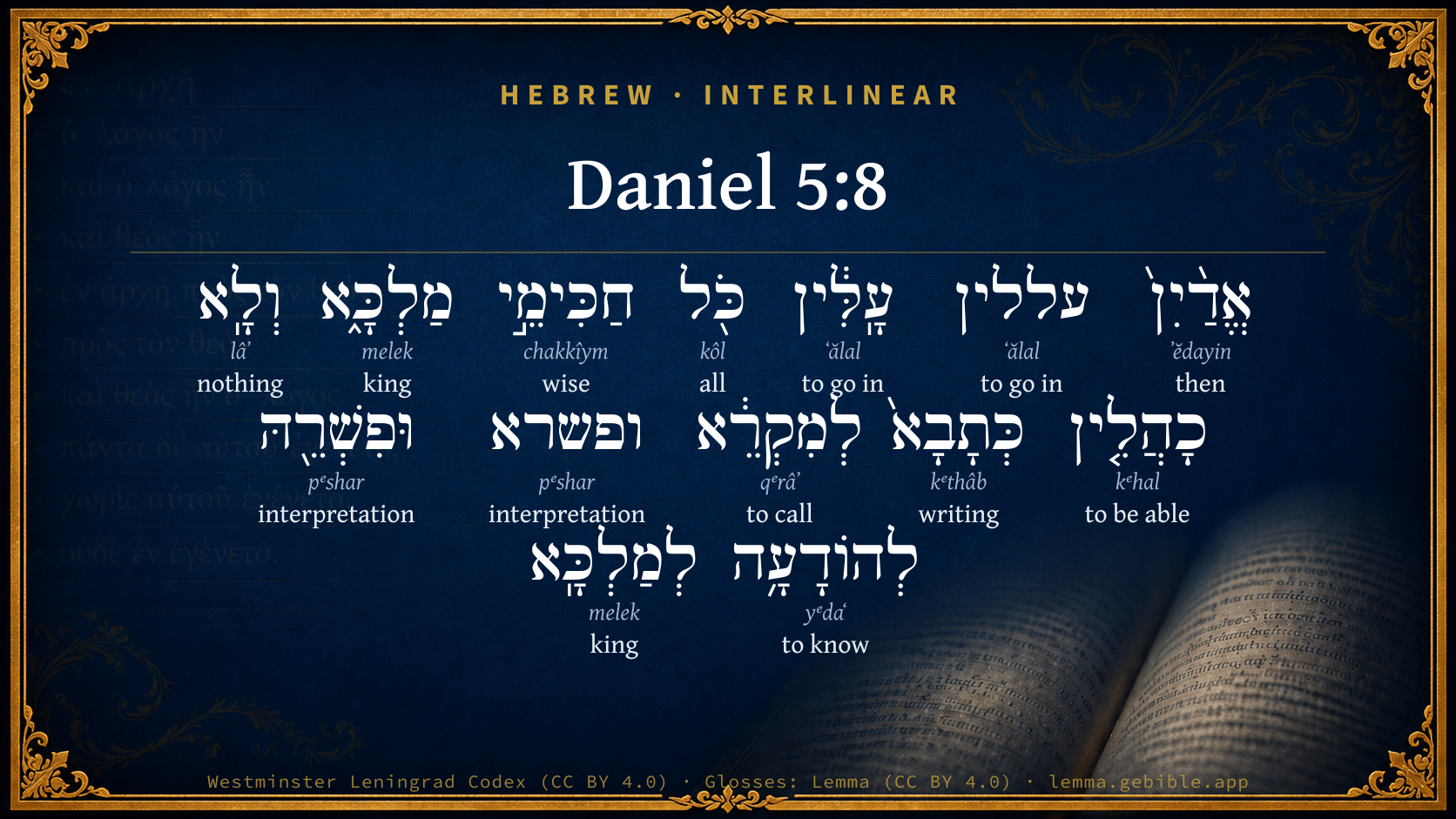
Hebrew (Westminster Leningrad Codex) Daniel 5:8 appears in the Hebrew Old Testament. The text above is from the Westminster Leningrad Codex. Each word links to its Strong’s number, a concise gloss, and parsing drawn from the Open Scriptures Hebrew Bible morphology. Click any word for its full Brown-Driver-Briggs (BDB) entry.
Download image
Cite this verse

Daniel 5:8 (World English Bible). Public Domain. Lemma interlinear Bible study tool, https://lemma.gebible.app/v/daniel/5/8.

Show BibTeX & RIS
BibTeX
RIS
English Translation
Then came in all the king's wise men; but they could not read the writing, nor make known to the king the interpretation.
World English Bible · Public Domain
Download a study sheet

One document with this verse’s original text, its word-by-word gloss line, the meaning frame, cross-references with their text, attributed commentary, and full source and license credits — printable, and it pastes into notes with its structure intact.

This verse Autodidact and up

Study sheet (.html) Plain text (.txt)

A passage Seminary Student

Up to 50 verses in one chapter. A passage sheet keeps up to 6 commentary sources and 12 cross-references per verse, in the order this page ranks them, and says so on the sheet whenever that leaves anything out. Ask for a single verse and you get the Autodidact verse sheet above.

Everything on this page stays free to read, with no account — the sheet is a download of what is already on screen, not access to it.

Want to remove ads? Support Godless Engineer
Compare translations 3

The same verse in 3 English versions, stacked beneath the original-language interlinear above. Click any original word for its lexicon entry.

Each is an independent rendering of the whole verse — the interlinear is not word-aligned to these translations.

Highlighted words mark where these versions differ — a whole-verse word diff, not a word-by-word alignment.

  • World English Bible Public Domain
    Then came in all the king's wise men; but they could not read the writing, nor make known to the king the interpretation.
  • King James Version Public Domain
    Then came in all the king's wise men: but they could not read the writing, nor make known to the king the interpretation thereof.
  • unfoldingWord Literal Text CC BY-SA 4.0
    Then all the wise men of the king came in, but they could not read the writing or make known the interpretation to the king.

unfoldingWord Literal Text — © unfoldingWord, licensed CC BY-SA 4.0. Word-aligned USFM3 via Door43 (git.door43.org/unfoldingWord/en_ult).

Versions to compare (up to 4)

3 of 4 selected

Show all 18 translations

Every available English version of this verse, each an independent rendering of the whole verse.

  • World English Bible Public Domain
    Then came in all the king's wise men; but they could not read the writing, nor make known to the king the interpretation.
  • Berean Standard Bible Public Domain
    So all the king’s wise men came in, but they could not read the inscription or interpret it for him.
  • Majority Standard Bible Public Domain
    So all the king’s wise men came in, but they could not read the inscription or interpret it for him.
  • King James Version Public Domain
    Then came in all the king's wise men: but they could not read the writing, nor make known to the king the interpretation thereof.
  • American Standard Version (1901) Public Domain
    Then came in all the king's wise men; but they could not read the writing, nor make known to the king the interpretation.
  • Revised Version (1885) Public Domain
    Then came in all the king’s wise men: but they could not read the writing, nor make known to the king the interpretation.
  • Geneva Bible (1599) Public Domain
    Then came all the Kings wise men, but they could neither reade the writing, nor shewe the King the interpretation.
  • Douay-Rheims (1899) Public Domain
    Then came in all the king's wise men, but they could neither read the writing, nor declare the interpretation to the king.
  • Young's Literal Translation Public Domain
    Then coming up are all the wise men of the king, and they are not able to read the writing, and the interpretation to make known to the king;
  • Literal Standard Version CC BY-SA 4.0
    Then all the wise men of the king are coming up, and they are not able to read the writing, and to make known the interpretation to the king;
  • Unlocked Literal Bible CC BY-SA 4.0
    Then all the king's men who were known for their wisdom came in, but they could not read the writing or explain its meaning to the king.
  • unfoldingWord Literal Text CC BY-SA 4.0
    Then all the wise men of the king came in, but they could not read the writing or make known the interpretation to the king.
  • Darby Bible Public Domain
    Then came in all the king's wise men, but they could not read the writing, nor make known to the king the interpretation.
  • World Messianic Bible Public Domain
    Then all the king’s wise men came in; but they could not read the writing, and couldn’t make known to the king the interpretation.
  • Webster's Bible Public Domain
    Then came in all the king's wise men: but they could not read the writing, nor make known to the king the interpretation of it.
  • Free Bible Version CC BY-SA 4.0
    However, after all the king's wise men had come in, they could not read the writing or explain to him what it meant.
  • Bible in Basic English Public Domain
    Then all the king's wise men came in: but they were not able to make out the writing or give the sense of it to the king.
  • JPS Tanakh (1917) Public Domain
    Then came in all the king's wise men: but they could not read the writing, nor make known to the king the interpretation.

Literal Standard Version (2020), Covenant Press — licensed CC BY-SA 4.0. Text via the HelloAO Bible API (eBible.org). Unlocked Literal Bible (unfoldingWord) — licensed CC BY-SA 4.0. Text via the HelloAO Bible API (eBible.org). unfoldingWord Literal Text — © unfoldingWord, licensed CC BY-SA 4.0. Word-aligned USFM3 via Door43 (git.door43.org/unfoldingWord/en_ult). Free Bible Version, Dr. Jonathan Gallagher — licensed CC BY-SA 4.0. Text via the HelloAO Bible API (eBible.org).

Word by word

More ways to search: Search by grammar → Find every occurrence → Compare this word →

Practice this passage: Drill this verse → Learn its vocabulary →

כָהֲלִ֤ין
kᵉhal
H3546
“being able”
Adjective, V
Part of Speech
Adjective
Full BDB Definition

Origin: a root corresponding to H3201 and H3557

TWOT: 2785

to be able - (Peal) to be able
  1. אֱדַ֨יִן֙ ʼĕdayin H116 “then” Adjective, D
  2. עללין ʻălal H5954 “going in” Adjective, V
  3. עָֽלִּ֔ין ʻălal H5954 “going in” Adjective, V
  4. כֹּ֖ל kôl H3606 “all of” Adjective, N, Common
  5. חַכִּימֵ֣י chakkîym H2445 “wise men of” Adjective, N, Common
  6. מַלְכָּ֑א melek H4430 “king · the” Adjective, N, Common + Particle, Definite Article
  7. וְלָֽא lâʼ H3809 “and · nothing” Adjective, C + Particle, Negative
  8. כְּתָבָא֙ kᵉthâb H3792 “writing · the” Adjective, N, Common + Particle, Definite Article
  9. לְמִקְרֵ֔א qᵉrâʼ H7123 “to call” Adjective, R + Verb, Qal, Infinitive Construct
  10. ופשרא pᵉshar H6591 “and · interpretation · the” Adjective, C + Noun, Common, Masculine, Singular, Determined + Particle, Definite Article
  11. וּפִשְׁרֵ֖הּ pᵉshar H6591 “and · interpretation · his” Adjective, C + Noun, Common, Masculine, Singular, Determined + Suffix, Personal, 3rd Person, Masculine, Singular
  12. לְהוֹדָעָ֥ה yᵉdaʻ H3046 “to know” Adjective, R + Verb, Hiphil, Infinitive Construct
  13. לְמַלְכָּֽא melek H4430 “to/for · king · the” Adjective, R + Noun, Common, Masculine, Singular, Determined + Particle, Definite Article

About this verse

These counts appear in no published source. They are computed here, from the morphology-tagged text and Lemma’s own curated glosses. What Lemma adds →

14
words
11
distinct lemmas
Prophets
section

Notable vocabulary

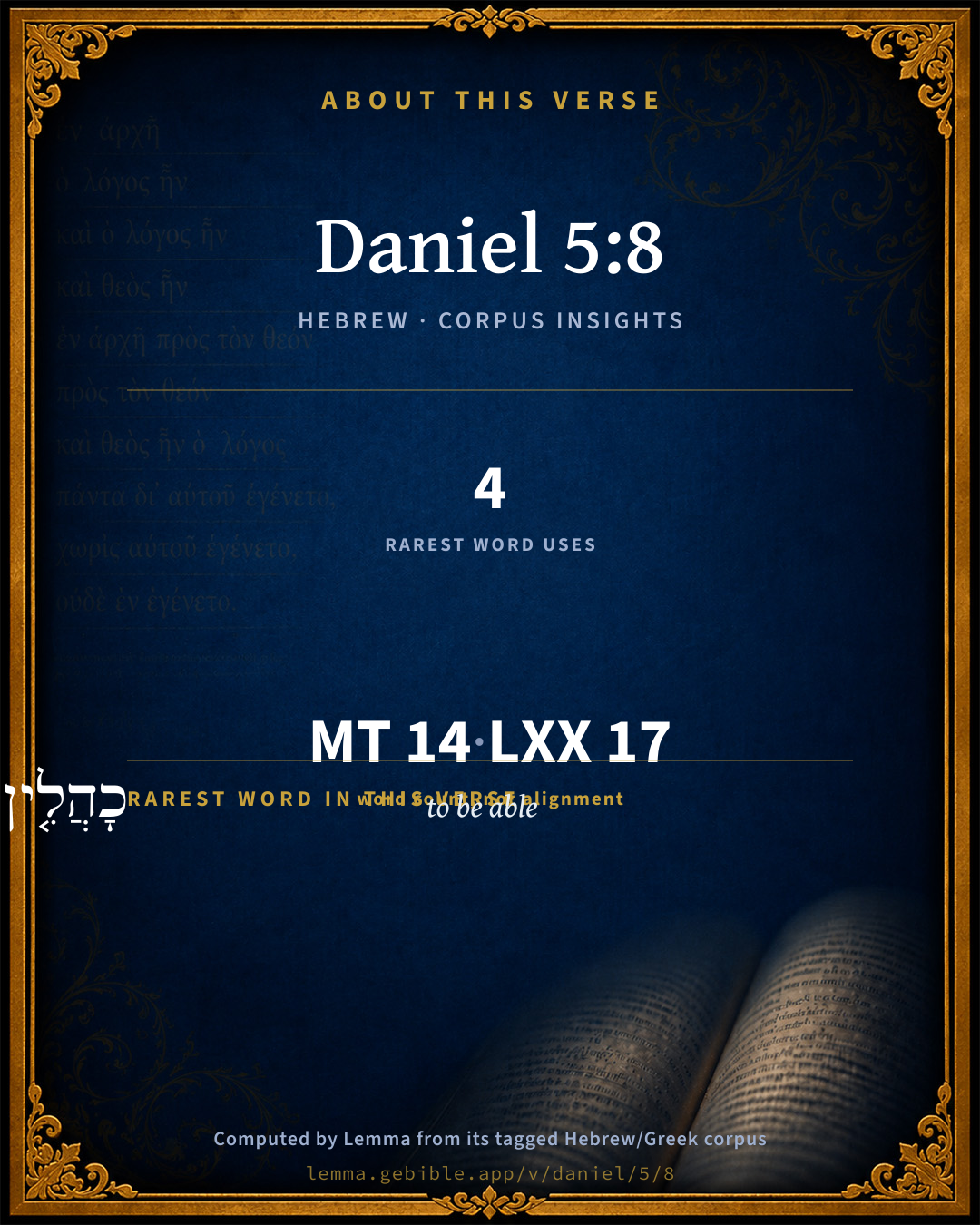
The rarest word here is כָהֲלִ֤ין to be able H3546 — appearing just 4 times in the whole Hebrew Bible.

Shared distinctive vocabulary

כָהֲלִ֤ין to be able H3546 occurs in 4 verses of the Hebrew Bible. Also found in:

Grammatical profile

  • 2 verbs
  • 1 noun
  • 6 adjectives
  • 5 particles

Verb forms

  • לְמִקְרֵ֔א Qal · Infinitive Construct
  • לְהוֹדָעָ֥ה Hiphil · Infinitive Construct

Repetition

Words recur within this verse — often emphatic in Hebrew:

  • עללין to go in H5954 ×2
  • מַלְכָּ֑א king H4430 ×2
  • ופשרא interpretation H6591 ×2

Hebrew & Septuagint length

In English translation the verse runs 23 words from the Hebrew and 23 from the Septuagint (LXX English) — the same length.

A rough comparison of the two English renderings, which tokenize alike — not a word-level alignment.

Word counts can differ between the Hebrew and the Greek without any difference in meaning — e.g. the Hebrew direct-object marker אֵת has no separate Greek word, and Greek often adds the article ὁ.

In the original languages it is 14 Hebrew tokens and 17 Greek tokens — but the two are counted differently (Hebrew bundles its prefixes and suffixes into one token; the Greek is in lemma form), so that isn’t a like-for-like length.

Cross-references

6

Topical passages linked to Daniel 5:8 in the Treasury of Scripture Knowledge — connected by theme and wording, ordered by reader-vote popularity; previews shown in the World English Bible.

  • Daniel 2:27 Daniel answered before the king, and said, The secret which the king has demanded can neither wise men, enchanters, magicians, nor soothsayers, show to the king;
  • Genesis 41:8 It happened in the morning that his spirit was troubled, and he sent and called for all the magicians of Egypt, and all the wise men of it. Pharaoh told them his dream, but there was no one who could interpret them to Pharaoh.
  • Daniel 4:7 Then came in the magicians, the enchanters, the Chaldeans, and the soothsayers; and I told the dream before them; but they did not make known to me the interpretation of it.
  • Isaiah 47:9 but these two things shall come to you in a moment in one day, the loss of children, and widowhood; in their full measure shall they come on you, in the multitude of your sorceries, and the great abundance of your enchantments.
  • Isaiah 47:12–15 Stand now with your enchantments, and with the multitude of your sorceries, in which you have labored from your youth; if so be you shall be able to profit, if so be you may prevail.
  • Daniel 5:15 Now the wise men, the enchanters, have been brought in before me, that they should read this writing, and make known to me the interpretation of it; but they could not show the interpretation of the thing.

Cross-references courtesy of OpenBible.info (CC BY 4.0).

Hebrew and Greek witnesses Masoretic Hebrew ↔ Greek Septuagint

The same verse in the two great witnesses to the Old Testament, shown verse-for-verse.

These are two independent witnesses, not word-aligned to each other, and the Septuagint is shown in lemma (dictionary) form.

Hebrew Daniel 5:8 Masoretic · Westminster Leningrad Codex

אֱדַ֨יִן֙ עללין עָֽלִּ֔ין כֹּ֖ל חַכִּימֵ֣י מַלְכָּ֑א וְלָֽא כָהֲלִ֤ין כְּתָבָא֙ לְמִקְרֵ֔א ופשרא וּפִשְׁרֵ֖הּ לְהוֹדָעָ֥ה לְמַלְכָּֽא

Then came in all the king's wise men; but they could not read the writing, nor make known to the king the interpretation.

World English Bible · Public Domain

Greek LXX Daniel 5:8 Septuagint · lemma form

καί εἰςπορεύομαι ὁ ἐπαοιδός καί φαρμακός καί γαζαρηνός καί οὐ δύναμαι οὐδείς ὁ σύγκριμα ὁ γραφή ἀποἀγγέλλω

Then came in all the king's wise men: but they could not read the writing, nor make known the interpretation to the king.

LXX2012 (modern English Septuagint) · Public Domain

On this verse, The Pulpit Commentary discusses the Septuagint’s reading. Read the note in Commentary ↓

Hebrew: Westminster Leningrad Codex (CC BY 4.0). Greek: Septuagint (public domain); English from LXX2012 (modern English Septuagint) (Public Domain). How the Septuagint differs from the Hebrew →

Commentary

Notes on Daniel 5:8 from classic Christian and Jewish commentators (each source and its license shown beneath its notes). The classic Christian expositions comment on the surrounding passage and are grouped to its opening verse, so a note may address several verses; the Jewish commentaries on the Tanakh (Rashi and others) are per-verse, so they appear only where the commentator wrote on this verse.

Lemma curates 59 commentaries, every one of them public domain or Creative Commons licensed, each selected and text-cleaned for this edition rather than reprinted as found. About our sources →

Trapp's Complete Commentary

John Trapp

Dan 5:8 Then came in all the king’s wise [men]: but they could not read the writing, nor make known to the king the interpretation thereof.

Ver. 8. But they could not read the writing.] Utpote caecitate et stupore pervulsi; they could not so read it as to make any good sense of it. It may be the initial letters only were set down, or else without pricks, or in a strange character, the Samaritan, or some other. The honour of the work was reserved for a better man.

John Trapp, A Commentary or Exposition upon All the Books of the Old and New Testament (1647–1656) — public domain. Text from a community e-Sword module.

Joseph Benson's Commentary

Dan 5:8-9. Then came in all the king’s wise men — Ambitious of the honour, and desirous to gratify the king. But they could not read the writing — Because, says Houbigant, it was written in the ancient Samaritan characters, which were very unlike the Chaldean letters. Or perhaps only the initial letters, M.T.P. were written. But God, for his own glory, reserved the honour of reading and interpreting it for his servant Daniel. Mr. Wintle renders the clause, “They were unable to read the writing, so as to make known the interpretation to the king.” Then was King Belshazzar greatly troubled — His consternation and distress were renewed and increased, his last hope having failed him; and his lords were astonished — His associates in sin shared in the consternation; and notwithstanding their number, mirth, and wine, were dismayed and terrified exceedingly.

Joseph Benson's Commentary on the Old and New Testaments (1811–1818) — public domain. Text from a community e-Sword module.

Tyndale Open Study Notes

Tyndale Open Resources

5:8 As before, the Babylonian wise men were unable to interpret the omen (cp. 2:4-11; 4:7; 5:15).

Tyndale Open Study Notes — © Tyndale Open Resources, licensed CC BY-SA 4.0. Text via the HelloAO Bible API.

Jamieson, Fausset & Brown

Robert Jamieson, A. R. Fausset & David Brown

The words were in such a character as to be illegible to the Chaldees, God reserving this honor to Daniel.

Jamieson, Fausset & Brown — Commentary Critical and Explanatory on the Whole Bible (1871) — public domain (CC PDM 1.0). Text via the HelloAO Bible API.

Adam Clarke's Commentary

Verse 8. They could not read the writing] Because it was in the pure Hebrew, not the Chaldean character. See below.

Adam Clarke's Commentary on the Bible (1810–1826) — public domain. Text from a community e-Sword/MySword module.

John Calvin's Commentaries

Here Daniel relates how deceived the king was in his opinion, in hoping for any interpretation of the writing from either the magi or the astrologers, the Chaldeans or the soothsayers; for none of them could read it. Hence he pays here the punishment of his ingratitude in passing over God’s Prophet, while he knew he had predicted truth to his grandfather just as it had happened, as well as Daniel’s general excellence in wisdom, Hence the proofs of his calling were sufficiently numerous and trustworthy. Since, then, he had so despised God’s unparalleled benefit, he is destitute of counsel:, and sees himself call in vain upon all the Chaldeans and astrologers. For Daniel says, There was no one who could read the writing or reveal its interpretation to the king Because this seems absurd, many Rabbis have hazarded various conjectures. Some think the letters were transposed; others guess that they were changed into their counterparts and equivalents; and others think the char-actors were changed. But we have elsewhere shewn how bold the Jews are in their conjectures, whenever they have no certain guide. We do not require their guesses, because, very probably, the writing was visible to the king and concealed from all the Chaldeans, or else they were so blind that they could see nothing; just as God denounced against the Jews a stupor of this kind. We see what he pronounces, by Isaiah, (Isaiah 29: 11,) “Your law shall be like a. sealed book: If it shall be said to any one, ‘Read it,’ he shall say, ‘The book is sealed, I cannot:’ or the book may be opened and ye shall all become blind: even those who seem to be sharper than all others, shall say they are ignorant and unlettered men.” Whatever God threatened against the Jews we know was fulfilled, and is fulfilled to this day, since a veil is put before their eyes, as Paul says. (2 Corinthians 3:14.) Hence they were blind in the midst of the brightest light. What wonder then if the same thing happened to the Chaldeans, so flint they could not read the writing? There is no necessity to conjecture any transposition of letters, or any inversion of their, order, or any change of one into another; for the word תקל, tekel, went first, and afterwards מנא, מנא Mena, Mena. These guesses then are frivolous; and thus much is certain, God wished the king to be made aware of his approaching destruction; next, his soul was moved, not with repentance, but only enough to render his sloth without excuse; and hence, whether willingly or not, he was compelled to send for some remedy, since he knew himself to be dealing with God.

John Calvin's Commentaries (1540-1563) — public domain. Text from the Calvin Translation Society English edition (1840s-50s) via the Christian Classics Ethereal Library (ccel.org). Calvin's coverage is partial (roughly two-thirds of the Bible); uncommented books and verses are honest gaps, never fabricated. The 19th-century editor's footnotes and remarks are omitted so the notes are faithfully Calvin's own voice.

Ellicott's Commentary for English Readers

(8) Then—i.e., after the king had addressed the wise men whom he had summoned. But why could not they read an inscription which Daniel deciphered at first sight? It has been conjectured (1) that the character was old Semitic, or one which the wise men did not know; (2) that the language of the inscription was unknown to them; (3) that the words were written in vertical columns, and the wise men endeavoured to read them horizontally. The only true explanation is to be found in the supernatural character of the inscription, and in the inspiration of Daniel. In this way God asserts Himself against the false wisdom of the heathens.

A Bible Commentary for English Readers, edited by Charles John Ellicott (1878–1897) — public domain. Text from a community e-Sword module.

The Cambridge Bible for Schools and Colleges

gen. ed. J. J. S. Perowne

8. The wise men, however, failed either to read or to explain the writing.

The Cambridge Bible for Schools and Colleges (gen. ed. J. J. S. Perowne; Cambridge University Press, 1878–1918) — public domain. Text from a community e-Sword module.

John Gill's Exposition

Then came in all the king's wise men,.... The whole college of them, the persons before described; over whom, in Nebuchadnezzar's time, Daniel was the chief of the governors, Dan 2:48, these came in readily, in hope of getting both riches and honour:

but they could not read the writing, nor make known to the king the interpretation thereof; for if they could not do the former, it must be impossible to do the latter; of the reason of which, various are the conjectures (p): as that, though these words were written in Chaldee, yet in characters, as the Samaritan or Phoenician, they did not understand; or were written without points, and so they knew not which were the proper ones to put to them; or they were written according to the position of the letters of the alphabet, called "athbash", of which See Gill on Jer 25:26, or the words were placed so as to be read backward, or else downward, and not straightforward; or they were all in one word; or only the initial letters of words; but the true reason was, that it was so ordained by the Lord, that they should not be able to read and interpret them; this being reserved for another man, Daniel, that he might have the honour, and God the glory.

(p) Vid. Jac. de Clerice Dissertat. de Epulo Belshazzar, in Thesaur. Theolog. Philol. vol. 1. p. 885.

John Gill's Exposition of the Whole Bible (1746–1763) — public domain (CC PDM 1.0). Text via the HelloAO Bible API.

Albert Barnes' Notes on the Bible

Then came in all the king’s wise men - The classes above referred to, Dan 5:7.

But they could not read the writing - The character was an unknown character to them. It may have been a character which was not found in any language, and which made the power of Daniel to read it the more remarkable, or it may have been, as suggested in the notes at Dan 5:7, a foreign character with which they had no acquaintance, though familiar to Daniel.

Albert Barnes' Notes on the Bible (1834–1885) — public domain. Text from a community e-Sword/MySword module.

Haydock's Catholic Bible Commentary

Read. It was written in Samaritan characters; or, for want of vowels, could not be read or understood. (Calmet)

George Leo Haydock (1774–1849), Haydock's Catholic Family Bible and Commentary, 1859 edition — public domain. Excludes Psalms (Douay-Rheims chapter numbering differs from Protestant) and Deuterocanonical books (Catholic canon only).

Matthew Poole's English Annotations

The rabbies say it was not in the Chaldee character, though the words were Chaldee, but the old Hebrew, Canaanitish, Phoenician, and Samaritan letters; or else because only the initial letters, M. T. P., were written. But God reserved this honour for Daniel, and to him that He might have all the glory. Besides, this interpretation was figurative, about weighing in a balance.

Matthew Poole's English Annotations on the Holy Bible (1683–1685) — public domain. Text from a community e-Sword/MySword module.

The Pulpit Commentary

Then came in all the king"s wise men: but they could not read the writing, nor make known to the king the interpretation thereof. As we have already said, the Septuagint here repeats the list of wise men. and omits "the Chaldeans." If the word "Chaldean" had been in the text originally, the fact that astrologers were frequently called Chaldeans would render it unlikely that the word should be omitted. Whereas from this very ground it was a word specially apt to be added on the margin, and once on the margin it would easily drop into the text. Even in the case of the Massoretic text, there seems to be a repetition here. It is certainly more obvious in the Septuagint text. The verse according to the Septuagint is, "And there entered in the enchanters, the sorcerers, and the astrologers, and were not able to announce the interpretation of the writing." Theodotion agrees here with the received text; the Peshitta omits "all." The only way in which we can escape the idea of this being a repetition is by holding that the word "all" is emphatic. The omission of the word "all" from the Peshitta is against this. It is to be observed that in the Septuagint there is no reference to "reading the writing;" it is only to announce the interpretation.

The Pulpit Commentary (1880–1919), ed. H.D.M. Spence-Jones & Joseph S. Exell — public domain. Text from a community e-Sword module.

unfoldingWord translationNotes

Door43 World Missions Community

Belshazzar

This is the son of Nebuchadnezzar who became king after his father. See how you wrote this name in Daniel 5:1. (See: How to Translate Names)

the look on his face changed

"his face became even more pale." The face of the king grew even more pale than in Daniel 5:6.

perplexed

unable to understand, confused

translationWords

king

wise

noble

unfoldingWord translationNotes — © Distant Shores Media and the Door43 World Missions Community, licensed CC BY-SA 4.0. Source: git.door43.org/Door43/en_tn.

Rashi

Rabbi Shlomo Yitzchaki (Rashi)

entered [as translated,] entered.

Rashi on the Tanakh — English translations: “The Judaica Press complete Tanach with Rashi, translated by A. J. Rosenberg” (CC BY 4.0); “Pentateuch with Rashi's commentary by M. Rosenbaum and A.M. Silbermann, 1929-1934” (public domain); “The Metsudah Tanach series, Lakewood, N.J” (CC BY 4.0); and “The Book of Joshua, Metsudah Publications, 1997” (CC BY 4.0). Text via Sefaria.

Lesson kit

Teaching starters — assembled from the data on this page, not authored interpretation. Every prompt links to the verse data it draws on. Edit before teaching.

Daniel, in the Prophets, opens this verse with 14 words (11 distinct Hebrew lemmas). Its most distinctive word is kᵉhal (“to be able”). A historical commentator’s framing appears above. Read the whole chapter for the surrounding context.

Discussion questions

  1. What does “to be able” (kᵉhal) contribute to the verse as a whole?
  2. Daniel 2:26 shares the word «to be able» with this verse. How do the two illuminate each other?
  3. “to go in” occurs 2× in this one verse. What is the effect of the repetition?
  4. These translations render this verse differently. What is at stake in choosing one wording over another?
  5. The verb «לְמִקְרֵ֔א» is Qal Infinitive Construct. How does its form color the action?
  6. Reading how Trapp's Complete Commentary and Joseph Benson's Commentary read this verse, where do the two commentators agree and where do they part?

Things to notice

Reading settings

Reading text

Shown beneath each verse's original-language words.

Old Testament
Old Testament edition

Read the OT as the Masoretic Hebrew (MT) or the Greek Septuagint (LXX).

English shown for the Greek Septuagint (in the Hebrew ↔ Greek comparison).

Comparing translations? Open the Compare panel on any verse page to stack up to four side by side.