
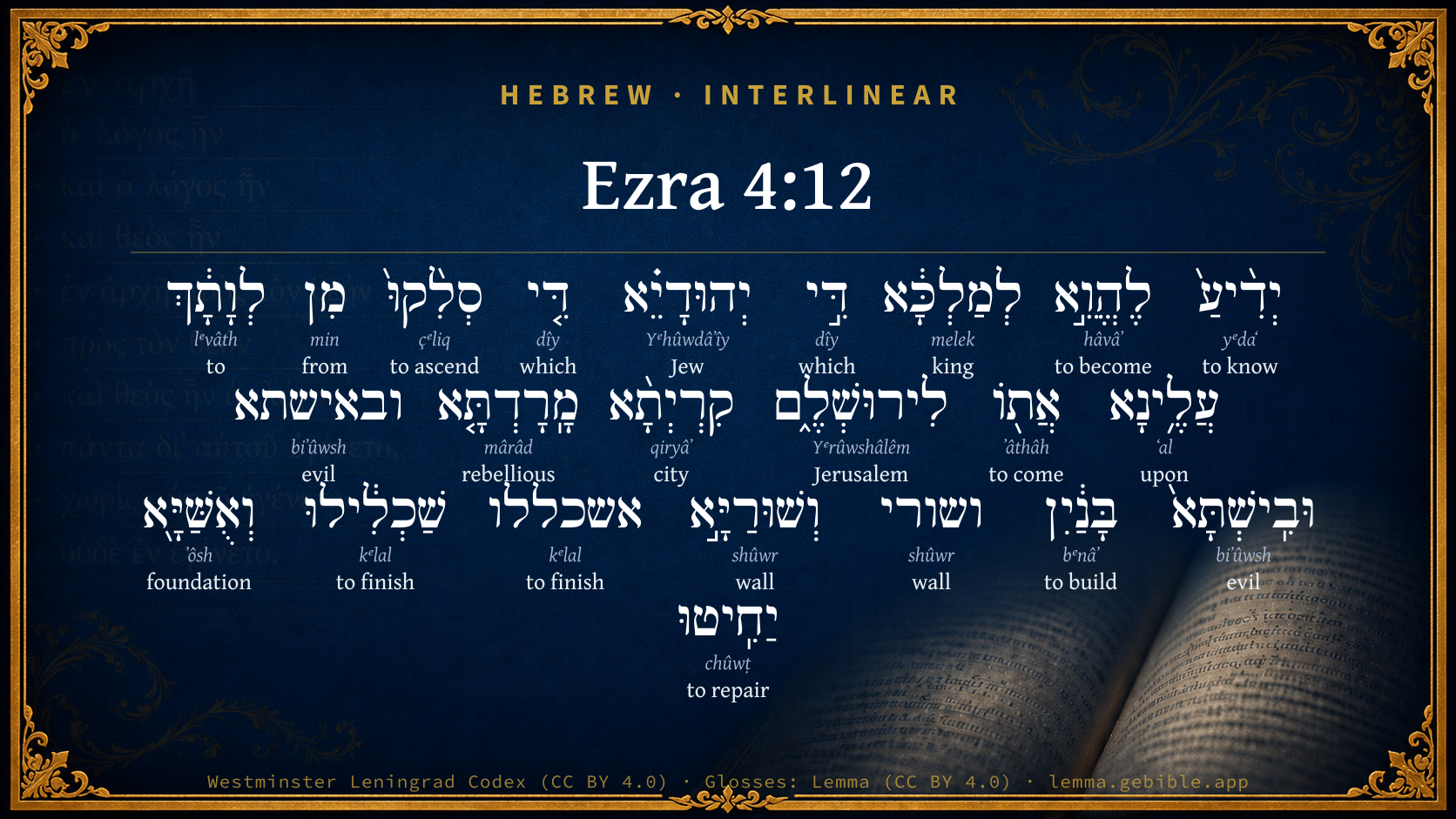
Ezra 4:12

Hebrew (Westminster Leningrad Codex) Ezra 4:12 appears in the Hebrew Old Testament. The text above is from the Westminster Leningrad Codex. Each word links to its Strong’s number, a concise gloss, and parsing drawn from the Open Scriptures Hebrew Bible morphology. Click any word for its full Brown-Driver-Briggs (BDB) entry.
Download image
Cite this verse

Ezra 4:12 (World English Bible). Public Domain. Lemma interlinear Bible study tool, https://lemma.gebible.app/v/ezra/4/12.

Show BibTeX & RIS
BibTeX
RIS
English Translation
Be it known to the king, that the Jews who came up from you are come to us to Jerusalem; they are building the rebellious and the bad city, and have finished the walls, and repaired the foundations.
World English Bible · Public Domain
Highlights
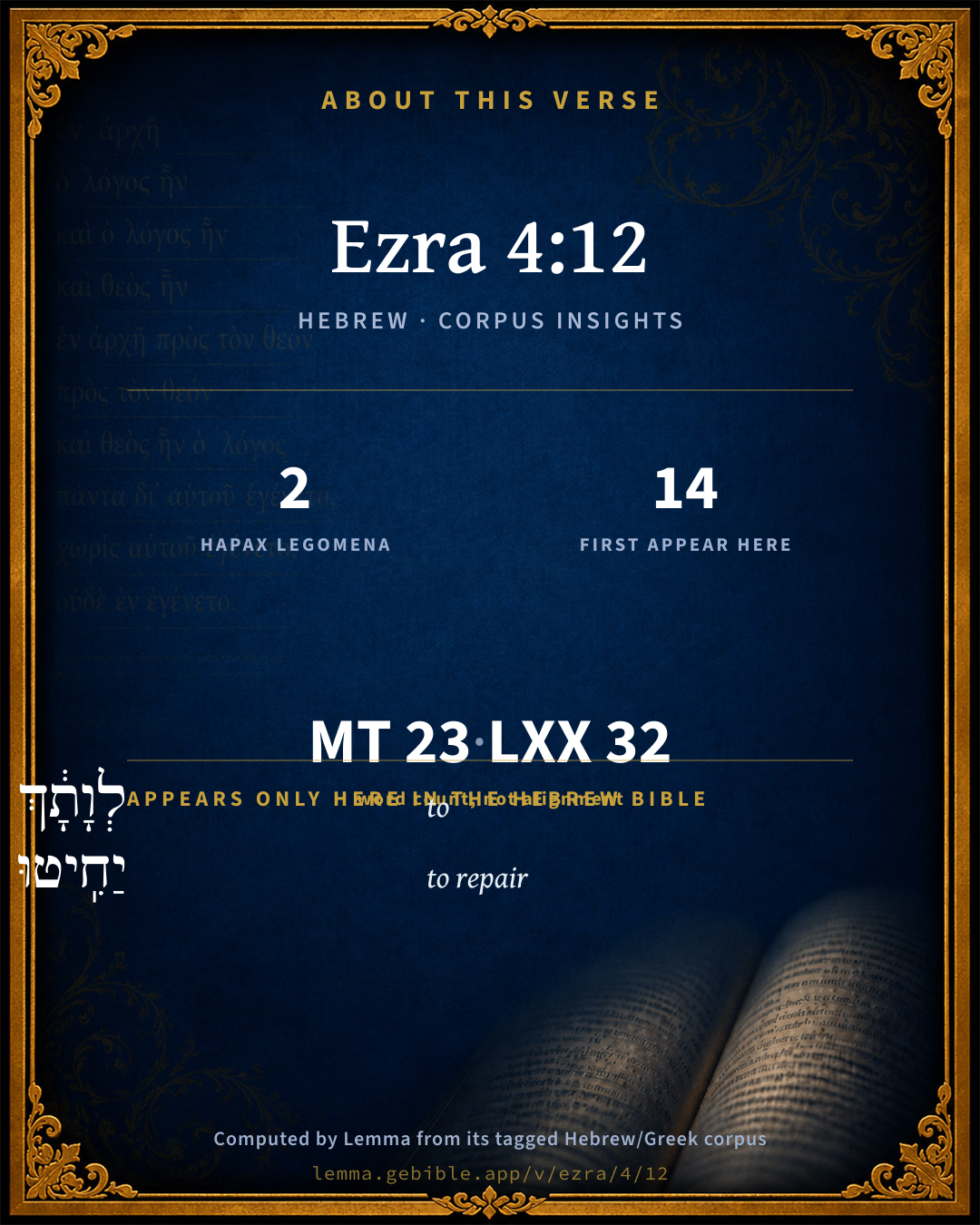
  • 2 hapax legomena — only here in the Hebrew Bible
  • 14 first appearances in the Hebrew Bible
Full analysis ↓
Download a study sheet

One document with this verse’s original text, its word-by-word gloss line, the meaning frame, cross-references with their text, attributed commentary, and full source and license credits — printable, and it pastes into notes with its structure intact.

This verse Autodidact and up

Study sheet (.html) Plain text (.txt)

A passage Seminary Student

Up to 50 verses in one chapter. A passage sheet keeps up to 6 commentary sources and 12 cross-references per verse, in the order this page ranks them, and says so on the sheet whenever that leaves anything out. Ask for a single verse and you get the Autodidact verse sheet above.

Everything on this page stays free to read, with no account — the sheet is a download of what is already on screen, not access to it.

Want to remove ads? Support Godless Engineer
Compare translations 3

The same verse in 3 English versions, stacked beneath the original-language interlinear above. Click any original word for its lexicon entry.

Each is an independent rendering of the whole verse — the interlinear is not word-aligned to these translations.

Highlighted words mark where these versions differ — a whole-verse word diff, not a word-by-word alignment.

  • World English Bible Public Domain
    Be it known to the king, that the Jews who came up from you are come to us to Jerusalem; they are building the rebellious and the bad city, and have finished the walls, and repaired the foundations.
  • King James Version Public Domain
    Be it known unto the king, that the Jews which came up from thee to us are come unto Jerusalem, building the rebellious and the bad city, and have set up the walls thereof, and joined the foundations.
  • unfoldingWord Literal Text CC BY-SA 4.0
    let it be known to the king that the Jews who went up from near you have come to us at Jerusalem. Rebuilding the rebellious and evil city, they are completing the walls and repairing the foundations.

unfoldingWord Literal Text — © unfoldingWord, licensed CC BY-SA 4.0. Word-aligned USFM3 via Door43 (git.door43.org/unfoldingWord/en_ult).

Versions to compare (up to 4)

3 of 4 selected

Show all 18 translations

Every available English version of this verse, each an independent rendering of the whole verse.

  • World English Bible Public Domain
    Be it known to the king, that the Jews who came up from you are come to us to Jerusalem; they are building the rebellious and the bad city, and have finished the walls, and repaired the foundations.
  • Berean Standard Bible Public Domain
    Let it be known to the king that the Jews who came from you to us have returned to Jerusalem. And they are rebuilding that rebellious and wicked city, restoring its walls, and repairing its foundations.
  • Majority Standard Bible Public Domain
    Let it be known to the king that the Jews who came from you to us have returned to Jerusalem and are rebuilding that rebellious and wicked city. They are restoring its walls and repairing its foundations.
  • King James Version Public Domain
    Be it known unto the king, that the Jews which came up from thee to us are come unto Jerusalem, building the rebellious and the bad city, and have set up the walls thereof, and joined the foundations.
  • American Standard Version (1901) Public Domain
    Be it known unto the king, that the Jews that came up from thee are come to us unto Jerusalem; they are building the rebellious and the bad city, and have finished the walls, and repaired the foundations.
  • Revised Version (1885) Public Domain
    Be it known unto the king, that the Jews which came up from thee are come to us unto Jerusalem; they are building the rebellious and the bad city, and have finished the walls, and repaired the foundations.
  • Geneva Bible (1599) Public Domain
    Be it knowen vnto the King that ye Iewes, which came vp from thee to vs, are come vnto Ierusalem (a citie rebellious and wicked) and buylde, and lay the foundations of the walles, and haue ioyned the foundations.
  • Douay-Rheims (1899) Public Domain
    Be it known to the king, that the Jews, who came up from thee to us, are come to Jerusalem a rebellious and wicked city, which they are building, setting up the ramparts thereof and repairing the walls.
  • Young's Literal Translation Public Domain
    Be it known to the king, that the Jews who have come up from thee unto us, have come in to Jerusalem, the rebellious and base city they are building, and the walls they have finished, and the foundations they join.
  • Literal Standard Version CC BY-SA 4.0
    be it known to the king, that the Jews who have come up from you to us, have come to Jerusalem, the rebellious and base city they are building, and the walls they have finished, and the foundations they join.
  • Unlocked Literal Bible CC BY-SA 4.0
    Let the king know that the Jews who went from you have come against us in Jerusalem to build a rebellious city. They have completed the walls and repaired the foundations.
  • unfoldingWord Literal Text CC BY-SA 4.0
    let it be known to the king that the Jews who went up from near you have come to us at Jerusalem. Rebuilding the rebellious and evil city, they are completing the walls and repairing the foundations.
  • Darby Bible Public Domain
    Be it known to the king that the Jews who came up from thee unto us have come to Jerusalem; they are building the rebellious and the bad city, and they complete the walls and join up the foundations.
  • World Messianic Bible Public Domain
    Be it known to the king that the Jews who came up from you have come to us to Jerusalem. They are building the rebellious and bad city, and have finished the walls and repaired the foundations.
  • Webster's Bible Public Domain
    Be it known to the king, that the Jews who came from thee to us are come to Jerusalem, building the rebellious and the noxious city, and have set up its walls, and joined the foundations.
  • Free Bible Version CC BY-SA 4.0
    Your Majesty should be informed that the Jews who came from you to us have returned to Jerusalem. They are rebuilding that rebellious and wicked city, completing repairs to the walls, and mending its foundations.
  • Bible in Basic English Public Domain
    We give news to the king that the Jews who came from you have come to us at Jerusalem; they are building up again that uncontrolled and evil town; the walls are complete and they are joining up the bases.
  • JPS Tanakh (1917) Public Domain
    be it known unto the king, that the Jews that came up from thee are come to us unto Jerusalem; they are building the rebellious and the bad city, and have finished the walls, and are digging out the foundations.

Literal Standard Version (2020), Covenant Press — licensed CC BY-SA 4.0. Text via the HelloAO Bible API (eBible.org). Unlocked Literal Bible (unfoldingWord) — licensed CC BY-SA 4.0. Text via the HelloAO Bible API (eBible.org). unfoldingWord Literal Text — © unfoldingWord, licensed CC BY-SA 4.0. Word-aligned USFM3 via Door43 (git.door43.org/unfoldingWord/en_ult). Free Bible Version, Dr. Jonathan Gallagher — licensed CC BY-SA 4.0. Text via the HelloAO Bible API (eBible.org).

Word by word

More ways to search: Search by grammar → Find every occurrence → Compare this word →

Practice this passage: Drill this verse → Learn its vocabulary →

לְוָתָ֔ךְ
lᵉvâth
H3890
“to · you”
Adjective, R + Suffix, Personal, 2nd Person, Masculine, Singular
Part of Speech
Adjective
Full BDB Definition

Origin: from a root corresponding to H3867

TWOT: 2813

to, at, beside, near, with
  1. יְדִ֨יעַ֙ yᵉdaʻ H3046 “known” Adjective, V, Singular
  2. לֶהֱוֵ֣א hâvâʼ H1934 “to become” Adjective, V
  3. לְמַלְכָּ֔א melek H4430 “to/for · king · the” Adjective, R + Noun, Common, Masculine, Singular, Determined + Particle, Definite Article
  4. דִּ֣י dîy H1768 “which” Adjective, T
  5. יְהוּדָיֵ֗א Yᵉhûwdâʼîy H3062 “Jews · the” Adjective, N + Particle, Definite Article
  6. דִּ֤י dîy H1768 “which” Adjective, T
  7. סְלִ֨קוּ֙ çᵉliq H5559 “to ascend” Adjective, V, Plural
  8. מִן min H4481 “from” Adjective, R
  9. עֲלֶ֥ינָא ʻal H5922 “upon · us” Adjective, R + Suffix, Personal, 1st Person, Common, Plural
  10. אֲת֖וֹ ʼâthâh H858 “to come” Adjective, V, Plural
  11. לִירוּשְׁלֶ֑ם Yᵉrûwshâlêm H3390 “to/for · Jerusalem” Adjective, R + Noun, Proper
  12. קִרְיְתָ֨א qiryâʼ H7149 “city · the” Adjective, N, Common + Particle, Definite Article
  13. מָֽרָדְתָּ֤א mârâd H4779 “rebellious · the” Adjective, A + Particle, Definite Article
  14. ובאישתא biʼûwsh H873 “and · evil · the” Adjective, C + Adjective, Adjective, Feminine, Singular, Determined + Particle, Definite Article
  15. וּבִֽישְׁתָּא֙ biʼûwsh H873 “and · evil · the” Adjective, C + Adjective, Adjective, Feminine, Singular, Determined + Particle, Definite Article
  16. בָּנַ֔יִן bᵉnâʼ H1124 “building” Adjective, V
  17. ושורי shûwr H7792 “and · walls of” Adjective, C + Noun, Common, Masculine, Plural, Construct
  18. וְשׁוּרַיָּ֣א shûwr H7792 “and · walls · the” Adjective, C + Noun, Common, Masculine, Plural, Determined + Particle, Definite Article
  19. אשכללו kᵉlal H3635 “to finish” Adjective, V
  20. שַׁכְלִ֔ילוּ kᵉlal H3635 “to finish” Adjective, V, Plural
  21. וְאֻשַּׁיָּ֖א ʼôsh H787 “and · foundations · the” Adjective, C + Noun, Common, Masculine, Plural, Determined + Particle, Definite Article
  22. יַחִֽיטוּ chûwṭ H2338 “to repair” Adjective, V

About this verse

These counts appear in no published source. They are computed here, from the morphology-tagged text and Lemma’s own curated glosses. What Lemma adds →

23
words
19
distinct lemmas
Historical
section

Notable vocabulary

2 hapax legomena — words that appear only here in the entire Hebrew Bible:

  • לְוָתָ֔ךְ to H3890
  • יַחִֽיטוּ to repair H2338

First appearance in Scripture

These words make their first canonical appearance in the Hebrew Bible here (14 in total — showing 8):

  • יְדִ֨יעַ֙ to know H3046
  • לֶהֱוֵ֣א to become H1934
  • יְהוּדָיֵ֗א Jew H3062
  • סְלִ֨קוּ֙ to ascend H5559
  • מִן from H4481
  • לְוָתָ֔ךְ to H3890
  • אֲת֖וֹ to come H858
  • מָֽרָדְתָּ֤א rebellious H4779

Shared distinctive vocabulary

מָֽרָדְתָּ֤א rebellious H4779 occurs in 2 verses of the Hebrew Bible. Also found in:

Grammatical profile

  • 2 nouns
  • 13 adjectives
  • 8 particles

Repetition

Words recur within this verse — often emphatic in Hebrew:

  • ובאישתא evil H873 ×2
  • ושורי wall H7792 ×2
  • אשכללו to finish H3635 ×2
  • דִּ֣י which H1768 ×2

Hebrew & Septuagint length

In English translation the verse runs 38 words from the Hebrew and 44 from the Septuagint (LXX English) — closely comparable.

A rough comparison of the two English renderings, which tokenize alike — not a word-level alignment.

Word counts can differ between the Hebrew and the Greek without any difference in meaning — e.g. the Hebrew direct-object marker אֵת has no separate Greek word, and Greek often adds the article ὁ.

In the original languages it is 23 Hebrew tokens and 32 Greek tokens — but the two are counted differently (Hebrew bundles its prefixes and suffixes into one token; the Greek is in lemma form), so that isn’t a like-for-like length.

Cross-references

18

Topical passages linked to Ezra 4:12 in the Treasury of Scripture Knowledge — connected by theme and wording, ordered by reader-vote popularity; previews shown in the World English Bible.

  • 2 Chronicles 36:13 He also rebelled against king Nebuchadnezzar, who had made him swear by God: but he stiffened his neck, and hardened his heart against turning to Yahweh, the God of Israel.
  • Ezra 5:3 At the same time came to them Tattenai, the governor beyond the River, and Shetharbozenai, and their companions, and said thus to them, Who gave you a decree to build this house, and to finish this wall?
  • Ezra 5:9 Then asked we those elders, and said to them thus, Who gave you a decree to build this house, and to finish this wall?
  • 2 Kings 18:20 You say (but they are but vain words), [There is] counsel and strength for the war. Now on whom do you trust, that you have rebelled against me?
  • 2 Kings 24:1 In his days Nebuchadnezzar king of Babylon came up, and Jehoiakim became his servant three years: then he turned and rebelled against him.
  • Ezra 4:15 that search may be made in the book of the records of your fathers: so shall you find in the book of the records, and know that this city is a rebellious city, and hurtful to kings and provinces, and that they have moved sedition within the same of old time; for which cause was this city laid waste.
  • Ezra 4:19 I decreed, and search has been made, and it is found that this city of old time has made insurrection against kings, and that rebellion and sedition have been made therein.
  • Nehemiah 1:3 They said to me, The remnant who are left of the captivity there in the province are in great affliction and reproach: the wall of Jerusalem also is broken down, and the gates of it are burned with fire.
  • Psalms 48:1–2 Great is Yahweh, and greatly to be praised, In the city of our God, in his holy mountain.
  • Isaiah 1:21–23 How the faithful city has become a prostitute! She was full of justice; righteousness lodged in her, But now murderers.
  • Jeremiah 52:3 For through the anger of Yahweh did it happen in Jerusalem and Judah, until he had cast them out from his presence. Zedekiah rebelled against the king of Babylon.
  • Ezekiel 17:12–21 Say now to the rebellious house, Don't you know what these things mean? tell them, Behold, the king of Babylon came to Jerusalem, and took the king of it, and the princes of it, and brought them to him to Babylon:
  • Daniel 9:25 Know therefore and discern, that from the going forth of the commandment to restore and to build Jerusalem to the Anointed One, the prince, shall be seven weeks, and sixty-two weeks: it shall be built again, with street and moat, even in troubled times.
  • Luke 13:34 "Jerusalem, Jerusalem, that kills the prophets, and stones those who are sent to her! How often I wanted to gather your children together, like a hen gathers her own brood under her wings, and you refused!
  • Luke 23:2–5 They began to accuse him, saying, "We found this man perverting the nation, forbidding paying taxes to Caesar, and saying that he himself is Christ, a king."
  • Acts 24:5 For we have found this man to be a plague, an instigator of insurrections among all the Jews throughout the world, and a ringleader of the sect of the Nazarenes.

Cross-references courtesy of OpenBible.info (CC BY 4.0).

Hebrew and Greek witnesses Masoretic Hebrew ↔ Greek Septuagint

The same verse in the two great witnesses to the Old Testament, shown verse-for-verse.

These are two independent witnesses, not word-aligned to each other, and the Septuagint is shown in lemma (dictionary) form.

Hebrew Ezra 4:12 Masoretic · Westminster Leningrad Codex

יְדִ֨יעַ֙ לֶהֱוֵ֣א לְמַלְכָּ֔א דִּ֣י יְהוּדָיֵ֗א דִּ֤י סְלִ֨קוּ֙ מִן לְוָתָ֔ךְ עֲלֶ֥ינָא אֲת֖וֹ לִירוּשְׁלֶ֑ם קִרְיְתָ֨א מָֽרָדְתָּ֤א ובאישתא וּבִֽישְׁתָּא֙ בָּנַ֔יִן ושורי וְשׁוּרַיָּ֣א אשכללו שַׁכְלִ֔ילוּ וְאֻשַּׁיָּ֖א יַחִֽיטוּ

Be it known to the king, that the Jews who came up from you are come to us to Jerusalem; they are building the rebellious and the bad city, and have finished the walls, and repaired the foundations.

World English Bible · Public Domain

Greek LXX Ezra 4:12 Septuagint · lemma form

γνωστός εἰμί ὁ βασιλεύς ὅτι ὁ ἰουδαῖος ἀναβαίνω ἀπό σύ ἐπί ἐγώ ἔρχομαι εἰς ἰερουσαλήμ ὁ πόλις ὁ ἀποστάτις καί πονηρός οἰκοδομέω καί ὁ τεῖχος αὐτός καταἀρτίζω εἰμί καί θεμέλιος αὐτός ἀναὑψόω

Be it known to the king, that the Jews who came up from you to us have come to Jerusalem the rebellious and wicked city, which they are building, and its walls are set in order, and they have established the foundations of it.

LXX2012 (modern English Septuagint) · Public Domain

In the Septuagint this is one book — Esdras B (2 Esdras): Ezra is chapters 1–10, Nehemiah 11–23.

Hebrew: Westminster Leningrad Codex (CC BY 4.0). Greek: Septuagint (public domain); English from LXX2012 (modern English Septuagint) (Public Domain). How the Septuagint differs from the Hebrew →

Commentary

Notes on Ezra 4:12 from classic Christian and Jewish commentators (each source and its license shown beneath its notes). The classic Christian expositions comment on the surrounding passage and are grouped to its opening verse, so a note may address several verses; the Jewish commentaries on the Tanakh (Rashi and others) are per-verse, so they appear only where the commentator wrote on this verse.

Lemma curates 59 commentaries, every one of them public domain or Creative Commons licensed, each selected and text-cleaned for this edition rather than reprinted as found. About our sources →

Trapp's Complete Commentary

John Trapp

Ezr 4:12 Be it known unto the king, that the Jews which came up from thee to us are come unto Jerusalem, building the rebellious and the bad city, and have set up the walls [thereof], and joined the foundations.

Ver. 12. The rebellious and the bad city] After so many years doth Jerusalem rue one perfidious act of Zedekiah; and, having once been treacherous, it still hears, "The rebellious and bad city," as if it had been a very πονηροπολις, a professed sanctuary of roguery (as the Jesuits say of Geneva), and as Florus saith of the temple at Jerusalem, that it was impiae gentis arcanum.

And have set up the walls thereof] This was no less false than scandalous. But malice careth not how true the accusation is, but how mischievous.

And joined the foundations] Chald. sewed together. Or, rather these false informers had sewed a lie together with great art, that it might seem a truth, Psa 119:69. The proud have forged a lie against me, assuunt mendacium mendacio, they have taught their tongues to speak lies, Jer 9:5, and are artists at it.

John Trapp, A Commentary or Exposition upon All the Books of the Old and New Testament (1647–1656) — public domain. Text from a community e-Sword module.

Joseph Benson's Commentary

Ezr 4:12. Thy servants, and at such a time, &c. — The particular time when the letter was written was no doubt expressed therein; but in this narrative it was sufficient to mention it in general.

Ezr 4:12. And have set up the walls thereof — This was a mere calumny, for they had attempted no such thing as to build the walls of Jerusalem. They had indeed built some houses, without which the place could not be inhabited, and were now employed in erecting the walls of the temple: but they had not begun to encompass the city with walls, to defend it against the incursions of their enemies. This was not undertaken till long after. The assertion of the Samaritans, therefore, was without foundation. But being confidently affirmed, they thought it would be easily credited by the king, whose heart and ears they had contrived to possess by their counsellors.

Joseph Benson's Commentary on the Old and New Testaments (1811–1818) — public domain. Text from a community e-Sword module.

Jamieson, Fausset & Brown

Robert Jamieson, A. R. Fausset & David Brown

the Jews which came up from thee to us--The name "Jews" was generally used after the return from the captivity, because the returning exiles belonged chiefly to the tribes of Judah and Benjamin. Although the edict of Cyrus permitted all who chose to return, a permission of which some of the Israelites availed themselves, the great body who went to settle in Judea were the men of Judah.

Jamieson, Fausset & Brown — Commentary Critical and Explanatory on the Whole Bible (1871) — public domain (CC PDM 1.0). Text via the HelloAO Bible API.

Ellicott's Commentary for English Readers

(12) Virulence and craft and exaggeration are stamped on every sentence of the letter. It only says, however, that “they are preparing the walls thereof, and joining the foundations.” Afterwards, however, the charge is modified in Ezr_4:13; Ezr_4:16.

A Bible Commentary for English Readers, edited by Charles John Ellicott (1878–1897) — public domain. Text from a community e-Sword module.

The Cambridge Bible for Schools and Colleges

gen. ed. J. J. S. Perowne

12. the Jews] We have here practically the first application of this name to the new community at Jerusalem. It had been used of the Southern Kingdom (2Ki_16:6; 2Ki_25:25; 2Ch_32:18) and of its exiles (Jer_32:12; Jer_34:9; Jer_38:19; Jer_40:11-12; Jer_40:15; Jer_41:3; Jer_44:1; Jer_52:28; Jer_52:30; Dan_3:8; Dan_3:12). As the return from the Captivity almost exclusively affected the exiles of the Southern Kingdom, the name was naturally applied to the new dwellers in Jerusalem and the neighbourhood, and was quickly adopted as the designation of all members of the race; cf. Zec_8:23; Ezr_4:23; Ezr_5:1; Ezr_5:5; Ezr_6:7-8; Ezr_6:14; ten times in Nehemiah, fifty-one times in Esther. The History of Israel had become the History of the Jews.

which came up from thee to us are come] R.V. which came up from thee are come to us, generally expressed; i.e. from exile on the banks of the Euphrates to dwell in Judæa and Jerusalem. The introductory statement of the subject.

building] R.V. they are building. A separate clause, containing an epitome of the charge against the Jews. ‘The rebellious and the bad city’, cf. Ezr_4:15. An appeal to its antecedents was calculated to prejudice the king against Jerusalem.

and have set up the walls] R.V. finished: the verb in the original has the idea of completion.

and joined the foundations] R.V. repaired, which gives the sense of the word better, and is more intelligible than the A.V.

The accusation that the Jews were engaged in rebuilding the city, strengthening and repairing the walls, seems to refer to the days of Artaxerxes and to the work either of Nehemiah or, as is more probable, of Ezra before Nehemiah’s arrival. Those who see Pseudo-Smerdis in Artaxerxes (Ezr_4:7; Ezr_4:11) maintain that the accusation is designedly false, and intended to incense the Government against the Jews for exceeding the instructions of Cyrus’s decree, which limited them to the restoration of the Temple.

The Cambridge Bible for Schools and Colleges (gen. ed. J. J. S. Perowne; Cambridge University Press, 1878–1918) — public domain. Text from a community e-Sword module.

John Gill's Exposition

Be it known now unto the king,.... And let it be seriously and thoroughly considered by him and his counsellors:

that if this city be builded, and its walls set up again, then will they not pay toll, tribute, and custom; being able to defend themselves against the king's forces, sent to reduce them to their obedience; these three words take in all sorts of taxes and levies on persons, goods, and merchandise:

and so thou shall endamage the revenue of the kings; not only his own, but his successors':

this they thought would be a very striking and powerful argument with him.

John Gill's Exposition of the Whole Bible (1746–1763) — public domain (CC PDM 1.0). Text via the HelloAO Bible API.

Haydock's Catholic Bible Commentary

CHAPTER IV.

Rebellious. The Jews had shewn themselves impatient of subjection, contending with the kings of Assyria and Babylon, whose territories were now possessed by the successors of Cyrus, ver. 15. (Haydock)

George Leo Haydock (1774–1849), Haydock's Catholic Family Bible and Commentary, 1859 edition — public domain. Excludes Psalms (Douay-Rheims chapter numbering differs from Protestant) and Deuterocanonical books (Catholic canon only).

Matthew Poole's English Annotations

Have set up the walls thereof: either,

1. The Jews had begun to build or repair some part of the walls which Nebuchadnezzar had left, which they aggravate in this manner. Or,

2. This is a mere fiction, which, being confidently affirmed, they thought would easily find belief with a king whose heart and ears they possessed by their hired counsellors, and others of their friends, or the enemies of the Jews.

Matthew Poole's English Annotations on the Holy Bible (1683–1685) — public domain. Text from a community e-Sword/MySword module.

Whedon's Commentary on the Bible

Daniel D. Whedon

12. The Jews — This name came to be the common appellation of all Israelites after the exile. It was, doubtless, due to the permanence of the kingdom of Judah long after the northern kingdom of Israel had ceased, and to the fact that by far the greater portion of the exiles who returned were of the tribe and kingdom of Judah.

The rebellious and the bad city — “In their craftiness they do not mention the temple which the Jews were building, and which Cyrus had encouraged them to build, but they mention the city, which they were not building.” — Wordsworth.

Set up the walls — It was perfectly in keeping with the character of these enemies of the Jews to misrepresent their work in this way. The exiles had received a royal charter permitting them to rebuild the temple, but not to rebuild the walls of the city. By confounding the two things these crafty Samaritans make out a damaging case against the Jews.

Daniel D. Whedon (gen. ed.), Commentary on the Old and New Testaments (1874–1909) — public domain. Text from a community e-Sword module.

The Pulpit Commentary

The Jews which came up from thee. i.e. from the central provinces from that part of the empire where thou dwellest. To us. To our part of the world to Palestine. Are building the rebellious and the bad city. The ground of this accusation must be sought in the various revolts of the Jews from the Babylonians recorded in 2Ki 24 2Ki 25. There had been one, or perhaps two, previous revolts from Assyria (2Ki_18:7; 2Ch_33:11) but of these the Samaritans probably knew nothing. They would, however, be likely to know that before Nebuchadnezzar took the extreme measure of removing the Jews from their own land to Babylon, they had rebelled against him three several times once under Jehoiakim, (2Ki_24:1) once under his son Jehoiachin (ibid. vers. 9, 10), and once under Zedekiah, the last king (ibid. ver. 20). Thus they had a basis of truth on which to ground their charge that Jerusalem was "the rebellious and the bad city." And have set up the walls thereof. It appears very clearly from the book of Nehemiah that the walls of Jerusalem were not restored till his time, seventy-five years after this. The Samaritans, however, would naturally exaggerate, and call the rebuilding of the temple, and of a certain number of dwelling-houses, a fortifying of the place. The exaggeration, however, is not so great in the Chaldee text as in the Authorized Version. What is said seems to be, that "they are setting up the walls and joining the foundations. " That the work was far from complete is admitted in the next verse. We may doubt whether it was really begun.

The Pulpit Commentary (1880–1919), ed. H.D.M. Spence-Jones & Joseph S. Exell — public domain. Text from a community e-Sword module.

John Wesley's Explanatory Notes

Be it known, &c. - This is a mere fiction, which being confidently affirmed, they thought would easily find belief with a king whose heart and ears they possessed by their hired counsellors.

John Wesley, Explanatory Notes Upon the Whole Bible (1754–1765) — public domain. Text via the GEBible commentary corpus.

Rashi

Rabbi Shlomo Yitzchaki (Rashi)

Let it be known to the king Let it be a known thing to the king.

that the Jews that the Jews who ascended from you upon us have come to Jerusalem.

the rebellious and sinful city they are building [as translated,] a rebellious and sinful city they are building.

the walls they have completed [as translated,] the walls they have completed.

and the walls [as translated,] and the walls.

they have joined Aram. יָחִיטוּ, an expression of a thread, like (Gen. 14:23): “not from a thread, (מִחוּטּ),” for they are “sewing” and joining the walls one to another.

Rashi on the Tanakh — English translations: “The Judaica Press complete Tanach with Rashi, translated by A. J. Rosenberg” (CC BY 4.0); “Pentateuch with Rashi's commentary by M. Rosenbaum and A.M. Silbermann, 1929-1934” (public domain); “The Metsudah Tanach series, Lakewood, N.J” (CC BY 4.0); and “The Book of Joshua, Metsudah Publications, 1997” (CC BY 4.0). Text via Sefaria.

Lesson kit

Teaching starters — assembled from the data on this page, not authored interpretation. Every prompt links to the verse data it draws on. Edit before teaching.

Ezra, in the Historical, opens this verse with 23 words (19 distinct Hebrew lemmas). Its most distinctive word is lᵉvâth (“to”). A historical commentator’s framing appears above. Read the whole chapter for the surrounding context.

Discussion questions

  1. How does “to” (lᵉvâth) shape what this verse is saying?
  2. 2 words here appear nowhere else in the Hebrew Bible. Why might the author reach for such rare wording?
  3. 14 words make their first appearance in Scripture here. What does this debut establish?
  4. How does Ezra 4:15, which shares the word «rebellious», read alongside this verse?
  5. What does the repetition of “evil” (2× in this one verse) do in this verse?
  6. These translations render this verse differently. What is at stake in choosing one wording over another?
  7. Compare how Trapp's Complete Commentary and Joseph Benson's Commentary read this verse. Where do they agree or differ?

Things to notice

  • 2 words in this verse appear nowhere else in the Hebrew Bible.
  • 14 words make their first canonical appearance in Scripture here.
  • This verse counts 23 Hebrew ↔ 32 Greek words.
  • These translations choose different wording for 18 words in this verse.
  • “evil” occurs 2× in this single verse.

Reading settings

Reading text

Shown beneath each verse's original-language words.

Old Testament
Old Testament edition

Read the OT as the Masoretic Hebrew (MT) or the Greek Septuagint (LXX).

English shown for the Greek Septuagint (in the Hebrew ↔ Greek comparison).

Comparing translations? Open the Compare panel on any verse page to stack up to four side by side.