
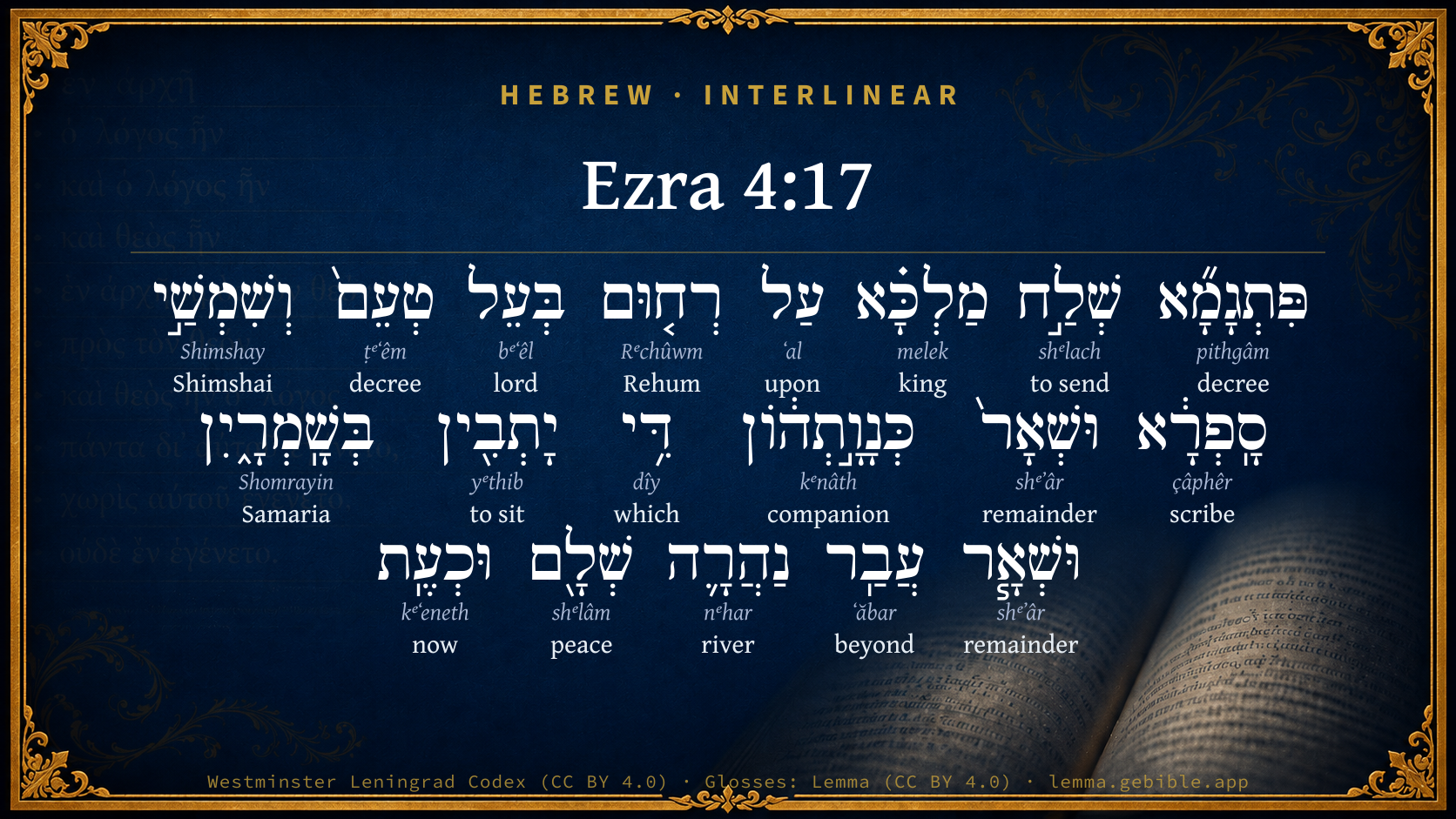
Ezra 4:17

Hebrew (Westminster Leningrad Codex) Ezra 4:17 appears in the Hebrew Old Testament. The text above is from the Westminster Leningrad Codex. Each word links to its Strong’s number, a concise gloss, and parsing drawn from the Open Scriptures Hebrew Bible morphology. Click any word for its full Brown-Driver-Briggs (BDB) entry.
Download image
Cite this verse

Ezra 4:17 (World English Bible). Public Domain. Lemma interlinear Bible study tool, https://lemma.gebible.app/v/ezra/4/17.

Show BibTeX & RIS
BibTeX
RIS
English Translation
[Then] sent the king an answer to Rehum the chancellor, and to Shimshai the scribe, and to the rest of their companions who dwell in Samaria, and in the rest [of the country] beyond the River: Peace, and so forth.
World English Bible · Public Domain
Highlights
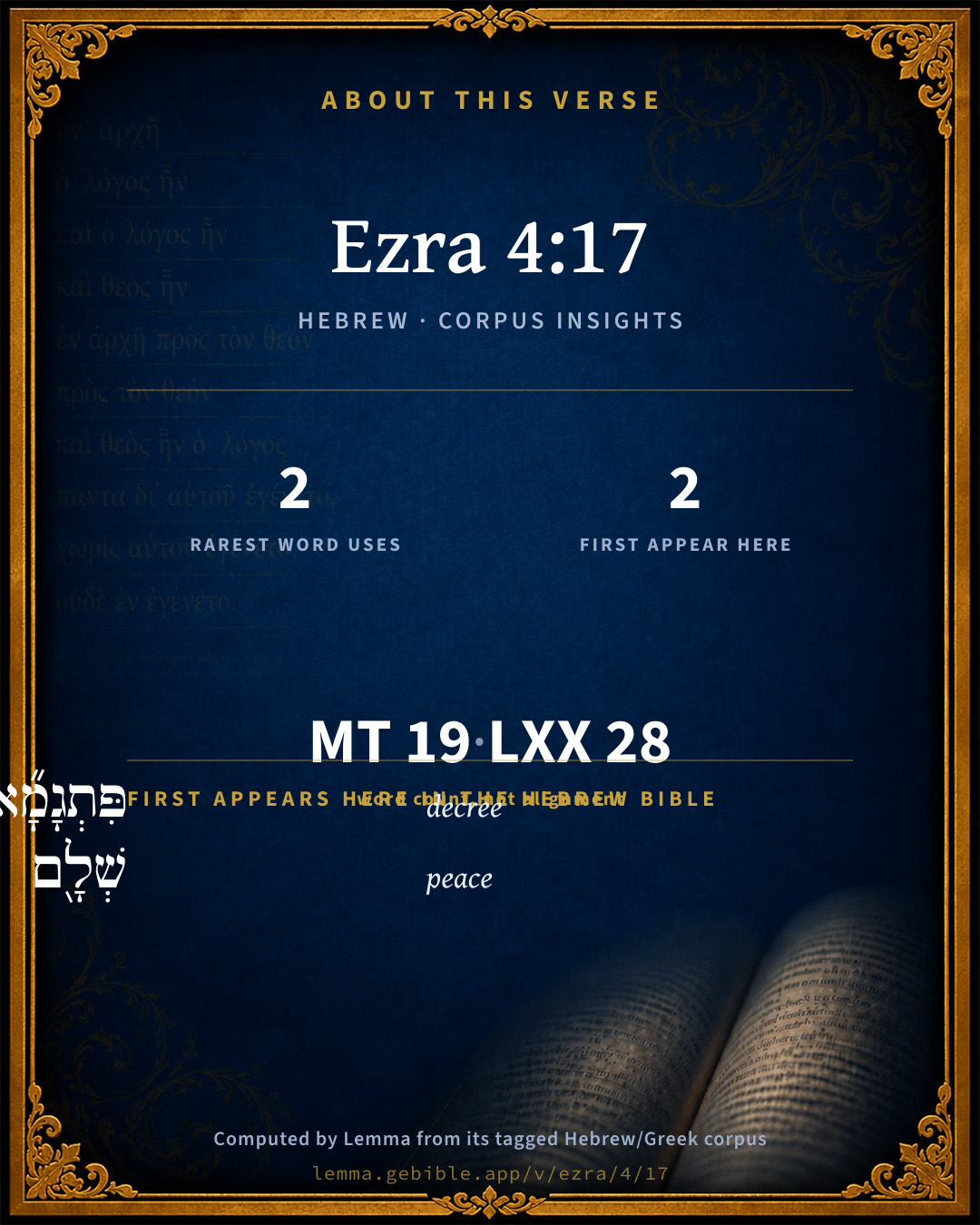
  • 2 first appearances in the Hebrew Bible
Full analysis ↓
Download a study sheet

One document with this verse’s original text, its word-by-word gloss line, the meaning frame, cross-references with their text, attributed commentary, and full source and license credits — printable, and it pastes into notes with its structure intact.

This verse Autodidact and up

Study sheet (.html) Plain text (.txt)

A passage Seminary Student

Up to 50 verses in one chapter. A passage sheet keeps up to 6 commentary sources and 12 cross-references per verse, in the order this page ranks them, and says so on the sheet whenever that leaves anything out. Ask for a single verse and you get the Autodidact verse sheet above.

Everything on this page stays free to read, with no account — the sheet is a download of what is already on screen, not access to it.

Want to remove ads? Support Godless Engineer
Compare translations 3

The same verse in 3 English versions, stacked beneath the original-language interlinear above. Click any original word for its lexicon entry.

Each is an independent rendering of the whole verse — the interlinear is not word-aligned to these translations.

Highlighted words mark where these versions differ — a whole-verse word diff, not a word-by-word alignment.

  • World English Bible Public Domain
    [Then] sent the king an answer to Rehum the chancellor, and to Shimshai the scribe, and to the rest of their companions who dwell in Samaria, and in the rest [of the country] beyond the River: Peace, and so forth.
  • King James Version Public Domain
    Then sent the king an answer unto Rehum the chancellor, and to Shimshai the scribe, and to the rest of their companions that dwell in Samaria, and unto the rest beyond the river, Peace, and at such a time.
  • unfoldingWord Literal Text CC BY-SA 4.0
    The king sent the answer: “To Rehum, a lord of decree, and Shimshai the scribe, and the rest of their companions who dwell in Samaria, and the rest of Beyond the River: Peace. And now:

unfoldingWord Literal Text — © unfoldingWord, licensed CC BY-SA 4.0. Word-aligned USFM3 via Door43 (git.door43.org/unfoldingWord/en_ult).

Versions to compare (up to 4)

3 of 4 selected

Show all 18 translations

Every available English version of this verse, each an independent rendering of the whole verse.

  • World English Bible Public Domain
    [Then] sent the king an answer to Rehum the chancellor, and to Shimshai the scribe, and to the rest of their companions who dwell in Samaria, and in the rest [of the country] beyond the River: Peace, and so forth.
  • Berean Standard Bible Public Domain
    Then the king sent this reply: To Rehum the commander, Shimshai the scribe, and the rest of your associates living in Samaria and elsewhere in the region west of the Euphrates: Greetings.
  • Majority Standard Bible Public Domain
    Then the king sent this reply: To Rehum the commander, Shimshai the scribe, and the rest of your associates living in Samaria and elsewhere in the region west of the Euphrates: Greetings.
  • King James Version Public Domain
    Then sent the king an answer unto Rehum the chancellor, and to Shimshai the scribe, and to the rest of their companions that dwell in Samaria, and unto the rest beyond the river, Peace, and at such a time.
  • American Standard Version (1901) Public Domain
    `Then' sent the king an answer unto Rehum the chancellor, and to Shimshai the scribe, and to the rest of their companions that dwell in Samaria, and in the rest `of the country' beyond the River: Peace, and so forth.
  • Revised Version (1885) Public Domain
    Then sent the king an answer unto Rehum the chancellor, and to Shimshai the scribe, and to the rest of their companions that dwell in Samaria, and in the rest of the country beyond the river, Peace, and so forth.
  • Geneva Bible (1599) Public Domain
    The King sent an answere vnto Rehum the Chauncelour, and Shimshai the Scribe, and so the rest of their companions that dwelt in Samaria, and vnto the other beyond the Riuer, Shelam and Cheeth.
  • Douay-Rheims (1899) Public Domain
    The king sent word to Reum Beelteem and Samsai the scribe, and to the rest that were in their council, inhabitants of Samaria, and to the rest beyond the river, sending greeting and peace.
  • Young's Literal Translation Public Domain
    An answer hath the king sent unto Rehum counsellor, and Shimshai scribe, and the rest of their companions who are dwelling in Samaria, and the rest beyond the river, `Peace, and at such a time:
  • Literal Standard Version CC BY-SA 4.0
    The king has sent an answer to Rehum counselor, and Shimshai scribe, and the rest of their companions who are dwelling in Samaria, and the rest beyond the river, “Peace, and at such a time:
  • Unlocked Literal Bible CC BY-SA 4.0
    So the king sent out a reply to Rehum and Shimshai and their companions in Samaria and the rest who were in the Province Beyond the River: “May peace be yours.
  • unfoldingWord Literal Text CC BY-SA 4.0
    The king sent the answer: “To Rehum, a lord of decree, and Shimshai the scribe, and the rest of their companions who dwell in Samaria, and the rest of Beyond the River: Peace. And now:
  • Darby Bible Public Domain
    The king sent an answer to Rehum the chancellor, and Shimshai the scribe, and the rest of their companions that dwell in Samaria, and the other places beyond the river: Peace, and so forth.
  • World Messianic Bible Public Domain
    Then the king sent an answer to Rehum the chancellor, and to Shimshai the scribe, and to the rest of their companions who live in Samaria, and in the rest of the country beyond the River: Peace.
  • Webster's Bible Public Domain
    Then the king sent an answer to Rehum the chancellor, and to Shimshai the scribe, and to the rest of their companions that dwell in Samaria, and to the rest beyond the river, Peace, and at such a time.
  • Free Bible Version CC BY-SA 4.0
    The king replied as follows: “To Rehum the commander, Shimshai the scribe, and fellow officers living in Samaria and in other areas west of the Euphrates: Greetings.
  • Bible in Basic English Public Domain
    Then the king sent an answer to Rehum, the chief ruler, and Shimshai the scribe, and their friends living in Samaria, and to the rest of those across the river, saying, Peace to you:
  • JPS Tanakh (1917) Public Domain
    Then sent the king an answer unto Rehum the commander, and to Shimshai the scribe, and to the rest of their companions that dwell in Samaria, and unto the rest beyond the River: 'Peace, and now

Literal Standard Version (2020), Covenant Press — licensed CC BY-SA 4.0. Text via the HelloAO Bible API (eBible.org). Unlocked Literal Bible (unfoldingWord) — licensed CC BY-SA 4.0. Text via the HelloAO Bible API (eBible.org). unfoldingWord Literal Text — © unfoldingWord, licensed CC BY-SA 4.0. Word-aligned USFM3 via Door43 (git.door43.org/unfoldingWord/en_ult). Free Bible Version, Dr. Jonathan Gallagher — licensed CC BY-SA 4.0. Text via the HelloAO Bible API (eBible.org).

Word by word

More ways to search: Search by grammar → Find every occurrence → Compare this word →

Practice this passage: Drill this verse → Learn its vocabulary →

בְּשָֽׁמְרָ֑יִן
Shomrayin
H8115
“in/at · Samaria”
Adjective, R + Noun, Proper
Part of Speech
Adjective + Noun
Type
Proper
Full BDB Definition

Origin: corresponding to H8111

TWOT: None

Samaria = "watch mountain" - the region of northern Palestine associated with the northern kingdom of the 10 tribes of Israel which split from the kingdom after the death of Solomon during the reign of his son Rehoboam and were ruled by Jeroboam - the capital city of the northern kingdom of Israel located 30 miles (50 kilometers) north of Jerusalem and 6 miles (10 kilometers) northwest of Shechem
  1. פִּתְגָמָ֞א pithgâm H6600 “decree · the” Adjective, N, Common + Particle, Definite Article
  2. שְׁלַ֣ח shᵉlach H7972 “to send” Adjective, V, Plural
  3. מַלְכָּ֗א melek H4430 “king · the” Adjective, N, Common + Particle, Definite Article
  4. עַל ʻal H5922 “upon” Adjective, R
  5. רְח֤וּם Rᵉchûwm H7348 “Rehum” Adjective, N
  6. בְּעֵל bᵉʻêl H1169 “lord of” Adjective, N, Common
  7. טְעֵם֙ ṭᵉʻêm H2942 “decree” Adjective, N, Common
  8. וְשִׁמְשַׁ֣י Shimshay H8124 “and · Shimshai” Adjective, C + Noun, Proper
  9. סָֽפְרָ֔א çâphêr H5613 “scribe · the” Adjective, N, Common + Particle, Definite Article
  10. וּשְׁאָר֙ shᵉʼâr H7606 “and · remainder of” Adjective, C + Noun, Common, Masculine, Singular, Construct
  11. כְּנָוָ֣תְה֔וֹן kᵉnâth H3675 “companions · his” Adjective, N, Common + Suffix, Personal, 3rd Person, Masculine, Singular
  12. דִּ֥י dîy H1768 “which” Adjective, T
  13. יָתְבִ֖ין yᵉthib H3488 “sitting” Adjective, V
  14. וּשְׁאָ֧ר shᵉʼâr H7606 “and · remainder of” Adjective, C + Noun, Common, Masculine, Singular, Construct
  15. עֲבַֽר ʻăbar H5675 “beyond” Adjective, N
  16. נַהֲרָ֛ה nᵉhar H5103 “river · the” Adjective, N + Particle, Definite Article
  17. שְׁלָ֖ם shᵉlâm H8001 “peace” Adjective, N, Common
  18. וּכְעֶֽת kᵉʻeneth H3706 “and · now” Adjective, C + Adverb

About this verse

These counts appear in no published source. They are computed here, from the morphology-tagged text and Lemma’s own curated glosses. What Lemma adds →

19
words
18
distinct lemmas
Historical
section

Notable vocabulary

The rarest word here is בְּשָֽׁמְרָ֑יִן Samaria H8115 — appearing just 2 times in the whole Hebrew Bible.

First appearance in Scripture

These words make their first canonical appearance in the Hebrew Bible here:

  • פִּתְגָמָ֞א decree H6600
  • שְׁלָ֖ם peace H8001

Shared distinctive vocabulary

בְּשָֽׁמְרָ֑יִן Samaria H8115 occurs in 2 verses of the Hebrew Bible. Also found in:

Grammatical profile

  • 4 nouns
  • 10 adjectives
  • 1 adverb
  • 4 particles

Repetition

A word recurs within this verse — often emphatic in Hebrew:

  • וּשְׁאָר֙ remainder H7606 ×2

Hebrew & Septuagint length

In English translation the verse runs 40 words from the Hebrew and 33 from the Septuagint (LXX English) — closely comparable.

A rough comparison of the two English renderings, which tokenize alike — not a word-level alignment.

Word counts can differ between the Hebrew and the Greek without any difference in meaning — e.g. the Hebrew direct-object marker אֵת has no separate Greek word, and Greek often adds the article ὁ.

In the original languages it is 19 Hebrew tokens and 28 Greek tokens — but the two are counted differently (Hebrew bundles its prefixes and suffixes into one token; the Greek is in lemma form), so that isn’t a like-for-like length.

Cross-references

7

Topical passages linked to Ezra 4:17 in the Treasury of Scripture Knowledge — connected by theme and wording, ordered by reader-vote popularity; previews shown in the World English Bible.

  • Ezra 4:7 In the days of Artaxerxes wrote Bishlam, Mithredath, Tabeel, and the rest of his companions, to Artaxerxes king of Persia; and the writing of the letter was written in the Syrian [character], and set forth in the Syrian [language].
  • Ezra 4:9–11 then [wrote] Rehum the chancellor, and Shimshai the scribe, and the rest of their companions, the Dinaites, and the Apharsathchites, the Tarpelites, the Apharsites, the Archevites, the Babylonians, the Shushanchites, the Dehaites, the Elamites,
  • Ezra 5:7 they sent a letter to him, in which was written thus: To Darius the king, all peace.
  • Ezra 7:12 Artaxerxes, king of kings, to Ezra the priest, the scribe of the law of the God of heaven, perfect and so forth.
  • Luke 10:5 Into whatever house you enter, first say, 'Peace be to this house.'
  • Acts 23:26 "Claudius Lysias to the most excellent governor Felix: Greetings.
  • Romans 1:7 to all who are in Rome, beloved of God, called to be saints: Grace to you and peace from God our Father and the Lord Jesus Christ.

Cross-references courtesy of OpenBible.info (CC BY 4.0).

Hebrew and Greek witnesses Masoretic Hebrew ↔ Greek Septuagint

The same verse in the two great witnesses to the Old Testament, shown verse-for-verse.

These are two independent witnesses, not word-aligned to each other, and the Septuagint is shown in lemma (dictionary) form.

Hebrew Ezra 4:17 Masoretic · Westminster Leningrad Codex

פִּתְגָמָ֞א שְׁלַ֣ח מַלְכָּ֗א עַל רְח֤וּם בְּעֵל טְעֵם֙ וְשִׁמְשַׁ֣י סָֽפְרָ֔א וּשְׁאָר֙ כְּנָוָ֣תְה֔וֹן דִּ֥י יָתְבִ֖ין בְּשָֽׁמְרָ֑יִן וּשְׁאָ֧ר עֲבַֽר נַהֲרָ֛ה שְׁלָ֖ם וּכְעֶֽת

[Then] sent the king an answer to Rehum the chancellor, and to Shimshai the scribe, and to the rest of their companions who dwell in Samaria, and in the rest [of the country] beyond the River: Peace, and so forth.

World English Bible · Public Domain

Greek LXX Ezra 4:17 Septuagint · lemma form

καί ἀποστέλλω ὁ βασιλεύς πρός ραουμ βααλταμ καί σαμσαι γραμματεύς καί ὁ κατάλοιπος σύνδουλος αὐτός ὁ οἰκέω ἐν σαμαρεία καί ὁ κατάλοιπος πέραν ὁ ποταμός εἰρήνη καί φημί

Then the king sent to Reum the chancellor, and Sampsa the scribe, and the rest of their fellow-servants who lived in Samaria, and the rest beyond the river, saying, Peace; and he says,

LXX2012 (modern English Septuagint) · Public Domain

In the Septuagint this is one book — Esdras B (2 Esdras): Ezra is chapters 1–10, Nehemiah 11–23.

On this verse, The Cambridge Bible for Schools and Colleges discusses the Septuagint’s reading. Read the note in Commentary ↓

Hebrew: Westminster Leningrad Codex (CC BY 4.0). Greek: Septuagint (public domain); English from LXX2012 (modern English Septuagint) (Public Domain). How the Septuagint differs from the Hebrew →

Commentary

Notes on Ezra 4:17 from classic Christian and Jewish commentators (each source and its license shown beneath its notes). The classic Christian expositions comment on the surrounding passage and are grouped to its opening verse, so a note may address several verses; the Jewish commentaries on the Tanakh (Rashi and others) are per-verse, so they appear only where the commentator wrote on this verse.

Lemma curates 59 commentaries, every one of them public domain or Creative Commons licensed, each selected and text-cleaned for this edition rather than reprinted as found. About our sources →

Trapp's Complete Commentary

John Trapp

Ezr 4:17 [Then] sent the king an answer unto Rehum the chancellor, and [to] Shimshai the scribe, and [to] the rest of their companions that dwell in Samaria, and [unto] the rest beyond the river, Peace, and at such a time.

Ver. 17. Peace, and at such a time] As the Latins saluting say, Ave, or Salve, the Greeks χαιρε, so the Hebrews and Syrians say, Shalom lach, that is, Peace be to thee (Hieron.). The Turks’ salutation at this day also is, Salaam aleek, the reply, Aleek Salaum, peace is a complexive blessing (Blount).

John Trapp, A Commentary or Exposition upon All the Books of the Old and New Testament (1647–1656) — public domain. Text from a community e-Sword module.

The Biblical Illustrator

Joseph S. Exell

Ezr_4:17-24

Them sent the king an answer.

The temporary triumph of the wicked

I. Examine the letter of the king. This letter suggests--

1. That the subtlety of the wicked frequently obtains a temporary triumph over the good.

2. That one generation frequently suffers through the sins of another and earlier one. The Jews smarted for their sins of Jehoiakim and Zedekiah.

3. That the cause of God is frequently reproached and hindered by the evil conduct of some of its adherents. The rebellions of Jehoiakim and Zedekiah were now made use of to asperse the Jews and to stop the work of God. All who love the gospel should therefore walk circumspectly.

II. The action of the Samaritans. Now when the copy of king Artaxerxes letter was read, etc. Their action was--

1. Prompt.

2. Personal.

3. Powerful.

Learn:

1. That the temporary triumph of a cause or a party is not a proof of its righteousness. The death and burial of Christ.

2. That we are not competent to judge the relation of the present events to the purpose and providence of the great God. (William Jones.)

Unto the rest beyond the river, Peace.

Peace beyond the river

I. The advent message of the church to sinners is, Beyond the river, Peace!, She tells of a promised land and arouses the slaves of sin.

II. Christ is come and with Him peace, but we must go to meet Him.

III. The road thither is hard--We must cross the river of self-denial. A legend says that once a wanderer went to a city, and the first man he met said to him, Of course you come to see our famous statue? and each one he met in that town told him of the famous statue; and, moreover, each one prided himself in having something to do with it: this one to guard it; that one to keep it clean, and so forth. As the traveller stood before it he asked, Who is this? Oh! weve forgotten his name, was the reply, but thats no matter, it is a splendid statue, and the glory of our town. Sadly the wanderer turned away, and do you know, dear people, as he went out of the gate some little children cried, Why, that is the man our famous statue was put up to! Is it not still possible for men and women to be church-goers and church-workers, to be proud of their Church, and yet the Living Christ passes by unknown? (The Literacy Churchman.)

.

The Biblical Illustrator, edited by Joseph S. Exell (c. 1880s–1900s) — public domain. Text from a community e-Sword module.

The Pulpit Commentary

CHAPTER 4:17-24.

Then sent the king an answer. The complaint made was of such importance that an answer was returned without delay. It was addressed both to Rehum and Shimshai, since they were independent authorities.. Peace, and at such a time. "Peace" (sheldm) is the ordinary Oriental salutation. The other word, uk"eth, is taken by our translators to refer to the date; but it really means, like uk"eneth (ver. 10), "and so forth," or et cetera.

HOMILETICS Vers. 17-24.

The work stopped.

The ostensible object of the letter to Artaxerxes (vers. 11-16) was to stop the building of the walls of Jerusalem. Its real object was to put a stop to the building of God"s house. In this for a time it succeeded, as our present passage records. Two things are to be especially noticed in the story of this grievous success. The weapon obtained was most efficient; the use made of it was most effectual.

I As EFFICIENT AID IS AS EVIL PLAN. This the Samaritans found provided for them in the reply of King Artaxerxes. Besides the bare fact of having a reply at all, which was satisfactory so far as showing that their accusation had reached headquarters (as they had planned), the reply itself, when examined, turned out all they could wish. For example, its language showed that their representations had met

(1) with most favourable attention. The number and character of those making them (as noted in our last) had been duly observed (ver. 17). Their friendly object in doing so was acknowledged by the usual friendly salutation ("Peace," etc.) in return. Also, the contents of the letter had been submitted carefully to the notice of the king. (ver. 18; comp. Est_6:1) As a beginning, therefore, what could be better? Next, we find that the recommendations of the letter had met

(2) with most ready compliance. The suggested "search" had been formally ordered (obs. word "decree" in margin), and properly instituted and carried out. Further, the result of that search had proved such as to give their words of warning

(3) most ample support. All that they had said was found true. Jerusalem,was found described in the government archives as "seditious," and that "of old (ver. 19). Also their fears as to the loss of revenue, and even of the province, had been fully justified by the search. Jerusalem, so it was found, had formerly both ruled and taxed all "beyond the river;" and might do so again, of course, if rebuilt (ver. 20). Not only so, but it may perhaps be noticed that, so far as the search went, nothing of an adverse nature had been found; or, at any rate, if found, had not been referred to. Est_6:2, 4 are at least sufficient to show how different a complexion the results of this search might have had, if thorough and earnest. Also, that, had it been so, the designs of the Samaritans would probably not have met, as we find them doing,

(4) with such signal success. For example, the builders at Jerusalem were to be made to "cease," the very upshot wished for. Not only so, they were not to begin again, except by express permission for it from the king himself. This "commandment" was to continue binding until there should be "another commandment" in its place. Added to which, the Samaritans themselves were not only at liberty, as though by a kind of "permissive legislation," to see to the execution of this decree of the king, but they were strongly urged, and almost entreated in fact, to prevent its infraction. One can see, in that concluding remonstrance, how well their (mis)-representations had told; and how fully they had succeeded in alarming and arousing the jealous covetousness of the king. "Take heed now that ye fail not to do this: why should damage grow to the hurt of the king?" Must they not have read this language with a smile of triumph as well as joy? Here was the king, in urging his own desires, forwarding theirs even more. Here was that which could be used against the Jewish elders at their only. strong point as it seemed. The one thing, as noted before, which appeared to give any strength to the builders of the temple, was the edict of Cyrus. Here was a similar edict, still more urgent and quite as explicit, on the exactly opposite side. Surely the means of success, if not success itself, was now placed in their power.

II AN EFFICIENT AID IN AN EVIL PLAN EFFECTUALLY EMPLOYED. Were the Samaritans able to use the aid thus placed in their hands? Were they satisfied with merely obtaining so welcome a decree? Unless a weapon is effectually wielded, it might as well remain hanging up in the armoury. Unless a decree is made known and enforced, it differs nothing from one not yet passed so far, at any rate, as its results are concerned? The Samaritan leaders and council, to whom came, in the first instance, the above-described decree of the king, seem to have been fully alive to these truths. They appear to have met together (ver. 23) in order to hear its contents. It was doubtless "read before" them with all proper state. After this, there was

(1) no delay. They proceeded to take action on it "in haste." They determined to strike, as we say, while the iron was hot. Also, they did this, we find,

(2) in person; not deputing action, it seems, on so pressing a matter, to any kind of subordinates. "They" themselves, who had thus received the letter, and heard it read, at once proceeded to act. May we not notice, too, in what way they did so? Namely, on the one hand,

(3) as to place. They went to Jerusalem, the city in question, the place which the king"s letter and their wishes had both so plainly in anew. Also, on the other hand,

(4) as to persons. They went "to Jerusalem to the Jews," it is stated; i.e. , as we take it, to the Jewish rulers and elders (so the expression "the Jews" is constantly used by St. John in his Gospel); in other words, to those men at Jerusalem who were actually engaged in directing and overseeing the erection of the temple, and so were those really responsible, in fact, for the whole of that work. Nor is this quite all we are told. We are told, further, of these Samaritan authorities and the point being expressly mentioned seems worthy of a special note, at least, in passing that they "made" the Jewish authorities "to cease" from their work; and that they did so, also, "by force and power that is to say, no doubt, with a very considerable exhibition of ill-usage and threat. In a word, it is as though, with this decree from Shushan in their hands, they had rushed all the way from Samaria and struck these Jerusalem Jews as they worked; and that with so much force and such a degree of skill as to deprive them of all power to go on. Nothing, in fact, could be better aimed, nothing more effectual, than this their stroke. It utterly destroyed the thing struck; at any rate for so long a time, and so completely, that there was nothing more to be said. "Then ceased the work of the house of God which is at Jerusalem." Not till a year and a half have passed by, not till a new king and even a new dynasty have appeared on the scene, shall we hear of it again!

See, therefore, in this matter

1. The mystery of Gods ways. The omnipotent God himself allowed his own work to be stopped l Not merely his own workmen. That is another thing, and often the case. (see Mat_14:3; Mar_9:18; Act_16:6, Act_16:7; Rev_11:7-10) Even such a stoppage, however, is, not uncommonly, a sufficiently mysterious thing in our eyes. The Baptist, apparently, felt this himself. (Mat_11:2-6) Who, again, without marvel, can see the glorious sunrise of Stephen"s ministry (Act_6:8-13) so suddenly set before men (Jer_15:9; Act_7:59) But this phenomenon of the cessation of the work itself is more marvellous still, because it appears at first hardly consistent with God"s own attributes and nature. Does it mean that he has changed his purposes ( (1 Samuel? (Rom_11:29; Jam_1:17) Or that he cannot carry them? (Mat_19:26; Mar_14:36) Especially may we ask thus where the work in question is one for which he has done so much and so triumphantly, as in this instance (see chaps, 1.-3., almost throughout). And still more where the cessation of the work is brought about by the enemies of himself and his people, and that with such a spring-tide of success as our eyes have just seen. The greatest things and the smallest (so our attention to some of the very minutiae of this case has served to show us), the "stars in their courses" and the dust of the desert have seemed in league here with God"s foes And the end has been what? The open failure, in the eyes of his enemies, and in the eyes of his friends as well, of the undertaking on which he had set his heart. That is what that deserted temple enclosure, with its manifestly interrupted labours, and its sorry wealth of unused materials, seemed to say for so long. It was like the flag of the enemies of Jehovah waving triumphantly over the very citadel of his strength! (Psa_74:7)

2. The mercy of God"s ways. After all, the case was not desperate. There was just a gleam of light in the darkness; a gleam, it is possible, that would never have been noticed unless the surrounding darkness had been so extreme; a gleam, however, all the more worthy of notice on that very account. Why that singular suggestion of a possible second "commandment" in the (otherwise) unfaltering royal decree of this chapter? Does Scripture tell us of anything like it in any other document of this nature? (comp. Ezr_1:2-4 Ezr_6:6-12 Ezr_7:11-26; Dan_3:29 Dan_6:25-27) Considering, indeed, the almost excessive value attached by the ancient Persian government to the idea of "finality" in its legislation (Daniel 6. throughout), is not this curious hint in the exactly opposite direction a feature of most singular note? And may we not believe, therefore, with all reverence, that we see in it the special handiwork and the special mercy of God himself? Often does he give such dim but priceless glimmerings of hope to those on the very verge of despair. (see Jud_1:13:22, 23; 2Sa_24:12-14; Jer_4:27 Jer_5:9, Jer_5:10, Jer_5:18; Luk_8:49, 50 24:17; Act_20:9, Act_20:10) This is equally true of his Church, (Psa_12:1) and of souls. (Psa_27:13) So often may it be said of both of them, as 2Co_4:8, 2Co_4:9.

HOMILIES BY J.S. EXELL. Vers. 17-24.

Man hindering the work of God.

I THAT MEN ARE CAPABLE OF HINDERING THE WORK OF GOD. "Give ye now commandment to cause these men to cease, and that this city be not builded" (ver. 21).

1. Presumptuous. "Then ceased the work of the house of God." How could presumption be greater than to stop the work of God; let men pluck the stars from the heavens, but let them not injure the Church of Christ.

2. Perplexing. Is it not a mystery that the Eternal will allow frail and sinful men to impede the work of his people?

3. Prejudicial. The walls of Jerusalem required restoration. The temple must be built and the old worship restored. This hindrance is injurious to the Jewish commonwealth. How do men prejudice great interests by staying the beneficent ministries of the Church.

4. Permitted. These hindrances were allowed for a time, that new energy might be stimulated, that the mercy of God might be seen in the aid given to the dejected workers, and his glory in the final defeat of all enemies.

5. Preparatory. To greater success; the pent-up stream will soon flow on more rapidly.

6. Patient. The work of the Church is patient; it will outlive all enmity.

II THE METHODS WHICH ARE MOST CALCULATED TO HINDER THE WORK OF GOD. The letter to the king caused the work to cease. The impediments to Church work are

1. External. The political may hinder the moral; unjust law, civil persecution, and the force of circumstances may sometimes cause the work of God to cease

1. Haste.

2. Force (ver. 23).

2. Internal. The work of God is more often hindered by a low spiritual condition, by a quarrelsome temper, by a critical spirit, by the thoughtless word; it is indeed sad to cause moral work to cease from within. See the responsibility of conduct, when a word may, like this letter to the king, stay the work of God.

III THE CONSEQUENCES WHICH FOLLOW WHEN THE WORK OF GOD IS HINDERED.

1. Disappointment. After the generous edict of Cyrus how disappointing this order to cease work. How often is the Church disappointed in her best efforts.

2. Complaint. No doubt many Israelites would indulge a complaining spirit. The Church should not grumble when its work is hindered, but pray.

3. Sorrow. That the good work should be unfinished.

4. Hope. That God will yet undertake their cause. E.

The Pulpit Commentary (1880–1919), ed. H.D.M. Spence-Jones & Joseph S. Exell — public domain. Text from a community e-Sword module.

Geneva Bible (1599)

Geneva Bible translators

Called also Cheeneth, as verse 11.

Some read for Shalom, salutation or greeting.

Geneva Bible (1599) marginal notes — public domain. Text via Bolls.life.

Matthew Henry's Commentary

Here we have,

I. The orders which the king of Persia gave, in answer to the information sent him by the Samaritans against the Jews. He suffered himself to be imposed upon by their fraud and falsehood, took no care to examine the allegations of their petition concerning that which the Jews were now doing, but took it for granted that the charge was true, and was very willing to gratify them with an order of council to stay proceedings. 1. He consulted the records concerning Jerusalem, and found that it had indeed rebelled against the king of Babylon, and therefore that it was, as they called it, a bad city (Ezr 4:19), and withal that in times past kings had reigned there, to whom all the countries on that side the river had been tributaries (Ezr 4:20), and that therefore there was danger that if ever they were able (which they were never likely to be) they would claim them again. Thus he says as they said, and pretends to give a reason for so doing. See the hard fate of princes, who must see and hear with other men's eyes and ears, and give judgment upon things as they are represented to them, though often represented falsely. God's judgment is always just because he sees things as they are, and it is according to truth. 2. He appointed these Samaritans to stop the building of the city immediately, till further orders should be given about it, Ezr 4:21, Ezr 4:22. Neither they, in their letter, nor he, in his order, make any mention of the temple, and the building of that, because both they and he knew that they had not only a permission, but a command, from Cyrus to rebuild that, which even these Samaritans had not the confidence to move for the repeal of. They spoke only of the city: "Let not that be built," that is, as a city with walls and gates; "whatever you do, prevent that, lest damage grow to the hurt of the kings:" he would not that the crown should lose by his wearing it.

II. The use which the enemies of the Jews made of these orders, so fraudulently obtained; upon the receipt of them they went up in haste to Jerusalem, Ezr 4:23. Their feet ran to evil, Pro 1:16. They were impatient till the builders were served with this prohibition, which they produced as their warrant to make them cease by force and power. As they abused the king in obtaining this order by their mis-informations, so they abused him in the execution of it; for the order was only to prevent the walling of the city, but, having force and power on their side, they construed it as relating to the temple, for it was that to which they had an ill will, and which they only wanted some colour to hinder the building of. There was indeed a general clause in the order, to cause these men to cease, which had reference to their complaint about building the walls; but they applied it to the building of the temple. See what need we have to pray, not only for kings, but for all in authority under them, and the governors sent by them, because the quietness and peaceableness of our lives, in all godliness and honesty, depend very much upon the integrity and wisdom of inferior magistrates, as well as the supreme. The consequence was that the work of the house of God ceased for a time, through the power and insolence of its enemies; and so, through the coldness and indifference of its friends, it stood still till the second year of Darius Hystaspes, for to me it seems clear by the thread of this sacred history that it was that Darius, Ezr 4:24. Though now a stop was put to it by the violence of the Samaritans, yet that they might soon after have gone on by connivance, if they had had a due affection to the work, appears by this, that before they had that express warrant from the king for doing it (ch. 6) they were reproved by the prophets for not doing it, Ezr 5:1, compared with Hag 1:1, etc. If they had taken due care to inform Cambyses of the truth of this case, perhaps he would have recalled his order; but, for aught I know, some of the builders were almost as willing it should cease as the adversaries themselves were. At some periods the church has suffered more by the coldness of its friends than by the heat of its enemies; but both together commonly make church-work slow work.

Matthew Henry's Commentary on the Whole Bible (1708–1710) — public domain (CC PDM 1.0). Text via the HelloAO Bible API.

Adam Clarke's Commentary

Verse 17. Peace, and at such a time] The word וכעת ucheeth is like that which we have already considered on Ezr 4:10, and probably has the same meaning.

Adam Clarke's Commentary on the Bible (1810–1826) — public domain. Text from a community e-Sword/MySword module.

Ellicott's Commentary for English Readers

(17) Peace, and at such a time.—Salutation, and so forth. The account of the reply and the beginning of it are strangely blended, as before.

A Bible Commentary for English Readers, edited by Charles John Ellicott (1878–1897) — public domain. Text from a community e-Sword module.

The Cambridge Bible for Schools and Colleges

gen. ed. J. J. S. Perowne

17. an answer] Another Persian word in the original, ‘pithgama’, used also in Est_1:20, a ‘decree’, and Ecc_8:11, ‘sentence’. The LXX. omits. Vulg. ‘verbum’. Here = a royal rescript.

Rehum &c.] see Ezr_4:9.

that dwell in Samaria] A detail not mentioned with such directness in Ezr_4:10. A comparison with that verse shows that the city, not the district, is intended.

unto the rest beyond the river] So margin of R.V.—R.V. text in the rest of the country beyond the river. See Ezr_4:10, where the application of the word ‘rest’ is clearly the same. There it follows after the verb ‘set in’ (lit. ‘cause to dwell’), here after the verb ‘dwell’. The district or territory, not the population, is referred to.

and at such a time] R.V. and so forth. Cf. Ezr_4:11.

The Cambridge Bible for Schools and Colleges (gen. ed. J. J. S. Perowne; Cambridge University Press, 1878–1918) — public domain. Text from a community e-Sword module.

John Gill's Exposition

The letter which ye sent unto us,.... The plural number is used, being now become courtly for kings thus to speak of themselves:

hath been plainly before me; by such that understood both the Syrian and Persian languages; the letter was written in the Syrian language, and the king being a Persian, it was necessary it should be interpreted and explained to him.

John Gill's Exposition of the Whole Bible (1746–1763) — public domain (CC PDM 1.0). Text via the HelloAO Bible API.

Haydock's Catholic Bible Commentary

Greeting. Protestants, "peace, and at such a time," which has no great meaning. (Haydock) See ver. 10.

George Leo Haydock (1774–1849), Haydock's Catholic Family Bible and Commentary, 1859 edition — public domain. Excludes Psalms (Douay-Rheims chapter numbering differs from Protestant) and Deuterocanonical books (Catholic canon only).

Whedon's Commentary on the Bible

Daniel D. Whedon

17. An answer — The original word (פתגם) conveys the idea not only of an answer, but also of a decree: an edict.

Peace, and at such a time — Rather, peace, and so forth. This expression denotes that the customary formularies of introduction are omitted. See note on Ezr_4:11.

Daniel D. Whedon (gen. ed.), Commentary on the Old and New Testaments (1874–1909) — public domain. Text from a community e-Sword module.

unfoldingWord translationNotes

Door43 World Missions Community

the Province Beyond the River

This is the name of the province that was west of the Euphrates River. It was across the river from the city of Susa. See how you translated this in Esra 4:10. (See: How to Translate Names)

The letter that you sent me has been translated and read

This can be translated in active form, in which case you will need to make explicit who translated and read the letter to the king. AT: "I have had my servants translate and read the letter that you sent to me" (See: Active or Passive)

Rehum

man's name. See how you translated this in Esra 2:2.

Shimshai

man's name. See how you translated this in Esra 4:8.

the River

the Euphrates River

translationWords

companion

Samaria

peace

epistle

unfoldingWord translationNotes — © Distant Shores Media and the Door43 World Missions Community, licensed CC BY-SA 4.0. Source: git.door43.org/Door43/en_tn.

Rashi

Rabbi Shlomo Yitzchaki (Rashi)

The king sent a word Aram. פִּתְגָּמָא שְּׁלַח מַלְכָּא

to Rehum the secretary to Rehum the secretary, and Shimshai the scribe, and to the rest of their companies, who dwelt in the cities of Samaria, and to the rest of the nations who were on the other side of the river of the side of the land of Israel.

Shelam and Ke’eth They are places, like “and Ke’eneth.” Sometimes he calls it this and sometimes that.

Rashi on the Tanakh — English translations: “The Judaica Press complete Tanach with Rashi, translated by A. J. Rosenberg” (CC BY 4.0); “Pentateuch with Rashi's commentary by M. Rosenbaum and A.M. Silbermann, 1929-1934” (public domain); “The Metsudah Tanach series, Lakewood, N.J” (CC BY 4.0); and “The Book of Joshua, Metsudah Publications, 1997” (CC BY 4.0). Text via Sefaria.

Lesson kit

Teaching starters — assembled from the data on this page, not authored interpretation. Every prompt links to the verse data it draws on. Edit before teaching.

Ezra, in the Historical, opens this verse with 19 words (18 distinct Hebrew lemmas). Its most distinctive word is Shomrayin (“Samaria”). A historical commentator’s framing appears above. Read the whole chapter for the surrounding context.

Discussion questions

  1. What does “Samaria” (Shomrayin) contribute to the verse as a whole?
  2. 2 words here appear for the first time in Scripture. What is being introduced at this debut?
  3. Ezra 4:10 shares the word «Samaria» with this verse. How do the two illuminate each other?
  4. “remainder” occurs 2× in this one verse. What is the effect of the repetition?
  5. These translations render this verse differently. What is at stake in choosing one wording over another?
  6. Reading how Trapp's Complete Commentary and The Biblical Illustrator read this verse, where do the two commentators agree and where do they part?

Things to notice

Reading settings

Reading text

Shown beneath each verse's original-language words.

Old Testament
Old Testament edition

Read the OT as the Masoretic Hebrew (MT) or the Greek Septuagint (LXX).

English shown for the Greek Septuagint (in the Hebrew ↔ Greek comparison).

Comparing translations? Open the Compare panel on any verse page to stack up to four side by side.