
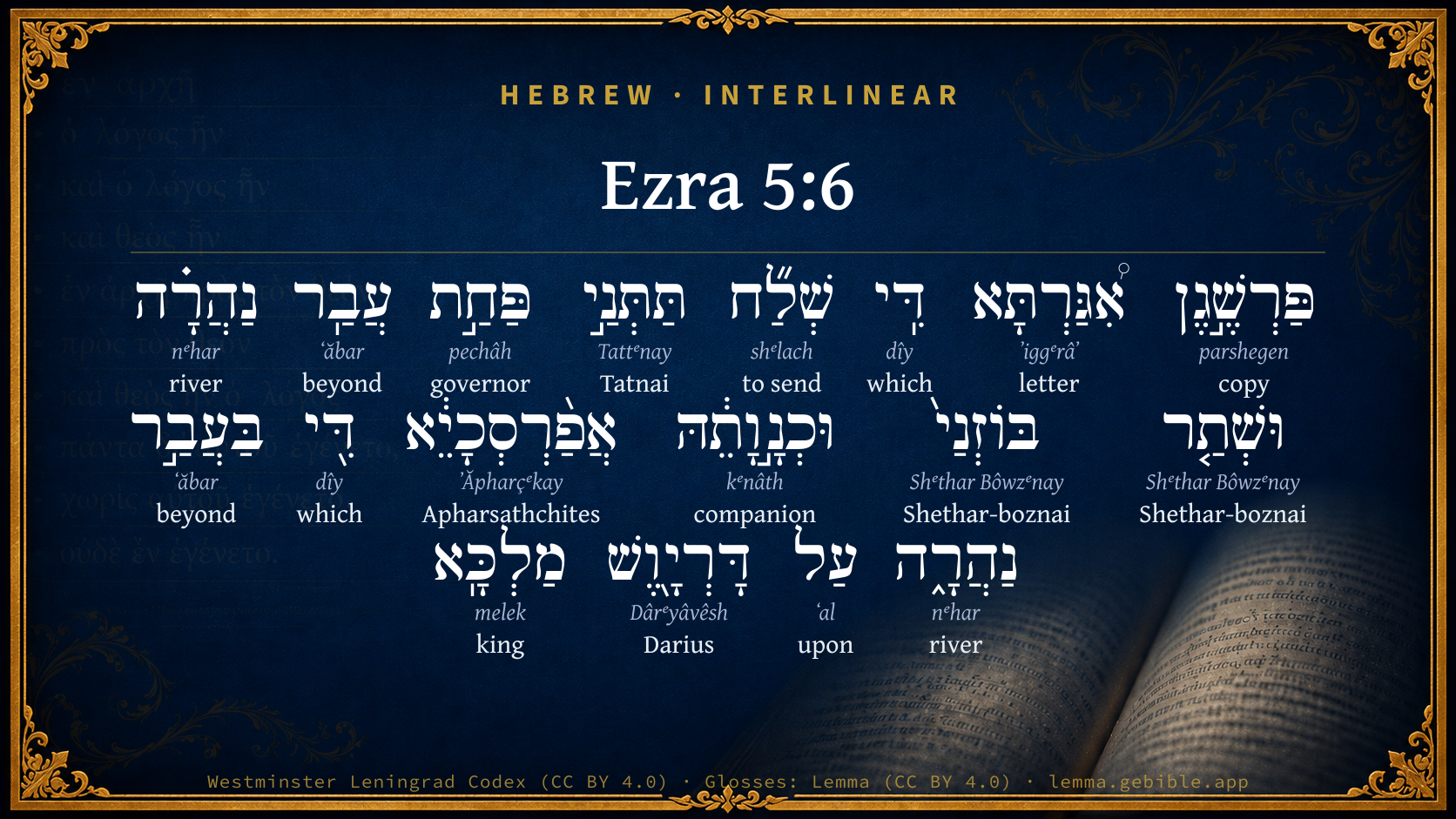
Ezra 5:6

Hebrew (Westminster Leningrad Codex) Ezra 5:6 appears in the Hebrew Old Testament. The text above is from the Westminster Leningrad Codex. Each word links to its Strong’s number, a concise gloss, and parsing drawn from the Open Scriptures Hebrew Bible morphology. Click any word for its full Brown-Driver-Briggs (BDB) entry.
Download image
Cite this verse

Ezra 5:6 (World English Bible). Public Domain. Lemma interlinear Bible study tool, https://lemma.gebible.app/v/ezra/5/6.

Show BibTeX & RIS
BibTeX
RIS
English Translation
The copy of the letter that Tattenai, the governor beyond the River, and Shetharbozenai, and his companions the Apharsachites, who were beyond the River, sent to Darius the king;
World English Bible · Public Domain
Download a study sheet

One document with this verse’s original text, its word-by-word gloss line, the meaning frame, cross-references with their text, attributed commentary, and full source and license credits — printable, and it pastes into notes with its structure intact.

This verse Autodidact and up

Study sheet (.html) Plain text (.txt)

A passage Seminary Student

Up to 50 verses in one chapter. A passage sheet keeps up to 6 commentary sources and 12 cross-references per verse, in the order this page ranks them, and says so on the sheet whenever that leaves anything out. Ask for a single verse and you get the Autodidact verse sheet above.

Everything on this page stays free to read, with no account — the sheet is a download of what is already on screen, not access to it.

Want to remove ads? Support Godless Engineer
Compare translations 3

The same verse in 3 English versions, stacked beneath the original-language interlinear above. Click any original word for its lexicon entry.

Each is an independent rendering of the whole verse — the interlinear is not word-aligned to these translations.

Highlighted words mark where these versions differ — a whole-verse word diff, not a word-by-word alignment.

  • World English Bible Public Domain
    The copy of the letter that Tattenai, the governor beyond the River, and Shetharbozenai, and his companions the Apharsachites, who were beyond the River, sent to Darius the king;
  • King James Version Public Domain
    The copy of the letter that Tatnai, governor on this side the river, and Shetharboznai and his companions the Apharsachites, which were on this side the river, sent unto Darius the king:
  • unfoldingWord Literal Text CC BY-SA 4.0
    A copy of the letter that Tattenai, the governor of Beyond-the-River, and Shethar-Bozenai and his companions, the officials who were in Beyond-the-River, sent to Darius the king.

unfoldingWord Literal Text — © unfoldingWord, licensed CC BY-SA 4.0. Word-aligned USFM3 via Door43 (git.door43.org/unfoldingWord/en_ult).

Versions to compare (up to 4)

3 of 4 selected

Show all 18 translations

Every available English version of this verse, each an independent rendering of the whole verse.

  • World English Bible Public Domain
    The copy of the letter that Tattenai, the governor beyond the River, and Shetharbozenai, and his companions the Apharsachites, who were beyond the River, sent to Darius the king;
  • Berean Standard Bible Public Domain
    This is the text of the letter that Tattenai the governor of the region west of the Euphrates, Shethar-bozenai, and their associates, the officials in the region, sent to King Darius.
  • Majority Standard Bible Public Domain
    This is the text of the letter that Tattenai the governor of the region west of the Euphrates, Shethar-bozenai, and their associates, the officials in the region, sent to King Darius.
  • King James Version Public Domain
    The copy of the letter that Tatnai, governor on this side the river, and Shetharboznai and his companions the Apharsachites, which were on this side the river, sent unto Darius the king:
  • American Standard Version (1901) Public Domain
    The copy of the letter that Tattenai, the governor beyond the River, and Shethar-bozenai, and his companions the Apharsachites, who were beyond the River, sent unto Darius the king;
  • Revised Version (1885) Public Domain
    The copy of the letter that Tattenai, the governor beyond the river, and Shethar-bozenai, and his companions the Apharsachites, which were beyond the river, sent unto Darius the king:
  • Geneva Bible (1599) Public Domain
    The copie of the letter, that Tatnai captaine beyond the Riuer, and Shether-boznai and his companions, Apharsechaie, (which were beyond the Riuer) sent vnto King Darius.
  • Douay-Rheims (1899) Public Domain
    The copy of the letter that Thathanai governor of the country beyond the river, and Stharbuzanai, and his counsellors the Arphasachites, who dwelt beyond the river, sent to Darius the king.
  • Young's Literal Translation Public Domain
    The copy of a letter that Tatnai, governor beyond the river, hath sent, and Shethar-Boznai and his companions, the Apharsachites who `are' beyond the river, unto Darius the king.
  • Literal Standard Version CC BY-SA 4.0
    The copy of a letter that Tatnai, governor beyond the river, has sent, and Shethar-Boznai and his companions, the Apharsachites who [are] beyond the river, to Darius the king.
  • Unlocked Literal Bible CC BY-SA 4.0
    This is a copy of the letter of Tattenai, governor of the Province Beyond the River, and Shethar-Bozenai and his accociates in the Province Beyond the River, which they sent to Darius the king.
  • unfoldingWord Literal Text CC BY-SA 4.0
    A copy of the letter that Tattenai, the governor of Beyond-the-River, and Shethar-Bozenai and his companions, the officials who were in Beyond-the-River, sent to Darius the king.
  • Darby Bible Public Domain
    The copy of the letter that Tatnai, governor on this side the river, and Shethar-boznai, and his companions the Apharsachites, who were on this side the river, sent to Darius the king.
  • World Messianic Bible Public Domain
    The copy of the letter that Tattenai, the governor beyond the River, and Shetharbozenai, and his companions the Apharsachites who were beyond the River, sent to Darius the king follows.
  • Webster's Bible Public Domain
    The copy of the letter that Tatnai, governor on this side of the river, and Shethar-boznai, and his companions the Apharsachites, who were on this side of the river, sent to Darius the king:
  • Free Bible Version CC BY-SA 4.0
    The following is a copy of the letter that Tattenai, the governor of the province west of the Euphrates, Shethar-bozenai, and their fellow officials, officials of the province, sent to King Darius.
  • Bible in Basic English Public Domain
    This is a copy of the letter which Tattenai, the ruler of the land across the river, and Shethar-bozenai and his friends the Apharsachites, living across the river, sent to Darius the king:
  • JPS Tanakh (1917) Public Domain
    The copy of the letter that Tattenai, the governor beyond the River, and Shethar-bozenai, and his companions the Apharesachites, who were beyond the River, sent unto Darius the king;

Literal Standard Version (2020), Covenant Press — licensed CC BY-SA 4.0. Text via the HelloAO Bible API (eBible.org). Unlocked Literal Bible (unfoldingWord) — licensed CC BY-SA 4.0. Text via the HelloAO Bible API (eBible.org). unfoldingWord Literal Text — © unfoldingWord, licensed CC BY-SA 4.0. Word-aligned USFM3 via Door43 (git.door43.org/unfoldingWord/en_ult). Free Bible Version, Dr. Jonathan Gallagher — licensed CC BY-SA 4.0. Text via the HelloAO Bible API (eBible.org).

Word by word

More ways to search: Search by grammar → Find every occurrence → Compare this word →

Practice this passage: Drill this verse → Learn its vocabulary →

פַּרְשֶׁ֣גֶן
parshegen
H6573
“copy of”
Adjective, N, Common
Part of Speech
Adjective
Gender
Common
Full BDB Definition

Origin: corresponding to H6572

TWOT: 2948

copy
  1. אִ֠גַּרְתָּא ʼiggᵉrâʼ H104 “letter · the” Adjective, N, Common + Particle, Definite Article
  2. דִּֽי dîy H1768 “which” Adjective, T
  3. שְׁלַ֞ח shᵉlach H7972 “to send” Adjective, V, Plural
  4. תַּתְּנַ֣י Tattᵉnay H8674 “Tatnai” Adjective, N
  5. פַּחַ֣ת pechâh H6347 “governor of” Adjective, N, Common
  6. עֲבַֽר ʻăbar H5675 “beyond” Adjective, N
  7. נַהֲרָ֗ה nᵉhar H5103 “river · the” Adjective, N + Particle, Definite Article
  8. וּשְׁתַ֤ר Shᵉthar Bôwzᵉnay H8370 “and · Shethar-boznai” Adjective, C + Noun, Proper
  9. בּוֹזְנַי֙ Shᵉthar Bôwzᵉnay H8370 “Shethar-boznai” Adjective, N
  10. וּכְנָ֣וָתֵ֔הּ kᵉnâth H3675 “and · companions · his” Adjective, C + Noun, Common, Masculine, Plural, Construct + Suffix, Personal, 3rd Person, Masculine, Singular
  11. אֲפַ֨רְסְכָיֵ֔א ʼĂpharçᵉkay H671 “Apharsathchites · the” Adjective, N, Common + Particle, Definite Article
  12. דִּ֖י dîy H1768 “which” Adjective, T
  13. בַּעֲבַ֣ר ʻăbar H5675 “in/at · beyond” Adjective, R + Noun, Proper
  14. נַהֲרָ֑ה nᵉhar H5103 “river · the” Adjective, N + Particle, Definite Article
  15. עַל ʻal H5922 “upon” Adjective, R
  16. דָּרְיָ֖וֶשׁ Dârᵉyâvêsh H1868 “Darius” Adjective, N
  17. מַלְכָּֽא melek H4430 “king · the” Adjective, N, Common + Particle, Definite Article

About this verse

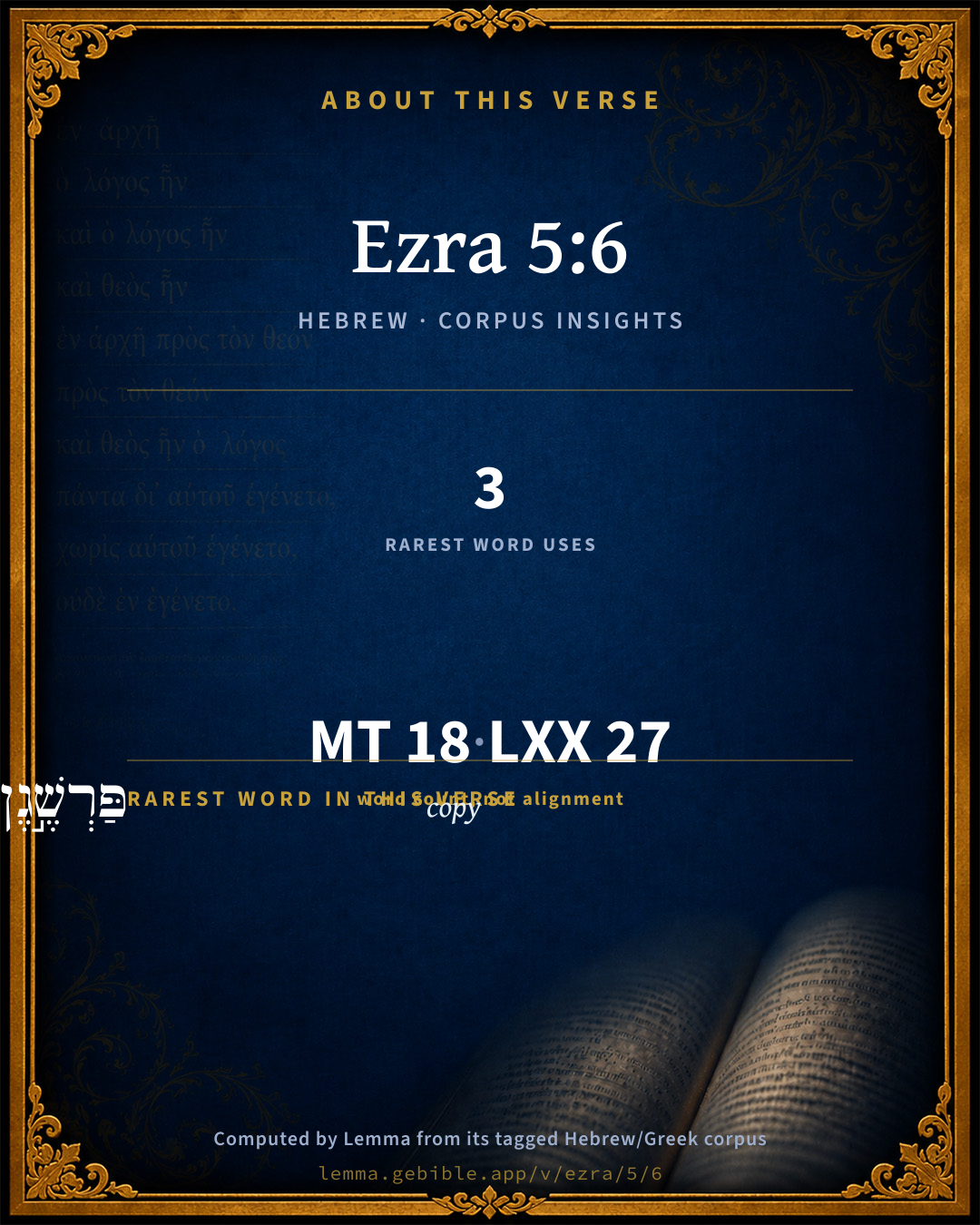
These counts appear in no published source. They are computed here, from the morphology-tagged text and Lemma’s own curated glosses. What Lemma adds →

18
words
14
distinct lemmas
Historical
section

Notable vocabulary

The rarest word here is פַּרְשֶׁ֣גֶן copy H6573 — appearing just 3 times in the whole Hebrew Bible.

Shared distinctive vocabulary

פַּרְשֶׁ֣גֶן copy H6573 occurs in 3 verses of the Hebrew Bible. Also found in:

Grammatical profile

  • 3 nouns
  • 10 adjectives
  • 5 particles

Repetition

Words recur within this verse — often emphatic in Hebrew:

  • עֲבַֽר beyond H5675 ×2
  • נַהֲרָ֗ה river H5103 ×2
  • וּשְׁתַ֤ר Shethar-boznai H8370 ×2
  • דִּֽי which H1768 ×2

Hebrew & Septuagint length

In English translation the verse runs 29 words from the Hebrew and 36 from the Septuagint (LXX English) — closely comparable.

A rough comparison of the two English renderings, which tokenize alike — not a word-level alignment.

Word counts can differ between the Hebrew and the Greek without any difference in meaning — e.g. the Hebrew direct-object marker אֵת has no separate Greek word, and Greek often adds the article ὁ.

In the original languages it is 18 Hebrew tokens and 27 Greek tokens — but the two are counted differently (Hebrew bundles its prefixes and suffixes into one token; the Greek is in lemma form), so that isn’t a like-for-like length.

Cross-references

5

Topical passages linked to Ezra 5:6 in the Treasury of Scripture Knowledge — connected by theme and wording, ordered by reader-vote popularity; previews shown in the World English Bible.

  • Ezra 4:9 then [wrote] Rehum the chancellor, and Shimshai the scribe, and the rest of their companions, the Dinaites, and the Apharsathchites, the Tarpelites, the Apharsites, the Archevites, the Babylonians, the Shushanchites, the Dehaites, the Elamites,
  • Ezra 4:11 This is the copy of the letter that they sent to Artaxerxes the king: Your servants the men beyond the River, and so forth.
  • Ezra 4:23 Then when the copy of king Artaxerxes' letter was read before Rehum, and Shimshai the scribe, and their companions, they went in haste to Jerusalem to the Jews, and made them to cease by force and power.
  • Ezra 5:3 At the same time came to them Tattenai, the governor beyond the River, and Shetharbozenai, and their companions, and said thus to them, Who gave you a decree to build this house, and to finish this wall?
  • Ezra 6:6 Now therefore, Tattenai, governor beyond the River, Shetharbozenai, and your companions the Apharsachites, who are beyond the River, be you far from there:

Cross-references courtesy of OpenBible.info (CC BY 4.0).

Hebrew and Greek witnesses Masoretic Hebrew ↔ Greek Septuagint

The same verse in the two great witnesses to the Old Testament, shown verse-for-verse.

These are two independent witnesses, not word-aligned to each other, and the Septuagint is shown in lemma (dictionary) form.

Hebrew Ezra 5:6 Masoretic · Westminster Leningrad Codex

פַּרְשֶׁ֣גֶן אִ֠גַּרְתָּא דִּֽי שְׁלַ֞ח תַּתְּנַ֣י פַּחַ֣ת עֲבַֽר נַהֲרָ֗ה וּשְׁתַ֤ר בּוֹזְנַי֙ וּכְנָ֣וָתֵ֔הּ אֲפַ֨רְסְכָיֵ֔א דִּ֖י בַּעֲבַ֣ר נַהֲרָ֑ה עַל דָּרְיָ֖וֶשׁ מַלְכָּֽא

The copy of the letter that Tattenai, the governor beyond the River, and Shetharbozenai, and his companions the Apharsachites, who were beyond the River, sent to Darius the king;

World English Bible · Public Domain

Greek LXX Ezra 5:6 Septuagint · lemma form

διασάφησις ἐπιστολή ὅς ἀποστέλλω θανθαναι ὁ ἔπαρχος ὁ πέραν ὁ ποταμός καί σαθαρβουζανα καί ὁ σύνδουλος αὐτός αφαρσαχαῖοι ὁ ἐν ὁ πέραν ὁ ποταμός δαρεῖος ὁ βασιλεύς

the copy of a letter, which Thanthanai, the governor of the part on this side the river, and Satharbuzanai, and their fellow-servants the Apharsachaeans who were on this side of the river, sent to king Darius.

LXX2012 (modern English Septuagint) · Public Domain

In the Septuagint this is one book — Esdras B (2 Esdras): Ezra is chapters 1–10, Nehemiah 11–23.

Hebrew: Westminster Leningrad Codex (CC BY 4.0). Greek: Septuagint (public domain); English from LXX2012 (modern English Septuagint) (Public Domain). How the Septuagint differs from the Hebrew →

Commentary

Notes on Ezra 5:6 from classic Christian and Jewish commentators (each source and its license shown beneath its notes). The classic Christian expositions comment on the surrounding passage and are grouped to its opening verse, so a note may address several verses; the Jewish commentaries on the Tanakh (Rashi and others) are per-verse, so they appear only where the commentator wrote on this verse.

Lemma curates 59 commentaries, every one of them public domain or Creative Commons licensed, each selected and text-cleaned for this edition rather than reprinted as found. About our sources →

Trapp's Complete Commentary

John Trapp

Ezr 5:6 The copy of the letter that Tatnai, governor on this side the river, and Shetharboznai, and his companions the Apharsachites, which [were] on this side the river, sent unto Darius the king:

Ver. 6. The Apharsachites] That is, Persians, sent as deputies by the king of Persia, to see the peace kept, and good orders observed.

John Trapp, A Commentary or Exposition upon All the Books of the Old and New Testament (1647–1656) — public domain. Text from a community e-Sword module.

The Biblical Illustrator

Joseph S. Exell

Ezr_5:6-17

The copy of the letter that Tatnai.

The letter of the king concerning the work

This letter has three chief divisions.

I. The inquisition of the Persian authorities.

II. The reply of the Jewish leaders. It presents the following aspects of the work. That it was--

1. Not a mere human enterprise, but a Divine commission.

2. Not an innovation, but a restoration.

3. Not in a spirit of presumption and pride, but of obedience and humility.

4. Not in opposition to, but in conformity with, royal authority.

5. Not political, but religious in its character.

III. The appeal of the Persian authorities to the king. Conclusion: Two things we may well admire and imitate.

1. The fairness of the Persian officials.

2. The faithfulness of the Jewish leaders. (William Jones.)

We are the servants of the God of heaven and earth.

The supremacy of God

Consider:

I. The universal supremacy of God.

1. Its ground.

(1) The perfections of His being.

(2) All things were created by Him.

(3) All things are sustained by Him.

(4) The benefits He bestows upon us and especially our redemption by Christ.

2. Its extent.

(1) Throughout heaven.

(2) Throughout earth.

(3) Throughout hell (2Pe_2:4).

II. The great obligation of men to obey Him. Our obedience should be--

1. Complete.

2. Perpetual.

3. Hearty.

4. Joyous.

III. The exalted privilege of men. When the service of God is rightly estimated, it is regarded as a glory and rejoiced in as a privilege. (William Jones.)

But after that our fathers had provoked the God of heaven.--

Arguments against sinning

In this verse we have three weighty reasons against abstaining from sin.

I. It provokes god. This will be more impressively realised if we reflect that He is a being of--

1. Infinite purity.

2. Infinite patience.

II. It deprives the sinner of his protection.

III. It strips the sinner of power to battle with his foes. Guilt robs a man of courage. The consciousness of right action in a righteous cause is the mightiest inspiration in conflict and the surest defence in peril. (William Jones.)

.

The Biblical Illustrator, edited by Joseph S. Exell (c. 1880s–1900s) — public domain. Text from a community e-Sword module.

Keil & Delitzsch

C. F. Keil & F. Delitzsch

In Ezr 5:6-17 follows the letter which the royal officials sent to the king. Ezr 5:6 and Ezr 5:7 form the introduction to this document, and correspond with Ezr 5:8-11 in Ezra 4. Copy of the letter (comp. Ezr 4:11) which Tatnai, etc., sent. The senders of the letter are, besides Tatnai, Shethar-Boznai and his companions the Apharsachites, the same called Ezr 4:9 the Apharsathchites, who perhaps, as a race specially devoted to the Persian king, took a prominent position among the settlers in Syria, and may have formed the royal garrison. After this general announcement of the letter, follows the more precise statement: They sent the matter to him; and in it was written, To King Darius, much peace. פּתגּן here is not command, but matter; see above. כלּא, its totality, is unconnected with, yet dependent on שׁלמא: peace in all things, in every respect. The letter itself begins with a simple representation of the state of affairs (Ezr 5:8): "We went into the province of Judaea, to the house of the great God (for so might Persian officials speak of the God of Israel, after what they had learned from the elders of Judah of the edict of Cyrus), and it is being built with freestone, and timber is laid in the walls; and this work is being diligently carried on, and is prospering under their hands." The placing of wood in the walls refers to building beams into the wall for flooring; for the building was not so far advanced as to make it possible that this should be said of covering the walls with wainscotting. The word אספּרנא here, and Ezr 6:8, Ezr 6:12-13; Ezr 7:17, Ezr 7:21, Ezr 7:26, is of Aryan origin, and is explained by Haug in Ew. Janro. v. p. 154, from the Old-Persian us-parna, to mean: carefully or exactly finished-a meaning which suits all these passages.

Keil & Delitzsch — Biblical Commentary on the Old Testament (1861–1891) — public domain (CC PDM 1.0). Text via the HelloAO Bible API. (Old Testament only.)

Tyndale Open Study Notes

Tyndale Open Resources

5:6-17 Ezra includes a copy in Aramaic of Tattenai’s letter to King Darius. Unlike the letter of 4:11-16, this letter was a straightforward inquiry into the validity of the Jews’ activity.

5:6 other officials: A Persian term for inspectors or investigators.

Tyndale Open Study Notes — © Tyndale Open Resources, licensed CC BY-SA 4.0. Text via the HelloAO Bible API.

Ellicott's Commentary for English Readers

(6) The copy of the letter.—This letter of Tatnai is introduced much in the same way as Helium’s; but its dispassionateness and good faith are in striking contrast with the latter.

Apharsachites.—Probably here the same as the Apharsites before, and suggesting some kind of Persian guard. But the reason of their introduction specifically here is obscure.

A Bible Commentary for English Readers, edited by Charles John Ellicott (1878–1897) — public domain. Text from a community e-Sword module.

The Cambridge Bible for Schools and Colleges

gen. ed. J. J. S. Perowne

6. Tatnai, the governor on this side the river] R.V. Tattenai, the governor beyond the river, and Shethar-bozenai. See note on Ezr_5:3.

the Apharsachites, which were on this side the river] R.V. the Apharsachites which were beyond the river. Who the Apharsachites of the ‘Abhar Nahara’ were is not known. Possibly the same as the ‘Apharsathcites’ of chap. Ezr_4:9 (where see note), represented officially by Shethar-bozenai, whose companions they are called.

The Cambridge Bible for Schools and Colleges (gen. ed. J. J. S. Perowne; Cambridge University Press, 1878–1918) — public domain. Text from a community e-Sword module.

John Gill's Exposition

The copy of the letter that Tatnai, governor on this side the river, and Shetharboznai, and his companions the Apharsachites, which were on this side the river,.... Which is thought by some to be one of the nations mentioned, Ezr 4:9 the name being pretty near alike to two of them; but perhaps might be a distinct colony in those parts Tatnai was governor of:

these sent unto Darius the king; and is as follows.

John Gill's Exposition of the Whole Bible (1746–1763) — public domain (CC PDM 1.0). Text via the HelloAO Bible API.

Albert Barnes' Notes on the Bible

Apharsachites, like Apharsites, and Apharsathchites Ezr 4:9, are thought by some to be forms of the word “Persians,” which is applied here generally to the foreign settlers in Samaria. (Others identify the first and the third names with the “Paretaceni,” a people on the Medo-Persian border.)

Albert Barnes' Notes on the Bible (1834–1885) — public domain. Text from a community e-Sword/MySword module.

Matthew Poole's English Annotations

The Apharsachites; a people so called, sent hither as a colony. As the other people, mentioned Ezr 4:9 they seem to have had a greater power with Rehum and Shimshai that with these new officers, who made choice of other companions.

Which were on this side the river, whereby they are distinguished from those of their brethren who yet continued in their native country beyond the river, and were not transplanted hither.

Matthew Poole's English Annotations on the Holy Bible (1683–1685) — public domain. Text from a community e-Sword/MySword module.

Whedon's Commentary on the Bible

Daniel D. Whedon

6. The Apharsachites — This one tribe and class of the colonists are here put for all those mentioned in Ezr_4:9, just as the Hittites are apparently named for all the Canaanites in Jos_1:4. See note there.

Daniel D. Whedon (gen. ed.), Commentary on the Old and New Testaments (1874–1909) — public domain. Text from a community e-Sword module.

The Pulpit Commentary

The Apharsachites recall the "Apharsites" and the "Apharsathchites" of Ezr_4:9. Possibly all the three forms are provincial variants of the more correct Parsaya, which appears in Dan_6:28 as the Chaldaean equivalent of Persian. " Here the Apharsachite "companions" of Tatnai and Shethar-boznai are perhaps the actual Persians who formed their body-guard and their train.

HOMILIES BY J.A. MACDONALD Vers. 6-17.

The letter to Darius.

The occasion of this letter was the resumption of the work of rebuilding the temple of the Lord at Jerusalem after an interval of sixteen years. The authors of it are Tatnai, the governor, probably of all the provinces west of the Euphrates, and Shethar-boznai, who may have been the scribe or secretary associated with him, as Shimshai was with Rehum. (see Ezr_4:8) Or possibly Shethar-boznai was the leading man of the Apharsachites; for these are mentioned as more particularly "his companions." The Apharsachites probably called the attention of Tatnai to the matter, who attended to it in a spirit of fairness which favourably contrasts with the conduct of the former leaders of these instigators (see ch. 4.). Having authenticated the letter, the writers proceed to state

I WHAT THEY DID.

1. They surveyed the building.

(1) They describe it as "the house of the great God. The renown of his wonderful works in Egypt, in the wilderness, in Canaan had filled the world. They were judgments upon the little gods of the nations. (see Exo_8:10 Exo_9:14 Exo_12:12 Exo_18:12; Num_33:4)

(2) They noted the importance of the building. "Great stones". (Luk_21:5, Luk_21:6) "Timber laid in the walls." Beams of cedars from Lebanon. All work for God should be nobly done.

(3) They also noted the rapid progress of the work.

2. They interrogated the elders.

(1) Who commanded you to build this house? This question is radical. Not, Who hath authorised you to resume the building? but, Who authorised the commencement of the work?

(2) By whose authority do you "make up this wall"? Probably referring to their repairing of breaches in it made by the "people of the land" (see ch. 3:23).

(3) "What are the names" of the chiefs? Those who work for God with his approval need not fear the scrutiny of inquisitors.

II WHAT THEY LEARNED.

1. That the builders professed themselves servants of the God of heaven and earth.

(1) What a glorious Being!

(2) What a noble service! Query Are we his servants? This honour not limited now to Israelites It is common to all true builders of the spiritual temple.

2. That they were engaged in no novel business.

(1)"we build the house that was builded these many years ago." About five centuries had elapsed. But even Solomon"s temple replaced the tabernacle which had been set up about five centuries still earlier. True religion may have external changes, but remains essentially the same.

3. That its ruin was occasioned by the rebellion of their fathers.

(1) God gave it up to desolation. The outward splendours of religion are nothing to him when the spirit of it is dead. (see Mat_23:37 Mat_24:1, Mat_24:2) The temple of Solomon in ruins was a fit emblem of humanity degraded by sin.

(2) Guilt is hereditary. "Our fathers had provoked," etc. They suffered; we suffer.

4. That the building is in process of restoration.

(1) "In the first year of Cyrus." Memorable for the termination of the seventy years of Jeremiah (2Ch_36:21; Jer_25:11, Jer_25:12; Dan_9:2) In this memorable year "the king made a decree," etc.

(2) Vessels of the house also restored. These had been desecrated "in the temple of Babylon." This was the temple of Belus or Bel. This desecration of the vessels a figure of the condition of backsliders from God. (see Act_9:15; Rom_9:22; 2Ti_2:21)

5. The prominent place occupied by Sheshbazzar.

(1) Cyrus trusted him with the custody of the sacred treasure. Made him governor. He was of the seed royal of Judah.

(2) His people honoured him. He laid the foundation-stone. Conducts the work.

(3) Type of Christ.

III THE RECOMMENDATION.

1. To test the question as to whether Cyrus authorised the work as alleged.

Nothing to object to the fairness of this. It could only prejudice the Jews if found untrue.

2. To signify the kings pleasure to his servants that they might carry it out. It were well if all who oppose God"s people were as reasonable as Tatnai. Opponents so honest and free from prejudice may have the honour, like Tatnai, of promoting the work of God. J.A.M. (see Ezr_6:13)

The Pulpit Commentary (1880–1919), ed. H.D.M. Spence-Jones & Joseph S. Exell — public domain. Text from a community e-Sword module.

Kretzmann's Popular Commentary

Paul E. Kretzmann

The Letter of Inquiry Directed To Darius—

v. 6. The copy of the letter that Tatnai, governor on this side the river, on the western side of the Euphrates, and Shetharboznai and his companions, the Apharsachites, the lower officials, which were on this side the river, sent unto Darius the king;

v. 7. they sent a letter unto him, they made a report of their investigation as carried on till then, wherein was written thus: Unto Darius the king, all peace!

v. 8. Be it known unto the king that we went into the province of Judea, the smaller subdivision of Tatnai’s satrapy, to the house of the great God, which is builded with great stones, literally, "with stones of rolling," since they were so large that they had to be rolled or dragged along the ground, and timber is laid in the walls, and this work goeth fast on and prospereth in their hands, the Jews were making fine headway in the construction of their Temple.

v. 9. Then asked we those elders and said unto them thus, Who commanded you to build this house and to make up these walls? Cf v. 4.

v. 10. We asked their names also to certify thee, to give all the information which the king might desire, that we might write the names of the men that were the chief of them.

v. 11. And thus they returned us answer, saying, We are the servants of the God of heaven and earth, the one whom they considered not only the highest, but the only true God, and build the house that was builded these many years ago, rebuilding the Temple of Solomon, which a great king of Israel builded and set up, 1Ki 6:1.

v. 12. But after that our fathers had provoked the God of heaven unto wrath, as it is so abundantly shown in the Books of the Kings and of Chronicles, 2Ch 36:16-17, he gave them into the hand of Nebuchadnezzar, the king of Babylon, the Chaldean, who destroyed this house and carried the people away into Babylon, 2Ki 24:2; 2Ki 25:8-11.

v. 13. But in the first year of Cyrus, the king of Babylon, the same King Cyrus made a decree to build this house of God, Ezr 1:1.

v. 14. And the vessels also of gold and silver of the house of God which Nebuchadnezzar took out of the Temple that was in Jerusalem and brought them into the Temple of Babylon, 2Ch 36:7-18, those did Cyrus the king take out of the Temple of Babylon, and they were delivered unto one, whose name was Sheshbazzar, whom he had made governor, rather, deputy;

v. 15. and said unto him, Take these vessels, go, carry them into the Temple that is in Jerusalem, and let the house of God be builded in his place. So the fact that Cyrus himself had expressly ordered the building of the Temple was strongly brought out.

v. 16. Then came the same Sheshbazzar and laid the foundation of the house of God which is in Jerusalem; and since that time even until now hath it been in building, and yet it is not finished. Tatnai probably included this in his report from the appearance of things in Jerusalem, since the Temple area had been in use all these years, even though actual building operations had ceased.

v. 17. Now, therefore, if it seem good to the king, let there be search made in the king’s treasure-house, which is there at Babylon, for the royal archives, where important state documents were kept, were a part of this treasure-house, whether it be so that a decree was made of Cyrus the king to build this house of God at Jerusalem, and let the king send his pleasure to us concerning this matter, render his opinion or decision. The mighty God of heaven and earth has also the powerful ones of the earth in His hand, guiding their hearts as the rivers of water and causing them to grant such liberties to the Church that it may continue its work of spreading the Gospel throughout the world.

Paul E. Kretzmann, Popular Commentary of the Bible (1921–1924) — public domain. Text from a community e-Sword module.

unfoldingWord translationNotes

Door43 World Missions Community

This is a copy of the letter

Ezra includes the contents of the letter to King Darius regarding their work on the temple.

the Province Beyond the River

This is the name of the province that was west of the Euphrates River. It was across the river from the city of Susa. See how you translated this in Esra 4:10. (See: How to Translate Names)

translationWords

Darius

king

peace

unfoldingWord translationNotes — © Distant Shores Media and the Door43 World Missions Community, licensed CC BY-SA 4.0. Source: git.door43.org/Door43/en_tn.

Rashi

Rabbi Shlomo Yitzchaki (Rashi)

The interpretation the interpretation of the text of the letter.

and his companies [as translated,] and his companies.

the Apharsechites They are one nation that was in their companies.

to King Darius Aram. עַל דָּרְיָוֶשּׁ מַלְכָּא, lit. on King Darius.

Rashi on the Tanakh — English translations: “The Judaica Press complete Tanach with Rashi, translated by A. J. Rosenberg” (CC BY 4.0); “Pentateuch with Rashi's commentary by M. Rosenbaum and A.M. Silbermann, 1929-1934” (public domain); “The Metsudah Tanach series, Lakewood, N.J” (CC BY 4.0); and “The Book of Joshua, Metsudah Publications, 1997” (CC BY 4.0). Text via Sefaria.

Lesson kit

Teaching starters — assembled from the data on this page, not authored interpretation. Every prompt links to the verse data it draws on. Edit before teaching.

Ezra, in the Historical, opens this verse with 18 words (14 distinct Hebrew lemmas). Its most distinctive word is parshegen (“copy”). A historical commentator’s framing appears above. Read the whole chapter for the surrounding context.

Discussion questions

  1. How does “copy” (parshegen) shape what this verse is saying?
  2. How does Ezra 4:11, which shares the word «copy», read alongside this verse?
  3. What does the repetition of “beyond” (2× in this one verse) do in this verse?
  4. These translations render this verse differently; the difference is in the English rendering, not the original. What questions does that raise?
  5. Compare how Trapp's Complete Commentary and The Biblical Illustrator read this verse. Where do they agree or differ?

Things to notice

Reading settings

Reading text

Shown beneath each verse's original-language words.

Old Testament
Old Testament edition

Read the OT as the Masoretic Hebrew (MT) or the Greek Septuagint (LXX).

English shown for the Greek Septuagint (in the Hebrew ↔ Greek comparison).

Comparing translations? Open the Compare panel on any verse page to stack up to four side by side.