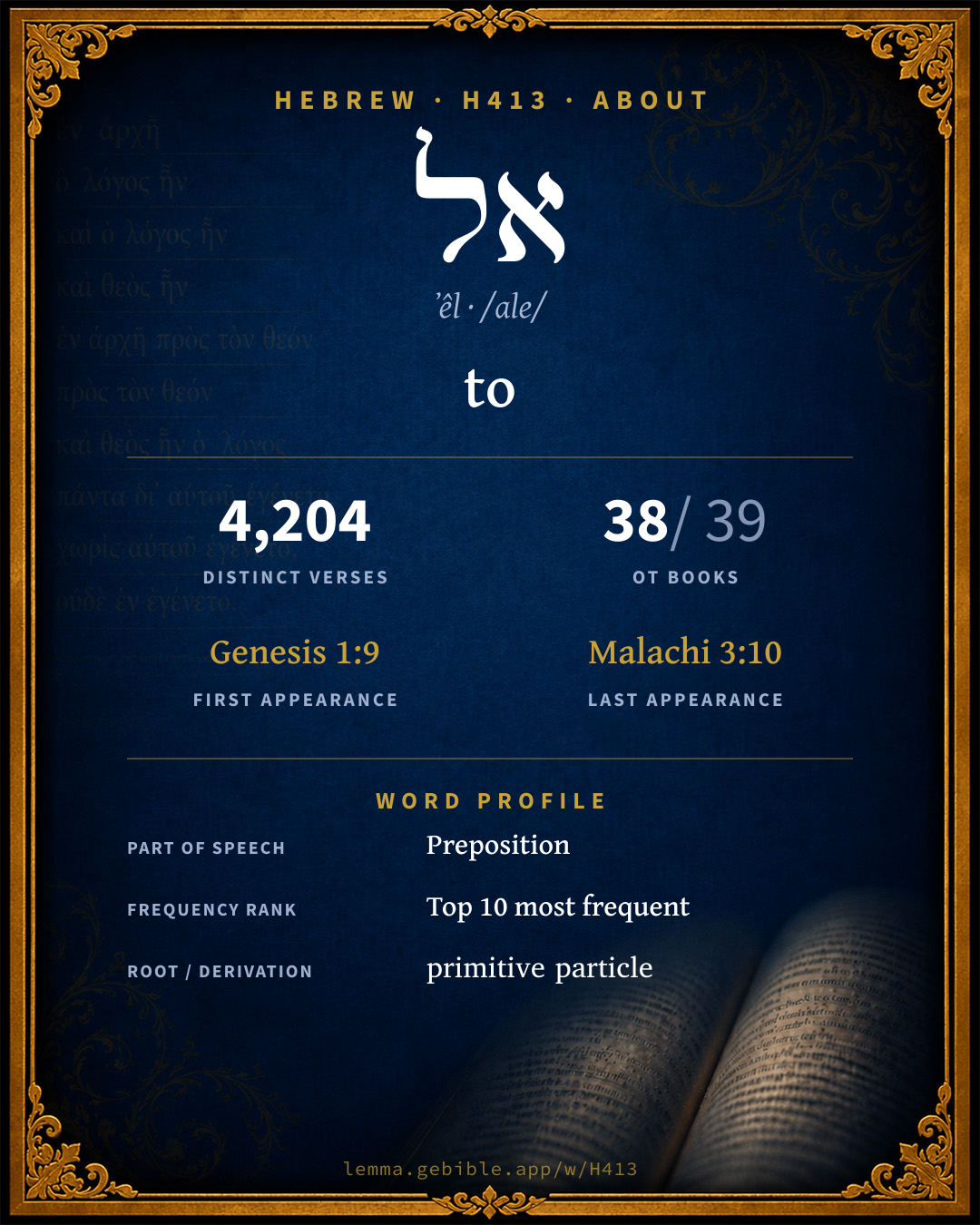
אֶל
to
also: toward, unto fuller range ↓
Full lexicon entry — Brown-Driver-Briggs (BDB)
From Brown-Driver-Briggs (BDB)
Where this word appears
Grammar key — what these labels mean
Part of speech
- Preposition
- A relational word (e.g. “in,” “to,” “from”) governing a noun.
- Particle
- A short function word — article, negation, interrogative, the sign of the direct object, and the like.
Every verse where H413 appears in the Book of Nehemiah — 48 distinct verses. Click any verse to open its interlinear word-by-word view. Verse text shown in the World English Bible for context — . Each verse’s Hebrew form is shown with its reference; the English is not keyword-highlighted, since the data carries no word-level English alignment. Use “Compare translations” on any verse to read it across multiple English versions. This concordance covers the Hebrew Bible; Septuagint (Greek Old Testament) occurrences are not indexed here.
Nehemiah
- Nehemiah 1:6 אֶל prep Let your ear now be attentive, and your eyes open, that you may listen to the prayer of your servant, which I pray before you at this time, day and night, for the children of Israel your servants while I confess the sins of the children of Israel, which we have sinned against you. Yes, I and my father's house have sinned:
- Nehemiah 1:9 אֵלַ֔/י אֶל prep + sfx pers 1cs prep but if you return to me, and keep my commandments and do them, though your outcasts were in the uttermost part of the heavens, yet will I gather them from there, and will bring them to the place that I have chosen, to cause my name to dwell there.
- Nehemiah 1:11 אֶל וְ/אֶל prep conj + prep Lord, I beg you, let now your ear be attentive to the prayer of your servant, and to the prayer of your servants, who delight to fear your name; and please prosper your servant this day, and grant him mercy in the sight of this man. Now I was cup bearer to the king.
- Nehemiah 2:4 אֶל prep Then the king said to me, For what do you make request? So I prayed to the God of heaven.
- Nehemiah 2:5 אֶל אֶל prep prep I said to the king, If it please the king, and if your servant have found favor in your sight, that you would send me to Judah, to the city of my fathers' tombs, that I may build it.
- Nehemiah 2:7 אֶל prep Moreover I said to the king, If it please the king, let letters be given me to the governors beyond the River, that they may let me pass through until I come to Judah;
- Nehemiah 2:8 אֶל אֵלָ֑י/ו prep prep + sfx pers 3ms and a letter to Asaph the keeper of the king's forest, that he may give me timber to make beams for the gates of the castle which appertains to the house, and for the wall of the city, and for the house that I shall enter into. The king granted me, according to the good hand of my God on me.
- Nehemiah 2:9 אֶֽל prep Then I came to the governors beyond the River, and gave them the king's letters. Now the king had sent with me captains of the army and horsemen.
- Nehemiah 2:11 אֶל prep So I came to Jerusalem, and was there three days.
- Nehemiah 2:12 אֶל prep I arose in the night, I and some few men with me; neither told I any man what my God put into my heart to do for Jerusalem; neither was there any animal with me, except the animal that I rode on.
- Nehemiah 2:13 וְ/אֶל וְ/אֶל conj + prep conj + prep I went out by night by the valley gate, even toward the jackal's well, and to the dung gate, and viewed the walls of Jerusalem, which were broken down, and the gates of it were consumed with fire.
- Nehemiah 2:14 אֶל וְ/אֶל prep conj + prep Then I went on to the spring gate and to the king's pool: but there was no place for the animal that was under me to pass.
- Nehemiah 2:17 אֲלֵ/הֶ֗ם prep + sfx pers 3mp Then said I to them, You see the evil case that we are in, how Jerusalem lies waste, and the gates of it are burned with fire: come, and let us build up the wall of Jerusalem, that we be no more a reproach.
- Nehemiah 4:4 אֶל prep Hear, our God; for we are despised: and turn back their reproach on their own head, and give them up for a spoil in a land of captivity;
- Nehemiah 4:9 אֶל prep But we made our prayer to our God, and set a watch against them day and night, because of them.
- Nehemiah 4:11 אֶל prep Our adversaries said, They shall not know, neither see, until we come into the midst of them, and kill them, and cause the work to cease.
- Nehemiah 4:14 אֶל וְ/אֶל וְ/אֶל prep conj + prep conj + prep I looked, and rose up, and said to the nobles, and to the rulers, and to the rest of the people, Don't be you afraid of them: remember the Lord, who is great and awesome, and fight for your brothers, your sons, and your daughters, your wives, and your houses.
- Nehemiah 4:15 אֶל אֶל prep prep It happened, when our enemies heard that it was known to us, and God had brought their counsel to nothing, that we returned all of us to the wall, everyone to his work.
- Nehemiah 4:19 אֶל וְ/אֶל וְ/אֶל prep conj + prep conj + prep I said to the nobles, and to the rulers and to the rest of the people, The work is great and large, and we are separated on the wall, one far from another:
- Nehemiah 4:20 אֵלֵ֑י/נוּ prep + sfx pers 1cp in whatever place you hear the sound of the trumpet, resort you there to us; our God will fight for us.
- Nehemiah 5:1 אֶל prep Then there arose a great cry of the people and of their wives against their brothers the Jews.
- Nehemiah 5:17 אֵלֵ֛י/נוּ prep + sfx pers 1cp Moreover there were at my table, of the Jews and the rulers, one hundred fifty men, besides those who came to us from among the nations that were round about us.
- Nehemiah 6:2 אֵלַ֣/י prep + sfx pers 1cs that Sanballat and Geshem sent to me, saying, Come, let us meet together in [one of] the villages in the plain of Ono. But they thought to do me mischief.
- Nehemiah 6:3 אֲלֵי/כֶֽם prep + sfx pers 2mp I sent messengers to them, saying, I am doing a great work, so that I can't come down: why should the work cease, while I leave it, and come down to you?
- Nehemiah 6:4 אֵלַ֛/י prep + sfx pers 1cs They sent to me four times after this sort; and I answered them after the same manner.
- Nehemiah 6:5 אֵלַ֨/י prep + sfx pers 1cs Then sent Sanballat his servant to me in like manner the fifth time with an open letter in his hand,
- Nehemiah 6:8 אֵלָי/ו֙ prep + sfx pers 3ms Then I sent to him, saying, There are no such things done as you say, but you feign them out of your own heart.
- Nehemiah 6:10 אֶל אֶל prep prep I went to the house of Shemaiah the son of Delaiah the son of Mehetabel, who was shut up; and he said, Let us meet together in the house of God, within the temple, and let us shut the doors of the temple: for they will come to kill you; yes, in the night will they come to kill you.
- Nehemiah 6:11 אֶל prep I said, Should such a man as I flee? and who is there that, being such as I, would go into the temple to save his life? I will not go in.
- Nehemiah 6:17 אֲלֵי/הֶֽם prep + sfx pers 3mp Moreover in those days the nobles of Judah sent many letters to Tobiah, and [the letters] of Tobiah came to them.
- Nehemiah 7:5 אֶל prep My God put into my heart to gather together the nobles, and the rulers, and the people, that they might be reckoned by genealogy. I found the book of the genealogy of those who came up at the first, and I found written therein:
- Nehemiah 8:1 אֶל prep All the people gathered themselves together as one man into the broad place that was before the water gate; and they spoke to Ezra the scribe to bring the book of the law of Moses, which Yahweh had commanded to Israel.
- Nehemiah 8:3 אֶל prep He read therein before the broad place that was before the water gate from early morning until midday, in the presence of the men and the women, and of those who could understand; and the ears of all the people were [attentive] to the book of the law.
- Nehemiah 8:13 אֶל אֶל prep prep On the second day were gathered together the heads of fathers' [houses] of all the people, the priests, and the Levites, to Ezra the scribe, even to give attention to the words of the law.
- Nehemiah 9:4 אֶל prep Then stood up on the stairs of the Levites, Jeshua, and Bani, Kadmiel, Shebaniah, Bunni, Sherebiah, Bani, [and] Chenani, and cried with a loud voice to Yahweh their God.
- Nehemiah 9:16 אֶל prep But they and our fathers dealt proudly and hardened their neck, and didn't listen to your commandments,
- Nehemiah 9:23 אֶל prep Their children also multiplied you as the stars of the sky, and brought them into the land concerning which you did say to their fathers, that they should go in to possess it.
- Nehemiah 9:26 אֵלֶ֑י/ךָ prep + sfx pers 2ms Nevertheless they were disobedient, and rebelled against you, and cast your law behind their back, and killed your prophets that testified against them to turn them again to you, and they committed awful blasphemies.
- Nehemiah 9:27 אֵלֶ֔י/ךָ prep + sfx pers 2ms Therefore you delivered them into the hand of their adversaries, who distressed them: and in the time of their trouble, when they cried to you, you heard from heaven; and according to your manifold mercies you gave them saviors who saved them out of the hand of their adversaries.
- Nehemiah 9:29 אֶל prep and testified against them, that you might bring them again to your law. Yet they dealt proudly, and didn't listen to your commandments, but sinned against your ordinances, (which if a man do, he shall live in them), and withdrew the shoulder, and hardened their neck, and would not hear.
- Nehemiah 9:34 אֶל prep neither have our kings, our princes, our priests, nor our fathers, kept your law, nor listened to your commandments and your testimonies with which you did testify against them.
- Nehemiah 10:28 אֶל prep The rest of the people, the priests, the Levites, the porters, the singers, the Nethinim, and all those who had separated themselves from the peoples of the lands to the law of God, their wives, their sons, and their daughters, everyone who had knowledge, and understanding;
- Nehemiah 10:37 אֶל prep and that we should bring the first fruits of our dough, and our heave-offerings, and the fruit of all manner of trees, the new wine and the oil, to the priests, to the chambers of the house of our God; and the tithes of our ground to the Levites; for they, the Levites, take the tithes in all the cities of our tillage.
- Nehemiah 10:38 אֶל prep The priest the son of Aaron shall be with the Levites, when the Levites take tithes: and the Levites shall bring up the tithe of the tithes to the house of our God, to the chambers, into the treasure-house.
- Nehemiah 10:39 אֶל prep For the children of Israel and the children of Levi shall bring the heave-offering of the grain, of the new wine, and of the oil, to the chambers, where are the vessels of the sanctuary, and the priests who minister, and the porters, and the singers: and we will not forsake the house of our God.
- Nehemiah 11:25 וְ/אֶל conj + prep As for the villages, with their fields, some of the children of Judah lived in Kiriath Arba and the towns of it, and in Dibon and the towns of it, and in Jekabzeel and the villages of it,
- Nehemiah 13:6 אֶל prep But in all this [time] I was not at Jerusalem; for in the two and thirtieth year of Artaxerxes king of Babylon I went to the king: and after certain days asked I leave of the king,
- Nehemiah 13:21 אֲלֵי/הֶם֙ prep + sfx pers 3mp Then I testified against them, and said to them, Why lodge you about the wall? if you do so again, I will lay hands on you. From that time forth came they no more on the Sabbath.
About this entry
At a glance — auto-summarized from this page’s data, not written by a person. Every figure links to its source below. This summary describes the numbers; it doesn’t interpret them.
“to” is the headline sense of the Hebrew preposition אל (ʼêl). Beyond “to” it also covers “toward” and “unto” — see its full sense range. With 4,204 verses in 38 books, it is one of the most common word in the Hebrew Bible. First canonically at Genesis 1:9, it enters the text early. It clusters with אליהועיני under a shared root. See the sense tree, 4,204-verse concordance, and the renderings breakdown below.
Gloss history
Strong's 1890 vs modern scholarship

About this word
Strong's H413 catalogs a Hebrew word from the Hebrew Old Testament.
These counts are not copied from any lexicon or concordance. They are computed here, from the morphology-tagged Hebrew Old Testament. What Lemma adds →
- 4,204
- distinct verses
- The word appears in 4,204 distinct verses.
- 38 / 39
- OT books
- The word appears in 38 of 39 Old Testament books.
- #4
- by frequency
- Top 10 most frequent Hebrew words (rank 4 of 8,640 Hebrew words by occurrence).
View all 4,204 occurrences in the concordance →
By section of the Old Testament
By traditional corpus
Conventional, traditional groupings — biblical authorship is debated, so this is a traditional corpus grouping, not an authorship claim. Each share is this word’s portion of its verses in that division of the Hebrew canon. Each figure is a share of the word’s 4,204 distinct verses.
- Prophets (Nevi'im) 2,341 verses · 56%
- Torah (Pentateuch) 1,300 verses · 31%
- Writings (Ketuvim) 563 verses · 13%
How translations render this word
Counts come from each version’s own published word-to-Strong’s tagging or interlinear alignment — an approximate guide to how each version renders this word, not a word-level alignment the data otherwise carries. Because each total is that version’s own tagged count, the per-version totals vary from one another and need not match the appearance or distinct-verse counts above. These counts may also differ from a printed concordance because Lemma counts each distinctly tagged rendering and does not collapse phrase taggings into a single head-word total. This is a fixed set of word-tagged versions (KJV, ASV, BSB, ULT) and does not change with the reading translation you choose elsewhere. Each version’s license is shown beside its name below (and on Sources).
- King James Version: Because 2×, For 2×, In 2×
- American Standard Version: In 3×, To 3×, Unto 3×
- Berean Standard Bible: To 2,001×, Me 343×, You 214×
- unfoldingWord Literal Text: To 2,791×, Him 374×, Me 349×
King James Version Public Domain
Renders H413 across 38 tagged occurrences — most commonly:
Plus 32 renderings that appear only once — usually multi-word phrases or single function words the recovered tagging swept in, not distinct renderings.
American Standard Version Public Domain
Renders H413 across 39 tagged occurrences — most commonly:
Plus 26 renderings that appear only once — usually multi-word phrases or single function words the recovered tagging swept in, not distinct renderings.
Berean Standard Bible Public Domain
Renders H413 across 4,199 tagged occurrences — most commonly:
Plus other, less common renderings. Plus 172 renderings that appear only once — usually multi-word phrases or single function words the recovered tagging swept in, not distinct renderings. Not rendered by a distinct English word in 1,299 further occurrences.
unfoldingWord Literal Text CC BY-SA 4.0
Renders H413 across 5,255 tagged occurrences — most commonly:
Plus other, less common renderings. Plus 133 renderings that appear only once — usually multi-word phrases or single function words the recovered tagging swept in, not distinct renderings.
7 senses and sub-senses in the full BDB
What do BDB’s symbols mean?
BDB uses these scholarly abbreviations:
| Symbol | Meaning |
|---|---|
| 𝔊 | the Septuagint (the ancient Greek translation, LXX) |
| 𝔙 | the Vulgate (the Latin translation) |
| 𝔖 | the Syriac version (the Peshitta) |
| 𝔗 | the Targum (the Aramaic translation) |
| ψ | the Psalms |
| √ | root (the underlying root or stem) |
| ‖ | parallel passage (a synonymous or contrasted parallel) |
| † | the dagger: every passage where the word occurs is cited |
The 7 senses and sub-senses the full Brown-Driver-Briggs lexicon distinguishes for this word, in lexicon order (not ranked by frequency), with BDB’s own verbatim wording and sub-sense lettering. Shown in Hebrew script with BDB’s own scholarly abbreviations. The condensed entry is in the Lexicon Entry tab. See also the Forms in the corpus table below.
- 1. of motion to or unto a person or place Gn 2:19, 22; 3,19; 8:9; 14:22; 16;9 etc., after every kind of verb expressing motion (בּוֹא, הָלַךְ, יָצָא, etc.) So with נָתַן to give (though ל is here more common) Gn 21:14; 35:4 Dt 13:2 +; מָכַר to sell Gn 37:36, etc. Metaph. Je 2:19 וְלֹאפַחְדָּתִי אֵלַיִךְ and that my fear (cometh) not unto thee (cf. Jb 31:23).—Peculiarly Gn 6:16 אֶל אַמָּה unto the length of a cubit, etc. And metaph. in the phrase אֶל־(אֱלֵי־)גִּיל unto exultation †Ho 9:1 Jb 3:22. Once, exceptionally (si vera l.) = even: Jb 5:5 וְאֶל־מִצִּנִּים יִקָּחֵהוּ and even out of thorns he taketh it. Sometimes pregnant, as Is 66:17 Je 41:7 זָנָה אֶל commit whoredom (by going) to Nu 25:1 Ez 16:26, 28, 29; דָּרַשׁ אֶל seek (by resorting) to one (sc. for oracles) Dt 18:11 Is 8:19; 11:10 +; חָבַר אֶל join together (& come) unto Gn 14:3; הִשְׁכִּים אֶל rise early (and go) to 19:27; 24:11 הִבְרִיךְ אֶל made to kneel down at; 47:18 תַּם אֶל i.e. has been made over to; פָּחַד אֶל to come in fear to Hos 3:5 Mi 7:17. Opp. is מִן, as מִן־הַקָּצֶה אֶל־הַקָּצֶה from end to end Ex 26:28; מִפֶּה אֶל־פֶּה Ezr 9:11 (syn. 2 K 21:16 פֶּה לָפֶה). And of time (rare) מֵעֵת אֶל־עֵת †1 Ch 9:25; מִיּוֹם אֶל־יוֹם †Nu 30:15 (P) 1 Ch 16:23 (in the ‖ ψ 96:2 מִיּוֹם לְיוֹם). e.g. Genesis 2:19
- 2. Where the limit is actually entered, into, Gn 6:18 and thou shalt enter into the ark 7:1; 19:3; 41:21; 42:17; & so after verbs of throwing, casting, putting 37:22 (הִשְׁלִיךְ) 39:20 וַיִּתְּנֵהוּ אֶל־בֵּית הַסֹּהַר put him into the prison house, Ex 28:30 (Lv 8:8) Dt 23:25; so after קָבַר to bury Gn 23:19; 25:9; 49:29; שָׂחַט to squeeze 40:11; מָחָה to blot out Nu 5:23, etc.; metaph. Gn 6:6 was pained into or unto his heart, שָׂם אֶל־לֵב, הֵשִׁיב to place, bring into (= lay to) heart Dt 4:39 2 S 19:20 al. In connexion with a number or multitude into which something enters, in among: 1 S 10:22 behold he had hid himself אֶל־הַכֵּלִים in among the baggage, Je 4:3 sow not אֶל־קֹצִים in among thorns. e.g. Genesis 6:18
- 3. Of direction towards anything: (a) of physical acts or states, as Gn 30:40 נָתַן פְּנֵי הַצֹּאן אֶל, 39:7 נָשָׂא עֵינָיו אֶל, Ex 25:20, Nu 6:26 נָשָׂא פָנָיו אֶל (2 K 9:32 differently), 24:1 שָׁת פָּנָיו אֶל, Jos 8:18 ψ 28:2 1 K 8:29, 30 (to pray towards) v 38; pregn. חָרַד אֶל to tremble (turning) to Gn 42:28, תָּמַהּ אֶל to wonder (turning) towards Gn 43:33; Is 13:8, פָּחַד אֶל Je 36:16: without a vb. פָּנִים אֶל־פָּנִים face to face Gn 32:31 +; פֶּה אֶל־פֶּה Nu 12:8; כִּי־אֵינֶנּוּ אֵלַי Gn 31:5 the face of Laban, that he is not toward me; עֵינֵי י׳ אֶל־פ׳ the eyes of י׳ are towards … ψ 34:16 (cf. 33:18). (b) with words such as אָמַר to say to Gn 3:1 + often, דִּבֶּר 8:15 + often, קָרָא 19:5, הִחְפַּלֵּל 20:17 etc., שָׁמַע to hearken to 16:11, הִלֵּל to praise to 12:15 (cf. Ez 13:19 חִלֵּל אֶל to profane to), הִזְכִּיר 40:14. (c) with words expressing the direction of the mind, as קִוָּה to wait ψ 27:14 +; יִחַל to hope Is 51:5; נָשָׂא נֶפֶשׁ אֶל to lift up the soul (i.e. set the desire) towards Dt 24:15 ψ 25:1; שָׂם לֵב אֶל, שָׁת to set the heart (mind) to Ex 9:21 al.; לָמַד אֶל to accustom oneself to Je 10:2; חָרַד אֶל to shew thought for 2 K 4:13; Gn 43:30; Dt 28:32 and thy eyes כָּלוֹת אֲלֵיהֶם failing (with longing) towards them, La 4:17; Is 63:15 2 S 3:8 1 K 14:13 ψ 40:6; alone, as predic., directed or disposed towards, Gn 3:16; 4:7 2 K 6:11 who of ours is towards (i.e. favours) the king of Syria? Ho 3:3 וְגַם־אֲנִי אֵלָֽיִךְ׃ Ez 36:9 Ho 2:17 Je 15:1 (אֵין נַפְשִׁי אֶל). e.g. Genesis 30:40
- 4. Where the motion or direction implied appears from the context to be of a hostile character, אֶל = against: Gn 4:8 וַיָּקָם ק׳ אֶל־הֶבֶל and Cain rose up against Abel (so 1 S 24:8) 22:12 Ex 14:5 Nu 32:14; with נִקְבַּץ Jos 10:6, הָלַךְ Ju 1:10; 20:30; with בָּא of calamity, etc., coming to or upon any one Gn 42:21 Ju 9:57 1 S 2:34 1 K 14:10 +; Is 2:4; 3:8 their tongue and doings are אֶל־י׳ 32:6 (לְדַבֵּר אֶל) Ho 7:15 (cf. Na 1:9) 12:5 וַיָּשַׂר אֶל־מַלְאָךְ and he strove against the angel. Here also belongs in partic. the phrace הִנְנִי אֶל … Behold I am against (thee, you etc.) †Na 2:14; 3:5 Je 21:13 (23:30–32 על) 50:31; 51:25 Ez 13:8, 20; 21:8; 29:10; 30:22; 34:10; 35:3; 38:3; 39:1 (5:8; 26:3; 28:22; 29:3 על: on 36:9 v. supr.) e.g. Genesis 4:8
- 5. Unto sometimes acquires from the context the sense of in addition to, as Lv 18:18 thou shalt not take אִשָּׁה אֶל אֲחוֹתָהּ a woman to, in addition to, her sister, Jos 13:22 (‖ Nu 31:8 על; 1 S 14:34 to eat אֶל־הַדָּם together with the blood (v 32 & generally עַל); 1 K 10:7 הוֹסִיף אֶל (generally עַל); Je 25:26; Ez 7:26 שְׁמוּעָה אֶל שְׁמוּעָה (‖ על); 44:7; La 3:41 let us lift up לְבָבֵנוּ אֶל־כַּפָּ֑יִם our hearts together with the hands (cf. إِلَى, Qor 4:2; WAG ii. § 51 c). 6. Metaph. in regard to, concerning, on account of: thus הִתְאַבֵּל to mourn concerning 1 S 15:35; הִנָּחֵם to repent as regards 2 S 24:16; דָּרַשׁ to inquire 1 K 14:5; הִתְפַּלֵּל to pray with regard to 1 S 1:27 2 K 19:20 Is 37:21; צָעַק to cry 2 K 8:3 (v 5 על); נֶעֱצַב be pained 1 S 20:34; נִחַם to comfort 2 S 10:2; more gen. 1 K 16:13; 21:22; אֶל־נֶפֶשׁ on account of, for the sake of, one’s life 1 K 19:3 2 K 7:7 (Gn 19:17 על). (עַל is more common in this sense.) And specially with verbs of saying, narrating, telling, etc. with regard to, as אָמַר Gn 20:2 Is 29:22; 37:33 +; דִּבֶּר 2 S 7:19 Je 40:16b; סִפֵּר ψ 2:7; 69:27; צִוָּה Is 23:11; שָׁמַע Ez 19:4; הַשְּׁמוּעָה אֶל the report regarding … 1 S 4:19. (Not freq., except in the case of אָמַר.) 7. Of rule or standard, according to (rare): אֶל־פִּי … according to the command of, Jos 15:13; 17:4: 21:3 (generally עַל־פִּי); אֶל־נָכוֹן according to what is fixed = of a certainty †1 S 23:23; 26:4 (v. Dr): perhaps ψ 5:1; 80:1 (45:1 עַל). 8. Expressing presence at a spot, against, at, by, not merely after verbs expressing or implying motion (cf. 1, Gn 24:11), as Jos 11:5 and they came and encamped together אֶל־מֵי מֵרוֹם at the waters of Merom, 1 S 5:4 cut off (and fallen) on to the threshold, 2 S 2:23 al. and smote him אֶל־הַחֹמֶשׁ in or on the belly, Dt 33:28 Ex 29:12 Lv 4:7; but also in other cases, as Jos 5:3 and he circucmcised the Israelites אֶל against, at the hill of the foreskins, 22:11 have built an altar אֶל־גְּלִילוֹת הַיַּרְדֵּן by the districts of Jordan, Ju 12:6 2 S 3:32, 14:30 & 18:4 אֶל־יַד at the side of (elsewhere לְיַד, עַל יַד), 1 K 13:20 as they were sitting אֶל־הַשֻּׁלְחָן at the table, 2 K 11:14 אֶל־הַמֶּלֶךְ by the king, Je 41:12 and found him by the great waters, etc., 46:10 אֶל־נְהַר פְּרָת by the Euphrates, Ez 3:15; 11:11; 17:8; 31:7; 40:18; 43:3; 47:7; 48:12. 9. Prefixed to other preps. it combines with them the idea of motion or direction to: thus אֶל־אַחֲרֵי 2 S 5:23 2 K 9:18, 19 סֹב אֶל־אַחֲרַי turn to behind me, Zc 6:6 (where אֶל is pleon., prob. due to clerical error; note יצא אל before & after); אֶל־בֵּין in between Ez 31:10, 14; אֵל־בֵּינוֹת similarly Ez 10:2; אֶל־מִבֵּית לְ׳ to (the part) within (v. sub בַּיִת), in within Lv 16:15, 2 K 11:15 ‖ have her forth in within the ranks; אֶל־מוּל v. מוּל; אֶל־מִנֶּגֶב לְ׳ unto the south of Jos 15:3; אֶל־מִחוּץ לְ׳ to the outside of Lv 4:12, 21 +; אֶל־נֹכַח to the front of Nu 19:4; אֶל־תַּחַת Ju 6:19 1 K 8:6 al. (v. sub תַּחַת). e.g. Leviticus 18:18
- 1. —In Gn 20:13 אֶל־כָּל־הַמָּקוֹם אֲשֶׁר נָבוֹא שָׁמָּה אִמְרִי־לִי וג׳; Nu 33:54 אֶל־אֲשֶׁר וג׳; Pr 17:8 (cf. Dt 16:6);—אֶל appears to be used by a species of attraction; the idea of motion involved in the relative clause influencing illogically the beginning of the sentence and causing אֶל to be used instead of בְּ. In Ez 31:14 אֵלֵיהֶם, as pointed, can only be from אַיִל iii or iv (q.v.); if the word be taken as the pron. with suff. (Hi Ke), אֲלֵיהֶם must be read. e.g. Genesis 20:13
- 2. —There is a tendency in Hebrew, especially manifest in S K Je Ez, to use אֶל in the sense of עַל; sometimes אֶל being used exceptionally in a phrase or construction which regularly, and in acc. with analogy, has עַל; sometimes, the two preps. interchanging, apparently without discrimination, in the same or parallel sentences. Thus (a) Jos 5:14 וַיִּפֹּל אֶל־פָּנָיו; 1 S 13:13 הֵכִין י׳ אֶת־מַמְלַכְתְּךָ אֶל־יִשְׂרָאֵל; 14:34 (v. sub 5); 17:3 עֹמְדִים אֶל־הָהָר (contr. עַל Dt 11:29); 19:16 2 S 6:3; 20:23 (contr. 8:16) 1 K 13:29 18:46 (contr. 2 K 3:15 על) Je 35:15 Ez 7:18. (b) Ju 6:37 and upon (עַל) all the earth let there be dryness, v 39 let there be dryness on (אֶל) the fleece; 1 S 14:10 come up עָלֵינוּ, v 12 come up אֵלֵינוּ; 16:23 & 16; 16:13 & 18:10 צָלַח אֶל, 10:6 al. צָלַח עַל; 25:17 evil is determined אֶל־אֲדֹנֵינוּ וְעַל כָּל־בֵּיתוֹ; v 25; 27:10; 2 S 2:9 וַיַּמְלִכֵהוּ אֶל … וְאֶל … וְאֶל … וְעַל … וְעַל … וְעֶל; 3:29 יָחֻלוּ עַל … וְאֶל …; 2 K 8:3 & 5; 9:6 & 3; Je 19:15; 25:2; 26:15 ye lay innocent blood עֲלֵיכֶם וְאֶל־הָעִיר הַזֹּאת; 27:19; 28:8; 33:14; 34:7; 36:31; 37:13, 14 Ez 2:6; 18:6, 11 & 15; 21:12 etc. ψ 79:6 (Je 10:25) על twice). It is prob. that this interchange, at least in many cases, is not original, but due to transcribers. Conversely, though not with the same frequency, עַל occurs where analogy would lead us to expect אֶל, or even in juxtaposition with אֶל, as 1 S 1:10 הִתְפַּלֵּל עַל to pray to (v 26 אֶל); v 13; 25:25 אֶל … עַל; 1 K 20:43 וַיֵּלֶךְ עַל־בֵּיתוֹ (21:4 אֶל); Is 22:15 Je 11:2; 23:35; 31:12(11). Cf. DrSm i. 13(×2); ii. 8, 7; 15, 4. e.g. Joshua 5:14
Senses from the full Brown-Driver-Briggs lexicon (Brown, Driver, Briggs; Oxford 1906 — public domain), digitized via Sefaria, supplemented by the OpenScriptures HebrewLexicon (CC BY 4.0). Full attribution on Sources.
Word origin
(nearly always followed by Makkeph), poet. אֱלֵי (cf. עֲלֵי, עֲדֵי), but only in Job (†3:22; 5:26; 15:22; 29:19), with suff. אֵלַי, אֵלֶיךָ, אֵלַיִךְ, etc. אֵלֵינוּ, אֲלֵיכֶם & (5 textual) אֲלֵכֶם, אֲלֵיהֶם & אֲלֵהֶם (both very often), once אֵלֵימוֹ ψ 2:5, אֲלֵיהֶן, once אֲלֵהֶן Ex 1:19 (Ar. إِلَى ), prep. denoting motion to or direction towards (whether physical or mental).
— Brown-Driver-Briggs (Oxford 1906, public domain), digitized via Sefaria, supplemented by the OpenScriptures HebrewLexicon (CC BY 4.0). See Sources.
Origin: primitive particle
Jastrow Dictionary
A second Hebrew/Aramaic lexicon for comparison, covering Aramaic and post-biblical (Talmudic, Targumic, Midrashic) usage that the biblical-Hebrew BDB does not. Matched by lemma rather than by Strong’s number, so a lemma may carry more than one Jastrow headword (shown separately below), and the entries cover usage well beyond the Bible.
אַל־
- a prefix, = עַל; e.g. אַלְתּוּסְבְּרָאוֹת (= על האוצרות) appointed over treasures, v. אַ־.
אַל
- (b. h.) not, no (according to Talmud a milder form of prohibition than לֹא; v. Y. Pes. VI, 33ᵇ). Aboth I, 3.—אל תקרי (abbr. א"ת), v. אֶלָּא. Taan. 11ᵃ א׳ יראה וכ׳ shall not live to see &c.; a. v. fr.
אֶל
- אול to turn) prep. to, toward. — Pl., with prefix מ a. suffix of pers. pron., of itself, of my (his &c.) own accord, on my (his &c.) authority. Yoma 5ᵇ לא מֵאֵלַי not on my own authority. Orlah I, 2 העולה מֵאֵלָיו growing spontaneously.—Y. Peah VII, 20ᵇ bot. its sacred character מֵאֵלָיו למדו they did derive from itself (i.e. from the wording of the law itself).—Hence מִמֵּילָא, v. מֵילָא.
אֵל
- v. אלל) God. Shebu. 35ᵃ divine names which dare not be erased are El &c. Taan. 6ᵇ bot.; a. fr.
A Dictionary of the Targumim, the Talmud Babli and Yerushalmi, and the Midrashic Literature (Marcus Jastrow; London, Luzac, 1903) — Public Domain. Digitized via Sefaria. Digitized via Sefaria. Full attribution on Sources.
Forms in the corpus
The 184 distinct written forms H413 takes in the Hebrew Bible, most frequent first — each parse links to that state’s occurrences in the concordance. Hebrew forms include their vowel points and cantillation, so a single lemma takes many written forms.
| Form | Parsing | Example | Uses |
|---|---|---|---|
| אֶל | Preposition | Amos 2:7 | 3,369 |
| וְ/אֶל | Preposition | Daniel 8:9 | 277 |
| אֶֽל | Preposition | Deuteronomy 31:20 | 139 |
| אֵלַ֔/י | Preposition | Daniel 8:14 | 87 |
| אֵלָי/ו֙ | Preposition | Daniel 8:7 | 77 |
| אֵלַ֥/י | Preposition | Deuteronomy 2:2 | 73 |
| אֵלָ֔י/ו | Preposition | Deuteronomy 28:25 | 73 |
| אֵלָ֗י/ו | Preposition | Deuteronomy 26:3 | 62 |
| אֵלַ֖/י | Preposition | Daniel 8:1 | 56 |
| אֵלָ֖י/ו | Preposition | Daniel 8:6 | 55 |
| אֵלָ֑/י | Preposition | Deuteronomy 2:1 | 46 |
| אֵלַ֗/י | Preposition | Amos 7:8 | 44 |
| אֵלֶ֔י/ךָ | Preposition | Daniel 10:20 | 42 |
| אֵלֶ֖י/ךָ | Preposition | Deuteronomy 5:27 | 40 |
| אֵלַ/י֙ | Preposition | Amos 7:15 | 39 |
| אֲלֵ/הֶ֔ם | Preposition | Exodus 5:21 | 36 |
| אֲלֵי/הֶ֔ם | Preposition | Deuteronomy 18:18 | 36 |
| אֵלָ֜י/ו | Preposition | Deuteronomy 31:7 | 34 |
| אֵלָֽ/י | Preposition | Deuteronomy 5:22 | 33 |
| אֵלָ֑י/ו | Preposition | Deuteronomy 4:7 | 30 |
| וְ/אֶֽל | Preposition | Deuteronomy 23:24 | 29 |
| אֲלֵי/הֶ֗ם | Preposition | Ezekiel 12:23 | 24 |
| אֵלֶֽי/ךָ | Preposition | Exodus 6:29 | 24 |
| אֵלַ֛/י | Preposition | Deuteronomy 3:26 | 23 |
| אֲלֵ/הֶ֑ם | Preposition | Deuteronomy 29:2 | 22 |
| אֲלֵי/הֶ֖ם | Preposition | Deuteronomy 28:32 | 22 |
| אֲלֵי/הֶם֙ | Preposition | Ezekiel 3:6 | 22 |
| אֵלֶ֑י/ךָ | Preposition | Daniel 10:11 | 21 |
| אֵלָ֛י/ו | Preposition | Esther 7:7 | 21 |
| אֵלָֽי/ו | Preposition | Deuteronomy 4:7 | 21 |
| אֲלֵ/הֶ֗ם | Preposition | Deuteronomy 5:1 | 20 |
| אֲלֵ/הֶם֙ | Preposition | Deuteronomy 20:3 | 20 |
| אֵלֶ֨י/ךָ֙ | Preposition | Daniel 10:11 | 20 |
| אֵלֶ֣י/ךָ | Preposition | 2 Samuel 14:32 | 19 |
| אֲלֵי/הֶֽם | Preposition | Deuteronomy 21:18 | 18 |
| אֲלֵי/הֶ֜ם | Preposition | Ezekiel 9:7 | 17 |
| אֵלֶ֗י/ךָ | Preposition | Deuteronomy 5:31 | 16 |
| אֵלֶ֔י/הָ | Preposition | Deuteronomy 22:14 | 15 |
| אֵלָ֣י/ו | Preposition | 2 Chronicles 35:21 | 14 |
| אֲלֵי/הֶ֑ם | Preposition | Esther 3:4 | 13 |
| אֲלֵי/כֶ֔ם | Preposition | Ezekiel 13:8 | 13 |
| אֵלֶ֨י/הָ֙ | Preposition | Deuteronomy 21:13 | 13 |
| אֵלֶ֖י/הָ | Preposition | Deuteronomy 20:10 | 12 |
| אֵלַ֜/י | Preposition | Exodus 11:8 | 12 |
| אֲלֵי/כֶ֑ם | Preposition | Exodus 3:13 | 11 |
| אֲלֵי/כֶֽם | Preposition | Deuteronomy 1:45 | 11 |
| אֵלֶ֛י/ךָ | Preposition | Deuteronomy 13:1 | 11 |
| אֵלַ֣/י | Preposition | Deuteronomy 9:13 | 11 |
| אֲלֵי/כֶ֖ם | Preposition | Deuteronomy 1:43 | 10 |
| אֶ֖ל | Preposition | Ezekiel 9:3 | 10 |
| אֵלֶ֥י/ךָ | Preposition | 2 Kings 9:5 | 9 |
| אֵלָ֥י/ו | Preposition | Exodus 36:3 | 9 |
| אֲלֵ/הֶ֜ם | Preposition | Exodus 16:3 | 8 |
| אֵ֠לָי/ו | Preposition | 1 Samuel 19:4 | 8 |
| אֵלֵ֖י/נוּ | Preposition | Deuteronomy 1:6 | 8 |
| אֲלֵ/הֶ֖ם | Preposition | Ecclesiastes 8:14 | 7 |
| אֵלֵ֔י/נוּ | Preposition | Genesis 19:5 | 7 |
| אֵלֶ֜י/ךָ | Preposition | Exodus 27:20 | 7 |
| אֵלֶֽי/הָ | Preposition | Genesis 20:6 | 7 |
| וְ/אֶ֖ל | Preposition | Daniel 9:6 | 7 |
The 60 most common forms are shown; 124 rarer forms follow in the full concordance.
Same root — word family
Other BDB entries built from the same root as H413, grouped by Strong’s listed origin. These share a root / origin per the lexicon — not necessarily a shared meaning. Each links to that word’s own entry.
Proper names from this root
People and places named from this root — a name, not an additional meaning of the word.
Compare all same-root words → 1 of the same-root words is a proper name (a person or place). They share a root, not necessarily a meaning.
Septuagint verse parallels
Most of the 4,204 Hebrew verses this word occurs in also exist in the Greek Old Testament (Septuagint), so the same passages can be read in Greek by switching the Old Testament edition to the Septuagint.
Read these verses in the Septuagint
- Genesis 1:9
- Exodus 1:9
- Leviticus 1:1
- Numbers 1:1
- Deuteronomy 1:1
- Joshua 1:1
- Judges 1:1
- Ruth 1:7
- 1 Samuel 1:14
- 2 Samuel 1:2
- 1 Kings 1:11
- 2 Kings 1:2
This is a verse-level parallel only — the same verses exist in both the Hebrew and Greek Old Testaments. No word-level Hebrew↔Greek correspondence is claimed: the data carries no such alignment, so no Greek word is shown as this Hebrew word’s translation. Coverage is not total — the Septuagint omits the deuterocanon and renumbers the Psalms, so some Hebrew verses have no direct Greek parallel.