
Nehemiah 6:2

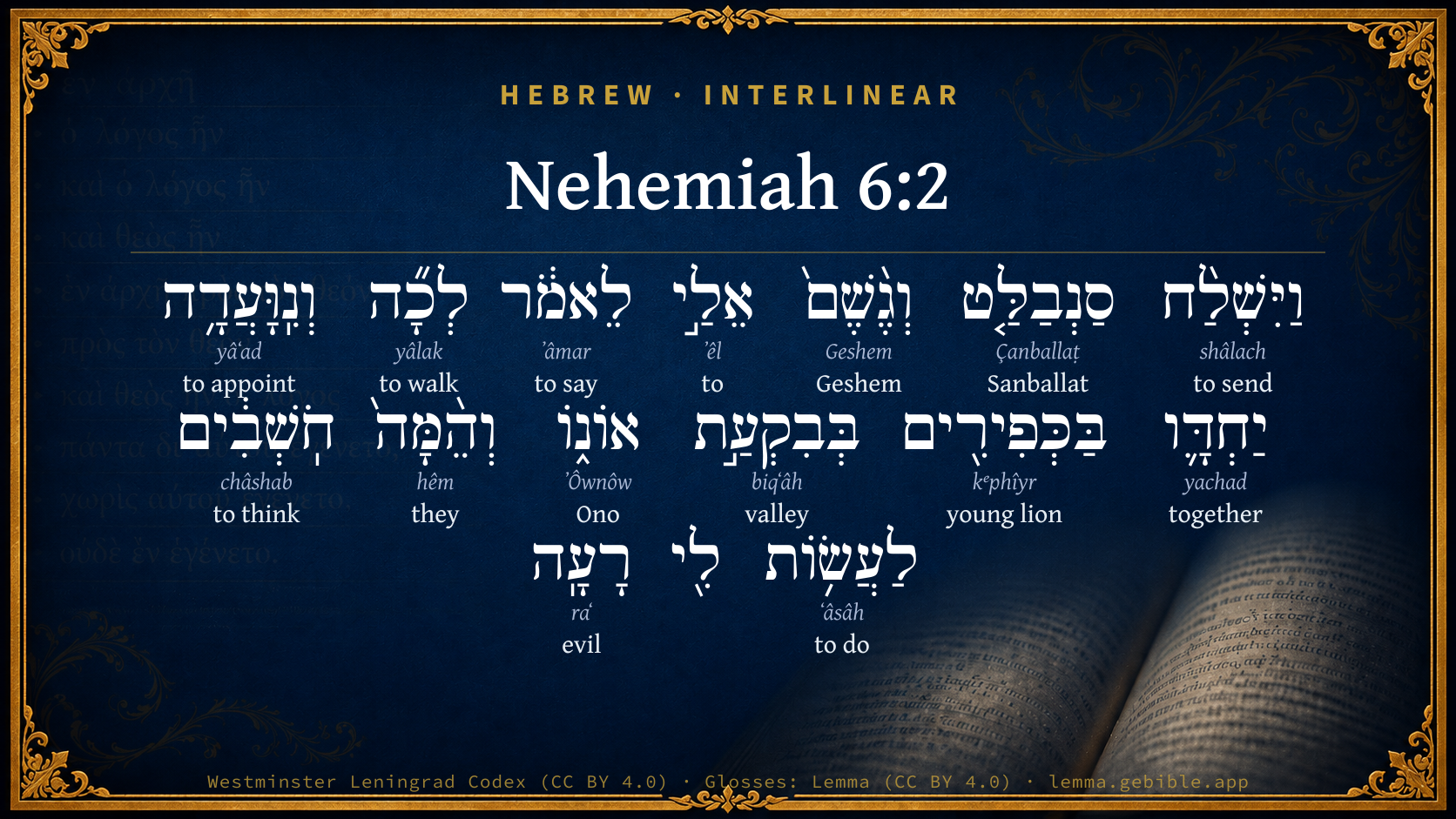
Hebrew (Westminster Leningrad Codex) Nehemiah 6:2 appears in the Hebrew Old Testament. The text above is from the Westminster Leningrad Codex. Each word links to its Strong’s number, a concise gloss, and parsing drawn from the Open Scriptures Hebrew Bible morphology. Click any word for its full Brown-Driver-Briggs (BDB) entry.
Download image
Cite this verse

Nehemiah 6:2 (World English Bible). Public Domain. Lemma interlinear Bible study tool, https://lemma.gebible.app/v/nehemiah/6/2.

Show BibTeX & RIS
BibTeX
RIS
English Translation
that Sanballat and Geshem sent to me, saying, Come, let us meet together in [one of] the villages in the plain of Ono. But they thought to do me mischief.
World English Bible · Public Domain
Download a study sheet

One document with this verse’s original text, its word-by-word gloss line, the meaning frame, cross-references with their text, attributed commentary, and full source and license credits — printable, and it pastes into notes with its structure intact.

This verse Autodidact and up

Study sheet (.html) Plain text (.txt)

A passage Seminary Student

Up to 50 verses in one chapter. A passage sheet keeps up to 6 commentary sources and 12 cross-references per verse, in the order this page ranks them, and says so on the sheet whenever that leaves anything out. Ask for a single verse and you get the Autodidact verse sheet above.

Everything on this page stays free to read, with no account — the sheet is a download of what is already on screen, not access to it.

Want to remove ads? Support Godless Engineer
Compare translations 3

The same verse in 3 English versions, stacked beneath the original-language interlinear above. Click any original word for its lexicon entry.

Each is an independent rendering of the whole verse — the interlinear is not word-aligned to these translations.

Highlighted words mark where these versions differ — a whole-verse word diff, not a word-by-word alignment.

  • World English Bible Public Domain
    that Sanballat and Geshem sent to me, saying, Come, let us meet together in [one of] the villages in the plain of Ono. But they thought to do me mischief.
  • King James Version Public Domain
    That Sanballat and Geshem sent unto me, saying, Come, let us meet together in some one of the villages in the plain of Ono. But they thought to do me mischief.
  • unfoldingWord Literal Text CC BY-SA 4.0
    that Sanballat and Geshem sent to me, saying, “Come, and let us appoint a time to meet together among the villages in the valley of Ono.” And they were thinking to do evil to me.

unfoldingWord Literal Text — © unfoldingWord, licensed CC BY-SA 4.0. Word-aligned USFM3 via Door43 (git.door43.org/unfoldingWord/en_ult).

Versions to compare (up to 4)

3 of 4 selected

Show all 18 translations

Every available English version of this verse, each an independent rendering of the whole verse.

  • World English Bible Public Domain
    that Sanballat and Geshem sent to me, saying, Come, let us meet together in [one of] the villages in the plain of Ono. But they thought to do me mischief.
  • Berean Standard Bible Public Domain
    Sanballat and Geshem sent me this message: “Come, let us meet together in one of the villages on the plain of Ono.” But they were planning to harm me.
  • Majority Standard Bible Public Domain
    Sanballat and Geshem sent me this message: “Come, let us meet together in one of the villages on the plain of Ono.” But they were planning to harm me.
  • King James Version Public Domain
    That Sanballat and Geshem sent unto me, saying, Come, let us meet together in some one of the villages in the plain of Ono. But they thought to do me mischief.
  • American Standard Version (1901) Public Domain
    that Sanballat and Geshem sent unto me, saying, Come, let us meet together in `one of' the villages in the plain of Ono. But they thought to do me mischief.
  • Revised Version (1885) Public Domain
    that Sanballat and Geshem sent unto me, saying, Come, let us meet together in one of the villages in the plain of Ono. But they thought to do me mischief.
  • Geneva Bible (1599) Public Domain
    Then sent Sanballat and Geshem vnto me, saying, Come thou that we may meete together in the villages in the plaine of Ono: and they thought to doe me euill.
  • Douay-Rheims (1899) Public Domain
    Sanaballat and Gossem Rent to me, saying: Come, and let us make a league together in the villages, in the plain of Ono. But they thought to do me mischief.
  • Young's Literal Translation Public Domain
    that Sanballat sendeth, also Geshem, unto me, saying, `Come and we meet together in the villages, in the valley of Ono;' and they are thinking to do to me evil.
  • Literal Standard Version CC BY-SA 4.0
    that Sanballat sends, also Geshem, to me, saying, “Come and we meet together in the villages, in the Valley of Ono”; and they are thinking to do to me evil.
  • Unlocked Literal Bible CC BY-SA 4.0
    Sanballat and Geshem sent to me saying, “Come, let us meet together somewhere in the plain of Ono.” But they intended to do harm to me.
  • unfoldingWord Literal Text CC BY-SA 4.0
    that Sanballat and Geshem sent to me, saying, “Come, and let us appoint a time to meet together among the villages in the valley of Ono.” And they were thinking to do evil to me.
  • Darby Bible Public Domain
    that Sanballat and Geshem sent to me, saying, Come, let us meet together in the villages in the plain of Ono. But they thought to do me mischief.
  • World Messianic Bible Public Domain
    Sanballat and Geshem sent to me, saying, “Come! Let’s meet together in the villages in the plain of Ono.” But they intended to harm me.
  • Webster's Bible Public Domain
    That Sanballat and Geshem sent to me, saying, Come, let us meet together in some one of the villages in the plain of Ono. But they thought to do me mischief.
  • Free Bible Version CC BY-SA 4.0
    they sent a message to me, saying, “Come on, let's meet in one of the villages on the plain of Ono.” But they intended to kill me.
  • Bible in Basic English Public Domain
    Sanballat and Geshem sent to me saying, Come, let us have a meeting in one of the little towns in the lowland of Ono. But their purpose was to do me evil.
  • JPS Tanakh (1917) Public Domain
    that Sanballat and Geshem sent unto me, saying: 'Come, let us meet together in one of the villages in the plain of Ono.' But they thought to do me mischief.

Literal Standard Version (2020), Covenant Press — licensed CC BY-SA 4.0. Text via the HelloAO Bible API (eBible.org). Unlocked Literal Bible (unfoldingWord) — licensed CC BY-SA 4.0. Text via the HelloAO Bible API (eBible.org). unfoldingWord Literal Text — © unfoldingWord, licensed CC BY-SA 4.0. Word-aligned USFM3 via Door43 (git.door43.org/unfoldingWord/en_ult). Free Bible Version, Dr. Jonathan Gallagher — licensed CC BY-SA 4.0. Text via the HelloAO Bible API (eBible.org).

Word by word

More ways to search: Search by grammar → Find every occurrence → Compare this word →

Practice this passage: Drill this verse → Learn its vocabulary →

וְגֶ֨שֶׁם֙
Geshem
H1654
“and · Geshem”
Conjunction + Noun, Proper
Part of Speech
Conjunction + Noun
Type
Proper
Full BDB Definition

Origin: the same as H1653

TWOT: None

Geshem or Gashmu = "rain" - an Arabian foe of Nehemiah
  1. וַיִּשְׁלַ֨ח shâlach H7971 “and · to send” Conjunction + Verb, Qal, Sequential Imperfect, 3rd Person, Masculine, Singular
  2. סַנְבַלַּ֤ט Çanballaṭ H5571 “Sanballat” Noun, Proper
  3. אֵלַ֣י ʼêl H413 “to · me” Preposition + Suffix, Personal, 1st Person, Common, Singular
  4. לֵאמֹ֔ר ʼâmar H559 “to say” Preposition + Verb, Qal, Infinitive Construct
  5. לְכָ֞ה yâlak H3212 “walk” Verb, Qal, Imperative, 2nd Person, Masculine, Singular + Suffix, h
  6. וְנִֽוָּעֲדָ֥ה yâʻad H3259 “and · to appoint” Conjunction + Verb, Niphal, Cohortative, 1st Person, Common, Plural
  7. יַחְדָּ֛ו yachad H3162 “together” Adverb
  8. בַּכְּפִירִ֖ים kᵉphîyr H3715 “in/at the · young lions” Preposition, Determined + Noun, Common, Masculine, Plural, Absolute
  9. בְּבִקְעַ֣ת biqʻâh H1237 “in/at · valley of” Preposition + Noun, Common, Feminine, Singular, Construct
  10. אוֹנ֑וֹ ʼÔwnôw H207 “Ono” Noun, Proper
  11. וְהֵ֨מָּה֙ hêm H1992 “and · they” Conjunction + Pronoun, Personal, 3rd Person, Masculine, Plural
  12. חֹֽשְׁבִ֔ים châshab H2803 “thinking” Verb, Qal, Participle Active, Masculine, Plural, Absolute
  13. לַעֲשׂ֥וֹת ʻâsâh H6213 “to do” Preposition + Verb, Qal, Infinitive Construct
  14. רָעָֽה raʻ H7451 “evil” Noun, Common, Feminine, Singular, Absolute

About this verse

These counts appear in no published source. They are computed here, from the morphology-tagged text and Lemma’s own curated glosses. What Lemma adds →

16
words
15
distinct lemmas
Historical
section

Notable vocabulary

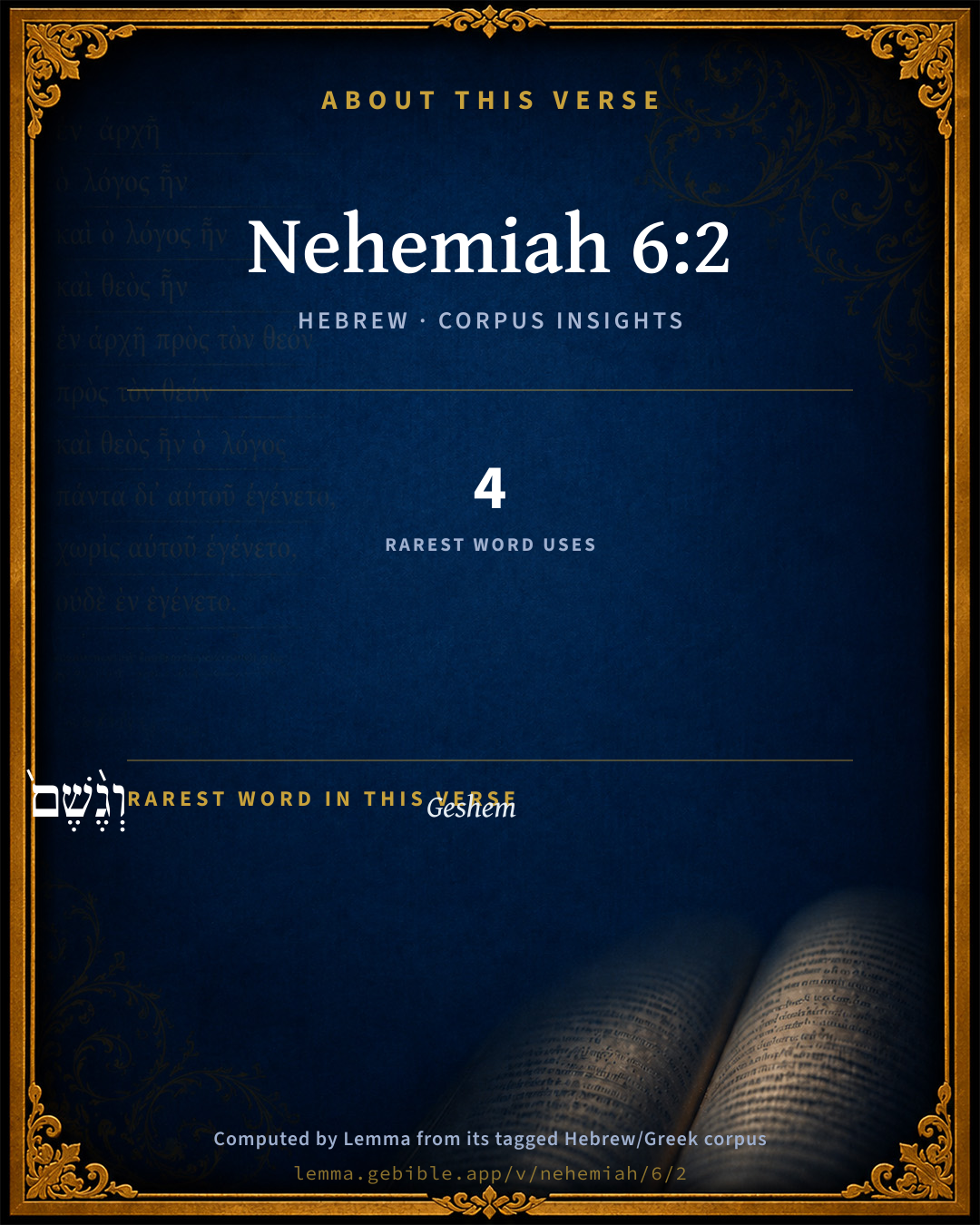
The rarest word here is וְגֶ֨שֶׁם֙ Geshem H1654 — appearing just 4 times in the whole Hebrew Bible.

Shared distinctive vocabulary

וְגֶ֨שֶׁם֙ Geshem H1654 occurs in 4 verses of the Hebrew Bible. Also found in:

Grammatical profile

  • 6 verbs
  • 6 nouns
  • 1 pronoun
  • 2 prepositions
  • 1 adverb

Verb forms

  • וַיִּשְׁלַ֨ח Qal · Sequential Imperfect
  • לֵאמֹ֔ר Qal · Infinitive Construct
  • לְכָ֞ה Qal · Imperative
  • וְנִֽוָּעֲדָ֥ה Niphal · Cohortative
  • חֹֽשְׁבִ֔ים Qal · Participle Active
  • לַעֲשׂ֥וֹת Qal · Infinitive Construct

Cross-references

13

Topical passages linked to Nehemiah 6:2 in the Treasury of Scripture Knowledge — connected by theme and wording, ordered by reader-vote popularity; previews shown in the World English Bible.

  • 1 Chronicles 8:12 The sons of Elpaal: Eber, and Misham, and Shemed, who built Ono and Lod, with the towns of it;
  • Psalms 37:12 The wicked plots against the just, And gnashes at him with his teeth.
  • Nehemiah 11:35 Lod, and Ono, the valley of craftsmen.
  • 2 Samuel 3:27 When Abner was returned to Hebron, Joab took him aside into the midst of the gate to speak with him quietly, and struck him there in the body, so that he died, for the blood of Asahel his brother.
  • 2 Samuel 20:9 Joab said to Amasa, Is it well with you, my brother? Joab took Amasa by the beard with his right hand to kiss him.
  • Psalms 12:2 Everyone lies to his neighbor. They speak with flattering lips, and with a double heart.
  • Psalms 37:32 The wicked watches the righteous, And seeks to kill him.
  • Proverbs 26:24–26 A malicious man disguises himself with his lips, But he harbors evil in his heart.
  • Ecclesiastes 4:4 Then I saw all the labor and achievement that is the envy of a man's neighbor. This also is vanity and a striving after wind.
  • Jeremiah 41:2 Then arose Ishmael the son of Nethaniah, and the ten men who were with him, and struck Gedaliah the son of Ahikam the son of Shaphan with the sword, and killed him, whom the king of Babylon had made governor over the land.
  • Ezekiel 33:31 They come to you as the people comes, and they sit before you as my people, and they hear your words, but don't do them; for with their mouth they show much love, but their heart goes after their gain.
  • Micah 7:4–5 The best of them is like a brier. The most upright is worse than a thorn hedge. The day of your watchmen, Even your visitation, has come; Now is the time of their confusion.
  • Luke 20:19–21 The chief priests and the scribes sought to lay hands on Him that very hour, but they feared the people--for they knew He had spoken this parable against them.

Cross-references courtesy of OpenBible.info (CC BY 4.0).

Hebrew and Greek witnesses Masoretic Hebrew ↔ Greek Septuagint

The same verse in the two great witnesses to the Old Testament, shown verse-for-verse.

These are two independent witnesses, not word-aligned to each other, and the Septuagint is shown in lemma (dictionary) form.

Hebrew Nehemiah 6:2 Masoretic · Westminster Leningrad Codex

וַיִּשְׁלַ֨ח סַנְבַלַּ֤ט וְגֶ֨שֶׁם֙ אֵלַ֣י לֵאמֹ֔ר לְכָ֞ה וְנִֽוָּעֲדָ֥ה יַחְדָּ֛ו בַּכְּפִירִ֖ים בְּבִקְעַ֣ת אוֹנ֑וֹ וְהֵ֨מָּה֙ חֹֽשְׁבִ֔ים לַעֲשׂ֥וֹת לִ֖י רָעָֽה

that Sanballat and Geshem sent to me, saying, Come, let us meet together in [one of] the villages in the plain of Ono. But they thought to do me mischief.

World English Bible · Public Domain

Greek LXX Structure differs

The Septuagint has no separate book of Nehemiah. Its Greek text is the second half of Esdras B (2 Esdras), chapters 11–23; Ezra is the first half (1–10).

A verse-for-verse comparison isn’t shown here because the chapters and verses don’t line up. Switch to the LXX edition with the MT / LXX toggle above to read the Greek directly.

Hebrew: Westminster Leningrad Codex (CC BY 4.0). Greek: Septuagint (public domain); English from a public-domain English Septuagint. How the Septuagint differs from the Hebrew →

Commentary

Notes on Nehemiah 6:2 from classic Christian and Jewish commentators (each source and its license shown beneath its notes). The classic Christian expositions comment on the surrounding passage and are grouped to its opening verse, so a note may address several verses; the Jewish commentaries on the Tanakh (Rashi and others) are per-verse, so they appear only where the commentator wrote on this verse.

Lemma curates 59 commentaries, every one of them public domain or Creative Commons licensed, each selected and text-cleaned for this edition rather than reprinted as found. About our sources →

Trapp's Complete Commentary

John Trapp

Neh 6:2 That Sanballat and Geshem sent unto me, saying, Come, let us meet together in [some one of] the villages in the plain of Ono. But they thought to do me mischief.

Ver. 2. That Sanballat and Geshem sent unto me] As if solicitous of my safety, and careful of the common good. He that hateth dissembleth with his lips, and layeth up deceit within him. When he speaketh fair believe him not; for there are seven abominations in his heart, Pro 26:24-25. Nehemiah well knew that all this pretended courtesy was but dross upon dirt, Neh 6:13, a fair glove drawn upon a foul hand, a cunning collusion to undo him. He therefore keeps aloof: quia me vestigia terrent, &c.

Come, let us meet together] Thus they called him to conference and consultation whiles the doors were not yet upon the gates; purposely to take him off the work; as the fox diverts the huntsman from following the hare; and as our deceitful hearts do too often draw us away from the prosecution of good purposes, by casting many other odd impertinent matters an our way.

In the plain of Ono] Which was in the tribe of Benjamin, Neh 11:30-31, near to Jerusalem; that he might the sooner come, and be the more secure; so the Papists appointed Trent for their conventicle, as near to the Reformed Churches; inviting their divines thereunto sub fide publica; under public trust, but that council was carried by the pope and his complices, with such infinite guile and craft, without any sincerity, upright dealing, and truth, as that the Protestants, Calvin, Buret, &c., kept off; as seeing that it was to no purpose to come among them.

But they thought to do me mischief] To kill me, or, at least, to captivate me.

John Trapp, A Commentary or Exposition upon All the Books of the Old and New Testament (1647–1656) — public domain. Text from a community e-Sword module.

Tyndale Open Study Notes

Tyndale Open Resources

6:2 The plain of Ono, located near Lod (Ezra 2:33), was probably a neutral site west of Jerusalem, where Nehemiah would have been unprotected.

Tyndale Open Study Notes — © Tyndale Open Resources, licensed CC BY-SA 4.0. Text via the HelloAO Bible API.

Adam Clarke's Commentary

Verse 2. Come, let us meet together in - the plain of Ono.] They wished to get him out of Jerusalem from among his friends, that they might either carry him off, or murder him. Ono is supposed to have been in the tribe of Benjamin, near Jordan.

Adam Clarke's Commentary on the Bible (1810–1826) — public domain. Text from a community e-Sword/MySword module.

Ellicott's Commentary for English Readers

(2) Sanballat and Geshem.—In the original of Neh_6:1, Tobiah is not distinguished from Sanballat by another preposition, as Geshem is; and here he is omitted, as not to appear in the conference otherwise than as Sanballat’s secretary.

In some one of the villages in the plain of Ono.—Probably, in Hahkiphirem, the name of a village in the plain of Ono, which was on the borders of Philistia, more than twenty miles from Jerusalem.

A Bible Commentary for English Readers, edited by Charles John Ellicott (1878–1897) — public domain. Text from a community e-Sword module.

The Cambridge Bible for Schools and Colleges

gen. ed. J. J. S. Perowne

2. Sanballat and Geshem] It is noticeable that Tobiah’s name is not also mentioned. Some commentators have held that this omission is to be accounted for by the fact of Tobiah being ‘the mere servant of Sanballat’ (see Neh_2:10). But the explanation seems very improbable when we consider the prominence of Tobiah in Neh_2:10; Neh_2:19, Neh_4:7, Neh_6:17; Neh_6:19, Neh_13:7-8, and the way in which his name is mentioned in Neh_6:12; Neh_6:14. It is better to suppose that Nehemiah’s enemies deputed two of the most crafty of their number to make these overtures for an interview. An invitation to meet and discuss matters with only two of the leaders would wear a friendly and innocent appearance. Perhaps Tobiah and the other conspirators were intended to take advantage of Nehemiah’s absence and to make a surprise attack upon Jerusalem.

in some one of the villages] R.V. in one of the villages. According to this translation the invitation leaves it open to Nehemiah to select the place of meeting. But literally the Hebrew gives ‘in the villages (Chephirim)’. It is very possible that this word gives the name of a place (cf. Chephirah, Ezr_2:25), as Rashi long ago suggested. It is certainly natural to expect that Sanballat and Geshem would name a place for the proposed interview; and the form of the Hebrew word favours this explanation. The proposed meeting-place then would be ‘Hacchephirim.’

in the plain of Ono] On Ono, see Ezr_2:33 (Neh_7:37; Neh_11:35; 1Ch_8:12). An interview in the plain of Ono would have necessitated Nehemiah’s absence from Jerusalem during three or four days. The object of his enemies was doubtless to seize or assassinate him at a distance from Jerusalem.

thought to do me mischief] ‘thought’ i.e. ‘considered how.’ Cf. Neh_6:6, ‘think to rebel.’ Gen_50:20, ‘ye thought (R.V. meant) evil against me.’ ‘Mischief,’ lit. ‘evil,’ by which expression Nehemiah hints that his foes plotted to assassinate him. Cf. 1Sa_23:9, ‘Saul devised mischief.’ Est_8:3, ‘the mischief of Haman the Agagite.’

The Cambridge Bible for Schools and Colleges (gen. ed. J. J. S. Perowne; Cambridge University Press, 1878–1918) — public domain. Text from a community e-Sword module.

John Gill's Exposition

Then Sanballat and Geshem sent unto me,.... Messengers:

saying, come, let us meet together in some one of the villages; in Cephirim, which Jarchi takes to be the name of a place, perhaps the same with Cephirah, a city in the tribe of Benjamin, Jos 18:26

in the plain of Ono; which was in the same tribe, see Ch1 8:12, they might pretend a friendly meeting, to accommodate differences between them, or to converse together about the general interest of the king of Persia in those parts:

but they thought to do me mischief; to kill him, or at least to confine him; this he either conjectured from their general character and behaviour, or he had intelligence of their design.

John Gill's Exposition of the Whole Bible (1746–1763) — public domain (CC PDM 1.0). Text via the HelloAO Bible API.

Albert Barnes' Notes on the Bible

The choice made of Ono, on the skirts of Benjamin, 25 or 30 miles from Jerusalem, as the meeting-place, was, no doubt, in order to draw Nehemiah to a distance from his supporters, that so an attack might be made on him with a better chance of success.

Albert Barnes' Notes on the Bible (1834–1885) — public domain. Text from a community e-Sword/MySword module.

Haydock's Catholic Bible Commentary

Make. Protestants, "meet together." (Haydock) --- When the adversaries of faith find themselves unable to suppress it, they offer peace: so when Protestants began, and where they are still weak, they would have none persecuted for any opinions in religious matters; "but where they are strong they hardly grant toleration to Catholics." (Worthington) --- This has been no where more observable than in these [British] islands, where the spirit of persecution has not yet subsided, though banished from most other countries. See Dr. Milner’s 4th let. to a Preb.; Debates in Parl. 1810, &c. (Haydock) --- Villages. Most of the Latin editions, before Sixtus V read, in vitulis in campo uno, (Calmet) "with sacrifices of calves in some one field." (Haydock) --- Perhaps Cephirim, (Tirinus) or copirim, "villages," (Haydock) may be the name of a place in the plain of Ono, (Tirinus) which is styled the valley of craftsmen, (chap. xi. 35.; Calmet) in the tribe of Benjamin, near the Jordan. (Adrichomius) --- Mischief, by taking or killing. (Menochius)

George Leo Haydock (1774–1849), Haydock's Catholic Family Bible and Commentary, 1859 edition — public domain. Excludes Psalms (Douay-Rheims chapter numbering differs from Protestant) and Deuterocanonical books (Catholic canon only).

Matthew Poole's English Annotations

Let us meet together; to consult about the common service of our master the king of Persia, or to make a friendly accommodation.

Ono; a city in the tribe of Benjamin; of which see Neh 11:35; 1Ch 8:12.

Matthew Poole's English Annotations on the Holy Bible (1683–1685) — public domain. Text from a community e-Sword/MySword module.

Whedon's Commentary on the Bible

Daniel D. Whedon

2. Let us meet — For conference.

Plain of Ono — Probably the same as “the Valley of Craftsmen,” in Neh_11:35; some depression or torrent-bed close by Ono, in which that and other villages seem to have been located. Ono and Lod were Benjamite towns, built by Elpaal or by one of his sons. 1Ch_8:12. The Talmudists locate these towns three miles apart, and the modern village Kefr Ana, about five miles north of Lydda, is, perhaps, the representative of the ancient Ono.

Thought to do me mischief — Designed either to assassinate him or take him prisoner.

Daniel D. Whedon (gen. ed.), Commentary on the Old and New Testaments (1874–1909) — public domain. Text from a community e-Sword module.

The Pulpit Commentary

In some one of the villages. The Hebrew has "in the villages," which seems too vague. Bertheau therefore suggests, "in Hakkiphirim," taking the word as the name of a particular village, which is probably right. Ono was near Lydda, in the plain country bordering on Philistia. They thought to do me mischief. An euphemism for "they thought to murder me.

Hindrances repelled.

"I am doing a great work, so that I cannot come down." This reply of Nehemiah to his subtle enemies is worthy of adoption by us in relation to all that would hinder us in Christ"s service. In giving them this turn, we may employ the words "come down," used here of locality, in the sense of descending to a lower mental or moral level.

I WHO MAY WELL ADOPT THESE WORDS.

1. All Christians.

(1) In relation to their spiritual culture, the working out of their own salvation, which is indeed "a great work.

(2) In relation to their special calling in life. Which is to each his "great work that which must occupy most of his time and thought and toil; that in which he is especially to glorify God.

(3) In relation to any work of Christian benevolence in which each may be engaged.

2. Those who occupy positions of peculiar responsibility. Whether in secular life or in the Church. Statesmen; parents, the nurture and training of whose families is "a great work;" ministers of religion; all on whom others depend for guidance, etc.

II To WHOM, AND OF WHAT, THEY MAY BE EMPLOYED. To all who would tempt us

1. Into obvious sin.

2. Into whatever practice would hinder us in our duty.

What is right for one may be wrong for another, because it would hinder him in his Christian life or work. Each must judge for himself what would be a hindrance to him. Let every one "seek first the kingdom of God and his righteousness," intent supremely on serving God and serving his generation according to the will of God, and all inferior things will be seen in their true light, and take their proper place. Let every one also leave his fellow Christians to order their lives according to their own judgment of what is right and good for them. He, however, who would live greatly for great ends must often say as to pursuits, amusements, gratifications of taste, social intercourse, etc., lawful or laudable in others, "I am doing," etc.

III THE REASONABLENESS OF THE WORDS AS THUS EMPLOYED. Concentration of mind and energy is essential to success in all important pursuits, and is adopted by all who determine to succeed. Whatever would hinder, however tempting, has to be resolutely renounced. The same concentration and self-denial are required in the Christian life, and are the more imperative and reasonable on account of the greatness of its aims and the peculiar perils which attend it. In conclusion

1. The sentiment of the text may be misapplied. As when (if such cases may be supposed possible) a pastor "cannot come down" from his studies to visit the sick or the poor, or to give counsel to the inquiring or the perplexed; or parents "cannot come down" from any other employment, secular or spiritual, to care properly for the good of their children; or the contemplative and studious Christian "cannot come down" to works of active benevolence, or even to diligence in his secular calling.

2. The sentiment may be pushed too far. Human nature cannot bear a perpetual strain; is not the better for incessant concentration on even the highest subjects and pursuits. We need variety. Recreation (truly such) is as much a duty as serious occupation. Sin is always to be renounced, but not always are we to refuse to "come down" to lighter matters than those of our main business in life. The highest life we can reach will be not hindered, but promoted, by a wise descent to lower things; and that not only because of the relief thus gained, but because the highest principles can be exercised and nourished by employment in the smallest matters.

3. To all temptations to real neglect of our work the words of the text should be perseveringly applied. Like Nehemiah, let us to every renewed temptation "answer after the same manner."

The Pulpit Commentary (1880–1919), ed. H.D.M. Spence-Jones & Joseph S. Exell — public domain. Text from a community e-Sword module.

John Wesley's Explanatory Notes

Meet - To consult about the common service of our master the king of Persia, or to make a friendly accommodation.

John Wesley, Explanatory Notes Upon the Whole Bible (1754–1765) — public domain. Text via the GEBible commentary corpus.

Rashi

Rabbi Shlomo Yitzchaki (Rashi)

in Kefirim This is a name of a place.

[which is] in the Valley of Ono That is the name of the valley.

and they were plotting against me. I understood from them that they were plotting against me to assassinate me there.

Rashi on the Tanakh — English translations: “The Judaica Press complete Tanach with Rashi, translated by A. J. Rosenberg” (CC BY 4.0); “Pentateuch with Rashi's commentary by M. Rosenbaum and A.M. Silbermann, 1929-1934” (public domain); “The Metsudah Tanach series, Lakewood, N.J” (CC BY 4.0); and “The Book of Joshua, Metsudah Publications, 1997” (CC BY 4.0). Text via Sefaria.

Lesson kit

Teaching starters — assembled from the data on this page, not authored interpretation. Every prompt links to the verse data it draws on. Edit before teaching.

Nehemiah, in the Historical, opens this verse with 16 words (15 distinct Hebrew lemmas). Its most distinctive word is Geshem (“Geshem”). A historical commentator’s framing appears above. Read the whole chapter for the surrounding context.

Discussion questions

  1. How does “Geshem” (Geshem) shape what this verse is saying?
  2. How does Nehemiah 2:19, which shares the word «Geshem», read alongside this verse?
  3. These translations render this verse differently. What is at stake in choosing one wording over another?
  4. «וַיִּשְׁלַ֨ח» is a Qal Sequential Imperfect verb. How does that grammatical form shape the action described?
  5. Compare how Trapp's Complete Commentary and Tyndale Open Study Notes read this verse. Where do they agree or differ?

Things to notice

Reading settings

Reading text

Shown beneath each verse's original-language words.

Old Testament
Old Testament edition

Read the OT as the Masoretic Hebrew (MT) or the Greek Septuagint (LXX).

English shown for the Greek Septuagint (in the Hebrew ↔ Greek comparison).

Comparing translations? Open the Compare panel on any verse page to stack up to four side by side.