
Nehemiah 4:9

Hebrew (Westminster Leningrad Codex) Nehemiah 4:9 appears in the Hebrew Old Testament. The text above is from the Westminster Leningrad Codex. Each word links to its Strong’s number, a concise gloss, and parsing drawn from the Open Scriptures Hebrew Bible morphology. Click any word for its full Brown-Driver-Briggs (BDB) entry.
Download image
Cite this verse

Nehemiah 4:9 (World English Bible). Public Domain. Lemma interlinear Bible study tool, https://lemma.gebible.app/v/nehemiah/4/9.

Show BibTeX & RIS
BibTeX
RIS
English Translation
But we made our prayer to our God, and set a watch against them day and night, because of them.
World English Bible · Public Domain
Download a study sheet

One document with this verse’s original text, its word-by-word gloss line, the meaning frame, cross-references with their text, attributed commentary, and full source and license credits — printable, and it pastes into notes with its structure intact.

This verse Autodidact and up

Study sheet (.html) Plain text (.txt)

A passage Seminary Student

Up to 50 verses in one chapter. A passage sheet keeps up to 6 commentary sources and 12 cross-references per verse, in the order this page ranks them, and says so on the sheet whenever that leaves anything out. Ask for a single verse and you get the Autodidact verse sheet above.

Everything on this page stays free to read, with no account — the sheet is a download of what is already on screen, not access to it.

Want to remove ads? Support Godless Engineer
Compare translations 3

The same verse in 3 English versions, stacked beneath the original-language interlinear above. Click any original word for its lexicon entry.

Each is an independent rendering of the whole verse — the interlinear is not word-aligned to these translations.

Highlighted words mark where these versions differ — a whole-verse word diff, not a word-by-word alignment.

  • World English Bible Public Domain
    But we made our prayer to our God, and set a watch against them day and night, because of them.
  • King James Version Public Domain
    Nevertheless we made our prayer unto our God, and set a watch against them day and night, because of them.
  • unfoldingWord Literal Text CC BY-SA 4.0
    And we prayed to our God. And we set up a guard on account of them, by day and by night against their faces.

unfoldingWord Literal Text — © unfoldingWord, licensed CC BY-SA 4.0. Word-aligned USFM3 via Door43 (git.door43.org/unfoldingWord/en_ult).

Versions to compare (up to 4)

3 of 4 selected

Show all 18 translations

Every available English version of this verse, each an independent rendering of the whole verse.

  • World English Bible Public Domain
    But we made our prayer to our God, and set a watch against them day and night, because of them.
  • Berean Standard Bible Public Domain
    So we prayed to our God and posted a guard against them day and night.
  • Majority Standard Bible Public Domain
    So we prayed to our God and posted a guard against them day and night.
  • King James Version Public Domain
    Nevertheless we made our prayer unto our God, and set a watch against them day and night, because of them.
  • American Standard Version (1901) Public Domain
    But we made our prayer unto our God, and set a watch against them day and night, because of them.
  • Revised Version (1885) Public Domain
    But we made our prayer unto our God, and set a watch against them day and night, because of them.
  • Geneva Bible (1599) Public Domain
    The we prayed vnto our God, and set watchmen by them, day and night, because of them.
  • Douay-Rheims (1899) Public Domain
    And we prayed to our God, and set watchmen upon the wall day and night against them.
  • Young's Literal Translation Public Domain
    And we pray unto our God, and appoint a watch against them, by day and by night, because of them.
  • Literal Standard Version CC BY-SA 4.0
    And we pray to our God, and appoint a watch against them, by day and by night, because of them.
  • Unlocked Literal Bible CC BY-SA 4.0
    But we prayed to our God and set a guard as protection against them day and night because of their threat.
  • unfoldingWord Literal Text CC BY-SA 4.0
    And we prayed to our God. And we set up a guard on account of them, by day and by night against their faces.
  • Darby Bible Public Domain
    Then we prayed to our God, and set a watch against them day and night, because of them.
  • World Messianic Bible Public Domain
    But we made our prayer to our God, and set a watch against them day and night because of them.
  • Webster's Bible Public Domain
    Nevertheless we made our prayer to our God, and set a watch against them day and night, because of them.
  • Free Bible Version CC BY-SA 4.0
    So we prayed to our God, and we had guards ready to defend against them day and night.
  • Bible in Basic English Public Domain
    But we made our prayer to God, and had men on watch against them day and night because of them.
  • JPS Tanakh (1917) Public Domain
    (4-3) But we made our prayer unto our God, and set a watch against them day and night, because of them.

Literal Standard Version (2020), Covenant Press — licensed CC BY-SA 4.0. Text via the HelloAO Bible API (eBible.org). Unlocked Literal Bible (unfoldingWord) — licensed CC BY-SA 4.0. Text via the HelloAO Bible API (eBible.org). unfoldingWord Literal Text — © unfoldingWord, licensed CC BY-SA 4.0. Word-aligned USFM3 via Door43 (git.door43.org/unfoldingWord/en_ult). Free Bible Version, Dr. Jonathan Gallagher — licensed CC BY-SA 4.0. Text via the HelloAO Bible API (eBible.org).

Word by word

More ways to search: Search by grammar → Find every occurrence → Compare this word →

Practice this passage: Drill this verse → Learn its vocabulary →

מִשְׁמָ֧ר
mishmâr
H4929
“guard”
Noun, Common, Masculine, Singular, Absolute
Part of Speech
Noun
Type
Common
Gender
Masculine
Number
Singular
State
Absolute
Full BDB Definition

Origin: from H8104

TWOT: 2414f

place of confinement, prison, guard, jail, guard post, watch, observance - jail, prison, guard-house - guard, guard post, act of guarding - observances
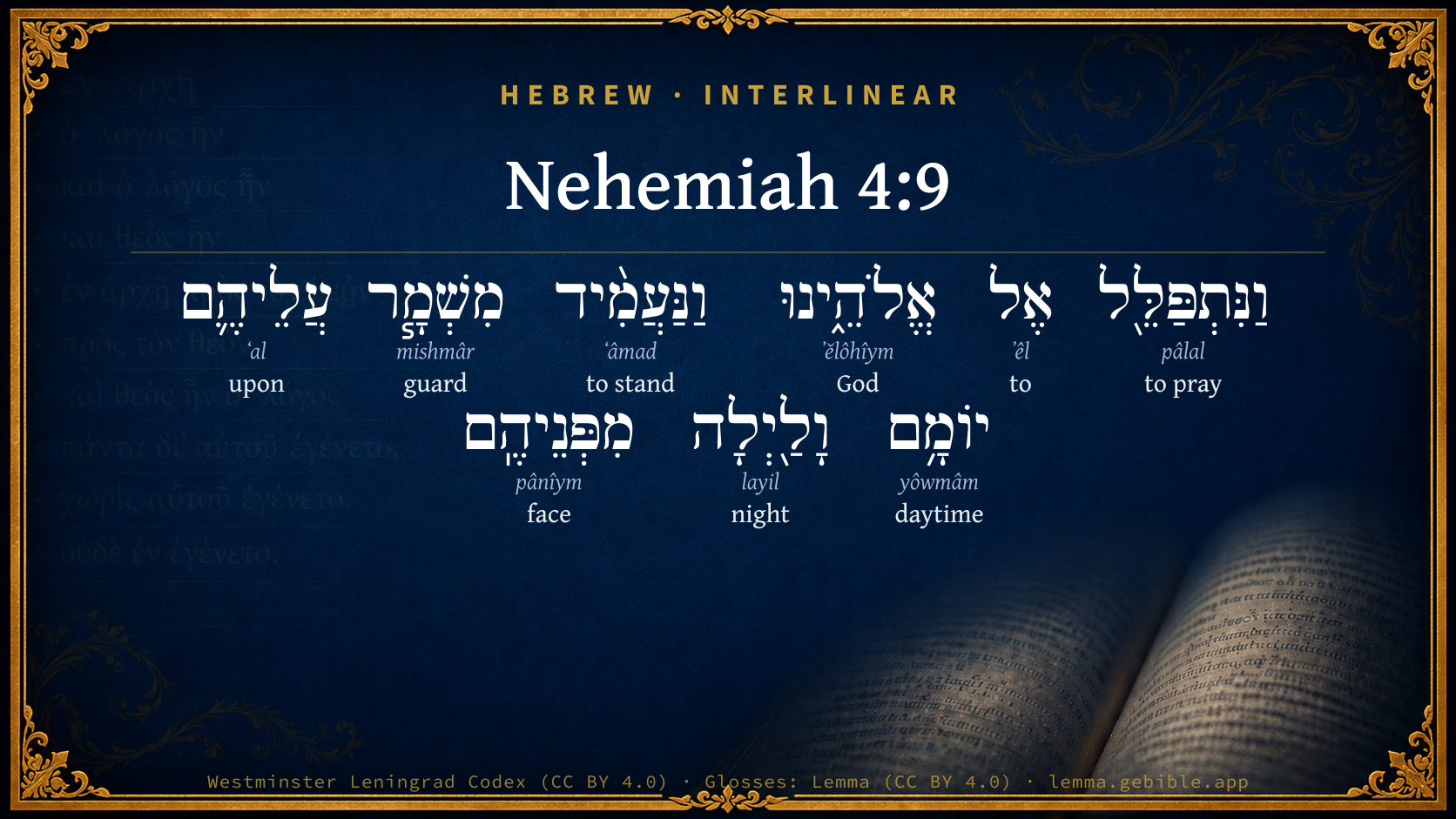
  1. וַנִּתְפַּלֵּ֖ל pâlal H6419 “and · to pray” Conjunction + Verb, Hithpael, Sequential Imperfect, 1st Person, Common, Plural
  2. אֶל ʼêl H413 “to” Preposition
  3. אֱלֹהֵ֑ינוּ ʼĕlôhîym H430 “God(s) · our” Noun, Common, Masculine, Plural, Construct + Suffix, Personal, 1st Person, Common, Plural
  4. וַנַּעֲמִ֨יד ʻâmad H5975 “and · to stand” Conjunction + Verb, Hiphil, Sequential Imperfect, 1st Person, Common, Plural
  5. עֲלֵיהֶ֛ם ʻal H5921 “upon · them” Preposition + Suffix, Personal, 3rd Person, Masculine, Plural
  6. יוֹמָ֥ם yôwmâm H3119 “daytime” Adverb
  7. וָלַ֖יְלָה layil H3915 “and · night” Conjunction + Noun, Common, Masculine, Singular, Absolute
  8. מִפְּנֵיהֶֽם pânîym H6440 “from · face(s) · their” Preposition + Noun, Common, Both, Plural, Construct + Suffix, Personal, 3rd Person, Masculine, Plural

About this verse

These counts appear in no published source. They are computed here, from the morphology-tagged text and Lemma’s own curated glosses. What Lemma adds →

9
words
9
distinct lemmas
Historical
section

Notable vocabulary

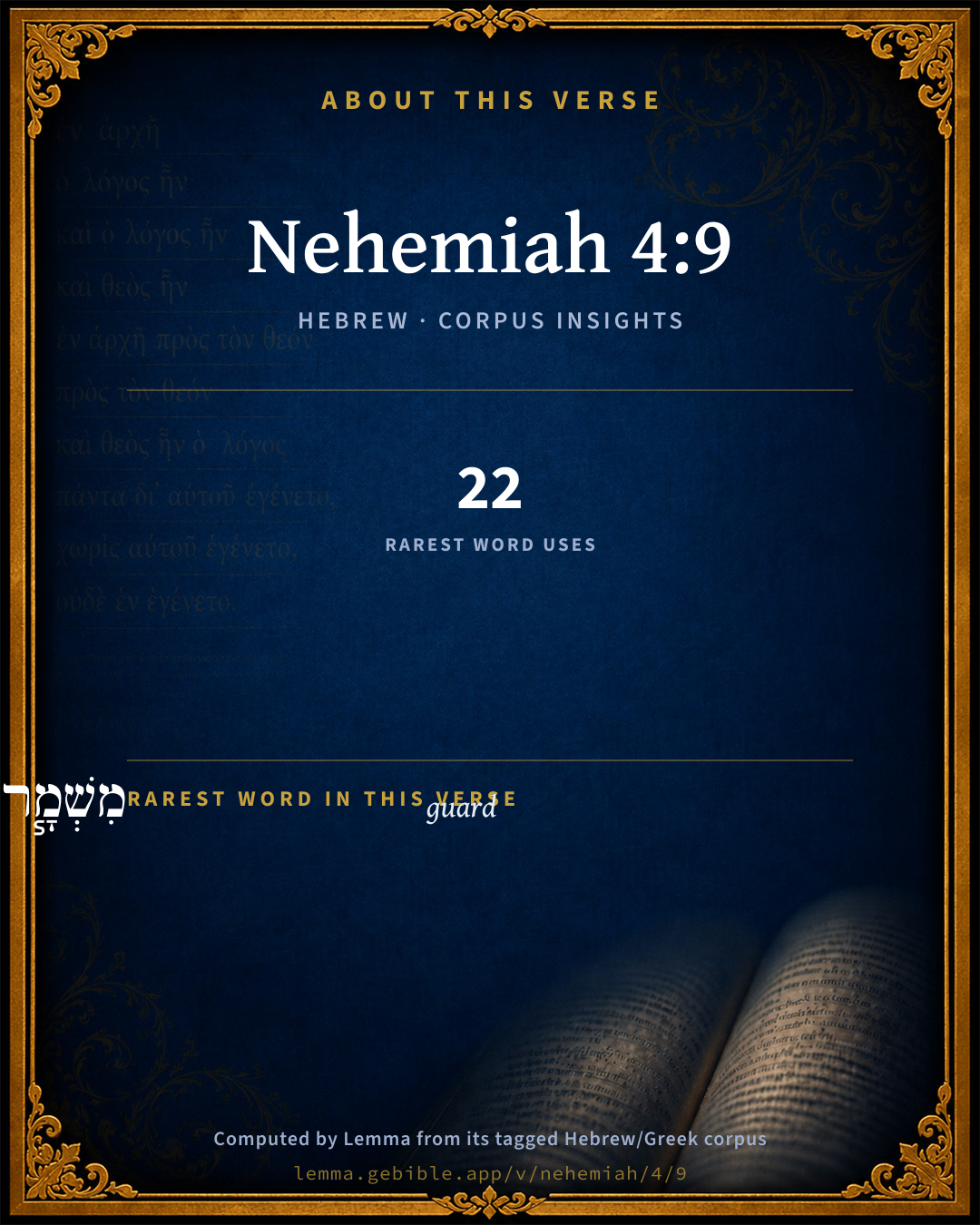
The rarest word here is מִשְׁמָ֧ר guard H4929 — appearing just 22 times in the whole Hebrew Bible.

Shared distinctive vocabulary

מִשְׁמָ֧ר guard H4929 occurs in 20 verses of the Hebrew Bible. Also found in:

Grammatical profile

  • 2 verbs
  • 4 nouns
  • 2 prepositions
  • 1 adverb

Verb forms

  • וַנִּתְפַּלֵּ֖ל Hithpael · Sequential Imperfect
  • וַנַּעֲמִ֨יד Hiphil · Sequential Imperfect

Cross-references

11

Topical passages linked to Nehemiah 4:9 in the Treasury of Scripture Knowledge — connected by theme and wording, ordered by reader-vote popularity; previews shown in the World English Bible.

  • 1 Peter 5:8 Be sober and self-controlled. Be watchful. Your adversary the devil, walks around like a roaring lion, seeking whom he may devour.
  • Psalms 50:15 Call on me in the day of trouble. I will deliver you, and you will honor me."
  • Acts 4:24–30 When they heard it, they lifted up their voice to God with one accord, and said, "O Lord, you are God, who made the heaven, the earth, the sea, and all that is in them;
  • Matthew 26:41 Watch and pray, that you don't enter into temptation. The spirit indeed is willing, but the flesh is weak."
  • Luke 6:11–12 But they were filled with rage, and talked with one another about what they might do to Jesus.
  • Luke 21:36 Therefore be watchful all the time, asking that you may be counted worthy to escape all these things that will happen, and to stand before the Son of Man."
  • Genesis 32:28 He said, "Your name will no longer be called 'Jacob,' but, 'Israel,' for you have fought with God and with men, and have prevailed."
  • 2 Kings 19:14–19 Hezekiah received the letter from the hand of the messengers, and read it; and Hezekiah went up to the house of Yahweh, and spread it before Yahweh.
  • Nehemiah 4:11 Our adversaries said, They shall not know, neither see, until we come into the midst of them, and kill them, and cause the work to cease.
  • Psalms 55:16–22 As for me, I will call on God. Yahweh will save me.
  • Genesis 32:9–12 Jacob said, "God of my father Abraham, and God of my father Isaac, Yahweh, who said to me, 'Return to your country, and to your relatives, and I will do you good.'

Cross-references courtesy of OpenBible.info (CC BY 4.0).

Hebrew and Greek witnesses Masoretic Hebrew ↔ Greek Septuagint

The same verse in the two great witnesses to the Old Testament, shown verse-for-verse.

These are two independent witnesses, not word-aligned to each other, and the Septuagint is shown in lemma (dictionary) form.

Hebrew Nehemiah 4:9 Masoretic · Westminster Leningrad Codex

וַנִּתְפַּלֵּ֖ל אֶל אֱלֹהֵ֑ינוּ וַנַּעֲמִ֨יד מִשְׁמָ֧ר עֲלֵיהֶ֛ם יוֹמָ֥ם וָלַ֖יְלָה מִפְּנֵיהֶֽם

But we made our prayer to our God, and set a watch against them day and night, because of them.

World English Bible · Public Domain

Greek LXX Structure differs

The Septuagint has no separate book of Nehemiah. Its Greek text is the second half of Esdras B (2 Esdras), chapters 11–23; Ezra is the first half (1–10).

A verse-for-verse comparison isn’t shown here because the chapters and verses don’t line up. Switch to the LXX edition with the MT / LXX toggle above to read the Greek directly.

Hebrew: Westminster Leningrad Codex (CC BY 4.0). Greek: Septuagint (public domain); English from a public-domain English Septuagint. How the Septuagint differs from the Hebrew →

Commentary

Notes on Nehemiah 4:9 from classic Christian and Jewish commentators (each source and its license shown beneath its notes). The classic Christian expositions comment on the surrounding passage and are grouped to its opening verse, so a note may address several verses; the Jewish commentaries on the Tanakh (Rashi and others) are per-verse, so they appear only where the commentator wrote on this verse.

Lemma curates 59 commentaries, every one of them public domain or Creative Commons licensed, each selected and text-cleaned for this edition rather than reprinted as found. About our sources →

Trapp's Complete Commentary

John Trapp

Neh 4:9 Nevertheless we made our prayer unto our God, and set a watch against them day and night, because of them.

Ver. 9. Nevertheless we made our prayer unto our God] Who is the saints’ sanctuary of safety, their present help in time of trouble. Prayer to him is an anchor in all storms and a salve for all sores; yea, it healeth not only body and soul, but even hard stony walls, Neh 4:7, provided that we judge ourselves in prayer, and commit our cause to God to be judged by him, as the Hebrew word נחפלל here importeth. Thus did the children of Reuben, Gad, and Manasseh, when to fight against the Hagarenes. Thus did Jabiz, and Jehoshaphat, and Constantine, and Theodosius, and that late victorious king of Sweden, of whom it is storied in his Life (Mr Clark), that he would pray ashipboard, ashore, in the field, in the midst of a battle; as if prayer alone were the surest piece of his whole armour.

And set a watch] According to that of our Saviour, "Watch and pray," Luk 21:36, and that of the heathen, Admota manu invocanda est Minerva. Ora et labora, pray, and then use best policy; first conquer heaven, and then presume of earth’s conquest.

Against them] Or, beside them, at the workmen’s elbows, and in the face of the enemies.

John Trapp, A Commentary or Exposition upon All the Books of the Old and New Testament (1647–1656) — public domain. Text from a community e-Sword module.

The Biblical Illustrator

Joseph S. Exell

Neh_4:9

We made our prayer unto our God, and set a watch.

Watch and pray

I. The duty of prayer.

1. Prayer implies trust.

2. It implies acknowledged weakness.

3. It realises Divine power. Hence in the Christian life that man is only safe, prosperous, or happy who is constantly on his knees.

II. Active vigilance and duty. Gods help is not intended to favour indolence, but to encourage exertion. The husbandman knows that God gives the increase, and therefore ploughs and sows. A man may talk, says Jay, about casting his care upon God, and may sing Jehovah-Jireh with all his energy as long as he pleases, but if he is idle, dissolute, foolish, he only tempts God, not trusts Him, for if a man will not work neither shall he eat. We have to carry on a greater work than Nehemiah. An enemy is endeavouring to prevent us building our eternal habitations, to hinder our work of preparation for heaven. Let us give our mental, moral, intellectual ability to working out our own salvation, knowing that God worketh in us to will and to do. (Homilist.)

Piety and prudence

I. The appeal of the church of God.

1. Recognising their weakness and dependence, they prayed unto God.

2. In spite of discouragements these men prayed. Nevertheless.

3. They must have been encouraged by remembering what relation God sustained towards them. Our God.

4. They united in supplication.

II. The reliance of the church upon itself. Set a watch.

1. There are enemies all around us.

2. God will not do for us what we can do for ourselves.

3. Our enemies are vigilant and untiring.

4. Our enemies conspire together. There is an unholy alliance of the forces of evil. (The Study.)

The union of prayer and watchfulness

This union is equally pleasing and profitable. It keeps our devotion from growing up into rank enthusiasm, and our diligence from sinking into the wisdom of the world which is foolishness with God. The life of the Christian is held forth as that of a warfare. What, then, can be more reasonable than to betake ourselves to prayer and vigilance?

I. Let us make our prayer to God.

1. It is recommended by God Himself--Call upon Me in the day of trouble, etc.

2. The very exercise of prayer is useful.

3. Prayer is the forming of a confederacy with God.

II. Set a watch, because of our enemies, night and day.

1. Impress your minds with a sense of your danger.

2. Study your constitutional weakness and failings.

3. Observe how you have already been foiled or ensnared.

4. Guard against the beginnings of sin.

5. Avoid the occasions of sin.

Nothing is more dangerous than idleness. Our idle days, says Henry, are the devils busy ones. Stagnant waters breed thousands of noxious insects; but this is not the case with living water. (William Jay.)

The model of a Christian warrior

I. His prayerfulness.

II. His watchfulness. Watchfulness without prayer is pre sumptuous pride, but prayer without watchfulness is presumptuous sloth. Confidence in the help of God must not prevent the use of all proper means for safety and deliverance. God promised Paul the lives of all on board the ship in which he sailed; but they were to use the means of safety. Some on boards, and some on broken pieces of the ship; and so it come to pass that they escaped all safe to land. While the Christian is surrounded with a powerful conspiracy of all the principalities of evil, he should aim at a military discipline of his heart and his thoughts. His conscience, like the trumpeter at Nehemiahs side, should be always awake.

III. His industry.

IV. His exalted courage, associated with a holy caution.

V. His cheerfulness in the performance of his arduous duties. (R. P. Buddicom.)

Nehemiahs devotion

The hardiest devotion is the healthiest. The devotion of the cloister is for the most part like the ghastly light that hovers over decomposition and decay; the devotion which characterises the diligent, spiritually-minded man of business resembles the star which shines on in the storm as in the calm--when the sky is clouded as when it is serene. (R. P. Buddicom.)

Praying and doing

I. Praying is the most important step of life. If a bad man would be good, the first step should be that of prayer. And our last breath when we leave this earth for the other world is prayer.

II. If our prayers are to bless us, we must pray earnestly.

III. Moreover, when we pray we are not to neglect the means of making our prayer effectual. We are to do as Nehemiah did--pray to God, and set a watch. I am not afraid of thieves; but while I pray to God to let His angels encamp about my house and guard it, I do not expect the angels to come into my lobbies and lock the doors. I can do that. While we pray we are not to neglect any means at our hands for doing the work for which we pray. In the same way, a working man who earns a couple of pounds a week may pray, O Lord, provide for me, and keep me from debt. It is right thus to pray, but then let not the working man neglect the means which are in his power to fulfil the prayer; let him put by two or three shillings a week to provide for any time of need. Some people seem to think that religion is a kind of spiritual charm, like the horse-shoe that our superstitious forefathers nailed behind the front door to keep out the bogies. They think that religion is for them to say prayers and go to church, and then God will keep them from hell. Oh, no.

IV. While we pray for success, let us take heed to watch for opportunities of doing good. A wealthy farmer, whose haystacks were numerous, and whose barns were full of corn, on reading in the newspapers about the great distress in the time of the cotton famine, prayed earnestly at the family altar that the poor might be fed and clothed, but he did not send any donation to the fund, and the next Sunday he uttered the same prayer. On the way to church the little son said, Father, I wish I had your corn. Why, my boy, what would you do with it? Father, I would give it to the hungry people for bread. It is no use praying that the hungry may be fed if you will not help to feed them from your full cupboard. The purpose of prayer is--asking God to give you power to do good, and then seeking opportunities to exert that power. (W. Birch.)

The two guards, praying and watching

In the text I see two guards.

I. First guard, prayer.

1. It was a prayer that meant business.

2. It was a prayer that overcame difficulties.

3. It was a prayer that came before anything else.

4. It was a prayer that was continued.

5. It was a prayer that was home-made.

6. It was a prayer that went to the home of prayer.

7. It was a prayer saturated with faith.

II. Second guard, watchfulness. This setting of a watch was--

1. A work appointed.

2. A work carefully done.

3. A work continued.

4. A work quickened by knowledge.

(1) We ought to set a watch against the enemies of our holy faith.

(2) We must set a watch against our personal adversaries.

(a) Ungodly relatives. Be patient, gentle, loving towards them. Do nothing that will give them occasion to blaspheme.

(b) The evil tendencies of our corrupt nature.

(3) We must watch against the beginning of sin.

(4) Watch for what God has to say to you.

5. Watch for yourself when you see another fall, lest you should fall in the same place.

III. I finish by putting the two guards together. Neither is sufficient alone. (C. H. Spurgeon.)

Watchfulness needed

An old writer, speaking of men as stewards of God, urges upon them as wise traders and servants to look to themselves carefully, and take care of four houses which are under their charge.

1. Their warehouse, or heart and memory, wherein they should store up precious things, holy affections, grateful remembrances, etc.

2. Their workhouse, or their actions, wherein they retail to others, for Gods glory, the grace entrusted to them.

3. Their clock-house--their speech--which must always, like a well-tuned bell, speak the truth accurately; and meaning also their observance of time, redeeming it by promptly doing the duties of every hour.

4. Their counting-house, or their conscience, which is to be scrupulously kept, and no false reckonings allowed, lest we deceive our own souls. (J. M. Randall.)

Watchfulness and prayer

A believers watchfulness is like that of a soldier. A sentinel posted on the walls, when he discerns a hostile party advancing, does not attempt to make head against them himself, but informs his commanding officer of the enemys approach, and leaves him to take the proper measures against the foe. So the Christian does not attempt to fight temptations in his own strength: his watchfulness lies in observing its approach, and in telling God of it by prayer. (W. Mason.)

At rest, but ready

At Christmas-time soldiers are in the habit of decorating their barrack-rooms, and are fond of putting mottoes cut out of gilt paper amongst the holly on their whitewashed walls. Last year I noticed in one room these two. Over the door there was, At peace, but still on guard; and in another place, At rest, but ready. Are not these equally applicable to spiritual life? If we have left our sins at the foot of the Cross, we should be at peace and rest, but on our guard against temptation, watching for the coming of the Lord. (The Quiver.)

And there is much rubbish.

The hindrances of rubbish

I. That there is too much rubbish in the pulpit. Carlyle, in giving a whimsical instance of the importance attached to etiquette at the Court of Louis XVI., while the infuriated mob were demanding entrance to his private apartments, compares it to the house-cricket still chirping amid the pealing of the trump of doom. And so, too, when the ambassador for Christ doles out to souls perishing for the Bread of Life the vain speculations of metaphysics and philosophy, he ought to be held accountable for the spiritual slumber which such narcotics are certain to produce.

II. Another reason why the walls of the spiritual Jerusalem are not built up with more rapidity is because of the rubbish about the post. The minds of multitudes are bewildered and turned aside from the pursuit of the one thing needful by unprofitable discussions concerning the modes of baptism and the disposition to magnify unimportant things into essentials.

III. The heaps of rubbish about the Lords table is another reason why the walls of the spiritual Jerusalem are built up so slowly.

IV. Then there is the rubbish of flimsy excuses which blocks up the path of life. (J. N. Norton.)

Removing rubbish

The ancient Jerusalem was but an imperfect type of the true city of God, which through the ages prophets have panted for and poets have sung, a city of truth, and righteousness and love; of liberty, equality, and fraternity, in a far fuller sense of the words than Rousseau dreamed of. For ages men have been building against opposition malignant and persistent, and with sure if slow progress. And we are building to-day. In a moment of pause we look round and still we say, There is much rubbish. What rubbish do you meet with.--

I. In English law.

II. In English society.

III. In English life.

IV. In church life.

V. In our libraries.

VI. In newspapers and magazines.

VII. In our minds.

VIII. In our hearts. (David Brook, M. A.)

Rubbish

We have to build the wall of the Church for God, but we cannot build it, for there is so much rubbish in our way. This is true--

I. of the building of the Church, which is the Jerusalem of God.

1. When the apostles began to build for God, there lay before them towering heaps of rubbish.

(1) Rabbinical.

(2) Pagan.

(3) Philosophical.

2. Soon after apostolic times came the old Roman rubbish.

3. At present there is still much rubbish coming from the world, the flesh, and the devil.

II. This is equally true of the temple of God, which is to be built in each one of our hearts. There is oftentimes in Christian people the old rubbish--

1. Of legal thought, of legal acting, of legal fearing.

2. Of old habits.

3. Of worldly associations.

4. Lofty thoughts of ourselves, engendered by worldly prosperity and spiritual acquisitions. (C. H. Spurgeon.)

Rubbish

But in our text we read of an unexpected difficulty pleaded by the men of Judah--a weary, trying, and depressing task, entailing much toil and little show of progress. So in the Christians inner life; there lies in his way a heap of broken resolutions, of former good intentions never carried out; a ponderous mass of indolent excuses for doing nothing; a rubbish pile of petty procrastinations, promising that some day we will improve, but putting off that day from time to time! It does indeed need Divine help and aid to summon up energy and to commence, beginning at once, that arduous work of removing the rubbish and ruins and starting afresh. So, also, those who would do good to others, who would rebuild Gods Zion and populate the kingdom of Christ with souls, must expect to find in their way a heavy and inert mass of ignorance, apathy, and opposition. We shall find at first disappointments and failures heaped up high in our path, but, like the faithful men of Jerusalem of old, let our answer be, We will rise up and build, and the encouraging voice of the true Nehemiah, the real Restorer of the Heavenly Zion, will greet us with the promise, The God of heaven will prosper you! (W. Hardman, LL. D.)

The Biblical Illustrator, edited by Joseph S. Exell (c. 1880s–1900s) — public domain. Text from a community e-Sword module.

Joseph Benson's Commentary

Neh 4:9. We made our prayer unto God — They committed themselves to the protection of God, whose servants they were, and whom they considered as being engaged for them. This was the way of good Nehemiah and his associates: all their cares, all their griefs, all their fears, they spread before God, and thereby made themselves easy. And set a watch against them day and night — They seconded their prayers by their endeavours, and kept a constant watch, that they might not be surprised by their enemies, for they knew them to be very vigilant to do mischief.

Joseph Benson's Commentary on the Old and New Testaments (1811–1818) — public domain. Text from a community e-Sword module.

MacLaren's Expositions of Holy Scripture

Alexander MacLaren

Nehemiah

DISCOURAGEMENTS AND COURAGE

Neh 4:9 - Neh 4:21.

Common hatred has a wonderful power of uniting former foes. Samaritans, wild Arabs of the desert, Ammonites, and inhabitants of Ashdod in the Philistine plain would have been brought together for no noble work, but mischief and malice fused them for a time into one. God’s work is attacked from all sides. Herod and Pilate can shake hands over their joint antagonism.

This passage paints vividly the discouragements which are apt to dog all good work, and the courage which refuses to be discouraged, and conquers by bold persistence. The first verse {Neh 4:9} may stand as a summary of the whole, though it refers to the preceding, not to the following, verses. The true way to meet opposition is twofold-prayer and prudent watchfulness. ‘Pray to God, and keep your powder dry,’ is not a bad compendium of the duty of a Christian soldier. The union of appeal to God with the full use of common sense, watchfulness, and prudence, would dissipate many hindrances to successful service.

I. In Neh 4:10 - Neh 4:12 Nehemiah tells, in his simple way, of the difficulties from three several quarters which threatened to stop his work. He had trouble from the workmen, from the enemies, and from the mass of Jews not resident in Jerusalem. The enthusiasm of the builders had cooled, and the magnitude of their task began to frighten them. Neh 4:6 tells us that the wall was completed ‘unto the half of it’; that is, to one-half the height, and half-way through is just the critical time in all protracted work. The fervour of beginning has passed; the animation from seeing the end at hand has not sprung up. There is a dreary stretch in the centre, where it takes much faith and self-command to plod on unfainting. Half-way to Australia from England is the region of sickening calms. It is easier to work in the fresh morning or in the cool evening than at midday. So in every great movement there are short-winded people who sit down and pant very soon, and their prudence croaks out undeniable facts. No doubt strength does become exhausted; no doubt there is ‘much rubbish’ {literally ‘dust’}. What then? The conclusion drawn is not so unquestionable as the premises. ‘We cannot build the wall’ Why not? Have you not built half of it? And was not the first half more embarrassed by rubbish than the second will be?

It is a great piece of Christian duty to recognise difficulties, and not be cowed by them. The true inference from the facts would have been, ‘so that we must put all our strength into the work, and trust in our God to help us.’ We may not be responsible for discouragements suggesting themselves, but we are responsible for letting them become dissuasives. Our one question should be, Has God appointed the work? If so, it has to be done, however little our strength, and however mountainous the accumulations of rubbish.

The second part in the trio was taken by the enemies-Sanballat and Tobiah and the rest. They laid their plans for a sudden swoop down on Jerusalem, and calculated that, if they could surprise the builders at their work, they would have no weapons to show fight with, and so would be easily despatched. Killing the builders was but a means; the desired end is significantly put last {Neh 4:11}, as being the stopping of the abhorred work. But killing the workmen does not cause the work to cease when it is God’s work, as the history of the Church in all ages shows. Conspirators should hold their tongues. It was not a hopeful way of beginning an attack, of which the essence was secrecy and suddenness, to talk about it. ‘A bird of the air carries the matter.’

The third voice is that of the Jews in other parts of the land, and especially those living on the borders of Samaria, next door to Sanballat. Neh 4:12 is probably best taken as in the Revised Version, which makes ‘Ye must return to us’ the imperative and often-repeated summons from these to the contingents from their respective places of abode, who had gone up to Jerusalem to help in building. Alarms of invasion made the scattered villagers wish to have all their men capable of bearing arms back again to defend their own homes. It was a most natural demand, but in this case, as so often, audacity is truest prudence; and in all high causes there come times when men have to trust their homes and dear ones to God’s protection. The necessity is heartrending, and we may well pray that we may not be exposed to it; but if it clearly arises, a devout man can have no doubt of his duty. How many American citizens had to face it in the great Civil War! And how character is ennobled by even so severe a sacrifice!

II. The calm heroism of Nehemiah and his wise action in the emergency are told in Neh 4:13 - Neh 4:15. He made a demonstration in force, which at once showed that the scheme of a surprise was blown to pieces. It is difficult to make out the exact localities in which he planted his men. ‘The lower places behind the wall’ probably means the points at which the new fortifications were lowest, which would be the most exposed to assault; and the ‘higher places’ {Auth. Ver.}, or ‘open places’ {Rev. Ver.}, describes the same places from another point of view. They afforded room for posting troops because they were without buildings. At any rate, the walls were manned, and the enemy would have to deal, not with unarmed labourers, but with prepared soldiers. The work was stopped, and trowel and spade exchanged for sword and spear. ‘And I looked,’ says Nehemiah. His careful eye travelled over the lines, and, seeing all in order, he cheered the little army with ringing words. He had prayed {Neh 1:5} to ‘the great and terrible God,’ and now he bids his men remember Him, and thence draw strength and courage. The only real antagonist of fear is faith. If we can grasp God, we shall not dread Sanballat and his crew. Unless we do, the world is full of dangers which it is not folly to fear.

Note, too, that the people are animated for the fight by reminding them of the dear ones whose lives and honour hung on the issue. Nothing is said about fighting for God and His Temple and city, but the motives adduced are not less sacred. Family love is God’s best of earthly gifts, and, though it is sometimes duty to ‘forget thine own people, and thy father’s house,’ as we have just seen, nothing short of these highest obligations can supersede the sweet one of straining every nerve for the well-being of dear ones in the hallowed circle of home.

So the plan of a sudden rush came to nothing. It does not appear that the enemy was in sight; but the news of the demonstration soon reached them, and was effectual. Prompt preparation against possible dangers is often the means of turning them aside. Watchfulness is indispensable to vigour of Christian character and efficiency of work. Suspicion is hateful and weakening; but a man who tries to serve God in such a world as this had need to be like the living creatures in the Revelation, having ‘eyes all over.’ ‘Blessed is the man that [in that sense] feareth always.’

The upshot of the alarm is very beautifully told: ‘We returned all of us to the wall, every one unto his work.’ No time was wasted in jubilation. The work was the main thing, and the moment the interruption was ended, back to it they all went. It is a fine illustration of persistent discharge of duty, and of that most valuable quality, the ability and inclination to keep up the main purpose of a life continuous through interruptions, like a stream of sweet water running through a bog.

III. The remainder of the passage tells us of the standing arrangements made in consequence of the alarm {Neh 4:16 - Neh 4:21}. First we hear what Nehemiah did with his own special ‘servants,’ whether these were slaves who had accompanied him from Shushan {as Stanley supposes}, or his body-guard as a Persian official. He divided them into two parts-one to work, one to watch. But he did not carry out this plan with the mass of the people, probably because it would have too largely diminished the number of builders. So he armed them all. The labourers who carried stones, mortar, and the like, could do their work after a fashion with one hand, and so they had a weapon in the other. If they worked in pairs, that would be all the easier. The actual builders needed both hands, and so they had swords stuck in their girdles. No doubt such arrangements hindered progress, but they were necessary. The lesson often drawn from them is no doubt true, that God’s workers must be prepared for warfare as well as building. There have been epochs in which that necessity was realised in a very sad manner; and the Church on earth will always have to be the Church militant. But it is well to remember that building is the end, and fighting is but the means. The trowel, not the sword, is the natural instrument. Controversy is second best-a necessity, no doubt, but an unwelcome one, and only permissible as a subsidiary help to doing the true work, rearing the walls of the city of God.

‘He that soundeth the trumpet was by me.’ The gallant leader was everywhere, animating by his presence. He meant to be in the thick of the fight, if it should come. And so he kept the trumpeter by his side, and gave orders that when he sounded all should hurry to the place; for there the enemy would be, and Nehemiah would be where they were. ‘The work is great and large, and we are separated . . . one far from another.’ How naturally the words lend themselves to the old lesson so often drawn from them! God’s servants are widely parted, by distance, by time, and, alas! by less justifiable causes. Unless they draw together they will be overwhelmed, taken in detail, and crushed. They must rally to help each other against the common foe.

Thank God! the longing for manifest Christian unity is deeper to-day than ever it was. But much remains to be done before it is adequately fulfilled in the recognition of the common bond of brotherhood, which binds us all in one family, if we have one Father. English and American Christians are bound to seek the tightening of the bonds between them and to set themselves against politicians who may seek to keep apart those who both in the flesh and in the spirit are brothers. All Christians have one great Captain; and He will be in the forefront of every battle. His clear trumpet-call should gather all His servants to His side.

The closing verse tells again how Nehemiah’s immediate dependants divided work and watching, and adds to the picture the continuousness of their toil from the first grey of morning till darkness showed the stars and ended another day of toil. Happy they who thus ‘from morn till noon, from noon till dewy eve,’ labour in the work of the Lord! For them, every new morning will dawn with new strength, and every evening be calm with the consciousness of ‘something attempted, something done.’

Alexander MacLaren, Expositions of Holy Scripture (1904–1910) — public domain. Text from a community e-Sword module.

Tyndale Open Study Notes

Tyndale Open Resources

4:9 we prayed . . . and guarded: This wise approach to the threat involved both relying on God and doing what was needed.

Tyndale Open Study Notes — © Tyndale Open Resources, licensed CC BY-SA 4.0. Text via the HelloAO Bible API.

Adam Clarke's Commentary

Verse 9. We made our prayer unto our God, and set a watch] The strongest confidence in the protection and favour of God does not preclude the use of all or any of the means of self-preservation and defence which his providence has put in our power. While God works in us to will and to do, we should proceed to willing, through the power he has given us to will; and we should proceed to action, through the power he has given us to act. We cannot will, but through God's power; we cannot act, but through God's strength. The power, and the use of it, are two distinct things. We may have the power to will, and not will; and we may have the power to do, and not act: therefore, says the apostle, seeing God has wrought in you these powers, see that YOU WORK OUT YOUR OWN salvation, with fear and trembling.

Adam Clarke's Commentary on the Bible (1810–1826) — public domain. Text from a community e-Sword/MySword module.

Ellicott's Commentary for English Readers

(9) Because of them.—Rather, over against them: opposite to each point of their encampment. The setting watch was accompanied by solemn and united prayer.

A Bible Commentary for English Readers, edited by Charles John Ellicott (1878–1897) — public domain. Text from a community e-Sword module.

The Cambridge Bible for Schools and Colleges

gen. ed. J. J. S. Perowne

9. Nevertheless] R.V. But. The simple copula in the original introduces the contrast between the plan of the enemy and the defensive measures adopted by the Jews. ‘Nevertheless’ is too strong an adversative. The thought is merely ‘and on our side, we made our prayer.’ On the prominence of prayer in these books see Ezr_8:23; Ezr_9:5; Ezr_10:1; Neh_1:4; Neh_2:4. Nehemiah mentions the spiritual source of aid first.

and set a watch] i.e. posted sentinels. The human means of defence are not neglected although the confidence rests in a higher protection.

day and night] i.e. while the builders were at work on the wall, the city was almost as defenceless against a surprise as in the dead of night.

against them … because of them] ‘against them,’ i.e. ‘to repel their attack:’ ‘because of them,’ literally ‘from before their face,’ i.e. in consequence of their hostility and the fear which they had excited. Others render ‘over against’, i.e. so as to watch and observe the movements of the foe. The rendering ‘over against’ introduces the idea of a definite mustering of defenders upon some particular quarter of the city, and some have suggested that the reference is to the north side as the most open for assault and nearest to the Samaritan forces. This gives too precise and limited a meaning. The character of the verse is indefinite and general. The recourse to prayer is mentioned in the first clause, and the posting of sentinels in the second. In both cases the action is due to the movement of the enemy, ‘because of them.’ After the words ‘against them’ it seems at first sight a weak conclusion to the sentence. But the words ‘against them’ belong to ‘set a watch’ and are the antithesis to ‘unto our God.’ The words ‘because of them’ refer to both clauses of the Neh_4:10-12. Nehemiah’s trials do not come upon him singly. He is confronted with (Neh_4:10) the murmurs of the Jews, (Neh_4:11) the openly expressed confidence of his foes, (Neh_4:12) the fears of the Jews in the rural districts.

The Cambridge Bible for Schools and Colleges (gen. ed. J. J. S. Perowne; Cambridge University Press, 1878–1918) — public domain. Text from a community e-Sword module.

John Gill's Exposition

Nevertheless, we made our prayer unto our God,.... Spread their case before him in prayer, entreating direction and help from him:

and set a watch against them day and night, because of them; to give notice of their approach, that they might prepare to defend themselves; though they prayed to God, and trusted in him for deliverance, they did not neglect the use of means.

John Gill's Exposition of the Whole Bible (1746–1763) — public domain (CC PDM 1.0). Text via the HelloAO Bible API.

Albert Barnes' Notes on the Bible

Because of them - Or, “over against them,” i. e. opposite to the place where they were encamped, probably on the north side of the city.

Albert Barnes' Notes on the Bible (1834–1885) — public domain. Text from a community e-Sword/MySword module.

Whedon's Commentary on the Bible

Daniel D. Whedon

9. Made our prayer… and set a watch — Here watching and prayer were strikingly exemplified. “The strongest confidence in the protection and favour of God does not preclude the use of all or any of the means of self-preservation and defence which his providence has put in our power.”

— Clarke.

Daniel D. Whedon (gen. ed.), Commentary on the Old and New Testaments (1874–1909) — public domain. Text from a community e-Sword module.

The Pulpit Commentary

We... set a watch against them day and night, because of them. Rather, "over against, them," "opposite to them opposite, that m, to the point from which they were expected to make their attack.

Prayer and watchfulness.

"Nevertheless we made our prayer unto God, and set a watch," etc.

I The Christian"s PERILS. His enemies are

1. Numerous. Satan and his angels, his own corruptions, the world.

2. Diverse. Different in nature, and mode of attack; assuming different forms; appealing in turn to every passion and principle of our nature.

3. Insidious. "The wiles of the devil." He can take the form of "an angel of light." Evil often appears as good. Danger lurks where we should least suspect it: in needful occupations, in lawful pleasures, in the society and influence of dearest friends.

4. Intent on our destruction. "Seeking whom he may devour. " Our highest interests, our eternal well-being, are imperilled.

II The Christian"s SAFEGUARDS.

1. Prayer. To him who is mightier than our mightiest foes; who has a perfect knowledge of them, and of our weaknesses; whose eye is ever upon them and us; who loves us and desires our safety; who has promised help and victory to those who call upon him. In his strength alone can we conquer.

2. Watchfulness. Habitual vigilance, for our foes may spring upon us from unexpected quarters; special watchfulness "over against them" (as the last words of the text should be rendered). Where from experience we have learned that our weakness and the enemy"s strength lie.

3. The two combined. God will protect those who watch as well as pray. Prayer aids watching, and watching prayer. "Watch unto prayer." Prayer without watchfulness is presumption. Watchfulness without prayer, sinful self-confidence. Each without the other is sure to fail. Both together will insure deliverance.

The Pulpit Commentary (1880–1919), ed. H.D.M. Spence-Jones & Joseph S. Exell — public domain. Text from a community e-Sword module.

Keil & Delitzsch

C. F. Keil & F. Delitzsch

The Jews, on the other hand, made preparation by prayer, and by setting a watch (משׁמר, comp. Neh 7:3; Neh 13:30) day and night. We, viz., Nehemiah and the superintendents of the work, prayed and set a watch עליהם, against them, to ward off a probable attack. מפּניהם, for fear of them, comp. Neh 4:10.

Keil & Delitzsch — Biblical Commentary on the Old Testament (1861–1891) — public domain (CC PDM 1.0). Text via the HelloAO Bible API. (Old Testament only.)

Rashi

Rabbi Shlomo Yitzchaki (Rashi)

that it had become known to us that they were coming to fight against us.

and we all returned We all returned from the place where we had gathered to meet the enemies, each one to his work in the building of the wall.

Rashi on the Tanakh — English translations: “The Judaica Press complete Tanach with Rashi, translated by A. J. Rosenberg” (CC BY 4.0); “Pentateuch with Rashi's commentary by M. Rosenbaum and A.M. Silbermann, 1929-1934” (public domain); “The Metsudah Tanach series, Lakewood, N.J” (CC BY 4.0); and “The Book of Joshua, Metsudah Publications, 1997” (CC BY 4.0). Text via Sefaria.

Lesson kit

Teaching starters — assembled from the data on this page, not authored interpretation. Every prompt links to the verse data it draws on. Edit before teaching.

Nehemiah, in the Historical, opens this verse with 9 words (9 distinct Hebrew lemmas). Its most distinctive word is mishmâr (“guard”). A historical commentator’s framing appears above. Read the whole chapter for the surrounding context.

Discussion questions

  1. How does “guard” (mishmâr) shape what this verse is saying?
  2. Genesis 40:3 shares the word «guard» with this verse. How do the two illuminate each other?
  3. The translations on this page render this verse differently — a whole-verse word diff, not a word-by-word alignment. What might account for the different wordings?
  4. The verb «וַנִּתְפַּלֵּ֖ל» is Hithpael Sequential Imperfect. How does its form color the action?
  5. Reading how Trapp's Complete Commentary and The Biblical Illustrator read this verse, where do the two commentators agree and where do they part?

Things to notice

Reading settings

Reading text

Shown beneath each verse's original-language words.

Old Testament
Old Testament edition

Read the OT as the Masoretic Hebrew (MT) or the Greek Septuagint (LXX).

English shown for the Greek Septuagint (in the Hebrew ↔ Greek comparison).

Comparing translations? Open the Compare panel on any verse page to stack up to four side by side.