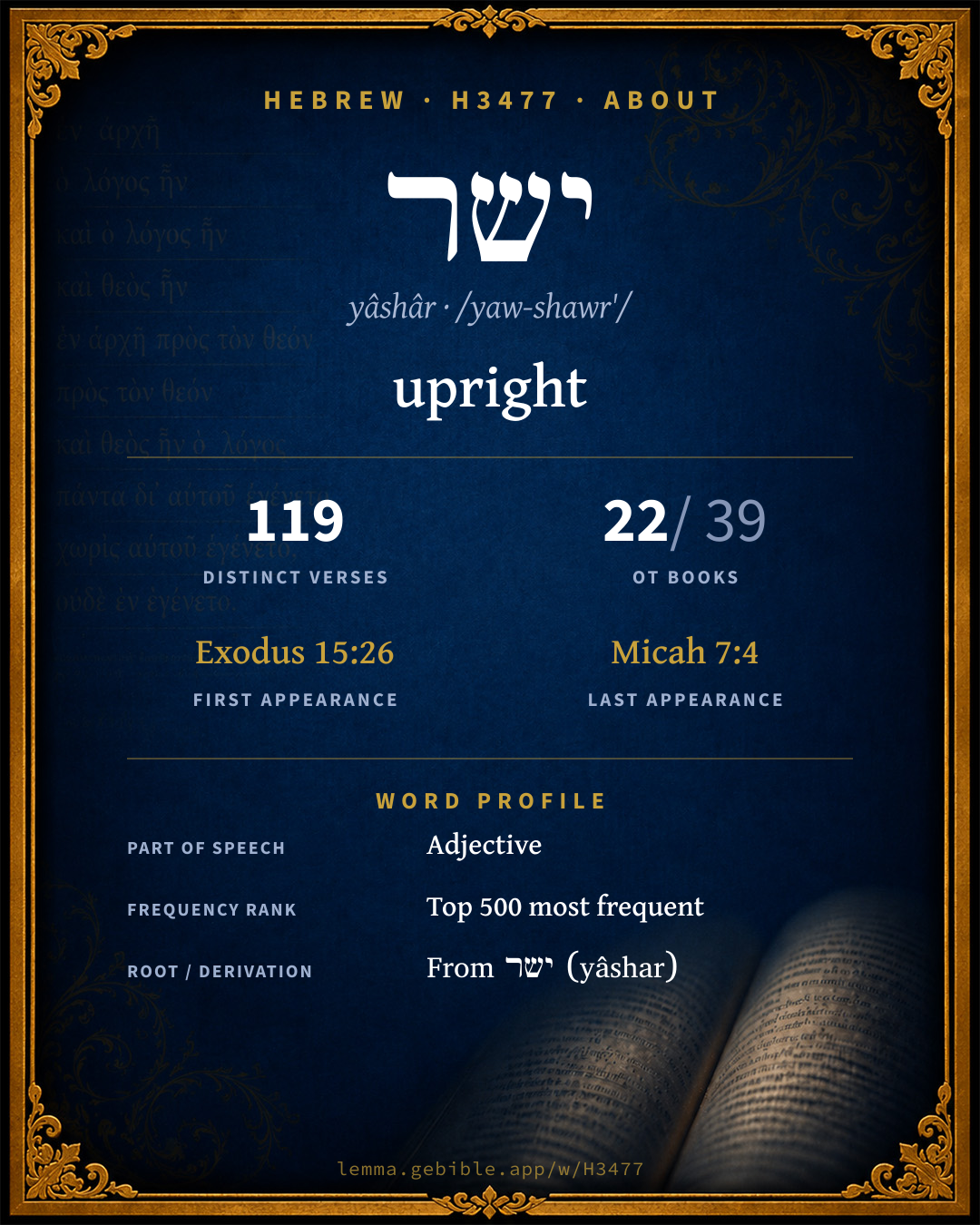
יָשָׁר
upright
also: straight, correct, right fuller range ↓
Full lexicon entry — Brown-Driver-Briggs (BDB)
From Brown-Driver-Briggs (BDB)
Where this word appears
See every Absolute-state word in the Hebrew Bible →
Grammar key — what these labels mean
Part of speech
- Adjective
- A word that describes or qualifies a noun.
State
- Absolute
- The independent form of a noun, not bound to a following word.
- Construct
- A noun bound to a following noun in a possessive / “of” relationship (the construct chain).
Gender
- Masculine
- Grammatically masculine.
- Feminine
- Grammatically feminine.
Number
- Singular
- One.
- Plural
- More than one (in Hebrew, generally three or more).
Grammatical forms
- Adjective, Adjective, Masculine, Singular, Absolute 71 times (60%)
- Adjective, Adjective, Masculine, Plural, Absolute 32 times (27%)
- Adjective, Adjective, Masculine, Plural, Construct 9 times (8%)
- Adjective, Adjective, Feminine, Singular, Absolute 5 times (4%)
- Adjective, Adjective, Feminine, Plural, Absolute 1 time (1%)
- Adjective, Adjective, Masculine, Singular, Construct 1 time (1%)
Parsed forms decoded from the imported morphology (morphhb / Westminster Leningrad Codex — WLC text public domain, morphhb tagging CC BY 4.0), counted across 119 parsed occurrences — not distinct verses.
Every verse where H3477 appears — 119 distinct verses across 22 books. Click any verse to open its interlinear word-by-word view. Verse text shown in the World English Bible for context — . Each verse’s Hebrew form is shown with its reference; the English is not keyword-highlighted, since the data carries no word-level English alignment. Use “Compare translations” on any verse to read it across multiple English versions. This concordance covers the Hebrew Bible; Septuagint (Greek Old Testament) occurrences are not indexed here.
Exodus 1 verse
Numbers 1 verse
Deuteronomy 7 verses
- Deuteronomy 6:18 הַ/יָּשָׁ֥ר ptcl def.art + Adjective Adjective ms You shall do that which is right and good in the sight of Yahweh; that it may be well with you, and that you may go in and possess the good land which Yahweh swore to your fathers,
- Deuteronomy 12:8 הַ/יָּשָׁ֥ר ptcl def.art + Adjective Adjective ms You shall not do after all the things that we do here this day, every man whatever is right in his own eyes;
- Deuteronomy 12:25 הַ/יָּשָׁ֖ר ptcl def.art + Adjective Adjective ms You shall not eat it; that it may go well with you, and with your children after you, when you shall do that which is right in the eyes of Yahweh.
- Deuteronomy 12:28 וְ/הַ/יָּשָׁ֔ר conj + ptcl def.art + Adjective Adjective ms Observe and hear all these words which I command you, that it may go well with you, and with your children after you forever, when you do that which is good and right in the eyes of Yahweh your God.
- Deuteronomy 13:18 הַ/יָּשָׁ֔ר ptcl def.art + Adjective Adjective ms when you shall listen to the voice of Yahweh your God, to keep all his commandments which I command you this day, to do that which is right in the eyes of Yahweh your God.
- Deuteronomy 21:9 הַ/יָּשָׁ֖ר ptcl def.art + Adjective Adjective ms So shall you put away the innocent blood from the midst of you, when you shall do that which is right in the eyes of Yahweh.
- Deuteronomy 32:4 וְ/יָשָׁ֖ר conj + Adjective Adjective ms The Rock, his work is perfect; For all his ways are justice: A God of faithfulness and without iniquity, Just and right is he.
Joshua 2 verses
- Joshua 9:25 וְ/כַ/יָּשָׁ֧ר conj + prep det + Adjective Adjective ms Now, behold, we are in your hand: as it seems good and right to you to do to us, do.
- Joshua 10:13 הַ/יָּשָׁ֑ר ptcl def.art + Adjective Adjective ms The sun stood still, and the moon stayed, Until the nation had avenged themselves of their enemies. Isn't this written in the book of Jashar? The sun stayed in the midst of the sky, and didn't hurry to go down about a whole day.
Judges 2 verses
- Judges 17:6 הַ/יָּשָׁ֥ר ptcl def.art + Adjective Adjective ms In those days there was no king in Israel: every man did that which was right in his own eyes.
- Judges 21:25 הַ/יָּשָׁ֥ר ptcl def.art + Adjective Adjective ms In those days there was no king in Israel: every man did that which was right in his own eyes.
1 Samuel 2 verses
- 1 Samuel 12:23 וְ/הַ/יְשָׁרָֽה conj + ptcl def.art + Adjective Adjective fs Moreover as for me, far be it from me that I should sin against Yahweh in ceasing to pray for you: but I will instruct you in the good and the right way.
- 1 Samuel 29:6 יָשָׁ֣ר adj Adjective ms Then Achish called David, and said to him, As Yahweh lives, you have been upright, and your going out and your coming in with me in the host is good in my sight; for I have not found evil in you since the day of your coming to me to this day: nevertheless the lords don't favor you.
2 Samuel 2 verses
- 2 Samuel 1:18 הַ/יָּשָֽׁר ptcl def.art + Adjective Adjective ms (and he bade them teach the children of Judah [the song of] the bow: behold, it is written in the book of Jashar):
- 2 Samuel 19:6 יָשָׁ֥ר adj Adjective ms in that you love those who hate you, and hate those who love you. For you have declared this day, that princes and servants are nothing to you: for this day I perceive that if Absalom had lived, and all we had died this day, then it had pleased you well.
1 Kings 6 verses
- 1 Kings 11:33 הַ/יָּשָׁ֧ר ptcl def.art + Adjective Adjective ms because that they have forsaken me, and have worshiped Ashtoreth the goddess of the Sidonians, Chemosh the god of Moab, and Milcom the god of the children of Ammon; and they have not walked in my ways, to do that which is right in my eyes, and [to keep] my statutes and my ordinances, as did David his father.
- 1 Kings 11:38 הַ/יָּשָׁ֤ר ptcl def.art + Adjective Adjective ms It shall be, if you will listen to all that I command you, and will walk in my ways, and do that which is right in my eyes, to keep my statutes and my commandments, as David my servant did; that I will be with you, and will build you a sure house, as I built for David, and will give Israel to you.
- 1 Kings 14:8 הַ/יָּשָׁ֥ר ptcl def.art + Adjective Adjective ms and tore the kingdom away from the house of David, and gave it you; and yet you have not been as my servant David, who kept my commandments, and who followed me with all his heart, to do that only which was right in my eyes,
- 1 Kings 15:5 הַ/יָּשָׁ֖ר ptcl def.art + Adjective Adjective ms because David did that which was right in the eyes of Yahweh, and didn't turn aside from anything that he commanded him all the days of his life, except only in the matter of Uriah the Hittite.
- 1 Kings 15:11 הַ/יָּשָׁ֖ר ptcl def.art + Adjective Adjective ms Asa did that which was right in the eyes of Yahweh, as did David his father.
- 1 Kings 22:43 הַ/יָּשָׁ֖ר ptcl def.art + Adjective Adjective ms He walked in all the way of Asa his father; He didn't turn aside from it, doing that which was right in the eyes of Yahweh: however the high places were not taken away; the people still sacrificed and burnt incense in the high places.
2 Kings 10 verses
- 2 Kings 10:3 וְ/הַ/יָּשָׁר֙ conj + ptcl def.art + Adjective Adjective ms look you out the best and meet of your master's sons, and set him on his father's throne, and fight for your master's house.
- 2 Kings 10:15 יָשָׁ֗ר adj Adjective ms When he was departed there, he lighted on Jehonadab the son of Rechab coming to meet him; and he greeted him, and said to him, Is your heart right, as my heart is with your heart? Jehonadab answered, It is. If it be, give me your hand. He gave him his hand; and he took him up to him into the chariot.
- 2 Kings 10:30 הַ/יָּשָׁר֙ ptcl def.art + Adjective Adjective ms Yahweh said to Jehu, Because you have done well in executing that which is right in my eyes, [and] have done to the house of Ahab according to all that was in my heart, your sons of the fourth generation shall sit on the throne of Israel.
- 2 Kings 12:2 הַ/יָּשָׁ֛ר ptcl def.art + Adjective Adjective ms Jehoash did that which was right in the eyes of Yahweh all his days in which Jehoiada the priest instructed him.
- 2 Kings 14:3 הַ/יָּשָׁר֙ ptcl def.art + Adjective Adjective ms He did that which was right in the eyes of Yahweh, yet not like David his father: he did according to all that Joash his father had done.
- 2 Kings 15:3 הַ/יָּשָׁ֖ר ptcl def.art + Adjective Adjective ms He did that which was right in the eyes of Yahweh, according to all that his father Amaziah had done.
- 2 Kings 15:34 הַ/יָּשָׁ֖ר ptcl def.art + Adjective Adjective ms He did that which was right in the eyes of Yahweh; he did according to all that his father Uzziah had done.
- 2 Kings 16:2 הַ/יָּשָׁ֗ר ptcl def.art + Adjective Adjective ms Twenty years old was Ahaz when he began to reign; and he reigned sixteen years in Jerusalem: and he didn't do that which was right in the eyes of Yahweh his God, like David his father.
- 2 Kings 18:3 הַ/יָּשָׁ֖ר ptcl def.art + Adjective Adjective ms He did that which was right in the eyes of Yahweh, according to all that David his father had done.
- 2 Kings 22:2 הַ/יָּשָׁ֖ר ptcl def.art + Adjective Adjective ms He did that which was right in the eyes of Yahweh, and walked in all the way of David his father, and didn't turn aside to the right hand or to the left.
2 Chronicles 11 verses
- 2 Chronicles 14:2 וְ/הַ/יָּשָׁ֔ר conj + ptcl def.art + Adjective Adjective ms Asa did that which was good and right in the eyes of Yahweh his God:
- 2 Chronicles 20:32 הַ/יָּשָׁ֖ר ptcl def.art + Adjective Adjective ms He walked in the way of Asa his father, and didn't turn aside from it, doing that which was right in the eyes of Yahweh.
- 2 Chronicles 24:2 הַ/יָּשָׁ֖ר ptcl def.art + Adjective Adjective ms Joash did that which was right in the eyes of Yahweh all the days of Jehoiada the priest.
- 2 Chronicles 25:2 הַ/יָּשָׁ֖ר ptcl def.art + Adjective Adjective ms He did that which was right in the eyes of Yahweh, but not with a perfect heart.
- 2 Chronicles 26:4 הַ/יָּשָׁ֖ר ptcl def.art + Adjective Adjective ms He did that which was right in the eyes of Yahweh, according to all that his father Amaziah had done.
- 2 Chronicles 27:2 הַ/יָּשָׁ֜ר ptcl def.art + Adjective Adjective ms He did that which was right in the eyes of Yahweh, according to all that his father Uzziah had done: however he didn't enter into the temple of Yahweh. The people did yet corruptly.
- 2 Chronicles 28:1 הַ/יָּשָׁ֛ר ptcl def.art + Adjective Adjective ms Ahaz was twenty years old when he began to reign; and he reigned sixteen years in Jerusalem: and he didn't do that which was right in the eyes of Yahweh, like David his father;
- 2 Chronicles 29:2 הַ/יָּשָׁ֖ר ptcl def.art + Adjective Adjective ms He did that which was right in the eyes of Yahweh, according to all that David his father had done.
- 2 Chronicles 29:34 יִשְׁרֵ֣י adj Adjective mp cs But the priests were too few, so that they could not flay all the burnt offerings: therefore their brothers the Levites helped them, until the work was ended, and until the priests had sanctified themselves; for the Levites were more upright in heart to sanctify themselves than the priests.
- 2 Chronicles 31:20 וְ/הַ/יָּשָׁר֙ conj + ptcl def.art + Adjective Adjective ms Thus did Hezekiah throughout all Judah; and he worked that which was good and right and faithful before Yahweh his God.
- 2 Chronicles 34:2 הַ/יָּשָׁ֖ר ptcl def.art + Adjective Adjective ms He did that which was right in the eyes of Yahweh, and walked in the ways of David his father, and didn't turn aside to the right hand or to the left.
Ezra 1 verse
Nehemiah 1 verse
Job 8 verses
- Job 1:1 וְ/יָשָׁ֛ר conj + Adjective Adjective ms There was a man in the land of Uz, whose name was Job. That man was blameless and upright, and one who feared God, and turned away from evil.
- Job 1:8 וְ/יָשָׁ֛ר conj + Adjective Adjective ms Yahweh said to Satan, "Have you considered my servant, Job? For there is none like him in the earth, a blameless and an upright man, one who fears God, and turns away from evil."
- Job 2:3 וְ/יָשָׁ֛ר conj + Adjective Adjective ms Yahweh said to Satan, "Have you considered my servant Job? For there is none like him in the earth, a blameless and an upright man, one who fears God, and turns away from evil. He still maintains his integrity, although you incited me against him, to ruin him without cause."
- Job 4:7 יְשָׁרִ֥ים adj Adjective mp "Remember, now, whoever perished, being innocent? Or where were the upright cut off?
- Job 8:6 וְ/יָשָׁ֗ר conj + Adjective Adjective ms If you were pure and upright, Surely now he would awaken for you, And make the habitation of your righteousness prosperous.
- Job 17:8 יְשָׁרִ֣ים adj Adjective mp Upright men shall be astonished at this. The innocent shall stir up himself against the godless.
- Job 23:7 יָ֭שָׁר adj Adjective ms There the upright might reason with him, So I should be delivered forever from my judge.
- Job 33:27 וְ/יָשָׁ֥ר conj + Adjective Adjective ms He sings before men, and says, 'I have sinned, and perverted that which was right, And it didn't profit me.
Psalms 25 verses
- Psalms 7:10 יִשְׁרֵי adj Adjective mp cs My shield is with God, Who saves the upright in heart.
- Psalms 11:2 לְ/יִשְׁרֵי prep + Adjective Adjective mp cs For, behold, the wicked bend their bows. They set their arrows on the strings, That they may shoot in darkness at the upright in heart.
- Psalms 11:7 יָ֝שָׁ֗ר adj Adjective ms For Yahweh is righteous. He loves righteousness. The upright shall see his face.
- Psalms 19:8 יְ֭שָׁרִים adj Adjective mp Yahweh's precepts are right, rejoicing the heart. Yahweh's commandment is pure, enlightening the eyes.
- Psalms 25:8 וְ/יָשָׁ֥ר conj + Adjective Adjective ms Good and upright is Yahweh, Therefore he will instruct sinners in the way.
- Psalms 32:11 יִשְׁרֵי adj Adjective mp cs Be glad in Yahweh, and rejoice, you righteous! Shout for joy, all you who are upright in heart!
- Psalms 33:1 לַ֝/יְשָׁרִ֗ים prep det + Adjective Adjective mp Rejoice in Yahweh, you righteous! Praise is fitting for the upright.
- Psalms 33:4 יָשָׁ֥ר adj Adjective ms For the word of Yahweh is right. All his work is done in faithfulness.
- Psalms 36:10 לְ/יִשְׁרֵי prep + Adjective Adjective mp cs Oh continue your loving kindness to those who know you, Your righteousness to the upright in heart.
- Psalms 37:14 יִשְׁרֵי adj Adjective mp cs The wicked have drawn out the sword, and have bent their bow, To cast down the poor and needy, To kill those who are upright in the way.
- Psalms 37:37 יָשָׁ֑ר adj Adjective ms Mark the perfect man, and see the upright, For there is a future for the man of peace.
- Psalms 49:14 יְשָׁרִ֨ים adj Adjective mp They are appointed as a flock for Sheol. Death shall be their shepherd. The upright shall have dominion over them in the morning. Their beauty shall decay in Sheol, Far from their mansion.
- Psalms 64:10 יִשְׁרֵי adj Adjective mp cs The righteous shall be glad in Yahweh, And shall take refuge in him. All the upright in heart shall praise him!
- Psalms 92:15 יָשָׁ֣ר adj Adjective ms To show that Yahweh is upright. He is my rock, And there is no unrighteousness in him.
- Psalms 94:15 יִשְׁרֵי adj Adjective mp cs For judgment will return to righteousness. All the upright in heart shall follow it.
- Psalms 97:11 וּֽ/לְ/יִשְׁרֵי conj + prep + Adjective Adjective mp cs Light is sown for the righteous, And gladness for the upright in heart.
- Psalms 107:7 יְשָׁרָ֑ה adj Adjective fs He led them also by a straight way, That they might go to a city to live in.
- Psalms 107:42 יְשָׁרִ֣ים adj Adjective mp The upright will see it, and be glad. All the wicked will shut their mouths.
- Psalms 111:1 יְשָׁרִ֣ים adj Adjective mp Praise Yah! I will give thanks to Yahweh with my whole heart, In the council of the upright, and in the congregation.
- Psalms 111:8 וְ/יָשָֽׁר conj + Adjective Adjective ms They are established forever and ever. They are done in truth and uprightness.
- Psalms 112:2 יְשָׁרִ֣ים adj Adjective mp His seed will be mighty in the land. The generation of the upright will be blessed.
- Psalms 112:4 לַ/יְשָׁרִ֑ים prep det + Adjective Adjective mp Light dawns in the darkness for the upright, Gracious, merciful, and righteous.
- Psalms 119:137 וְ֝/יָשָׁ֗ר conj + Adjective Adjective ms You are righteous, Yahweh. Your judgments are upright.
- Psalms 125:4 וְ֝/לִֽ/ישָׁרִ֗ים conj + prep + Adjective Adjective mp Do good, Yahweh, to those who are good, To those who are upright in their hearts.
- Psalms 140:13 יְ֝שָׁרִ֗ים adj Adjective mp Surely the righteous will give thanks to your name. The upright will dwell in your presence.
Proverbs 25 verses
- Proverbs 2:7 לַ֭/יְשָׁרִים prep det + Adjective Adjective mp He lays up sound wisdom for the upright. He is a shield to those who walk in integrity;
- Proverbs 2:21 יְשָׁרִ֥ים adj Adjective mp For the upright will dwell in the land. The perfect will remain in it.
- Proverbs 3:32 יְשָׁרִ֥ים adj Adjective mp For the perverse is an abomination to Yahweh, But his friendship is with the upright.
- Proverbs 8:9 וִֽ֝/ישָׁרִ֗ים conj + Adjective Adjective mp They are all plain to him who understands, Right to those who find knowledge.
- Proverbs 11:3 יְשָׁרִ֣ים adj Adjective mp The integrity of the upright shall guide them, But the perverseness of the treacherous shall destroy them.
- Proverbs 11:6 יְ֭שָׁרִים adj Adjective mp The righteousness of the upright shall deliver them, But the unfaithful will be trapped by evil desires.
- Proverbs 11:11 יְ֭שָׁרִים adj Adjective mp By the blessing of the upright, the city is exalted, But it is overthrown by the mouth of the wicked.
- Proverbs 12:6 יְ֝שָׁרִ֗ים adj Adjective mp The words of the wicked are about lying in wait for blood, But the speech of the upright rescues them.
- Proverbs 12:15 יָשָׁ֣ר adj Adjective ms The way of a fool is right in his own eyes, But he who is wise listens to counsel.
- Proverbs 14:9 יְשָׁרִ֣ים adj Adjective mp Fools mock at making atonement for sins, But among the upright there is good will.
- Proverbs 14:11 יְשָׁרִ֣ים adj Adjective mp The house of the wicked will be overthrown, But the tent of the upright will flourish.
- Proverbs 14:12 יָ֭שָׁר adj Adjective ms There is a way which seems right to a man, But in the end it leads to death.
- Proverbs 15:8 יְשָׁרִ֣ים adj Adjective mp The sacrifice made by the wicked is an abomination to Yahweh, But the prayer of the upright is his delight.
- Proverbs 15:19 יְשָׁרִ֣ים adj Adjective mp The way of the sluggard is like a thorn patch, But the path of the upright is a highway.
- Proverbs 16:13 יְשָׁרִ֣ים adj Adjective mp Righteous lips are the delight of kings. They value one who speaks the truth.
- Proverbs 16:17 יְ֭שָׁרִים adj Adjective mp The highway of the upright is to depart from evil. He who keeps his way preserves his soul.
- Proverbs 16:25 יָ֭שָׁר adj Adjective ms There is a way which seems right to a man, But in the end it leads to death.
- Proverbs 20:11 יָשָׁ֣ר adj Adjective ms Even a child makes himself known by his doings, Whether his work is pure, and whether it is right.
- Proverbs 21:2 יָשָׁ֣ר adj Adjective ms Every way of a man is right in his own eyes, But Yahweh weighs the hearts.
- Proverbs 21:8 יָשָׁ֥ר adj Adjective ms The way of the guilty is devious, But the conduct of the innocent is upright.
- Proverbs 21:18 יְשָׁרִ֣ים adj Adjective mp The wicked is a ransom for the righteous; The treacherous for the upright.
- Proverbs 21:29 וְ֝/יָשָׁ֗ר conj + Adjective Adjective ms A wicked man hardens his face; But as for the upright, he establishes his ways.
- Proverbs 28:10 יְשָׁרִ֨ים adj Adjective mp Whoever causes the upright to go astray in an evil way, He will fall into his own trap; But the blameless will inherit good.
- Proverbs 29:10 וִֽ֝/ישָׁרִ֗ים conj + Adjective Adjective mp The bloodthirsty hate a man of integrity; And they seek the life of the upright.
- Proverbs 29:27 יְשַׁר adj Adjective ms cs A dishonest man detests the righteous, And the upright in their ways detest the wicked.
Ecclesiastes 1 verse
Isaiah 1 verse
Jeremiah 5 verses
- Jeremiah 26:14 וְ/כַ/יָּשָׁ֖ר conj + prep det + Adjective Adjective ms But as for me, behold, I am in your hand: do with me as is good and right in your eyes.
- Jeremiah 31:9 יָשָׁ֔ר adj Adjective ms They shall come with weeping; and with petitions will I lead them: I will cause them to walk by rivers of waters, in a straight way in which they shall not stumble; for I am a father to Israel, and Ephraim is my firstborn.
- Jeremiah 34:15 הַ/יָּשָׁר֙ ptcl def.art + Adjective Adjective ms You were now turned, and had done that which is right in my eyes, in proclaiming liberty every man to his neighbor; and you had made a covenant before me in the house which is called by my name:
- Jeremiah 40:4 הַ/יָּשָׁ֧ר ptcl def.art + Adjective Adjective ms Now, behold, I loose you this day from the chains which are on your hand. If it seem good to you to come with me into Babylon, come, and I will look well to you; but if it seem ill to you to come with me into Babylon, forbear: behold, all the land is before you; where it seems good and right to you to go, there go.
- Jeremiah 40:5 הַ/יָּשָׁ֧ר ptcl def.art + Adjective Adjective ms Now while he was not yet gone back, Go back then, [said he], to Gedaliah the son of Ahikam, the son of Shaphan, whom the king of Babylon has made governor over the cities of Judah, and dwell with him among the people; or go wherever it seems right to you to go. So the captain of the guard gave him food and a present, and let him go.
Ezekiel 2 verses
- Ezekiel 1:7 יְשָׁרָ֑ה adj Adjective fs Their feet were straight feet; and the sole of their feet was like the sole of a calf's foot; and they sparkled like burnished brass.
- Ezekiel 1:23 יְשָׁר֔וֹת adj Adjective fp Under the expanse were their wings straight, the one toward the other: everyone had two which covered on this side, and every one had two which covered on that side, their bodies.
Daniel 1 verse
Hosea 1 verse
Micah 4 verses
- Micah 2:7 הַ/יָּשָׁ֥ר ptcl def.art + Adjective Adjective ms Shall it be said, O house of Jacob: "Is the Spirit of Yahweh angry? Are these his doings? Don't my words do good to him who walks blamelessly?"
- Micah 3:9 הַ/יְשָׁרָ֖ה ptcl def.art + Adjective Adjective fs Please listen to this, you heads of the house of Jacob, And rulers of the house of Israel, Who abhor justice, And pervert all equity.
- Micah 7:2 וְ/יָשָׁ֥ר conj + Adjective Adjective ms The godly man has perished out of the earth, And there is no one upright among men. They all lie in wait for blood; Every man hunts his brother with a net.
- Micah 7:4 יָשָׁ֖ר adj Adjective ms The best of them is like a brier. The most upright is worse than a thorn hedge. The day of your watchmen, Even your visitation, has come; Now is the time of their confusion.
About this entry
At a glance — auto-summarized from this page’s data, not written by a person. Every figure links to its source below. This summary describes the numbers; it doesn’t interpret them.
ישר — transliterated yâshâr — is a Hebrew adjective carrying the sense “upright.” Alongside “upright” the lexicon also lists “straight”, “correct”, and “right” — part of its full sense range. The Hebrew Bible uses it across 119 verses — common. Debuting at Exodus 15:26, it then recurs through the corpus. It shares a root with ישר, ישר and מישור. See the sense tree, 119-verse concordance, and the renderings breakdown below.
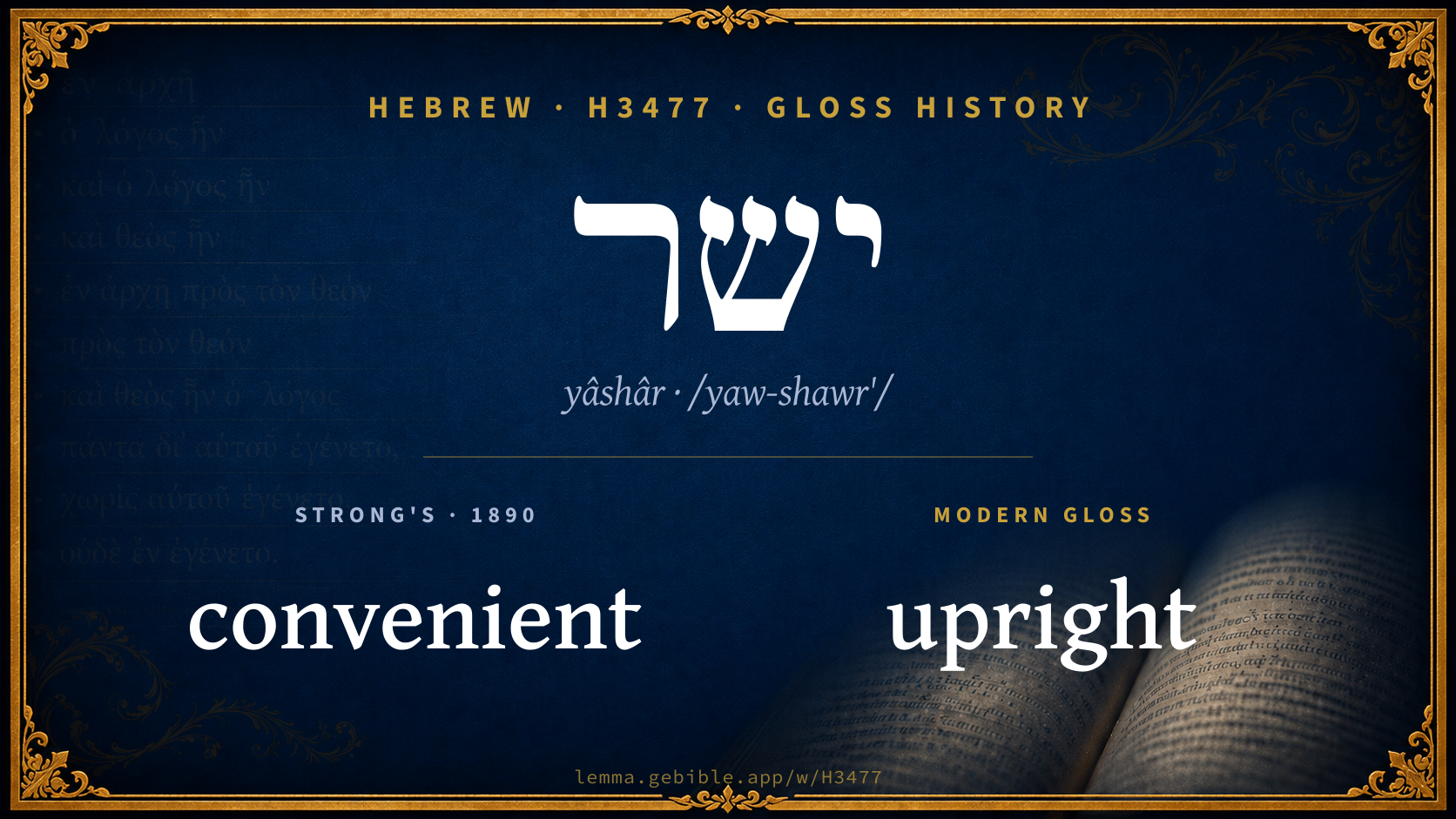
Gloss history
Strong's 1890 vs modern scholarship
About this word
Strong's H3477 catalogs a Hebrew word from the Hebrew Old Testament.
These counts are not copied from any lexicon or concordance. They are computed here, from the morphology-tagged Hebrew Old Testament. What Lemma adds →
- 119
- distinct verses
- The word appears in 119 distinct verses.
- 22 / 39
- OT books
- The word appears in 22 of 39 Old Testament books.
- #363
- by frequency
- Top 500 most frequent Hebrew words (rank 363 of 8,640 Hebrew words by occurrence).
View all 119 occurrences in the concordance →
Most concentrated in
- Psalms 25 verses 21%
- Proverbs 25 verses 21%
- 2 Chronicles 11 verses 9%
By section of the Old Testament
By traditional corpus
Conventional, traditional groupings — biblical authorship is debated, so this is a traditional corpus grouping, not an authorship claim. Each share is this word’s portion of its verses in that division of the Hebrew canon. Each figure is a share of the word’s 119 distinct verses.
- Writings (Ketuvim) 73 verses · 61%
- Prophets (Nevi'im) 37 verses · 31%
- Torah (Pentateuch) 9 verses · 8%
How translations render this word
Counts come from each version’s own published word-to-Strong’s tagging or interlinear alignment — an approximate guide to how each version renders this word, not a word-level alignment the data otherwise carries. Because each total is that version’s own tagged count, the per-version totals vary from one another and need not match the appearance or distinct-verse counts above. These counts may also differ from a printed concordance because Lemma counts each distinctly tagged rendering and does not collapse phrase taggings into a single head-word total. This is a fixed set of word-tagged versions (KJV, ASV, BSB, ULT) and does not change with the reading translation you choose elsewhere. Each version’s license is shown beside its name below (and on Sources).
- King James Version: Upright 30×, Was right 21×, Right 13×
- American Standard Version: Upright 29×, Was right 19×, Is right 11×
- Berean Standard Bible: Upright 47×, Right 23×, Is right 9×
- unfoldingWord Literal Text: Upright 32×, Right 24×, Was right 8×
King James Version Public Domain
Renders H3477 across 119 tagged occurrences — most commonly:
Plus 28 renderings that appear only once — usually multi-word phrases or single function words the recovered tagging swept in, not distinct renderings.
American Standard Version Public Domain
Renders H3477 across 117 tagged occurrences — most commonly:
Plus 32 renderings that appear only once — usually multi-word phrases or single function words the recovered tagging swept in, not distinct renderings.
Berean Standard Bible Public Domain
Renders H3477 across 119 tagged occurrences — most commonly:
Plus 24 renderings that appear only once — usually multi-word phrases or single function words the recovered tagging swept in, not distinct renderings.
unfoldingWord Literal Text CC BY-SA 4.0
Renders H3477 across 126 tagged occurrences — most commonly:
Plus other, less common renderings. Plus 19 renderings that appear only once — usually multi-word phrases or single function words the recovered tagging swept in, not distinct renderings.
9 senses and sub-senses in the full BDB
What do BDB’s symbols mean?
BDB uses these scholarly abbreviations:
| Symbol | Meaning |
|---|---|
| 𝔊 | the Septuagint (the ancient Greek translation, LXX) |
| 𝔙 | the Vulgate (the Latin translation) |
| 𝔖 | the Syriac version (the Peshitta) |
| 𝔗 | the Targum (the Aramaic translation) |
| ψ | the Psalms |
| √ | root (the underlying root or stem) |
| ‖ | parallel passage (a synonymous or contrasted parallel) |
| † | the dagger: every passage where the word occurs is cited |
The 9 senses and sub-senses the full Brown-Driver-Briggs lexicon distinguishes for this word, in lexicon order (not ranked by frequency), with BDB’s own verbatim wording and sub-sense lettering. Shown in Hebrew script with BDB’s own scholarly abbreviations. The condensed entry is in the Lexicon Entry tab. See also the Forms in the corpus table below.
- 1. straight, level, of a way Is 26:7 Je 31:9 ψ 107:7 Ezr 8:21; foot Ez 1:7; wings v 23 (? v. supr.) e.g. Isaiah 26:7
- 2. right, pleasing:
- a. to God, הַיָּשָׁר בעיני that which is right, pleasing in the eyes of, agreeable to (either cstr. before י׳, or with sfs. referring to him), especially in Deut. writers, Ex 15:26 (R), Dt 12:25; 13:19; 21:9 1 K 11:33, 38; 14:8, 15:5, 11; 22:43 = 2 Ch 20:32, 2 K 10:30, 12:3; 14:3; 15:3, 34; 16:2; 18:3; 22:2 = 2 Ch 24:2; 25:2; 26:4; 27:2; 28:1; 29:2; 34:2, Je 34:15; הישׁר והטוב בעיני י׳ Dt 6:18; הטוב והישׁר בעיני י׳ 12:28 2 Ch 14:1; הטוב והישׁר והאמת לפני י׳ 31:20. e.g. Exodus 15:26
- b. to man, (ה)ישׁר בעיני Dt 12:8 Ju 17:6; 21:25 2 S 19:7 Je 40:5 Pr 12:15; 21:2; (ה)טוב ו(ה)ישׁר בעיני Jos 9:25 (D), Je 26:14; 40:4; יֵשׁ דֶּרֶךְ יָשָׁר לִפְנֵי־אִישׁ Pr 14:12 there is a way which is pleasing before a man = 16:25. e.g. Deuteronomy 12:8
- 3. straightforward, just, upright:
- a. of God, צַדִּיק וְיָשָׁר הוּא Dt 32:4 (song); טוב וישׁר י׳ ψ 25:8; ישׁר י׳ 92:16; his ways Ho 14:10; his משׁפטים Ne 9:13 ψ 119:137; פִּקּוּדִים 19:9; דָּבָר 33:4; the words of divine wisdom Pr 8:9. e.g. Deuteronomy 32:4
- b. of man, God made him upright Ec 7:29; but יָשָׁר בָּאָדָם אָ֑יִן Mi 7:2 an upright man among men there is none, and yet Job is תָּם וְיָשָׁר Jb 1:1 (v. Da), v 8; 2:3, cf. ψ 37:37; זַךְ וישׁר Jb 8:6; so earlier of David as an uprightman 1 S 29:6; of man’s doings ‖ זַךְ Pr 20:11, cf. 21:8; of his way of life ‖ טובה 1 S 12:23; יְשַׁר־דֶּרֶךְ Pr 29:27; יִשְׁרִי־דֶרֶךְ ψ 37:14; of his heart, mind, and will, יִשְׁרֵי לֵבָב upright of heart 2 Ch 29:34; רִשְׁרֵי־לֵב ψ 7:11; 11:2; 32:11; 36:11; 64:11; 94:15; 97:11; יְשָׁרִים בְּלִבּוֹתָם 125:4. e.g. Ecclesiastes 7:29
- c. as a noun, (1) with ref. to things, יָשָׁר הֶעֱוֵיתִי the right I have perverted Jb 33:27; הַיְשָׁרָה יְעַקֵּ֑שׁוּ Mi 3:9 pervert the right (lit. twist that which is straight); דֹּבֵר יְשָׁרִים speaketh right things Pr 16:13, cf. 2 K 10:15. (2) more commonly of men, in sg. (ה)יָשָׁר Mi 2:7; 7:4 2 K 10:3 Pr 21:29 Jb 23:7; collective, ψ 11:7; also in סֵפֶר הַיָּשָׁר book of the upright Jos 10:13 2 S 1:18 (cf. 1 K 8:53 𝔊; DrIntr. 182), a collection of ancient national poetry; in pl. יְשָׁרִים the upright, of pious Israel Nu 23:10 (song E); elsewhere of the upright among the people of God as distinguished from the wicked, in WisdLt, Jb 4:7; 17:8 Pr 2:7, 21; 3:32; 11:3, 6, 11; 12:6; 14:9, 11; 15:8, 19; 16:17; 21:18; 28:10; 29:10, in late ψψ 33:1; 49:15; 107:42; 111:1; 112:2, 4; 140:14 and Dn 11:17. e.g. Job 33:27
- 4. abstr., uprightness, בֶּאֱמֶת וְיָשָׁר ψ 111:8 (Thes), but read rather ישֶׁר with Hi Ri Bae, after 𝔊 𝔖 𝔗 Jer. e.g. Psalms 111:8
Senses from the full Brown-Driver-Briggs lexicon (Brown, Driver, Briggs; Oxford 1906 — public domain), digitized via Sefaria, supplemented by the OpenScriptures HebrewLexicon (CC BY 4.0). Full attribution on Sources.
Word origin
adj. straight, right;—י׳ 1 S 29:6 + 70 times; cstr. יְשַׁר Pr 29:27; f. יְשָׁרָה Ez 1:7 + 4 times; pl. יְשָׁרִים Nu 23:10 + 31 times; cstr. יִשְׁרֵי ψ 7:11 + 8 times; f. יְשָׁרוֹת Ez 1:23 (del. Co);—
— Brown-Driver-Briggs (Oxford 1906, public domain), digitized via Sefaria, supplemented by the OpenScriptures HebrewLexicon (CC BY 4.0). See Sources.
Derived from ישר (yâshar) (H3474) — to be right.
Jastrow Dictionary
A second Hebrew/Aramaic lexicon for comparison, covering Aramaic and post-biblical (Talmudic, Targumic, Midrashic) usage that the biblical-Hebrew BDB does not. Matched by lemma rather than by Strong’s number, so a lemma may carry more than one Jastrow headword (shown separately below), and the entries cover usage well beyond the Bible.
יָשַׁר
- to be firm, strong, healthy; to be straight, right. יִישַׁר כֹּחֲךָ or חֵילְךָ ‘may thy strength (health) be firm’, a phrase of approval and thanks. Sabb. 87ᵃ, a. fr. (play on אֲשֶׁר, Ex. XXXIV, 1) י׳ כ׳ ששברת, be thanked for having broken (the tablets). Gen. R. s. 54 (play on וישרנה, I Sam. VI, 12) י׳ חילכם; a. e.—(יֵשַׁר) יִישַׁר (sub. כחך) thanks! right! Ber. 42ᵇ; Sabb. 53ᵃ; Erub. 32ᵇ; a. fr.—Cmp. אַיְשַׁר. e.g. Exodus 34:1
- to straighten, direct, to make firm. Ex. R. s. 1 (ref. to יֵשֶׁר, I Chr. II, 18) זה כלב שיי׳ את עצמו that is Caleb who kept himself straight (did not yield to the rest of the spies). Num. R. s. 8 (ref. to Ps. L, 23 ושם דרך) המְיַישֵּׁר אורחותיו וכ׳ he who directs his ways straight (pays regard to his doings).—Part. pass. מְיוּשָּׁר, f. מְיוּשֶּׁרֶת. Pirké d’R. El. ch. X דרכי מי׳ לפני my way is levelled before me.—Meg. 18ᵇ (ref. to יישרו, Prov. IV, 25) מְיוּשָּׁרִין הן אצל וכ׳ they remain firm with (in the memory of) &c. e.g. 1 Chronicles 2:18
יְשַׁר
- Targ. II Esth. VII, 9 יִישַׁר חילך (Var. יִשַּׁר). [Cant. R. to I, 4 ישריין, v. next w.]
- to be strengthened. Targ. Y. Deut. X, 2, v. אֲשַׁר.
יָשָׁר
- preced.) firm, sound; straight, right, upright. Gen. R. s. 49 אברהם זה י׳ מן היְשָׁרִים this Abraham is firmer than all the firm (angels); Yalk. ib. 82 אברהם זה י׳; Midr. Till. to Ps. XI, 7 קודם לִישָׁרוֹ של עולם וכ׳ before they see the Right One of the world, they (the pious) shall behold the faces of the firm (believers); a. fr.—Pl. יְשָׁרִים, יְשָׁרִין. Cant. R. to I, 4 מה ישריין רחמיך, [read as:] Yalk. ib. 982 מה ישרים וכ׳, expl. מה תקיפין וכ׳ how strong are thy mercies. Midr. Till. l. c. איזו כת … זו כת י׳ which is the highest class among those who will greet the countenance of the Divine Presence (in the hereafter)? The class of the firm believers. Midr. Till. to Ps. XXV, 14 … בתחלה ואה"כ נתן לי׳ first the secret of the Lord is communicated to those who fear him (human beings), and then to the firm ones (the angels, cmp. יְצוּקִים s. v. יָצַק); Gen. R. s. 49; a. e.—Fem. יְשָׁרָה, pl. יְשָׁרוֹת (sub בעיניו; with ref. to Deut. XII, 8) [right in the eyes of the offerer,] free-will offerings (opp. חוֹבָה). Zeb. 114ᵃ י׳ תקריבו וכ׳ free-will sacrifices you may offer (on the bamoth, v. בָּמָה), but no obligatory offerings; ib. 117ᵇ. Ib. י׳ נינהו they belong to the class of free-will offerings. Ib. 118ᵃ; a. fr.—סֵפֶר הַיָּשָׁר the Book Yashar, a lost book (Josh. X, 13; II Sam. I, 18). Ab. Zar. 25ᵃ. Y. Sot. I, end, 17ᶜ e.g. Deuteronomy 12:8
A Dictionary of the Targumim, the Talmud Babli and Yerushalmi, and the Midrashic Literature (Marcus Jastrow; London, Luzac, 1903) — Public Domain. Digitized via Sefaria. Digitized via Sefaria. Full attribution on Sources.
Forms in the corpus
The 55 distinct written forms H3477 takes in the Hebrew Bible, most frequent first — each parse links to that state’s occurrences in the concordance. Hebrew forms include their vowel points and cantillation, so a single lemma takes many written forms.
Same root — word family
Other BDB entries built from the same root as H3477, grouped by Strong’s listed origin. These share a root / origin per the lexicon — not necessarily a shared meaning. Each links to that word’s own entry.
Derives from
Shares the same root
Derived from this word
Proper names from this root
People and places named from this root — a name, not an additional meaning of the word.
- ישר Yêsher H3475 Jesher
- ישרון Yᵉshurûwn H3484 Jeshurun
- שרון Shârôwn H8289 Sharon
- ישראלה Yᵉsarʼêlâh H3480 Jesharelah
Compare all same-root words → Showing 4 of 10 — not the complete family. 4 of the same-root words are proper names (people or places). They share a root, not necessarily a meaning.
Septuagint verse parallels
This word appears in 111 verses that also exist in the Greek Old Testament (Septuagint), out of the 119 Hebrew verses it occurs in. You can read those verses in Greek by switching the Old Testament edition to the Septuagint.
Read these verses in the Septuagint
- Exodus 15:26
- Numbers 23:10
- Deuteronomy 6:18
- Joshua 9:25
- Judges 17:6
- 1 Samuel 12:23
- 2 Samuel 1:18
- 1 Kings 11:33
- 2 Kings 10:3
- 2 Chronicles 14:2
- Ezra 8:21
- Job 1:1
This is a verse-level parallel only — the same verses exist in both the Hebrew and Greek Old Testaments. No word-level Hebrew↔Greek correspondence is claimed: the data carries no such alignment, so no Greek word is shown as this Hebrew word’s translation. Coverage is not total — the Septuagint omits the deuterocanon and renumbers the Psalms, so some Hebrew verses have no direct Greek parallel.