
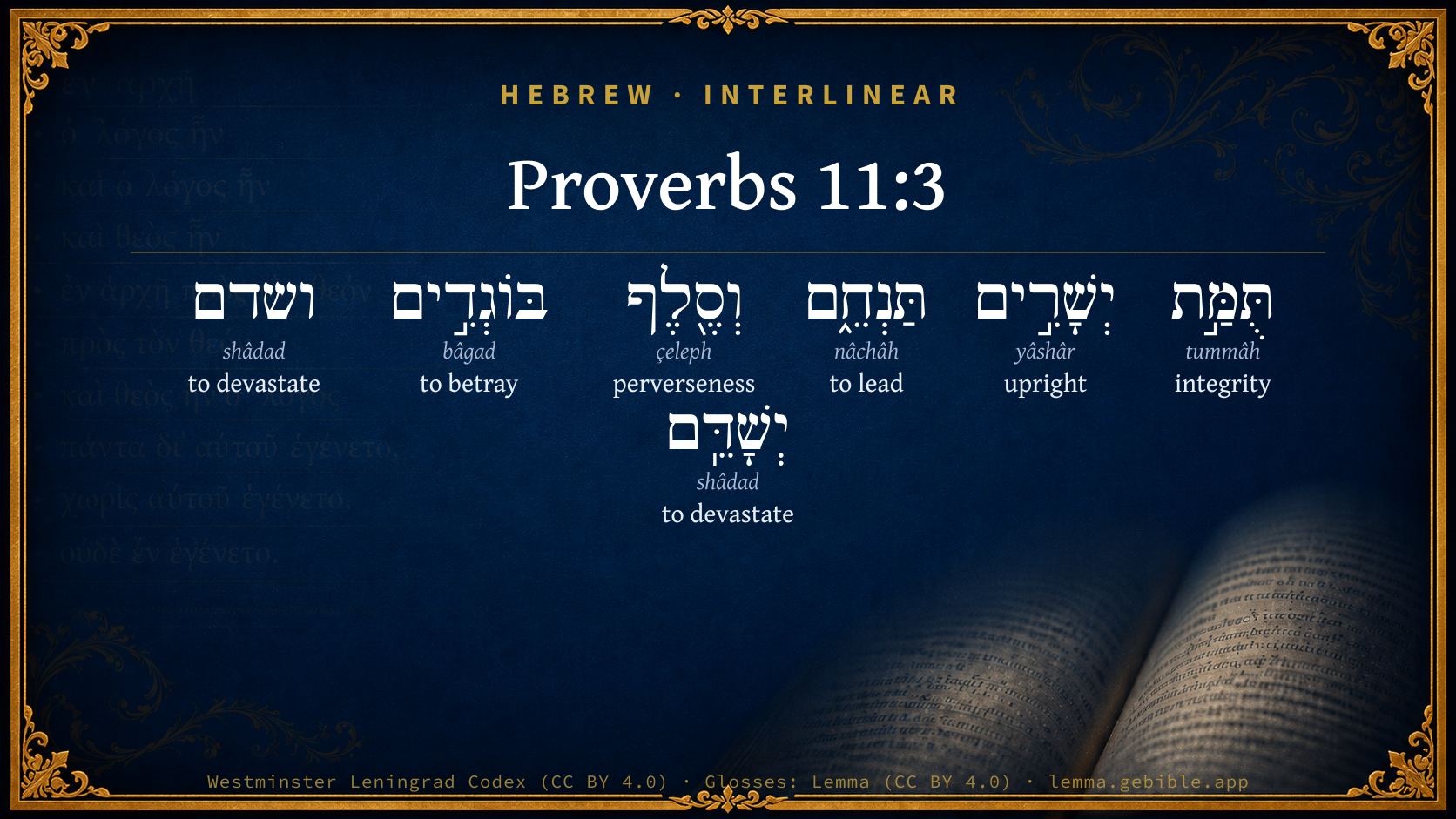
Proverbs 11:3

Hebrew (Westminster Leningrad Codex) Proverbs 11:3 appears in the Hebrew Old Testament. The text above is from the Westminster Leningrad Codex. Each word links to its Strong’s number, a concise gloss, and parsing drawn from the Open Scriptures Hebrew Bible morphology. Click any word for its full Brown-Driver-Briggs (BDB) entry.
Download image
Cite this verse

Proverbs 11:3 (World English Bible). Public Domain. Lemma interlinear Bible study tool, https://lemma.gebible.app/v/proverbs/11/3.

Show BibTeX & RIS
BibTeX
RIS
English Translation
The integrity of the upright shall guide them, But the perverseness of the treacherous shall destroy them.
World English Bible · Public Domain
Highlights
  • 1 first appearance in the Hebrew Bible
Full analysis ↓
Download a study sheet

One document with this verse’s original text, its word-by-word gloss line, the meaning frame, cross-references with their text, attributed commentary, and full source and license credits — printable, and it pastes into notes with its structure intact.

This verse Autodidact and up

Study sheet (.html) Plain text (.txt)

A passage Seminary Student

Up to 50 verses in one chapter. A passage sheet keeps up to 6 commentary sources and 12 cross-references per verse, in the order this page ranks them, and says so on the sheet whenever that leaves anything out. Ask for a single verse and you get the Autodidact verse sheet above.

Everything on this page stays free to read, with no account — the sheet is a download of what is already on screen, not access to it.

Want to remove ads? Support Godless Engineer
Compare translations 3

The same verse in 3 English versions, stacked beneath the original-language interlinear above. Click any original word for its lexicon entry.

Each is an independent rendering of the whole verse — the interlinear is not word-aligned to these translations.

Highlighted words mark where these versions differ — a whole-verse word diff, not a word-by-word alignment.

  • World English Bible Public Domain
    The integrity of the upright shall guide them, But the perverseness of the treacherous shall destroy them.
  • King James Version Public Domain
    The integrity of the upright shall guide them: but the perverseness of transgressors shall destroy them.
  • unfoldingWord Literal Text CC BY-SA 4.0
    The integrity of the upright ones will guide them, but the crookedness of the treacherous ones will destroy them.

unfoldingWord Literal Text — © unfoldingWord, licensed CC BY-SA 4.0. Word-aligned USFM3 via Door43 (git.door43.org/unfoldingWord/en_ult).

Versions to compare (up to 4)

3 of 4 selected

Show all 18 translations

Every available English version of this verse, each an independent rendering of the whole verse.

  • World English Bible Public Domain
    The integrity of the upright shall guide them, But the perverseness of the treacherous shall destroy them.
  • Berean Standard Bible Public Domain
    The integrity of the upright guides them, but the perversity of the faithless destroys them.
  • Majority Standard Bible Public Domain
    The integrity of the upright guides them, but the perversity of the faithless destroys them.
  • King James Version Public Domain
    The integrity of the upright shall guide them: but the perverseness of transgressors shall destroy them.
  • American Standard Version (1901) Public Domain
    The integrity of the upright shall guide them; But the perverseness of the treacherous shall destroy them.
  • Revised Version (1885) Public Domain
    The integrity of the upright shall guide them: but the perverseness of the treacherous shall destroy them.
  • Geneva Bible (1599) Public Domain
    The vprightnes of the iust shall guide them: but the frowardnes of the transgressers shall destroy them.
  • Douay-Rheims (1899) Public Domain
    The simplicity of the just shall guide them: and the deceitfulness of the wicked shall destroy them.
  • Young's Literal Translation Public Domain
    The integrity of the upright leadeth them, And the perverseness of the treacherous destroyeth them.
  • Literal Standard Version CC BY-SA 4.0
    The integrity of the upright leads them, || And the perverseness of the treacherous destroys them.
  • Unlocked Literal Bible CC BY-SA 4.0
    The integrity of the upright guides them, but the crooked ways of the treacherous destroy them.
  • unfoldingWord Literal Text CC BY-SA 4.0
    The integrity of the upright ones will guide them, but the crookedness of the treacherous ones will destroy them.
  • Darby Bible Public Domain
    The integrity of the upright guideth them; but the crookedness of the unfaithful destroyeth them.
  • World Messianic Bible Public Domain
    The integrity of the upright shall guide them, but the perverseness of the treacherous shall destroy them.
  • Webster's Bible Public Domain
    The integrity of the upright shall guide them: but the perverseness of transgressors shall destroy them.
  • Free Bible Version CC BY-SA 4.0
    Honesty guides the good, but deceit destroys liars.
  • Bible in Basic English Public Domain
    The righteousness of the upright will be their guide, but the twisted ways of the false will be their destruction.
  • JPS Tanakh (1917) Public Domain
    The integrity of the upright shall guide them; but the perverseness of the faithless shall destroy them.

Literal Standard Version (2020), Covenant Press — licensed CC BY-SA 4.0. Text via the HelloAO Bible API (eBible.org). Unlocked Literal Bible (unfoldingWord) — licensed CC BY-SA 4.0. Text via the HelloAO Bible API (eBible.org). unfoldingWord Literal Text — © unfoldingWord, licensed CC BY-SA 4.0. Word-aligned USFM3 via Door43 (git.door43.org/unfoldingWord/en_ult). Free Bible Version, Dr. Jonathan Gallagher — licensed CC BY-SA 4.0. Text via the HelloAO Bible API (eBible.org).

Word by word

More ways to search: Search by grammar → Find every occurrence → Compare this word →

Practice this passage: Drill this verse → Learn its vocabulary →

About this verse

These counts appear in no published source. They are computed here, from the morphology-tagged text and Lemma’s own curated glosses. What Lemma adds →

7
words
6
distinct lemmas
Wisdom
section

Notable vocabulary

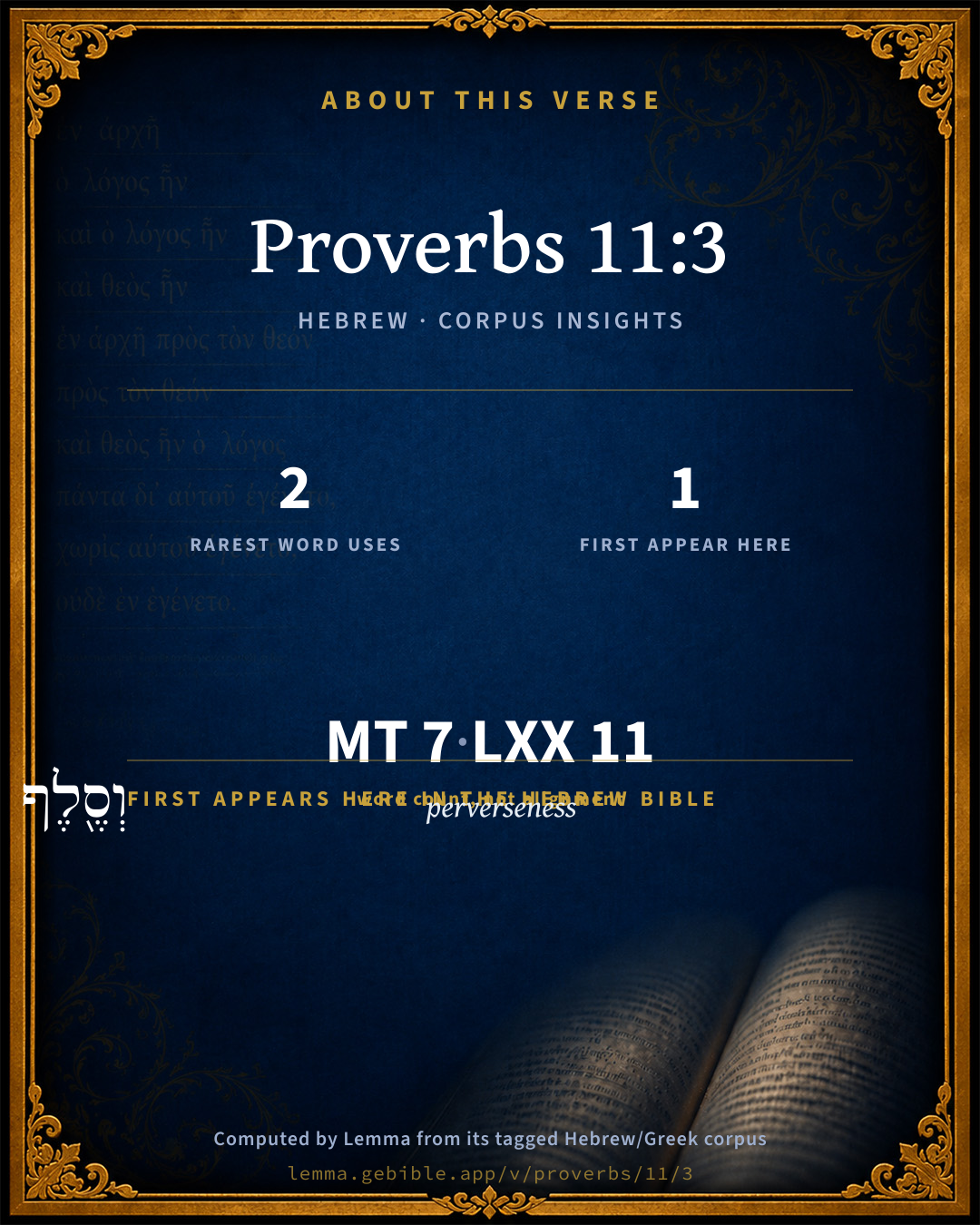
The rarest word here is וְסֶ֖לֶף perverseness H5558 — appearing just 2 times in the whole Hebrew Bible.

First appearance in Scripture

This word makes its first canonical appearance in the Hebrew Bible here:

  • וְסֶ֖לֶף perverseness H5558

Shared distinctive vocabulary

וְסֶ֖לֶף perverseness H5558 occurs in 2 verses of the Hebrew Bible. Also found in:

Grammatical profile

  • 3 verbs
  • 3 nouns
  • 1 adjective

Verb forms

  • תַּנְחֵ֑ם Hiphil · Imperfect
  • בּוֹגְדִ֣ים Qal · Participle Active
  • יְשָׁדֵּֽם Qal · Imperfect

Repetition

A word recurs within this verse — often emphatic in Hebrew:

  • ושדם to devastate H7703 ×2

Hebrew & Septuagint length

In English translation the verse runs 17 words from the Hebrew and 19 from the Septuagint (LXX English) — closely comparable.

A rough comparison of the two English renderings, which tokenize alike — not a word-level alignment.

Word counts can differ between the Hebrew and the Greek without any difference in meaning — e.g. the Hebrew direct-object marker אֵת has no separate Greek word, and Greek often adds the article ὁ.

In the original languages it is 7 Hebrew tokens and 11 Greek tokens — but the two are counted differently (Hebrew bundles its prefixes and suffixes into one token; the Greek is in lemma form), so that isn’t a like-for-like length.

Cross-references

10

Topical passages linked to Proverbs 11:3 in the Treasury of Scripture Knowledge — connected by theme and wording, ordered by reader-vote popularity; previews shown in the World English Bible.

  • Proverbs 28:18 Whoever walks blamelessly is kept safe; But one with perverse ways will fall suddenly.
  • Proverbs 13:6 Righteousness guards the way of integrity, But wickedness overthrows the sinner.
  • Psalms 25:21 Let integrity and uprightness preserve me, For I wait for you.
  • Psalms 26:1 Judge me, Yahweh, for I have walked in my integrity. I have trusted also in Yahweh without wavering.
  • Proverbs 19:3 The foolishness of man subverts his way; His heart rages against Yahweh.
  • John 7:17 If anyone desires to do his will, he will know about the teaching, whether it is from God, or if I am speaking from myself.
  • Proverbs 11:5 The righteousness of the blameless will direct his way, But the wicked shall fall by his own wickedness.
  • Ecclesiastes 7:17 Don't be too wicked, neither be foolish. Why should you die before your time?
  • Isaiah 1:28 But the destruction of transgressors and sinners shall be together, And those who forsake Yahweh shall be consumed.
  • Proverbs 21:7 The violence of the wicked will drive them away, Because they refuse to do what is right.

Cross-references courtesy of OpenBible.info (CC BY 4.0).

Hebrew and Greek witnesses Masoretic Hebrew ↔ Greek Septuagint

The same verse in the two great witnesses to the Old Testament, shown verse-for-verse.

These are two independent witnesses, not word-aligned to each other, and the Septuagint is shown in lemma (dictionary) form.

Hebrew Proverbs 11:3 Masoretic · Westminster Leningrad Codex

תֻּמַּ֣ת יְשָׁרִ֣ים תַּנְחֵ֑ם וְסֶ֖לֶף בּוֹגְדִ֣ים ושדם יְשָׁדֵּֽם

The integrity of the upright shall guide them, But the perverseness of the treacherous shall destroy them.

World English Bible · Public Domain

Greek LXX Proverbs 11:3 Septuagint · lemma form

ἀποθνήσκω δίκαιος λείπω μετάμελος πρόχειρος δέ γίγνομαι καί ἐπίχαρτος ἀσεβής ἀπώλεια

When a just man dies he leaves regret: but the destruction of the ungodly is speedy, and causes joy.

LXX2012 (modern English Septuagint) · Public Domain

On this verse, The Pulpit Commentary discusses the Septuagint’s reading. Read the note in Commentary ↓

Hebrew: Westminster Leningrad Codex (CC BY 4.0). Greek: Septuagint (public domain); English from LXX2012 (modern English Septuagint) (Public Domain). How the Septuagint differs from the Hebrew →

Commentary

Notes on Proverbs 11:3 from classic Christian and Jewish commentators (each source and its license shown beneath its notes). The classic Christian expositions comment on the surrounding passage and are grouped to its opening verse, so a note may address several verses; the Jewish commentaries on the Tanakh (Rashi and others) are per-verse, so they appear only where the commentator wrote on this verse.

Lemma curates 59 commentaries, every one of them public domain or Creative Commons licensed, each selected and text-cleaned for this edition rather than reprinted as found. About our sources →

Trapp's Complete Commentary

John Trapp

Pro 11:3 The integrity of the upright shall guide them: but the perverseness of transgressors shall destroy them.

Ver. 3. The integrity of the upright shall guide them.] An elegant allusion in the original. Their uprightness shall lead them whither they would, and secure them from danger. They "fulfil the royal law," {Jas 2:8} keep the king’s highway, and so are kept safe; while those that go out of God’s precincts are out of his protection.

But the perverseness of transgressors.] Of prevaricators, that run upon rough precipices. These are by the prophet Amos likened to horses running upon a rock, where first they break their hoofs, and then their necks. {Amo 6:12}

John Trapp, A Commentary or Exposition upon All the Books of the Old and New Testament (1647–1656) — public domain. Text from a community e-Sword module.

The Biblical Illustrator

Joseph S. Exell

Pro_11:3

The integrity of the upright sham guide them.

Integrity the best guide both in religious inquiries and in moral conduct

The policy of the world, like the world itself, is fluctuating and deceitful. Uncertain both in its objects and its means, it knows nothing of that steadfastness which religious principle communicates both to mind and conduct. The shifts and windings of those who are guided by no higher principles than those of pride and avarice would be truly ludicrous if they were not accompanied with serious mischief. Integrity, originating in the honest feelings of nature, exalted by piety, and cherished by serious reflections upon the ends of a probationary state, is our purest guide amidst all the temptations and difficulties, through all the vicissitudes and perplexities, both in thought and in action, which are continually occurring in the journey of life. By integrity is meant, steady determination to abide by the profession of important truth, however unfashionable, and to be upright in all transactions with the world, at whatever expense of temporary ease and interest.

I. Integrity is the surest guide to every practical purpose in our religious inquiries. These inquiries have unfortunately been perplexed and mystified by the polemics of Churches and sects. Of course it is integrity, enlightened, to a certain degree, by a right education, that is meant. Go to the Bible with the sincere desire of gaining the knowledge of practical and consolatory truths, without any sectarian bias, and it is impossible that you should err in anything that might affect your practice here, or your salvation hereafter. Your integrity will guide you in all that is essential.

II. Integrity is our best guide in our worldly transactions, as men and as members of society. It is the great solver of all moral difficulties. Whence do these originate? They are generated by that interference of complicated interests, which embarrasses and perverts the minds of those who have no settled principle to which they can refer amidst the ever-varying plans of worldly wisdom. Integrity, enlightened by the truths, and fortified by the promises of the gospel, admits of no hesitation on account of any temporary inconvenience, to which an honest conduct may expose us. In public concerns, the surest way to outwit cunning and artifice would be to fix only upon such objects as reason can indicate and conscience may approve. Truth, in the hands of wisdom and courage, has a commanding aspect, which would confound the subtle chicanery and pitiful arts of a selfish and low-minded diplomacy. And in private transactions between man and man it holds equally true that enlightened integrity, acting with perseverance upon a settled plan, ultimately gains the very end by upright means which in the cunning and dishonest tall a thousand times for once that they succeed. Integrity makes a man rich in character, and that ensures him the best chance of gaining earthly success and wealth. (Jas. Lindsay, D.D.)

On integrity as the guide of life

A man of integrity is one who makes it his constant rule to follow the road of duty according as the Word of God and the voice of his conscience point it out to him. The upright man is guided by a fixed principle of mind. Hence you find him ever and everywhere the same. In what manner does such integrity serve as the guide of his life? To conduct ourselves in human affairs with wisdom and propriety is often a matter of no small difficulty. Amidst that variety of characters, of jarring dispositions, and of interfering interests, which is found among those with whom we have intercourse, we are frequently at a stand as to the part most prudent for us to choose. In public and in private life, the doubt started by the wise man frequently occurs. Who knoweth what is good for man in this life? In such situations as these, the principle of integrity interposes to give light and direction. The virtuous man has one oracle, to which he resorts in every dubious case. He consults his conscience. The principle of integrity will always, if we listen to it impartially, give a clear decision.

1. The guidance of integrity is the safest under which we can be placed. The road in which it leads us is, upon the whole, freest from dangers. The man of the world aims at higher things, and more rapid success, than the man of moderation and virtue. But, at the same time, he incurs greater risks and dangers. No calculation of probabilities can ensure safety to him who is acting a deceitful part. He who follows the guidance of integrity, walks in the high road, on which the light of the sun shines. The principle of integrity by no means excludes prudence in the conduct of life. It implies no improvident or thoughtless simplicity.

2. The path of integrity is the most honourable. Integrity is the foundation of all that is high in character among mankind. He who rests upon an internal principle of virtue and honour will act with a dignity and boldness of which they are incapable who are wholly guided by interest. That firmness which the consciousness of rectitude inspires gives vigour and force to his exertions on every great occasion. It adds double weight to all the abilities of which he is possessed. They who oppose him are obliged to honour him. Such a man is trusted and relied on, as well as esteemed.

3. The plan of conduct on which the man of integrity proceeds is the most comfortable, attended with the greatest satisfaction to his own mind. His reference of all his actions to Divine approbation furnishes another source of satisfaction and peace.

4. The man of integrity has in view the prospect of immortal rewards. True integrity will prove the truest wisdom both for this world and the next. (Hugh Blair, D.D.)

Integrity a good guide

Nehemiah was brave and upright; and his integrity guided him to honour and renown, and his righteousness delivered his friends and their enterprise from disaster (Neh_6:10-16). Haman was perverse and wicked; his ways were crooked; he conspired to take away the lives of others; and on the gallows which he had set up for Mordecai he himself was hung: and so the transgressor was taken in his own naughtiness (Est_7:10).

The Biblical Illustrator, edited by Joseph S. Exell (c. 1880s–1900s) — public domain. Text from a community e-Sword module.

The Preacher's Complete Homiletical Commentary

Joseph S. Exell (gen. ed.)

CRITICAL NOTES.—

Pro_11:3. Guide, “lead” “as a shepherd his sheep, and therefore in the path of safety and peace” (Stuart). Perverseness, “slipperiness,” “falseness.” Destroy. An intensive word in the Hebrew, “to lay hold of them with violent force” (Stuart).

MAIN HOMILETICS OF Pro_11:3

THE INFALLIBLE GUIDE

I. The upright man is in danger. To say that a man needs a guide is to say that he is exposed to some kind of danger—that the path which he has to tread is one in which it is possible to sustain loss of some kind. A man does not need a guide when he is walking in a road where he knows every step of the way, where his path lies straight before him, beset with no danger. An upright man has much to lose. He can lose much in losing one thing, he can, indeed, lose all in one thing, his all for time and eternity, viz., his moral character. If his uprightness of character sustains any loss, if any stain is permitted to fall upon that, it will only regain its erectness and purity at the cost of much pain and time. What was gained with difficulty at first will be harder to regain. It is up-hill work to redeem a lost character, and if it is not redeemed, existence is cast away and the man is said to be lost. And the very fact that a man is godly places him in danger. The thief is never found measuring the height of the wall or testing the security of the locks of the house where poverty reigns. He does not haunt such a dwelling, and reckon up the opposition he would be likely to meet with there. Such a house has no attraction for him, and is safe from all danger so far as he is concerned, because there is no silver or gold there. But the house filled with plate and jewels is the one around which he paces with stealthy steps, and whose means of defence and unguarded doors or windows he takes note of. Such a house draws him towards it as the magnet draws the needle. So the godless man has little or no attraction for the enemy of souls. The very poverty of his moral nature renders him an unattractive object to the great thief of character. But an upright man he considers a foeman worthy of his steel, and the rich graces that dwell within the heart of such a one have a magnetic power for him who was “a murderer from the beginning” (Joh_8:44), and for all his emissaries and agents, whether they be devils or men.

II. The infallible guide for the godly or upright man: Integrity. What is integrity? Dr. Bushnell says: “As an integer is a whole, in distinction from a fraction, which is only a part, so a man of integrity is a man whose aim in the right is a whole aim, in distinction from one whose aim is divided, partial, or unstable. It does not mean that he has never been a sinner, or that he is not one now, but simply that the intent of his soul is to do and be wholly right with God and man. Old Simeon was such a man. It is said of him that he was just, that is, he was single in his purpose in relation to man, and that he was devout, which expresses the wholeness of his aim in relation to God. Paul was such a man. “What shall I do, Lord?”—“This one thing I do” was the key note of his life. (Act_22:10; Php_3:13)

1. This guide is one whose voice is not easily mistaken. If a man sets his own interest before him as the guide of his life, he is very likely to be mistaken as to what his own interest really is even so far as regards the present life. We are so short-sighted as to be unable to foretell what may be the issue of any act of life in relation to our own personal and present well-being looked at from a material point of view. If we are more unselfish and adopt the famous principle of “the good of the greatest number,” we involve ourselves in a still greater perplexity. This problem is one which can be solved by God alone. But every man whose conscience is not wholly depraved can determine as to the right and wrong of his actions, and thus possesses a clue to guide him step by step through every intricate path of life. Darkness of soul and circumstances may at times surround him, but here is a pole-star which will shine through the gloom. “In the darkest hour through which a human soul can pass,” says Robertson, of Brighton, speaking of the doubts and perplexities to which the most sincere men are often the most liable, “whatever else is doubtful this is certain, that it is better to be generous than selfish, better to be chaste than licentious, better to be true than false, better to be brave than a coward. Blessed beyond all earthly blessedness is the man who, in the tempestuous darkness of the soul, has dared to hold fast to these venerable landmarks. Thrice blessed is he, who, when all is drear and cheerless within and without, has obstinately clung to moral good. Thrice blessed because his night shall pass into bright, clear day.” Thus “the integrity of the upright shall guide them.” This virtue is a guide as recognisable as sunlight. The eye of every man, in every nation, recognises the sun as the light which is the guide of his life; and integrity, honesty, and complete dealing between man and man is recognisable by every man whose conscience is not wholly blinded by long-continued persistence in wickedness (see Luk_12:57).

2. It shall guide a man to happiness. We have seen that happiness or self-interest cannot be the guide of life, either in relation to the one man or to the many. The happiness of one man, in this narrow and low sense of the word, may mean misery to another; but right-doing is the high road to the happiness of the individual, and the promoter of the happiness of all to whom he is related. Though happiness is not the aim of the upright man, yea, because it is not the aim of his life, he will be guided into it. The man who does right simply because it is right, and without hope of reward, will have a reward. Integrity must lead to the happiness of the upright man. The approbation of conscience is a large element of blessed happiness, and the certainty that right-doing can wrong none of his fellow-creatures, but may add much to their well-being, is another element in the reward. There is also happiness in the possession of a single aim, an undivided purpose in life. The concentration of all a man’s powers to one point increases his power to accomplish the task to which he has set himself. He is like a man steering for the harbour, with his eye upon the compass and his hand upon the wheel; he is conscious of a power to carry out his purpose, and the certainty of success is in itself a reward.

3. It must guide a man to heaven. All the upright who are in heaven have been guided there by integrity—by first of all “rendering unto God the things that are God’s”—loyal obedience to His conditions of salvation, and then, as a necessary result, rendering unto their fellow-men that which is their due.

ILLUSTRATION OF THE SECOND CLAUSE OF Pro_11:3

“The perverseness of transgressors shall destroy them.” A Grecian legend.—An old diver was wont to boast of his skill to bring up treasures from the sea. To test his power the people threw many a golden coin and silver cup into deep water, all of which he brought to the surface with triumph. But one day a disguised fiend threw a tinsel crown into a whirlpool, and challenged the confident diver to bring it up, promising him, if he succeeded, the power to wear it, and to transmit it to his children. Down he sprung after the bauble, but the nereids of the sea, hearing the clangour of the crown when it fell upon their grottos, closed around him as he was grasping his prize and held him fast till he perished. The most daring may dare once too often; folly, though long successful, will plunge its victim into ruin at last.—Biblical Treasury.

OUTLINES AND SUGGESTIVE COMMENTS

All obliquity and trick in the intercourse of men is a libel on Providence. Every recourse to falsehood is a direct distrust of God. Truth is both the shortest and the surest road in every difficulty. How much labour is lost by adopting tortuous paths. A great part of life’s labour consists in following a crooked course, and then trying to make it appear a straight one. The crooked line is far more difficult at the first, and the defence of it afterwards doubles the labour.—Arnot.

“I will walk in mine integrity,” was David’s staff, and in doing anything there is no such guide to do it well as the integrity of the heart. Knowledge is requisite, and is a good director: counsel may be needful, and is a good conductor; but the master pilot is the sincerity of the heart. If that be wanting the others will not be following, if that be present the others will not be wanting.—Jermin.

Everyone that is truly godly hath a faithful guide and an upright counsellor in his own breast. A sound heart is the stern of the soul, and a good conscience is the pilot to govern it.—Dod.

A man, to be led, must have a way; and, to have a way, he must have an end at which he is aiming. The end of the “upright” man is righteousness itself. If the great joy of heaven is uprightness, and the price of wisdom is above rubies, of course “integrity” is the best guide in the world, because of course righteousness is the best guide to righteousness; and, poor or rich, the righteous man is always advancing in his treasure. Righteousness is also the best guide to happiness, for no good thing shall be withholden from them that walk uprightly. Sin, on the other hand, by increasing itself, is itself its own seducer.—Miller.

Sincerity is one eminent branch of the good man’s character. Nathaniel was a man without guile. We accordingly find that, though prejudiced against Jesus of Nazareth, his sincerity appeared in the means which he employed to arrive at a knowledge of the truth, and he was led by it in the right way. Christ’s enemies were men of perverse spirits. They crucified Him with a view to maintain their honour and preserve their nation; but by their perverse conduct both were destroyed.—Lawson.

Every man who comes into a state of right intent, will forthwith also be a Christian. Whoever is willing to be carried just where it will carry him, cost him what it may, in that man the spirit of all sin is broken, and his mind is in a state to lay hold of Christ and to be laid hold of by Him.… “For the eyes of the Lord run to and fro throughout the whole earth, to show Himself strong in the behalf of them whose heart is perfect towards Him” (2Ch_16:9). God is on the lookout always for an honest man—him to help, and with him, and for him, to be strong. And if there be one, God will not miss him; for His desiring, all-searching eyes are running the world through always to find him.—Bushnell.

I. The guidance of integrity is the safest under which we can be placed. Perfect immunity from danger is not to be expected in this life. But let us inquire who the persons are that, in all the different lines of life, have gone through the world with most success, and we shall find that the men of probity and honour form by far the most considerable part of the list; that men of plain understanding, acting upon fair and direct views, have much oftener prospered than men of the deepest policy, who were devoid of principle. II. It is unquestionably the most honourable. Other qualities may add splendour to character; but if this essential requisite be wanting, all its lustre fades. He who rests upon an internal principle of virtue and honour, will act with a dignity and boldness of which they are incapable who are wholly guided by interest. He is above those timid, suspicious, and cautious restraints which fetter and embarrass their conduct. III. This plan of conduct is the most comfortable. Amidst the various and perplexing events of life, it is of singular advantage to be kept free from doubt as to the part most proper to be chosen. The man of principle is a stranger to those inward troubles which beset men who consult nothing but worldly interest. His time is not lost, nor his temper fretted, by long and anxious consultations. One light always shines upon him from above. One path always opens clear and distinct upon his view. He is also delivered from all inward upbraidings, from all alarms founded on the dread of discovery and disgrace. The man of virtue has committed his way to the Lord. He co-operates with the Divine purpose. The power which sways the universe is engaged on his side. By natural consequence, he has ground to expect that any seeming disappointments which he may now incur shall be over-ruled in the end to some salutary result. IV. He has always in view the prospect of immortal rewards. That surely is the wisest direction of conduct, which is most amply recompensed at last.—Blair.

For Homiletics of Pro_11:4 see chapter Pro_10:2. The thought of the first clauses of Pro_11:5-6 is the same as that treated Pro_11:3.

The Preacher's Complete Homiletical Commentary (gen. ed. Joseph S. Exell; Funk & Wagnalls, c. 1892) — public domain (pre-1929). A full-Bible homiletical/sermon-outline anthology covering 65 of 66 books (2 John is absent from the source module). Text from a community e-Sword module.

Matthew Henry's Commentary

It is not only promised that God will guide the upright, and threatened that he will destroy the transgressors, but, that we may be the more fully assured of both, it is here represented as if the nature of the thing were such on both sides that it would do it itself. 1. The integrity of an honest man will itself be his guide in the way of duty and the way of safety. His principles are fixed, his rule is certain, and therefore his way is plain; his sincerity keeps him steady, and he needs not tack about every time the wind turns, having no other end to drive at than to keep a good conscience. Integrity and uprightness will preserve men, Psa 25:21. 2. The iniquity of a bad man will itself be his ruin. As the plainness of a good man will be his protection, though he is ever so much exposed, so the perverseness of sinners will be their destruction, though they think themselves eve so well fortified. They shall fall into pits of their own digging, Pro 5:22.

Matthew Henry's Commentary on the Whole Bible (1708–1710) — public domain (CC PDM 1.0). Text via the HelloAO Bible API.

Jamieson, Fausset & Brown

Robert Jamieson, A. R. Fausset & David Brown

guide--to lead, as a shepherd (Pro 6:7; Psa 78:52).

perverseness--ill-nature.

destroy--with violence.

Jamieson, Fausset & Brown — Commentary Critical and Explanatory on the Whole Bible (1871) — public domain (CC PDM 1.0). Text via the HelloAO Bible API.

Ellicott's Commentary for English Readers

(3) The perverseness of transgressors shall destroy them.—Fraudulent persons (literally, those who “cover” a matter up) pervert the truth, thereby ruining their own characters (inasmuch as in time they can hardly distinguish right from wrong), and losing the favour of Almighty God.

A Bible Commentary for English Readers, edited by Charles John Ellicott (1878–1897) — public domain. Text from a community e-Sword module.

The Cambridge Bible for Schools and Colleges

gen. ed. J. J. S. Perowne

3. perverseness] Some would render slipperiness; as we say, “a slippery fellow.” The noun occurs here only and in Pro_15:4, but the cognate verb is found several times in this Book (Pro_13:6, Pro_19:3, Pro_21:12). What is here meant is the trickiness and want of straightforwardness (the opposite of the “integrity” of the former clause) which mark the character and conduct of the treacherous (R.V.).

The Cambridge Bible for Schools and Colleges (gen. ed. J. J. S. Perowne; Cambridge University Press, 1878–1918) — public domain. Text from a community e-Sword module.

John Gill's Exposition

The integrity of the upright shall guide them,.... The Spirit of God is the best guide of an upright man; he leads into all truth, and unto the land of uprightness, and continues to be a guide, even unto death; and it is right to walk after him, and not after the flesh: and besides him, the upright man has the word of God as a lamp to his feet, and a light to his paths, which he does well to take heed to; and next to that is the sincerity and uprightness of his heart, which will not suffer him, knowingly and willingly, to go aside into crooked paths, or to do amiss: integrity of heart and innocency of hand go together; such are the followers of the Lamb, as described, Rev 14:4; see Psa 25:21;

but the perverseness of transgressors shall destroy them; the perverse ways, words, and actions of such as transgress the law of God, deal treacherously with God and men, as the word (e) signifies, shall be their ruin: the perverse doctrines and worship of the man of sin, and his followers, shall bring destruction upon them, Th2 2:4. The word for "perverseness" is only used here and in Pro 15:4; and there plainly signifies the perverseness of the tongue or speech, and so may have respect to corrupt doctrine.

(e) "perfidosorum", Junius & Tremellius, Piscator; "perfidorum", Cocceius, Michaelis.

John Gill's Exposition of the Whole Bible (1746–1763) — public domain (CC PDM 1.0). Text via the HelloAO Bible API.

Matthew Poole's English Annotations

The integrity of the upright, their sincere obedience to God’s laws,

shall guide them; shall keep them from crooked and dangerous courses, and lead them in a right and safe way.

The perverseness of transgressors shall destroy them; those wicked devices by which they design and expect to secure themselves, shall be the instrument of their destruction.

Matthew Poole's English Annotations on the Holy Bible (1683–1685) — public domain. Text from a community e-Sword/MySword module.

Whedon's Commentary on the Bible

Daniel D. Whedon

3. Shall guide — Or lead them, as a shepherd does his flock. Principles of rectitude shall conduct in the way of safety, but the perverseness of transgressors, or, as it might literally be rendered, the slipperiness of the treacherous, shall utterly destroy them, or break them to pieces. There may be an antithesis here between the integrity — wholeness — of the upright, and the breaking to pieces of the treacherous. Rectitude is a straight path, leading to safety; treachery, hypocrisy, a slippery path, leading to ruin. On first clause, compare Pro_3:6; Psa_107:7; on latter clause, Pro_15:4.

Daniel D. Whedon (gen. ed.), Commentary on the Old and New Testaments (1874–1909) — public domain. Text from a community e-Sword module.

The Pulpit Commentary

The integrity the simple straightforwardness of the upright shall guide them in the right way, and give them success in their undertakings with the blessing of God (comp. ver. 5). Septuagint, "the perfection of the straightforward". (Pro_10:9) The perverseness (seleph); (Pro_15:4) and there only. Vulgate, supplantatio; Septuagint, uposkelismov , "the tripping up," making others fall, putting a stumbling block in others" way. Transgressors; treacherous and deceitful. Such persons shall be caught in their own net; (Psa_35:8) they not only bring punishment on themselves when their evil designs are discovered and frustrated, but they ruin their moral nature, lose all sense of truth and right, and are rejected of God. This clause and the following verse are omitted in the Vatican and some other manuscripts of the Septuagint.

Vers. 3-5, 8-11, 19, 20, 28, 31. The pricelessness of integrity.

We have here a view of the exceeding worth of moral integrity, or of righteousness; we see what, in the judgment of the wise, it will do for its possessor. It will

I DIRECT HIS WAY. "The integrity of the upright shall guide them; ... the righteousness of the perfect i.e. the upright shall direct his way" (vers. 35). And we read. (Pro_10:9) that "he that walketh uprightly walketh surely." The man who honestly and earnestly seeks guidance of God will find what he seeks; he will know what he should do, and whither he should go, and how he should act, in the various relations of life. Instead of moving onwards and backwards, instead of inclining this way and that, he will walk straight on in the highway of justice, purity, devotion. And he will walk "surely." It is not in the way of holiness that the snares of sin or the stumbling blocks of folly are scattered about.

II DELIVER HIM IN DANGER OR DISTRESS. (Vers. 4, 8, 9) "Many are the afflictions" even "of the righteous," but "the Lord delivereth him," etc.; "Unto the upright there ariseth light in the darkness". (Psa_112:4) Righteousness brings deliverance in many ways.

1. It secures the favour, and thus the merciful interposisition, of the Almighty.

2. It commands the esteem, and thus the succour, of the good and true.

3. It confers mental and physical vigour on its subjects, and makes them strong for the day of peril and of need.

4. It endows with those moral qualities conscientiousness, consciousness of rectitude, courage, patience, hopefulness, perseverance which lead to victory.

III MAKE HIM THE SOURCE OF ENLARGEMENT TO OTHERS. "The city is exalted" (ver. 11). Every man is something the better for the integrity of his neighbor; and the contribution of many righteous men to the exaltation and enlargement of the city, or the Church, or the society, is very great. They are the salt which preserves it; they are the fountain and the garner which supply its need and minister to its strength.

IV PROMOTE HIS PROSPERITY. (Vers. 28, 31) As a rule, upon the whole, the righteous man will prosper and be recompensed "on the earth." Sobriety, purity, justice, prudence; in fact, integrity conducts to well being now and here.

V SECURE FOR HIM THE GOOD PLEASURE OF THE HIGHEST. (Ver. 20) What a recompense is this be a delight unto the Lord," to "have this testimony, that he pleases God"! What a reward of the purest and most enduring kind to the Christian man, that he is "pleasing Christ," is living every day in the sunshine of his Lord"s approval!

VI ISSUES IN THE FULNESS OF LIFE. "He that is steadfast in righteousness shall attain unto life.

1. Unto the fulness of spiritual life below; nearness of access to God; a real approval by God and of delight in him; constancy of service rendered unto him; growing likeness to his Divine spirit and character.

2. Unto the fulness of eternal life hereafter. C.

The Pulpit Commentary (1880–1919), ed. H.D.M. Spence-Jones & Joseph S. Exell — public domain. Text from a community e-Sword module.

Keil & Delitzsch

C. F. Keil & F. Delitzsch

3 The integrity of the upright guideth them;

But the perverseness of the ungodly destroyeth them.

To the upright, ישׁרים, who keep the line of rectitude without turning aside therefrom into devious paths (Psa 125:4.), stand opposed (as at Pro 2:21.) the ungodly (faithless), בּגדים, who conceal (from בּגד, to cover, whence בּגד = כּסוּת) malicious thoughts and plans. And the contrast of תּמּה, integrity = unreserved loving submission, is סלף, a word peculiar to the Solomonic Mashal, with its verb סלּף (vid., p. 32). Hitzig explains it by the Arab. saraf, to step out, to tread over; and Ewald by lafat, to turn, to turn about ("treacherous, false step"), both of which are improbable. Schultens compares salaf in the meaning to smear (R. לף, לב, ἀλείφειν; cf. regarding such secondary formations with ש preceding, Hupfeld on Psa 5:7), and translates here, lubricitas. But this rendering is scarcely admissible. It has against it lexical tradition (Menahem: מוטה, wavering; Perchon: זיוף, falsifying; Kimchi: עוות, misrepresentation, according to which the Graec. Venet. σκολιότης), as well as the methodical comparison of the words. The Syriac has not this verbal stem, but the Targum has סלף in the meaning to distort, to turn the wrong way (σκολιοῦν, στρεβλοῦν), Pro 10:10, and Est 6:10, where, in the second Targum, פּוּמהּ אסתּלף means "his mouth was crooked." With justice, therefore, Gesenius in his Thesaurus has decided in favour of the fundamental idea pervertere, from which also the Peshito and Saadia proceed; for in Exo 23:8 they translate (Syr.) mhapêk (it, the gift of bribery, perverts) and (Arab.) tazyf (= תּזיּף, it falsifies). Fl. also, who at Pro 15:4 remarks, "סלף, from סלף, to stir up, to turn over, so that the lowermost becomes the uppermost," gives the preference to this primary idea, in view of the Arab. salaf, invertere terram conserendi causa. It is moreover confirmed by salaf, praecedere, which is pervertere modified to praevertere. But how does סלף mean perversio (Theod. ὑποσκελισμός), in the sense of the overthrow prepared for thy neighbour? The parallels demand the sense of a condition peculiar to the word and conduct of the godless (treacherous), Pro 22:12 (cf. Exo 23:8), Pro 19:3, thus perversitas, perversity; but this as contrary to truth and rectitude (opp. תּמּה), "perverseness," as we have translated it, for we understand by it want of rectitude (dishonesty) and untruthfulness. While the sincerity of the upright conducts them, and, so to say, forms their salvus conductus, which guards them against the danger of erring and of hostile assault, the perverseness of the treacherous destroys them; for the disfiguring of truth avenges itself against them, and they experience the reverse of the proverb, "das Ehrlich whrt am lngsten" (honesty endures the longest). The Chethı̂b ושׁדם (ושׁדּם) is an error of transcription; the Kerı̂ has the proper correction, ישׁדּם = ישׁדדם, Jer 5:6. Regarding שׁדד (whence שׁדּי), which, from its root-signification of making close and fast, denotes violence and destruction, vid., under Gen 17.

Keil & Delitzsch — Biblical Commentary on the Old Testament (1861–1891) — public domain (CC PDM 1.0). Text via the HelloAO Bible API. (Old Testament only.)

Bridges on Proverbs

Charles Bridges

Integrity or righteousness is a most valuable guide in all perplexities. (Mat 6:22 .) The single desire to know the will of God, only that we may do it (Psa 143:10 ), will always bring light upon our path. It is also a covert from many dreaded evils. "God is a buckler to them that walk uprightly. Who therefore is he that will harm you, it ye be followers of that which is good?" (1Pe 3:13 .) Let the Christian "stand, having on the breast-plate of righteousness; and that wicked one toucheth him not." (Eph 6:14 . 1Jn 5:18 .) Often indeed does it deliver from temporal, always from eternal, death. "Whoso walketh uprightly shall be saved. In the pathway thereof there is no death. If a man keep my sayings, he shall never see — never taste of — death." (Gen 7:1 ; 2Ki 20:3-6 . Joh 8:51 .)

The perverseness, that neglects this godly principle, is the sinner’s own snare and destruction. (Pro 28:18 . Joh 8:51 . Ezr 18:27 .) And when the day of wrath cometh — as come it will — "a great ransom will not deliver." (Deu 1:43-44 . Num 22:32 . Isa 1:28 . Ezr 9:9-10 . Hos 14:9 .) Riches will profit nothing (Job 36:18-19 ); not even will they obtain "a drop of water to cool the tormented tongue." (Luk 16:19-24 .) In vain will "the rich men of the earth" seek a shelter from "the wrath of the Lamb." (Rev 6:15-17 .) They and their hopes will perish together.†1 ’They were not living, but lying hopes, and dying hopes.’†2 What a contrast to that "hope, which is as an anchor of the soul, both sure and steadfast, and which entereth into that within the veil!"†3

Footnotes:

†1 Pro 10:28. Job 8:13-14 ; Job 11:20 ; Job 18:14-18 . Psa 49:17-18 ; Psa 146:4 . One of Bunyan’s graphical and accurate sketches represents Ignorance ferried over the river by one Vain Hope, ascending the hill alone, without encouragement, and ultimately bound and carried away. ’Then I saw’ — adds he with fearful solemnity — ’that there was a way to Hell, even from the gates of Heaven!’

†2 Leighton on 1Pe 1:3 .

†3 Heb 6:19. Does not this verse prove the knowledge of a future state; since, as respects this life, the expectation of the righteous — alike with that of the wicked — perisheth? Compare 1Co 15:19 .

Charles Bridges, An Exposition of the Book of Proverbs (1846) — public domain. Text from a community e-Sword module.

Kretzmann's Popular Commentary

Paul E. Kretzmann

v. 3. The integrity of the upright, their innocence and rectitude, shall guide them; but the perverseness of transgressors shall destroy them, for their malicious transgressions eventually plunge them into ruin.

Paul E. Kretzmann, Popular Commentary of the Bible (1921–1924) — public domain. Text from a community e-Sword module.

unfoldingWord translationNotes

Door43 World Missions Community

the treacherous

This nominal adjective can be stated as an adjective. AT: "treacherous people" or "those who are treacherous" (See: Nominal Adjectives)

Wealth is worthless on the day of wrath

The "day of wrath" represents a specific event, such as the "day of Yahweh" or "judgment day" or "last days." AT: "A person's wealth will do him no good when God comes to judge" (See: Assumed Knowledge and Implicit Information)

translationWords

integrity

righteous

day

wrath

die

unfoldingWord translationNotes — © Distant Shores Media and the Door43 World Missions Community, licensed CC BY-SA 4.0. Source: git.door43.org/Door43/en_tn.

Rashi

Rabbi Shlomo Yitzchaki (Rashi)

The innocence of the upright leads them Heb. תנחם, will guide them.

but the distortion of the treacherous robs them Heb. ישדם, like ישדדם

Rashi on the Tanakh — English translations: “The Judaica Press complete Tanach with Rashi, translated by A. J. Rosenberg” (CC BY 4.0); “Pentateuch with Rashi's commentary by M. Rosenbaum and A.M. Silbermann, 1929-1934” (public domain); “The Metsudah Tanach series, Lakewood, N.J” (CC BY 4.0); and “The Book of Joshua, Metsudah Publications, 1997” (CC BY 4.0). Text via Sefaria.

Lesson kit

Teaching starters — assembled from the data on this page, not authored interpretation. Every prompt links to the verse data it draws on. Edit before teaching.

Proverbs, in the Wisdom, opens this verse with 7 words (6 distinct Hebrew lemmas). Its most distinctive word is çeleph (“perverseness”). A historical commentator’s framing appears above. Read the whole chapter for the surrounding context.

Discussion questions

  1. How does “perverseness” (çeleph) shape what this verse is saying?
  2. The word “perverseness” first appears here in Scripture. What is being introduced at this debut?
  3. Proverbs 15:4 shares the word «perverseness» with this verse. How do the two illuminate each other?
  4. “to devastate” occurs 2× in this one verse. What is the effect of the repetition?
  5. These translations render this verse differently. What is at stake in choosing one wording over another?
  6. The verb «תַּנְחֵ֑ם» is Hiphil Imperfect. How does its form color the action?
  7. Reading how Trapp's Complete Commentary and The Biblical Illustrator read this verse, where do the two commentators agree and where do they part?

Things to notice

Reading settings

Reading text

Shown beneath each verse's original-language words.

Old Testament
Old Testament edition

Read the OT as the Masoretic Hebrew (MT) or the Greek Septuagint (LXX).

English shown for the Greek Septuagint (in the Hebrew ↔ Greek comparison).

Comparing translations? Open the Compare panel on any verse page to stack up to four side by side.