Deuteronomy 12:25

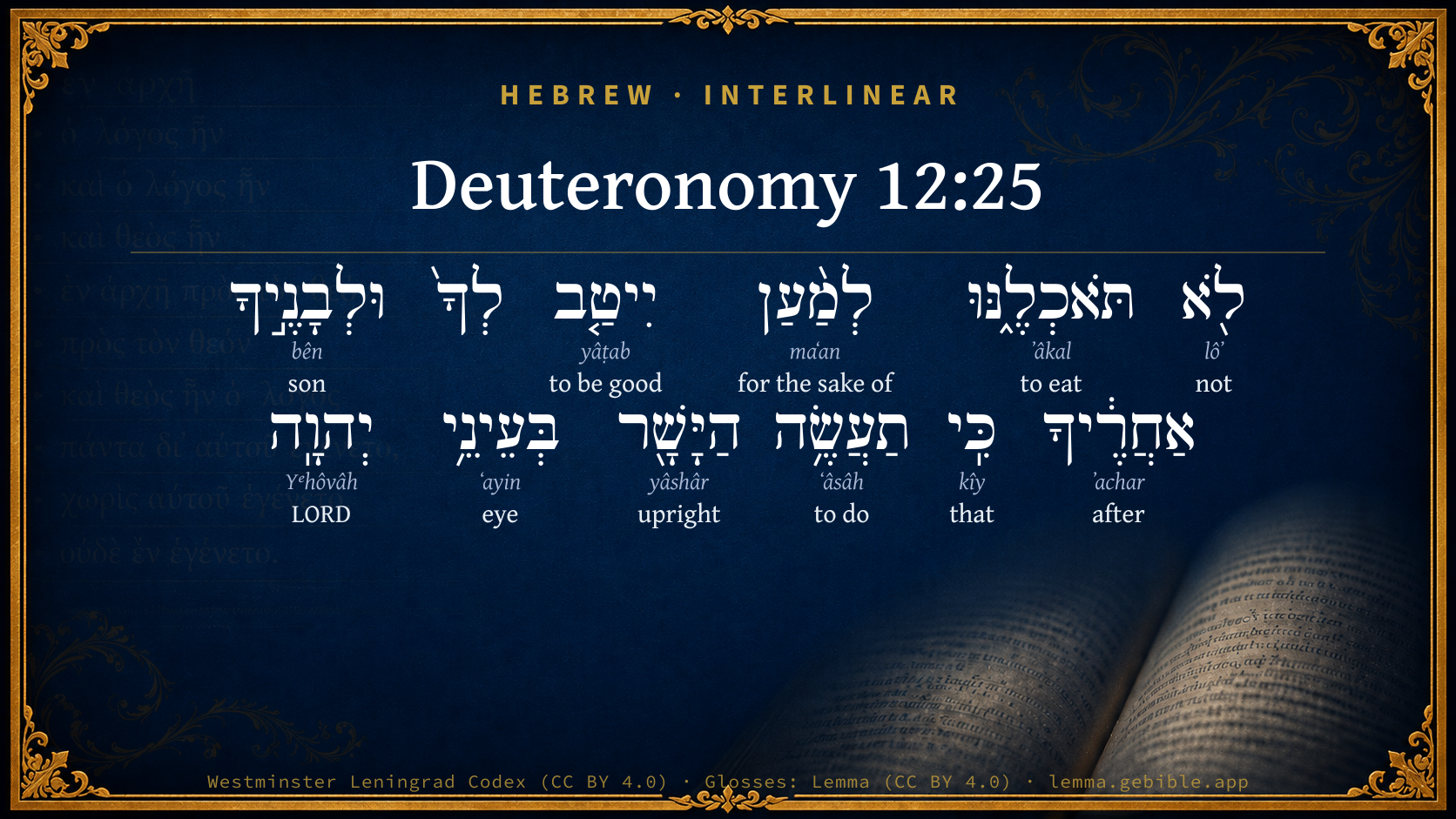
Hebrew (Westminster Leningrad Codex) Deuteronomy 12:25 appears in the Hebrew Old Testament. The text above is from the Westminster Leningrad Codex. Each word links to its Strong’s number, a concise gloss, and parsing drawn from the Open Scriptures Hebrew Bible morphology. Click any word for its full Brown-Driver-Briggs (BDB) entry.
Download image
Cite this verse

Deuteronomy 12:25 (World English Bible). Public Domain. Lemma interlinear Bible study tool, https://lemma.gebible.app/v/deuteronomy/12/25.

Show BibTeX & RIS
BibTeX
RIS
English Translation
You shall not eat it; that it may go well with you, and with your children after you, when you shall do that which is right in the eyes of Yahweh.
World English Bible · Public Domain
Download a study sheet

One document with this verse’s original text, its word-by-word gloss line, the meaning frame, cross-references with their text, attributed commentary, and full source and license credits — printable, and it pastes into notes with its structure intact.

This verse Autodidact and up

Study sheet (.html) Plain text (.txt)

A passage Seminary Student

Up to 50 verses in one chapter. A passage sheet keeps up to 6 commentary sources and 12 cross-references per verse, in the order this page ranks them, and says so on the sheet whenever that leaves anything out. Ask for a single verse and you get the Autodidact verse sheet above.

Everything on this page stays free to read, with no account — the sheet is a download of what is already on screen, not access to it.

Want to remove ads? Support Godless Engineer
Compare translations 3

The same verse in 3 English versions, stacked beneath the original-language interlinear above. Click any original word for its lexicon entry.

Each is an independent rendering of the whole verse — the interlinear is not word-aligned to these translations.

Highlighted words mark where these versions differ — a whole-verse word diff, not a word-by-word alignment.

  • World English Bible Public Domain
    You shall not eat it; that it may go well with you, and with your children after you, when you shall do that which is right in the eyes of Yahweh.
  • King James Version Public Domain
    Thou shalt not eat it; that it may go well with thee, and with thy children after thee, when thou shalt do that which is right in the sight of the LORD.
  • unfoldingWord Literal Text CC BY-SA 4.0
    Do not eat it, so that it may go well for you and for your sons after you, when you will do right in the eyes of Yahweh.

unfoldingWord Literal Text — © unfoldingWord, licensed CC BY-SA 4.0. Word-aligned USFM3 via Door43 (git.door43.org/unfoldingWord/en_ult).

Versions to compare (up to 4)

3 of 4 selected

Show all 18 translations

Every available English version of this verse, each an independent rendering of the whole verse.

  • World English Bible Public Domain
    You shall not eat it; that it may go well with you, and with your children after you, when you shall do that which is right in the eyes of Yahweh.
  • Berean Standard Bible Public Domain
    Do not eat it, so that it may go well with you and your children after you, because you will be doing what is right in the eyes of the LORD.
  • Majority Standard Bible Public Domain
    Do not eat it, so that it may go well with you and your children after you, because you will be doing what is right in the eyes of the LORD.
  • King James Version Public Domain
    Thou shalt not eat it; that it may go well with thee, and with thy children after thee, when thou shalt do that which is right in the sight of the LORD.
  • American Standard Version (1901) Public Domain
    Thou shalt not eat it; that it may go well with thee, and with thy children after thee, when thou shalt do that which is right in the eyes of Jehovah.
  • Revised Version (1885) Public Domain
    Thou shalt not eat it; that it may go well with thee, and with thy children after thee, when thou shalt do that which is right in the eyes of the LORD.
  • Geneva Bible (1599) Public Domain
    Thou shalt not eat it, that it may go well with thee; and with thy children after thee, when thou shalt doe that which is right in the sight of the Lord:
  • Douay-Rheims (1899) Public Domain
    That it may be well with thee and thy children after thee, when thou shalt do that which is pleasing in the sight of the Lord.
  • Young's Literal Translation Public Domain
    thou dost not eat it, in order that it may be well with thee, and with thy sons after thee, when thou dost that which `is' right in the eyes of Jehovah.
  • Literal Standard Version CC BY-SA 4.0
    you do not eat it, in order that it may be well with you and with your sons after you when you do that which [is] right in the eyes of YHWH.
  • Unlocked Literal Bible CC BY-SA 4.0
    You will not eat it, so that it may go well with you, and with your children after you, when you will do what is right in the eyes of Yahweh.
  • unfoldingWord Literal Text CC BY-SA 4.0
    Do not eat it, so that it may go well for you and for your sons after you, when you will do right in the eyes of Yahweh.
  • Darby Bible Public Domain
    thou shalt not eat it; that it may go well with thee, and with thy children after thee, when thou shalt do what is right in the eyes of Jehovah.
  • World Messianic Bible Public Domain
    You shall not eat it, that it may go well with you and with your children after you, when you do that which is right in the LORD’s eyes.
  • Webster's Bible Public Domain
    Thou shalt not eat it; that it may be well with thee, and with thy children after thee, when thou shalt do that which is right in the sight of the LORD.
  • Free Bible Version CC BY-SA 4.0
    Don't eat it, so that all will go well with you and your children, because you will be doing what is right in the Lord's sight.
  • Bible in Basic English Public Domain
    Do not take it for food; so that it may be well for you and for your children after you, while you do what is right in the eyes of the Lord.
  • JPS Tanakh (1917) Public Domain
    Thou shalt not eat it; that it may go well with thee, and with thy children after thee, when thou shalt do that which is right in the eyes of the LORD.

Literal Standard Version (2020), Covenant Press — licensed CC BY-SA 4.0. Text via the HelloAO Bible API (eBible.org). Unlocked Literal Bible (unfoldingWord) — licensed CC BY-SA 4.0. Text via the HelloAO Bible API (eBible.org). unfoldingWord Literal Text — © unfoldingWord, licensed CC BY-SA 4.0. Word-aligned USFM3 via Door43 (git.door43.org/unfoldingWord/en_ult). Free Bible Version, Dr. Jonathan Gallagher — licensed CC BY-SA 4.0. Text via the HelloAO Bible API (eBible.org).

Word by word

More ways to search: Search by grammar → Find every occurrence → Compare this word →

Practice this passage: Drill this verse → Learn its vocabulary →

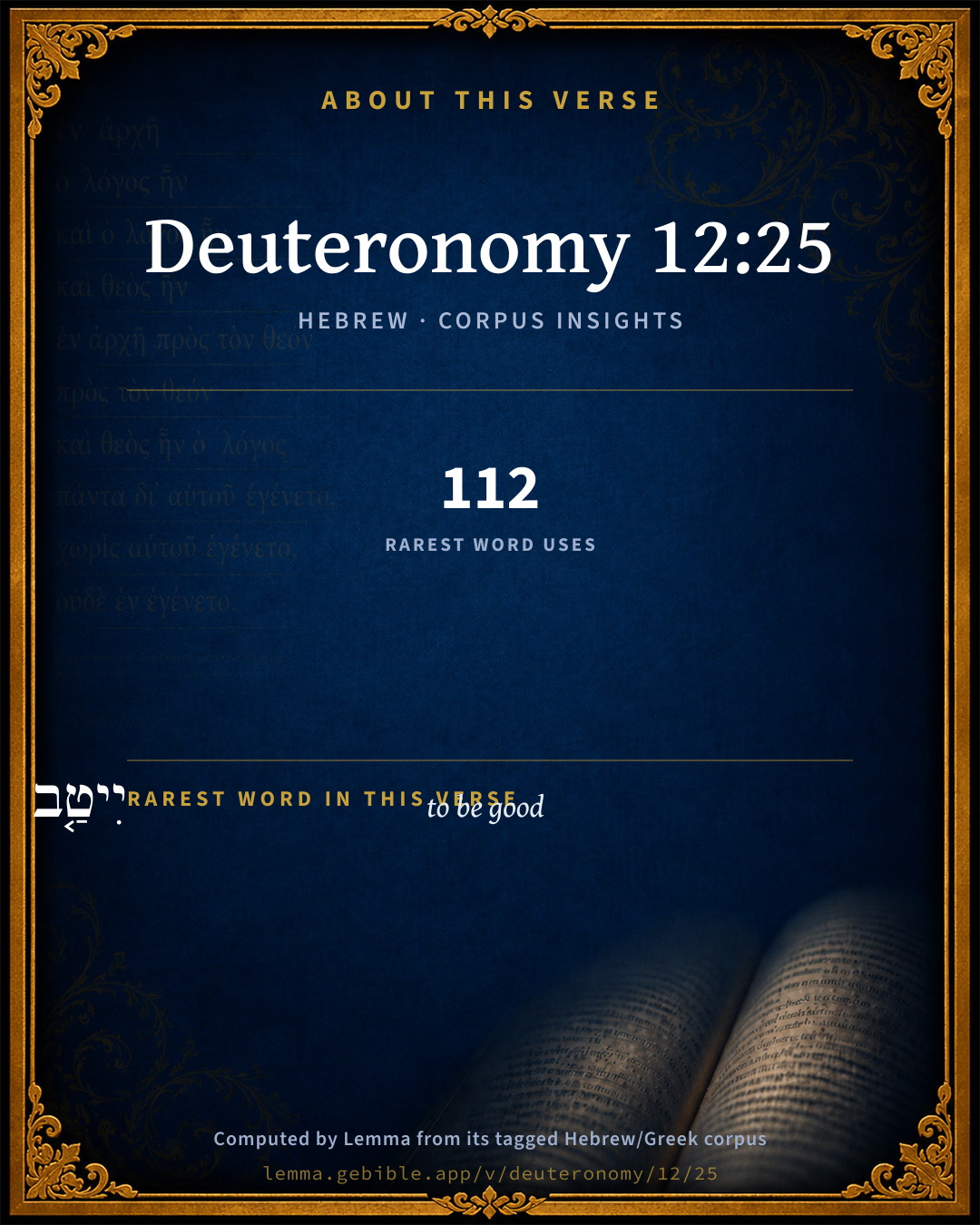
יִיטַ֤ב
yâṭab
H3190
“to be good”
Verb, Qal, Imperfect, 3rd Person, Masculine, Singular
Part of Speech
Verb
Stem
Qal
Form
Imperfect
Person
3rd Person
Gender
Masculine
Number
Singular
Full BDB Definition

Origin: a primitive root

TWOT: 863

to be good, be pleasing, be well, be glad - (Qal) - to be glad, be joyful - to be well placed - to be well for, be well with, go well with - to be pleasing, be pleasing to - (Hiphil) - to make glad, rejoice - to do good to, deal well with - to do well, do thoroughly - to make a thing good or right or beautiful - to do well, do right
  1. לֹ֖א lôʼ H3808 “not” Particle, Negative
  2. תֹּאכְלֶ֑נּוּ ʼâkal H398 “to eat · him” Verb, Qal, Imperfect, 2nd Person, Masculine, Singular + Suffix, Personal, 3rd Person, Masculine, Singular
  3. לְמַ֨עַן maʻan H4616 “for the sake of” Preposition
  4. וּלְבָנֶ֣יךָ bên H1121 “and · to/for · sons · your” Conjunction + Preposition + Noun, Common, Masculine, Plural, Construct + Suffix, Personal, 2nd Person, Masculine, Singular
  5. אַחֲרֶ֔יךָ ʼachar H310 “after · you” Preposition + Suffix, Personal, 2nd Person, Masculine, Singular
  6. כִּֽי kîy H3588 “that” Conjunction
  7. תַעֲשֶׂ֥ה ʻâsâh H6213 “to do” Verb, Qal, Imperfect, 2nd Person, Masculine, Singular
  8. הַיָּשָׁ֖ר yâshâr H3477 “the · upright” Particle, Definite Article + Adjective, Adjective, Masculine, Singular, Absolute
  9. בְּעֵינֵ֥י ʻayin H5869 “in/at · eyes of” Preposition + Noun, Common, Both, Dual, Construct
  10. יְהוָֽה Yᵉhôvâh H3068 “LORD” Noun, Proper

About this verse

These counts appear in no published source. They are computed here, from the morphology-tagged text and Lemma’s own curated glosses. What Lemma adds →

12
words
11
distinct lemmas
Pentateuch
section

Grammatical profile

  • 3 verbs
  • 3 nouns
  • 1 adjective
  • 3 prepositions
  • 1 conjunction
  • 1 particle

Verb forms

  • תֹּאכְלֶ֑נּוּ Qal · Imperfect
  • יִיטַ֤ב Qal · Imperfect
  • תַעֲשֶׂ֥ה Qal · Imperfect

Hebrew & Septuagint length

In English translation the verse runs 31 words from the Hebrew and 33 from the Septuagint (LXX English) — closely comparable.

A rough comparison of the two English renderings, which tokenize alike — not a word-level alignment.

Word counts can differ between the Hebrew and the Greek without any difference in meaning — e.g. the Hebrew direct-object marker אֵת has no separate Greek word, and Greek often adds the article ὁ.

Cross-references

12

Topical passages linked to Deuteronomy 12:25 in the Treasury of Scripture Knowledge — connected by theme and wording, ordered by reader-vote popularity; previews shown in the World English Bible.

  • Exodus 15:26 and he said, "If you will diligently listen to the voice of Yahweh your God, and will do that which is right in his eyes, and will pay attention to his commandments, and keep all his statutes, I will put none of the diseases on you, which I have put on the Egyptians; for I am Yahweh who heals you."
  • Deuteronomy 4:40 You shall keep his statutes, and his commandments, which I command you this day, that it may go well with you, and with your children after you, and that you may prolong your days in the land, which Yahweh your God gives you, forever.
  • 1 Kings 11:38 It shall be, if you will listen to all that I command you, and will walk in my ways, and do that which is right in my eyes, to keep my statutes and my commandments, as David my servant did; that I will be with you, and will build you a sure house, as I built for David, and will give Israel to you.
  • Isaiah 3:10 Tell the righteous "Good!" For they shall eat the fruit of their deeds.
  • Deuteronomy 13:18 when you shall listen to the voice of Yahweh your God, to keep all his commandments which I command you this day, to do that which is right in the eyes of Yahweh your God.
  • Deuteronomy 6:18 You shall do that which is right and good in the sight of Yahweh; that it may be well with you, and that you may go in and possess the good land which Yahweh swore to your fathers,
  • Deuteronomy 5:16 "Honor your father and your mother, as Yahweh your God commanded you; that your days may be long, and that it may go well with you, in the land which Yahweh your God gives you.
  • Deuteronomy 12:28 Observe and hear all these words which I command you, that it may go well with you, and with your children after you forever, when you do that which is good and right in the eyes of Yahweh your God.
  • Psalms 112:2 His seed will be mighty in the land. The generation of the upright will be blessed.
  • Ecclesiastes 2:26 For to the man who pleases him, God gives wisdom, knowledge, and joy; but to the sinner he gives travail, to gather and to heap up, that he may give to him who pleases God. This also is vanity and a chasing after wind.
  • Isaiah 48:18–19 Oh that you had listened to my commandments! then had your peace been as a river, and your righteousness as the waves of the sea:
  • Ezekiel 33:25 Therefore tell them, Thus says the Lord Yahweh: You eat with the blood, and lift up your eyes to your idols, and shed blood: and shall you possess the land?

Cross-references courtesy of OpenBible.info (CC BY 4.0).

Hebrew and Greek witnesses Masoretic Hebrew ↔ Greek Septuagint

The same verse in the two great witnesses to the Old Testament, shown verse-for-verse.

These are two independent witnesses, not word-aligned to each other, and the Septuagint is shown in lemma (dictionary) form.

Hebrew Deuteronomy 12:25 Masoretic · Westminster Leningrad Codex

לֹ֖א תֹּאכְלֶ֑נּוּ לְמַ֨עַן יִיטַ֤ב לְךָ֙ וּלְבָנֶ֣יךָ אַחֲרֶ֔יךָ כִּֽי תַעֲשֶׂ֥ה הַיָּשָׁ֖ר בְּעֵינֵ֥י יְהוָֽה

You shall not eat it; that it may go well with you, and with your children after you, when you shall do that which is right in the eyes of Yahweh.

World English Bible · Public Domain

Greek LXX Deuteronomy 12:25 Septuagint · lemma form

οὐ ἐσθίω αὐτός ἵνα εὖ σύ γίγνομαι καί ὁ υἱός σύ μετά σύ ἐάν ποιέω ὁ καλός καί ὁ ἀρεστός ἐναντίον κύριος ὁ θεός σύ

You shall not eat it, that it may be well with you and with your sons after you, if you shall do that which is good and pleasing before the Lord your God.

LXX2012 (modern English Septuagint) · Public Domain

Hebrew: Westminster Leningrad Codex (CC BY 4.0). Greek: Septuagint (public domain); English from LXX2012 (modern English Septuagint) (Public Domain). How the Septuagint differs from the Hebrew →

Targum (Aramaic paraphrase)

2

The Targum is the ancient Jewish Aramaic paraphrase of the Hebrew Scriptures — an interpretive translation, not the Hebrew text itself. Onkelos (literal) and Pseudo-Jonathan (expansive) render the Torah, and Jonathan the Prophets. Coverage is partial: where no permissively-licensed English translation exists for a verse, only the Aramaic is shown. This is verse-level text, not a word-by-word alignment to the Hebrew.

  1. Targum Onkelos Torah (Genesis–Deuteronomy)
    לָא תֵּיכְלִנֵהּ בְּדִיל דְיֵיטַב לָךְ וְלִבְנָיךְ בַּתְרָךְ אֲרֵי תַעְבֵּד דְכָשָׁר קֳדָם יְיָ

    (no public-domain English translation for this verse)

    Targum Onkelos — Aramaic: “Onkelos Genesis” (public domain); “Onkelos Exodus” (public domain); “Onkelos Leviticus” (public domain); “Onkelos Numbers” (public domain); “Onkelos Deuteronomy” (public domain). English: “Sefaria Community Translation” (CC0 1.0 (public-domain dedication)); “J.W. Etheridge. The Targums of Onkelos and Jonathan Ben Uzziel on the Pentateuch. London: Longmans, Green, 1862” (public domain). Text via Sefaria.

  2. Targum Pseudo-Jonathan Torah (Genesis–Deuteronomy)
    לָא תֵיכְלוּנֵיהּ מִן בִּגְלַל דְּיֵיטִיב לְכוֹן וְלִבְנֵיכוֹן בַּתְרֵיכוֹן אֲרוּם תַּעַבְדוּן דְּכָשַׁר קֳדָם יְיָ

    eat it not, that it may be well with you, and with your children after you, while you do that which is right before the Lord.

    Targum Pseudo-Jonathan — Aramaic: “Targum Jonathan on Genesis” (public domain); “Targum Jonathan on Exodus” (public domain); “Targum Jonathan on Leviticus” (public domain); “Targum Jonathan on Numbers” (public domain); “Targum Jonathan on Deuteronomy” (public domain). English: “The Targum of Jonathan ben Uzziel, trans. J. W. Etheridge, London, 1862” (public domain). Text via Sefaria.

Commentary

Notes on Deuteronomy 12:25 from classic Christian and Jewish commentators (each source and its license shown beneath its notes). The classic Christian expositions comment on the surrounding passage and are grouped to its opening verse, so a note may address several verses; the Jewish commentaries on the Tanakh (Rashi and others) are per-verse, so they appear only where the commentator wrote on this verse.

Lemma curates 59 commentaries, every one of them public domain or Creative Commons licensed, each selected and text-cleaned for this edition rather than reprinted as found. About our sources →

Trapp's Complete Commentary

John Trapp

Deu 12:25 Thou shalt not eat it; that it may go well with thee, and with thy children after thee, when thou shalt do [that which is] right in the sight of the LORD.

Ver. 25. Thou shalt not eat it.] Who can ever think any commandment of God to be light or little, when this of not eating the blood is charged with so much strictness? The minutula of the law, as well as the magnalia, must be carefully heeded and practised.

John Trapp, A Commentary or Exposition upon All the Books of the Old and New Testament (1647–1656) — public domain. Text from a community e-Sword module.

Ellicott's Commentary for English Readers

(25) That it may go well with thee.—Very possibly, the physical as well as the moral effect of the rule is contemplated here.

A Bible Commentary for English Readers, edited by Charles John Ellicott (1878–1897) — public domain. Text from a community e-Sword module.

John Gill's Exposition

Thou shall not eat it, that it may be well with thee, and with thy children after thee,.... That they and their posterity might be spared, and continue long, and enjoy much prosperity; for those that eat blood, contrary to this command of God, it is threatened that he would set his face against them, and they should be cut off, Lev 7:27,

when thou shall do that which is right in the sight of the Lord; not only observe this command, but all others.

John Gill's Exposition of the Whole Bible (1746–1763) — public domain (CC PDM 1.0). Text via the HelloAO Bible API.

Keil & Delitzsch

C. F. Keil & F. Delitzsch

On the promise for doing what was right in the eyes of the Lord, see Deu 6:18. - In Deu 12:26, Deu 12:27, the command to offer all the holy gifts at the place chosen by the Lord is enforced once more, as in Deu 12:6, Deu 12:11, Deu 12:17, Deu 12:18; also to prepare the sacrifices at His altar. קדשׁים, the holy offerings prescribed in the law, as in Num 18:8; see at Lev 21:22. The "votive offerings" are mentioned in connection with these, because vows proceeded from a spontaneous impulse. לך יהיוּ אשׁר, "which are to thee," are binding upon thee. In v. 27, "the flesh and the blood" are in opposition to "thy burnt-offerings:" "thy burnt-offerings, namely the flesh and blood of them," thou shalt prepare at the altar of Jehovah; i.e., the flesh and blood of the burnt-offerings were to be placed upon and against the altar (see at Lev 1:5-9). Of the slain-offerings, i.e., the shelamim, the blood was to be poured out against the altar (Lev 3:2, Lev 3:8, Lev 3:13); "the flesh thou canst eat" (cf. Lev 7:11.). There is no ground for seeking an antithesis in ישּׁפך, as Knobel does, to the זרק in the sacrificial ritual. The indefinite expression may be explained from the retrospective allusion to Deu 12:24 and the purely suggestive character of the whole passage, the thing itself being supposed to be sufficiently known from the previous laws.

Keil & Delitzsch — Biblical Commentary on the Old Testament (1861–1891) — public domain (CC PDM 1.0). Text via the HelloAO Bible API. (Old Testament only.)

Rashi

Rabbi Shlomo Yitzchaki (Rashi)

לא תאכלנו THOU SHALT NOT EAT IT — This is a prohibition against eating of the blood contained in the limbs (Keritot 4b).

למען ייטב לך וגו׳ THAT IT MAY BE WELL WITH THEE, etc. — Go and learn how great is the grant of reward for keeping the divine commandments: if in the case of blood for which the soul of man feels a loathing, he who keeps aloof from it obtains merit for himself and for his children after him, how much the more is it so in the case of robbery or forbidden sexual relations for which the soul of man may feel a longing (Makkot 23b).

Rashi on the Tanakh — English translations: “The Judaica Press complete Tanach with Rashi, translated by A. J. Rosenberg” (CC BY 4.0); “Pentateuch with Rashi's commentary by M. Rosenbaum and A.M. Silbermann, 1929-1934” (public domain); “The Metsudah Tanach series, Lakewood, N.J” (CC BY 4.0); and “The Book of Joshua, Metsudah Publications, 1997” (CC BY 4.0). Text via Sefaria.

Lesson kit

Teaching starters — assembled from the data on this page, not authored interpretation. Every prompt links to the verse data it draws on. Edit before teaching.

Deuteronomy, in the Pentateuch, opens this verse with 12 words (11 distinct Hebrew lemmas). Its most distinctive word is yâṭab (“to be good”). A historical commentator’s framing appears above. Read the whole chapter for the surrounding context.

Discussion questions

  1. How does “to be good” (yâṭab) shape what this verse is saying?
  2. How does Exodus 15:26, which shares this passage’s theme, read alongside this verse?
  3. The translations on this page render this verse differently — a whole-verse word diff, not a word-by-word alignment. What might account for the different wordings?
  4. «תֹּאכְלֶ֑נּוּ» is a Qal Imperfect verb. How does that grammatical form shape the action described?
  5. Compare how Trapp's Complete Commentary and Ellicott's Commentary for English Readers read this verse. Where do they agree or differ?

Things to notice

Reading settings

Reading text

Shown beneath each verse's original-language words.

Old Testament
Old Testament edition

Read the OT as the Masoretic Hebrew (MT) or the Greek Septuagint (LXX).

English shown for the Greek Septuagint (in the Hebrew ↔ Greek comparison).

Comparing translations? Open the Compare panel on any verse page to stack up to four side by side.