
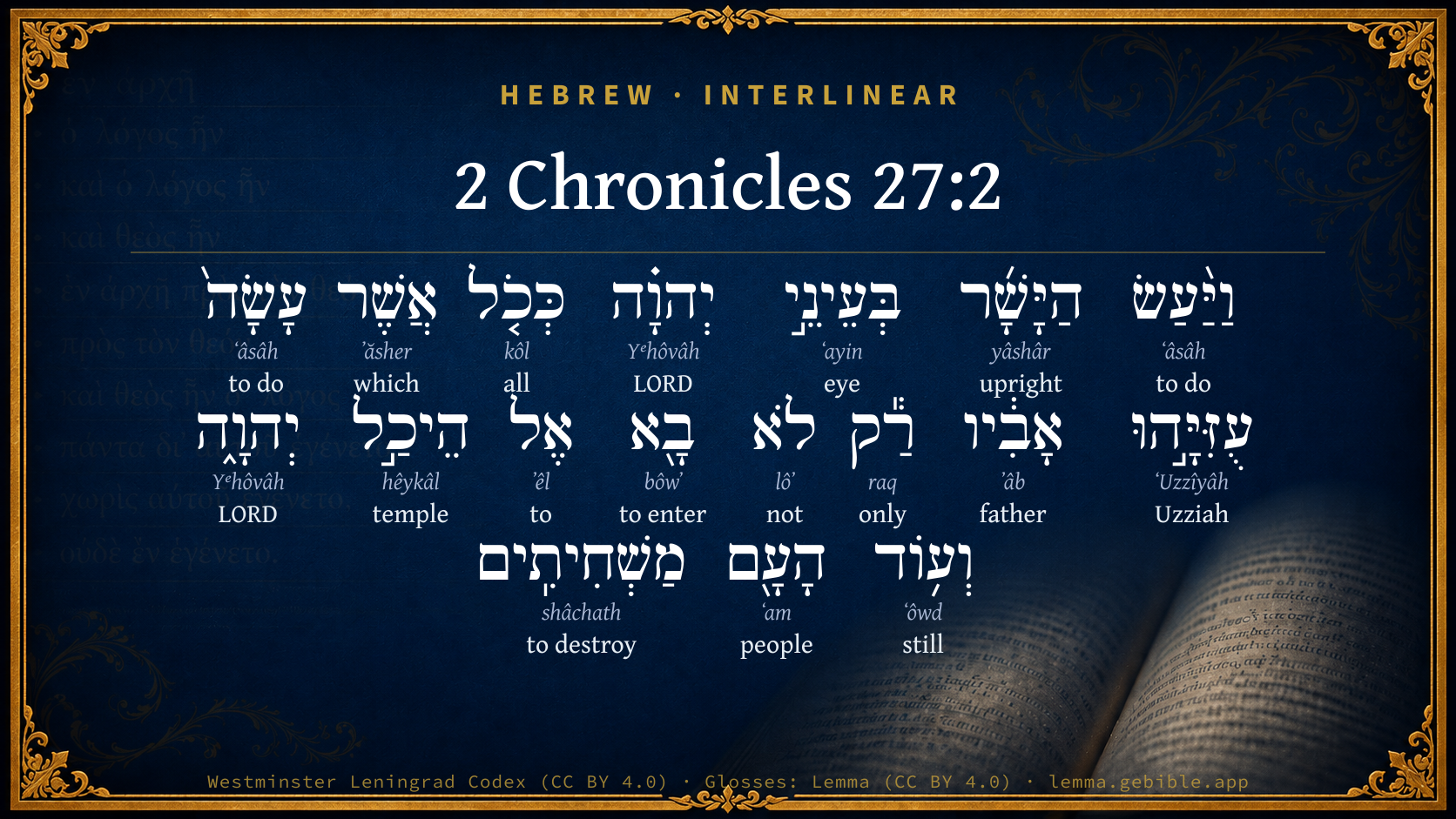
2 Chronicles 27:2

Hebrew (Westminster Leningrad Codex) 2 Chronicles 27:2 appears in the Hebrew Old Testament. The text above is from the Westminster Leningrad Codex. Each word links to its Strong’s number, a concise gloss, and parsing drawn from the Open Scriptures Hebrew Bible morphology. Click any word for its full Brown-Driver-Briggs (BDB) entry.
Download image
Cite this verse

2 Chronicles 27:2 (World English Bible). Public Domain. Lemma interlinear Bible study tool, https://lemma.gebible.app/v/2-chronicles/27/2.

Show BibTeX & RIS
BibTeX
RIS
English Translation
He did that which was right in the eyes of Yahweh, according to all that his father Uzziah had done: however he didn't enter into the temple of Yahweh. The people did yet corruptly.
World English Bible · Public Domain
Download a study sheet

One document with this verse’s original text, its word-by-word gloss line, the meaning frame, cross-references with their text, attributed commentary, and full source and license credits — printable, and it pastes into notes with its structure intact.

This verse Autodidact and up

Study sheet (.html) Plain text (.txt)

A passage Seminary Student

Up to 50 verses in one chapter. A passage sheet keeps up to 6 commentary sources and 12 cross-references per verse, in the order this page ranks them, and says so on the sheet whenever that leaves anything out. Ask for a single verse and you get the Autodidact verse sheet above.

Everything on this page stays free to read, with no account — the sheet is a download of what is already on screen, not access to it.

Want to remove ads? Support Godless Engineer
Compare translations 3

The same verse in 3 English versions, stacked beneath the original-language interlinear above. Click any original word for its lexicon entry.

Each is an independent rendering of the whole verse — the interlinear is not word-aligned to these translations.

Highlighted words mark where these versions differ — a whole-verse word diff, not a word-by-word alignment.

  • World English Bible Public Domain
    He did that which was right in the eyes of Yahweh, according to all that his father Uzziah had done: however he didn't enter into the temple of Yahweh. The people did yet corruptly.
  • King James Version Public Domain
    And he did that which was right in the sight of the LORD, according to all that his father Uzziah did: howbeit he entered not into the temple of the LORD. And the people did yet corruptly.
  • unfoldingWord Literal Text CC BY-SA 4.0
    And he did what was right in the eyes of Yahweh, according to all that Uzziah his father did, except he did not go into the temple of Yahweh. And yet the people were acting corruptly.

unfoldingWord Literal Text — © unfoldingWord, licensed CC BY-SA 4.0. Word-aligned USFM3 via Door43 (git.door43.org/unfoldingWord/en_ult).

Versions to compare (up to 4)

3 of 4 selected

Show all 18 translations

Every available English version of this verse, each an independent rendering of the whole verse.

  • World English Bible Public Domain
    He did that which was right in the eyes of Yahweh, according to all that his father Uzziah had done: however he didn't enter into the temple of Yahweh. The people did yet corruptly.
  • Berean Standard Bible Public Domain
    And he did what was right in the eyes of the LORD, just as his father Uzziah had done. In addition, he did not enter the temple of the LORD. But the people still behaved corruptly.
  • Majority Standard Bible Public Domain
    And he did what was right in the eyes of the LORD, just as his father Uzziah had done. In addition, he did not enter the temple of the LORD. But the people still behaved corruptly.
  • King James Version Public Domain
    And he did that which was right in the sight of the LORD, according to all that his father Uzziah did: howbeit he entered not into the temple of the LORD. And the people did yet corruptly.
  • American Standard Version (1901) Public Domain
    And he did that which was right in the eyes of Jehovah, according to all that his father Uzziah had done: howbeit he entered not into the temple of Jehovah. And the people did yet corruptly.
  • Revised Version (1885) Public Domain
    And he did that which was right in the eyes of the LORD, according to all that his father Uzziah had done: howbeit he entered not into the temple of the LORD. And the people did yet corruptly.
  • Geneva Bible (1599) Public Domain
    And hee did vprightly in the sight of the Lord according to all that his father Vzziah did, saue that hee entred not into the Temple of the Lord, and the people did yet corrupt their wayes.
  • Douay-Rheims (1899) Public Domain
    And he did that which was right before the Lord, according to all that Ozias his father had done, only that he entered not into the temple of the Lord, and the people still transgressed.
  • Young's Literal Translation Public Domain
    And he doth that which is right in the eyes of Jehovah, according to all that Uzziah his father did; only, he hath not come in unto the temple of Jehovah; and again are the people doing corruptly.
  • Literal Standard Version CC BY-SA 4.0
    And he does that which is right in the eyes of YHWH, according to all that his father Uzziah did; only, he has not come into the temple of YHWH; and again the people are doing corruptly.
  • Unlocked Literal Bible CC BY-SA 4.0
    He did what was right in the eyes of Yahweh, following the example of his father, Uzziah, in everything. He also refrained from going into the temple of Yahweh. But the people were still behaving in evil ways.
  • unfoldingWord Literal Text CC BY-SA 4.0
    And he did what was right in the eyes of Yahweh, according to all that Uzziah his father did, except he did not go into the temple of Yahweh. And yet the people were acting corruptly.
  • Darby Bible Public Domain
    And he did what was right in the sight of Jehovah, according to all that his father Uzziah had done; only he entered not into the temple of Jehovah. And the people still acted corruptly.
  • World Messianic Bible Public Domain
    He did that which was right in the LORD’s eyes, according to all that his father Uzziah had done. However he didn’t enter into the LORD’s temple. The people still acted corruptly.
  • Webster's Bible Public Domain
    And he did that which was right in the sight of the LORD, according to all that his father Uzziah did: yet, he entered not into the temple of the LORD. And the people did yet corruptly.
  • Free Bible Version CC BY-SA 4.0
    He did what was right in the Lord's sight as his father Uzziah had done, and he did not enter the Lord's Temple as his father had. But the people still acted corruptly.
  • Bible in Basic English Public Domain
    He did what was right in the eyes of the Lord, as his father Uzziah had done; but he did not go into the Temple of the Lord. And the people still went on in their evil ways.
  • JPS Tanakh (1917) Public Domain
    And he did that which was right in the eyes of the LORD, according to all that his father Uzziah had done; howbeit he entered not into the temple of the LORD. And the people did yet corruptly.

Literal Standard Version (2020), Covenant Press — licensed CC BY-SA 4.0. Text via the HelloAO Bible API (eBible.org). Unlocked Literal Bible (unfoldingWord) — licensed CC BY-SA 4.0. Text via the HelloAO Bible API (eBible.org). unfoldingWord Literal Text — © unfoldingWord, licensed CC BY-SA 4.0. Word-aligned USFM3 via Door43 (git.door43.org/unfoldingWord/en_ult). Free Bible Version, Dr. Jonathan Gallagher — licensed CC BY-SA 4.0. Text via the HelloAO Bible API (eBible.org).

Word by word

More ways to search: Search by grammar → Find every occurrence → Compare this word →

Practice this passage: Drill this verse → Learn its vocabulary →

עֻזִּיָּ֣הוּ
ʻUzzîyâh
H5818
“Uzziah”
Noun, Proper
Part of Speech
Noun
Type
Proper
Full BDB Definition

Origin: from H5797 and H3050

TWOT: None

Uzziah = "my strength is Jehovah" - son of king Amaziah of Judah and king of Judah himself for 52 years; also 'Azariah' - a Kohathite Levite and ancestor of Samuel - a priest of the sons of Harim who took a foreign wife in the time of Ezra - a Judaite, father of Athaiah or Uthai - father of Jehonathan, one of David's overseers
  1. וַיַּ֨עַשׂ ʻâsâh H6213 “and · to do” Conjunction + Verb, Qal, Sequential Imperfect, 3rd Person, Masculine, Singular
  2. הַיָּשָׁ֜ר yâshâr H3477 “the · upright” Particle, Definite Article + Adjective, Adjective, Masculine, Singular, Absolute
  3. בְּעֵינֵ֣י ʻayin H5869 “in/at · eyes of” Preposition + Noun, Common, Both, Dual, Construct
  4. יְהוָ֗ה Yᵉhôvâh H3068 “LORD” Noun, Proper
  5. כְּכֹ֤ל kôl H3605 “like/as · all” Preposition + Noun, Common, Masculine, Singular, Absolute
  6. אֲשֶׁר ʼăsher H834 “which” Particle, Relative
  7. עָשָׂה֙ ʻâsâh H6213 “to do” Verb, Qal, Perfect, 3rd Person, Masculine, Singular
  8. אָבִ֔יו ʼâb H1 “father · his” Noun, Common, Masculine, Singular, Construct + Suffix, Personal, 3rd Person, Masculine, Singular
  9. רַ֕ק raq H7535 “only” Particle, Accusative
  10. לֹא lôʼ H3808 “not” Particle, Negative
  11. בָ֖א bôwʼ H935 “to enter” Verb, Qal, Perfect, 3rd Person, Masculine, Singular
  12. אֶל ʼêl H413 “to” Preposition
  13. הֵיכַ֣ל hêykâl H1964 “temple of” Noun, Common, Masculine, Singular, Construct
  14. יְהוָ֑ה Yᵉhôvâh H3068 “LORD” Noun, Proper
  15. וְע֥וֹד ʻôwd H5750 “and · still” Conjunction + Adverb
  16. הָעָ֖ם ʻam H5971 “the · people” Particle, Definite Article + Noun, Common, Masculine, Singular, Absolute
  17. מַשְׁחִיתִֽים shâchath H7843 “destroying” Verb, Hiphil, Participle Active, Masculine, Plural, Absolute

About this verse

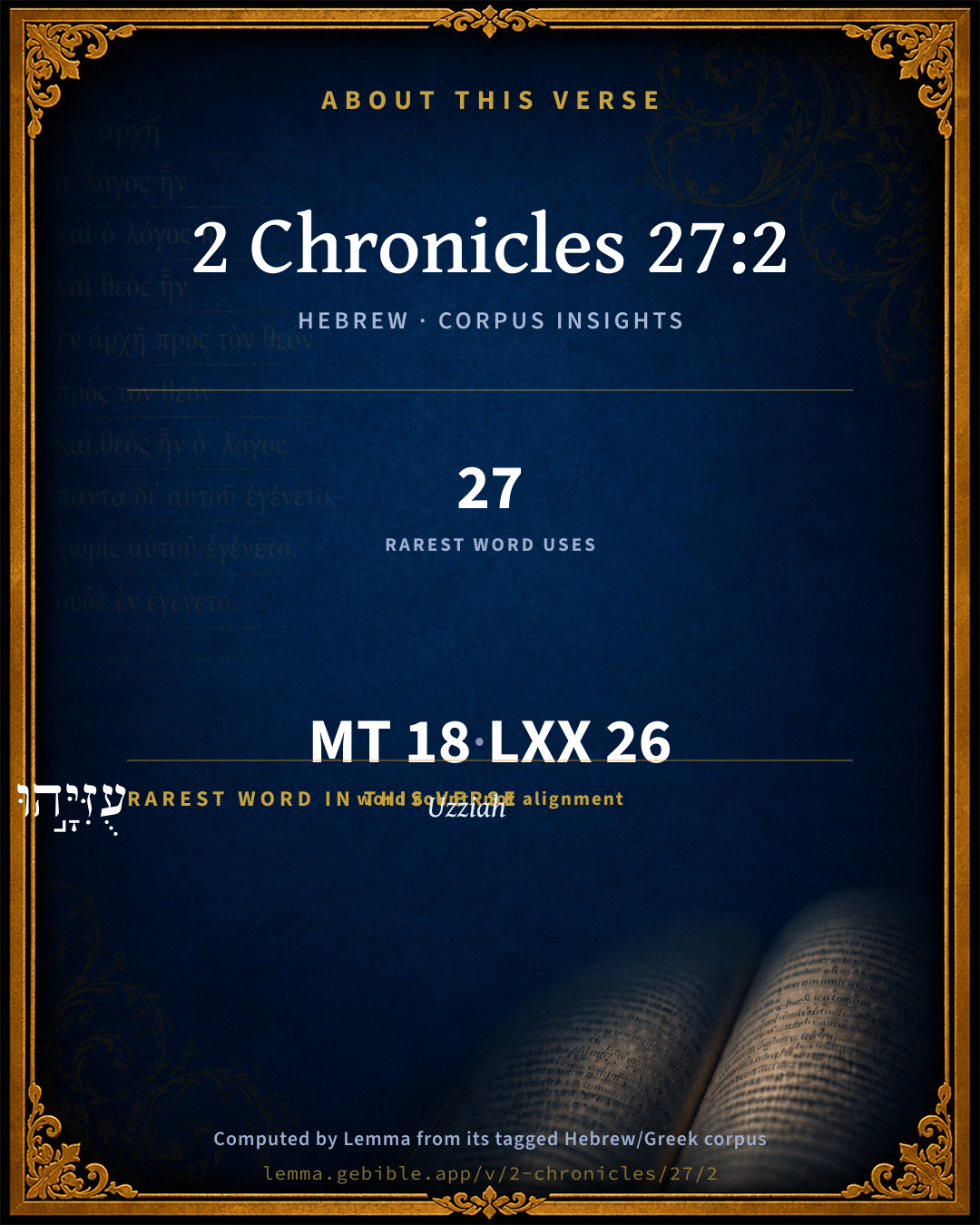
These counts appear in no published source. They are computed here, from the morphology-tagged text and Lemma’s own curated glosses. What Lemma adds →

18
words
16
distinct lemmas
Historical
section

Shared distinctive vocabulary

עֻזִּיָּ֣הוּ Uzziah H5818 occurs in 26 verses of the Hebrew Bible. Also found in:

Grammatical profile

  • 4 verbs
  • 8 nouns
  • 1 adjective
  • 1 preposition
  • 1 adverb
  • 3 particles

Verb forms

  • וַיַּ֨עַשׂ Qal · Sequential Imperfect
  • עָשָׂה֙ Qal · Perfect
  • בָ֖א Qal · Perfect
  • מַשְׁחִיתִֽים Hiphil · Participle Active

Repetition

Words recur within this verse — often emphatic in Hebrew:

  • וַיַּ֨עַשׂ to do H6213 ×2
  • יְהוָ֗ה LORD H3068 ×2

Hebrew & Septuagint length

In English translation the verse runs 34 words from the Hebrew and 37 from the Septuagint (LXX English) — closely comparable.

A rough comparison of the two English renderings, which tokenize alike — not a word-level alignment.

Word counts can differ between the Hebrew and the Greek without any difference in meaning — e.g. the Hebrew direct-object marker אֵת has no separate Greek word, and Greek often adds the article ὁ.

In the original languages it is 18 Hebrew tokens and 26 Greek tokens — but the two are counted differently (Hebrew bundles its prefixes and suffixes into one token; the Greek is in lemma form), so that isn’t a like-for-like length.

Cross-references

5

Topical passages linked to 2 Chronicles 27:2 in the Treasury of Scripture Knowledge — connected by theme and wording, ordered by reader-vote popularity; previews shown in the World English Bible.

  • 2 Kings 15:34–35 He did that which was right in the eyes of Yahweh; he did according to all that his father Uzziah had done.
  • 2 Chronicles 26:4 He did that which was right in the eyes of Yahweh, according to all that his father Amaziah had done.
  • 2 Chronicles 26:16–21 But when he was strong, his heart was lifted up, so that he did corruptly, and he trespassed against Yahweh his God; for he went into the temple of Yahweh to burn incense on the altar of incense.
  • Psalms 119:120 My flesh trembles for fear of you. I am afraid of your judgments.
  • Acts 5:13 None of the rest dared to join them, however the people honored them.

Cross-references courtesy of OpenBible.info (CC BY 4.0).

Hebrew and Greek witnesses Masoretic Hebrew ↔ Greek Septuagint

The same verse in the two great witnesses to the Old Testament, shown verse-for-verse.

These are two independent witnesses, not word-aligned to each other, and the Septuagint is shown in lemma (dictionary) form.

Hebrew 2 Chronicles 27:2 Masoretic · Westminster Leningrad Codex

וַיַּ֨עַשׂ הַיָּשָׁ֜ר בְּעֵינֵ֣י יְהוָ֗ה כְּכֹ֤ל אֲשֶׁר עָשָׂה֙ עֻזִּיָּ֣הוּ אָבִ֔יו רַ֕ק לֹא בָ֖א אֶל הֵיכַ֣ל יְהוָ֑ה וְע֥וֹד הָעָ֖ם מַשְׁחִיתִֽים

He did that which was right in the eyes of Yahweh, according to all that his father Uzziah had done: however he didn't enter into the temple of Yahweh. The people did yet corruptly.

World English Bible · Public Domain

Greek LXX 2 Chronicles 27:2 Septuagint · lemma form

καί ποιέω ὁ εὐθής ἐνώπιον κύριος κατά πᾶς ὅσος ποιέω οζιας ὁ πατήρ αὐτός ἀλλά οὐ εἰςἔρχομαι εἰς ὁ ναός κύριος καί ἔτι ὁ λαός καταφθείρω

And he did that which was right in the sight of the Lord, according to all that his father Ozias did: but he went not into the temple of the Lord. And still the people corrupted themselves.

LXX2012 (modern English Septuagint) · Public Domain

Hebrew: Westminster Leningrad Codex (CC BY 4.0). Greek: Septuagint (public domain); English from LXX2012 (modern English Septuagint) (Public Domain). How the Septuagint differs from the Hebrew →

Commentary

Notes on 2 Chronicles 27:2 from classic Christian and Jewish commentators (each source and its license shown beneath its notes). The classic Christian expositions comment on the surrounding passage and are grouped to its opening verse, so a note may address several verses; the Jewish commentaries on the Tanakh (Rashi and others) are per-verse, so they appear only where the commentator wrote on this verse.

Lemma curates 59 commentaries, every one of them public domain or Creative Commons licensed, each selected and text-cleaned for this edition rather than reprinted as found. About our sources →

Trapp's Complete Commentary

John Trapp

2Ch 27:2 And he did [that which was] right in the sight of the LORD, according to all that his father Uzziah did: howbeit he entered not into the temple of the LORD. And the people did yet corruptly.

Ver. 2. And he did that which was right.] See 2Ki 15:34. Josephus saith that no virtue was wanting unto him, and that he was pious, just, public spirited, &c.

Howbeit he entered not into the temple,] viz., To encroach upon the priest’s office; to serve God, no doubt but he entered into it frequently.

And the people did yet corruptly.] By sacrificing and burning incense still in the high places, {2Ki 15:35} though Isaiah, Hosea, Micah, and other holy prophets then living showed them their sin. To this day, people will not leave their old evil customs, though never so much preached down.

John Trapp, A Commentary or Exposition upon All the Books of the Old and New Testament (1647–1656) — public domain. Text from a community e-Sword module.

Geneva Bible (1599)

Geneva Bible translators

To wit, to offer incense against the word of God, which thing is spoken in the commendation of Jotham.

They were not clean purged from idolatry.

Geneva Bible (1599) marginal notes — public domain. Text via Bolls.life.

Jamieson, Fausset & Brown

Robert Jamieson, A. R. Fausset & David Brown

he did that which was right--The general rectitude of his government is described by representing it as conducted on the excellent principles which had guided the early part of his father's reign.

the people did yet corruptly--(See Kg2 15:35); but the description here is more emphatic, that though Jotham did much to promote the good of his kingdom and aimed at a thorough reformation in religion, the widespread and inveterate wickedness of the people frustrated all his laudable efforts.

Jamieson, Fausset & Brown — Commentary Critical and Explanatory on the Whole Bible (1871) — public domain (CC PDM 1.0). Text via the HelloAO Bible API.

Adam Clarke's Commentary

Verse 2. He entered not into the temple] He copied his father's conduct as far as it was constitutional; and avoided his transgression. See the preceding chapter. (2Ch 26)

Adam Clarke's Commentary on the Bible (1810–1826) — public domain. Text from a community e-Sword/MySword module.

Ellicott's Commentary for English Readers

(2) Howbeit he entered not.—The chronicler adds this reservation upon the preceding general statement. The author of Kings, having said nothing of Uzziah’s sacrilege, had no need to make such an exception.

And the people did yet corruptly.—Still used to deal corruptly; a paraphrase of what we read in 2Ki_15:35, “the people still used to sacrifice and burn incense on the high places.” We know further, from the extant utterances of the prophets of those days, that a deep-seated moral corruption was sapping the strength of the nation. (Comp. Mic_3:10-12; Hos_4:1-2.)

A Bible Commentary for English Readers, edited by Charles John Ellicott (1878–1897) — public domain. Text from a community e-Sword module.

The Cambridge Bible for Schools and Colleges

gen. ed. J. J. S. Perowne

2. howbeit he entered not into the temple of the Lord] Kings has a different limitation, viz., “howbeit the high places were not removed.”

did yet corruptly] In Kings, “sacrificed and burnt incense still in the high places.”

The Cambridge Bible for Schools and Colleges (gen. ed. J. J. S. Perowne; Cambridge University Press, 1878–1918) — public domain. Text from a community e-Sword module.

John Gill's Exposition

He built the high gate in the house of the Lord,.... See the note on Kg2 15:35.

and on the wall of Ophel he built much; which Kimchi interprets an high place; it was the eastern part of Mount Zion. Josephus (f) calls it Ophlas, and says it joined to the eastern porch of the temple; and some have thought the porch of the temple is meant; the Targum renders it a palace; it is a tradition of the Jews that it was the holy of holies (g).

(f) De Bell. Jud. l. 5. c. 4. sect. 2. (g) Vid. Hieron Trad. Heb. in lib. Paralipom. fol. 86. A. F. G.

John Gill's Exposition of the Whole Bible (1746–1763) — public domain (CC PDM 1.0). Text via the HelloAO Bible API.

Haydock's Catholic Bible Commentary

Lord. Like Ozias, to offer incense. He was content with the royal dignity, without arrogating to himself that of the priests. C. --- Transgressed. Heb. "acted corruptly," on the heights, 4 K. xv. 35. H.

George Leo Haydock (1774–1849), Haydock's Catholic Family Bible and Commentary, 1859 edition — public domain. Excludes Psalms (Douay-Rheims chapter numbering differs from Protestant) and Deuterocanonical books (Catholic canon only).

Matthew Poole's English Annotations

He entered not into the temple of the Lord, to wit, to offer incense. But seeing this was not commendable, how is this mentioned as an exception from the foregoing character, that he did as his father did in that which was right, &c.?

Answ. It is an exception only from the last clause, where also one word may be supplied out of the foregoing words, as is most usual in Scripture; thus, He did

according to all that his father Uzziah did; then it fitly follows, howbeit, &c., i.e. except in his miscarriages.

Matthew Poole's English Annotations on the Holy Bible (1683–1685) — public domain. Text from a community e-Sword/MySword module.

The Pulpit Commentary

Howbeit. This word purports to render the Hebrew qr, which might find a more telling reproduction in such a phrase as "and moreover." It has been said, wherein his father did right, so did he; and to his clear advantage, where his father went wrong, he did riot. The people did yet corruptly. The parallel, in its ver. 35, specifies in what this consisted, viz. that they continued the high places, burning incense and sacrificing at them. The early chapters of Isaiah depict forcibly the extent of this national apostasy, and the heinous offensiveness of it in the Divine sight.

The Pulpit Commentary (1880–1919), ed. H.D.M. Spence-Jones & Joseph S. Exell — public domain. Text from a community e-Sword module.

John Wesley's Explanatory Notes

He did - He did according to all that his father Uzziah did; except in his miscarriages. We must not imitate those we have the greatest esteem for, any farther than we do well; but their failings must be warnings to us, to walk more circumspectly.

John Wesley, Explanatory Notes Upon the Whole Bible (1754–1765) — public domain. Text via the GEBible commentary corpus.

Rashi

Rabbi Shlomo Yitzchaki (Rashi)

as all that his father Uzziah the good deeds that his father had done. That is what R. Simeon ben Yohai said in Tractate Sotah (sic. Should be Sukkah 45b): If Abraham would take upon himself all the sins of the generations until his time, I would take upon myself the sins of the generations from Abraham until my time. And if Jotham the son of Uzziah were with me, we would take upon ourselves the sins of all the generations from Abraham until the end of all generations, for in all the kings before him and after him we find sin, except in Jotham. Concerning David it is written, (I Kings 15:5): “Only concerning the matter of Uriah the Hittite”; concerning Solomon it is written, (ibid. 11:4): “His wives turned his heart away”; Rehoboam forsook the Lord’s Torah; Abijah (ibid. 15:3): “went in all his father’s sins”; Asa took silver and gold from the treasuries of the House of the Lord and put the prophet in prison; Jehoshaphat associated with a wicked man (Ahab and his son Ahaziah); Joram killed his brother; Ahaziah’s mother advised him to sin; Joash killed Zechariah and was [later punished by being] sexually molested (Yer. Kid. 1:7); Amaziah prostrated himself before the graven images of Seir; Uzziah entered the Temple to burn incense; Ahaz went in the ways of the kings of Israel and also made monuments for the baalim; Hezekiah became haughty and there was anger upon him, and the sages did not concur with him on three things that he did (Pes. 4:9); Manasseh did evil in the eyes of the Lord; Josiah did not heed the words of prophecy from God; Zedekiah did evil in the eyes of the Lord and did not humble himself before Jeremiah (below 36:12). In Jotham, however, no trace of sin was found. (R. Eliezer the son of Moses told me this.)

the people were still acting corruptly as it is written in II Kings (15:35): “the people were still slaughtering and burning incense [on the high places].”

Rashi on the Tanakh — English translations: “The Judaica Press complete Tanach with Rashi, translated by A. J. Rosenberg” (CC BY 4.0); “Pentateuch with Rashi's commentary by M. Rosenbaum and A.M. Silbermann, 1929-1934” (public domain); “The Metsudah Tanach series, Lakewood, N.J” (CC BY 4.0); and “The Book of Joshua, Metsudah Publications, 1997” (CC BY 4.0). Text via Sefaria.

Lesson kit

Teaching starters — assembled from the data on this page, not authored interpretation. Every prompt links to the verse data it draws on. Edit before teaching.

2 Chronicles, in the Historical, opens this verse with 18 words (16 distinct Hebrew lemmas). Its most distinctive word is ʻUzzîyâh (“Uzziah”). A historical commentator’s framing appears above. Read the whole chapter for the surrounding context.

Discussion questions

  1. The word ʻUzzîyâh carries the sense “Uzziah.” How does it shape the verse?
  2. How does 2 Kings 15:13, which shares the word «Uzziah», read alongside this verse?
  3. What does the repetition of “to do” (2× in this one verse) do in this verse?
  4. These translations render this verse differently. What is at stake in choosing one wording over another?
  5. «וַיַּ֨עַשׂ» is a Qal Sequential Imperfect verb. How does that grammatical form shape the action described?
  6. Compare how Trapp's Complete Commentary and Geneva Bible (1599) read this verse. Where do they agree or differ?

Things to notice

Reading settings

Reading text

Shown beneath each verse's original-language words.

Old Testament
Old Testament edition

Read the OT as the Masoretic Hebrew (MT) or the Greek Septuagint (LXX).

English shown for the Greek Septuagint (in the Hebrew ↔ Greek comparison).

Comparing translations? Open the Compare panel on any verse page to stack up to four side by side.