
Job 17:8

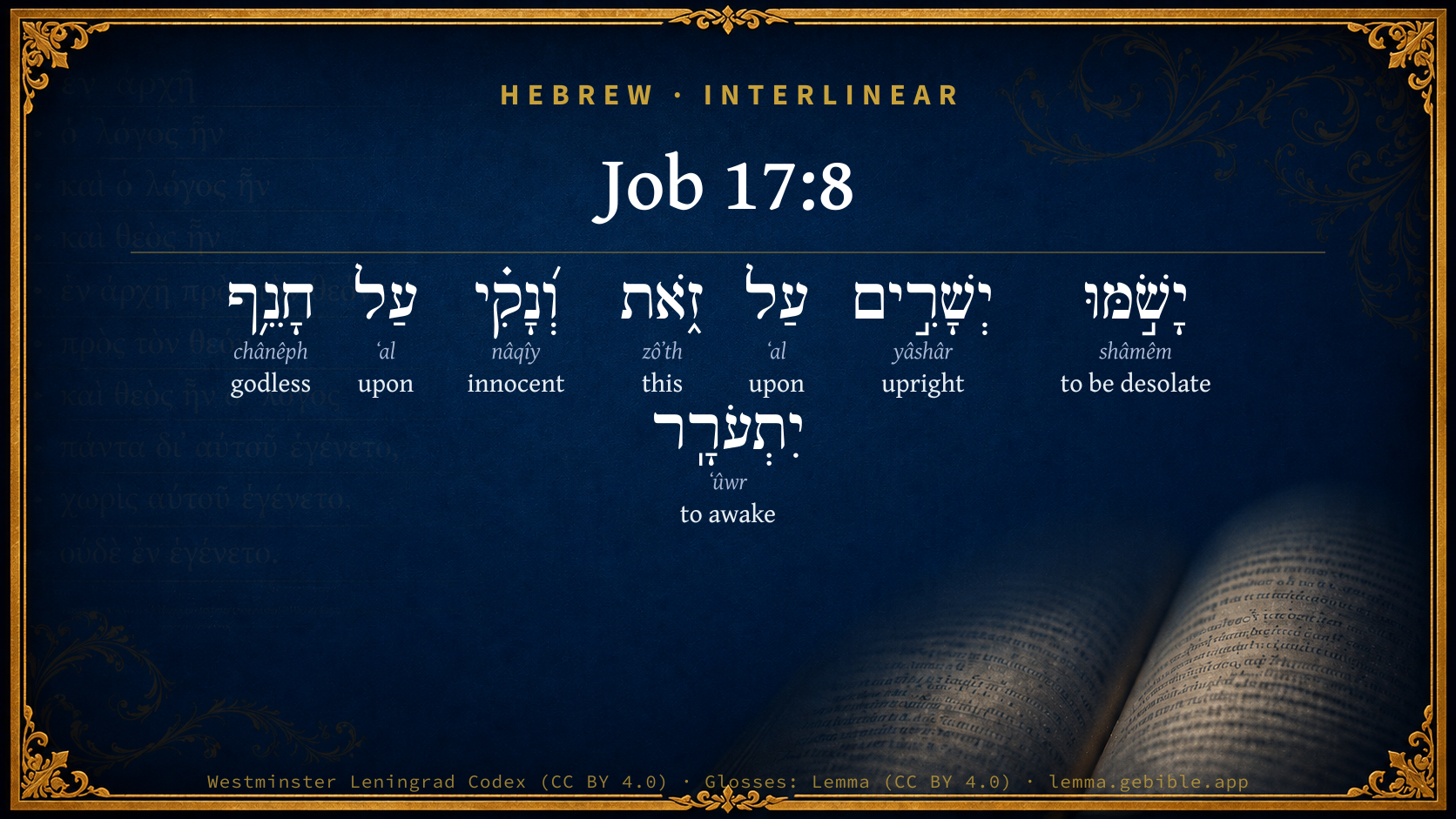
Hebrew (Westminster Leningrad Codex) Job 17:8 appears in the Hebrew Old Testament. The text above is from the Westminster Leningrad Codex. Each word links to its Strong’s number, a concise gloss, and parsing drawn from the Open Scriptures Hebrew Bible morphology. Click any word for its full Brown-Driver-Briggs (BDB) entry.
Download image
Cite this verse

Job 17:8 (World English Bible). Public Domain. Lemma interlinear Bible study tool, https://lemma.gebible.app/v/job/17/8.

Show BibTeX & RIS
BibTeX
RIS
English Translation
Upright men shall be astonished at this. The innocent shall stir up himself against the godless.
World English Bible · Public Domain
Download a study sheet

One document with this verse’s original text, its word-by-word gloss line, the meaning frame, cross-references with their text, attributed commentary, and full source and license credits — printable, and it pastes into notes with its structure intact.

This verse Autodidact and up

Study sheet (.html) Plain text (.txt)

A passage Seminary Student

Up to 50 verses in one chapter. A passage sheet keeps up to 6 commentary sources and 12 cross-references per verse, in the order this page ranks them, and says so on the sheet whenever that leaves anything out. Ask for a single verse and you get the Autodidact verse sheet above.

Everything on this page stays free to read, with no account — the sheet is a download of what is already on screen, not access to it.

Want to remove ads? Support Godless Engineer
Compare translations 3

The same verse in 3 English versions, stacked beneath the original-language interlinear above. Click any original word for its lexicon entry.

Each is an independent rendering of the whole verse — the interlinear is not word-aligned to these translations.

Highlighted words mark where these versions differ — a whole-verse word diff, not a word-by-word alignment.

  • World English Bible Public Domain
    Upright men shall be astonished at this. The innocent shall stir up himself against the godless.
  • King James Version Public Domain
    Upright men shall be astonied at this, and the innocent shall stir up himself against the hypocrite.
  • unfoldingWord Literal Text CC BY-SA 4.0
    The upright wonder at this, and the innocent rouses himself against the godless.

unfoldingWord Literal Text — © unfoldingWord, licensed CC BY-SA 4.0. Word-aligned USFM3 via Door43 (git.door43.org/unfoldingWord/en_ult).

Versions to compare (up to 4)

3 of 4 selected

Show all 18 translations

Every available English version of this verse, each an independent rendering of the whole verse.

  • World English Bible Public Domain
    Upright men shall be astonished at this. The innocent shall stir up himself against the godless.
  • Berean Standard Bible Public Domain
    The upright are appalled at this, and the innocent are stirred against the godless.
  • Majority Standard Bible Public Domain
    The upright are appalled at this, and the innocent are stirred against the godless.
  • King James Version Public Domain
    Upright men shall be astonied at this, and the innocent shall stir up himself against the hypocrite.
  • American Standard Version (1901) Public Domain
    Upright men shall be astonished at this, And the innocent shall stir up himself against the godless.
  • Revised Version (1885) Public Domain
    Upright men shall be astonied at this, and the innocent shall stir up himself against the godless.
  • Geneva Bible (1599) Public Domain
    The righteous shalbe astonied at this, and the innocent shalbe moued against ye hypocrite.
  • Douay-Rheims (1899) Public Domain
    The just shall be astonished at this, and the innocent shall be raised up against the hypocrite.
  • Young's Literal Translation Public Domain
    Astonished are the upright at this, And the innocent against the profane Stirreth himself up.
  • Literal Standard Version CC BY-SA 4.0
    The upright are astonished at this, and the innocent stirs himself up against the profane.
  • Unlocked Literal Bible CC BY-SA 4.0
    Upright men will be stunned by this; the innocent man will stir himself up against godless men.
  • unfoldingWord Literal Text CC BY-SA 4.0
    The upright wonder at this, and the innocent rouses himself against the godless.
  • Darby Bible Public Domain
    Upright men [shall be] astonished at this, and the innocent shall be stirred up against the ungodly;
  • World Messianic Bible Public Domain
    Upright men will be astonished at this. The innocent will stir himself up against the godless.
  • Webster's Bible Public Domain
    Upright men shall be astonished at this, and the innocent shall stir up himself against the hypocrite.
  • Free Bible Version CC BY-SA 4.0
    People who think they are good are shocked to see me. Those who are innocent are troubled by the godless.
  • Bible in Basic English Public Domain
    The upright are surprised at this, and he who has done no wrong is troubled because of the evil-doers.
  • JPS Tanakh (1917) Public Domain
    Upright men are astonished at this, and the innocent stirreth up himself against the godless.

Literal Standard Version (2020), Covenant Press — licensed CC BY-SA 4.0. Text via the HelloAO Bible API (eBible.org). Unlocked Literal Bible (unfoldingWord) — licensed CC BY-SA 4.0. Text via the HelloAO Bible API (eBible.org). unfoldingWord Literal Text — © unfoldingWord, licensed CC BY-SA 4.0. Word-aligned USFM3 via Door43 (git.door43.org/unfoldingWord/en_ult). Free Bible Version, Dr. Jonathan Gallagher — licensed CC BY-SA 4.0. Text via the HelloAO Bible API (eBible.org).

Word by word

More ways to search: Search by grammar → Find every occurrence → Compare this word →

Practice this passage: Drill this verse → Learn its vocabulary →

About this verse

These counts appear in no published source. They are computed here, from the morphology-tagged text and Lemma’s own curated glosses. What Lemma adds →

8
words
7
distinct lemmas
Wisdom
section

Notable vocabulary

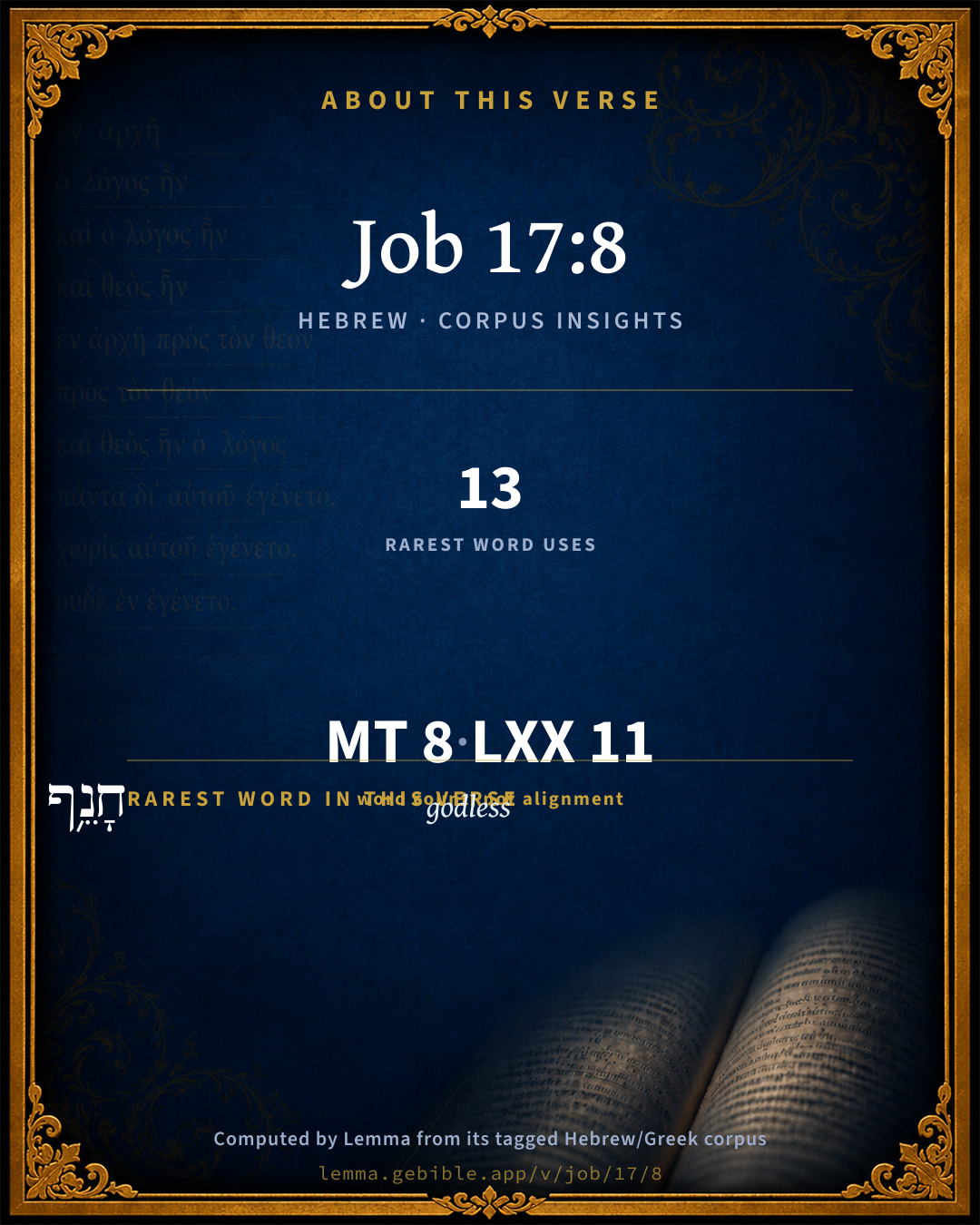
The rarest word here is חָנֵ֥ף godless H2611 — appearing just 13 times in the whole Hebrew Bible.

Shared distinctive vocabulary

חָנֵ֥ף godless H2611 occurs in 13 verses of the Hebrew Bible. Also found in:

Grammatical profile

  • 2 verbs
  • 3 adjectives
  • 1 pronoun
  • 2 prepositions

Verb forms

  • יָשֹׁ֣מּוּ Qal · Imperfect
  • יִתְעֹרָֽר Hithpolel · Imperfect

Repetition

A word recurs within this verse — often emphatic in Hebrew:

Hebrew & Septuagint length

In English translation the verse runs 16 words from the Hebrew and 16 from the Septuagint (LXX English) — the same length.

A rough comparison of the two English renderings, which tokenize alike — not a word-level alignment.

Word counts can differ between the Hebrew and the Greek without any difference in meaning — e.g. the Hebrew direct-object marker אֵת has no separate Greek word, and Greek often adds the article ὁ.

In the original languages it is 8 Hebrew tokens and 11 Greek tokens — but the two are counted differently (Hebrew bundles its prefixes and suffixes into one token; the Greek is in lemma form), so that isn’t a like-for-like length.

Cross-references

7

Topical passages linked to Job 17:8 in the Treasury of Scripture Knowledge — connected by theme and wording, ordered by reader-vote popularity; previews shown in the World English Bible.

  • Ecclesiastes 5:8 If you see the oppression of the poor, and the violent taking away of justice and righteousness in a district, don't marvel at the matter: for one official is eyed by a higher one; and there are officials over them.
  • Habakkuk 1:13 You who have purer eyes than to see evil, and who cannot look on perversity, why do you tolerate those who deal treacherously, and keep silent when the wicked swallows up the man who is more righteous than he,
  • Job 22:19 The righteous see it, and are glad; The innocent ridicule them,
  • Job 34:30 That the godless man may not reign, That there be no one to ensnare the people.
  • Psalms 73:12–15 Behold, these are the wicked. Being always at ease, they increase in riches.
  • Acts 13:46 Paul and Barnabas spoke out boldly, and said, "It was necessary that God's word should be spoken to you first. Since indeed you thrust it from you, and judge yourselves unworthy of eternal life, behold, we turn to the Gentiles.
  • Romans 11:33 Oh the depth of the riches both of the wisdom and the knowledge of God! How unsearchable are his judgments, and his ways past tracing out!

Cross-references courtesy of OpenBible.info (CC BY 4.0).

Hebrew and Greek witnesses Masoretic Hebrew ↔ Greek Septuagint

The same verse in the two great witnesses to the Old Testament, shown verse-for-verse.

These are two independent witnesses, not word-aligned to each other, and the Septuagint is shown in lemma (dictionary) form.

Hebrew Job 17:8 Masoretic · Westminster Leningrad Codex

יָשֹׁ֣מּוּ יְשָׁרִ֣ים עַל זֹ֑את וְ֝נָקִ֗י עַל חָנֵ֥ף יִתְעֹרָֽר

Upright men shall be astonished at this. The innocent shall stir up himself against the godless.

World English Bible · Public Domain

Greek LXX Job 17:8 Septuagint · lemma form

θαῦμα ἔχω ἀληθινός ἐπί οὗτος δίκαιος δέ ἐπί παράνομος ἐπι ἀναἵστημι

Wonder has seized true men upon this; and let the just rise up against the transgressor.

LXX2012 (modern English Septuagint) · Public Domain

Hebrew: Westminster Leningrad Codex (CC BY 4.0). Greek: Septuagint (public domain); English from LXX2012 (modern English Septuagint) (Public Domain). How the Septuagint differs from the Hebrew →

Commentary

Notes on Job 17:8 from classic Christian and Jewish commentators (each source and its license shown beneath its notes). The classic Christian expositions comment on the surrounding passage and are grouped to its opening verse, so a note may address several verses; the Jewish commentaries on the Tanakh (Rashi and others) are per-verse, so they appear only where the commentator wrote on this verse.

Lemma curates 59 commentaries, every one of them public domain or Creative Commons licensed, each selected and text-cleaned for this edition rather than reprinted as found. About our sources →

Trapp's Complete Commentary

John Trapp

Job 17:8 Upright [men] shall be astonied at this, and the innocent shall stir up himself against the hypocrite.

Ver. 8. Upright men shall be astonied at this] They shall silently admire and adore the fathomless depth of the divine administration when they see a man so upright to suffer such heavy pressures; yet shall they not censure me as you do, nor condemn me for complaining, since there is a cause. They cannot indeed see far into God’s secret intentions, they do therefore mirari marvel, rather than rimari, examine, like as the old Romans dedicated unto Victory a certain lake, the depth whereof they could not fathom.

And the innocent shall stir up himself against the hypocrite] He shall learn of me not to be baffled out of his sincerity, to be mocked out of his integrity, but to maintain and take comfort therein against all his false accusers. Opposition doth not weaken, but waken, heroic spirits, 2Sa 6:21-22. They proceed so much the more vigorously in the ways of holiness; like as lime burns the more for the cold water cast upon it, and as the palm tree, which, although it have many weights at the top, and many snakes at the bottom, yet it stirreth up itself, and flourisheth, taking for its posy, Nec premor, nec perimor. Nothing hurteth or hindereth me.

John Trapp, A Commentary or Exposition upon All the Books of the Old and New Testament (1647–1656) — public domain. Text from a community e-Sword module.

Joseph Benson's Commentary

Job 17:8. Upright men shall be astonied at this — Wise and good men, when they shall see me, and consider my calamities, will not be so forward to censure and condemn me as you are, but will rather stand and wonder at the depth and mysteriousness of God’s judgments, which fall so heavily upon innocent men, while the worst of men prosper. And, or, rather, but, or yet, the innocent shall stir himself up against the hypocrite — Notwithstanding all these sufferings of good men, and the astonishment which they cause, he shall be so far from joining his opinions, counsels, and interest with those profane men, who take occasion from thence to censure afflicted persons, and desert, condemn, and reproach the profession and practice of godliness, that he will the more zealously oppose those hypocrites who make these strange providences of God an objection to religion, and will prefer afflicted piety to prosperous iniquity.

Joseph Benson's Commentary on the Old and New Testaments (1811–1818) — public domain. Text from a community e-Sword module.

Tyndale Open Study Notes

Tyndale Open Resources

17:8-9 Some scholars view these verses as being out of place, but perhaps Job was ironically quoting his opponents’ words.

Tyndale Open Study Notes — © Tyndale Open Resources, licensed CC BY-SA 4.0. Text via the HelloAO Bible API.

Geneva Bible (1599)

Geneva Bible translators

To wit, when they see the godly punished: but in the end they shalt come to understanding, and know what shall be the reward of the hypocrite.

Geneva Bible (1599) marginal notes — public domain. Text via Bolls.life.

Jamieson, Fausset & Brown

Robert Jamieson, A. R. Fausset & David Brown

astonied--at my unmerited sufferings.

against the hypocrite--The upright shall feel their sense of justice wounded ("will be indignant") because of the prosperity of the wicked. By "hypocrite" or "ungodly," he perhaps glances at his false friends.

Jamieson, Fausset & Brown — Commentary Critical and Explanatory on the Whole Bible (1871) — public domain (CC PDM 1.0). Text via the HelloAO Bible API.

Adam Clarke's Commentary

Verse 8. Upright men shall be astonied] In several of these verses Job is supposed to speak prophetically of his future restoration, and of the good which religious society should derive from the history of his original affluence, consequent poverty and affliction, and final restoration to health, peace, and prosperity. The upright will receive the account with astonishment, and wonder at the dispensations of the Almighty; while hypocrites, false professors and the sour-headed, godly, shall be unmasked, and innocent men, whether in affliction or affluence, shall be known to be favourites of the Almighty.

Adam Clarke's Commentary on the Bible (1810–1826) — public domain. Text from a community e-Sword/MySword module.

Ellicott's Commentary for English Readers

(8) Upright men shall be astonied.—“As a result of the warning my case would give, upright men would be astonished at it, innocent men would be encouraged, and the righteous would persevere and wax bold.”

A Bible Commentary for English Readers, edited by Charles John Ellicott (1878–1897) — public domain. Text from a community e-Sword module.

The Cambridge Bible for Schools and Colleges

gen. ed. J. J. S. Perowne

8, 9. Effect produced on religious minds by the sight of such sufferings inflicted on the godly. Such moral perversions in the rule of the world “confound” religious men, and rouse their moral indignation against the wicked, who are prosperous; cf. similar thoughts Psa_37:1 seq., Psa_73:2 seq. The word this refers to Job’s case as an instance of the moral wrong that is observed in the rule of the world. On “hypocrite,” i. e. godless, see ch. Job_8:13.

The Cambridge Bible for Schools and Colleges (gen. ed. J. J. S. Perowne; Cambridge University Press, 1878–1918) — public domain. Text from a community e-Sword module.

John Gill's Exposition

Upright men shall be astonished at this,.... Such as were upright in heart, and in their walk conversation, sincere and honourable in their profession of religion, these would be amazed at the afflictions of Job, and the unkindness of his friends; it is hereby suggested, that it would be then, and in ages to come, a matter of surprise to truly gracious persons, when they should hear of such sore afflictions laid upon so good a man, and he told what censures, calumnies, and reproaches, were cast upon him by his friends; this would be so astonishing, that they would not know how to believe it, and still more at a loss how to account for it, that such things should be permitted in Providence, there being reason to believe the truth of them:

and the innocent shall stir up himself against the hypocrite; that is, such, who though they are not free from sin, yet live holy and harmless lives and conversations among men, so that they are not chargeable with any gross iniquity, or what is scandalous and unbecoming their character; these shall rise up with indignation against such persons as pretend to a great deal of sanctify and devotion, and yet have no charity or love to an afflicted saint, but censure and reproach him, and add affliction to his affliction. Thus Job retorts the charge of hypocrisy his friends brought against him upon them; for he seems tacitly to design them, and delivers these words as a kind of solace to himself; that though he was thus used by them at that time, yet good men in future time would have different apprehensions of him, and rise up and vindicate his name and character.

John Gill's Exposition of the Whole Bible (1746–1763) — public domain (CC PDM 1.0). Text via the HelloAO Bible API.

Albert Barnes' Notes on the Bible

Upright men shall be astonished at this - At the course of events in regard to me. They will be amazed that God has suffered a holy man to be plunged into such calamities, and to be treated in this manner by his friends. The fact at which he supposes they would be so much astonished was, that the good were afflicted in this manner, and that no relief was furnished.

And the innocent shall stir up himself - Shall rouse himself, or assume vigor to resist the wicked.

The hypocrite - The wicked - alluding probably to his professed friends. The idea of hypocrisy which the sentence conveys arises from the fact, that they professed to be “his” friends, and had proved to be false; and that they had professed to be the friends of God, and yet had uttered sentiments inconsistent with any right views of him. He now says, that that could not go unnoticed. The world would be aroused at so remarkable a state of things, and a just public indignation would be the result.

Albert Barnes' Notes on the Bible (1834–1885) — public domain. Text from a community e-Sword/MySword module.

Haydock's Catholic Bible Commentary

Hypocrite. If you condemn me, I shall comfort myself with the approbation of the righteous, and still maintain my station. (Haydock) --- Men of sense and virtue will tremble at the judgments of God, and will never join the crowd of scoffers. (Calmet)

George Leo Haydock (1774–1849), Haydock's Catholic Family Bible and Commentary, 1859 edition — public domain. Excludes Psalms (Douay-Rheims chapter numbering differs from Protestant) and Deuterocanonical books (Catholic canon only).

Matthew Poole's English Annotations

Wise and good men, when they shall see and consider my calamities, will not be so forward to censure and condemn me as you are, but will rather stand and wonder at the depth and mysteriousness of God’s counsels and judgments, which fall so heavily upon innocent men, while the worst of men prosper.

And the innocent shall stir up himself against the hypocrite: but, or yet, (notwithstanding all these sufferings of good men and the astonishment which they cause,)

innocent (or religious persons shall be so far from joining their opinions, and counsels, and interests, with

hypocrites, or profane men, who thence take occasion to censure the afflicted person, and to reproach, and condemn, and desert the profession and practice of godliness, that they) will stir up themselves against them in holy indignation, and will oppose their wicked courses, and will prefer afflicted piety before prosperous iniquity.

Matthew Poole's English Annotations on the Holy Bible (1683–1685) — public domain. Text from a community e-Sword/MySword module.

Whedon's Commentary on the Bible

Daniel D. Whedon

8. The hypocrite — The impure. To the righteous, the permitted sufferings of the just man at the hands of the unjust present a dark feature of the divine economy. The Church in all ages has been baptized with blood. All life of appreciable worth begins and matures through suffering, and the higher spiritual life is not excepted. According to the value of the life is the fierceness of the sorrow that accompanies it into being — a thought that holds good with respect to the highest saints in heaven.

(Rev_7:13-15.) The divine will that spares not the Son of God, subjects to kindred suffering those in whom he is most deeply interested.

Daniel D. Whedon (gen. ed.), Commentary on the Old and New Testaments (1874–1909) — public domain. Text from a community e-Sword module.

The Pulpit Commentary

Upright men shall be astonished at this. When Job"s case comes to beknown, "upright men" will be astonished at it. They will marvel how it came to pass that such a man so true, so faithful, so "perfect" (Job_1:1) could have been allowed by God to suffer so terribly. In a world where, up to Job"s time, prosperity had been taken as the measure of goodness, the marvel was naturally great. Even now many a Christian is surprised and disturbed in mind if he gives the case prolonged and serious attention, though he holds the clue to it in that most enlightening phrase, "perfect through sufferings". (Heb_2:10) And the innocent shall stir up himself against the hypocrite. On astonishment will follow indignation. When it becomes generally recognized that, in a vast number of eases, the righteous suffer, while the wicked enjoy great prosperity, good men"s feelings will be stirred up against these prosperous ones; they will wax indignant, and take part against them.

The Pulpit Commentary (1880–1919), ed. H.D.M. Spence-Jones & Joseph S. Exell — public domain. Text from a community e-Sword module.

John Wesley's Explanatory Notes

Astonied - At the depth and mysteriousness of God's judgments, which fall on innocent men, while the worst of men prosper. Yet - Notwithstanding all these sufferings of good men, and the astonishment which they cause, he shall the more zealously oppose those hypocrites, who make these strange providences of God an objection to religion.

John Wesley, Explanatory Notes Upon the Whole Bible (1754–1765) — public domain. Text via the GEBible commentary corpus.

Rashi

Rabbi Shlomo Yitzchaki (Rashi)

will be appalled they will wonder.

and an innocent one If there is a righteous [man] who hears the mockery of these hypocrites.

will be aroused to quarrel with you.

Rashi on the Tanakh — English translations: “The Judaica Press complete Tanach with Rashi, translated by A. J. Rosenberg” (CC BY 4.0); “Pentateuch with Rashi's commentary by M. Rosenbaum and A.M. Silbermann, 1929-1934” (public domain); “The Metsudah Tanach series, Lakewood, N.J” (CC BY 4.0); and “The Book of Joshua, Metsudah Publications, 1997” (CC BY 4.0). Text via Sefaria.

Lesson kit

Teaching starters — assembled from the data on this page, not authored interpretation. Every prompt links to the verse data it draws on. Edit before teaching.

Job, in the Wisdom, opens this verse with 8 words (7 distinct Hebrew lemmas). Its most distinctive word is chânêph (“godless”). A historical commentator’s framing appears above. Read the whole chapter for the surrounding context.

Discussion questions

  1. What does “godless” (chânêph) contribute to the verse as a whole?
  2. How does Job 8:13, which shares the word «godless», read alongside this verse?
  3. What does the repetition of “upon” (2× in this one verse) do in this verse?
  4. The translations on this page render this verse differently — a whole-verse word diff, not a word-by-word alignment. What might account for the different wordings?
  5. «יָשֹׁ֣מּוּ» is a Qal Imperfect verb. How does that grammatical form shape the action described?
  6. Compare how Trapp's Complete Commentary and Joseph Benson's Commentary read this verse. Where do they agree or differ?

Things to notice

Reading settings

Reading text

Shown beneath each verse's original-language words.

Old Testament
Old Testament edition

Read the OT as the Masoretic Hebrew (MT) or the Greek Septuagint (LXX).

English shown for the Greek Septuagint (in the Hebrew ↔ Greek comparison).

Comparing translations? Open the Compare panel on any verse page to stack up to four side by side.