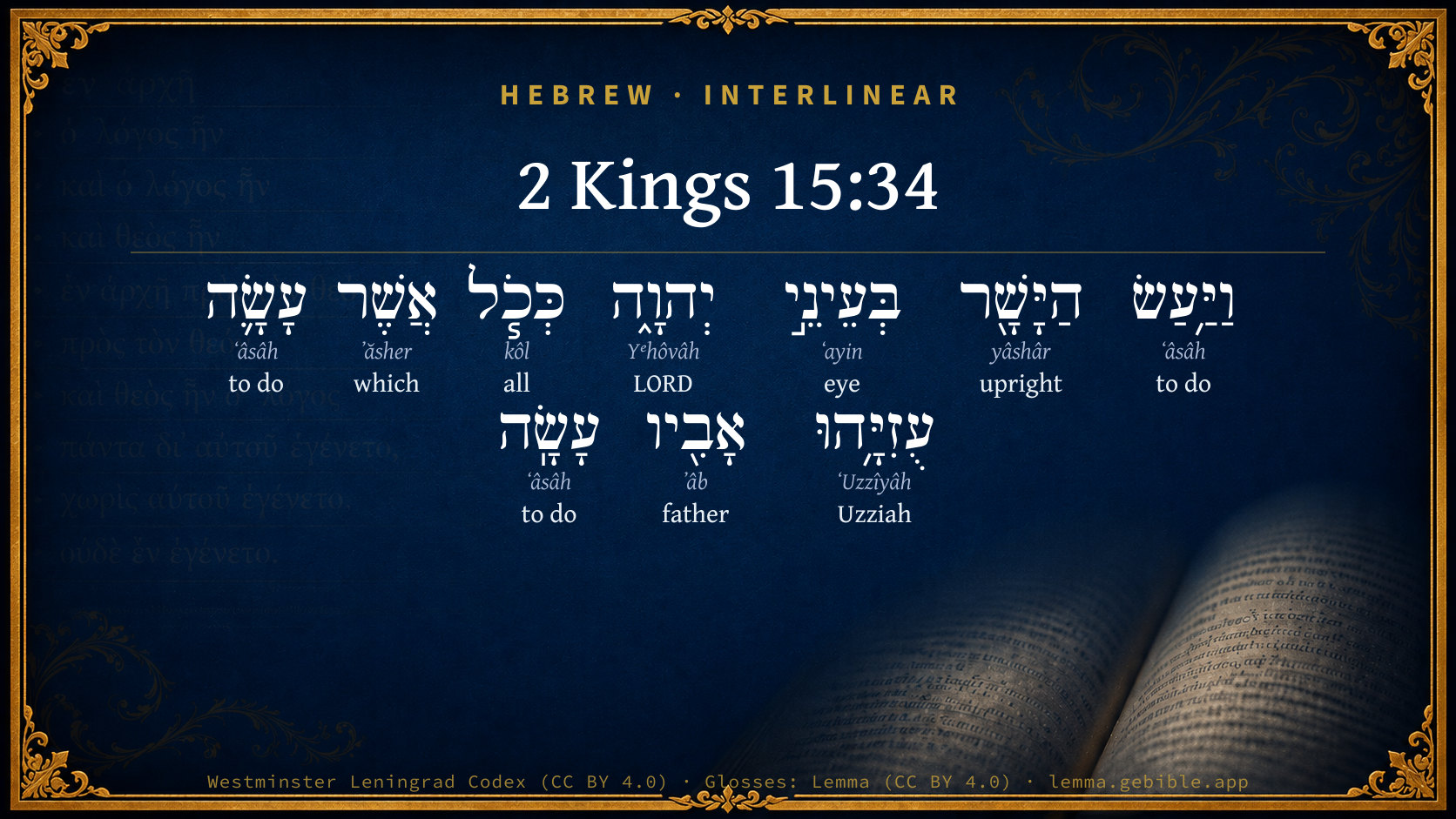
2 Kings 15:34

Hebrew (Westminster Leningrad Codex) 2 Kings 15:34 appears in the Hebrew Old Testament. The text above is from the Westminster Leningrad Codex. Each word links to its Strong’s number, a concise gloss, and parsing drawn from the Open Scriptures Hebrew Bible morphology. Click any word for its full Brown-Driver-Briggs (BDB) entry.
Download image
Cite this verse

2 Kings 15:34 (World English Bible). Public Domain. Lemma interlinear Bible study tool, https://lemma.gebible.app/v/2-kings/15/34.

Show BibTeX & RIS
BibTeX
RIS
English Translation
He did that which was right in the eyes of Yahweh; he did according to all that his father Uzziah had done.
World English Bible · Public Domain
Download a study sheet

One document with this verse’s original text, its word-by-word gloss line, the meaning frame, cross-references with their text, attributed commentary, and full source and license credits — printable, and it pastes into notes with its structure intact.

This verse Autodidact and up

Study sheet (.html) Plain text (.txt)

A passage Seminary Student

Up to 50 verses in one chapter. A passage sheet keeps up to 6 commentary sources and 12 cross-references per verse, in the order this page ranks them, and says so on the sheet whenever that leaves anything out. Ask for a single verse and you get the Autodidact verse sheet above.

Everything on this page stays free to read, with no account — the sheet is a download of what is already on screen, not access to it.

Want to remove ads? Support Godless Engineer
Compare translations 3

The same verse in 3 English versions, stacked beneath the original-language interlinear above. Click any original word for its lexicon entry.

Each is an independent rendering of the whole verse — the interlinear is not word-aligned to these translations.

Highlighted words mark where these versions differ — a whole-verse word diff, not a word-by-word alignment.

  • World English Bible Public Domain
    He did that which was right in the eyes of Yahweh; he did according to all that his father Uzziah had done.
  • King James Version Public Domain
    And he did that which was right in the sight of the LORD: he did according to all that his father Uzziah had done.
  • unfoldingWord Literal Text CC BY-SA 4.0
    And he did right in the eyes of Yahweh. Like all that Azariah his father did, he did.

unfoldingWord Literal Text — © unfoldingWord, licensed CC BY-SA 4.0. Word-aligned USFM3 via Door43 (git.door43.org/unfoldingWord/en_ult).

Versions to compare (up to 4)

3 of 4 selected

Show all 18 translations

Every available English version of this verse, each an independent rendering of the whole verse.

  • World English Bible Public Domain
    He did that which was right in the eyes of Yahweh; he did according to all that his father Uzziah had done.
  • Berean Standard Bible Public Domain
    And he did what was right in the eyes of the LORD, just as his father Uzziah had done.
  • Majority Standard Bible Public Domain
    And he did what was right in the eyes of the LORD, just as his father Uzziah had done.
  • King James Version Public Domain
    And he did that which was right in the sight of the LORD: he did according to all that his father Uzziah had done.
  • American Standard Version (1901) Public Domain
    And he did that which was right in the eyes of Jehovah; he did according to all that his father Uzziah had done.
  • Revised Version (1885) Public Domain
    And he did that which was right in the eyes of the LORD: he did according to all that his father Uzziah had done.
  • Geneva Bible (1599) Public Domain
    And hee did vprightly in the sight of the Lord: he did according to all that his father Vzziah had done.
  • Douay-Rheims (1899) Public Domain
    And he did that which was right before the Lord: according to all that his father Ozias had done, so did he.
  • Young's Literal Translation Public Domain
    and he doth that which `is' right in the eyes of Jehovah, according to all that Uzziah his father did he hath done.
  • Literal Standard Version CC BY-SA 4.0
    and he does that which [is] right in the eyes of YHWH; he has done according to all that his father Uzziah did.
  • Unlocked Literal Bible CC BY-SA 4.0
    Jotham did what was right in the eyes of Yahweh. He followed the example of all his father Azariah had done.
  • unfoldingWord Literal Text CC BY-SA 4.0
    And he did right in the eyes of Yahweh. Like all that Azariah his father did, he did.
  • Darby Bible Public Domain
    And he did what was right in the sight of Jehovah: he did according to all that his father Uzziah had done.
  • World Messianic Bible Public Domain
    He did that which was right in the LORD’s eyes. He did according to all that his father Uzziah had done.
  • Webster's Bible Public Domain
    And he did that which was right in the sight of the LORD: he did according to all that his father Uzziah had done.
  • Free Bible Version CC BY-SA 4.0
    He did what was right in the Lord's sight, just as his father Uzziah had done.
  • Bible in Basic English Public Domain
    And he did what was right in the eyes of the Lord, as his father Uzziah had done.
  • JPS Tanakh (1917) Public Domain
    And he did that which was right in the eyes of the LORD; he did according to all that his father Uzziah had done.

Literal Standard Version (2020), Covenant Press — licensed CC BY-SA 4.0. Text via the HelloAO Bible API (eBible.org). Unlocked Literal Bible (unfoldingWord) — licensed CC BY-SA 4.0. Text via the HelloAO Bible API (eBible.org). unfoldingWord Literal Text — © unfoldingWord, licensed CC BY-SA 4.0. Word-aligned USFM3 via Door43 (git.door43.org/unfoldingWord/en_ult). Free Bible Version, Dr. Jonathan Gallagher — licensed CC BY-SA 4.0. Text via the HelloAO Bible API (eBible.org).

Word by word

More ways to search: Search by grammar → Find every occurrence → Compare this word →

Practice this passage: Drill this verse → Learn its vocabulary →

עֻזִיָּ֥הוּ
ʻUzzîyâh
H5818
“Uzziah”
Noun, Proper
Part of Speech
Noun
Type
Proper
Full BDB Definition

Origin: from H5797 and H3050

TWOT: None

Uzziah = "my strength is Jehovah" - son of king Amaziah of Judah and king of Judah himself for 52 years; also 'Azariah' - a Kohathite Levite and ancestor of Samuel - a priest of the sons of Harim who took a foreign wife in the time of Ezra - a Judaite, father of Athaiah or Uthai - father of Jehonathan, one of David's overseers
  1. וַיַּ֥עַשׂ ʻâsâh H6213 “and · to do” Conjunction + Verb, Qal, Sequential Imperfect, 3rd Person, Masculine, Singular
  2. הַיָּשָׁ֖ר yâshâr H3477 “the · upright” Particle, Definite Article + Adjective, Adjective, Masculine, Singular, Absolute
  3. בְּעֵינֵ֣י ʻayin H5869 “in/at · eyes of” Preposition + Noun, Common, Both, Dual, Construct
  4. יְהוָ֑ה Yᵉhôvâh H3068 “LORD” Noun, Proper
  5. כְּכֹ֧ל kôl H3605 “like/as · all” Preposition + Noun, Common, Masculine, Singular, Absolute
  6. אֲשֶׁר ʼăsher H834 “which” Particle, Relative
  7. עָשָׂ֛ה ʻâsâh H6213 “to do” Verb, Qal, Perfect, 3rd Person, Masculine, Singular
  8. אָבִ֖יו ʼâb H1 “father · his” Noun, Common, Masculine, Singular, Construct + Suffix, Personal, 3rd Person, Masculine, Singular
  9. עָשָֽׂה ʻâsâh H6213 “to do” Verb, Qal, Perfect, 3rd Person, Masculine, Singular

About this verse

These counts appear in no published source. They are computed here, from the morphology-tagged text and Lemma’s own curated glosses. What Lemma adds →

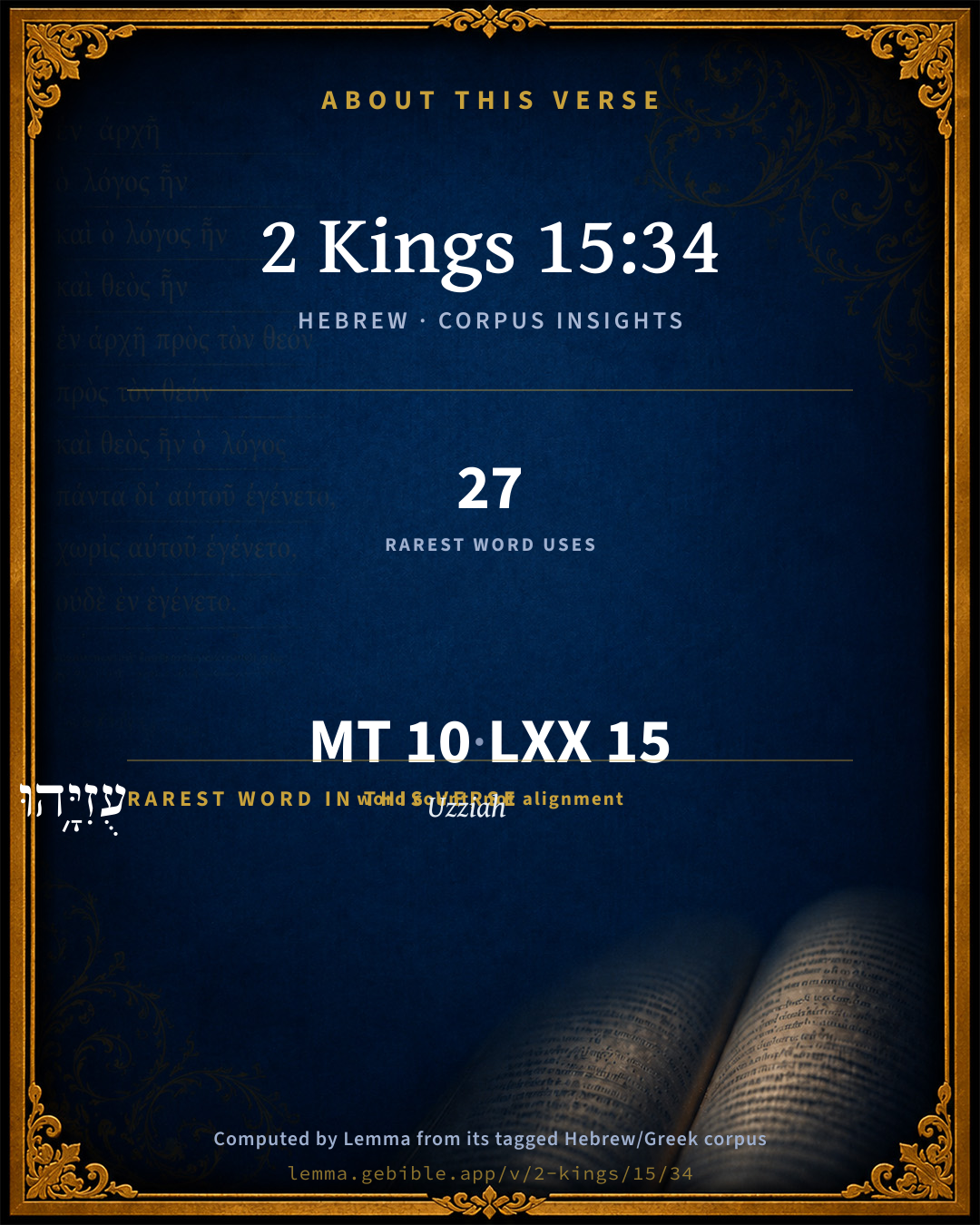
10
words
8
distinct lemmas
Historical
section

Shared distinctive vocabulary

עֻזִיָּ֥הוּ Uzziah H5818 occurs in 26 verses of the Hebrew Bible. Also found in:

Grammatical profile

  • 3 verbs
  • 5 nouns
  • 1 adjective
  • 1 particle

Verb forms

  • וַיַּ֥עַשׂ Qal · Sequential Imperfect
  • עָשָׂ֛ה Qal · Perfect
  • עָשָֽׂה Qal · Perfect

Repetition

A word recurs within this verse — often emphatic in Hebrew:

  • וַיַּ֥עַשׂ to do H6213 ×3

Hebrew & Septuagint length

In English translation the verse runs 22 words from the Hebrew and 22 from the Septuagint (LXX English) — the same length.

A rough comparison of the two English renderings, which tokenize alike — not a word-level alignment.

Word counts can differ between the Hebrew and the Greek without any difference in meaning — e.g. the Hebrew direct-object marker אֵת has no separate Greek word, and Greek often adds the article ὁ.

In the original languages it is 10 Hebrew tokens and 15 Greek tokens — but the two are counted differently (Hebrew bundles its prefixes and suffixes into one token; the Greek is in lemma form), so that isn’t a like-for-like length.

Cross-references

3

Topical passages linked to 2 Kings 15:34 in the Treasury of Scripture Knowledge — connected by theme and wording, ordered by reader-vote popularity; previews shown in the World English Bible.

  • 2 Chronicles 26:4–5 He did that which was right in the eyes of Yahweh, according to all that his father Amaziah had done.
  • 2 Kings 15:3–4 He did that which was right in the eyes of Yahweh, according to all that his father Amaziah had done.
  • 2 Chronicles 27:2 He did that which was right in the eyes of Yahweh, according to all that his father Uzziah had done: however he didn't enter into the temple of Yahweh. The people did yet corruptly.

Cross-references courtesy of OpenBible.info (CC BY 4.0).

Hebrew and Greek witnesses Masoretic Hebrew ↔ Greek Septuagint

The same verse in the two great witnesses to the Old Testament, shown verse-for-verse.

These are two independent witnesses, not word-aligned to each other, and the Septuagint is shown in lemma (dictionary) form.

Hebrew 2 Kings 15:34 Masoretic · Westminster Leningrad Codex

וַיַּ֥עַשׂ הַיָּשָׁ֖ר בְּעֵינֵ֣י יְהוָ֑ה כְּכֹ֧ל אֲשֶׁר עָשָׂ֛ה עֻזִיָּ֥הוּ אָבִ֖יו עָשָֽׂה

He did that which was right in the eyes of Yahweh; he did according to all that his father Uzziah had done.

World English Bible · Public Domain

Greek LXX 2 Kings 15:34 Septuagint · lemma form

καί ποιέω ὁ εὐθής ἐν ὀφθαλμός κύριος κατά πᾶς ὅσος ποιέω οζιας ὁ πατήρ αὐτός

And he did that which was right in the sight of the Lord, according to all things that his father Azarias did.

LXX2012 (modern English Septuagint) · Public Domain

Hebrew: Westminster Leningrad Codex (CC BY 4.0). Greek: Septuagint (public domain); English from LXX2012 (modern English Septuagint) (Public Domain). How the Septuagint differs from the Hebrew →

Targum (Aramaic paraphrase)

1

The Targum is the ancient Jewish Aramaic paraphrase of the Hebrew Scriptures — an interpretive translation, not the Hebrew text itself. Onkelos (literal) and Pseudo-Jonathan (expansive) render the Torah, and Jonathan the Prophets. Coverage is partial: where no permissively-licensed English translation exists for a verse, only the Aramaic is shown. This is verse-level text, not a word-by-word alignment to the Hebrew.

  1. Targum Jonathan Prophets (Joshua–Malachi)
    וַעֲבַד דְכָשַׁר קֳדָם יְיָ כְּכָל דַעֲבַד עֻזִיָה אֲבוּהִי עֲבַד:

    (no public-domain English translation for this verse)

    Targum Jonathan — Aramaic: “Mikraot Gedolot” (public domain). English: “Sefaria Community Translation” (CC0 1.0 (public-domain dedication)); “London "Chaldee Paraphrase," 1871” (public domain). Text via Sefaria.

Commentary

Notes on 2 Kings 15:34 from classic Christian and Jewish commentators (each source and its license shown beneath its notes). The classic Christian expositions comment on the surrounding passage and are grouped to its opening verse, so a note may address several verses; the Jewish commentaries on the Tanakh (Rashi and others) are per-verse, so they appear only where the commentator wrote on this verse.

Lemma curates 59 commentaries, every one of them public domain or Creative Commons licensed, each selected and text-cleaned for this edition rather than reprinted as found. About our sources →

Trapp's Complete Commentary

John Trapp

2Ki 15:34 And he did [that which was] right in the sight of the LORD: he did according to all that his father Uzziah had done.

Ver. 34. And he did that which was right.] Both for matter, manner, motive, and end; a good prince he was.

John Trapp, A Commentary or Exposition upon All the Books of the Old and New Testament (1647–1656) — public domain. Text from a community e-Sword module.

Tyndale Open Study Notes

Tyndale Open Resources

15:34-35 Although Jotham did what was pleasing in the Lord’s sight, he allowed worship at pagan shrines to continue. • rebuilt the upper gate of the Temple: The prosperity of Uzziah’s reign continued during his son Jotham’s reign. Jotham built onto Jerusalem’s wall at the hill of Ophel and did construction at many Judean sites (2 Chr 27:3-4). He also conquered the rebellious Ammonites (2 Chr 27:5), whom Uzziah had forced into subservience (2 Chr 26:8).

Tyndale Open Study Notes — © Tyndale Open Resources, licensed CC BY-SA 4.0. Text via the HelloAO Bible API.

Geneva Bible (1599)

Geneva Bible translators

He showeth that his uprightness was not such, but that he had many and great faults.

Geneva Bible (1599) marginal notes — public domain. Text via Bolls.life.

The Cambridge Bible for Schools and Colleges

gen. ed. J. J. S. Perowne

32–38. Jotham king of Judah. Commencement of the plots of Israel against Judah (2Ch_27:1-9)

34. according to all that his father Uzziah had done] The Chronicler notes the great exception ‘Howbeit he entered not into the temple of the Lord’. As this sin of Uzziah had not been recorded by the compiler of Kings, it is natural that he should not allude to it in the notice of Jotham.

The Cambridge Bible for Schools and Colleges (gen. ed. J. J. S. Perowne; Cambridge University Press, 1878–1918) — public domain. Text from a community e-Sword module.

Albert Barnes' Notes on the Bible

Jotham imitated his father in all respects, excepting in his impious usurpation of the priestly functions (2Ki 15:5 note; 2Ch 27:2).

Albert Barnes' Notes on the Bible (1834–1885) — public domain. Text from a community e-Sword/MySword module.

Haydock's Catholic Bible Commentary

Did he. Yet he did not imitate his presumption. God gave great success to his enterprises, 2 Paralipomenon xxvii. 2.

George Leo Haydock (1774–1849), Haydock's Catholic Family Bible and Commentary, 1859 edition — public domain. Excludes Psalms (Douay-Rheims chapter numbering differs from Protestant) and Deuterocanonical books (Catholic canon only).

The Pulpit Commentary

And he did that which was right in the sight of the Lord: he did according to all that his father Uzziah had done. The author of Chronicles says the same, but adds, very pertinently, "Howbeit he entered not into the temple of the Lordi.e. he did not repeat his father"s act of impiety. Josephus is still warmer in his praises. "This king," he says (l.s.c.), "was deficient in no manner of virtue; but was at once pious in things pertaining to God, and just in those pertaining to men. He was careful and watchful over the city; whatever needed reparation or adornment, he labored to supply strenuously, as the porticoes in the temple and the gates thereof; and where any part of the wall had gone to ruin, he raised it up again, and built towers of vast size and difficult to capture. And in all other matters pertaining to the kingdom, where there had been neglect, he applied great care and attention."

The Pulpit Commentary (1880–1919), ed. H.D.M. Spence-Jones & Joseph S. Exell — public domain. Text from a community e-Sword module.

unfoldingWord translationNotes

Door43 World Missions Community

what was right in the eyes of Yahweh

The eyes represent seeing, and seeing represents thoughts or judgment. AT: "what was right in Yahweh's judgment" or "what Yahweh considers to be right" (See: Metaphor)

the high places were not taken away

This can be stated in active form. AT: "no one took away the high places" or "Jotham did not have anyone take the high places away" (See: Active or Passive)

were not taken away

Being taken away represents being destroyed. AT: "were not destroyed" (See: Metaphor)

Jotham built the upper gate

"Jotham built" represents Jotham making his workers build it. AT: "Jotham had his workers build the upper gate" (See: Metonymy)

are they not written ... Judah?

This question is used to either inform or remind the readers that the information about Jotham is in this other book. See how you translated this in 2 Kings 8:23. AT: "they are written in The Book of the Events of the Kings of Judah." (See: Rhetorical Question)

translationWords

Yahweh

high place

sacrifice

incense

gate

house of God

unfoldingWord translationNotes — © Distant Shores Media and the Door43 World Missions Community, licensed CC BY-SA 4.0. Source: git.door43.org/Door43/en_tn.

Lesson kit

Teaching starters — assembled from the data on this page, not authored interpretation. Every prompt links to the verse data it draws on. Edit before teaching.

2 Kings, in the Historical, opens this verse with 10 words (8 distinct Hebrew lemmas). Its most distinctive word is ʻUzzîyâh (“Uzziah”). A historical commentator’s framing appears above. Read the whole chapter for the surrounding context.

Discussion questions

  1. How does “Uzziah” (ʻUzzîyâh) shape what this verse is saying?
  2. How does 2 Kings 15:13, which shares the word «Uzziah», read alongside this verse?
  3. What does the repetition of “to do” (3× in this one verse) do in this verse?
  4. These translations render this verse differently; the difference is in the English rendering, not the original. What questions does that raise?
  5. «וַיַּ֥עַשׂ» is a Qal Sequential Imperfect verb. How does that grammatical form shape the action described?
  6. Compare how Trapp's Complete Commentary and Tyndale Open Study Notes read this verse. Where do they agree or differ?

Things to notice

Reading settings

Reading text

Shown beneath each verse's original-language words.

Old Testament
Old Testament edition

Read the OT as the Masoretic Hebrew (MT) or the Greek Septuagint (LXX).

English shown for the Greek Septuagint (in the Hebrew ↔ Greek comparison).

Comparing translations? Open the Compare panel on any verse page to stack up to four side by side.