
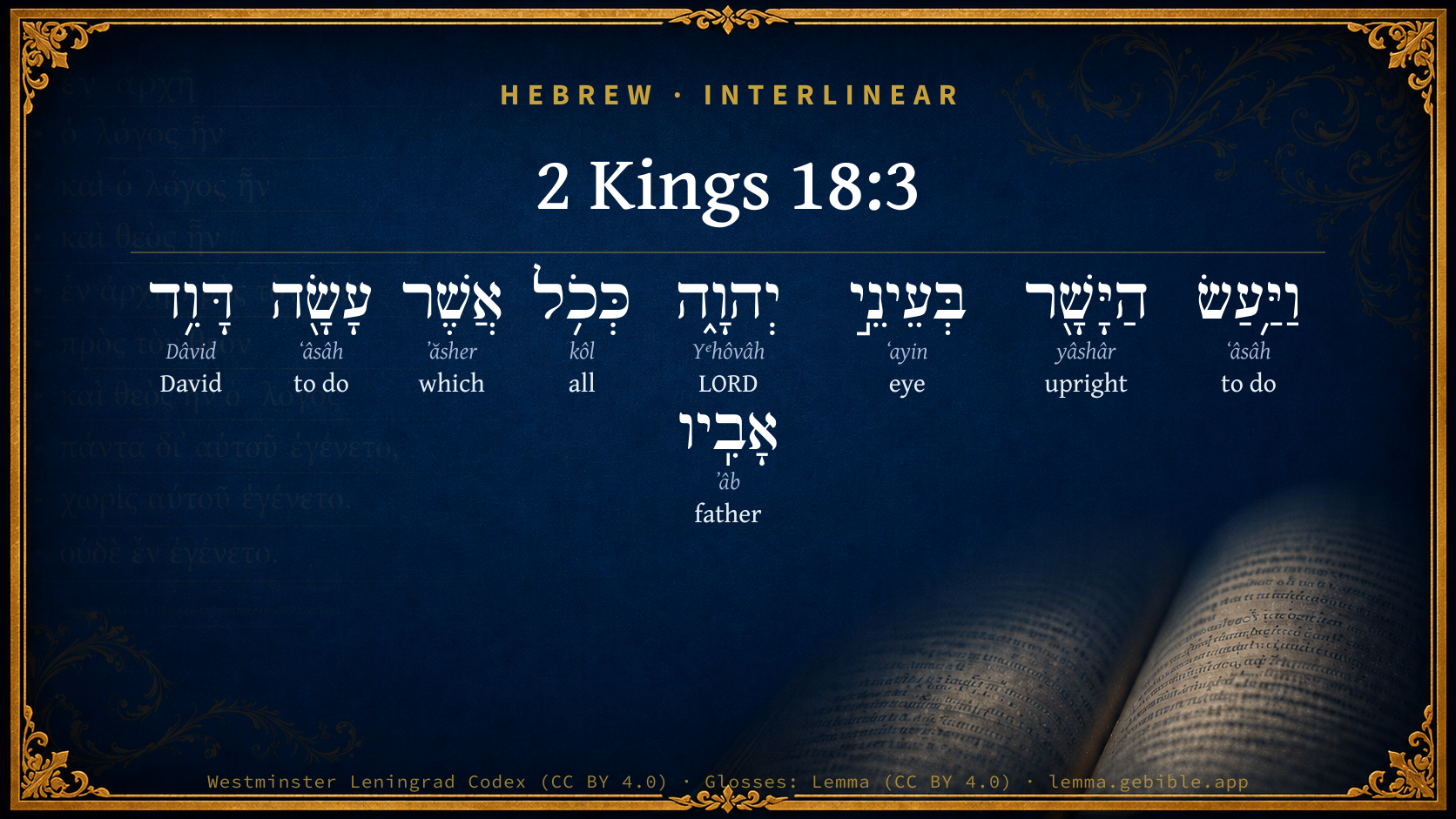
2 Kings 18:3

Hebrew (Westminster Leningrad Codex) 2 Kings 18:3 appears in the Hebrew Old Testament. The text above is from the Westminster Leningrad Codex. Each word links to its Strong’s number, a concise gloss, and parsing drawn from the Open Scriptures Hebrew Bible morphology. Click any word for its full Brown-Driver-Briggs (BDB) entry.
Download image
Cite this verse

2 Kings 18:3 (World English Bible). Public Domain. Lemma interlinear Bible study tool, https://lemma.gebible.app/v/2-kings/18/3.

Show BibTeX & RIS
BibTeX
RIS
English Translation
He did that which was right in the eyes of Yahweh, according to all that David his father had done.
World English Bible · Public Domain
Download a study sheet

One document with this verse’s original text, its word-by-word gloss line, the meaning frame, cross-references with their text, attributed commentary, and full source and license credits — printable, and it pastes into notes with its structure intact.

This verse Autodidact and up

Study sheet (.html) Plain text (.txt)

A passage Seminary Student

Up to 50 verses in one chapter. A passage sheet keeps up to 6 commentary sources and 12 cross-references per verse, in the order this page ranks them, and says so on the sheet whenever that leaves anything out. Ask for a single verse and you get the Autodidact verse sheet above.

Everything on this page stays free to read, with no account — the sheet is a download of what is already on screen, not access to it.

Want to remove ads? Support Godless Engineer
Compare translations 3

The same verse in 3 English versions, stacked beneath the original-language interlinear above. Click any original word for its lexicon entry.

Each is an independent rendering of the whole verse — the interlinear is not word-aligned to these translations.

Highlighted words mark where these versions differ — a whole-verse word diff, not a word-by-word alignment.

  • World English Bible Public Domain
    He did that which was right in the eyes of Yahweh, according to all that David his father had done.
  • King James Version Public Domain
    And he did that which was right in the sight of the LORD, according to all that David his father did.
  • unfoldingWord Literal Text CC BY-SA 4.0
    And he did right in the eyes of Yahweh, like all that David his father had done.

unfoldingWord Literal Text — © unfoldingWord, licensed CC BY-SA 4.0. Word-aligned USFM3 via Door43 (git.door43.org/unfoldingWord/en_ult).

Versions to compare (up to 4)

3 of 4 selected

Show all 18 translations

Every available English version of this verse, each an independent rendering of the whole verse.

  • World English Bible Public Domain
    He did that which was right in the eyes of Yahweh, according to all that David his father had done.
  • Berean Standard Bible Public Domain
    And he did what was right in the eyes of the LORD, just as his father David had done.
  • Majority Standard Bible Public Domain
    And he did what was right in the eyes of the LORD, just as his father David had done.
  • King James Version Public Domain
    And he did that which was right in the sight of the LORD, according to all that David his father did.
  • American Standard Version (1901) Public Domain
    And he did that which was right in the eyes of Jehovah, according to all that David his father had done.
  • Revised Version (1885) Public Domain
    And he did that which was right hi the eyes of the LORD, according to all that David his father had done.
  • Geneva Bible (1599) Public Domain
    And he did vprightly in the sight of the Lord, according to all that Dauid his father had done.
  • Douay-Rheims (1899) Public Domain
    And he did that which was good before the Lord, according to all that David his father had done.
  • Young's Literal Translation Public Domain
    And he doth that which `is' right in the eyes of Jehovah, according to all that David his father did,
  • Literal Standard Version CC BY-SA 4.0
    And he does that which [is] right in the eyes of YHWH, according to all that his father David did,
  • Unlocked Literal Bible CC BY-SA 4.0
    He did what was right in the eyes of Yahweh, following the example of all that David, his ancestor, had done.
  • unfoldingWord Literal Text CC BY-SA 4.0
    And he did right in the eyes of Yahweh, like all that David his father had done.
  • Darby Bible Public Domain
    And he did what was right in the sight of Jehovah, according to all that David his father had done.
  • World Messianic Bible Public Domain
    He did that which was right in the LORD’s eyes, according to all that David his father had done.
  • Webster's Bible Public Domain
    And he did that which was right in the sight of the LORD, according to all that David his father did.
  • Free Bible Version CC BY-SA 4.0
    He did what was right in the Lord's sight, following all that his forefather David had done.
  • Bible in Basic English Public Domain
    He did what was right in the eyes of the Lord as David his father had done.
  • JPS Tanakh (1917) Public Domain
    And he did that which was right in the eyes of the LORD, according to all that David his father had done.

Literal Standard Version (2020), Covenant Press — licensed CC BY-SA 4.0. Text via the HelloAO Bible API (eBible.org). Unlocked Literal Bible (unfoldingWord) — licensed CC BY-SA 4.0. Text via the HelloAO Bible API (eBible.org). unfoldingWord Literal Text — © unfoldingWord, licensed CC BY-SA 4.0. Word-aligned USFM3 via Door43 (git.door43.org/unfoldingWord/en_ult). Free Bible Version, Dr. Jonathan Gallagher — licensed CC BY-SA 4.0. Text via the HelloAO Bible API (eBible.org).

Word by word

More ways to search: Search by grammar → Find every occurrence → Compare this word →

Practice this passage: Drill this verse → Learn its vocabulary →

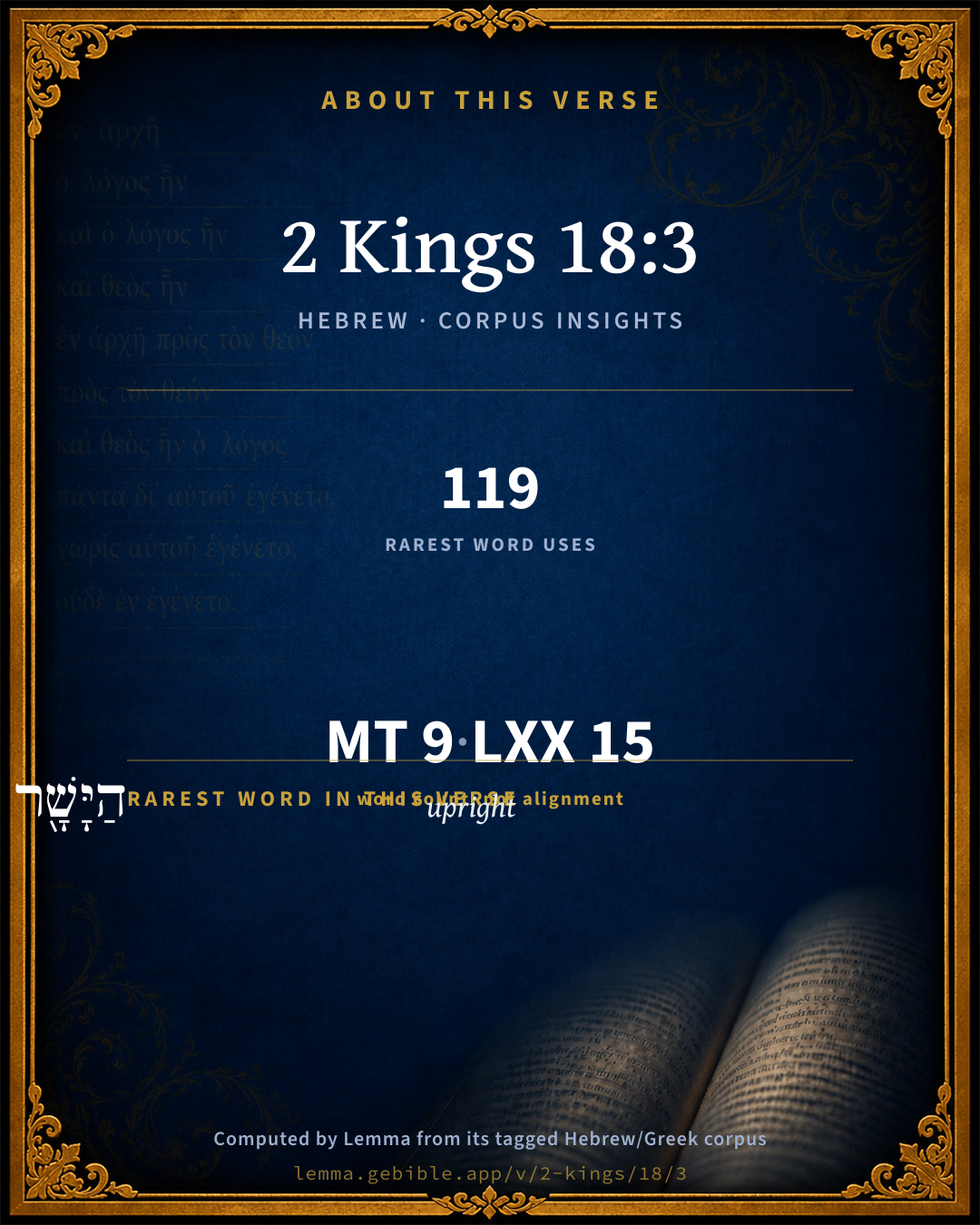
הַיָּשָׁ֖ר
yâshâr
H3477
“the · upright”
Particle, Definite Article + Adjective, Adjective, Masculine, Singular, Absolute
Part of Speech
Particle + Adjective
Type
Adjective
Gender
Masculine
Number
Singular
State
Absolute
Full BDB Definition

Origin: from H3474

TWOT: 930a

straight, upright, correct, right - straight, level - right, pleasing, correct - straightforward, just, upright, fitting, proper - uprightness, righteous, upright - that which is upright (substantive)
  1. וַיַּ֥עַשׂ ʻâsâh H6213 “and · to do” Conjunction + Verb, Qal, Sequential Imperfect, 3rd Person, Masculine, Singular
  2. בְּעֵינֵ֣י ʻayin H5869 “in/at · eyes of” Preposition + Noun, Common, Both, Dual, Construct
  3. יְהוָ֑ה Yᵉhôvâh H3068 “LORD” Noun, Proper
  4. כְּכֹ֥ל kôl H3605 “like/as · all” Preposition + Noun, Common, Masculine, Singular, Absolute
  5. אֲשֶׁר ʼăsher H834 “which” Particle, Relative
  6. עָשָׂ֖ה ʻâsâh H6213 “to do” Verb, Qal, Perfect, 3rd Person, Masculine, Singular
  7. דָּוִ֥ד Dâvid H1732 “David” Noun, Proper
  8. אָבִֽיו ʼâb H1 “father · his” Noun, Common, Masculine, Singular, Construct + Suffix, Personal, 3rd Person, Masculine, Singular

About this verse

These counts appear in no published source. They are computed here, from the morphology-tagged text and Lemma’s own curated glosses. What Lemma adds →

9
words
8
distinct lemmas
Historical
section

Grammatical profile

  • 2 verbs
  • 5 nouns
  • 1 adjective
  • 1 particle

Verb forms

  • וַיַּ֥עַשׂ Qal · Sequential Imperfect
  • עָשָׂ֖ה Qal · Perfect

Repetition

A word recurs within this verse — often emphatic in Hebrew:

  • וַיַּ֥עַשׂ to do H6213 ×2

Hebrew & Septuagint length

In English translation the verse runs 20 words from the Hebrew and 21 from the Septuagint (LXX English) — closely comparable.

A rough comparison of the two English renderings, which tokenize alike — not a word-level alignment.

Word counts can differ between the Hebrew and the Greek without any difference in meaning — e.g. the Hebrew direct-object marker אֵת has no separate Greek word, and Greek often adds the article ὁ.

In the original languages it is 9 Hebrew tokens and 15 Greek tokens — but the two are counted differently (Hebrew bundles its prefixes and suffixes into one token; the Greek is in lemma form), so that isn’t a like-for-like length.

Cross-references

15

Topical passages linked to 2 Kings 18:3 in the Treasury of Scripture Knowledge — connected by theme and wording, ordered by reader-vote popularity; previews shown in the World English Bible.

  • 2 Kings 20:3 Remember now, Yahweh, I beg you, how I have walked before you in truth and with a perfect heart, and have done that which is good in your sight. Hezekiah wept sore.
  • Exodus 15:26 and he said, "If you will diligently listen to the voice of Yahweh your God, and will do that which is right in his eyes, and will pay attention to his commandments, and keep all his statutes, I will put none of the diseases on you, which I have put on the Egyptians; for I am Yahweh who heals you."
  • Deuteronomy 6:18 You shall do that which is right and good in the sight of Yahweh; that it may be well with you, and that you may go in and possess the good land which Yahweh swore to your fathers,
  • 1 Kings 3:14 If you will walk in my ways, to keep my statutes and my commandments, as your father David did walk, then I will lengthen your days.
  • 1 Kings 11:4 For it happened, when Solomon was old, that his wives turned away his heart after other gods; and his heart was not perfect with Yahweh his God, as was the heart of David his father.
  • 1 Kings 11:38 It shall be, if you will listen to all that I command you, and will walk in my ways, and do that which is right in my eyes, to keep my statutes and my commandments, as David my servant did; that I will be with you, and will build you a sure house, as I built for David, and will give Israel to you.
  • 1 Kings 15:5 because David did that which was right in the eyes of Yahweh, and didn't turn aside from anything that he commanded him all the days of his life, except only in the matter of Uriah the Hittite.
  • 1 Kings 15:11 Asa did that which was right in the eyes of Yahweh, as did David his father.
  • 2 Kings 22:2 He did that which was right in the eyes of Yahweh, and walked in all the way of David his father, and didn't turn aside to the right hand or to the left.
  • 2 Chronicles 29:2 He did that which was right in the eyes of Yahweh, according to all that David his father had done.
  • 2 Chronicles 31:20–21 Thus did Hezekiah throughout all Judah; and he worked that which was good and right and faithful before Yahweh his God.
  • Job 33:27 He sings before men, and says, 'I have sinned, and perverted that which was right, And it didn't profit me.
  • Psalms 119:128 Therefore I consider all of your precepts to be right. I hate every false way.
  • Romans 7:12 Therefore the law indeed is holy, and the commandment holy, and righteous, and good.
  • Ephesians 6:1 Children, obey your parents in the Lord, for this is right.

Cross-references courtesy of OpenBible.info (CC BY 4.0).

Hebrew and Greek witnesses Masoretic Hebrew ↔ Greek Septuagint

The same verse in the two great witnesses to the Old Testament, shown verse-for-verse.

These are two independent witnesses, not word-aligned to each other, and the Septuagint is shown in lemma (dictionary) form.

Hebrew 2 Kings 18:3 Masoretic · Westminster Leningrad Codex

וַיַּ֥עַשׂ הַיָּשָׁ֖ר בְּעֵינֵ֣י יְהוָ֑ה כְּכֹ֥ל אֲשֶׁר עָשָׂ֖ה דָּוִ֥ד אָבִֽיו

He did that which was right in the eyes of Yahweh, according to all that David his father had done.

World English Bible · Public Domain

Greek LXX 2 Kings 18:3 Septuagint · lemma form

καί ποιέω ὁ εὐθής ἐν ὀφθαλμός κύριος κατά πᾶς ὅσος ποιέω δαυίδ ὁ πατήρ αὐτός

And he did that which was right in the sight of the Lord, according to all that his father David did.

LXX2012 (modern English Septuagint) · Public Domain

Hebrew: Westminster Leningrad Codex (CC BY 4.0). Greek: Septuagint (public domain); English from LXX2012 (modern English Septuagint) (Public Domain). How the Septuagint differs from the Hebrew →

Targum (Aramaic paraphrase)

1

The Targum is the ancient Jewish Aramaic paraphrase of the Hebrew Scriptures — an interpretive translation, not the Hebrew text itself. Onkelos (literal) and Pseudo-Jonathan (expansive) render the Torah, and Jonathan the Prophets. Coverage is partial: where no permissively-licensed English translation exists for a verse, only the Aramaic is shown. This is verse-level text, not a word-by-word alignment to the Hebrew.

  1. Targum Jonathan Prophets (Joshua–Malachi)
    וַעֲבַד דְכָשַׁר קֳדָם יְיָ כְּכֹל דַעֲבַד דָוִד אֲבוּהִי:

    (no public-domain English translation for this verse)

    Targum Jonathan — Aramaic: “Mikraot Gedolot” (public domain). English: “Sefaria Community Translation” (CC0 1.0 (public-domain dedication)); “London "Chaldee Paraphrase," 1871” (public domain). Text via Sefaria.

Commentary

Notes on 2 Kings 18:3 from classic Christian and Jewish commentators (each source and its license shown beneath its notes). The classic Christian expositions comment on the surrounding passage and are grouped to its opening verse, so a note may address several verses; the Jewish commentaries on the Tanakh (Rashi and others) are per-verse, so they appear only where the commentator wrote on this verse.

Lemma curates 59 commentaries, every one of them public domain or Creative Commons licensed, each selected and text-cleaned for this edition rather than reprinted as found. About our sources →

Trapp's Complete Commentary

John Trapp

2Ki 18:3 And he did [that which was] right in the sight of the LORD, according to all that David his father did.

Ver. 3. And he did that which was right.] See 1Ki 14:8.

John Trapp, A Commentary or Exposition upon All the Books of the Old and New Testament (1647–1656) — public domain. Text from a community e-Sword module.

The Biblical Illustrator

Joseph S. Exell

2Ki_18:3-7

And he did that which was right in the sight of the Lord.

Goodness and prosperity

It is impossible to read these words without some surprise. First of all, we are surprised at the fact of a good king reigning over either of the kingdoms of the Israelites, and secondly we are surprised at the assertion made in the latter part of this verse, when the conclusion of the chapter appears to give it a direct and absolute contradiction. So far from Hezekiah prospering whithersoever he went, he is described as being assailed most bitterly by his enemies, insulted and besieged, and, in fact, all but utterly destroyed. We may, however, reconcile the statement with the recorded facts by remembering that, after all, the Almighty did not allow him to be utterly destroyed or entirely cast down. And not only so--the afflictions which came upon him and the straits into which he was led were really the results of his own folly, and only came to him when he forgot to trust in the Lord his God, and relied on his own strength. And these thoughts lead us back again to the fact brought before us in the text. We are taught thereby--

I. That there is an intimate connection between goodness and prosperity. When Hezekiah served God he prospered, when he leaned on his own strength he did not. Real prosperity is only to be obtained in the service of God. A false tinsel may, for a moment, gild the course of the sinful. A momentary glamour of unholy light may flicker on their actions, but it soon will fade away. True stable advantage is only for the righteous. This is shown us--

1. In history. What has become of the long list of mighty kings and conquerors who have held the world in unrighteous sway? Their bodies have faded and the kingdoms crumbled to dust. But those who have been servants of God are now reigning in kingdoms of a brightness far exceeding any worldly kingdom. This is shown us--

2. In the lessons and examples of Scripture. So numerous are these that they will occur to all. Joseph is a striking instance of good, Ahab of evil. In the history of the kings we find that whenever any king turned away from his evil courses the kingdom prospered, to sink again to his lowest ebb when an evil ruler ascended the throne. David is ever repeating the same important truth. Our Lord tells us the same. Seek ye first the kingdom of God and His righteousness, and all these things shall be added unto you. This is shown us--

3. By our own personal experience. What does David say? I have been young and now am old, yet saw I the righteous never forsaken or his seed begging bread. The longer we live the more we may discover that those who love God are no losers even in a worldly point of view. They not only have the promise of good things to come, but also have the blessings of the life that now is, far more often than is generally supposed.

II. That this connection between good and prosperity is owing to the presence and influence of God. God was with Hezekiah, and it was God who made him to prosper in all that he did. We shall see the reasonableness of this fact if we remember--

1. That God is the only source of prosperity. He maketh rich and He alone. The cattle upon a thousand hills are His. All the gold and silver in the world are His. He can and will bestow them upon whom He will.

2. That God is the only source of protection. His knowledge and power and resources can and will be bestowed by Him in the protection of His people. It was so in the case of Hezekiah. How powerless were all the mighty hosts of his enemies to injure even a hair of his head so long as the shield of the Almighty was his protection!

3. That God is the only source of happiness. Even prosperity does not always bring happiness. It may if it is sanctified. It is God alone who can sanctify. And He can give happiness in this world and joy in the next. Thus, as God Himself is good, He bestows rewards upon those who partake of His nature. Righteousness itself is the highest form of prosperity, and the noblest attainment of human nature, because it enlists infinite power on our behalf. Conclusion.

What a blessed lot is that of him who has the Lord for his God through Jesus Christ our Saviour! May we all strive to do that which is right in His sight, and so we shall reap the promised reward. (Homilist.)

The good son of a bad father

Ahaz, King of Judah, is dead. At his death no tear was shed, except some down-trodden one wept for joy that the king was gone. Destitute of true courage, of piety, of noble or elevating thoughts, he has fallen all covered with shame and irreligion.

I. The worst of fathers have sometimes left behind them the best of sons. It was so with Ahaz. But no thanks are due to him. His influence, example, and life were all such as seemed likely to fill the mind of his son with that which was not good. Yet the son was one of the best of kings, and a good man.

II. The sons of bad fathers suffer some loss through paternal wickedness and folly. This does not need much illustration, for, unfortunately, we have too many instances before our eyes almost daily. It is patent to us all that the iniquity of the father is visited upon the children. This is true both in body, estate, and character. We suffer for what our parents were and did, and cant help it. I dare say many of you have lived long enough to believe that many of your weaknesses and much of your poverty are the result, not of your own profligacy and extravagance, but of those who have preceded you. Few of you will question the soundness of my conclusions on these two. You may be disposed to do a little when I say that the son suffers in character because of the bad father.

III. In the case of Ahaz, we see how God sometimes sets aside the notions of men and selects from unlikely schools the instruments with which He will accomplish great reforms and bring great blessings. Hezekiah, reared in the house of Ahaz, became a reformer of the abuses of his nation, restored prosperity to it, and brought the people back to the neglected Temple and the all but forgotten God. The son of an idolatrous king, he became the champion of true religion. Here we get a principle of widest application and illustration. The Bible abounds with it, and our experience too.

IV. I Notice that here we have a lesson of the mothers influence. Did you notice with what care the sacred writer tells us the name of the mother of Hezekiah, and whose daughter she was? Abi, or Abijah, the daughter of Zachariah. It is not often you find it so stated in the Scriptures. Are we to conclude that Hezekiah was the good son mainly because he was the son of a good woman? Be that as it may in this case, the mothers influence is unbounded. It begins with the babe, and never ends. Beecher said, A babe is a mothers anchor. She cannot swing far from her moorings. And, we may add, the babe cannot swing far from its mother. Her heart is a schoolroom. (C. Leach, D. D.)

Hezekiah

After a long journey underground we seem to have come suddenly upon a sweet garden, and the sight of it is as heaven. The charm is always in the contrast. If things are not quite so good as we supposed them to be, they are all the better by reason of circumstances through which we have passed, which have made us ill at ease, and have impoverished or disheartened us; then very little of the other kind goes a long way. A man comes up out of the underground railway and says when he emerges into the light, How fresh the air is here! What a healthy locality! How well to live in this neighbourhood! Why does he speak so kindly of his surroundings? Not because of those surroundings intrinsically, but because of the contrast which they present to the circumstances through which he has just passed. Hezekiah was no perfect man. We shall see how noble he was, and how rich in many high qualities, yet how now and again we see the crutch of the cripple under the purple of the king. It is well for us that he was occasionally and temporarily weak, or he would have been like a star we cannot touch, and at which we cannot light our own torch. Perhaps it is well for him that we approach his case after such an experience. He thus gets advantages which otherwise might not have been accorded to him: he looks the higher for the dwarfs that are round about him, the whiter because of the black population amidst which he stands, at once a contrast and a rebuke. But from Hezekiahs point of view the case was different. Behind him were traditions of the corruptest sort. He was as a speckled bird in the line of his own family. It is hard to be good amidst so much that is really bad. (J. Parker, D. D.)

The Biblical Illustrator, edited by Joseph S. Exell (c. 1880s–1900s) — public domain. Text from a community e-Sword module.

Tyndale Open Study Notes

Tyndale Open Resources

18:3-4 Unlike Ahaz (16:2), Hezekiah compared favorably with David. Hezekiah destroyed false objects of worship, including the pagan shrines . . . sacred pillars, and . . . Asherah poles (see 16:3-10; 17:9-11, 19). • Apparently the bronze serpent used by Moses (Num 21) had become an object of illicit worship.

Tyndale Open Study Notes — © Tyndale Open Resources, licensed CC BY-SA 4.0. Text via the HelloAO Bible API.

Geneva Bible (1599)

Geneva Bible translators

Although they of Judah were given to idolatry and impiety, as they of Israel were, yet God for his promise sake was merciful unto the throne of David, and yet by his judgment toward the other, provoked to repentance.

Geneva Bible (1599) marginal notes — public domain. Text via Bolls.life.

Adam Clarke's Commentary

Verse 3. He did that which was right in the sight of the Lord] In 2Ch 29:1-36 of the second book of Chronicles, we have an account of what this pious king did to restore the worship of God. He caused the priests and Levites to cleanse the holy house, which had been shut up by his father Ahaz, and had been polluted with filth of various kinds; and this cleansing required no less than sixteen days to accomplish it. As the passover, according to the law, must be celebrated the fourteenth of the first month, and the Levites could not get the temple cleansed before the sixteenth day, he published the passover for the fourteenth of the second month, and sent through all Judah and Israel to collect all the men that feared God, that the passover might be celebrated in a proper manner. The concourse was great, and the feast was celebrated with great magnificence. When the people returned to their respective cities and villages, they began to throw down the idol altars, statues, images, and groves, and even to abolish the high places; the consequence was that a spirit of piety began to revive in the land, and a general reformation took place.

Adam Clarke's Commentary on the Bible (1810–1826) — public domain. Text from a community e-Sword/MySword module.

The Cambridge Bible for Schools and Colleges

gen. ed. J. J. S. Perowne

3. he did that which was right in the sight of the Lord] The Chronicler (2 Chronicles 29, 30, 31) gives among the good deeds of Hezekiah some that are not noticed by the compiler of Kings. In the first year of his reign and in the first month, he opened the doors of the house of the Lord and repaired them. He gathered the priests and Levites together and made them purify themselves and cleanse the house of the Lord. Then the king commanded a solemn sacrifice to be made on the altar of the Lord, and made regulations concerning the musical services of the temple. After that in the second month he proclaimed a solemn passover to which he invited all who would come both of Judah and of Israel, and posts were sent out to spread the announcement of the approaching feast. Some in Israel mocked at this, but some out of the tribes of Asher and Manasseh and Zebulon came to passover in Jerusalem. The idolatrous altars in Jerusalem were all destroyed and cast into the brook Kidron. The feast was prolonged for a second seven days and there was great joy in Jerusalem. After this the altars in Judah and in Benjamin, as well as in some parts of the kingdom of Israel, were broken down. The king then made arrangements for the courses of the priests and Levites, and appointed the order of their work, and the tithes that should be paid for their support. Officers were also appointed to have the oversight of this tithe system, both of its collection and its distribution among the priests and Levites. All these reforms appear to have been made at the very outset of Hezekiah’s reign. They embrace no doubt the matters mentioned in verse 4 below, but the Chronicler’s detail gives a more lively picture of the activity in reformation, which marked the opening of the new reign.

The Cambridge Bible for Schools and Colleges (gen. ed. J. J. S. Perowne; Cambridge University Press, 1878–1918) — public domain. Text from a community e-Sword module.

John Gill's Exposition

And he did that which was right in the sight of the Lord, according to all that David his father did. Some of the kings of Judah, that were better than some others, are said to do that which was right, but not like David; or they did as he did, but not according to all that he did, as is here said of Hezekiah.

And he did that which was right in the sight of the Lord, according to all that David his father did. Some of the kings of Judah, that were better than some others, are said to do that which was right, but not like David; or they did as he did, but not according to all that he did, as is here said of Hezekiah.

2 Kings 18:4

kg2 18:4

kg2 18:4

kg2 18:4He removed the high places,.... Which the best of the kings of Judah never attempted, and which is observed of them to their discredit:

and broke the images, and cut down the groves; the idols his father set up and served, Kg2 16:4, groves and idols in them, were early instances of idolatry; See Gill on Jdg 3:7, and their use for temples are still continued, not only among some Indian nations (l), but among some Christians in the northern parts of Europe (m):

and brake in pieces the brazen serpent that Moses had made; which he made in the wilderness, and which was brought by the children of Israel with them into the land of Canaan, and was kept as a memorial of the miracle wrought by looking to it, being laid up in some proper place where it had been preserved to this day:

for unto those days the children of Israel did burn incense to it not from the time it was brought into Canaan, nor even in later times, in the days of Asa and Jehoshaphat, who would never have suffered it; very probably this piece of idolatry began in the times of Ahaz, who encouraged everything of that kind: for this serpent they had a great veneration, being made by Moses, and a means in his time of healing the Israelites; and they imagined it might be of some service to them, in a way of mediation to God; and worthy of worship, having some degree of divinity, as Kimchi and Ben Gersom; but Laniado (n) excuses them from all show of idolatry, and supposes what they did was for the honour of God only; hence sprung the heresy of the Ophites, according to Theodoret:

and he called it Nehushtan; perceiving they were ensnared by it, and drawn into idolatry to it, by way of contempt he called it by this name, which signifies "brass"; suggesting that it was only a mere piece of brass, had no divinity in it, and could be of no service to them in divine things; and, that it might no longer be a snare to them, he broke it into pieces; and, as the Jews (o) say, ground it to powder, and scattered it to every wind, that there might be no remains of it.

(l) See Dampier's Voyage, vol. 1. p. 411. (m) Vid. Fabritii Bibliograph. Antiqu. c. 9. sect. 11. (n) Cli Yaker, fol. 538. 2. (o) T. Bab. Avodah Zarah, fol. 44. 1.

John Gill's Exposition of the Whole Bible (1746–1763) — public domain (CC PDM 1.0). Text via the HelloAO Bible API.

Albert Barnes' Notes on the Bible

He did that which was right ... - This is said without qualification of only three kings of Judah, Asa 1Ki 15:11, Hezekiah, and Josiah 2Ki 22:2. See some details of Hezekiah’s acts at the commencement of his reign in 2 Chr. 29, etc. It is thought that his reformation was preceded, and perhaps caused, by the prophecy of Micah recorded in Jer 26:18; Mic 3:12.

Albert Barnes' Notes on the Bible (1834–1885) — public domain. Text from a community e-Sword/MySword module.

Haydock's Catholic Bible Commentary

Good; opening the temple, celebrating the Passover with extraordinary magnificence, &c. He had invited people from all Israel, and at their return they broke many statues. Ezechias provided for the subsistence of the Levitical tribe, by ordering the laws to be put in execution in their favour, 2 Paralipomenon xxix., and xxx.

George Leo Haydock (1774–1849), Haydock's Catholic Family Bible and Commentary, 1859 edition — public domain. Excludes Psalms (Douay-Rheims chapter numbering differs from Protestant) and Deuterocanonical books (Catholic canon only).

Whedon's Commentary on the Bible

Daniel D. Whedon

4. High places — See on 1Ki_3:2.

Images… groves — See note on 1Ki_14:15; 1Ki_14:23.

Brake in pieces the brazen serpent — Compare Num_21:9. This ancient relic would naturally acquire, in the lapse of time, a mysterious sanctity, and would easily become an object of idolatry to a people so habituated to high places and images and groves as both Israel and Judah had now become; and Hezekiah was convinced that the only sure way to stop this form of idolatry was to break the brazen thing in pieces. It would seem great sacrilege to destroy a relic so ancient and so sacred, but it was idolatry to preserve it. Winer and Bahr think that this was not the identical brazen serpent that Moses had made, but one like it, which the sensuous people in a time of idolatry had made in remembrance of what Moses had done and commanded. But this exposition contradicts the text, and cannot therefore be sustained in the absence of any other notice of the brazen serpent since the time of Moses.

Unto those days — That is, the days of Hezekiah. How long previously the children of Israel had been accustomed to burn incense to it does not appear, but probably from the beginning of idolatrous practices in the kingdom; certainly not from the days of Moses.

He called it Nehushtan — Nehushtan means brazen, and hence many interpreters understand that when the king destroyed this idol he called it, by way of contempt, Nehushtan, “the brazen thing.” Others take the words he called indefinitely, in the sense of it was called, or they called it, indicating that Nehushtan was the title by which the brazen serpent was popularly called. So Bahr explains that the name originated in the glowing red or fiery colour of the brass, and is equivalent to the “Glowing-red One,” the “Consuming One,” the “Burning One.”

Daniel D. Whedon (gen. ed.), Commentary on the Old and New Testaments (1874–1909) — public domain. Text from a community e-Sword module.

The Pulpit Commentary

And he did that which was right in the sight of the Lord, according to all that David his father did. Such unqualified praise is only assigned to two other kings of Judah Asa (1Ki_15:11) and Josiah. (2Ki_22:2) It is curious that all three were the sons of wicked fathers. Hezekiah was probably, at an early age, Brought under the influence of Isaiah, who was on familiar terms with his father Ahaz, (Isa_7:3-16) and would be likely to do all that lay in his power toturn Hezekiah from his father"s evil ways, and to foster all the germs of good in his character.

The Pulpit Commentary (1880–1919), ed. H.D.M. Spence-Jones & Joseph S. Exell — public domain. Text from a community e-Sword module.

Lesson kit

Teaching starters — assembled from the data on this page, not authored interpretation. Every prompt links to the verse data it draws on. Edit before teaching.

2 Kings, in the Historical, opens this verse with 9 words (8 distinct Hebrew lemmas). Its most distinctive word is yâshâr (“upright”). A historical commentator’s framing appears above. Read the whole chapter for the surrounding context.

Discussion questions

  1. How does “upright” (yâshâr) shape what this verse is saying?
  2. 2 Kings 20:3 shares this passage’s theme. How do the two illuminate each other?
  3. “to do” occurs 2× in this one verse. What is the effect of the repetition?
  4. The translations on this page render this verse differently — a whole-verse word diff, not a word-by-word alignment. What might account for the different wordings?
  5. The verb «וַיַּ֥עַשׂ» is Qal Sequential Imperfect. How does its form color the action?
  6. Reading how Trapp's Complete Commentary and The Biblical Illustrator read this verse, where do the two commentators agree and where do they part?

Things to notice

Reading settings

Reading text

Shown beneath each verse's original-language words.

Old Testament
Old Testament edition

Read the OT as the Masoretic Hebrew (MT) or the Greek Septuagint (LXX).

English shown for the Greek Septuagint (in the Hebrew ↔ Greek comparison).

Comparing translations? Open the Compare panel on any verse page to stack up to four side by side.