

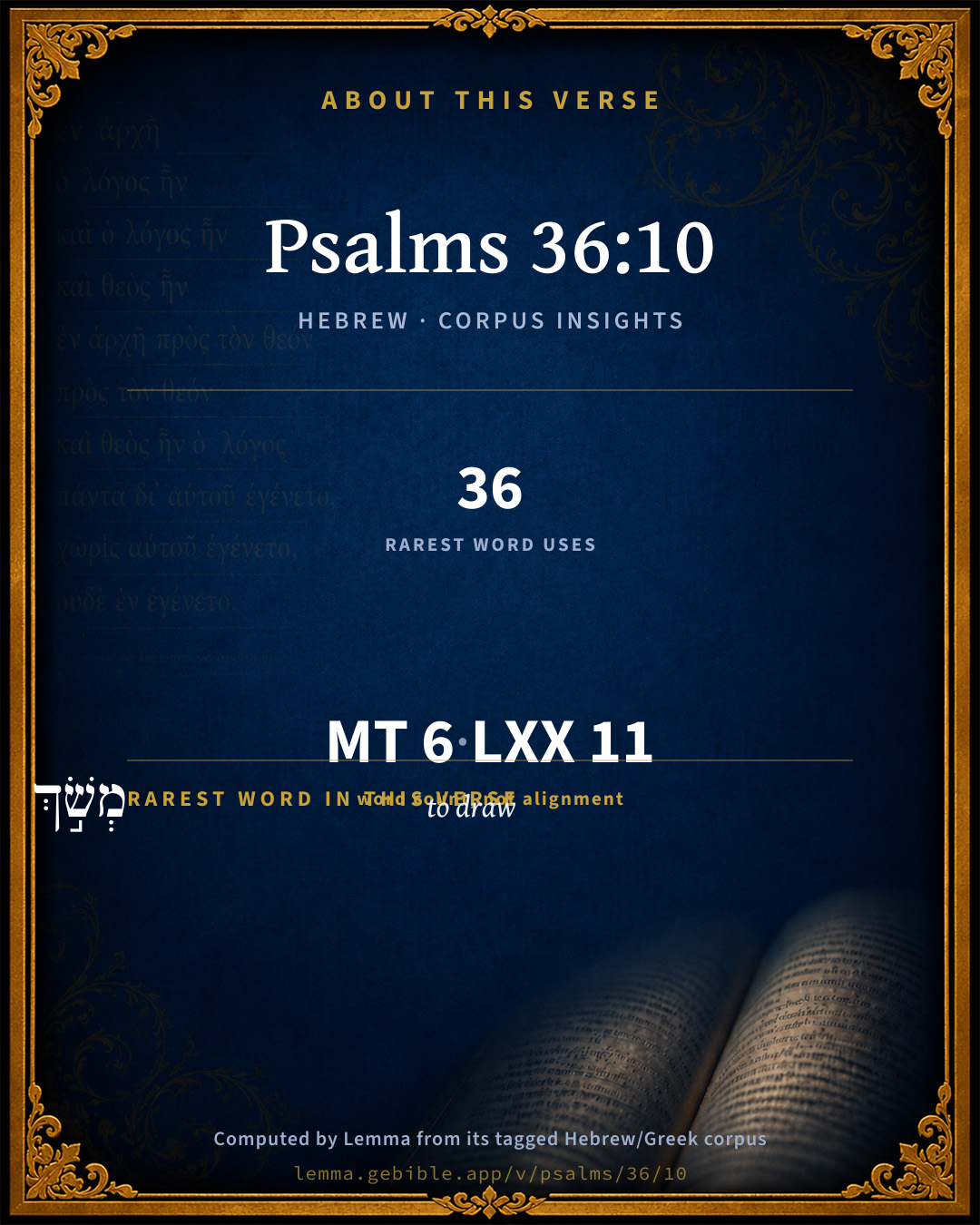
Psalms 36:10

Hebrew (Westminster Leningrad Codex) Psalms 36:10 appears in the Hebrew Old Testament. The text above is from the Westminster Leningrad Codex. Each word links to its Strong’s number, a concise gloss, and parsing drawn from the Open Scriptures Hebrew Bible morphology. Click any word for its full Brown-Driver-Briggs (BDB) entry.
Download image
Cite this verse

Psalms 36:10 (World English Bible). Public Domain. Lemma interlinear Bible study tool, https://lemma.gebible.app/v/psalms/36/10.

Show BibTeX & RIS
BibTeX
RIS
English Translation
Oh continue your loving kindness to those who know you, Your righteousness to the upright in heart.
World English Bible · Public Domain
Download a study sheet

One document with this verse’s original text, its word-by-word gloss line, the meaning frame, cross-references with their text, attributed commentary, and full source and license credits — printable, and it pastes into notes with its structure intact.

This verse Autodidact and up

Study sheet (.html) Plain text (.txt)

A passage Seminary Student

Up to 50 verses in one chapter. A passage sheet keeps up to 6 commentary sources and 12 cross-references per verse, in the order this page ranks them, and says so on the sheet whenever that leaves anything out. Ask for a single verse and you get the Autodidact verse sheet above.

Everything on this page stays free to read, with no account — the sheet is a download of what is already on screen, not access to it.

Want to remove ads? Support Godless Engineer
Compare translations 3

The same verse in 3 English versions, stacked beneath the original-language interlinear above. Click any original word for its lexicon entry.

Each is an independent rendering of the whole verse — the interlinear is not word-aligned to these translations.

Highlighted words mark where these versions differ — a whole-verse word diff, not a word-by-word alignment.

  • World English Bible Public Domain
    Oh continue your loving kindness to those who know you, Your righteousness to the upright in heart.
  • King James Version Public Domain
    O continue thy lovingkindness unto them that know thee; and thy righteousness to the upright in heart.
  • unfoldingWord Literal Text CC BY-SA 4.0
    Extend your covenant faithfulness to the knowers of you, and your righteousness to the upright of heart.

unfoldingWord Literal Text — © unfoldingWord, licensed CC BY-SA 4.0. Word-aligned USFM3 via Door43 (git.door43.org/unfoldingWord/en_ult).

Versions to compare (up to 4)

3 of 4 selected

Show all 18 translations

Every available English version of this verse, each an independent rendering of the whole verse.

  • World English Bible Public Domain
    Oh continue your loving kindness to those who know you, Your righteousness to the upright in heart.
  • Berean Standard Bible Public Domain
    Extend Your loving devotion to those who know You, and Your righteousness to the upright in heart.
  • Majority Standard Bible Public Domain
    Extend Your loving devotion to those who know You, and Your righteousness to the upright in heart.
  • King James Version Public Domain
    O continue thy lovingkindness unto them that know thee; and thy righteousness to the upright in heart.
  • American Standard Version (1901) Public Domain
    Oh continue thy lovingkindness unto them that know thee, And thy righteousness to the upright in heart.
  • Revised Version (1885) Public Domain
    O continue thy lovingkindness unto them that know thee; and thy righteousness to the upright in heart.
  • Geneva Bible (1599) Public Domain
    Extend thy louing kindnes vnto them that knowe thee, and thy righteousnesse vnto them that are vpright in heart.
  • Douay-Rheims (1899) Public Domain
    For with thee is the fountain of life; and in thy light we shall see light.
  • Young's Literal Translation Public Domain
    Draw out Thy kindness to those knowing Thee, And Thy righteousness to the upright of heart.
  • Literal Standard Version CC BY-SA 4.0
    Draw out Your kindness to those knowing You, || And Your righteousness to the upright of heart.
  • Unlocked Literal Bible CC BY-SA 4.0
    Extend your covenant faithfulness fully to those who know you, your defense to the upright of heart.
  • unfoldingWord Literal Text CC BY-SA 4.0
    Extend your covenant faithfulness to the knowers of you, and your righteousness to the upright of heart.
  • Darby Bible Public Domain
    Continue thy loving-kindness unto them that know thee, and thy righteousness to the upright in heart;
  • World Messianic Bible Public Domain
    Oh continue your loving kindness to those who know you, your righteousness to the upright in heart.
  • Webster's Bible Public Domain
    \\36:9\\For with thee is the fountain of life: in thy light shall we see light.
  • Free Bible Version CC BY-SA 4.0
    Extend your trustworthy love to those who know you, and your goodness to those who truly live right.
  • Bible in Basic English Public Domain
    O let there be no end to your loving mercy to those who have knowledge of you, or of your righteousness to the upright in heart.
  • JPS Tanakh (1917) Public Domain
    (36-11) O continue Thy lovingkindness unto them that know Thee; and Thy righteousness to the upright in heart.

Literal Standard Version (2020), Covenant Press — licensed CC BY-SA 4.0. Text via the HelloAO Bible API (eBible.org). Unlocked Literal Bible (unfoldingWord) — licensed CC BY-SA 4.0. Text via the HelloAO Bible API (eBible.org). unfoldingWord Literal Text — © unfoldingWord, licensed CC BY-SA 4.0. Word-aligned USFM3 via Door43 (git.door43.org/unfoldingWord/en_ult). Free Bible Version, Dr. Jonathan Gallagher — licensed CC BY-SA 4.0. Text via the HelloAO Bible API (eBible.org).

Word by word

More ways to search: Search by grammar → Find every occurrence → Compare this word →

Practice this passage: Drill this verse → Learn its vocabulary →

מְשֹׁ֣ךְ
mâshak
H4900
“draw”
Verb, Qal, Imperative, 2nd Person, Masculine, Singular
Part of Speech
Verb
Stem
Qal
Form
Imperative
Person
2nd Person
Gender
Masculine
Number
Singular
Full BDB Definition

Origin: a primitive root

TWOT: 1257

to draw, drag, seize - (Qal) - to draw (and lift out), drag along, lead along, drag or lead off, draw down - to draw (the bow) - to proceed, march - to draw out or give (a sound) - to draw out, prolong, continue - to trail (seed in sowing) - to cheer, draw, attract, gratify - (Niphal) to be drawn out - (Pual) - to be drawn out, be postponed, be deferred - to be tall
  1. חַ֭סְדְּךָ chêçêd H2617 “kindness · your” Noun, Common, Masculine, Singular, Construct + Suffix, Personal, 2nd Person, Masculine, Singular
  2. לְיֹדְעֶ֑יךָ yâdaʻ H3045 “to/for · knowing · you” Preposition + Verb, Qal, Participle Active, Masculine, Plural, Construct + Suffix, Personal, 2nd Person, Masculine, Singular
  3. וְ֝צִדְקָֽתְךָ֗ tsᵉdâqâh H6666 “and · righteousness · your” Conjunction + Noun, Common, Feminine, Singular, Construct + Suffix, Personal, 2nd Person, Masculine, Singular
  4. לְיִשְׁרֵי yâshâr H3477 “to/for · upright of” Preposition + Adjective, Adjective, Masculine, Plural, Construct
  5. לֵֽב lêb H3820 “heart” Noun, Common, Masculine, Singular, Absolute

About this verse

These counts appear in no published source. They are computed here, from the morphology-tagged text and Lemma’s own curated glosses. What Lemma adds →

6
words
6
distinct lemmas
Wisdom
section

Shared distinctive vocabulary

מְשֹׁ֣ךְ to draw H4900 occurs in 36 verses of the Hebrew Bible. Also found in:

Grammatical profile

  • 2 verbs
  • 3 nouns
  • 1 adjective

Verb forms

  • מְשֹׁ֣ךְ Qal · Imperative
  • לְיֹדְעֶ֑יךָ Qal · Participle Active

Hebrew & Septuagint length

In English translation the verse runs 17 words from the Hebrew and 16 from the Septuagint (LXX English) — closely comparable.

A rough comparison of the two English renderings, which tokenize alike — not a word-level alignment.

Word counts can differ between the Hebrew and the Greek without any difference in meaning — e.g. the Hebrew direct-object marker אֵת has no separate Greek word, and Greek often adds the article ὁ.

In the original languages it is 6 Hebrew tokens and 11 Greek tokens — but the two are counted differently (Hebrew bundles its prefixes and suffixes into one token; the Greek is in lemma form), so that isn’t a like-for-like length.

Cross-references

16

Topical passages linked to Psalms 36:10 in the Treasury of Scripture Knowledge — connected by theme and wording, ordered by reader-vote popularity; previews shown in the World English Bible.

  • Jeremiah 24:7 I will give them a heart to know me, that I am Yahweh: and they shall be my people, and I will be their God; for they shall return to me with their whole heart.
  • Hebrews 8:11 They will not teach every man his fellow citizen, Every man his brother, saying, 'Know the Lord,' For all will know me, From the least of them to the greatest of them.
  • Psalms 9:10 Those who know your name will put their trust in you, For you, Yahweh, have not forsaken those who seek you.
  • Psalms 97:10–11 You who love Yahweh, hate evil. He preserves the souls of his saints. He delivers them out of the hand of the wicked.
  • Jeremiah 22:16 He judged the cause of the poor and needy; then it was well. Wasn't this to know me? says Yahweh.
  • John 17:3 This is eternal life, that they should know you, the only true God, and him whom you sent, Jesus Christ.
  • 1 Peter 1:5 who by the power of God are guarded through faith for a salvation ready to be revealed in the last time.
  • Psalms 18:24–25 Therefore Yahweh has rewarded me according to my righteousness, According to the cleanness of my hands in his eyesight.
  • Psalms 143:1–2 Hear my prayer, Yahweh. Listen to my petitions. In your faithfulness and righteousness, relieve me.
  • Psalms 94:14–15 For Yahweh won't reject his people, Neither will he forsake his inheritance.
  • Jeremiah 31:3 Yahweh appeared of old to me, [saying], Yes, I have loved you with an everlasting love: therefore with loving kindness have I drawn you.
  • 2 Timothy 4:7–8 I have fought the good fight. I have finished the course. I have kept the faith.
  • Isaiah 51:6–8 Lift up your eyes to the heavens, and look on the earth beneath; for the heavens shall vanish away like smoke, and the earth shall wax old like a garment; and those who dwell therein shall die in like manner: but my salvation shall be forever, and my righteousness shall not be abolished.
  • Psalms 7:8–10 Yahweh administers judgment to the peoples. Judge me, Yahweh, according to my righteousness, And to my integrity that is in me.
  • Psalms 103:17 But Yahweh's loving kindness is from everlasting to everlasting with those who fear him, His righteousness to children's children;
  • John 15:9–10 Even as the Father has loved me, I also have loved you. Remain in my love.

Cross-references courtesy of OpenBible.info (CC BY 4.0).

Hebrew and Greek witnesses Masoretic Hebrew ↔ Greek Septuagint

The same verse in the two great witnesses to the Old Testament, shown verse-for-verse.

You’re reading Greek Psalm 35 (Hebrew Psalm 36). The Septuagint counts the superscription, so verse numbers can differ from the Hebrew — chapter-level alignment, not verse-by-verse. Numbering follows Rahlfs.

These are two independent witnesses, not word-aligned to each other, and the Septuagint is shown in lemma (dictionary) form.

Hebrew Psalms 36:10 Masoretic · Westminster Leningrad Codex

מְשֹׁ֣ךְ חַ֭סְדְּךָ לְיֹדְעֶ֑יךָ וְ֝צִדְקָֽתְךָ֗ לְיִשְׁרֵי לֵֽב

Oh continue your loving kindness to those who know you, Your righteousness to the upright in heart.

World English Bible · Public Domain

Greek LXX Greek Psalm 35:10 Septuagint · lemma form

ὅτι παρά σύ πηγή ζωή ἐν ὁ φῶς σύ ὁράω φῶς

Extend your mercy to them that know you; and your righteousness to the upright in heart.

LXX2012 (modern English Septuagint) · Public Domain

Hebrew: Westminster Leningrad Codex (CC BY 4.0). Greek: Septuagint (public domain); English from LXX2012 (modern English Septuagint) (Public Domain). How the Septuagint differs from the Hebrew →

Commentary

Notes on Psalms 36:10 from classic Christian and Jewish commentators (each source and its license shown beneath its notes). The classic Christian expositions comment on the surrounding passage and are grouped to its opening verse, so a note may address several verses; the Jewish commentaries on the Tanakh (Rashi and others) are per-verse, so they appear only where the commentator wrote on this verse.

Lemma curates 59 commentaries, every one of them public domain or Creative Commons licensed, each selected and text-cleaned for this edition rather than reprinted as found. About our sources →

The Cambridge Bible for Schools and Colleges

gen. ed. J. J. S. Perowne

10. A prayer for the continued exercise of the attributes which have been celebrated in Psa_36:5-9. All God’s bounty to man flows from His lovingkindness, yet His righteousness also is concerned in the fulfilment of His covenant and promise.

them that know thee] With an effectual knowledge which must issue in loving obedience (Psa_9:10; Psa_91:14); and entitles its possessors to be called upright in heart (Psa_7:10; Psa_11:2; Psa_32:11).

10–12. Concluding prayer for the continuance of God’s lovingkindness and for protection from the wicked, with a confident anticipation of the final downfall of evil-doers. Psa_36:10 springs naturally out of Psa_36:5-9, and Psa_36:11-12 clearly revert to Psa_36:1-4.

The Cambridge Bible for Schools and Colleges (gen. ed. J. J. S. Perowne; Cambridge University Press, 1878–1918) — public domain. Text from a community e-Sword module.

Trapp's Complete Commentary

John Trapp

Psa 36:10 O continue thy lovingkindness unto them that know thee; and thy righteousness to the upright in heart.

Ver. 10. O continue thy lovingkindness] Heb. Draw it out at full length, extend and exercise it, lengthen and perpetuate it. Thus the godly, greatly taken with the sweetness of God’s house, and rapt in the admiration of his transcendant goodness towards them, pray for a continuance thereof; intimating also by the manner of expression that God’s peculiar mercies to his are a continued series; there is a connection between them, yea, a concatenation. And as in a chain one link draweth on another, so doth one mercy another, unless we break the chain by our unthankfulness.

Unto them that know thee … to the upright in heart] Here we have a just description of the heirs of God’s promises, and of the partakers of his peculiar mercies. First, They must be knowing persons; know they must God and his will, themselves and their duties. Secondly, They must be upright in heart; for knowledge without practice is like Rachel, beautiful, but barren; or like rain in the middle region, where it doth no good. "A good understanding have all they that do his precepts," Psa 111:10, and such only are upright in heart.

John Trapp, A Commentary or Exposition upon All the Books of the Old and New Testament (1647–1656) — public domain. Text from a community e-Sword module.

The Biblical Illustrator

Joseph S. Exell

Psa_36:10-12

O continue Thy loving-kindness unto them that know Thee.

1. The true mark of a godly man standeth in the conjunction of faith in God with sincere study of obedience to him, for he is the man that knoweth God, and is upright in heart.

2. Albeit, what the believer hath found in God by experience, he may expect it shall be continued to him, both for his entertainment by God, and defence and deliverance in his righteous cause from his enemies; yet must he follow his confidence with prayer, O continue Thy lovingkindness.

3. As we have no right to any benefit, but in so far as we are of the number of upright-hearted believers, so should we seek every benefit we would have, as being of this number, and as seeking that others may be sharers with us, as David doth before.

4. It is the Lord only who can divert proud persecutors, that they hurt not His children, and it is the Lord only who can keep His children in the course of faith and obedience, when the wicked employ their power against them.

5. The ruin of the enemies of the godly is as certain as if it were already past; yea, faith may look upon it through the prospect of the Word of God, as if it were to be seen and pointed out to others to behold with their eyes. There are the workers of iniquity fallen.

6. The fall of the wicked is not like the fall of the godly, for though the godly fall sundry times, yet they recover their feet again; but a fall is prepared for the wicked, after which they shall not recover themselves, They are cast down, and shall not be able to rise. (D. Dickson.)

.

Psa_37:1-40

The Biblical Illustrator, edited by Joseph S. Exell (c. 1880s–1900s) — public domain. Text from a community e-Sword module.

Joseph Benson's Commentary

Psa 36:10. O continue thy loving-kindness unto them, that know thee — That is, that know thee so as sincerely to love thee, for every one that loveth is born of God, and knoweth God: whereas he that loveth not, knoweth not God, for God is love, 1Jn 4:7. As thou hast begun, so continue the manifestation and exhibition of thy loving-kindness to such, both in this life and the next. Hebrew, משׁךְ חסדךְ, meshok chasdecha, extend, or draw forth thy lovingkindness, or mercy: let it not be like a fountain sealed, but let it be drawn forth for their comfort. And thy righteousness to the upright in heart — By giving them that protection and assistance, which thou art by nature inclined, and by thy promise engaged to give them.

Joseph Benson's Commentary on the Old and New Testaments (1811–1818) — public domain. Text from a community e-Sword module.

J. A. Alexander on Psalms

Joseph Addison Alexander

11. (Psa 36:10). Continue thy mercy to those knowing thee, and thy righteousness to the upright in heart. To his glowing description of the blessedness resident in God and flowing from his favour, he now adds a prayer that it may be extended to the class, of which he claims to be a member. The first verb literally means to draw out or protract, and is the same that is used in different applications in Psa 10:9; Psa 28:3, above.—Those knowing thee, and as a necessary consequence loving thee, since genuine knowledge of the true God is inseparable from right affections towards him.—Thy righteousness, thy true and faithful dealings with those trusting in thy mercy, here and often elsewhere represented as the upright or straightforward in heart as well as in behaviour.

Joseph Addison Alexander, The Psalms Translated and Explained (1850) — public domain. Text from a community e-Sword module.

Tyndale Open Study Notes

Tyndale Open Resources

36:10-11 Since God’s wisdom extends to all of creation, it protects the godly.

Tyndale Open Study Notes — © Tyndale Open Resources, licensed CC BY-SA 4.0. Text via the HelloAO Bible API.

Geneva Bible (1599)

Geneva Bible translators

He showeth who are God’s children, to wit, they that know him, and lead their lives uprightly.

Geneva Bible (1599) marginal notes — public domain. Text via Bolls.life.

Jamieson, Fausset & Brown

Robert Jamieson, A. R. Fausset & David Brown

that know thee--right knowledge of God is the source of right affections and conduct.

Jamieson, Fausset & Brown — Commentary Critical and Explanatory on the Whole Bible (1871) — public domain (CC PDM 1.0). Text via the HelloAO Bible API.

Adam Clarke's Commentary

Verse 10. O continue thy loving-kindness] Literally, "Draw out thy mercy." The allusion to the spring is still kept up.

Unto them that know thee] To them who acknowledge thee in the midst of a crooked and perverse generation.

And thy righteousness] That grace which justifies the ungodly, and sanctifies the unholy.

To the upright in heart.] לישרי לב levishrey leb, to the straight of heart; to those who have but one end in view, and one aim to that end. This is true of every genuine penitent, and of every true believer.

Adam Clarke's Commentary on the Bible (1810–1826) — public domain. Text from a community e-Sword/MySword module.

John Calvin's Commentaries

10. Prolong thy mercy to them that know thee. David now sets himself to pray. And, first, he asks in general, that God would continue his mercy to all the godly, and then he pleads particularly in his own behalf, imploring the help of God against his enemies. Those who affirm that God is here said to prolong or extend his mercy because it is exalted above the heavens, indulge in a style of speaking too puerile. When David spake of it in such terms in a preceding verse, his intention was not, as I have already said, to represent the mercy of God as shut up in heaven, but simply to declare that it was diffused throughout the world; and here what he desires is just this, that God would continue to manifest, even to the end, his mercy towards his people. With the mercy of God he connects his righteousness, combining them as cause and effect. We have already said in another place, that the righteousness of God is manifested in his undertaking the defense of his own people, vindicating their innocence, avenging their wrongs, restraining their enemies, and in proving himself faithful in the preservation of their welfare and happiness against all who assail them. Now, since all this is done for them freely by God, David, with good reason, makes mention particularly of his goodness, and places it first in order, that we may learn to depend entirely upon his favor. We ought also to observe the epithets by which he describes true believers; first, he says, that they know God; and, secondly, that they are upright in heart. We learn from this that true godliness springs from the knowledge of God, and again, that the light of faith must necessarily dispose us to uprightness of heart. At the same time, we ought always to bear in mind, that we only know God aright when we render to him the honor to which he is entitled; that is, when we place entire confidence in him.

John Calvin's Commentaries (1540-1563) — public domain. Text from the Calvin Translation Society English edition (1840s-50s) via the Christian Classics Ethereal Library (ccel.org). Calvin's coverage is partial (roughly two-thirds of the Bible); uncommented books and verses are honest gaps, never fabricated. The 19th-century editor's footnotes and remarks are omitted so the notes are faithfully Calvin's own voice.

John Gill's Exposition

O continue thy lovingkindness to them that know thee,.... That is, spiritually and experimentally; and such are they that trust in him and love him: and these are the objects of the love of God; not that their knowledge, faith, or love, are the cause of his love to them; but these things describe and point at manifestly the objects of it; and this request regards the open discovery of it unto them: for the love of God itself always continues, though the manifestations of it are not always the same; and it is for the enlargement and continuance of them the psalmist here prays: for it may be rendered, "draw out thy lovingkindness" (g); that is, to a greater length; make a larger and clearer discovery of it, that the height and depth, and length and breadth of it, may be more discerned;

and thy righteousness unto the upright in heart; who are sincere and without guile; who have new hearts created and right spirits renewed in them, and have truth in the inward parts; and unto and upon such is the righteousness of Christ, and where it always continues, for it is an everlasting one; but here it means a clearer and constant revelation of it from faith to faith; unless it should rather intend the righteousness of God in protecting his people from the insults of their enemies, and the continual exertion of it for that purpose.

(g) "trahe", Pagninus, Montanus; "extende", Vatablus, Piscator; "protrahe", Cocceius, Gejerus, Michaelis.

John Gill's Exposition of the Whole Bible (1746–1763) — public domain (CC PDM 1.0). Text via the HelloAO Bible API.

Albert Barnes' Notes on the Bible

O continue - Margin, as in Hebrew: “draw out at length.” The Hebrew word means “to draw;” hence, “to draw out,” in the sense of “continuing” or “prolonging.” Compare Psa 85:5; Psa 109:12; Jer 31:3. The desire of the psalmist here is, that God would make the manifestation of his loving-kindness “continuous” or “perpetual” to His people; that it might not be fitful and interrupted, but always enduring, or constant. It is the utterance of a prayer that his favor might always be manifested to his friends.

Thy loving-kindness - Thy mercy, Psa 36:5, Psa 36:7. “Unto them that know thee.” That are thy friends. The word “know” is often used to denote true religion: Joh 17:3; Phi 3:10; Eph 3:19; 2Ti 1:12.

And thy righteousness - Thy favor; thy protection. That is, show to them the righteousness, or the glory of thy character. Deal with them according to those just principles which belong to thy character. Compare the notes at 1Jo 1:9.

To the upright in heart - Those who are pure and holy in their intentions or their purposes. Compare Psa 7:10. All true uprightness has its seat in the heart, and the psalmist prays that God would show his continued favor to those whom he sees to be true in heart to himself.

Albert Barnes' Notes on the Bible (1834–1885) — public domain. Text from a community e-Sword/MySword module.

Matthew Poole's English Annotations

Continue; as this word signifies, Psa 85:5; Ecc 2:3; Jer 31:3. As thou hast begun, so continue the manifestation and exhibition of it, both in this life, and to the next. Or, extend, or draw forth. Let it not be like a fountain sealed, but let it be drawn forth for their comfort. Know thee, i.e. sincerely love thee, as it is explained in the next clause; for knowing implies affection, as Psa 9:10, and oft elsewhere.

Thy righteousness; which will appear in giving them that protection and assistance which thou art by thy nature inclined, and by thy promise engaged, to give them.

Matthew Poole's English Annotations on the Holy Bible (1683–1685) — public domain. Text from a community e-Sword/MySword module.

The Treasury of David

Charles H. Spurgeon

Ver. 10. O continue thy lovingkindness unto them that know thee. We ask no more than a continuance of the past mercy. Lord, extend this grace of thine to all the days of all who have been taught to know thy faithful love, thy tenderness, thine immutability and omnipotence. As they have been taught of the Lord to know the Lord, so go on to instruct them and perfect them. This prayer is the heart of the believer asking precisely that which the heart of his God is prepared to grant. It is well when the petition is but the reflection of the promise. And thy righteousness to the upright in heart. As thou hast never failed the righteous, so abide thou in the same manner their defender and avenger. The worst thing to be feared by the man of God is to be forsaken of heaven, hence this prayer; but the fear is groundless, hence the peace which faith brings to us. Learn from this verse, that although a continuance of mercy is guaranteed in the covenant, we are yet to make it a matter of prayer. For this good thing will the Lord be enquired of.

Ver. 10. Continue thy lovingkindness. When God begins once to let out mercy to his servants, he stints not presently, but proceeds. ...When Rachel had her first son, she called his name Joseph, which signifieth adding, or increase; for she said, "The Lord shall add to me another son." Ge 30:24. Now God hath begun to show kindness, he shall not only give me this, but he shall give me another son also. When the Lord hath bestowed one mercy on you, you may name it Joseph, increase, addition, for God will bestow another upon you. Abraham had many mercies from God, one after another; and Moses, a multitude of mercies; he converses with God face to face; he hears God speak; he has God's presence to go along with him; yea, he sees all God's goodness and glory to pass before him. When mercies come forth, God will not presently shut the door of mercy again. Continue thy lovingkindness. The Hebrew is, draw forth, or draw out thy lovingkindness: a metaphor either taken from vessels of wine, which being set abroach once, yield not only one cup, but many cups; so when God setteth abroach the wine of his mercy, he will not fill your cup once, but twice and seven times: or, taken from a mother, who hath her breasts full of milk, draws them out for her child, not once, but often; the child shall have the breast many times in the day, and many times in the night, so when God begins to show mercy to you, he will draw out his breasts of consolation, and will bestow mercy after mercy upon you; or, from a line which is extended, for so God being in a way of mercy, will extend the line of mercy, and measure out mercy after mercy for you. William Greenhill.

Ver. 10. The true mark of a godly man standeth in the conjunction of faith in God, with sincere study of obedience to him, for, He is the man that knoweth God, and is upright in heart. David Dickson.

Ver. 10.

1. The character of the righteous he knows God, and is upright in heart.

2. His privilege lovingkindness and righteousness.

3. His prayer, continue, etc.

Ver. 10. The need of daily supplies of grace.

Psalms 36:11*

Charles H. Spurgeon's The Treasury of David (1869–1885) — public domain. Psalms only. Text from a community e-Sword/MySword module.

The Pulpit Commentary

O continue thy loving-kindness unto them that know thee. Here begins the third strophe. Having finished his" instruction," the psalmist passes on to prayer; and is content to ask that God will be in the future such as he has been in the past that he will "lengthen out," prolong, or "continue his loving-kindness" to his faithful servants, dealing with them as he has hitherto dealt with them (vers. 5, 7), mercifully, graciously, and lovingly. His faithful servants are "those that know him," because, as Hengstenberg observes, "the true and essential knowledge of God is to be found only in a sanctified mind." And thy righteousness to the upright in heart. Continue, i.e. , to deal justly with those whose heart is right with thee who, in spite of occasional lapses, are really in heart sincere.

The Pulpit Commentary (1880–1919), ed. H.D.M. Spence-Jones & Joseph S. Exell — public domain. Text from a community e-Sword module.

Keil & Delitzsch

C. F. Keil & F. Delitzsch

(Heb.: 36:11-13) Now for the first time, in the concluding hexastich, after complaint and commendation comes the language of prayer. The poet prays that God would lengthen out, i.e., henceforth preserve (משׁך, as in Psa 109:12), such mercy to His saints; that the foot of arrogance, which is conceived of as a tyrant, may not come suddenly upon him (בּוא, as in Psa 35:8), and that the hand of the wicked may not drive him from his home into exile (cf. Psa 10:18). With חסד alternates צדקה, which, on its merciful side, is turned towards them that now God, and bestows upon them the promised gracious reward. Whilst the Psalmist is thus praying, the future all at once becomes unveiled to him. Certain in his own mind that his prayer will be heard, he sees the adversaries of God and of His saints for ever overthrown. שׁם, as in Psa 14:5, points to the place where the judgment is executed. The preterites are prophetic, as in Psa 14:5; Psa 64:8-10. The poet, like Isaiah (Isa 26:14), beholds the whole tribe of the oppressors of Jahve's Church changed into a field of corpses, without hope of any rising again.

Keil & Delitzsch — Biblical Commentary on the Old Testament (1861–1891) — public domain (CC PDM 1.0). Text via the HelloAO Bible API. (Old Testament only.)

unfoldingWord translationNotes

Door43 World Missions Community

Extend your covenant faithfulness fully to those who know you

The writer speaks of Yahweh continuing to act faithfully towards the people as if Yahweh were to extend his covenant faithfulness or make it longer. The abstract noun "faithfulness" can be translated with an adverb. AT: "Continue to act faithfully to those who know you" (See: Metaphor and Abstract Nouns)

your defense to the upright of heart

The abstract noun "defense" can be stated as a verb. "Continue" is implied from the previous phrase. AT: "Continue to protect the upright of heart" (See: Abstract Nouns and Ellipsis)

the upright of heart

Here "heart" refers to the people. AT: "the upright" or "people who act righteously" (See: Synecdoche)

the foot of the arrogant man ... the hand of the wicked

Here "foot" and "hand" refer to the evil people. These are not specific men. This refers to evil people in general. AT: "arrogant people ... wicked people" (See: Synecdoche and Generic Noun Phrases)

drive me away

"send me away" or "make me leave my place"

evildoers have fallen; they are knocked down and are not able to get up

All three phrases describe the evildoers as defeated. (See: Metaphor)

they are knocked down

This can be stated in active form. AT: "you have knocked them down" or "you have destroyed them" (See: Active or Passive)

are not able to get up

"cannot get up"

translationWords

covenant faithfulness

know

righteous

heart

arrogant

hand

evil

unfoldingWord translationNotes — © Distant Shores Media and the Door43 World Missions Community, licensed CC BY-SA 4.0. Source: git.door43.org/Door43/en_tn.

Lesson kit

Teaching starters — assembled from the data on this page, not authored interpretation. Every prompt links to the verse data it draws on. Edit before teaching.

Psalms, in the Wisdom, opens this verse with 6 words (6 distinct Hebrew lemmas). Its most distinctive word is mâshak (“to draw”). A historical commentator’s framing appears above. Read the whole chapter for the surrounding context.

Discussion questions

  1. How does “to draw” (mâshak) shape what this verse is saying?
  2. Genesis 37:28 shares the word «to draw» with this verse. How do the two illuminate each other?
  3. The translations on this page render this verse differently — a whole-verse word diff, not a word-by-word alignment. What might account for the different wordings?
  4. The verb «מְשֹׁ֣ךְ» is Qal Imperative. How does its form color the action?
  5. Reading how The Cambridge Bible for Schools and Colleges and Trapp's Complete Commentary read this verse, where do the two commentators agree and where do they part?

Things to notice

Reading settings

Reading text

Shown beneath each verse's original-language words.

Old Testament
Old Testament edition

Read the OT as the Masoretic Hebrew (MT) or the Greek Septuagint (LXX).

English shown for the Greek Septuagint (in the Hebrew ↔ Greek comparison).

Comparing translations? Open the Compare panel on any verse page to stack up to four side by side.