Proverbs 28:10

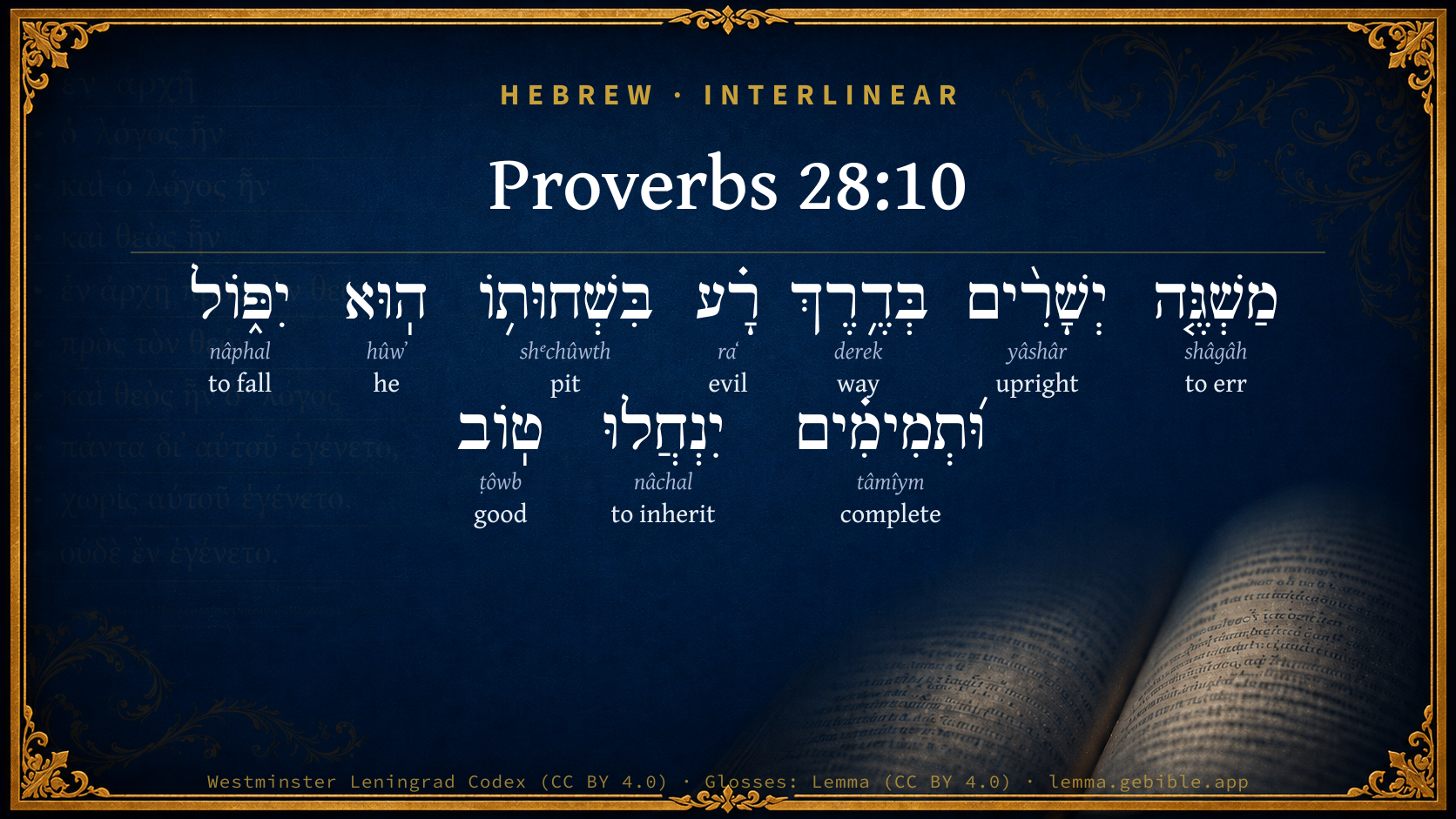
Hebrew (Westminster Leningrad Codex) Proverbs 28:10 appears in the Hebrew Old Testament. The text above is from the Westminster Leningrad Codex. Each word links to its Strong’s number, a concise gloss, and parsing drawn from the Open Scriptures Hebrew Bible morphology. Click any word for its full Brown-Driver-Briggs (BDB) entry.
Download image
Cite this verse

Proverbs 28:10 (World English Bible). Public Domain. Lemma interlinear Bible study tool, https://lemma.gebible.app/v/proverbs/28/10.

Show BibTeX & RIS
BibTeX
RIS
English Translation
Whoever causes the upright to go astray in an evil way, He will fall into his own trap; But the blameless will inherit good.
World English Bible · Public Domain
Highlights
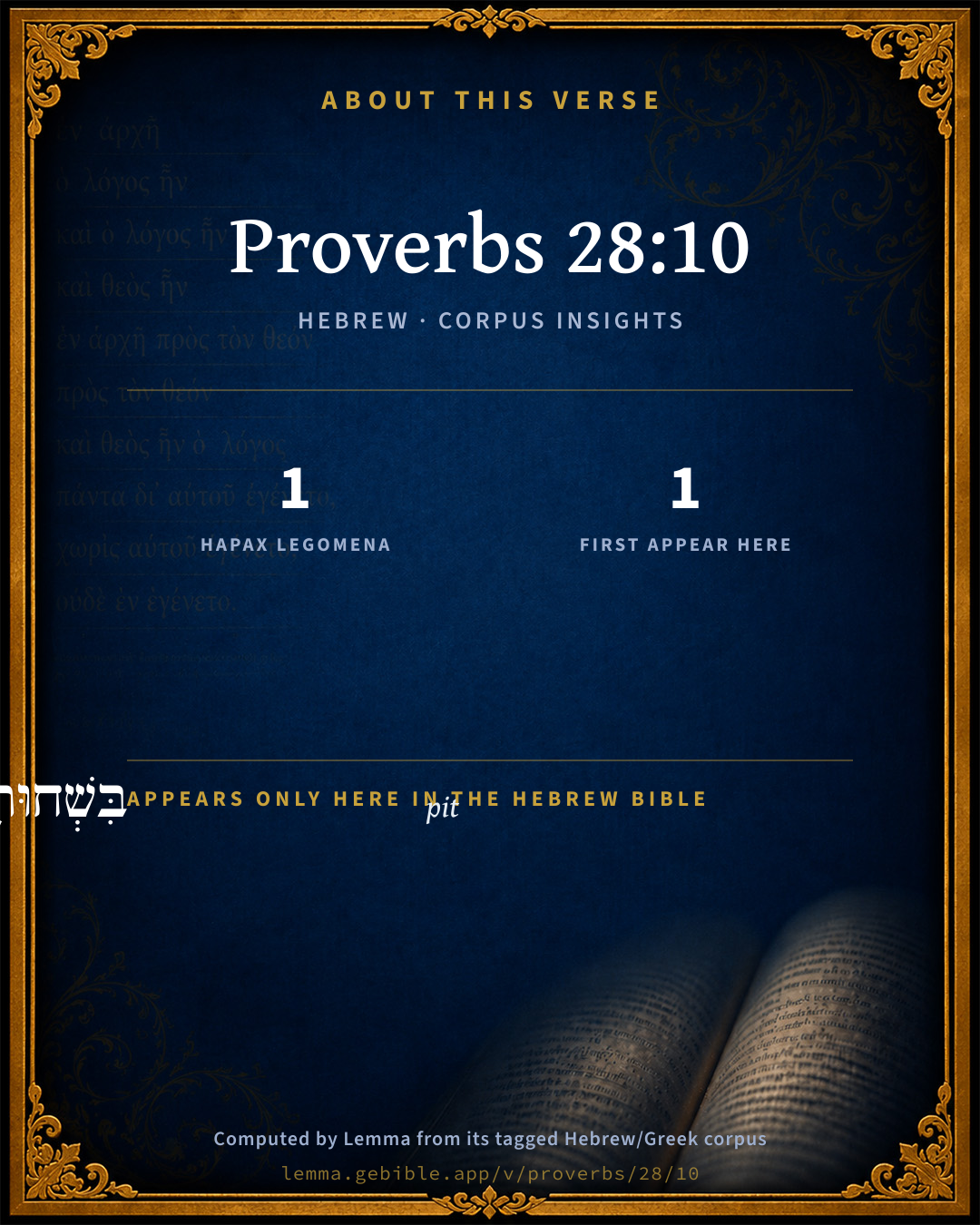
  • 1 hapax legomenon — only here in the Hebrew Bible
  • 1 first appearance in the Hebrew Bible
Full analysis ↓
Download a study sheet

One document with this verse’s original text, its word-by-word gloss line, the meaning frame, cross-references with their text, attributed commentary, and full source and license credits — printable, and it pastes into notes with its structure intact.

This verse Autodidact and up

Study sheet (.html) Plain text (.txt)

A passage Seminary Student

Up to 50 verses in one chapter. A passage sheet keeps up to 6 commentary sources and 12 cross-references per verse, in the order this page ranks them, and says so on the sheet whenever that leaves anything out. Ask for a single verse and you get the Autodidact verse sheet above.

Everything on this page stays free to read, with no account — the sheet is a download of what is already on screen, not access to it.

Want to remove ads? Support Godless Engineer
Compare translations 3

The same verse in 3 English versions, stacked beneath the original-language interlinear above. Click any original word for its lexicon entry.

Each is an independent rendering of the whole verse — the interlinear is not word-aligned to these translations.

Highlighted words mark where these versions differ — a whole-verse word diff, not a word-by-word alignment.

  • World English Bible Public Domain
    Whoever causes the upright to go astray in an evil way, He will fall into his own trap; But the blameless will inherit good.
  • King James Version Public Domain
    Whoso causeth the righteous to go astray in an evil way, he shall fall himself into his own pit: but the upright shall have good things in possession.
  • unfoldingWord Literal Text CC BY-SA 4.0
    One leading the upright astray in the way of evil into his pit he himself will fall, but the blameless will inherit good.

unfoldingWord Literal Text — © unfoldingWord, licensed CC BY-SA 4.0. Word-aligned USFM3 via Door43 (git.door43.org/unfoldingWord/en_ult).

Versions to compare (up to 4)

3 of 4 selected

Show all 18 translations

Every available English version of this verse, each an independent rendering of the whole verse.

  • World English Bible Public Domain
    Whoever causes the upright to go astray in an evil way, He will fall into his own trap; But the blameless will inherit good.
  • Berean Standard Bible Public Domain
    He who leads the upright along the path of evil will fall into his own pit, but the blameless will inherit what is good.
  • Majority Standard Bible Public Domain
    He who leads the upright along the path of evil will fall into his own pit, but the blameless will inherit what is good.
  • King James Version Public Domain
    Whoso causeth the righteous to go astray in an evil way, he shall fall himself into his own pit: but the upright shall have good things in possession.
  • American Standard Version (1901) Public Domain
    Whoso causeth the upright to go astray in an evil way, He shall fall himself into his own pit; But the perfect shall inherit good.
  • Revised Version (1885) Public Domain
    Whoso causeth the upright to go astray in an evil way, he shall fall himself into his own pit: but the perfect shall inherit good.
  • Geneva Bible (1599) Public Domain
    He that causeth the righteous to go astray by an euill way, shall fall into his owne pit, and the vpright shall inherite good things.
  • Douay-Rheims (1899) Public Domain
    He that deceiveth the just in a wicked way, shall fall in his own destruction: and the upright shall possess his goods.
  • Young's Literal Translation Public Domain
    Whoso is causing the upright to err in an evil way, Into his own pit he doth fall, And the perfect do inherit good.
  • Literal Standard Version CC BY-SA 4.0
    Whoever is causing the upright to err in an evil way, || He falls into his own pit, || And the perfect inherits good.
  • Unlocked Literal Bible CC BY-SA 4.0
    Whoever misleads the upright into an evil way will fall into his own pit, but the blameless will have a good inheritance.
  • unfoldingWord Literal Text CC BY-SA 4.0
    One leading the upright astray in the way of evil into his pit he himself will fall, but the blameless will inherit good.
  • Darby Bible Public Domain
    Whoso causeth the upright to go astray in an evil way, shall himself fall into his own pit; but the perfect shall inherit good.
  • World Messianic Bible Public Domain
    Whoever causes the upright to go astray in an evil way, he will fall into his own trap; but the blameless will inherit good.
  • Webster's Bible Public Domain
    Whoever causeth the righteous to go astray in an evil way, he shall fall himself into his own pit: but the upright shall have good things in possession.
  • Free Bible Version CC BY-SA 4.0
    Those who lead good people astray into evil ways will fall into their own traps, but the innocent will receive a good reward.
  • Bible in Basic English Public Domain
    Anyone causing the upright to go wandering in an evil way, will himself go down into the hole he has made; but the upright will have good things for their heritage.
  • JPS Tanakh (1917) Public Domain
    Whoso causeth the upright to go astray in an evil way, he shall fall himself into his own pit; but the whole-hearted shall inherit good.

Literal Standard Version (2020), Covenant Press — licensed CC BY-SA 4.0. Text via the HelloAO Bible API (eBible.org). Unlocked Literal Bible (unfoldingWord) — licensed CC BY-SA 4.0. Text via the HelloAO Bible API (eBible.org). unfoldingWord Literal Text — © unfoldingWord, licensed CC BY-SA 4.0. Word-aligned USFM3 via Door43 (git.door43.org/unfoldingWord/en_ult). Free Bible Version, Dr. Jonathan Gallagher — licensed CC BY-SA 4.0. Text via the HelloAO Bible API (eBible.org).

Word by word

More ways to search: Search by grammar → Find every occurrence → Compare this word →

Practice this passage: Drill this verse → Learn its vocabulary →

בִּשְׁחוּת֥וֹ
shᵉchûwth
H7816
“in/at · pit · his”
Preposition + Noun, Common, Feminine, Singular, Construct + Suffix, Personal, 3rd Person, Masculine, Singular
Part of Speech
Preposition + Noun
Type
Common
Gender
Feminine
Number
Singular
State
Construct
Full BDB Definition

Origin: from H7812

TWOT: 2360a

pit
  1. מַשְׁגֶּ֤ה shâgâh H7686 “erring” Verb, Hiphil, Participle Active, Masculine, Singular, Absolute
  2. יְשָׁרִ֨ים yâshâr H3477 “upright” Adjective, Adjective, Masculine, Plural, Absolute
  3. בְּדֶ֥רֶךְ derek H1870 “in/at · way of” Preposition + Noun, Common, Both, Singular, Construct
  4. רָ֗ע raʻ H7451 “evil” Adjective, Adjective, Masculine, Singular, Absolute
  5. הֽוּא hûwʼ H1931 “he” Pronoun, Personal, 3rd Person, Masculine, Singular
  6. יִפּ֑וֹל nâphal H5307 “to fall” Verb, Qal, Imperfect, 3rd Person, Masculine, Singular
  7. וּ֝תְמִימִ֗ים tâmîym H8549 “and · complete” Conjunction + Adjective, Adjective, Masculine, Plural, Absolute
  8. יִנְחֲלוּ nâchal H5157 “to inherit” Verb, Qal, Imperfect, 3rd Person, Masculine, Plural
  9. טֽוֹב ṭôwb H2896 “good” Adjective, Adjective, Masculine, Singular, Absolute

About this verse

These counts appear in no published source. They are computed here, from the morphology-tagged text and Lemma’s own curated glosses. What Lemma adds →

10
words
10
distinct lemmas
Wisdom
section

Notable vocabulary

1 hapax legomenon — a word that appears only here in the entire Hebrew Bible:

  • בִּשְׁחוּת֥וֹ pit H7816

First appearance in Scripture

This word makes its first canonical appearance in the Hebrew Bible here:

  • בִּשְׁחוּת֥וֹ pit H7816

Shared distinctive vocabulary

מַשְׁגֶּ֤ה to err H7686 occurs in 19 verses of the Hebrew Bible. Also found in:

Grammatical profile

  • 3 verbs
  • 2 nouns
  • 4 adjectives
  • 1 pronoun

Verb forms

  • מַשְׁגֶּ֤ה Hiphil · Participle Active
  • יִפּ֑וֹל Qal · Imperfect
  • יִנְחֲלוּ Qal · Imperfect

Hebrew & Septuagint length

In English translation the verse runs 24 words from the Hebrew and 28 from the Septuagint (LXX English) — closely comparable.

A rough comparison of the two English renderings, which tokenize alike — not a word-level alignment.

Word counts can differ between the Hebrew and the Greek without any difference in meaning — e.g. the Hebrew direct-object marker אֵת has no separate Greek word, and Greek often adds the article ὁ.

Cross-references

22

Topical passages linked to Proverbs 28:10 in the Treasury of Scripture Knowledge — connected by theme and wording, ordered by reader-vote popularity; previews shown in the World English Bible.

  • Proverbs 26:27 Whoever digs a pit shall fall into it. Whoever rolls a stone, it will come back on him.
  • Psalms 37:25–26 I have been young, and now am old, Yet I have not seen the righteous forsaken, Nor his children begging for bread.
  • Psalms 7:15–16 He has dug a hole, And has fallen into the pit which he made.
  • Psalms 37:11 But the humble shall inherit the land, And shall delight themselves in the abundance of peace.
  • Proverbs 10:3 Yahweh will not allow the soul of the righteous to go hungry, But he thrusts away the desire of the wicked.
  • Proverbs 15:6 In the house of the righteous is much treasure, But the income of the wicked brings trouble.
  • Matthew 6:33 But seek first God's Kingdom, and his righteousness; and all these things will be given to you as well.
  • Deuteronomy 7:12–14 It shall happen, because you listen to these ordinances, and keep and do them, that Yahweh your God will keep with you the covenant and the loving kindness which he swore to your fathers:
  • Romans 16:17–18 Now I beg you, brothers, look out for those who are causing the divisions and occasions of stumbling, contrary to the doctrine which you learned, and turn away from them.
  • 2 Corinthians 11:3–4 But I am afraid that somehow, as the serpent deceived Eve in his craftiness, so your minds might be corrupted from the simplicity that is in Christ.
  • 2 Corinthians 11:13–15 For such men are false apostles, deceitful workers, masquerading as Christ's apostles.
  • Galatians 1:8–9 But even though we, or an angel from heaven, should preach to you any gospel other than that which we preached to you, let him be cursed.
  • Galatians 2:4 This was because of the false brothers secretly brought in, who stole in to spy out our liberty which we have in Christ Jesus, that they might bring us into bondage;
  • Galatians 3:1–4 Foolish Galatians, who has bewitched you not to obey the truth, before whose eyes Jesus Christ was openly set forth among you as crucified?
  • 2 Peter 2:18–20 For, uttering great swelling words of emptiness, they entice in the lusts of the flesh, by licentiousness, those who are indeed escaping from those who live in error;
  • Revelation 2:14 But I have a few things against you, because you have there some who hold the teaching of Balaam, who taught Balak to throw a stumbling block before the children of Israel, to eat things sacrificed to idols, and to commit sexual immorality.
  • Numbers 31:15–16 Moses said to them, Have you saved all the women alive?
  • 1 Samuel 26:19 Now therefore, please let my lord the king hear the words of his servant. If it be Yahweh that has stirred you up against me, let him accept an offering: but if it be the children of men, cursed be they before Yahweh: for they have driven me out this day that I shouldn't cling to Yahweh's inheritance, saying, Go, serve other gods.
  • Psalms 9:15 The nations have sunk down in the pit that they made; In the net which they hid, their own foot is taken.
  • Proverbs 21:20 There is precious treasure and oil in the dwelling of the wise; But a foolish man swallows it up.
  • Ecclesiastes 10:8 He who digs a pit may fall into it; and whoever breaks through a wall may be bitten by a snake.
  • Acts 13:8–10 But Elymas the sorcerer (for so is his name by interpretation) withstood them, seeking to turn aside the proconsul from the faith.

Cross-references courtesy of OpenBible.info (CC BY 4.0).

Hebrew and Greek witnesses Masoretic Hebrew ↔ Greek Septuagint

The same verse in the two great witnesses to the Old Testament, shown verse-for-verse.

These are two independent witnesses, not word-aligned to each other, and the Septuagint is shown in lemma (dictionary) form.

Hebrew Proverbs 28:10 Masoretic · Westminster Leningrad Codex

מַשְׁגֶּ֤ה יְשָׁרִ֨ים בְּדֶ֥רֶךְ רָ֗ע בִּשְׁחוּת֥וֹ הֽוּא יִפּ֑וֹל וּ֝תְמִימִ֗ים יִנְחֲלוּ טֽוֹב

Whoever causes the upright to go astray in an evil way, He will fall into his own trap; But the blameless will inherit good.

World English Bible · Public Domain

Greek LXX Proverbs 28:10 Septuagint · lemma form

ὅς πλανάω εὐθύς ἐν ὁδός κακός εἰς διαφθορά αὐτός ἐνπίπτω ὁ δέ ἄνομος διαἔρχομαι ἀγαθός καί οὐ εἰςἔρχομαι εἰς αὐτός

He that causes upright men to err in an evil way, himself shall fall into destruction: transgressor also shall pass by prosperity, but shall not enter into it.

LXX2012 (modern English Septuagint) · Public Domain

On this verse, The Pulpit Commentary discusses the Septuagint’s reading. Read the note in Commentary ↓

Hebrew: Westminster Leningrad Codex (CC BY 4.0). Greek: Septuagint (public domain); English from LXX2012 (modern English Septuagint) (Public Domain). How the Septuagint differs from the Hebrew →

Commentary

Notes on Proverbs 28:10 from classic Christian and Jewish commentators (each source and its license shown beneath its notes). The classic Christian expositions comment on the surrounding passage and are grouped to its opening verse, so a note may address several verses; the Jewish commentaries on the Tanakh (Rashi and others) are per-verse, so they appear only where the commentator wrote on this verse.

Lemma curates 59 commentaries, every one of them public domain or Creative Commons licensed, each selected and text-cleaned for this edition rather than reprinted as found. About our sources →

Trapp's Complete Commentary

John Trapp

Pro 28:10 Whoso causeth the righteous to go astray in an evil way, he shall fall himself into his own pit: but the upright shall have good [things] in possession.

Ver. 10. Whoso causeth the righteous to go astray, &c.] This follows fitly upon the former. Seducers and sectaries dissuade men from hearing the law in public assemblies, and carry them into by corners under a pretence of prayer; like moles, they do all their mischief by working underground, as Epiphanius observeth, they shall therefore perish in their own pit. "If the blind lead the blind," &c. {See Trapp on "Pro 26:27"}

But the upright shall have good things in possession.] They shall not be so "led away with the error of the wicked as to fall from their own steadfastness," {2Pe 3:17} or to forfeit their hereditary right to the kingdom, because "both the deceived and the deceiver are with the Lord," {Job 12:13; Job 12:16} and it is impossible for the elect to be fundamentally and finally seduced, {Mat 24:24} since they are "kept by the power of God through faith unto salvation." {1Pe 1:5} Heaven is kept for them and they for heaven; how then should they miss it?

John Trapp, A Commentary or Exposition upon All the Books of the Old and New Testament (1647–1656) — public domain. Text from a community e-Sword module.

The Biblical Illustrator

Joseph S. Exell

Pro_28:10

Whoso causeth the righteous to go astray in an evil way, he shall fall himself into his own pit.

Opposite characters and opposite destinies

I. Here are the opposite characters--the perverse and the upright.

1. Notice the perverse. Who are the perverse? Whoso causeth the righteous to go astray in an evil way. Two things are observable here.

(1) A sad possibility that the righteous should go astray. This possibility is implied in moral responsibility. Were it impossible for the righteous to go astray, they would be mere machines, not moral agents; there would be no virtue in their obedience, no guilt in their transgression. Moral beings are like planets, bound ever to roll in the orbits in which they were first placed, and move with the same speed and regularity; they can bound into another, and move at what rate they please. This possibility is demonstrated in facts. Righteous angels have fallen. Righteous men have fallen (Adam, Lot, David, Peter). This possibility is assumed in the appeals of Scripture.

(2) An infernal attempt. The attempt is to cause the righteous to go astray. Wicked men are constantly making the attempt in a thousand different ways. By suggesting doubts as to the existence of God, the immortality of the soul, the truth of the Bible, etc., etc.; and by insidious but potent appeals to those elements of depravity which linger to a greater or less degree in the souls of even the best men to the end of life. Society abounds with tempters.

2. The upright. The upright here stand in contrast to those who tempt the righteous to go astray. Who are the upright? The men of incorruptible truth, inflexible rectitude; the men, in one word, who do justice, love mercy, and walk humbly with their God. Job was an upright man, one that feared God and eschewed evil.

II. Opposite destinies.

1. The destiny of the one is self-ruin. Shall fall himself into his own pit.

2. The destiny of the other is a blessed inheritance. The upright shall have good things in possession. (Homilist.)

The Biblical Illustrator, edited by Joseph S. Exell (c. 1880s–1900s) — public domain. Text from a community e-Sword module.

Joseph Benson's Commentary

Pro 28:10. Whoso causeth the righteous to go astray — Who, by evil counsel, or example, or artifice, draws them into such practices as expose them to great danger and mischief; he shall fall himself into his own pit — Into that very mischief which he designed for them; but the upright shall have good things — Shall, by God’s good providence towards him, both keep the good, of which the wicked seeks to deprive him, and escape that mischief which he plots against him.

Joseph Benson's Commentary on the Old and New Testaments (1811–1818) — public domain. Text from a community e-Sword module.

Matthew Henry's Commentary

Here is, 1. The doom of seducers, who attempt to draw good people, or those who profess to be such, into sin and mischief, who take pride in causing the righteous to go astray in an evil way, in drawing them into a snare, that they may insult over them. They shall not gain their point; it is impossible to deceive the elect. But they shall fall themselves into their own pit; and having been not only sinners, but tempters, not only unrighteous, but enemies to the righteous, their condemnation will be so much the greater, Mat 23:14, Mat 23:15. 2. The happiness of the sincere. They shall not only be preserved from the evil way which the wicked would decoy them into, but they shall have good things, the best things, in possession, the graces and comforts of God's Spirit, besides what they have in reversion.

Matthew Henry's Commentary on the Whole Bible (1708–1710) — public domain (CC PDM 1.0). Text via the HelloAO Bible API.

Jamieson, Fausset & Brown

Robert Jamieson, A. R. Fausset & David Brown

(Compare Pro 26:27).

Jamieson, Fausset & Brown — Commentary Critical and Explanatory on the Whole Bible (1871) — public domain (CC PDM 1.0). Text via the HelloAO Bible API.

Adam Clarke's Commentary

Verse 10. Whoso causeth the righteous to go astray] He who strives to pervert one really converted to God, in order that he may pour contempt on religion, shall fall into that hell to which he has endeavoured to lead the other.

Adam Clarke's Commentary on the Bible (1810–1826) — public domain. Text from a community e-Sword/MySword module.

Ellicott's Commentary for English Readers

(10) He shall fall himself into his own pit.—See above on Pro_26:27.

A Bible Commentary for English Readers, edited by Charles John Ellicott (1878–1897) — public domain. Text from a community e-Sword module.

The Cambridge Bible for Schools and Colleges

gen. ed. J. J. S. Perowne

10. the upright &c.] Better, with R.V., the perfect shall inherit good.

The Cambridge Bible for Schools and Colleges (gen. ed. J. J. S. Perowne; Cambridge University Press, 1878–1918) — public domain. Text from a community e-Sword module.

John Gill's Exposition

Whoso causeth the righteous to go astray in an evil way,.... That is, who attempts to deceive them, and draw them into errors or immoralities, and so into a snare, into mischief and ruin; first into the evil of sin, in order to bring them into the evil of punishment; I say, who attempts to do it; for it is not possible that God's elect, those who are truly righteous and good, should be totally and finally deceived, Mat 24:24;

he shall fall himself into his own pit; which he had dug and prepared for the righteous, who through the grace and goodness of God is preserved from it; the mischief intended for the good man falls upon himself in righteous, judgment, Psa 7:15;

but the upright shall have, good things in possession; or "shall inherit good things" (h); they are heirs of God, and joint heirs with Christ, and shall inherit all things; they have all good things in Christ, with him and from him now; nor can they be taken from them, or they be caused to lose them by all the policy and craft of men and devils, who seek to draw them into sin and snares with that view; but, notwithstanding all their efforts, they shall keep possession of their good things here, the grace of the spirit, and the blessings of grace, and shall enjoy glory hereafter.

(h) "haereditate accipient bonum", Pagninus, Montanus; "haereditabunt bonum", Michaelis; so Mercerus, Cocceius; "haereditatem cernent ubertatem boni", Schultens.

John Gill's Exposition of the Whole Bible (1746–1763) — public domain (CC PDM 1.0). Text via the HelloAO Bible API.

Albert Barnes' Notes on the Bible

When the wicked succeed in tempting the righteous, Vice seems to win a triumph. But the triumph is suicidal. The tempter will suffer the punishment he deserves, and the blameless, if true to themselves, will be strengthened and ennobled by the temptation.

Albert Barnes' Notes on the Bible (1834–1885) — public domain. Text from a community e-Sword/MySword module.

Matthew Poole's English Annotations

Whoso causeth the righteous to go astray in an evil way; that by evil counsel, or example, or artifice draws them into such practices as expose them to great danger and mischief.

The upright shall have good things in possession; shall by God’s good providence towards him, both keep the good of which the wicked seeks to deprive him, and escape that mischief which he plotteth against him.

Matthew Poole's English Annotations on the Holy Bible (1683–1685) — public domain. Text from a community e-Sword/MySword module.

Whedon's Commentary on the Bible

Daniel D. Whedon

10. The righteous to go astray — Misleads them so as to make them do wrong.

The upright shall have good — The perfect, blameless, or morally whole, shall inherit good, shall hold it as coming by divine promise.

Comp. Pro_11:6; Pro_8:26-27.

Daniel D. Whedon (gen. ed.), Commentary on the Old and New Testaments (1874–1909) — public domain. Text from a community e-Sword module.

The Pulpit Commentary

A tristich. Whoso causeth the righteous to go astray in an evil way. It is doubtful whether physical danger or moral seduction is meant. The gnome is true in either case; he who mishads one who trusted him, and who, being simple and good, ought to have been respected and to have received better treatment, shall fall into the destruction which he prepared for the other. (Pro_26:27) Taking the proverb in a moral sense, we find this truth: If the good man does ever yield to the temptations of the sinner, the latter does not reap the enjoyment which he expected from the other"s lapse, rather he is made twofold more the child of hell, he himself sinks the deeper and more hopelessly for playing the devil"s pert, while the just rises from hi. temporary fall morn humble, watchful, and guarded for the future. But the upright shall have good things in possession; or, shall inherit good. (Pro_3:35) He shall be abundantly rewarded by God"s grace and protection, by the comfort of a conscience at rest, and by prosperity in his worldly concerns an adumbration of the eternal recompense awaiting him in the life to come. St. Jerome has changed the incidence of the gnome by inserting ejus, thus: Et simplices possidebunt bona ejus, which makes the meaning to be that the righteous shall be the instruments of retribution on the deceiver, whose riches shall pass over into their possession. But the Hebrew gives no countenance to this interpretation. Septuagint, "The transgressors shall pass by good things, and shall not enter into them," where the translator has misunderstood the original.

The tempter.

I THE GREATEST SIN IS TEMPTING ANOTHER TO SIN. This is Satanic wickedness, following the example of the devil.

1. It is most guilty because it tends to increase wickedness. It is sowing evil seeds. It is bad enough to cultivate the deadly fruit in one"s own life, but to propagate it elsewhere is to be a source of trouble and manifold wickedness.

2. It is particularly guilty because it ruins souls. It is an attack upon other men. The tempter is a murderer. At least, he is an enemy who sows tares in his neighbours" fields, and so brings trouble wantonly on others.

II THIS SIN IS COMMITTED BY MEANS OF EVIL EXAMPLE. The tempter need not whisper enticing words, much less need he approach his victim in the attitude of "a roaring lion, seeking whom he may devour." It is enough that his conduct sets a pattern of wickedness. We are responsible for the examples we exhibit before the world. Most important in the presence of children, who are naturally imitative, and who take their patterns from the manners of the elder people among whom they live, the example of heads of families is peculiarly impressive. Therefore the guilt of such persons is grave indeed when their reckless wickedness drags poor children down to sin.

III THIS SIN MAY BE SUCCESSFUL. It is possible to cause the righteous to go astray in an evil way.

1. This may happen with innocent children. They are naturally righteous; for "of such is the kingdom of heaven." But they are not unassailable in their simplicity and early purity. The most awful fact in life is the corruption of childhood by the wickedness of older and stronger life.

2. It is possible with good men and women. To be good is not to be above temptation. Even Christ was tempted, though he resisted successfully. Therefore

(1) when a good man is led astray we have no proof that his goodness was a hypocritical pretence; and

(2) no one can be so secure in his consciousness of integrity as to afford to play with temptation and to beast of his own strength. There are joints in the thickest armour, and keen darts that find out the smallest weak places.

IV THE SIN OF TEMPTING ANOTHER TO SIN WILL BRING RUIN ON THE TEMPTER. Of all sins this one cannot be let go unchecked and unpunished. For the sake of the victims who are threatened by it God will assuredly visit it with wrath. The tempter is a deadly serpent, whose horrible enticements only make its venom the more dangerous; and all the resources of righteousness must be put forth to crush and destroy such a pest. But no miraculous interference is needed to punish the sin of tempting. We have not to summon the Archangel Michael to fight the dangerous reptile. In the end it will turn its sting on itself. The tempter will fall into his own pit. He will alienate his victims, and he will make an enemy of all that is good. Friendless and helpless, he must perish in the hour of his need.

The Pulpit Commentary (1880–1919), ed. H.D.M. Spence-Jones & Joseph S. Exell — public domain. Text from a community e-Sword module.

John Wesley's Explanatory Notes

Causeth - That by evil counsel, or example, or artifice, draws them into evil.

John Wesley, Explanatory Notes Upon the Whole Bible (1754–1765) — public domain. Text via the GEBible commentary corpus.

Keil & Delitzsch

C. F. Keil & F. Delitzsch

A tristich beginning with a participle:

He who misleads the upright into an evil way,

He shall fall into his own pit;

But the innocent shall inherit that which is good.

In the first case, Pro 26:27 is fulfilled: the deceiver who leads astray falls himself into the destruction which he prepared for others, whether he misleads them into sin, and thus mediately prepares destruction for them, or that he does this immediately by enticing them into this or that danger; for בּדרך רע may be understood of the way of wicked conduct, as well as of the experience of evil, of being betrayed, robbed, or even murdered. That those who are misled are called ישׁרים, explains itself in the latter case: that they are such as he ought to show respect towards, and such as deserved better treatment, heightens the measure of his guilt. If we understand being morally led astray, yet may we not with Hitzig here find the "theory" which removes the punishment from the just and lays it on the wicked. The clause Pro 11:8 is not here applicable. The first pages of the Scripture teach that the deceiver does not by any means escape punishment; but certainly the deceiver of the upright does not gain his object, for his diabolical joy at the destruction of such an one is vain, because God again helps him with the right way, but casts the deceiver so much the deeper down. As the idea of דרך רע has a twofold direction, so the connections of the words may be genitival (via mali) as well as adjectival (via mala). בּשׁחוּתו is not incorrectly written for בּשׁוּחתו, for שׁחית occurs (only here) with שׁחוּת as its warrant both from שׁחה, to bend, to sink; cf. לזוּת under Pro 4:24. In line third, opposite to "he who misleads," stand "the innocent" (pious), who, far from seeking to entice others into the evil way and bring them to ruin, are unreservedly and honestly devoted to God and to that which is good; these shall inherit good (cf. Pro 3:35); even the consciousness of having made no man unhappy makes them happy; but even in their external relations there falls to them the possession of all good, which is the divinely ordained reward of the good.

Keil & Delitzsch — Biblical Commentary on the Old Testament (1861–1891) — public domain (CC PDM 1.0). Text via the HelloAO Bible API. (Old Testament only.)

Bridges on Proverbs

Charles Bridges

To delight in the enticing of sinners in an evil way, is the very image and aspect of the tempter. But the chief delight, the main effort, is to cause the righteous to go astray. No rejoicing is so great, as when "a standard-bearer fainteth." (Isa 10:18 .) Because, while it shews the seducer’s enmity to the truth, it countenances him in his sin. Yet how transient is his joy! Success is his ruin. By the retributive justice of God, he often falls into his own pit. (Pro 26:27 .) The snare of Balaam for the people of God ended in his own ruin.†1

The malice of Satan and his emissaries sets out the faithfulness of our Almighty Keeper. "Thou preparest a table fur us in the presence of our enemies," who gnash their teeth at the sight. (Psa 23:5 .) Even if they succeed for awhile in leading the righteous astray, recovering mercy is in store for them;†2 and brought out of the snare in deep humiliation, the upright, instead of the evil meditated against them, have good things in possession. What good things they are, can never be fully written or thought of. For "eye hath not seen, nor hath ear heard, neither hath it entered into the heart of man." (1Co 2:9 .) But whatever they be — Christian — take them to thee, claim thy right, and be not robbed of thy portion. And if we have good things in possession, much more we have in reversion "an inheritance undefiled, unfading," of which none can spoil us. (1Pe 1:4 .) "Who shall separate us from our Father’s love? Neither life, nor death; neither earth nor hell." (Rom 8:39 .)

Footnotes:

†1 Rev 2:14. Num 31:15-16, with Num 31:8 .

†2 Psa 23:3. Luk 22:31-32 .

Charles Bridges, An Exposition of the Book of Proverbs (1846) — public domain. Text from a community e-Sword module.

Rashi

Rabbi Shlomo Yitzchaki (Rashi)

into his own pit Heb. בשחותו, from an expression of שחת, a pit.

Rashi on the Tanakh — English translations: “The Judaica Press complete Tanach with Rashi, translated by A. J. Rosenberg” (CC BY 4.0); “Pentateuch with Rashi's commentary by M. Rosenbaum and A.M. Silbermann, 1929-1934” (public domain); “The Metsudah Tanach series, Lakewood, N.J” (CC BY 4.0); and “The Book of Joshua, Metsudah Publications, 1997” (CC BY 4.0). Text via Sefaria.

Lesson kit

Teaching starters — assembled from the data on this page, not authored interpretation. Every prompt links to the verse data it draws on. Edit before teaching.

Proverbs, in the Wisdom, opens this verse with 10 words (10 distinct Hebrew lemmas). Its most distinctive word is shᵉchûwth (“pit”). A historical commentator’s framing appears above. Read the whole chapter for the surrounding context.

Discussion questions

  1. What does “pit” (shᵉchûwth) contribute to the verse as a whole?
  2. This verse holds 1 word here found nowhere else in the Hebrew Bible. What might the rare word draw attention to?
  3. The word “pit” first appears here in Scripture. What is being introduced at this debut?
  4. Leviticus 4:13 shares the word «to err» with this verse. How do the two illuminate each other?
  5. These translations render this verse differently; the difference is in the English rendering, not the original. What questions does that raise?
  6. The verb «מַשְׁגֶּ֤ה» is Hiphil Participle Active. How does its form color the action?
  7. Reading how Trapp's Complete Commentary and The Biblical Illustrator read this verse, where do the two commentators agree and where do they part?

Things to notice

  • 1 word in this verse appears nowhere else in the Hebrew Bible.
  • 1 word makes its first canonical appearance in Scripture here.
  • These translations choose different wording for 19 words in this verse.
  • 10 distinct Hebrew lemmas span 10 words in this verse.

Reading settings

Reading text

Shown beneath each verse's original-language words.

Old Testament
Old Testament edition

Read the OT as the Masoretic Hebrew (MT) or the Greek Septuagint (LXX).

English shown for the Greek Septuagint (in the Hebrew ↔ Greek comparison).

Comparing translations? Open the Compare panel on any verse page to stack up to four side by side.