
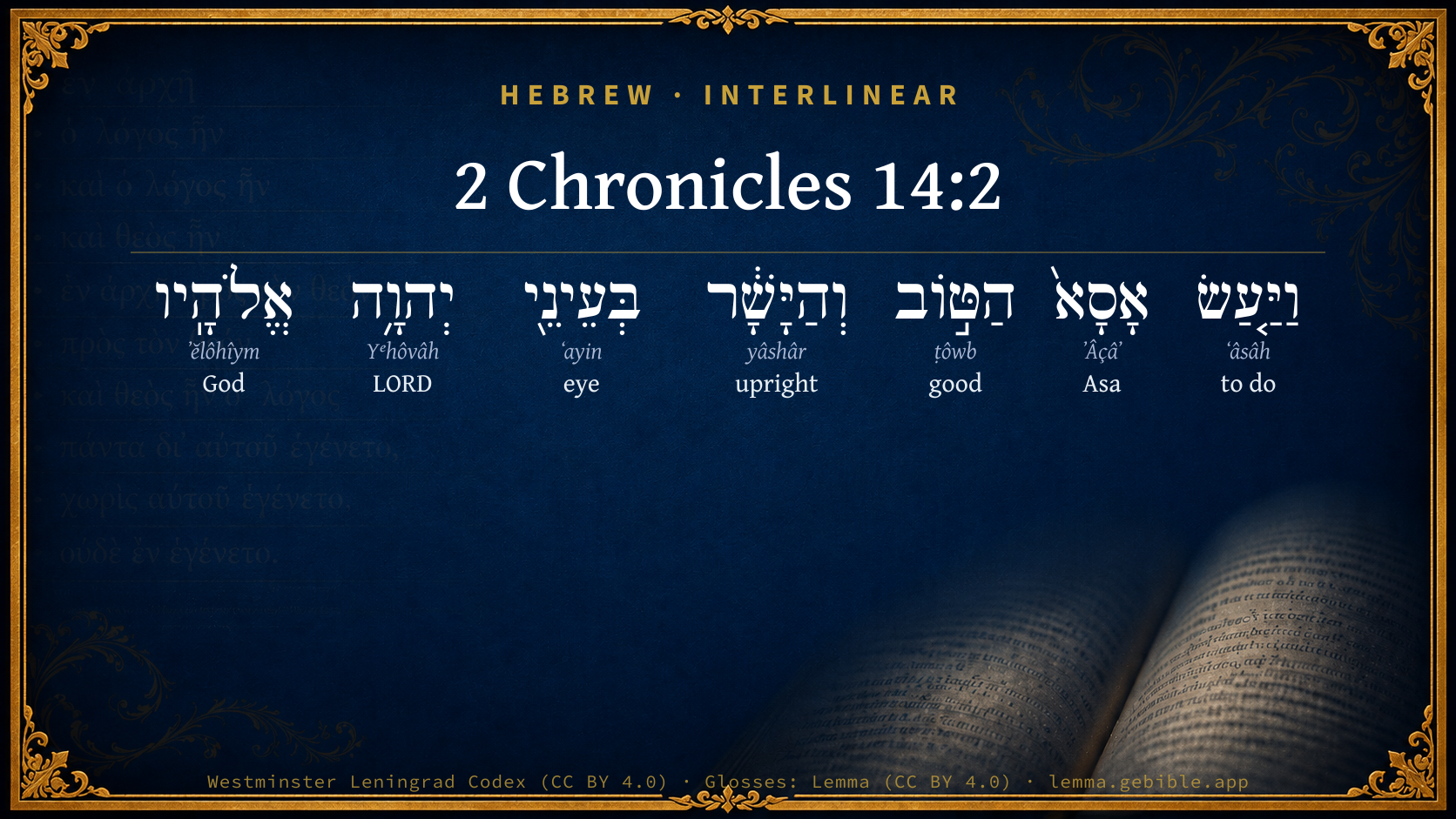
2 Chronicles 14:2

Hebrew (Westminster Leningrad Codex) 2 Chronicles 14:2 appears in the Hebrew Old Testament. The text above is from the Westminster Leningrad Codex. Each word links to its Strong’s number, a concise gloss, and parsing drawn from the Open Scriptures Hebrew Bible morphology. Click any word for its full Brown-Driver-Briggs (BDB) entry.
Download image
Cite this verse

2 Chronicles 14:2 (World English Bible). Public Domain. Lemma interlinear Bible study tool, https://lemma.gebible.app/v/2-chronicles/14/2.

Show BibTeX & RIS
BibTeX
RIS
English Translation
Asa did that which was good and right in the eyes of Yahweh his God:
World English Bible · Public Domain
Download a study sheet

One document with this verse’s original text, its word-by-word gloss line, the meaning frame, cross-references with their text, attributed commentary, and full source and license credits — printable, and it pastes into notes with its structure intact.

This verse Autodidact and up

Study sheet (.html) Plain text (.txt)

A passage Seminary Student

Up to 50 verses in one chapter. A passage sheet keeps up to 6 commentary sources and 12 cross-references per verse, in the order this page ranks them, and says so on the sheet whenever that leaves anything out. Ask for a single verse and you get the Autodidact verse sheet above.

Everything on this page stays free to read, with no account — the sheet is a download of what is already on screen, not access to it.

Want to remove ads? Support Godless Engineer
Compare translations 3

The same verse in 3 English versions, stacked beneath the original-language interlinear above. Click any original word for its lexicon entry.

Each is an independent rendering of the whole verse — the interlinear is not word-aligned to these translations.

Highlighted words mark where these versions differ — a whole-verse word diff, not a word-by-word alignment.

  • World English Bible Public Domain
    Asa did that which was good and right in the eyes of Yahweh his God:
  • King James Version Public Domain
    And Asa did that which was good and right in the eyes of the LORD his God:
  • unfoldingWord Literal Text CC BY-SA 4.0
    And Asa did the good and the right in the eyes of Yahweh his God.

unfoldingWord Literal Text — © unfoldingWord, licensed CC BY-SA 4.0. Word-aligned USFM3 via Door43 (git.door43.org/unfoldingWord/en_ult).

Versions to compare (up to 4)

3 of 4 selected

Show all 18 translations

Every available English version of this verse, each an independent rendering of the whole verse.

  • World English Bible Public Domain
    Asa did that which was good and right in the eyes of Yahweh his God:
  • Berean Standard Bible Public Domain
    And Asa did what was good and right in the eyes of the LORD his God.
  • Majority Standard Bible Public Domain
    And Asa did what was good and right in the eyes of the LORD his God.
  • King James Version Public Domain
    And Asa did that which was good and right in the eyes of the LORD his God:
  • American Standard Version (1901) Public Domain
    And Asa did that which was good and right in the eyes of Jehovah his God:
  • Revised Version (1885) Public Domain
    And Asa did that which was good and right in the eyes of the LORD his God:
  • Geneva Bible (1599) Public Domain
    And Asa did that was good and right in the eyes of the Lord his God.
  • Douay-Rheims (1899) Public Domain
    And Asa did that which was good and pleasing in the sight of his God, and he destroyed the altars of foreign worship, and the high places.
  • Young's Literal Translation Public Domain
    And Asa doth that which is good, and that which is right, in the eyes of Jehovah his God,
  • Literal Standard Version CC BY-SA 4.0
    And Asa does that which is good and that which is right in the eyes of his God YHWH,
  • Unlocked Literal Bible CC BY-SA 4.0
    Asa did what was good and right in the eyes of Yahweh his God,
  • unfoldingWord Literal Text CC BY-SA 4.0
    And Asa did the good and the right in the eyes of Yahweh his God.
  • Darby Bible Public Domain
    And Asa did what was good and right in the sight of Jehovah his God;
  • World Messianic Bible Public Domain
    Asa did that which was good and right in the LORD his God’s eyes,
  • Webster's Bible Public Domain
    And Asa did that which was good and right in the eyes of the LORD his God:
  • Free Bible Version CC BY-SA 4.0
    Asa did what was good and right in the Lord's sight.
  • Bible in Basic English Public Domain
    And Asa did what was good and right in the eyes of the Lord his God;
  • JPS Tanakh (1917) Public Domain
    (14-1) And Asa did that which was good and right in the eyes of the LORD his God;

Literal Standard Version (2020), Covenant Press — licensed CC BY-SA 4.0. Text via the HelloAO Bible API (eBible.org). Unlocked Literal Bible (unfoldingWord) — licensed CC BY-SA 4.0. Text via the HelloAO Bible API (eBible.org). unfoldingWord Literal Text — © unfoldingWord, licensed CC BY-SA 4.0. Word-aligned USFM3 via Door43 (git.door43.org/unfoldingWord/en_ult). Free Bible Version, Dr. Jonathan Gallagher — licensed CC BY-SA 4.0. Text via the HelloAO Bible API (eBible.org).

Word by word

More ways to search: Search by grammar → Find every occurrence → Compare this word →

Practice this passage: Drill this verse → Learn its vocabulary →

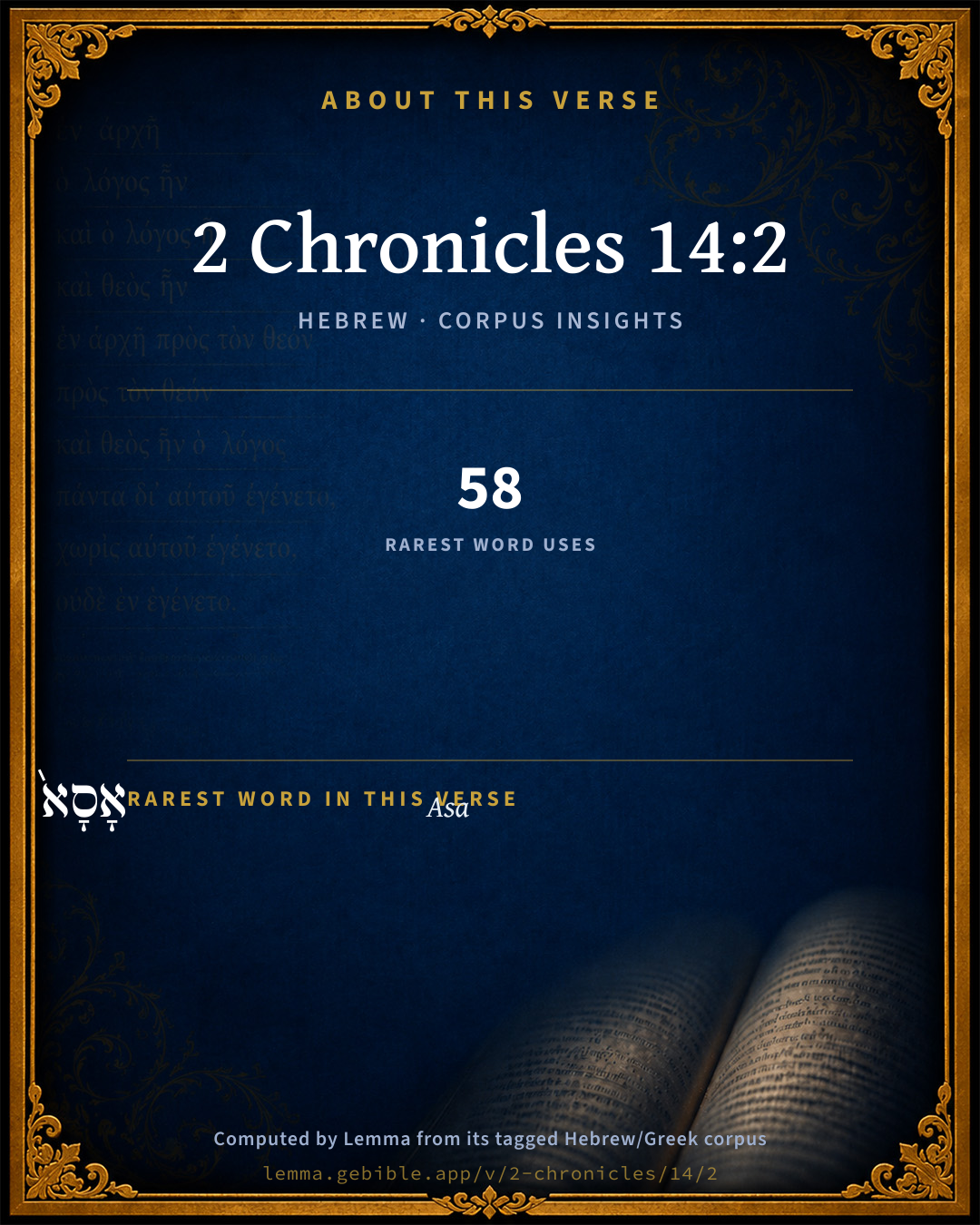
About this verse

These counts appear in no published source. They are computed here, from the morphology-tagged text and Lemma’s own curated glosses. What Lemma adds →

7
words
7
distinct lemmas
Historical
section

Shared distinctive vocabulary

אָסָא֙ Asa H609 occurs in 52 verses of the Hebrew Bible. Also found in:

Grammatical profile

  • 1 verb
  • 4 nouns
  • 2 adjectives

Verb forms

  • וַיַּ֤עַשׂ Qal · Sequential Imperfect

Hebrew & Septuagint length

In English translation the verse runs 15 words from the Hebrew and 17 from the Septuagint (LXX English) — closely comparable.

A rough comparison of the two English renderings, which tokenize alike — not a word-level alignment.

Word counts can differ between the Hebrew and the Greek without any difference in meaning — e.g. the Hebrew direct-object marker אֵת has no separate Greek word, and Greek often adds the article ὁ.

Cross-references

4

Topical passages linked to 2 Chronicles 14:2 in the Treasury of Scripture Knowledge — connected by theme and wording, ordered by reader-vote popularity; previews shown in the World English Bible.

  • 1 Kings 15:11 Asa did that which was right in the eyes of Yahweh, as did David his father.
  • 1 Kings 15:14 But the high places were not taken away: nevertheless the heart of Asa was perfect with Yahweh all his days.
  • 2 Chronicles 31:20 Thus did Hezekiah throughout all Judah; and he worked that which was good and right and faithful before Yahweh his God.
  • Luke 1:75 In holiness and righteousness before him all the days of our life.

Cross-references courtesy of OpenBible.info (CC BY 4.0).

Hebrew and Greek witnesses Masoretic Hebrew ↔ Greek Septuagint

The same verse in the two great witnesses to the Old Testament, shown verse-for-verse.

These are two independent witnesses, not word-aligned to each other, and the Septuagint is shown in lemma (dictionary) form.

Hebrew 2 Chronicles 14:2 Masoretic · Westminster Leningrad Codex

וַיַּ֤עַשׂ אָסָא֙ הַטּ֣וֹב וְהַיָּשָׁ֔ר בְּעֵינֵ֖י יְהוָ֥ה אֱלֹהָֽיו

Asa did that which was good and right in the eyes of Yahweh his God:

World English Bible · Public Domain

Greek LXX 2 Chronicles 14:2 Septuagint · lemma form

καί ἀποἵστημι ὁ θυσιαστήριον ὁ ἀλλότριος καί ὁ ὑψηλός καί συντρίβω ὁ στήλη καί ἐκκόπτω ὁ ἄλσος

And he did that which was good and right in the sight of the Lord his God.

LXX2012 (modern English Septuagint) · Public Domain

Hebrew: Westminster Leningrad Codex (CC BY 4.0). Greek: Septuagint (public domain); English from LXX2012 (modern English Septuagint) (Public Domain). How the Septuagint differs from the Hebrew →

Commentary

Notes on 2 Chronicles 14:2 from classic Christian and Jewish commentators (each source and its license shown beneath its notes). The classic Christian expositions comment on the surrounding passage and are grouped to its opening verse, so a note may address several verses; the Jewish commentaries on the Tanakh (Rashi and others) are per-verse, so they appear only where the commentator wrote on this verse.

Lemma curates 59 commentaries, every one of them public domain or Creative Commons licensed, each selected and text-cleaned for this edition rather than reprinted as found. About our sources →

Ellicott's Commentary for English Readers

REIGN OF ASA (2 Chronicles 14-16.)

(a) EFFORTS TO ROOT OUT ILLEGITIMATE WORSHIPS, AND TO STRENGTHEN THE SYSTEM OF NATIONAL DEFENCES (2Ch_14:2-7; comp. 1Ki_15:9-15).

(2) That which was good and right.—Literally, The good and the right, an expression defined in 2Ch_14:3-4. It is used of Hezekiah, 2Ch_31:20. See 1Ki_15:11, “And Asa did the right in the eyes of the Lord, like David his father.”

For (and) . . . the altars of the strange gods.—Literally, altars of the alien. Vulg., “altaria peregrini cultus.” Comp. the expression, gods of the alien (Gen. xxxv, 2, 4). (Comp. 1Ki_15:12 b, and he took away all the idols that his fathers had made; a summary statement, which is here expanded into details.) But both here and in 2Ch_12:1-2, the chronicler has omitted to mention the qedçshîm (Authorised Version, “Sodomites”) (1Ki_15:12 a)

And the high places.—i.e., those dedicated to foreign religions. It is clear from 2Ch_15:17, as well as 1Ki_15:14, that high places dedicated to the worship of Jehovah were not done away with by Asa.

Brake down the images.—Brake in pieces (or shattered) the pillars. They were dedicated to Baal, and symbolised the solar rays, being, no doubt, a species of obelisk. (See Gen_28:18; Exo_34:13; Jdg_3:7.)

The “high places, images, and groves” of this verse are all mentioned in 1Ki_14:23.

A Bible Commentary for English Readers, edited by Charles John Ellicott (1878–1897) — public domain. Text from a community e-Sword module.

Trapp's Complete Commentary

John Trapp

2Ch 14:2 And Asa did [that which was] good and right in the eyes of the LORD his God:

Ver. 2. And Asa did that which was good.] See 1Ki 15:11.

In the eyes of the Lord.] Not in his own eyes, or the eyes of men, qui larvis ducuntur, which are oft bemisted.

John Trapp, A Commentary or Exposition upon All the Books of the Old and New Testament (1647–1656) — public domain. Text from a community e-Sword module.

Joseph Benson's Commentary

2Ch 14:2. Asa did that which was good and right in the eyes of the Lord — Happy they that walk by this rule; that do not only that which is right in their own eyes, or in the eyes of the world, but which is so in God’s eyes. Asa saw that God’s eye was always upon him, and therefore he kept his eye always upon God, studied to approve himself to him, and endeavoured in all things to please him.

Joseph Benson's Commentary on the Old and New Testaments (1811–1818) — public domain. Text from a community e-Sword module.

MacLaren's Expositions of Holy Scripture

Alexander MacLaren

2 Chronicles

ASA’S REFORMATION, AND CONSEQUENT PEACE AND VICTORY

2Ch 14:2 - 2Ch 14:8.

Asa was Rehoboam’s grandson, and came to the throne when a young man. The two preceding reigns had favoured idolatry, but the young king had a will of his own, and inaugurated a religious revolution, with which and its happy results this passage deals.

I. It first recounts the thorough clearance of idolatrous emblems and images which Asa made. ‘Strange altars,’-that is, those dedicated to other gods; ‘high places,’-that is, where illegal sacrifice to Jehovah was offered; ‘pillars,’-that is, stone columns; and ‘Asherim,’-that is, trees or wooden poles, survivals of ancient stone- or tree-worship; ‘sun-images,’-that is, probably, pillars consecrated to Baal as sun-god, were all swept away. The enumeration vividly suggests the incongruous rabble of gods which had taken the place of the one Lord. How vainly we try to make up for His absence from our hearts by a multitude of finite delights and helpers! Their multiplicity proves the insufficiency of each and of all.

1Ki 15:13 adds a detail which brings out still more clearly Asa’s reforming zeal; for it tells us that he had to fight against the influence of his mother, who had been prominent in supporting disgusting and immoral forms of worship, and who retained some authority, of which her son was strong enough to take the extreme step of depriving her. Remembering the Eastern reverence for a mother, we can estimate the effort which that required, and the resolution which it implied. But 1 Kings differs from our narrative in stating that the ‘high places’ were not taken away-the explanation of the variation probably being that the one account tells what Asa attempted and commanded, and the other records the imperfect way in which his orders were carried out. They would be obeyed in Jerusalem and its neighbourhood, but in many a secluded corner the old rites would be observed.

It is vain to force religious revolutions. Laws which are not supported by the national conscience will only be obeyed where disobedience will involve penalties. If men’s hearts cleave to Baal, they will not be turned into Jehovah-worshippers by a king’s commands. Asa could command Judah to ‘seek the Lord God of their fathers, and to do the law,’ but he could not make them do it.

II. The chronicler brings out strongly the truth which runs through his whole book,-namely, the connection between honouring Jehovah and national prosperity. He did not import that thought into his narrative, but he insisted on it as moulding the history of Judah. Modern critics charge him with writing with a bias, but he learned the ‘bias’ from God’s own declarations, and had it confirmed by observation, reflection, and experience. The whole history of Israel and Judah was one long illustration of the truth which he is constantly repeating. No doubt, the divine dealings with Israel brought obedience and well-being into closer connection than exists now; but in deepest truth the sure defence of our national prosperity is the same as theirs, and it is still the case that ‘righteousness exalteth a nation.’ ‘The kingdom was quiet,’ says the chronicler, ‘and he had no war in those years; because the Lord had given him rest.’ 1 Kings makes more of the standing enmity with the northern kingdom, and records scarcely anything of Asa’s reign except the war which, as it says, was between him and Baasha of Israel ‘all their days.’ But, according to 2Ch 16:1, Baasha did not proceed to war till Asa’s thirty-sixth year, and the halcyon time of peace evidently followed immediately on the religious reformation at its very beginning.

Asa’s experience embodies a truth which is substantially fulfilled in nations and in individuals; for obedience brings rest, often outward tranquillity, always inward calm. Note the heightened earnestness expressed in the repetition of the expression ‘We have sought the Lord’ in 2Ch 14:7, and the grand assurance of His favour as the source of well-being in the clause which follows, ‘and He hath given us rest on every side.’ That is always so, and will be so with us. If we seek Him with our whole hearts, keeping Him ever before us amid the distractions of life, taking Him as our aim and desire, and ever stretching out the tendrils of our hearts to feel after Him and clasp Him, all around and within will be tranquil, and even in warfare we shall preserve unbroken peace.

Asa teaches us, too, the right use of tranquillity. He clearly and gratefully recognised God’s hand in it, and traced it not to his own warlike skill or his people’s prowess, but to Him. And he used the time of repose to strengthen his defences, and exercise his soldiers against possible assaults. We do not yet dwell in the land of peace, where it is safe to be without bolts and bars, but have ever to be on the watch for sudden attacks. Rest from war should give leisure for building not only fortresses, but temples, as was the case with Solomon. The time comes when, as in many an ancient fortified city of Europe, the ramparts may be levelled, and flowers bloom where sentries walked; but to-day we have to be on perpetual guard, and look to our fortifications, if we would not be overcome.

Alexander MacLaren, Expositions of Holy Scripture (1904–1910) — public domain. Text from a community e-Sword module.

Tyndale Open Study Notes

Tyndale Open Resources

14:2-5 At the beginning of his reign, Asa . . . removed the foreign altars in Judah (14:5). However, he did not remove the pagan shrines from Israel (15:17). These were probably in the cities of the northern kingdom that Asa had inherited from Abijah. Idolatry practiced by other peoples occupying the land plagued Judah throughout its history; this pagan activity might have revived toward the end of Asa’s reign more than thirty years later.

Tyndale Open Study Notes — © Tyndale Open Resources, licensed CC BY-SA 4.0. Text via the HelloAO Bible API.

Jamieson, Fausset & Brown

Robert Jamieson, A. R. Fausset & David Brown

Asa did that which was good and right--(compare Kg1 15:14). Still his character and life were not free from faults (Ch2 16:7, Ch2 16:10, Ch2 16:12).

Jamieson, Fausset & Brown — Commentary Critical and Explanatory on the Whole Bible (1871) — public domain (CC PDM 1.0). Text via the HelloAO Bible API.

Adam Clarke's Commentary

Verse 2. Did that which was good] He attended to what the law required relative to the worship of God. He was no idolater, though, morally speaking, he was not exempt from faults, 1Kg 15:14. He suppressed idolatry universally, and encouraged the people to worship the true God: see 2Ch 14:3-5.

Adam Clarke's Commentary on the Bible (1810–1826) — public domain. Text from a community e-Sword/MySword module.

John Gill's Exposition

And Asa did that which was good and right,.... See Kg1 15:11.

.

2 Chronicles 14:3

ch2 14:3

ch2 14:3

ch2 14:3For he took away the altars of the strange gods,.... Or of a strange people, of the Zidonians, Ammonites, and Moabites, which had remained from the times of Solomon, and which he built for his wives, Kg1 11:7.

and the high places; built for idols; for as for those on which the true God was worshipped, they were not removed in his days, Kg1 15:14.

and brake down the images: or statues, or pillars, erected to the honour of idols, and on which the images of them were placed:

and cut down the groves; in the midst of which they stood.

John Gill's Exposition of the Whole Bible (1746–1763) — public domain (CC PDM 1.0). Text via the HelloAO Bible API.

Haydock's Catholic Bible Commentary

God, with respect to the external worship of the true God, (Haydock) though he had some faults, 3 Kings xv. 14. --- Places, while he tolerated those which were intended for the service of the Lord, (Calmet) though illegally; and he even left the buildings erected by Solomon standing, (4 Kings xxiii. 13.; Tirinus) thinking they might be no longer dangerous. (Salien) --- Several other pious kings did the like, for which they deserved some reprehension; as they could not be ignorant, that this was considered as wrong by the more enlightened, Ecclesiasticus xlix. 5. (Tirinus) --- It was the king’s duty to destroy the exterior practices of idolatry, while the priests and prophets were to instruct. (Worthington)

George Leo Haydock (1774–1849), Haydock's Catholic Family Bible and Commentary, 1859 edition — public domain. Excludes Psalms (Douay-Rheims chapter numbering differs from Protestant) and Deuterocanonical books (Catholic canon only).

Matthew Poole's English Annotations

Of this and the next verse, See Poole "1Ki 15:11" See Poole "1Ki 15:12"

Matthew Poole's English Annotations on the Holy Bible (1683–1685) — public domain. Text from a community e-Sword/MySword module.

The Pulpit Commentary

That which was good and right. Our Authorized Version does not omit to mark the first three words with italic type, the simple and emphatic original being, the good and the straight.

Vers. 2, 3, 5.

Destructive godliness.

Human energy and capacity show themselves in two forms -in the destructive and in the constructive. Though action of the latter kind is the more honourable and admirable of the two, yet that of the former is also useful and needful in its time. Moses did a very good work for the people of Israel when he ground to powder the golden calf; and Hezekiah, when he broke in pieces the brazen serpent and called it "a bit of brass;" and the Christians of Ephesus did a wise as well as a worthily sacrificial thing when they burnt the "books" out of which they had been making large profits for their pocket. (Act_20:19) Destructive godliness sometimes indicates a devotedness, and sometimes renders a service which deserves to take high rank amongst the excellences and even the nobilities of human worth. We look at

I THE DESTRUCTIVE PIETY SHOWN BY THE KING. He removed the high places set apart for idolatrous worship, also the altars of false gods; he "cut down the groves" where moral and devotional abominations were likely to be committed; he "took away the sodomites out of the land, and removed all the idols that his fathers had made". (1Ki_15:12) And that which was, perhaps, more than all this, as evidencing a sincerity and thoroughness of heart toward God, and justifying the language used by the Chronicler (ver. 2) concerning him, he destroyed the idol of Maachah, and even removed that idolatrous queen from the official dignity she had been enjoying. Asa, therefore, struck a very decisive and damaging blow at the idolatry of his time; he powerfully and effectually discouraged iniquity and immorality in three ways:

1. He showed his own personal and royal hatred of them.

2. He rebuked and punished the perpetrators of them.

3. He took away the means of indulging in them.

By these measures he strove well and wrought successfully for the truth of God and for the purity of his people.

II OUR OWN ACTION IN THE SAME DIRECTION, In what ways shall we serve God by a destructive piety?

1. By promoting wise legislative measures. There arc evils which it is needless to name from which large numbers of people need to be protected. To be tempted by them is to be overcome, is to be slain by them; they are active sources of evil and of suffering, of ruin and of death; they ought to be suppressed; and one part of a Christian man"s duty is to join his fellow-citizens in cutting down or "removing those high places" of the land.

2. By excluding evil things and evil persons from the home. There are men and there is literature concerning whom and concerning which we can only say that they arc sources of defilement; and if we have not power, like an Oriental monarch, to forbid them the land, we can forbid them the home; we can see that, in respect of those who are in our charge and for whose well-being we are responsible, that these men and these books are well beyond reach.

3. , By putting down evil language. This we may do, in many quarters, by firmly discountenancing and fearlessly condemning it; the voice of righteous reprobation will soon silence the profane and lascivious tongue.

4. By expelling from our own life that which imperils our moral or spiritual integrity. Every man must know, or should know, what habits (in eating or drinking, in recreation, etc.) are fascinating, absorbing, dangerous to himself; must know in what direction it is perilous to set out, lest he should go too far. There let him determinately bar the way; that threatening habit let him exclude rigorously from his life C.. (see Mat_5:29, Mat_5:30)

Vers. 2, 4, 6, 7.

Constructive godliness.

It is better to construct than to destroy (see preceding homily), and though Asa did well in demolishing the strange altars and expelling the sodomites from the land, he did even better in

(1) encouraging all Judah to seek God in worship and to obey his Law, and in

(2) fortifying his territory against the enemy while the land was in his full possession (while the land was "yet before" them). The patriotism and the piety that expended themselves in spiritual and in material edification were of the best. We shall find their analogue among ourselves in

I BUILDING UP OURSELVES on our holy faith. (Jud_1:20) A man"s first duty is that which he owes to his own spirit; for God has given him that, above all things, to have in charge and to present pure and perfect before him at the last. We are, therefore, most sacredly bound to build up ourselves in faith, in love, in purity, in truthfulness, in moral and spiritual integrity, in mercy and magnanimity. And this we shall do

(1) by the study of our Lord Jesus Christ (of his life and character);

(2) by the worship of him and fellowship with him, both in the home and in the sanctuary;

(3) by an earnest and prayerful endeavour to do and bear his will, and to follow his example until we attain to his likeness.

II EDIFYING THOSE WHOM WE CAN INFLUENCE; bringing to bear upon the inmates of our home, upon those whom we employ (or by whom we are employed), upon our nearer neighbours, upon our fellow-townsmen, upon our fellow-worshippers and fellow-workers in the kingdom of God, all the strengthening, stimulating, elevating influence we can possibly command.

III CARING FOR CONSULTING THE WELFARE OF OUR COUNTRY. Asa built those "fenced cities in Judah" that he might make timely provision against the enemy and thus keep him off, or repel him if he attacked. What are the enemies of our native land? These are not to be found (chiefly) in invading hosts; there is but little to be feared from them. We find our national enemies in intemperance, in impurity, in dishonesty and fraud, in unconscientious and unfaithful labour, and, therefore, in poor and unsound production, in political charlatanism and pretence, in ecclesiastical bitterness. We want to call into the field forces that will expel these evils from the land. Where shall we find them?

1. In Christ-like men; in men imbued with the spirit, possessed of the principles, living the life, of Jesus Christ.

2. In Christian institutions; in earnest, working Churches; in Sunday schools; in temperance societies; in guilds for the inculcation of all that is pure and wholesome; in philanthropic associations of many kinds.

3. In Christian literature. Not only that which is distinctively religions, but that also which is sound in tone and spirit, which imparts and infuses a true idea of human character and human life.

Our patriotic work must be found in building up these; building up these men in our homes and circles by the influence of our Christian character; sustaining these institutions by generous gifts of time and strength and money; countenancing and supporting this wholesome, edifying literature. So shall we also "build and prosper. C.

The Pulpit Commentary (1880–1919), ed. H.D.M. Spence-Jones & Joseph S. Exell — public domain. Text from a community e-Sword module.

Lesson kit

Teaching starters — assembled from the data on this page, not authored interpretation. Every prompt links to the verse data it draws on. Edit before teaching.

2 Chronicles, in the Historical, opens this verse with 7 words (7 distinct Hebrew lemmas). Its most distinctive word is ʼÂçâʼ (“Asa”). A historical commentator’s framing appears above. Read the whole chapter for the surrounding context.

Discussion questions

  1. What does “Asa” (ʼÂçâʼ) contribute to the verse as a whole?
  2. How does 1 Kings 15:8, which shares the word «Asa», read alongside this verse?
  3. The translations on this page render this verse differently — a whole-verse word diff, not a word-by-word alignment. What might account for the different wordings?
  4. «וַיַּ֤עַשׂ» is a Qal Sequential Imperfect verb. How does that grammatical form shape the action described?
  5. Compare how Ellicott's Commentary for English Readers and Trapp's Complete Commentary read this verse. Where do they agree or differ?

Things to notice

Reading settings

Reading text

Shown beneath each verse's original-language words.

Old Testament
Old Testament edition

Read the OT as the Masoretic Hebrew (MT) or the Greek Septuagint (LXX).

English shown for the Greek Septuagint (in the Hebrew ↔ Greek comparison).

Comparing translations? Open the Compare panel on any verse page to stack up to four side by side.