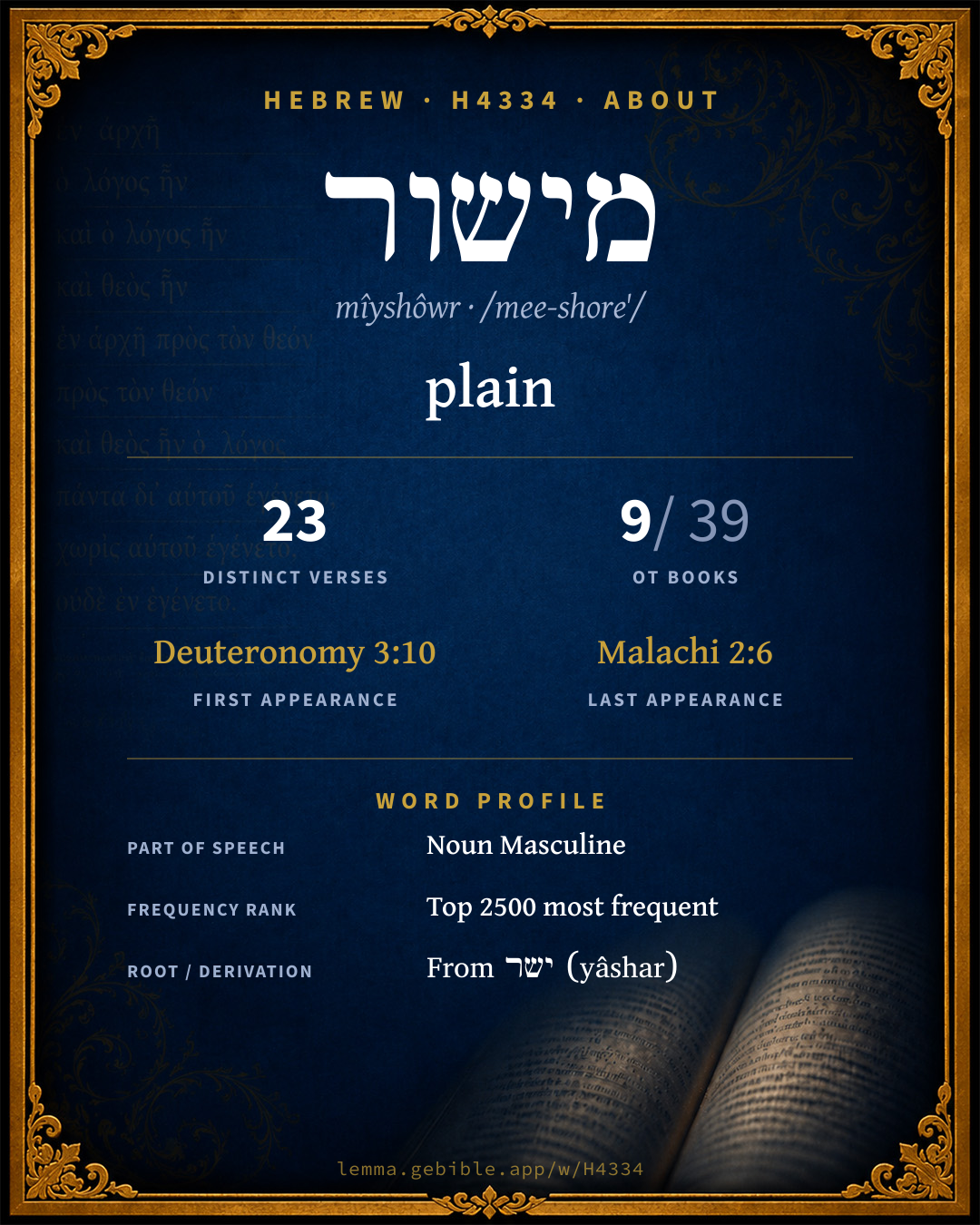
מִישׁוֹר
plain
‘plain’ is one of 4 main senses fuller range ↓
Full lexicon entry — Brown-Driver-Briggs (BDB)
From Brown-Driver-Briggs (BDB)
Where this word appears
Grammar key — what these labels mean
Part of speech
- Noun
- A naming word — a person, place, thing, or idea.
Noun type
- Common
- A common noun — a general class of person, place, or thing (“king,” “city,” “water”), not a specific name.
State
- Absolute
- The independent form of a noun, not bound to a following word.
Gender
- Masculine
- Grammatically masculine.
Number
- Singular
- One.
Every verse where H4334 appears — 23 distinct verses across 9 books. Click any verse to open its interlinear word-by-word view. Verse text shown in the World English Bible for context — . Each verse’s Hebrew form is shown with its reference; the English is not keyword-highlighted, since the data carries no word-level English alignment. Use “Compare translations” on any verse to read it across multiple English versions. This concordance covers the Hebrew Bible; Septuagint (Greek Old Testament) occurrences are not indexed here.
Deuteronomy 2 verses
- Deuteronomy 3:10 הַ/מִּישֹׁ֗ר ptcl def.art + n c ms all the cities of the plain, and all Gilead, and all Bashan, to Salecah and Edrei, cities of the kingdom of Og in Bashan.
- Deuteronomy 4:43 הַ/מִּישֹׁ֖ר ptcl def.art + n c ms [namely], Bezer in the wilderness, in the plain country, for the Reubenites; and Ramoth in Gilead, for the Gadites; and Golan in Bashan, for the Manassites.
Joshua 5 verses
- Joshua 13:9 הַ/מִּישֹׁ֥ר ptcl def.art + n c ms from Aroer, that is on the edge of the valley of the Arnon, and the city that is in the middle of the valley, and all the plain of Medeba to Dibon;
- Joshua 13:16 הַ/מִּישֹׁ֖ר ptcl def.art + n c ms Their border was from Aroer, that is on the edge of the valley of the Arnon, and the city that is in the middle of the valley, and all the plain by Medeba;
- Joshua 13:17 בַּ/מִּישֹׁ֑ר prep det + n c ms Heshbon, and all its cities that are in the plain; Dibon, and Bamoth Baal, and Beth Baal Meon,
- Joshua 13:21 הַ/מִּישֹׁ֔ר ptcl def.art + n c ms and all the cities of the plain, and all the kingdom of Sihon king of the Amorites, who reigned in Heshbon, whom Moses struck with the chiefs of Midian, Evi, and Rekem, and Zur, and Hur, and Reba, the princes of Sihon, who lived in the land.
- Joshua 20:8 בַּ/מִּישֹׁ֖ר prep det + n c ms Beyond the Jordan at Jericho eastward, they assigned Bezer in the wilderness in the plain out of the tribe of Reuben, and Ramoth in Gilead out of the tribe of Gad, and Golan in Bashan out of the tribe of Manasseh.
1 Kings 2 verses
- 1 Kings 20:23 בַּ/מִּישׁ֔וֹר prep det + n c ms The servants of the king of Syria said to him, Their god is a god of the hills; therefore they were stronger than we: but let us fight against them in the plain, and surely we shall be stronger than they.
- 1 Kings 20:25 בַּ/מִּישׁ֔וֹר prep det + n c ms and number you an army, like the army that you have lost, horse for horse, and chariot for chariot; and we will fight against them in the plain, and surely we shall be stronger than they. He listened to their voice, and did so.
2 Chronicles 1 verse
Psalms 5 verses
- Psalms 26:12 בְ/מִישׁ֑וֹר prep + n c ms My foot stands in an even place. In the congregations I will bless Yahweh.
- Psalms 27:11 מִישׁ֑וֹר n c ms Teach me your way, Yahweh. Lead me in a straight path, because of my enemies.
- Psalms 45:6 מִ֝ישֹׁ֗ר n c ms Your throne, God, is forever and ever. A scepter of equity is the scepter of your kingdom.
- Psalms 67:4 מִישׁ֑וֹר n c ms Oh let the nations be glad and sing for joy, For you will judge the peoples with equity, And govern the nations on earth. Selah.
- Psalms 143:10 מִישֽׁוֹר n c ms Teach me to do your will, For you are my God. Your Spirit is good. Lead me in the land of uprightness.
Isaiah 3 verses
- Isaiah 11:4 בְּ/מִישׁ֖וֹר prep + n c ms but with righteousness shall he judge the poor, and decide with equity for the humble of the earth; and he shall strike the earth with the rod of his mouth; and with the breath of his lips shall he kill the wicked.
- Isaiah 40:4 לְ/מִישׁ֔וֹר prep + n c ms Every valley shall be exalted, and every mountain and hill shall be made low; and the uneven shall be made level, and the rough places a plain:
- Isaiah 42:16 לְ/מִישׁ֔וֹר prep + n c ms I will bring the blind by a way that they don't know; in paths that they don't know will I lead them; I will make darkness light before them, and crooked places straight. These things will I do, and I will not forsake them.
Jeremiah 3 verses
- Jeremiah 21:13 הַ/מִּישֹׁ֖ר ptcl def.art + n c ms Behold, I am against you, O inhabitant of the valley, [and] of the rock of the plain, says Yahweh; you that say, Who shall come down against us? or who shall enter into our habitations?
- Jeremiah 48:8 הַ/מִּישֹׁ֑ר ptcl def.art + n c ms The destroyer shall come on every city, and no city shall escape; the valley also shall perish, and the plain shall be destroyed; as Yahweh has spoken.
- Jeremiah 48:21 הַ/מִּישֹׁ֑ר ptcl def.art + n c ms Judgment is come on the plain country, on Holon, and on Jahzah, and on Mephaath,
Zechariah 1 verse
Malachi 1 verse
About this entry
At a glance — auto-summarized from this page’s data, not written by a person. Every figure links to its source below. This summary describes the numbers; it doesn’t interpret them.
The Hebrew noun מישור centers on the idea of “plain.” Older and newer Bibles part ways — “plain” in the King James Version, “plateau” (Berean Standard Bible) in modern versions. See the renderings breakdown. It turns up in 23 verses across 9 books, an uncommon footprint. Its earliest occurrence is Deuteronomy 3:10. The lexicon spreads it across several senses; see its full sense range. Dig into 23-verse concordance and the renderings breakdown below.
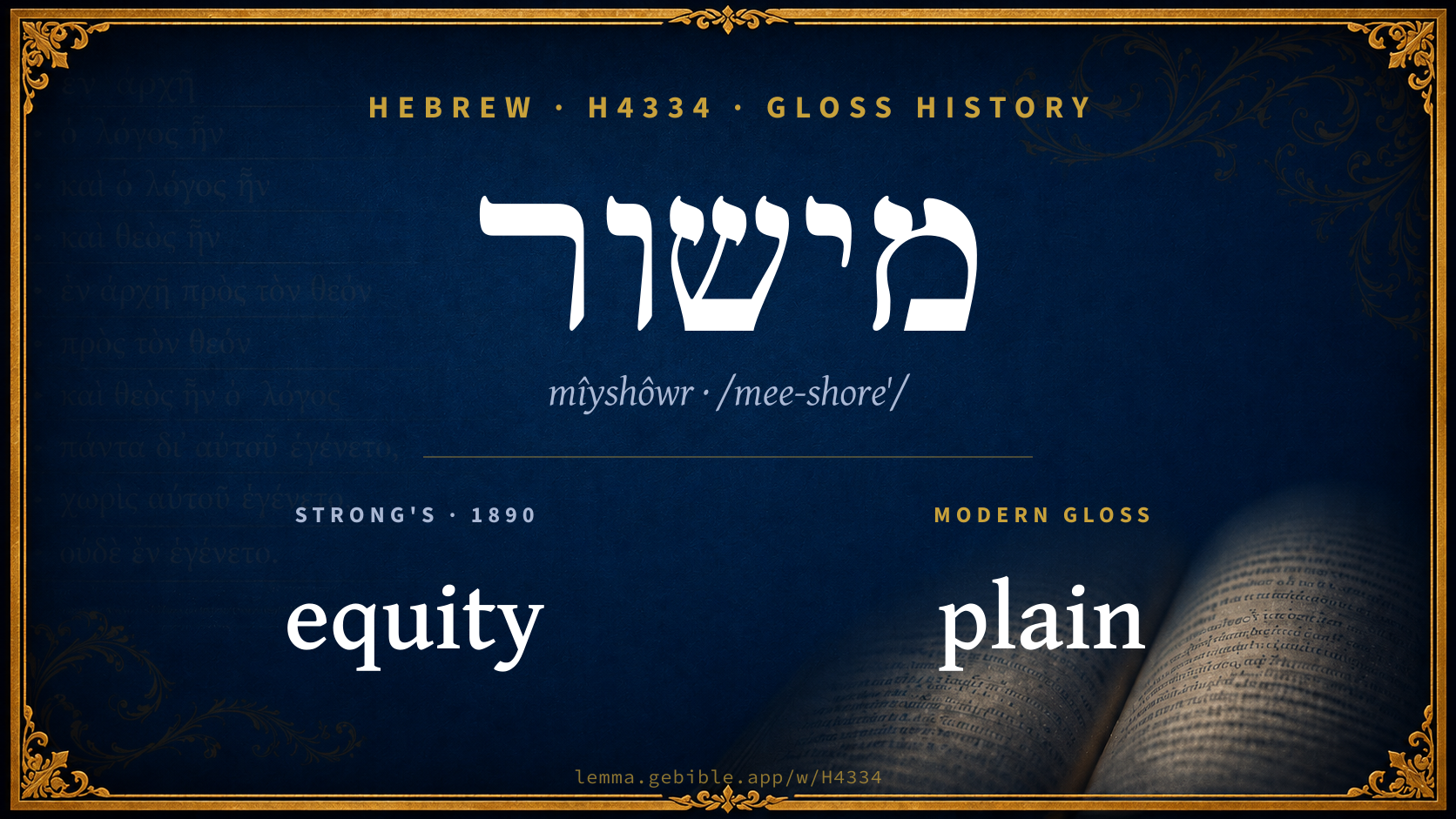
Gloss history
Strong's 1890 vs modern scholarship
About this word
Strong's H4334 catalogs a Hebrew word from the Hebrew Old Testament.
These counts are not copied from any lexicon or concordance. They are computed here, from the morphology-tagged Hebrew Old Testament. What Lemma adds →
- 23
- distinct verses
- The word appears in 23 distinct verses.
- 9 / 39
- OT books
- The word appears in 9 of 39 Old Testament books.
- #1,368
- by frequency
- Top 2500 most frequent Hebrew words (rank 1,368 of 8,640 Hebrew words by occurrence).
View all 23 occurrences in the concordance →
By section of the Old Testament
By traditional corpus
Conventional, traditional groupings — biblical authorship is debated, so this is a traditional corpus grouping, not an authorship claim. Each share is this word’s portion of its verses in that division of the Hebrew canon. Each figure is a share of the word’s 23 distinct verses.
- Prophets (Nevi'im) 15 verses · 65%
- Writings (Ketuvim) 6 verses · 26%
- Torah (Pentateuch) 2 verses · 9%
How translations render this word
Counts come from each version’s own published word-to-Strong’s tagging or interlinear alignment — an approximate guide to how each version renders this word, not a word-level alignment the data otherwise carries. Because each total is that version’s own tagged count, the per-version totals vary from one another and need not match the appearance or distinct-verse counts above. These counts may also differ from a printed concordance because Lemma counts each distinctly tagged rendering and does not collapse phrase taggings into a single head-word total. This is a fixed set of word-tagged versions (KJV, ASV, BSB, ULT) and does not change with the reading translation you choose elsewhere. Each version’s license is shown beside its name below (and on Sources).
- King James Version: Plain 9×, All the plain 2×, Equity 2×
- American Standard Version: Plain 9×, Equity 3×, All the plain 2×
- Berean Standard Bible: Plateau 8×, High plain 2×, Level 2×
- unfoldingWord Literal Text: Plain 4×, Plateau 4×, Level ground 3×
King James Version Public Domain
Renders H4334 across 23 tagged occurrences — most commonly:
Plus 10 renderings that appear only once — usually multi-word phrases or single function words the recovered tagging swept in, not distinct renderings.
American Standard Version Public Domain
Renders H4334 across 22 tagged occurrences — most commonly:
Plus 6 renderings that appear only once — usually multi-word phrases or single function words the recovered tagging swept in, not distinct renderings.
Berean Standard Bible Public Domain
Renders H4334 across 23 tagged occurrences — most commonly:
Plus 7 renderings that appear only once — usually multi-word phrases or single function words the recovered tagging swept in, not distinct renderings.
unfoldingWord Literal Text CC BY-SA 4.0
Renders H4334 across 21 tagged occurrences — most commonly:
Plus 5 renderings that appear only once — usually multi-word phrases or single function words the recovered tagging swept in, not distinct renderings.
Senses in the full BDB
What do BDB’s symbols mean?
BDB uses these scholarly abbreviations:
| Symbol | Meaning |
|---|---|
| 𝔊 | the Septuagint (the ancient Greek translation, LXX) |
| 𝔙 | the Vulgate (the Latin translation) |
| 𝔖 | the Syriac version (the Peshitta) |
| 𝔗 | the Targum (the Aramaic translation) |
| ψ | the Psalms |
| √ | root (the underlying root or stem) |
| ‖ | parallel passage (a synonymous or contrasted parallel) |
| † | the dagger: every passage where the word occurs is cited |
The 3 senses and sub-senses the full Brown-Driver-Briggs lexicon distinguishes for this word, in lexicon order (not ranked by frequency), with BDB’s own verbatim wording and sub-sense lettering. Shown in Hebrew script with BDB’s own scholarly abbreviations. The condensed entry is in the Lexicon Entry tab. See also the Forms in the corpus table below.
- 1. 3 antith. הר(ים) 1 K 20:23, 25 Zc 4:7; עָקֹב Is 40:4; מַעֲקַשִּׁים 42:16; + שְׁפֵלָה 2 Ch 26:10; ‖ עֵמֶק Je 21:13; הַמִּישׁוֹר specifically of the elevated plateau or 3 between the Arnon and Heshbon Dt 3:10; 4:43 Jos 13:9, 16, 17, 21; 20:8 Je 48:8, 21. e.g. 1 Kings 20:23
- 2. level place (free from obstacles), fig. for place of safety, comfort, and prosperity ψ 26:12; ארח מ׳ 27:11; אֶרֶץ מ׳ 143:10. e.g. Psalms 26:12
- 3. uprightness (cf. מֵישָׁר 2), in government ψ 67:5; שֵׁבֶט מ׳ 45:7; ‖ צֶדֶק Is 11:4; שָׁלוֹם Mal 2:6. e.g. Psalms 67:5
Senses from the full Brown-Driver-Briggs lexicon (Brown, Driver, Briggs; Oxford 1906 — public domain), digitized via Sefaria, supplemented by the OpenScriptures HebrewLexicon (CC BY 4.0). Full attribution on Sources.
Word origin
n.m. Je 48:8 level place, uprightness;—מ׳ ψ 27:11 + 9 times; מִישֹׁר Zc 4:7 (v. Baer) + 12 times;—
— Brown-Driver-Briggs (Oxford 1906, public domain), digitized via Sefaria, supplemented by the OpenScriptures HebrewLexicon (CC BY 4.0). See Sources.
Derived from ישר (yâshar) (H3474) — to be right.
Jastrow Dictionary
A second Hebrew/Aramaic lexicon for comparison, covering Aramaic and post-biblical (Talmudic, Targumic, Midrashic) usage that the biblical-Hebrew BDB does not. Matched by lemma rather than by Strong’s number, so a lemma may carry more than one Jastrow headword (shown separately below), and the entries cover usage well beyond the Bible.
מִישׁוֹר
- plain, level; common (cmp. בִּקְעָה). Yoma 75ᵃ (play on מישרים, Prov. XXIII, 31) עריות כולן דומות עליו כמ׳ all forbidden connections appear to him like a common (to which all have access). Ib. כל העולם … כמ׳ the entire world appears to him like a common (he disregards other people’s rights); Num. R. s. 10 עושה אותן הפקר כמ׳ he considers all sins free like a common. Ib. שנוטלין … בתיהם כמ׳ they (the oppressors) carry off all that belongs to them (the Jews), and their houses are left levelled like a common. Tanḥ. R’eh 3 אחת תחלתה קוצים וסופה מ׳ ואחת תחלתה מ׳ וכ׳ one road full of thorns in the beginning but level in the end, and one level in the beginning &c.; a. e. e.g. Proverbs 23:31
A Dictionary of the Targumim, the Talmud Babli and Yerushalmi, and the Midrashic Literature (Marcus Jastrow; London, Luzac, 1903) — Public Domain. Digitized via Sefaria. Digitized via Sefaria. Full attribution on Sources.
Forms in the corpus
The 17 distinct written forms H4334 takes in the Hebrew Bible, most frequent first — each parse links to that state’s occurrences in the concordance. Hebrew forms include their vowel points and cantillation, so a single lemma takes many written forms.
| Form | Parsing | Example | Uses |
|---|---|---|---|
| הַ/מִּישֹׁ֖ר | Noun, Common, Masculine, Singular, Absolute | Deuteronomy 4:43 | 3 |
| בַּ/מִּישׁ֔וֹר | Noun, Common, Masculine, Singular, Absolute | 1 Kings 20:23 | 2 |
| הַ/מִּישֹׁ֑ר | Noun, Common, Masculine, Singular, Absolute | Jeremiah 48:8 | 2 |
| לְ/מִישׁ֔וֹר | Noun, Common, Masculine, Singular, Absolute | Isaiah 40:4 | 2 |
| מִישׁ֑וֹר | Noun, Common, Masculine, Singular, Absolute | Psalms 27:11 | 2 |
| בְ/מִישׁ֑וֹר | Noun, Common, Masculine, Singular, Absolute | Psalms 26:12 | 1 |
| בְּ/מִישׁ֖וֹר | Noun, Common, Masculine, Singular, Absolute | Isaiah 11:4 | 1 |
| בַּ/מִּישֹׁ֑ר | Noun, Common, Masculine, Singular, Absolute | Joshua 13:17 | 1 |
| בַּ/מִּישֹׁ֖ר | Noun, Common, Masculine, Singular, Absolute | Joshua 20:8 | 1 |
| הַ/מִּישֹׁ֔ר | Noun, Common, Masculine, Singular, Absolute | Joshua 13:21 | 1 |
| הַ/מִּישֹׁ֗ר | Noun, Common, Masculine, Singular, Absolute | Deuteronomy 3:10 | 1 |
| הַ/מִּישֹׁ֥ר | Noun, Common, Masculine, Singular, Absolute | Joshua 13:9 | 1 |
| וּ/בְ/מִישׁוֹר֙ | Noun, Common, Masculine, Singular, Absolute | Malachi 2:6 | 1 |
| וּ/בַ/מִּישׁ֑וֹר | Noun, Common, Masculine, Singular, Absolute | 2 Chronicles 26:10 | 1 |
| לְ/מִישֹׁ֑ר | Noun, Common, Masculine, Singular, Absolute | Zechariah 4:7 | 1 |
| מִ֝ישֹׁ֗ר | Noun, Common, Masculine, Singular, Absolute | Psalms 45:6 | 1 |
| מִישֽׁוֹר | Noun, Common, Masculine, Singular, Absolute | Psalms 143:10 | 1 |
Same root — word family
Other BDB entries built from the same root as H4334, grouped by Strong’s listed origin. These share a root / origin per the lexicon — not necessarily a shared meaning. Each links to that word’s own entry.
Derives from
Shares the same root
Proper names from this root
People and places named from this root — a name, not an additional meaning of the word.
Compare all same-root words → Showing 4 of 8 — not the complete family. 3 of the same-root words are proper names (people or places). They share a root, not necessarily a meaning.
Septuagint verse parallels
This word appears in 20 verses that also exist in the Greek Old Testament (Septuagint), out of the 23 Hebrew verses it occurs in. You can read those verses in Greek by switching the Old Testament edition to the Septuagint.
Read these verses in the Septuagint
- Deuteronomy 3:10
- Joshua 13:9
- 1 Kings 20:23
- 2 Chronicles 26:10
- Psalms 26:12
- Isaiah 11:4
- Jeremiah 21:13
- Zechariah 4:7
- Malachi 2:6
This is a verse-level parallel only — the same verses exist in both the Hebrew and Greek Old Testaments. No word-level Hebrew↔Greek correspondence is claimed: the data carries no such alignment, so no Greek word is shown as this Hebrew word’s translation. Coverage is not total — the Septuagint omits the deuterocanon and renumbers the Psalms, so some Hebrew verses have no direct Greek parallel.