
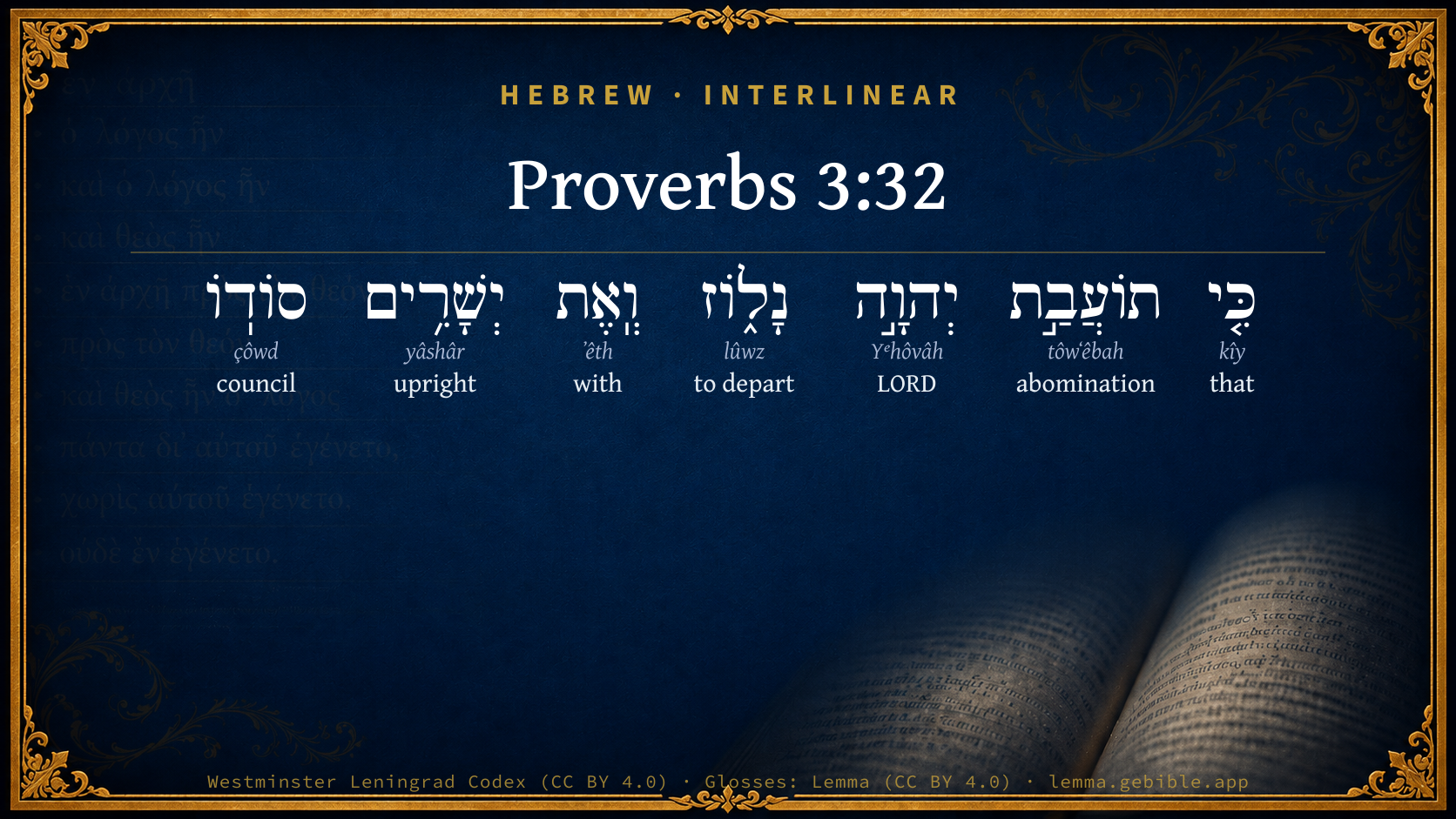
Proverbs 3:32

Hebrew (Westminster Leningrad Codex) Proverbs 3:32 appears in the Hebrew Old Testament. The text above is from the Westminster Leningrad Codex. Each word links to its Strong’s number, a concise gloss, and parsing drawn from the Open Scriptures Hebrew Bible morphology. Click any word for its full Brown-Driver-Briggs (BDB) entry.
Download image
Cite this verse

Proverbs 3:32 (World English Bible). Public Domain. Lemma interlinear Bible study tool, https://lemma.gebible.app/v/proverbs/3/32.

Show BibTeX & RIS
BibTeX
RIS
English Translation
For the perverse is an abomination to Yahweh, But his friendship is with the upright.
World English Bible · Public Domain
Download a study sheet

One document with this verse’s original text, its word-by-word gloss line, the meaning frame, cross-references with their text, attributed commentary, and full source and license credits — printable, and it pastes into notes with its structure intact.

This verse Autodidact and up

Study sheet (.html) Plain text (.txt)

A passage Seminary Student

Up to 50 verses in one chapter. A passage sheet keeps up to 6 commentary sources and 12 cross-references per verse, in the order this page ranks them, and says so on the sheet whenever that leaves anything out. Ask for a single verse and you get the Autodidact verse sheet above.

Everything on this page stays free to read, with no account — the sheet is a download of what is already on screen, not access to it.

Want to remove ads? Support Godless Engineer
Compare translations 3

The same verse in 3 English versions, stacked beneath the original-language interlinear above. Click any original word for its lexicon entry.

Each is an independent rendering of the whole verse — the interlinear is not word-aligned to these translations.

Highlighted words mark where these versions differ — a whole-verse word diff, not a word-by-word alignment.

  • World English Bible Public Domain
    For the perverse is an abomination to Yahweh, But his friendship is with the upright.
  • King James Version Public Domain
    For the froward is abomination to the LORD: but his secret is with the righteous.
  • unfoldingWord Literal Text CC BY-SA 4.0
    For an abomination to Yahweh he who goes astray, but with the upright ones his secret counsel.

unfoldingWord Literal Text — © unfoldingWord, licensed CC BY-SA 4.0. Word-aligned USFM3 via Door43 (git.door43.org/unfoldingWord/en_ult).

Versions to compare (up to 4)

3 of 4 selected

Show all 18 translations

Every available English version of this verse, each an independent rendering of the whole verse.

  • World English Bible Public Domain
    For the perverse is an abomination to Yahweh, But his friendship is with the upright.
  • Berean Standard Bible Public Domain
    for the LORD detests the perverse, but He is a friend to the upright.
  • Majority Standard Bible Public Domain
    for the LORD detests the perverse, but He is a friend to the upright.
  • King James Version Public Domain
    For the froward is abomination to the LORD: but his secret is with the righteous.
  • American Standard Version (1901) Public Domain
    For the perverse is an abomination to Jehovah; But his friendship is with the upright.
  • Revised Version (1885) Public Domain
    For the perverse is an abomination to the LORD: but his secret is with the upright.
  • Geneva Bible (1599) Public Domain
    For the frowarde is abomination vnto the Lord: but his secret is with the righteous.
  • Douay-Rheims (1899) Public Domain
    For every mocker is an abomination to the Lord, and his communication is with the simple.
  • Young's Literal Translation Public Domain
    For an abomination to Jehovah `is' the perverted, And with the upright `is' His secret counsel.
  • Literal Standard Version CC BY-SA 4.0
    For the perverted [is] an abomination to YHWH, || And His secret counsel [is] with the upright.
  • Unlocked Literal Bible CC BY-SA 4.0
    For the devious person is detestable to Yahweh, but he brings the upright person into his confidence.
  • unfoldingWord Literal Text CC BY-SA 4.0
    For an abomination to Yahweh he who goes astray, but with the upright ones his secret counsel.
  • Darby Bible Public Domain
    For the perverse is an abomination to Jehovah; but his secret is with the upright.
  • World Messianic Bible Public Domain
    For the perverse is an abomination to the LORD, but his friendship is with the upright.
  • Webster's Bible Public Domain
    For the froward is abomination to the LORD: but his secret is with the righteous.
  • Free Bible Version CC BY-SA 4.0
    For the Lord hates deceitful people, but he is a friend to those who do what is good.
  • Bible in Basic English Public Domain
    For the wrong-hearted man is hated by the Lord, but he is a friend to the upright.
  • JPS Tanakh (1917) Public Domain
    For the perverse is an abomination to the LORD; but His counsel is with the upright.

Literal Standard Version (2020), Covenant Press — licensed CC BY-SA 4.0. Text via the HelloAO Bible API (eBible.org). Unlocked Literal Bible (unfoldingWord) — licensed CC BY-SA 4.0. Text via the HelloAO Bible API (eBible.org). unfoldingWord Literal Text — © unfoldingWord, licensed CC BY-SA 4.0. Word-aligned USFM3 via Door43 (git.door43.org/unfoldingWord/en_ult). Free Bible Version, Dr. Jonathan Gallagher — licensed CC BY-SA 4.0. Text via the HelloAO Bible API (eBible.org).

Word by word

More ways to search: Search by grammar → Find every occurrence → Compare this word →

Practice this passage: Drill this verse → Learn its vocabulary →

About this verse

These counts appear in no published source. They are computed here, from the morphology-tagged text and Lemma’s own curated glosses. What Lemma adds →

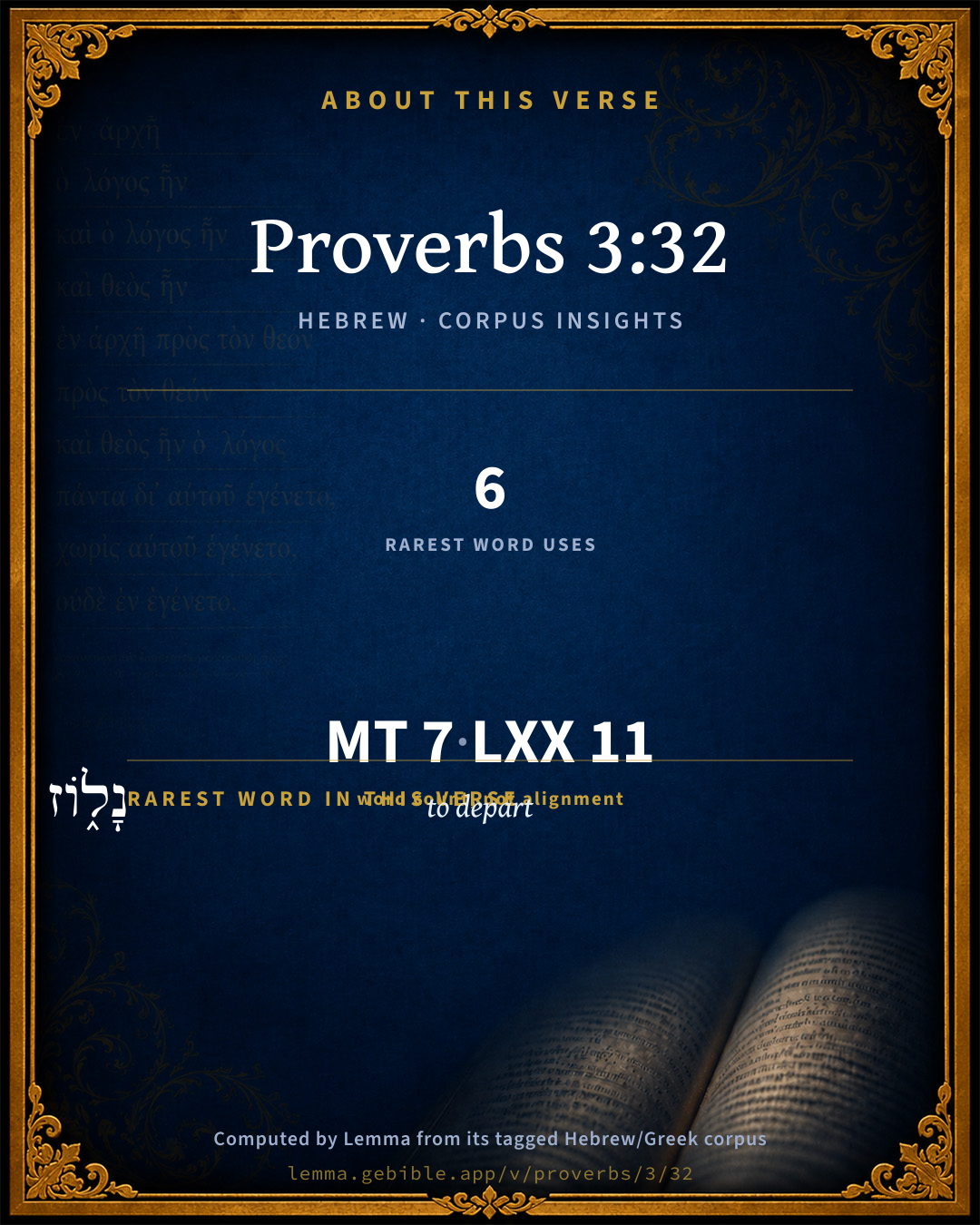
7
words
7
distinct lemmas
Wisdom
section

Notable vocabulary

The rarest word here is נָל֑וֹז to depart H3868 — appearing just 6 times in the whole Hebrew Bible.

Shared distinctive vocabulary

נָל֑וֹז to depart H3868 occurs in 6 verses of the Hebrew Bible. Also found in:

Grammatical profile

  • 1 verb
  • 3 nouns
  • 1 adjective
  • 1 preposition
  • 1 conjunction

Verb forms

  • נָל֑וֹז Niphal · Participle Active

Hebrew & Septuagint length

In English translation the verse runs 15 words from the Hebrew and 15 from the Septuagint (LXX English) — the same length.

A rough comparison of the two English renderings, which tokenize alike — not a word-level alignment.

Word counts can differ between the Hebrew and the Greek without any difference in meaning — e.g. the Hebrew direct-object marker אֵת has no separate Greek word, and Greek often adds the article ὁ.

In the original languages it is 7 Hebrew tokens and 11 Greek tokens — but the two are counted differently (Hebrew bundles its prefixes and suffixes into one token; the Greek is in lemma form), so that isn’t a like-for-like length.

Cross-references

14

Topical passages linked to Proverbs 3:32 in the Treasury of Scripture Knowledge — connected by theme and wording, ordered by reader-vote popularity; previews shown in the World English Bible.

  • Psalms 25:14 The friendship of Yahweh is with those who fear him. He will show them his covenant.
  • Proverbs 11:20 Those who are perverse in heart are an abomination to Yahweh, But those whose ways are blameless are his delight.
  • John 15:15 No longer do I call you servants, for the servant doesn't know what his lord does. But I have called you friends, for everything that I heard from my Father, I have made known to you.
  • Proverbs 17:15 He who justifies the wicked, and he who condemns the righteous, Both of them alike are an abomination to Yahweh.
  • Proverbs 8:13 The fear of Yahweh is to hate evil. I hate pride, arrogance, the evil way, and the perverse mouth.
  • Matthew 13:11 He answered them, "To you it is given to know the mysteries of the Kingdom of Heaven, but it is not given to them.
  • John 14:21–24 One who has my commandments, and keeps them, that person is one who loves me. One who loves me will be loved by my Father, and I will love him, and will reveal myself to him."
  • Psalms 18:26 With the pure, you will show yourself pure. With the crooked you will show yourself shrewd.
  • Job 29:4 As I was in the ripeness of my days, When the friendship of God was in my tent;
  • Matthew 11:25 At that time, Jesus answered, "I thank you, Father, Lord of heaven and earth, that you hid these things from the wise and understanding, and revealed them to infants.
  • Proverbs 6:6–19 Go to the ant, you sluggard. Consider her ways, and be wise;
  • Luke 16:15 He said to them, "You are those who justify yourselves in the sight of men, but God knows your hearts. For that which is exalted among men is an abomination in the sight of God.
  • Revelation 2:17 He who has an ear, let him hear what the Spirit says to the assemblies. To him who overcomes, to him I will give of the hidden manna, and I will give him a white stone, and on the stone a new name written, which no one knows but he who receives it.
  • Proverbs 14:10 The heart knows its own bitterness and joy; He will not share these with a stranger.

Cross-references courtesy of OpenBible.info (CC BY 4.0).

Hebrew and Greek witnesses Masoretic Hebrew ↔ Greek Septuagint

The same verse in the two great witnesses to the Old Testament, shown verse-for-verse.

These are two independent witnesses, not word-aligned to each other, and the Septuagint is shown in lemma (dictionary) form.

Hebrew Proverbs 3:32 Masoretic · Westminster Leningrad Codex

כִּ֤י תוֹעֲבַ֣ת יְהוָ֣ה נָל֑וֹז וְֽאֶת יְשָׁרִ֥ים סוֹדֽוֹ

For the perverse is an abomination to Yahweh, But his friendship is with the upright.

World English Bible · Public Domain

Greek LXX Proverbs 3:32 Septuagint · lemma form

ἀκάθαρτος γάρ ἔναντι κύριος πᾶς παράνομος ἐν δέ δίκαιος οὐ συνεδριάζω

For every transgressor is unclean before the Lord; neither does he sit among the righteous.

LXX2012 (modern English Septuagint) · Public Domain

On this verse, The Pulpit Commentary discusses the Septuagint’s reading. Read the note in Commentary ↓

Hebrew: Westminster Leningrad Codex (CC BY 4.0). Greek: Septuagint (public domain); English from LXX2012 (modern English Septuagint) (Public Domain). How the Septuagint differs from the Hebrew →

Commentary

Notes on Proverbs 3:32 from classic Christian and Jewish commentators (each source and its license shown beneath its notes). The classic Christian expositions comment on the surrounding passage and are grouped to its opening verse, so a note may address several verses; the Jewish commentaries on the Tanakh (Rashi and others) are per-verse, so they appear only where the commentator wrote on this verse.

Lemma curates 59 commentaries, every one of them public domain or Creative Commons licensed, each selected and text-cleaned for this edition rather than reprinted as found. About our sources →

Trapp's Complete Commentary

John Trapp

Pro 3:32 For the froward [is] abomination to the LORD: but his secret [is] with the righteous.

Ver. 32. For the froward is abomination.] The vitilitigator, the wrangler, the common barreter, though he may prosper in the world, yet God cannot abide him; his money will perish with him. He will one day say to his cursed heaps of evil gotten goods, as Charles the Fifth, emperor, in his old age did of his victories, trophies, riches, honours; he cursed them all, saying, Abite hinc, abite longe; Avaunt, be packing, hence, away. {a}

But his secret.] They shall be of his cabinet council, that choose rather to lie in the dust than to rise by evil arts, by wicked principles; such were Joseph, Macaiah, Daniel, &c.

{a} Phil. Morn.

John Trapp, A Commentary or Exposition upon All the Books of the Old and New Testament (1647–1656) — public domain. Text from a community e-Sword module.

Geneva Bible (1599)

Geneva Bible translators

That is, his covenant and fatherly affection which is hid and secret from the world.

Geneva Bible (1599) marginal notes — public domain. Text via Bolls.life.

Jamieson, Fausset & Brown

Robert Jamieson, A. R. Fausset & David Brown

Reasons for the warning.

froward-- (Pro 2:15).

secret . . . righteous--in their communion (Amo 3:7).

Jamieson, Fausset & Brown — Commentary Critical and Explanatory on the Whole Bible (1871) — public domain (CC PDM 1.0). Text via the HelloAO Bible API.

Adam Clarke's Commentary

Verse 32. But his secret] סודו sodo, his secret assembly; godly people meet there, and God dwells there.

Adam Clarke's Commentary on the Bible (1810–1826) — public domain. Text from a community e-Sword/MySword module.

Ellicott's Commentary for English Readers

(32) His secret is with the righteous—i.e., He holds confidential intercourse with them. (Comp. Psa_25:14, and the reward of love and obedience to Christ, that both Father and Son will “come” unto the believer, and “make their abode with him,” through the indwelling Spirit, Joh_14:23.)

A Bible Commentary for English Readers, edited by Charles John Ellicott (1878–1897) — public domain. Text from a community e-Sword module.

The Cambridge Bible for Schools and Colleges

gen. ed. J. J. S. Perowne

32. his secret] i.e., as R.V. margin explains, his counsel (Gen_18:17), or his friendship (Exo_33:11). Comp. Psa_25:14 (and note there in this Series); Joh_15:15.

The Cambridge Bible for Schools and Colleges (gen. ed. J. J. S. Perowne; Cambridge University Press, 1878–1918) — public domain. Text from a community e-Sword module.

John Gill's Exposition

For the froward is abomination to the Lord,.... The perverse man, that pleases not God, and is contrary to all men, as the Jews were; one froward in his words and actions: "who transgresses the law", as the Arabic version renders it; one that acts contrary to the nature, will, and word of God; and such an one is not only abominable in his sight, but an "abomination" itself; it is sin, which is that abominable thing that God hates, that makes him so: and the Targum is,

"for iniquity is abominable before the Lord;''

but his secret is with the righteous: not such who are outwardly so to others, or trust in themselves that they are righteous, or seek for righteousness by their own works; but such who are justified by the righteousness of Christ, which faith receives from him, and in consequence of which a man lives soberly and righteously: with these the "secret" of the Lord is; of his love, grace, and favour, which was from everlasting, and is manifested in regeneration; of his purposes of grace, with respect to election, redemption, calling, and adoption, which is made known in effectual calling; of his covenant, as that he is their covenant God, Christ is their covenant head and Mediator, and that they have an interest in all the grace, blessings, and promises of it; of the Gospel, and the several mysteries of it, which are so to carnal men; of his providences, what he is doing, or what he is about to do, and will do hereafter, Amo 3:7; and of communion and fellowship with him. The phrase denotes friendship and familiarity; God deals with the righteous as a man does with his intimate friend, converses freely with him, and discloses his secrets to him: and the word is rendered "confabulation" by the Targum, Syriac, and Vulgate Latin versions; see Job 29:4.

John Gill's Exposition of the Whole Bible (1746–1763) — public domain (CC PDM 1.0). Text via the HelloAO Bible API.

Matthew Poole's English Annotations

The froward; or, perverse, who walketh in crooked or sinful paths, as the oppressor last mentioned; opposed to the upright man, who is called right or straight, as Deu 32:4; Pro 29:27. Is abomination to the Lord; God hates him, and therefore sooner or later he must needs be extremely and eternally miserable.

His secret is with the righteous; they are God’s friends and favourites, to whom he familiarly imparts, as men use to do to their friends, his mind and counsels, or his secret favours and comforts, to which other men are strangers. Compare Psa 25:14; Joh 15:15; Rev 2:17.

Matthew Poole's English Annotations on the Holy Bible (1683–1685) — public domain. Text from a community e-Sword/MySword module.

Whedon's Commentary on the Bible

Daniel D. Whedon

32. For the froward — The perverse; those departing from the principles of justice.

But his secret — Secret or confidential intercourse or communion, as that of friend with friend. The wicked he loathes, the upright he loves. See Job_19:19; Psa_55:14; Psa_25:14, where the same word occurs, rendered in the first inward, intimate, or confidential friends, in the latter, counsel or intercourse. The word suggests that communion and interchange of thought which takes place only between intimate and confidential friends. The parallelism here is between נלוז, naloz, the curved or bent. rendered froward, and ישׁרים, yesharim, those that are straight, upright, or righteous.

Daniel D. Whedon (gen. ed.), Commentary on the Old and New Testaments (1874–1909) — public domain. Text from a community e-Sword module.

The Pulpit Commentary

This verse gives the reason for the previous warning. The oppressor is here included under the more general term, "the froward." The froward; naloz, hiph. participle from luz, "to bend aside," and hence a perverted or wicked man, one who turns aside from the way of uprightness, a transgressor of the Law (cf. LXX, paranomov ); and so the opposite of "the righteous," y"sharim, "the upright," those who pursue the path of justness, or the straightforward. Abomination (toevah); i.e. an abhorrence, something which, being impure and unclean (cf. LXX, akayartov ), is especially abhorrent to Jehovah. In some passages it is connected with idolatry, as in 1Ki_14:24 and 2Ki_23:13, but is never used in this sense in the Proverbs, where it occurs about twenty times. (see Pro_28:9 Pro_21:27 Pro_11:1, Pro_11:20, etc.) The passage shows that prosperity and worldly success are not always a true measure of Divine favour. His secret (sodo); Vulgate, sermocinatio. Here sod probably means "familiar intercourse," as in Job_29:4 and Psa_25:14; and hence the special favour with which Jehovah regards the upright, by revealing to them what he conceals item others, or his friendship. (compare what our Lord says in Joh_15:14, Joh_15:15) Dathe translates "probis vero est familiaris." Gesenius says sod properly means "a couch," or triclinium on which people recline; but Delitzsch derives it from the root sod, "to be firm," "compressed," and states that it therefore means properly "a being together, or sitting together." The LXX continues the "froward man" (paranomov ) as the subject, and renders, "Every transgressor is impure before God, and does not sit together with (ou sunedriazei ) the just.

Vers. 32-35. The discernment of Jehovah.

This is a leading thought of the Old Testament. In ordinary life, in civilized times, the character of individuals is concealed from us by the intermixtures of society and the complexity of its interests. Even in village life it is difficult to classify people; but God distinguishes in

I HIS VIEW OF INDIVIDUAL CHARACTER.

1. He abominates the perverse, the crooked, twisted, deceitful character. All in the spirit must be compared with that ideal geometrical rectitude of form, so to speak, which is the truth of his Being.

2. With the upright he "maintains good friendship" (ver. 32), or "is in secret alliance". (Job_29:4 Psa_25:14) To enjoy the friendship of discerning minds, what greater privilege can there be? To live on such terms with God is the privilege of the true soul.

II HIS PROVIDENTIAL ADMINISTRATION. "His curse dwells in the house of the wicked." A fatality of evil clings to him and his. But Jehovah blesses the tent of the righteous. He scoffs at the scoffer, but gives to the lowly grace. (comp. Jam_4:6 1Pe_5:5) The wise under this administration inherit glory, while ignominy carries away the fools.

1. These are, in the mode of their presentation, generalized or abstract truths, and as such must be understood. The study of apparent exceptions, even the admission of them, is foreign to this phase of Oriental thought. It was the presence of exceptions, insoluble to ancient thought, which excited the doubt and grief of Job and some of the psalmists.

2. While the truth must be stated, from the exigencies of language, in this sharp polar antithesis, actual human character is found, with all its merits and shades, in the intermediate region.

3. The subtle intermixtures of good and evil in human character, recognized by modern thought, defy complete analysis. We must suspend our judgment in particular cases, leaving all to him who brings to light the hidden things of darkness; conscious that there must be great "reversals of human judgment" upon the character of man (see Mozley"s sermon on this subject). J.

The Pulpit Commentary (1880–1919), ed. H.D.M. Spence-Jones & Joseph S. Exell — public domain. Text from a community e-Sword module.

John Wesley's Explanatory Notes

Abomination - Therefore sooner or later he must be miserable. The righteous - They are God's friends, to whom he imparts the favours and comforts to which other men are strangers.

John Wesley, Explanatory Notes Upon the Whole Bible (1754–1765) — public domain. Text via the GEBible commentary corpus.

Rashi

Rabbi Shlomo Yitzchaki (Rashi)

for the perverse is an abomination to the Lord One who is crooked in his ways.

but His counsel is with the upright Heb. ואת, and with, etc.

Rashi on the Tanakh — English translations: “The Judaica Press complete Tanach with Rashi, translated by A. J. Rosenberg” (CC BY 4.0); “Pentateuch with Rashi's commentary by M. Rosenbaum and A.M. Silbermann, 1929-1934” (public domain); “The Metsudah Tanach series, Lakewood, N.J” (CC BY 4.0); and “The Book of Joshua, Metsudah Publications, 1997” (CC BY 4.0). Text via Sefaria.

Lesson kit

Teaching starters — assembled from the data on this page, not authored interpretation. Every prompt links to the verse data it draws on. Edit before teaching.

Proverbs, in the Wisdom, opens this verse with 7 words (7 distinct Hebrew lemmas). Its most distinctive word is lûwz (“to depart”). A historical commentator’s framing appears above. Read the whole chapter for the surrounding context.

Discussion questions

  1. How does “to depart” (lûwz) shape what this verse is saying?
  2. How does Proverbs 2:15, which shares the word «to depart», read alongside this verse?
  3. These translations render this verse differently; the difference is in the English rendering, not the original. What questions does that raise?
  4. «נָל֑וֹז» is a Niphal Participle Active verb. How does that grammatical form shape the action described?
  5. Compare how Trapp's Complete Commentary and Geneva Bible (1599) read this verse. Where do they agree or differ?

Things to notice

Reading settings

Reading text

Shown beneath each verse's original-language words.

Old Testament
Old Testament edition

Read the OT as the Masoretic Hebrew (MT) or the Greek Septuagint (LXX).

English shown for the Greek Septuagint (in the Hebrew ↔ Greek comparison).

Comparing translations? Open the Compare panel on any verse page to stack up to four side by side.