
Psalms 119:137

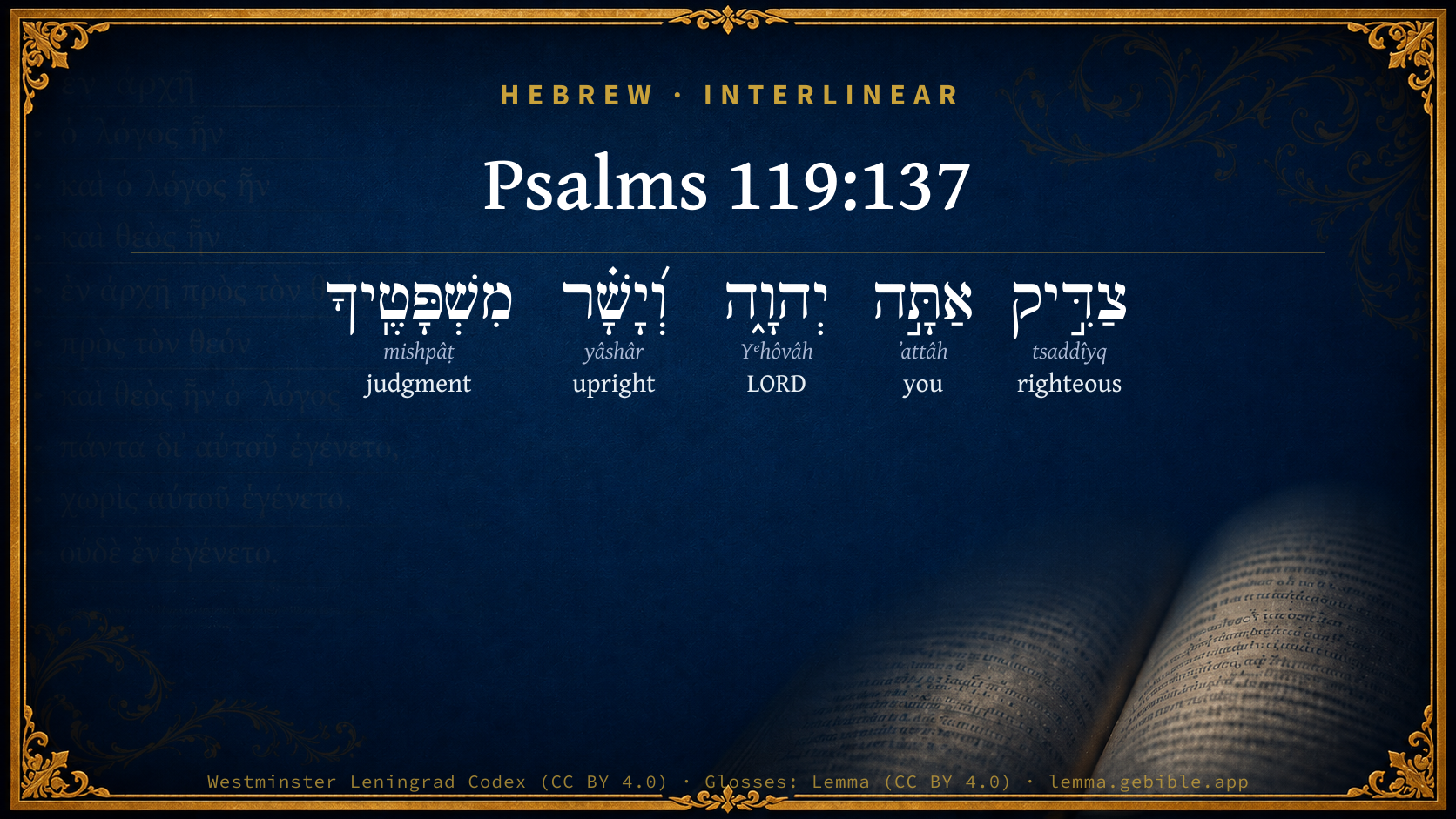
Hebrew (Westminster Leningrad Codex) Psalms 119:137 appears in the Hebrew Old Testament. The text above is from the Westminster Leningrad Codex. Each word links to its Strong’s number, a concise gloss, and parsing drawn from the Open Scriptures Hebrew Bible morphology. Click any word for its full Brown-Driver-Briggs (BDB) entry.
Download image
Cite this verse

Psalms 119:137 (World English Bible). Public Domain. Lemma interlinear Bible study tool, https://lemma.gebible.app/v/psalms/119/137.

Show BibTeX & RIS
BibTeX
RIS
English Translation
You are righteous, Yahweh. Your judgments are upright.
World English Bible · Public Domain
Download a study sheet

One document with this verse’s original text, its word-by-word gloss line, the meaning frame, cross-references with their text, attributed commentary, and full source and license credits — printable, and it pastes into notes with its structure intact.

This verse Autodidact and up

Study sheet (.html) Plain text (.txt)

A passage Seminary Student

Up to 50 verses in one chapter. A passage sheet keeps up to 6 commentary sources and 12 cross-references per verse, in the order this page ranks them, and says so on the sheet whenever that leaves anything out. Ask for a single verse and you get the Autodidact verse sheet above.

Everything on this page stays free to read, with no account — the sheet is a download of what is already on screen, not access to it.

Want to remove ads? Support Godless Engineer
Compare translations 3

The same verse in 3 English versions, stacked beneath the original-language interlinear above. Click any original word for its lexicon entry.

Each is an independent rendering of the whole verse — the interlinear is not word-aligned to these translations.

Highlighted words mark where these versions differ — a whole-verse word diff, not a word-by-word alignment.

  • World English Bible Public Domain
    You are righteous, Yahweh. Your judgments are upright.
  • King James Version Public Domain
    Righteous art thou, O LORD, and upright are thy judgments.
  • unfoldingWord Literal Text CC BY-SA 4.0
    Righteous you, Yahweh, and upright your judgments.

unfoldingWord Literal Text — © unfoldingWord, licensed CC BY-SA 4.0. Word-aligned USFM3 via Door43 (git.door43.org/unfoldingWord/en_ult).

Versions to compare (up to 4)

3 of 4 selected

Show all 17 translations

Every available English version of this verse, each an independent rendering of the whole verse.

  • World English Bible Public Domain
    You are righteous, Yahweh. Your judgments are upright.
  • Berean Standard Bible Public Domain
    Righteous are You, O LORD, and upright are Your judgments.
  • Majority Standard Bible Public Domain
    Righteous are You, O LORD, and upright are Your judgments.
  • King James Version Public Domain
    Righteous art thou, O LORD, and upright are thy judgments.
  • American Standard Version (1901) Public Domain
    TSADHE. Righteous art thou, O Jehovah, And upright are thy judgments.
  • Revised Version (1885) Public Domain
    Righteous art thou, O LORD, and upright are thy judgments.
  • Geneva Bible (1599) Public Domain
    TSADDI. Righteous art thou, O Lord, and iust are thy iudgements.
  • Young's Literal Translation Public Domain
    `Tzade.' Righteous `art' Thou, O Jehovah, And upright `are' Thy judgments.
  • Literal Standard Version CC BY-SA 4.0
    [TSADE] You [are] righteous, O YHWH, || And Your judgments [are] upright.
  • Unlocked Literal Bible CC BY-SA 4.0
    You are righteous, Yahweh, and your decrees are fair.
  • unfoldingWord Literal Text CC BY-SA 4.0
    Righteous you, Yahweh, and upright your judgments.
  • Darby Bible Public Domain
    TZADE. Righteous art thou, Jehovah, and upright are thy judgments.
  • World Messianic Bible Public Domain
    You are righteous, LORD. Your judgments are upright.
  • Webster's Bible Public Domain
    TSADDI. Righteous art thou, O LORD, and upright are thy judgments.
  • Free Bible Version CC BY-SA 4.0
    Lord, you are right, and what you decide is just!
  • Bible in Basic English Public Domain
    TZADE O Lord, great is your righteousness, and upright are your decisions.
  • JPS Tanakh (1917) Public Domain
    TZADE. Righteous art Thou, O LORD, and upright are Thy judgments.

Literal Standard Version (2020), Covenant Press — licensed CC BY-SA 4.0. Text via the HelloAO Bible API (eBible.org). Unlocked Literal Bible (unfoldingWord) — licensed CC BY-SA 4.0. Text via the HelloAO Bible API (eBible.org). unfoldingWord Literal Text — © unfoldingWord, licensed CC BY-SA 4.0. Word-aligned USFM3 via Door43 (git.door43.org/unfoldingWord/en_ult). Free Bible Version, Dr. Jonathan Gallagher — licensed CC BY-SA 4.0. Text via the HelloAO Bible API (eBible.org).

Word by word

More ways to search: Search by grammar → Find every occurrence → Compare this word →

Practice this passage: Drill this verse → Learn its vocabulary →

וְ֝יָשָׁ֗ר
yâshâr
H3477
“and · upright”
Conjunction + Adjective, Adjective, Masculine, Singular, Absolute
Part of Speech
Conjunction + Adjective
Type
Adjective
Gender
Masculine
Number
Singular
State
Absolute
Full BDB Definition

Origin: from H3474

TWOT: 930a

straight, upright, correct, right - straight, level - right, pleasing, correct - straightforward, just, upright, fitting, proper - uprightness, righteous, upright - that which is upright (substantive)
  1. צַדִּ֣יק tsaddîyq H6662 “righteous” Adjective, Adjective, Masculine, Singular, Absolute
  2. אַתָּ֣ה ʼattâh H859 “you” Pronoun, Personal, 2nd Person, Masculine, Singular
  3. יְהוָ֑ה Yᵉhôvâh H3068 “LORD” Noun, Proper
  4. מִשְׁפָּטֶֽיךָ mishpâṭ H4941 “judgments · your” Noun, Common, Masculine, Plural, Construct + Suffix, Personal, 2nd Person, Masculine, Singular

About this verse

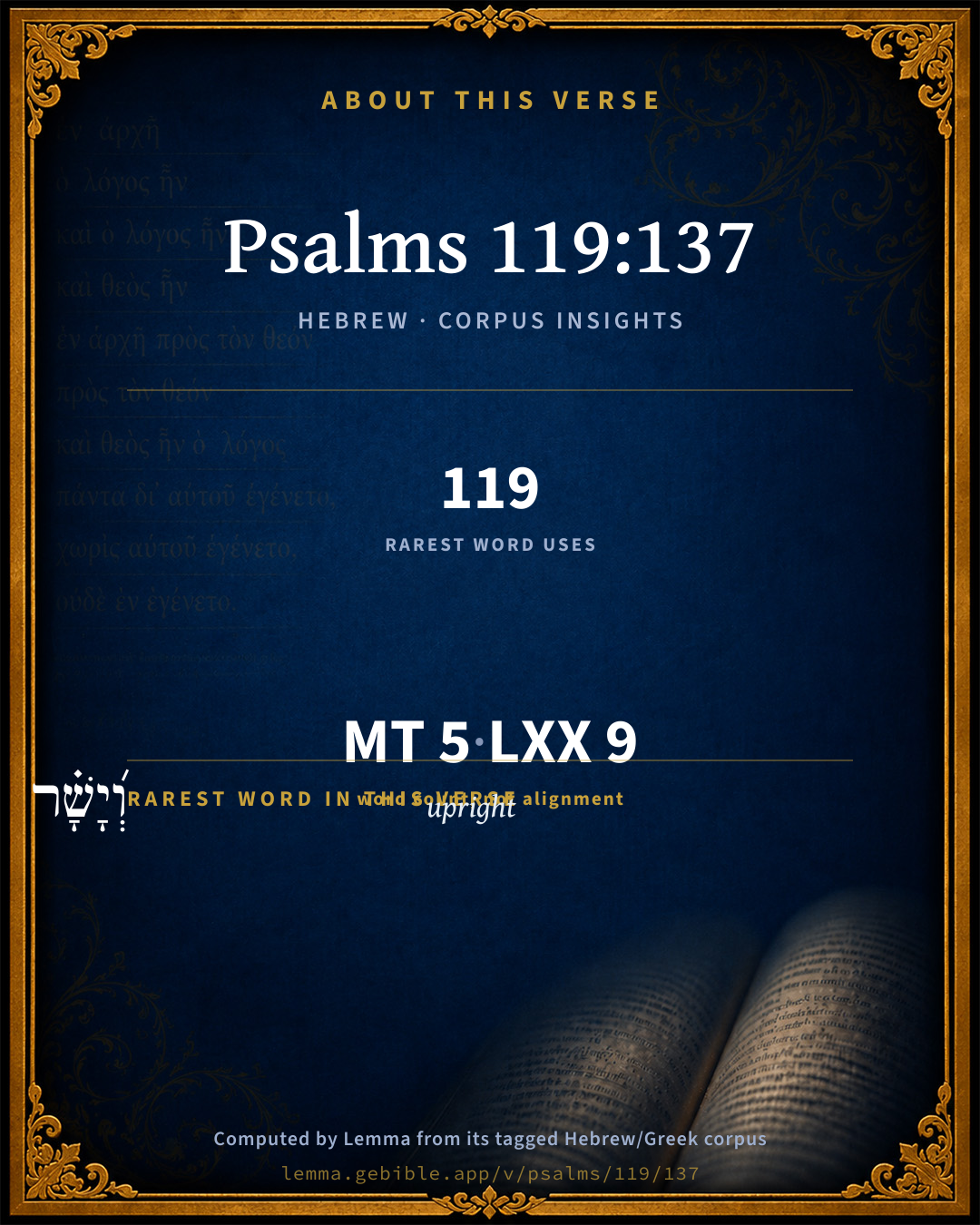
These counts appear in no published source. They are computed here, from the morphology-tagged text and Lemma’s own curated glosses. What Lemma adds →

5
words
5
distinct lemmas
Wisdom
section

Grammatical profile

  • 2 nouns
  • 2 adjectives
  • 1 pronoun

Hebrew & Septuagint length

In English translation the verse runs 8 words from the Hebrew and 10 from the Septuagint (LXX English) — closely comparable.

A rough comparison of the two English renderings, which tokenize alike — not a word-level alignment.

Word counts can differ between the Hebrew and the Greek without any difference in meaning — e.g. the Hebrew direct-object marker אֵת has no separate Greek word, and Greek often adds the article ὁ.

In the original languages it is 5 Hebrew tokens and 9 Greek tokens — but the two are counted differently (Hebrew bundles its prefixes and suffixes into one token; the Greek is in lemma form), so that isn’t a like-for-like length.

Cross-references

15

Topical passages linked to Psalms 119:137 in the Treasury of Scripture Knowledge — connected by theme and wording, ordered by reader-vote popularity; previews shown in the World English Bible.

  • Ezra 9:15 Yahweh, the God of Israel, you are righteous; for we are left a remnant that is escaped, as it is this day: behold, we are before you in our guiltiness; for none can stand before you because of this.
  • Jeremiah 12:1 Righteous are you, Yahweh, when I contend with you; yet would I reason the cause with you: why does the way of the wicked prosper? why are all they at ease who deal very treacherously?
  • Psalms 145:17 Yahweh is righteous in all his ways, And gracious in all his works.
  • Daniel 9:7 Lord, righteousness belongs to you, but to us confusion of face, as at this day; to the men of Judah, and to the inhabitants of Jerusalem, and to all Israel, who are near, and who are far off, through all the countries where you have driven them, because of their trespass that they have trespassed against you.
  • Deuteronomy 32:4 The Rock, his work is perfect; For all his ways are justice: A God of faithfulness and without iniquity, Just and right is he.
  • Nehemiah 9:33 However you are just in all that is come on us; for you have dealt truly, but we have done wickedly;
  • Psalms 99:4 The King's strength also loves justice. You do establish equity. You execute justice and righteousness in Jacob.
  • Psalms 103:6 Yahweh executes righteous acts, And justice for all who are oppressed.
  • Daniel 9:14 Therefore has Yahweh watched over the evil, and brought it on us; for Yahweh our God is righteous in all his works which he does, and we have not obeyed his voice.
  • Revelation 16:7 I heard the altar saying, "Yes, Lord God, the Almighty, true and righteous are your judgments."
  • Romans 2:5 But according to your hardness and unrepentant heart you are treasuring up for yourself wrath in the day of wrath, revelation, and of the righteous judgment of God;
  • Romans 3:5–6 But if our unrighteousness commends the righteousness of God, what will we say? Is God unrighteous who inflicts wrath? I speak like men do.
  • Revelation 15:3–4 They sang the song of Moses, the servant of God, and the song of the Lamb, saying, "Great and marvelous are your works, Lord God, the Almighty; Righteous and true are your ways, you King of the nations.
  • Revelation 19:2 for true and righteous are his judgments. For he has judged the great prostitute, who corrupted the earth with her sexual immorality, and he has avenged the blood of his servants at her hand."
  • Romans 9:14 What shall we say then? Is there unrighteousness with God? May it never be!

Cross-references courtesy of OpenBible.info (CC BY 4.0).

Hebrew and Greek witnesses Masoretic Hebrew ↔ Greek Septuagint

The same verse in the two great witnesses to the Old Testament, shown verse-for-verse.

You’re reading Greek Psalm 118 (Hebrew Psalm 119). The Septuagint counts the superscription, so verse numbers can differ from the Hebrew — chapter-level alignment, not verse-by-verse. Numbering follows Rahlfs.

These are two independent witnesses, not word-aligned to each other, and the Septuagint is shown in lemma (dictionary) form.

Hebrew Psalms 119:137 Masoretic · Westminster Leningrad Codex

צַדִּ֣יק אַתָּ֣ה יְהוָ֑ה וְ֝יָשָׁ֗ר מִשְׁפָּטֶֽיךָ

You are righteous, Yahweh. Your judgments are upright.

World English Bible · Public Domain

Greek LXX Greek Psalm 118:137 Septuagint · lemma form

σαδη δίκαιος εἰμί κύριος καί εὐθής ὁ κρίσις σύ

Righteous are you, O Lord, and upright are your judgments.

LXX2012 (modern English Septuagint) · Public Domain

On this verse, Keil & Delitzsch discusses the Septuagint’s reading. Read the note in Commentary ↓

Hebrew: Westminster Leningrad Codex (CC BY 4.0). Greek: Septuagint (public domain); English from LXX2012 (modern English Septuagint) (Public Domain). How the Septuagint differs from the Hebrew →

Commentary

Notes on Psalms 119:137 from classic Christian and Jewish commentators (each source and its license shown beneath its notes). The classic Christian expositions comment on the surrounding passage and are grouped to its opening verse, so a note may address several verses; the Jewish commentaries on the Tanakh (Rashi and others) are per-verse, so they appear only where the commentator wrote on this verse.

Lemma curates 59 commentaries, every one of them public domain or Creative Commons licensed, each selected and text-cleaned for this edition rather than reprinted as found. About our sources →

Trapp's Complete Commentary

John Trapp

Psa 119:137 TZADDI. Righteous [art] thou, O LORD, and upright [are] thy judgments.

Ver. 137. Righteous art thou, O Lord] Essentially and efficiently.

And upright are thy judgments] Which are sometimes secret, but always just, as the Emperor Mauricius also acknowledged, when his wife and children were slain before his eyes by the traitor Phocas.

John Trapp, A Commentary or Exposition upon All the Books of the Old and New Testament (1647–1656) — public domain. Text from a community e-Sword module.

The Biblical Illustrator

Joseph S. Exell

Psa_119:137-144

Righteous art Thou, O Lord, and upright are Thy judgments.

The testimony of a tried saint

I. His testimony concerning God.

1. Concerning the Divine character (verses 137,142).

(1) Gods righteousness has no standard but Himself What He does is right, not because it conforms to anything outside Himself, but because it conforms to His nature.

(2) Gods righteousness agrees with the moral constitution of the universe. Universal conscience agrees with it. Just and right are Thy ways.

2. Concerning His Word.

(1) Faithful. His Word is truth.

(2) Pure as the purest gold, free from all dross, pure as the purest sunbeam, absolutely free from all erroneous thoughts, from all unholy sentiments and passions.

II. His testimony concerning himself.

1. Zeal for the Divine (verse 139). How few can say they are zealous for the right, person! When he saw the utter forgetfulness of his contemporaries of God, his heart glowed with zeal for the Divine glory.

2. Love for the purity of truth (verse 140). Some may love the truth on account of the beautiful form in which it is presented, the power of its suggestiveness and the sublimity of its speculations. But this man loved it for the sake of its purity.

3. Consciousness of self-insignificance (verse 141). How insignificant is the greatest man in comparison with God--His character and manifestations!

4. Joy in suffering (verse 143). His interest in the Divine Word bore him up and made him happy even under suffering.

5. A desire for further knowledge. More light is what he wanted. (Homilist.)

The Biblical Illustrator, edited by Joseph S. Exell (c. 1880s–1900s) — public domain. Text from a community e-Sword module.

The Treasury of David

Charles H. Spurgeon

Ver. 137. Righteous art thou, O LORD. The Psalmist has not often used the name of Jehovah in this vast composition. The whole psalm shows him to have been a deeply religious man, thoroughly familiar with the things of God; and such persons never use the holy name of God carelessly, nor do they even use it at all frequently in comparison with the thoughtless and the ungodly. Familiarity begets reverence in this case. Here he uses the sacred name in worship. He praises God by ascribing to him perfect righteousness. God is always right, and he is always actively light, that is, righteous. This quality is bound up in our very idea of God. We cannot imagine an unrighteous God.

And upright are thy judgments. Here he extols God's word, or recorded judgments, as being right, even as their Author is righteous. That which conics from the Righteous God is itself righteous. Jehovah both saith and doth that which is right, and that alone. This is a great stay to the soul in time of trouble. When we are most sorely afflicted, and cannot see the reason for the dispensation, we may fall back upon this most sure and certain fact, that God is righteous, and his dealings with us are righteous too. It should be our glory to sing this brave confession when all things around us appear to suggest the contrary. This is the richest adoration this which rises from the lips of faith when carnal reason mutters about undue severity, and the like.

S. Jerome, whom most of the medievalists follow, explains Tsaddi as meaning justice or righteousness, which, however, is mru, tsedek But he is so far right that there is a play in this strophe on the sound of the initial letter, as in the case of Gemol;for the very first word, righteous, is mru, tsaddik, and the whole scope of the strophe is the strong grasp which even the young and inexperienced soul can have of righteousness amidst the troubles of the world. Neale and Littledale.

All these verses begin with Tzaddi, the eighteenth letter of the Hebrew alphabet; Ps 119:137, 142, 144, with some form of the word which we render righteous, or righteousness; each of the remainder with a wholly different word. William S. Plumer.

Ver. 137. Righteous art thou, O LORD, etc. Here David, sore troubled with grief for the wickedness of his enemies, yea, tempted greatly to impatience and distrust, by looking to their prosperous estate, notwithstanding their so gross impiety, doth now show unto us a three fold ground of comfort, which in this dangerous temptation upheld him. The first is, a consideration of that which God is in himself; namely, just and righteous: the second, a consideration of the equity of his word; the third, a view of his constant truth, declared in his working and doing according to his word. When we find ourselves tempted to distrust by looking to the prosperity of the wicked, let us look up to God, and consider his nature, his word, his works, and we shall find comfort.

Righteous art thou. This is the first ground of comfort a meditation of the righteousness of God's nature; he alters not with times, he changes not with persons, he is, alway and unto all, one and the same righteous and holy God. Righteousness is essential to him, it is himself; and he can no more defraud the godly of their promised comforts, not let the wicked go unpunished in their sins, than he can deny himself to be God, which is impossible. William Cowper.

Ver. 137. Righteous art thou, O LORD, etc. Essentially, originally, and of himself; naturally, immutably and universally, in all his ways and works of nature and grace; in his thoughts, purposes, counsels, and decrees; in all the dispensations of his providence; in redemption, in the justification of a sinner, in the pardon of sin, and in the gift of eternal life through Christ. "And upright are thy judgments." They are according to the rules of justice and equity. He refers to the precepts of the word, the doctrines of the gospel, as well as the judgments of God inflicted on wicked men, and all the providential dealings of God with his people, and also the final judgment. John Gill.

Ver. 137. Righteous art thou, O LORD, etc. Here is much to keep the children of God in awe. The Lord is a righteous God: though they have found mercy and taken sanctuary in his grace, the Lord is impartial in his justice. God that did not spare the angels when they sinned, nor his Son when he was a sinner by imputation, will not spare you, though you are the dearly beloved of his soul: Pro 11:31. The sinful courses of God's children occasion bitterness enough; they never venture upon sin, but with great Joss. If Paul give way to a little pride, God will humble him. If any give way to sin, their pilgrimage will be made uncomfortable. Eli falls into negligence and indulgence, then is the ark of God taken, his two sons are slain in battle, his daughter-in-law dies, he himself breaks his neck. Oh! the wonderful tragedies that sin works in the houses of the children of God! David, when he intermeddled with forbidden fruit, was driven from his palace, his concubines defiled, his own son slain; a great many calamities did light upon him. Therefore the children of God have cause to fear; for the Lord is a just God, and they will find it so. Here upon earth he hath reserved liberty to visit their iniquity with rods, and their transgression with scourges. I must press you to imitate God's righteousness: "If ye know that he is righteous, ye know that every one that doeth righteousness is born of him": 1Jo 2:29. You have a righteous God; and this part of his character you should copy out. Thomas Manton.

Ver. 137. David's great care, when he was under the afflicting hand of God, was to clear the Lord of injustice. Oh! Lord, saith he, there is not the least show, spot, stain, blemish, or mixture of injustice, in all the afflictions thou hast brought upon me. I desire to take shame to myself, and to set to my seal, that the Lord is righteous, and that there is no injustice, no cruelty, nor no extremity in all that the Lord hath brought upon me. He sweetly and readily subscribes unto the righteousness of God in those sharp and smart afflictions that God exercised him with. "Righteous art thou, O LORD, and upright are thy judgments." God's judgments are always just; he never afflicts but in faithfulness. His will is the rule of justice; and therefore a gracious soul dares not cavil nor question his proceedings. Thomas Brooks.

Ver. 137. The hundred and thirty-seventh verse, like the twenty-fifth, is associated with the sorrows of an Imperial penitent (Gibbon, Decline and Fall, ch. 46). When the deposed and captive Emperor Maurice was led out for execution by the usurper Phocas, his five sons were previously murdered one by one in his presence; and at each fatal blow he patiently exclaimed, "Righteous art thou, O Lord, and upright are thy judgments." Neale and Littledale.

Outlines Upon Keywords of the Psalm, By Pastor C. A. Davis.

Ver. 137-144. The righteousness of God and his word. (Ps 119:137-138). Indignation at the forgetfulness of the enemies (Ps 119:139) The purity of the word (Ps 119:140-141). This righteousness of God and his testimonies is everlasting (Ps 119:142-144).

Ver. 137-138. Solemn contemplation.

1. The contemplation of the deep and awful display of the divine character is good for the soul.

2. It will lead to a conviction of the righteousness of God's character and administration.

3. It will result in loyal submission. C.A.D.

Ver. 137. A consideration of divine righteousness. Convinces us of sin, reconciles us to trying providence, excites a desire to imitate, arouses to reverent adoration.

Ver. 137. God is righteous.

1. In his commands.

2. In his threatenings.

3. In his chastisement.

4. In his judgments.

5. In his promises. G.R.

Psalms 119:138*

Charles H. Spurgeon's The Treasury of David (1869–1885) — public domain. Psalms only. Text from a community e-Sword/MySword module.

Joseph Benson's Commentary

TZADDI.

Psa 119:137-138. Righteous art thou, O Lord — In thy nature and attributes, and therefore it is impossible that thou shouldest be unjust in any of thy laws or providences. Thy testimonies that thou hast commanded — Hebrew, צוית צדק עדתיךְ, Thou hast commanded righteousness, even thy testimonies, or, by thy testimonies, or, the righteousness of thy testimonies, and truth, very much, or, earnestly. The sense is, Thou hast strictly and severely, under the highest obligations and penalties, commanded in thy word. that men should be just and true in all their actions.

Joseph Benson's Commentary on the Old and New Testaments (1811–1818) — public domain. Text from a community e-Sword module.

Keil & Delitzsch

C. F. Keil & F. Delitzsch

The eightfold Tsade. God rules righteously and faithfully according to His word, for which the poet is accordingly zealous, although young and despised. The predicate ישׂר in Psa 119:137 precedes its subject משׁפּטיך (God's decisions in word and in deed) in the primary form (after the model of the verbal clause Psa 124:5), just as in German [and English] the predicative adjective remains undeclined. The accusatives צדק and אמוּנה in Psa 119:138 are not predicative (Hitzig), to which the former ("as righteousness") - not the latter however - is not suited, but adverbial accusatives (in righteousness, in faithfulness), and מאד according to its position is subordinate to ואמונה as a virtual adjective (cf. Isa 47:9): the requirements of the revealed law proceed from a disposition towards and mode of dealing with men which is strictly determined by His holiness (צדק), and beyond measure faithfully and honestly designs the well-being of men (אמונה מאד). To see this good law of God despised by his persecutors stirs the poet up with a zeal, which brings him, from their side, to the brink of extreme destruction (Psa 69:10, cf. צמתּת, Psa 88:17). God's own utterance is indeed without spot, and therefore not to be carped at; it is pure, fire-proved, noblest metal (Psa 18:31; Psa 12:7), therefore he loves it, and does not, though young (lxx νεώτερος, Vulgate adolescentulus) and lightly esteemed, care for the remonstrances of his proud opponents who are old and more learned than himself (the organization of Psa 119:141 is like Psa 119:95, and frequently). The righteousness (צדקה) of the God of revelation becomes eternal righteousness (צדק), and His law remains eternal truth (אמת). צדקה is here the name of the attribute and of the action that is conditioned in accordance with it; צדק the name of the state that thoroughly accords with the idea of that which is right. So too in Psa 119:144 : צדק are Jahve's testimonies for ever, so that all creatures must give glory to their harmony with that which is absolutely right. To look ever deeper and deeper into this their perfection is the growing life of the spirit. The poet prays for this vivifying insight.

Keil & Delitzsch — Biblical Commentary on the Old Testament (1861–1891) — public domain (CC PDM 1.0). Text via the HelloAO Bible API. (Old Testament only.)

J. A. Alexander on Psalms

Joseph Addison Alexander

137. (Psa 119:137) Righteous (art) thou, O Jehovah, and just thy judgments. The English and the ancient versions make the second adjective agree with judgments, although different in number. This might be justified by making just a neuter adjective or substantive, as in Psa 111:8. It is much more simple and agreeable to usage to apply the epithet to God himself, as in Deu 32:4, and explain thy judgments as a kind of adverbial or qualifying phrase, very common in Hebrew, but in our idiom requiring the insertion of a preposition, upright (in or as to) thy judgments.

Joseph Addison Alexander, The Psalms Translated and Explained (1850) — public domain. Text from a community e-Sword module.

Tyndale Open Study Notes

Tyndale Open Resources

119:137-144 Tsadhe (צ): God is righteous, and his word is right and just, especially in contrast to the deceptions of the wicked.

Tyndale Open Study Notes — © Tyndale Open Resources, licensed CC BY-SA 4.0. Text via the HelloAO Bible API.

Matthew Henry's Commentary

Here is, 1. The righteousness of God, the infinite rectitude and perfection of his nature. As he is what he is, so he is what he should be, and in every thing acts as becomes him; there is nothing wanting, nothing amiss, in God; his will is the eternal rule of equity, and he is righteous, for he does all according to it. 2. The righteousness of his government. He rules the world by his providence, according to the principles of justice, and never did, nor ever can do, any wrong to any of his creatures: Upright are thy judgments, the promises and threatenings and the executions of both. Every word of God is pure, and he will be true to it; he perfectly knows the merits of every cause and will judge accordingly. 3. The righteousness of his commands, which he has given to be the rule of our obedience: "Thy testimonies that thou hast commanded, which are backed with thy sovereign authority, and to which thou dost require our obedience, are exceedingly righteous and faithful, righteousness and faithfulness itself." As he acts like himself, so his law requires that we act like ourselves and like him, that we be just to ourselves and to all we deal with, true to all the engagements we lay ourselves under both to God and man. That which we are commanded to practise is righteous; that which we are commanded to believe is faithful. It is necessary to our faith and obedience that we be convinced of this.

Matthew Henry's Commentary on the Whole Bible (1708–1710) — public domain (CC PDM 1.0). Text via the HelloAO Bible API.

Adam Clarke's Commentary

LETTER צ TSADDI. - Eighteenth Division

Verse 137. Righteous art thou] Thou art infinitely holy in thy nature; and therefore thou art upright in thy judgments - all thy dispensations to men.

Adam Clarke's Commentary on the Bible (1810–1826) — public domain. Text from a community e-Sword/MySword module.

John Calvin's Commentaries

137. O Jehovah! thou art righteous. The Prophet yields to God the praise of righteousness, and also acknowledges that it is to be found in his law. Some understand judgments as referring to those infliction’s by which God chastises the sins of men; but this does not seem so fitly to agree with the scope of the passage. Besides, as the adjective ישר, yashar, translated right, is put in the singular number with the word judgments, the sentence should be explained thus that there is not any one of the judgments of God which is not right. Should we be inclined to take ישר as a substantive, the sense will be almost the same. All men indeed grant that God is righteous; but the Prophet has expressed more than the common sort of men, yea than the whole world, perceive in reference to this subject; for in designating God righteous, he means, that as soon as we depart from Him, we will not find a particle of righteousness anywhere else. When he adds that the evidence and testimony of this righteousness are to be seen in the law, he teaches us that God is robbed of his praise, if we do not subscribe to all his commandments. To the same purpose is the following verse, which declares that God has taught in his law full and perfect righteousness and truth. The adverb, מאד, meod, which signifies greatly, is with more propriety connected with the nouns than with the verb commanded; inasmuch as it was God’s design to exhibit in the law a perfect rule of righteousness. The doctrine of the law is honored with these encomiums, that all of us may learn to derive wisdom from it, and that no man may devise for himself any other standard of rectitude or righteousness than that which is exhibited in the law; a very necessary lesson, since every man would willingly frame for himself a new pattern or standard of righteousness.

John Calvin's Commentaries (1540-1563) — public domain. Text from the Calvin Translation Society English edition (1840s-50s) via the Christian Classics Ethereal Library (ccel.org). Calvin's coverage is partial (roughly two-thirds of the Bible); uncommented books and verses are honest gaps, never fabricated. The 19th-century editor's footnotes and remarks are omitted so the notes are faithfully Calvin's own voice.

Ellicott's Commentary for English Readers

TZADDI.

(137) And upright.—For an interesting historical association with this verse see Gibbon’s account of the death of the Emperor Maurice (chap 46).

A Bible Commentary for English Readers, edited by Charles John Ellicott (1878–1897) — public domain. Text from a community e-Sword module.

The Cambridge Bible for Schools and Colleges

gen. ed. J. J. S. Perowne

137. Righteous] This fundamental attribute of the Author of the law necessarily determines its character in all its aspects. Cp. Psa_19:9.

upright are &c.] R.V. marg. upright in thy judgements is a possible but less obvious construction.

137–144. Tsâdç. The righteousness, purity, and truth of God’s law command the Psalmist’s deepest love and reverence.

The Cambridge Bible for Schools and Colleges (gen. ed. J. J. S. Perowne; Cambridge University Press, 1878–1918) — public domain. Text from a community e-Sword module.

John Gill's Exposition

I am small and despised,.... Or, "I have been" (x). Some versions render it "young" (y); as if it had respect to the time of his anointing by Samuel, when he was overlooked and despised in his father's family, Sa1 16:11; but the word here used is not expressive of age, but of state, condition, and circumstances; and the meaning is, that he was little in his own esteem, and in the esteem of men, and was despised; and that on account of religion, in which he was a type of Christ, Psa 22:6; and which is the common lot of good men, who are treated by the world as the faith of it, and the offscouring of all things;

yet do not I forget thy precepts; to observe and keep them: the ill treatment of men on account of religion did not cause him to forsake it, or to leave the ways, word, and worship of God; see Psa 119:83.

(x) "ego fui, et adhuc sum", Michaelis. (y) Sept. "adolescentulus", V. L.

John Gill's Exposition of the Whole Bible (1746–1763) — public domain (CC PDM 1.0). Text via the HelloAO Bible API.

Albert Barnes' Notes on the Bible

Righteous art thou, O Lord ... - This commences a new division of the psalm, indicated by the Hebrew letter Tsaddiy (צ ts) - corresponding with “ts.” The thought in this verse is, that God is right, or righteous, in his judgments, that is, in his law; or, in other words, that his law is founded on principles of equity.

Albert Barnes' Notes on the Bible (1834–1885) — public domain. Text from a community e-Sword/MySword module.

Matthew Poole's English Annotations

TZADDI

Righteous art thou, by thine essence and nature, and therefore it is impossible that thou shouldst be unjust in any of thy laws or providences.

Matthew Poole's English Annotations on the Holy Bible (1683–1685) — public domain. Text from a community e-Sword/MySword module.

Whedon's Commentary on the Bible

Daniel D. Whedon

צ, Tsade.

137-144. Thy law is the truth—This division, more than any other, tells us of a heart to which the eternal God was a living power. Young, weak, small, the writer feels himself enlivened by ideas and affections originating beyond himself. Such temper Jesus showed when he put on authority and cleansed the temple. Such temper our psalmist may have seen in Nehemiah while putting forth his efforts to restore Jerusalem. It is still the secret explanation of every mystery of toil and sacrifice for the faith. By this temper morality is heightened into religion, the essence of which is loyal, admiring devotion to a higher power.

Daniel D. Whedon (gen. ed.), Commentary on the Old and New Testaments (1874–1909) — public domain. Text from a community e-Sword module.

The Pulpit Commentary

xTZADDI

Righteous art thou, O Lord. (comp. Psa_7:9 Psa_11:7 Psa_25:8 Psa_116:5 Psa_145:17) And upright are thy judgments (see vers. 106, 160, 164).

Vers. 137-160. Earnestness.

Much is said in this psalm about seeking and serving "with the whole heart." This is, indeed, the secret of real success, of ultimate victory. Many will fail to reach the goal and to wear the prize because they set out in a languid, half-hearted spirit, or because they started with nothing more than religious excitement. What is needed is genuine earnestness of soul. This

I INCLUDES A PROFOUND REGARD FOR THE WILL AND WORD OF GOD. To this the psalmist gives utterance here (vers. 137, 138, 140, 142, 144, 151, 152, 159, 160).

1. It is the truth itself.

2. It makes perfectly just and righteous demands.

3. It offers only that which is certain to be granted, and requires only that which is truly necessary; it is "very faithful.

4. It is free from everything that would wound sensitiveness or hurt the conscience, and it makes for absolute goodness and virtue; it is very pure.

5. It blesses and sustains through all the changes of a human life, and it outlives the changes of the centuries. It is as needful now as it ever was, and it will be the stay and strength of human souls forever; it is "everlasting.

6. It is worthy of our deep and true affection; it is something we "love.

II TRIUMPHS OVER OUR SENSE OF PERSONAL INSIGNIFICANCE. (Ver. 141) Religious earnestness does not dwell upon, and is not arrested by, a sense of personal obscurity. Every human soul is great, because related intimately to God, and because bound to duty and capable of holy service. The most despised individual soul can hold in its mind the thoughts and illustrate in its life the truth and principles of God himself. (see Psa_40:17)

III TRIUMPHS OVER THE DEPRESSION OF GREAT SORROWS. (Ver. 143) Troubles may accumulate, heavy burdens may weigh down the soul, saddest losses may darken the way, but the earnest spirit that trusts in God and looks to him for help will not be overwhelmed.

IV INVOLVES DEVOTEDNESS TO THE CAUSE OF GOD AND TRUTH. (Vers, 136, 139, 158) The reverent study of God"s Word will make us increasingly conformed to the likeness and deepeningly interested in the cause of God. Hence there will be growing in our hearts a profound grief as we witness the sins and the consequent sorrows and miseries of mankind. This will rest on our heart and sadden our life, even as it did with our Lord. The woe of the world will be our trouble; and the cause of Christ, so often defeated and so long arrested, will be the source of great and lifelong solicitude. Of ourselves, as of our Master, it will be relatively true that "our zeal has consumed us," has worn us out. (Psa_69:9 Joh_2:17)

V SHOWS ITSELF IN A STRONG SENSE OF GOD"S NEAR PRESENCE AND GREAT GOODNESS. (Vers. 151, 156)

VI SHOWS ITSELF IN CONTINUAL DELIGHT IN DIVINE TRUTH. (Ver. 148) Whether taken hyperbolically or literally, the text indicates a deep unbroken delight in meditating on the revealed truth of God; even weariness and sleep give way to the eagerness and interest which is taken in these high themes, in these precious promises,

VII SHOWS ITSELF IN FERVENT PRAYER. (Vers. 145-147, 149, 154, 156, 159) The psalmist tells us how much and how earnestly he cried and pleaded with God; he continually breaks into the strain of his song with the prayer, "Quicken thou me!" If we are in earnest in the service (, f Christ, we shall:

1. Realize that we have urgent need of constant Divine influence from the Holy Spirit.

2. Have our regular times of public and private devotion, which we shall not permit business or pleasure to invade.

3. Maintain intercourse with Heaven by the abiding sense of God"s presence and the frequent, ejaculatory prayer.

Vers. 137-144. The righteous Lord and Word.

In this section we have, mainly, a further eulogium of God"s Word. Righteousness is the key-note of these verses, even as the initial letter with which they all begin is the first and prominent letter in the Hebrew word for "righteousness." But the remembrance of the righteousness of the Word of the Lord sends his thoughts to the righteousness of the Lord himself. The name of Jehovah does not often occur in this psalm, but here it is openly and emphatically given. For the most part the psalmist has been praising the richness and volume and preciousness of the stream, which, of course, could not be done without implicitly praising the fountain whence the stream issued. But here that fountain the righteous Jehovah is explicitly named and glorified. It is good to rise up from the gifts to the Giver of all. Note

I JEHOVAH IS RIGHTEOUS. (Ver. 137) To receive, retain, and hand on this foundation-truth was Israel"s great function. To no other nation had God so revealed himself. It was not merely the unity of God that Israel was commissioned to teach, but, what was yet more important, the righteousness of God. But no other nation knew either the one truth or the other. When we remember that men become like the gods they worship, it is evident that the truth of the righteousness of Jehovah cannot be overestimated in its practical power. And today, amongst ourselves, it is the foundation and stability of all our national life. We cannot understand all we see, but we can and do believe in a righteous God.

II HIS RIGHTEOUSNESS IS EVERLASTING. (Ver. 142) In days when the oppression of ungodly men was rampant and raging ruthlessly against the righteous, what could sustain their soul but this immovable conviction that the Lord"s righteousness was everlasting? It might be for a while obscured, but it should surely shine out again ere long. Men die, but God liveth. (Psa_90:1)

III HE HAS GIVEN TO US TESTIMONIES OF HIMSELF. (Ver. 138) The Scriptures in a very real sense are God"s Word. They contain, embody, and enshrine it for all generations. To assert that they are of purely human origin, as are the poems of Homer, the works of Shakespeare, or any other product of human genius, is to be insensible to their distinguishing characteristic as a revelation of God. The treasure is often in earthen vessels, but it is there all the same, and is ever to be distinguished from the vessel that contains it.

IV THESE TESTIMONIES ARE THEMSELVES RIGHTEOUS. (Vers. 138, 140) Compare them with any, even the purest of human laws, or philosophies, or sacred literatures, and let honest verdict be given: will not their righteousness shine out as the light? There are few who will now dispute this.

V THEIR RIGHTEOUSNESS, LIKE HIS WHO GAVE THEM, IS EVERLASTING. The lapse of ages, the increased light of science and experience, the testing to which they have been and yet are perpetually subjected, has not lessened, but rather heightened, the estimate of their righteousness (ver. 144).

VI THE RESULTS OF THESE CONVICTIONS UPON THE BELIEVING SOUL.

1. Intense zeal. (Ver. 139)

2. Ardent love. (Ver. 140)

3. Affectionate retention of God"s Word in the memory. (Ver. 141)

4. Rejoicing in tribulation. (Ver. 143)

5. Longing to understand more. (Ver. 144) S.C.

Rests in God"s righteousness.

"The soul takes refuge in the sense of the eternity of righteousness, both against all transitory forgetfulness and denial of it, and against all contempt and persecution of those who love it. The Law is "right forevermore;" its righteousness must shine out in the end." "The initial letter with which every, verse (of this section) commences is the Hebrew tz, and the keyword is "purity." The expression, "Righteous art thou, O Jehovah," we should express by saying, "Ideal, or standard, or absolute Righteousness art thou.

I RIGHTEOUSNESS IS CONCEIVABLE. Man is able to create in his mind the idea of absolute right the moral straight line. But this suggests a philosophical difficulty. Is that an innate idea, or is it dependent on acquired knowledge? Can man know right without knowing wrong? Can man conceive perfect right without a revealed standard? Man has the mental power of conceiving completion. No matter what he deals with, he can think of it in a perfect state. And this power can be applied to moral things; he can conceive complete rightness. But the fact must be noted, that man cannot think without using the materials provided by God"s revelation in nature and in his own nature. Man knows nothing of himself, of the world, or of God, save through revelations made to him, which are the necessary materials of his thinking. God helps him to conceive righteousness.

II RIGHTEOUSNESS IS CONCEIVED AS PERSONAL. A philosopher may conceive such a perfection of morals as he can call "righteousness," but his conception is absolutely ineffective to him. It lies wholly outside the man himself. The idea must be associated with a person, and the person must be kin to the person having the idea, or it can be no power. Absolute perfection in morals, or righteousness, associated with a person kin with man, is God. "Righteous art thou, O Jehovah.

III A RIGHTEOUS PERSON CAN BECOME THE SOUL"S REST. Because righteousness then ceases to be an abstract thing. It becomes relative. The person may have a personal interest in making us what he is. "The Eternal, who makes for righteousness. R.T.

The Pulpit Commentary (1880–1919), ed. H.D.M. Spence-Jones & Joseph S. Exell — public domain. Text from a community e-Sword module.

Kretzmann's Popular Commentary

Paul E. Kretzmann

Tzaddi. The Proper Appreciation of the Word of God. —

v. 137. Righteous art Thou, O Lord, and upright are Thy judgments, for the right knowledge of God is gained from Scriptures and results in the proper worship of God.

v. 138. Thy testimonies that Thou hast commanded, whose observance He has laid upon all men, are righteous and very faithful, literally, "righteousness and faithfulness," not falsehood and deceit, as the enemies of the Word falsely state.

v. 139. My zeal hath consumed me, has brought him near to destruction, has almost robbed him of his life, because mine enemies have forgotten Thy words. All believers, filled with true zeal for God and His Word, consume themselves in fighting false doctrine and godless life.

v. 140. Thy Word is very pure, like a precious metal which comes out of the assayer’s refining without a trace of dross; therefore Thy servant loveth it.

v. 141. I am small and despised, young and insignificant, without influential connections in the world, his opinions, therefore, being belittled and ridiculed by the wise and mighty of this world; yet do I not forget Thy precepts, they had not been able to shake his convictions concerning the Word.

v. 142. Thy righteousness is an everlasting righteousness, outlasting all earthly cavil and enmity, and Thy Law is the truth. Cf Joh 17:17.

v. 143. Trouble and anguish have taken hold on me, on account of the opposition of the enemies; yet Thy commandments are my delights, wherefore he continues to cling to them in spite of all affliction.

v. 144. The righteousness of Thy testimonies is everlasting, they had proved their. power in the past and would again do so in the future, upon this fact he could rely; give me understanding, and I shall live, be partaker of true spiritual life through the knowledge of the Word, the source from which all believers draw life and strength day after day.

Paul E. Kretzmann, Popular Commentary of the Bible (1921–1924) — public domain. Text from a community e-Sword module.

unfoldingWord translationNotes

Door43 World Missions Community

TSADHE

This is the name of the eighteenth letter of the Hebrew alphabet. In the Hebrew language, each line of verses 137-144 begins with this letter

covenant decrees

Other possible meanings are "testimonies" or "laws." See how you translated this in Psalms 78:5.

translationWords

righteous

Yahweh

decree

covenant

faithful

unfoldingWord translationNotes — © Distant Shores Media and the Door43 World Missions Community, licensed CC BY-SA 4.0. Source: git.door43.org/Door43/en_tn.

Lesson kit

Teaching starters — assembled from the data on this page, not authored interpretation. Every prompt links to the verse data it draws on. Edit before teaching.

Psalms, in the Wisdom, opens this verse with 5 words (5 distinct Hebrew lemmas). Its most distinctive word is yâshâr (“upright”). A historical commentator’s framing appears above. Read the whole chapter for the surrounding context.

Discussion questions

  1. What does “upright” (yâshâr) contribute to the verse as a whole?
  2. Ezra 9:15 shares this passage’s theme. How do the two illuminate each other?
  3. These translations render this verse differently; the difference is in the English rendering, not the original. What questions does that raise?
  4. Reading how Trapp's Complete Commentary and The Biblical Illustrator read this verse, where do the two commentators agree and where do they part?

Things to notice

Reading settings

Reading text

Shown beneath each verse's original-language words.

Old Testament
Old Testament edition

Read the OT as the Masoretic Hebrew (MT) or the Greek Septuagint (LXX).

English shown for the Greek Septuagint (in the Hebrew ↔ Greek comparison).

Comparing translations? Open the Compare panel on any verse page to stack up to four side by side.