
Psalms 140:13

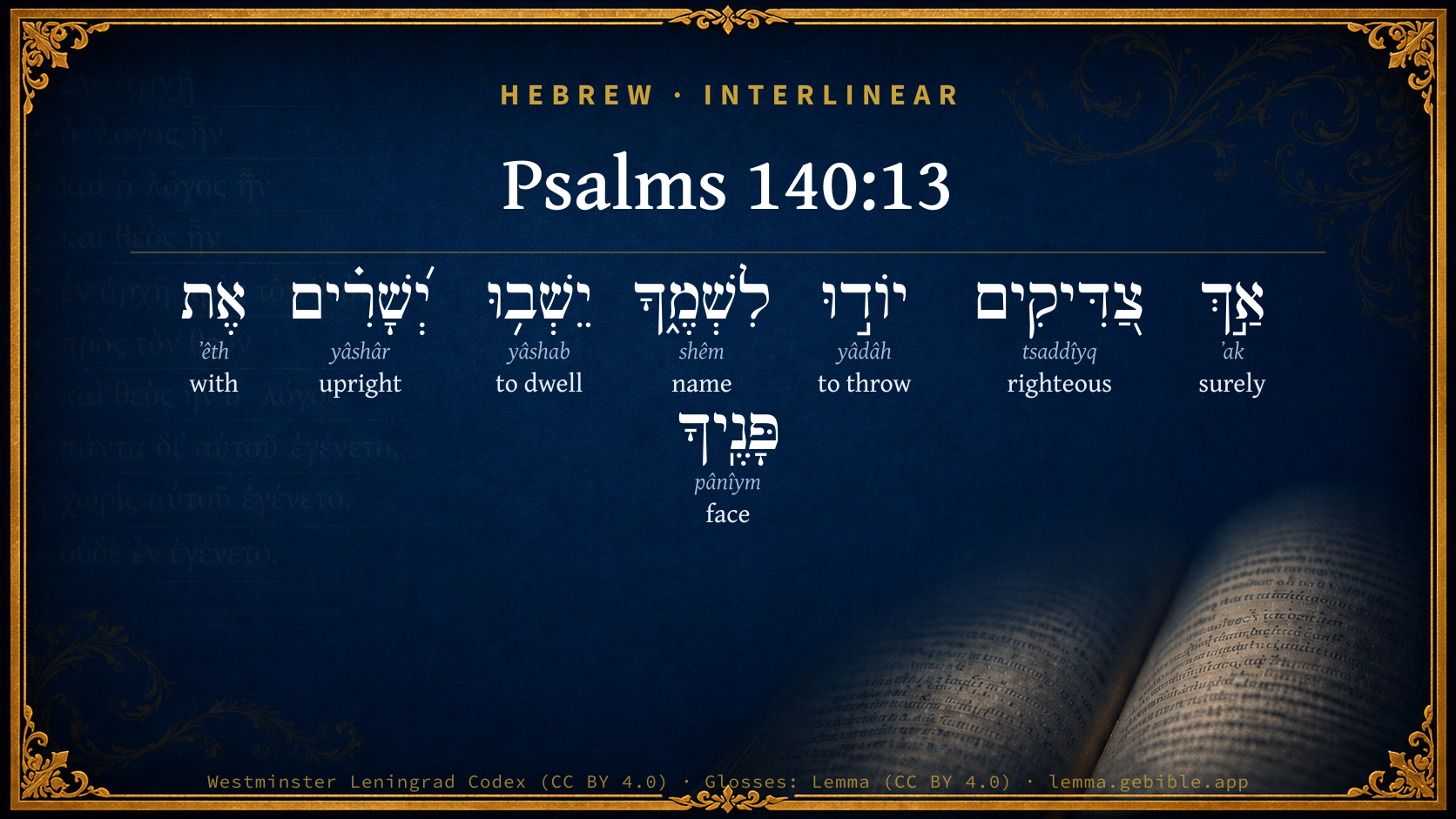
Hebrew (Westminster Leningrad Codex) Psalms 140:13 appears in the Hebrew Old Testament. The text above is from the Westminster Leningrad Codex. Each word links to its Strong’s number, a concise gloss, and parsing drawn from the Open Scriptures Hebrew Bible morphology. Click any word for its full Brown-Driver-Briggs (BDB) entry.
Download image
Cite this verse

Psalms 140:13 (World English Bible). Public Domain. Lemma interlinear Bible study tool, https://lemma.gebible.app/v/psalms/140/13.

Show BibTeX & RIS
BibTeX
RIS
English Translation
Surely the righteous will give thanks to your name. The upright will dwell in your presence.
World English Bible · Public Domain
Download a study sheet

One document with this verse’s original text, its word-by-word gloss line, the meaning frame, cross-references with their text, attributed commentary, and full source and license credits — printable, and it pastes into notes with its structure intact.

This verse Autodidact and up

Study sheet (.html) Plain text (.txt)

A passage Seminary Student

Up to 50 verses in one chapter. A passage sheet keeps up to 6 commentary sources and 12 cross-references per verse, in the order this page ranks them, and says so on the sheet whenever that leaves anything out. Ask for a single verse and you get the Autodidact verse sheet above.

Everything on this page stays free to read, with no account — the sheet is a download of what is already on screen, not access to it.

Want to remove ads? Support Godless Engineer
Compare translations 3

The same verse in 3 English versions, stacked beneath the original-language interlinear above. Click any original word for its lexicon entry.

Each is an independent rendering of the whole verse — the interlinear is not word-aligned to these translations.

Highlighted words mark where these versions differ — a whole-verse word diff, not a word-by-word alignment.

  • World English Bible Public Domain
    Surely the righteous will give thanks to your name. The upright will dwell in your presence.
  • King James Version Public Domain
    Surely the righteous shall give thanks unto thy name: the upright shall dwell in thy presence.
  • unfoldingWord Literal Text CC BY-SA 4.0
    Surely the righteous will praise your name; the upright will dwell before your face.

unfoldingWord Literal Text — © unfoldingWord, licensed CC BY-SA 4.0. Word-aligned USFM3 via Door43 (git.door43.org/unfoldingWord/en_ult).

Versions to compare (up to 4)

3 of 4 selected

Show all 18 translations

Every available English version of this verse, each an independent rendering of the whole verse.

  • World English Bible Public Domain
    Surely the righteous will give thanks to your name. The upright will dwell in your presence.
  • Berean Standard Bible Public Domain
    Surely the righteous will praise Your name; the upright will dwell in Your presence.
  • Majority Standard Bible Public Domain
    Surely the righteous will praise Your name; the upright will dwell in Your presence.
  • King James Version Public Domain
    Surely the righteous shall give thanks unto thy name: the upright shall dwell in thy presence.
  • American Standard Version (1901) Public Domain
    Surely the righteous shall give thanks unto thy name: The upright shall dwell in thy presence. Psalm 141 A Psalm of David.
  • Revised Version (1885) Public Domain
    Surely the righteous shall give thanks unto thy name: the upright shall dwell in thy presence.
  • Geneva Bible (1599) Public Domain
    Surely the righteous shall prayse thy Name, and the iust shall dwell in thy presence.
  • Douay-Rheims (1899) Public Domain
    For thou hast possessed my reins: thou hast protected me from my mother's womb.
  • Young's Literal Translation Public Domain
    Only -- the righteous give thanks to Thy name, The upright do dwell with Thy presence!
  • Literal Standard Version CC BY-SA 4.0
    Surely the righteous give thanks to Your Name, || The upright dwell with Your presence!
  • Unlocked Literal Bible CC BY-SA 4.0
    Surely the righteous people will give thanks to your name; the upright people will live in your presence.
  • unfoldingWord Literal Text CC BY-SA 4.0
    Surely the righteous will praise your name; the upright will dwell before your face.
  • Darby Bible Public Domain
    Yea, the righteous shall give thanks unto thy name; the upright shall dwell in thy presence.
  • World Messianic Bible Public Domain
    Surely the righteous will give thanks to your name. The upright will dwell in your presence.
  • Webster's Bible Public Domain
    \\140:12\\I know that the LORD will maintain the cause of the afflicted, and the right of the poor.
  • Free Bible Version CC BY-SA 4.0
    Truly those who live right are thankful for the kind of person you are, and those who are honest will live in your presence.
  • Bible in Basic English Public Domain
    Truly, the upright will give praise to your name: the holy will have a place in your house.
  • JPS Tanakh (1917) Public Domain
    (140-14) Surely the righteous shall give thanks unto Thy name; the upright shall dwell in Thy presence.

Literal Standard Version (2020), Covenant Press — licensed CC BY-SA 4.0. Text via the HelloAO Bible API (eBible.org). Unlocked Literal Bible (unfoldingWord) — licensed CC BY-SA 4.0. Text via the HelloAO Bible API (eBible.org). unfoldingWord Literal Text — © unfoldingWord, licensed CC BY-SA 4.0. Word-aligned USFM3 via Door43 (git.door43.org/unfoldingWord/en_ult). Free Bible Version, Dr. Jonathan Gallagher — licensed CC BY-SA 4.0. Text via the HelloAO Bible API (eBible.org).

Word by word

More ways to search: Search by grammar → Find every occurrence → Compare this word →

Practice this passage: Drill this verse → Learn its vocabulary →

יוֹד֣וּ
yâdâh
H3034
“to throw”
Verb, Hiphil, Imperfect, 3rd Person, Masculine, Plural
Part of Speech
Verb
Stem
Hiphil
Form
Imperfect
Person
3rd Person
Gender
Masculine
Number
Plural
Full BDB Definition

Origin: a primitive root; used only as denominative from H3027

TWOT: 847

to throw, shoot, cast - (Qal) to shoot (arrows) - (Piel) to cast, cast down, throw down - (Hiphil) - to give thanks, laud, praise - to confess, confess (the name of God) - (Hithpael) - to confess (sin) - to give thanks
  1. אַ֣ךְ ʼak H389 “surely” Particle, Accusative
  2. צַ֭דִּיקִים tsaddîyq H6662 “righteous” Adjective, Adjective, Masculine, Plural, Absolute
  3. לִשְׁמֶ֑ךָ shêm H8034 “to/for · name · your” Preposition + Noun, Common, Masculine, Singular, Construct + Suffix, Personal, 2nd Person, Masculine, Singular
  4. יֵשְׁב֥וּ yâshab H3427 “to dwell” Verb, Qal, Imperfect, 3rd Person, Masculine, Plural
  5. יְ֝שָׁרִ֗ים yâshâr H3477 “upright” Adjective, Adjective, Masculine, Plural, Absolute
  6. אֶת ʼêth H854 “with” Preposition
  7. פָּנֶֽיךָ pânîym H6440 “face(s) · your” Noun, Common, Both, Plural, Construct + Suffix, Personal, 2nd Person, Masculine, Singular

About this verse

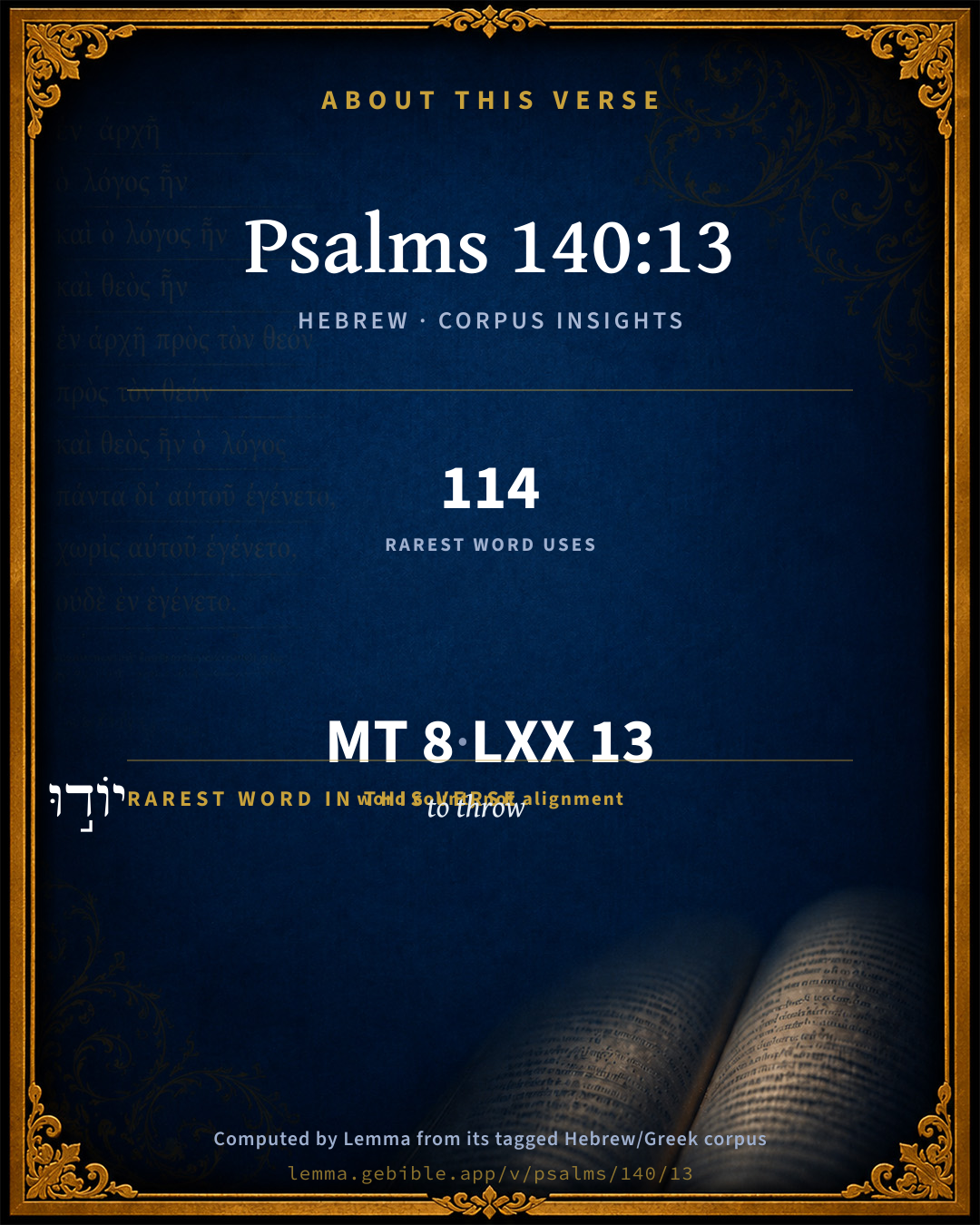
These counts appear in no published source. They are computed here, from the morphology-tagged text and Lemma’s own curated glosses. What Lemma adds →

8
words
8
distinct lemmas
Wisdom
section

Grammatical profile

  • 2 verbs
  • 2 nouns
  • 2 adjectives
  • 1 preposition
  • 1 particle

Verb forms

  • יוֹד֣וּ Hiphil · Imperfect
  • יֵשְׁב֥וּ Qal · Imperfect

Hebrew & Septuagint length

In English translation the verse runs 16 words from the Hebrew and 16 from the Septuagint (LXX English) — the same length.

A rough comparison of the two English renderings, which tokenize alike — not a word-level alignment.

Word counts can differ between the Hebrew and the Greek without any difference in meaning — e.g. the Hebrew direct-object marker אֵת has no separate Greek word, and Greek often adds the article ὁ.

In the original languages it is 8 Hebrew tokens and 13 Greek tokens — but the two are counted differently (Hebrew bundles its prefixes and suffixes into one token; the Greek is in lemma form), so that isn’t a like-for-like length.

Cross-references

12

Topical passages linked to Psalms 140:13 in the Treasury of Scripture Knowledge — connected by theme and wording, ordered by reader-vote popularity; previews shown in the World English Bible.

  • Psalms 11:7 For Yahweh is righteous. He loves righteousness. The upright shall see his face.
  • Psalms 16:11 You will show me the path of life. In your presence is fullness of joy. In your right hand there are pleasures forevermore.
  • Isaiah 3:10 Tell the righteous "Good!" For they shall eat the fruit of their deeds.
  • John 17:24 Father, I desire that they also whom you have given me be with me where I am, that they may see my glory, which you have given me, for you loved me before the foundation of the world.
  • 1 Thessalonians 4:17 then we who are alive, who are left, will be caught up together with them in the clouds, to meet the Lord in the air. So we will be with the Lord forever.
  • John 14:3 If I go and prepare a place for you, I will come again, and will receive you to myself; that where I am, you may be there also.
  • Revelation 7:14–17 I told him, "My lord, you know." He said to me, "These are those who came out of the great tribulation. They washed their robes, and made them white in the Lamb's blood.
  • Psalms 23:6 Surely goodness and loving kindness shall follow me all the days of my life, And I shall dwell in Yahweh's house forever.
  • Psalms 32:11–33:1 Be glad in Yahweh, and rejoice, you righteous! Shout for joy, all you who are upright in heart!
  • Psalms 73:24 You will guide me with your counsel, And afterward receive me to glory.
  • Psalms 97:12 Be glad in Yahweh, you righteous people! Give thanks to his holy Name.
  • Revelation 21:24–27 The nations will walk in its light. The kings of the earth bring the glory and honor of the nations into it.

Cross-references courtesy of OpenBible.info (CC BY 4.0).

Hebrew and Greek witnesses Masoretic Hebrew ↔ Greek Septuagint

The same verse in the two great witnesses to the Old Testament, shown verse-for-verse.

You’re reading Greek Psalm 139 (Hebrew Psalm 140). The Septuagint counts the superscription, so verse numbers can differ from the Hebrew — chapter-level alignment, not verse-by-verse. Numbering follows Rahlfs.

These are two independent witnesses, not word-aligned to each other, and the Septuagint is shown in lemma (dictionary) form.

Hebrew Psalms 140:13 Masoretic · Westminster Leningrad Codex

אַ֣ךְ צַ֭דִּיקִים יוֹד֣וּ לִשְׁמֶ֑ךָ יֵשְׁב֥וּ יְ֝שָׁרִ֗ים אֶת פָּנֶֽיךָ

Surely the righteous will give thanks to your name. The upright will dwell in your presence.

World English Bible · Public Domain

Greek LXX Greek Psalm 139:13 Septuagint · lemma form

γιγνώσκω ὅτι ποιέω κύριος ὁ κρίσις ὁ πτωχός καί ὁ δίκη ὁ πένης

Surely the righteous shall give thanks to your name: the upright shall dwell in your presence.

LXX2012 (modern English Septuagint) · Public Domain

Hebrew: Westminster Leningrad Codex (CC BY 4.0). Greek: Septuagint (public domain); English from LXX2012 (modern English Septuagint) (Public Domain). How the Septuagint differs from the Hebrew →

Commentary

Notes on Psalms 140:13 from classic Christian and Jewish commentators (each source and its license shown beneath its notes). The classic Christian expositions comment on the surrounding passage and are grouped to its opening verse, so a note may address several verses; the Jewish commentaries on the Tanakh (Rashi and others) are per-verse, so they appear only where the commentator wrote on this verse.

Lemma curates 59 commentaries, every one of them public domain or Creative Commons licensed, each selected and text-cleaned for this edition rather than reprinted as found. About our sources →

Trapp's Complete Commentary

John Trapp

Psa 140:13 Surely the righteous shall give thanks unto thy name: the upright shall dwell in thy presence.

Ver. 13. Shall give thanks] He shall have no other cause.

The upright shall dwell in thy presence] When the hypocrite shall be dog out-of-doors, Job 13:16.

John Trapp, A Commentary or Exposition upon All the Books of the Old and New Testament (1647–1656) — public domain. Text from a community e-Sword module.

J. A. Alexander on Psalms

Joseph Addison Alexander

14. (Psa 140:13) Only the righteous shall give thanks unto thy name, the upright shall sit in thy presence. Only the righteous shall have occasion for thanksgiving. There is no need therefore of departing from the proper sense of the Hebrew particle. See above, on Psa 73:1. Sit in thy presence, as thy friends or guests or favoured servants. Perhaps it may mean sit (enthroned) before thee. Compare Mat 19:28. Some understand the sense to be, shall dwell (in the land) before thee, i.e. under thy protection and inspection. Compare Psa 21:6; Psa 41:12), 56:13).

Joseph Addison Alexander, The Psalms Translated and Explained (1850) — public domain. Text from a community e-Sword module.

Geneva Bible (1599)

Geneva Bible translators

That is, shall be defended and preserved by thy fatherly providence and care.

Geneva Bible (1599) marginal notes — public domain. Text via Bolls.life.

Adam Clarke's Commentary

Verse 13. The righteous shall give thanks] For thou wilt support and deliver him.

The upright shall dwell in thy presence.] Shall be admitted to the most intimate intercourse with God.

The persecuted have ever been dear to God Almighty; and the martyrs were, in an especial manner, his delight; and in proportion as he loved those, so must he hate and detest these.

ANALYSIS OF THE HUNDRED AND FORTIETH PSALM

David, being persecuted by Saul, Doeg, and the men of Ziph, prays to God against their evil tongues. But the fathers apply it more largely to the Church, in its persecution by wicked men and devils.

The Psalm is divided into four parts: -

I. A petition to be delivered from his enemies, whom he describes, Ps 140:1-6.

II. A protestation of his confidence in God, Ps 140:6-7.

III. A prayer against them, Ps 140:8-11.

IV. A manifestation of his hope, that God will maintain his just cause, Ps 140:12-13.

I. He first summarily proposes his petition.

1. "Deliver me, O Lord," c. From Saul, Doeg, or the devil.

2. "Preserve me," &c. From his violence and malice, and their effects. 1. Evil counsels, and wicked stratagems: "Which imagine mischief," &c. 2. From their evil words, which were consonant with their thoughts.

"They have sharpened their tongues," &c. With calumnies and frauds.

"Like a serpent," &c. Their bitter words are as the poison of the viper and adder, or the asp, which, without pain, extinguishes life.

He repeats his petition: "Keep me, O Lord," &c.

To move God, he shows their intentions.

1. "They have purposed," &c.: To make me walk slowly, or not at all, in the ways of God to turn me back.

2. The method they took to attain their purpose: "The proud have laid a snare," c.: as hunters do for birds and beasts. So the devil shows the bait, but hides the hook: under pleasure he hides the bitterness of its reward and consequences.

II. He implores aid from God against the evil and danger.

1. "I said unto the Lord," &c. I do not cast away my confidence.

2. "Hear the voice," &c.

Better to show the ground of his constancy, he declares, -

1. What esteem he had for his God: "Thou art the strength," &c. My fortification against all my enemies.

2. What he had formerly done for him: "Thou hast covered my head," &c.

III. The other part of his petition consists in praying against their plots.

1. "Grant not, O Lord," &c. Let them not have their wishes.

2. "Further not his wicked device," &c. Give them no prosperity in them.

3. "Lest they exalt themselves," &c. Triumph in my being conquered by them.

After praying against them, predicts their punishment: "As for the head of those that compass me about," &c.

1. "Let the mischief of their own lips," &c.

2. Deal severely with them: "Let burning coals," &c. Let them suffer extreme punishment: "Let them be cast into the fire," &c.

3. "Let not an evil speaker," &c. - a liar, flatterer, &c., "be established in the earth."

4. "Evil shall hunt," &c. Give no rest, but pursue the wicked man to his utter ruin all those who persecute the church, who write their laws in her blood.

IV. To the infliction of punishment on the wicked, he subjoins, by an antithesis, the promise of God for the defence of the righteous, and so concludes.

1. "I know," c. Am certainly persuaded by my own experience, and the example of my forefathers, whom thou hast delivered in their trials and temptations.

2. "That the Lord will maintain," &c. He may defer his help and deliverance but he will not take it from them.

And this he confirms and amplifies from the final cause, which is double.

1. That they praise him: "Surely the righteous shall give thanks," &c. Being delivered, they attribute the honour, not to themselves, or their innocency or merit, but give the glory of his grace and love to God alone.

2. That they remain before him in his Church militant and triumphant. That they may "dwell in thy presence," &c. Walk before his face here, dwell in his favour, and enjoy the beatific vision hereafter.

Adam Clarke's Commentary on the Bible (1810–1826) — public domain. Text from a community e-Sword/MySword module.

Ellicott's Commentary for English Readers

(13) Surely.—Or, perhaps here, only, the primary meaning of the particle.

Dwell.—For the thought comp. Psa_11:7; Psa_16:11. After the peril and seeming abandonment God again proves the covenant promise true, and those whom the heathen would have chased from the land find in it a sure dwelling-place in the light of the presence and favour of Jehovah.

A Bible Commentary for English Readers, edited by Charles John Ellicott (1878–1897) — public domain. Text from a community e-Sword module.

The Cambridge Bible for Schools and Colleges

gen. ed. J. J. S. Perowne

13. Surely] The particle ’ak expresses the thought, Nay but after all; in spite of present trials.

shall dwell in thy presence] In the land where Jehovah’s Presence is especially manifested. Cp. Psa_102:28. The manifestation of God which is destruction to the wicked (Psa_9:3) is security and happiness to the upright. Cp. Psa_11:7, note; Psa_16:11; Psa_89:15.

The Cambridge Bible for Schools and Colleges (gen. ed. J. J. S. Perowne; Cambridge University Press, 1878–1918) — public domain. Text from a community e-Sword module.

John Gill's Exposition

Surely the righteous shall give thanks unto thy name,.... The same with the poor and the afflicted; who, though traduced by men, and evil spoken of and ill used by them, are righteous in the sight of God; being justified by the righteousness of Christ, which is imputed to them, and received by faith, in consequence of which they live soberly and righteously: these the psalmist knew and was assured they would give thanks to the Lord, and praise his holy name, for the righteousness by which they are made righteous, and for every other blessing of grace and mercy of life; for maintaining their cause and their right, and for the ruin and destruction of their enemies; see Rev 18:20;

the upright shall dwell in thy presence; under his care and protection; in his gracious presence, enjoying the light of his countenance here; and in his glorious presence hereafter, where is fulness of joy: these upright ones are such who are upright in heart; whose hearts are right with God, sincere in his service and worship, and walk uprightly according to the rule of his word. These, as some render it, "shall sit before him" (t) or "in his presence": as children before a father, in whom he delights; or as disciples before a master, to be taught and instructed. The Targum is,

"shall return to pray before thee:''

and so Aben Ezra interprets it of their dwelling, or sitting before God, in the house of prayer; and Kimchi adds, by way of explanation,

"to seek thee, and know thy ways.''

Jerom reads it, "shall dwell with thy countenance or face" (u); and understands it of dwelling with Christ, the face of God, Heb 1:3; with whom they shall dwell for evermore.

(t) "considebunt", Junius & Tremellius; "sedebunt", Cocceius; so Ainsworth and Syriac version. (u) So Sept. V. L. Arabic version, and Pagninus.

Next: Psalms Chapter 141

John Gill's Exposition of the Whole Bible (1746–1763) — public domain (CC PDM 1.0). Text via the HelloAO Bible API.

Albert Barnes' Notes on the Bible

Surely the righteous shall give thanks unto thy name - Unto thee.

(1) they will have occasion to do it;

(2) they will be disposed to do it.

They will not be unmindful of the favors conferred upon them; it will be a characteristic of them that they “will” be thankful.

The upright shall dwell in thy presence - They shall be under thy protection; they shall be admitted to thy favor; they shall dwell in thy dwelling-place.

(1) On earth they shall enjoy his favor - “as if” they abode with God.

(2) in heaven they will be permitted to dwell with him forever.

The general idea of the psalm is, that the poor, the persecuted, the afflicted, if righteous, shall enjoy the favor and protection of God. God is on their side, and not on the side of the wicked who oppress them. But then, people “should be righteous” in order that they may find the favor of God and dwell with him. There is no reason why a “poor” wicked man should enjoy the favor of God anymore than why a “rich” wicked man should. It is not poverty or riches that commend us to God; it is faith, and holiness, and love, and obedience, in the condition of life in which we are placed, be it in a cottage or a palace.

Albert Barnes' Notes on the Bible (1834–1885) — public domain. Text from a community e-Sword/MySword module.

Matthew Poole's English Annotations

Shall give thanks unto thy name; shall have occasion to praise thee for their deliverance.

Shall dwell in thy presence; shall constantly enjoy thy gracious and powerful presence and assistance.

Matthew Poole's English Annotations on the Holy Bible (1683–1685) — public domain. Text from a community e-Sword/MySword module.

The Treasury of David

Charles H. Spurgeon

Ver. 13. Surely the righteous shall give thanks unto thy name. The former Psalm had its "surely", but this is a more pleasing one. As surely as God will slay the wicked he will save the oppressed, and fill their hearts and mouths with praises. Whoever else may be silent, the righteous will give thanks; and whatever they may suffer, the matter will end ill their living through the trial, and magnifying the Lord for his delivering grace. On earth ere long, and in heaven for ever, the pure in heart shall sing unto the Lord. How loud and sweet will be the songs of the redeemed in the millennial age, when the meek shall inherit the earth, and delight themselves in the abundance of peace!

The upright shall dwell in thy presence. Thus shall they give thanks in the truest and fullest manner. This abiding before the Lord shall render to him "songs without words", and therefore all the more spiritual and true. Their living and walking with their God shall be their practical form of gratitude. Sitting down in holy peace, like children at their father's table, their joyful looks and language shall speak their high esteem and fervent love to him who has become their dwelling place. How high have we climbed in this Psalmfrom being hunted by the evil man to dwelling in the divine presence; so doth faith upraise the saint from the lowest depths to heights of peaceful repose. Well might the song be studded with Selahs, or uplifters.

Ver. 13. Surely the righteous shall give thanks unto thy name, etc. Teacheth us two things, first, that it becometh the godly to show themselves continually thankful, because God is continually merciful to them; secondly, what is the excellent estate and condition of God's children, which, though it do not yet appear, yet shall it in the end break forth with fulness of glory." Thomas Witcocks.

Ver. 13. The upright shall dwell in thy presence. "Sit in thy presence", as thy friends or guests or favoured servants. Perhaps it may mean sit (enthroned) before thee. Compare Mt 19:28. Some understand the sense to be shall dwell (in the land) before thee, i.e., under thy protection and inspection. Joseph Addison Alexander.

Ver. 13. One of the noblest forms of praise, dwelling in the presence of God. Or, reverent regard to God's presence, holy communion with the Lord, confiding rest in God's dealings, obedient doing of the heavenly willthe best way of giving thanks to God.

Ver. 13. Two assertions beyond contradiction.

1. The righteous are sure to give thanks to God, let others be as thankless as they will. For,

a) They recognise all their good as coming from God.

b) They realise themselves as unworthy of the good they receive.

c) They are anxious to do right, because they are righteous; and that involves thanksgiving.

d) Thankfulness is a part of the joy derived from what they enjoy.

2. The upright are sure to dwell in God's presence.

a) In the sense of setting the Lord before them.

b) In the sense of an abiding present fellowship with God.

c) In the sense of enjoying God's approval.

d) In the sense of dwelling in heaven for ever. J. F.

Charles H. Spurgeon's The Treasury of David (1869–1885) — public domain. Psalms only. Text from a community e-Sword/MySword module.

The Pulpit Commentary

Surely the righteous shall give thanks unto thy Name; the upright shall dwell in thy presence. The result of God"s punishment of the wicked, and deliverance of the righteous is naturally that the righteous give him thanks, frequent his courts, and "dwell," as it were, "in his presence.

The inward sense of right is an assurance of safety.

The "upright" man is the man of integrity. And the consciousness of integrity gives, and properly gives, confidence and security. A man may cherish a sense of right, of uprightness, of sincerity. He may be sure that this puts him into the sympathy and favor of God. The psalmist who may well have been David may properly plead before God and say, "Judge me, O Lord, according to my righteousness, and according to mine integrity that is in me." When the psalmist made this plea, he was suffering from unjust suspicions and unworthy accusations, very much as was the writer of the psalm now before us. But these terms, "uprightness," "integrity," "righteousness," need very careful consideration. They can be applied to a man. It is certain that man can be said to have a righteousness. "Except your righteousness shall exceed the righteousness of the scribes and Pharisees." We have known men and women of integrity who were right-hearted and sincere, and gained our confidence because they were. Sometimes, in the Scriptures, the word "righteousness" means right-hearted-ness, sincerity; it shows a man who is, at heart, centered on God and virtue. We have a way of speaking of men as being "good at bottom." If we say that as any excuse for men"s sins, we are altogether in the wrong. If we say it in recognition of human frailty, and with discernment of life as the conflict of the human will over the disabilities that surround us, then it is a true and worthy speech.

I A MAN MUST HAVE ESTABLISHED GOOD PRINCIPLES IF HE IS TO HAVE AN INWARD SENSE OF RIGHT. When there is drifting and uncertainty as to what is right, there can be no restful inward conviction that we are right.

II A MAN MUST HAVE GOOD CONTROL OF HIS LIFE IF HE IS TO HAVE AN INWARD SENSE OF RIGHT. There must be harmony between the conduct and relations of the life and the cherished feelings of the heart, or the sense of sincerity will be destroyed.

III A MAN MUST BE SURE OF DIVINE DEFENSE IF HE IS SURE OF HIS OWN SINCERITY, God is true; he must be on the side of the true. God is served by the sincere; he surely defends his servants. R.T.

The Pulpit Commentary (1880–1919), ed. H.D.M. Spence-Jones & Joseph S. Exell — public domain. Text from a community e-Sword module.

John Wesley's Explanatory Notes

Dwell - Shall constantly enjoy thy gracious and powerful presence.

John Wesley, Explanatory Notes Upon the Whole Bible (1754–1765) — public domain. Text via the GEBible commentary corpus.

Rashi

Rabbi Shlomo Yitzchaki (Rashi)

I know that ultimately the Lord will perform the judgment of a poor man, and He will avenge the vengeance of His servants.

Rashi on the Tanakh — English translations: “The Judaica Press complete Tanach with Rashi, translated by A. J. Rosenberg” (CC BY 4.0); “Pentateuch with Rashi's commentary by M. Rosenbaum and A.M. Silbermann, 1929-1934” (public domain); “The Metsudah Tanach series, Lakewood, N.J” (CC BY 4.0); and “The Book of Joshua, Metsudah Publications, 1997” (CC BY 4.0). Text via Sefaria.

Lesson kit

Teaching starters — assembled from the data on this page, not authored interpretation. Every prompt links to the verse data it draws on. Edit before teaching.

Psalms, in the Wisdom, opens this verse with 8 words (8 distinct Hebrew lemmas). Its most distinctive word is yâdâh (“to throw”). A historical commentator’s framing appears above. Read the whole chapter for the surrounding context.

Discussion questions

  1. What does “to throw” (yâdâh) contribute to the verse as a whole?
  2. How does Psalms 11:7, which shares this passage’s theme, read alongside this verse?
  3. These translations render this verse differently. What is at stake in choosing one wording over another?
  4. «יוֹד֣וּ» is a Hiphil Imperfect verb. How does that grammatical form shape the action described?
  5. Compare how Trapp's Complete Commentary and J. A. Alexander on Psalms read this verse. Where do they agree or differ?

Things to notice

Reading settings

Reading text

Shown beneath each verse's original-language words.

Old Testament
Old Testament edition

Read the OT as the Masoretic Hebrew (MT) or the Greek Septuagint (LXX).

English shown for the Greek Septuagint (in the Hebrew ↔ Greek comparison).

Comparing translations? Open the Compare panel on any verse page to stack up to four side by side.