
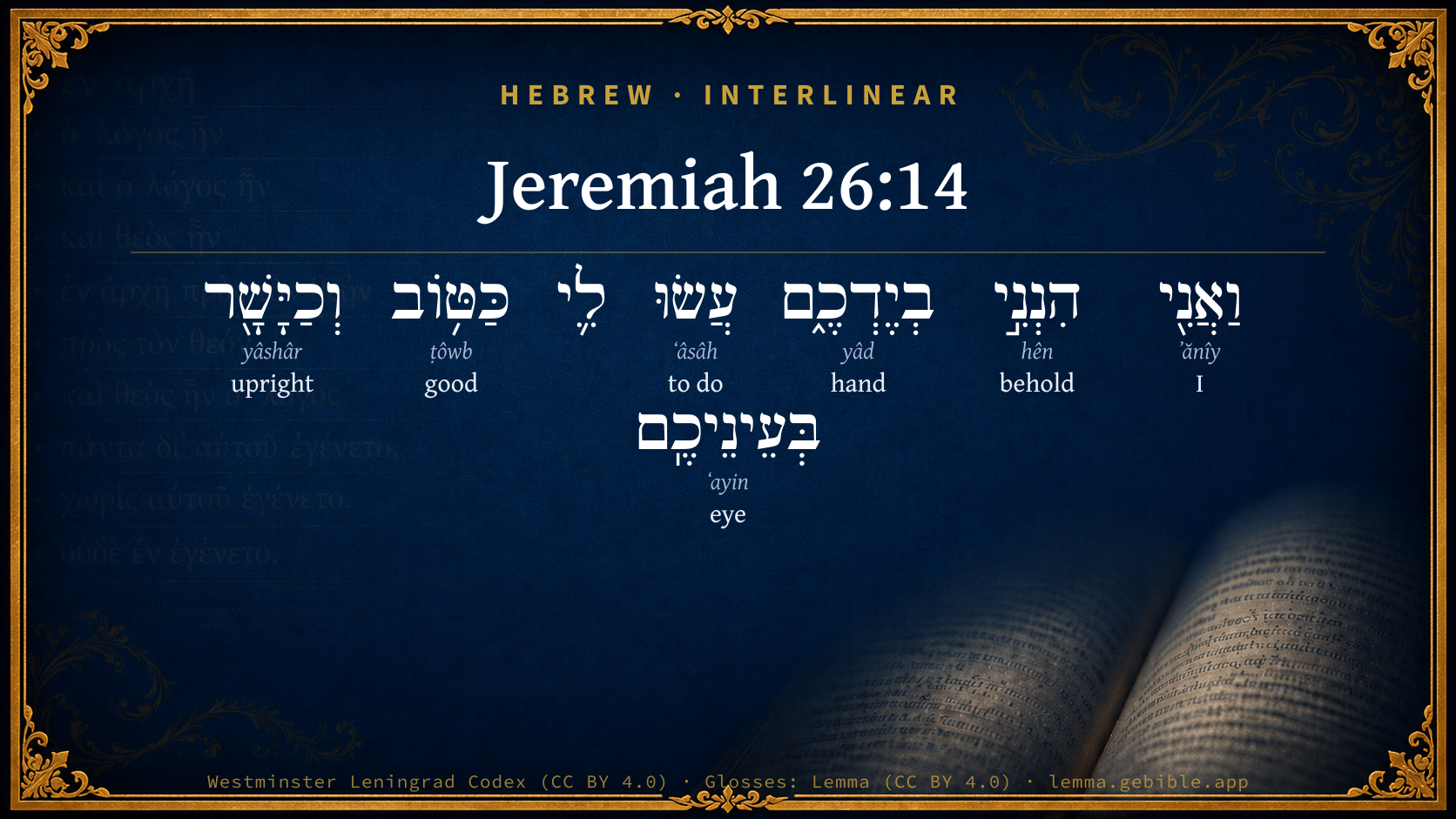
Jeremiah 26:14

Hebrew (Westminster Leningrad Codex) Jeremiah 26:14 appears in the Hebrew Old Testament. The text above is from the Westminster Leningrad Codex. Each word links to its Strong’s number, a concise gloss, and parsing drawn from the Open Scriptures Hebrew Bible morphology. Click any word for its full Brown-Driver-Briggs (BDB) entry.
Download image
Cite this verse

Jeremiah 26:14 (World English Bible). Public Domain. Lemma interlinear Bible study tool, https://lemma.gebible.app/v/jeremiah/26/14.

Show BibTeX & RIS
BibTeX
RIS
English Translation
But as for me, behold, I am in your hand: do with me as is good and right in your eyes.
World English Bible · Public Domain
Download a study sheet

One document with this verse’s original text, its word-by-word gloss line, the meaning frame, cross-references with their text, attributed commentary, and full source and license credits — printable, and it pastes into notes with its structure intact.

This verse Autodidact and up

Study sheet (.html) Plain text (.txt)

A passage Seminary Student

Up to 50 verses in one chapter. A passage sheet keeps up to 6 commentary sources and 12 cross-references per verse, in the order this page ranks them, and says so on the sheet whenever that leaves anything out. Ask for a single verse and you get the Autodidact verse sheet above.

Everything on this page stays free to read, with no account — the sheet is a download of what is already on screen, not access to it.

Want to remove ads? Support Godless Engineer
Compare translations 3

The same verse in 3 English versions, stacked beneath the original-language interlinear above. Click any original word for its lexicon entry.

Each is an independent rendering of the whole verse — the interlinear is not word-aligned to these translations.

Highlighted words mark where these versions differ — a whole-verse word diff, not a word-by-word alignment.

  • World English Bible Public Domain
    But as for me, behold, I am in your hand: do with me as is good and right in your eyes.
  • King James Version Public Domain
    As for me, behold, I am in your hand: do with me as seemeth good and meet unto you.
  • unfoldingWord Literal Text CC BY-SA 4.0
    And as for me, behold, I in your hand. Do to me according to the good and according to the right in your eyes.

unfoldingWord Literal Text — © unfoldingWord, licensed CC BY-SA 4.0. Word-aligned USFM3 via Door43 (git.door43.org/unfoldingWord/en_ult).

Versions to compare (up to 4)

3 of 4 selected

Show all 18 translations

Every available English version of this verse, each an independent rendering of the whole verse.

  • World English Bible Public Domain
    But as for me, behold, I am in your hand: do with me as is good and right in your eyes.
  • Berean Standard Bible Public Domain
    As for me, here I am in your hands; do to me what you think is good and right.
  • Majority Standard Bible Public Domain
    As for me, here I am in your hands; do to me what you think is good and right.
  • King James Version Public Domain
    As for me, behold, I am in your hand: do with me as seemeth good and meet unto you.
  • American Standard Version (1901) Public Domain
    But as for me, behold, I am in your hand: do with me as is good and right in your eyes.
  • Revised Version (1885) Public Domain
    But as for me, behold, I am in your hand: do with me as is good and right in your eyes.
  • Geneva Bible (1599) Public Domain
    As for me, beholde, I am in your hands: do with me as ye thinke good and right.
  • Douay-Rheims (1899) Public Domain
    But as for me, behold I am in your hands: do with me what is good and right in your eyes:
  • Young's Literal Translation Public Domain
    `And I, lo, I `am' in your hand, do to me as is good and as is right in your eyes;
  • Literal Standard Version CC BY-SA 4.0
    And I, behold, I [am] in your hand, do to me as is good and as is right in your eyes;
  • Unlocked Literal Bible CC BY-SA 4.0
    I myself—look at me!—am in your hand. Do to me what is good and right in your eyes.
  • unfoldingWord Literal Text CC BY-SA 4.0
    And as for me, behold, I in your hand. Do to me according to the good and according to the right in your eyes.
  • Darby Bible Public Domain
    But as for me, behold, I am in your hand; do unto me as seemeth good and right in your eyes:
  • World Messianic Bible Public Domain
    But as for me, behold, I am in your hand. Do with me what is good and right in your eyes.
  • Webster's Bible Public Domain
    As for me, behold, I am in your hand: do with me as it seemeth good and meet to you.
  • Free Bible Version CC BY-SA 4.0
    As far as I'm concerned, I'm in your hands; do with me whatever you think is good and right.
  • Bible in Basic English Public Domain
    As for me, here I am in your hands: do with me whatever seems good and right in your opinion.
  • JPS Tanakh (1917) Public Domain
    But as for me, behold, I am in your hand; do with me as is good and right in your eyes.

Literal Standard Version (2020), Covenant Press — licensed CC BY-SA 4.0. Text via the HelloAO Bible API (eBible.org). Unlocked Literal Bible (unfoldingWord) — licensed CC BY-SA 4.0. Text via the HelloAO Bible API (eBible.org). unfoldingWord Literal Text — © unfoldingWord, licensed CC BY-SA 4.0. Word-aligned USFM3 via Door43 (git.door43.org/unfoldingWord/en_ult). Free Bible Version, Dr. Jonathan Gallagher — licensed CC BY-SA 4.0. Text via the HelloAO Bible API (eBible.org).

Word by word

More ways to search: Search by grammar → Find every occurrence → Compare this word →

Practice this passage: Drill this verse → Learn its vocabulary →

וְכַיָּשָׁ֖ר
yâshâr
H3477
“and · like/as the · upright”
Conjunction + Preposition, Determined + Adjective, Adjective, Masculine, Singular, Absolute
Part of Speech
Conjunction + Preposition + Adjective
Type
Adjective
Gender
Masculine
Number
Singular
State
Absolute
Full BDB Definition

Origin: from H3474

TWOT: 930a

straight, upright, correct, right - straight, level - right, pleasing, correct - straightforward, just, upright, fitting, proper - uprightness, righteous, upright - that which is upright (substantive)
  1. וַאֲנִ֖י ʼănîy H589 “and · I” Conjunction + Pronoun, Personal, 1st Person, Common, Singular
  2. הִנְנִ֣י hên H2005 “behold · me” Particle, Demonstrative + Suffix, Personal, 1st Person, Common, Singular
  3. בְיֶדְכֶ֑ם yâd H3027 “in/at · hand · your” Preposition + Noun, Common, Both, Singular, Construct + Suffix, Personal, 2nd Person, Masculine, Plural
  4. עֲשׂוּ ʻâsâh H6213 “do” Verb, Qal, Imperative, 2nd Person, Masculine, Plural
  5. כַּטּ֥וֹב ṭôwb H2896 “like/as the · good” Preposition, Determined + Adjective, Adjective, Masculine, Singular, Absolute
  6. בְּעֵינֵיכֶֽם ʻayin H5869 “in/at · eyes · your” Preposition + Noun, Common, Both, Dual, Construct + Suffix, Personal, 2nd Person, Masculine, Plural

About this verse

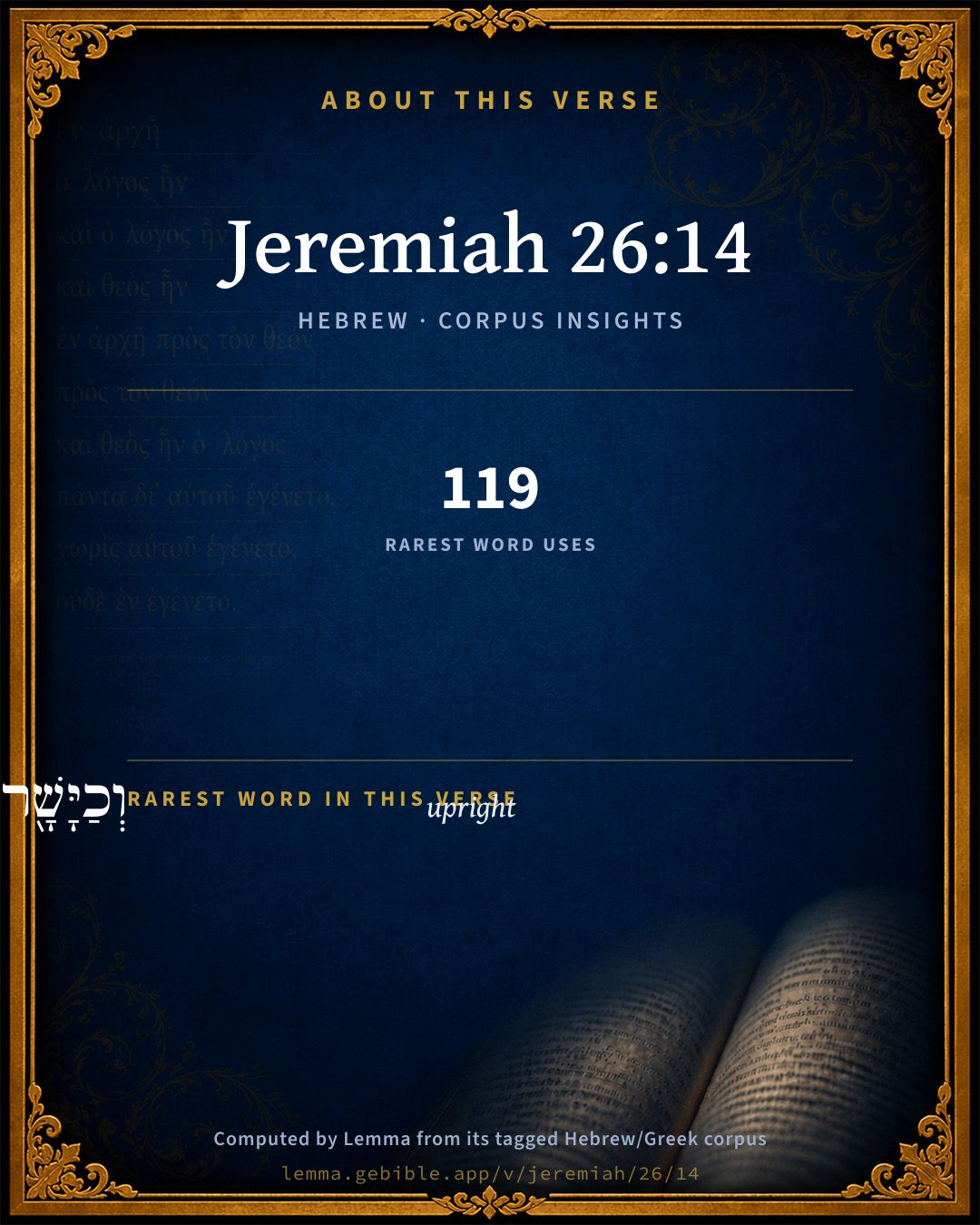
These counts appear in no published source. They are computed here, from the morphology-tagged text and Lemma’s own curated glosses. What Lemma adds →

8
words
7
distinct lemmas
Prophets
section

Grammatical profile

  • 1 verb
  • 2 nouns
  • 2 adjectives
  • 1 pronoun
  • 1 preposition
  • 1 particle

Verb forms

  • עֲשׂוּ Qal · Imperative

Cross-references

4

Topical passages linked to Jeremiah 26:14 in the Treasury of Scripture Knowledge — connected by theme and wording, ordered by reader-vote popularity; previews shown in the World English Bible.

  • Joshua 9:25 Now, behold, we are in your hand: as it seems good and right to you to do to us, do.
  • 2 Samuel 15:26 but if he say thus, I have no delight in you; behold, here am I, let him do to me as seems good to him.
  • Jeremiah 38:5 Zedekiah the king said, Behold, he is in your hand; for the king is not he who can do anything against you.
  • Daniel 3:16 Shadrach, Meshach, and Abednego answered the king, Nebuchadnezzar, we have no need to answer you in this matter.

Cross-references courtesy of OpenBible.info (CC BY 4.0).

Hebrew and Greek witnesses Masoretic Hebrew ↔ Greek Septuagint

The same verse in the two great witnesses to the Old Testament, shown verse-for-verse.

These are two independent witnesses, not word-aligned to each other, and the Septuagint is shown in lemma (dictionary) form.

Hebrew Jeremiah 26:14 Masoretic · Westminster Leningrad Codex

וַאֲנִ֖י הִנְנִ֣י בְיֶדְכֶ֑ם עֲשׂוּ לִ֛י כַּטּ֥וֹב וְכַיָּשָׁ֖ר בְּעֵינֵיכֶֽם

But as for me, behold, I am in your hand: do with me as is good and right in your eyes.

World English Bible · Public Domain

Greek LXX Structure differs

In the Septuagint, Jeremiah is about an eighth shorter than the Hebrew and arranges its material differently — the Oracles Against the Nations (Hebrew chapters 46–51) appear in the middle of the Greek book, after 25:13. Because the chapter and verse boundaries do not line up, a verse-for-verse comparison with the Hebrew is not shown.

A verse-for-verse comparison isn’t shown here because the chapters and verses don’t line up. Switch to the LXX edition with the MT / LXX toggle above to read the Greek directly.

Hebrew: Westminster Leningrad Codex (CC BY 4.0). Greek: Septuagint (public domain); English from a public-domain English Septuagint. How the Septuagint differs from the Hebrew →

Targum (Aramaic paraphrase)

1

The Targum is the ancient Jewish Aramaic paraphrase of the Hebrew Scriptures — an interpretive translation, not the Hebrew text itself. Onkelos (literal) and Pseudo-Jonathan (expansive) render the Torah, and Jonathan the Prophets. Coverage is partial: where no permissively-licensed English translation exists for a verse, only the Aramaic is shown. This is verse-level text, not a word-by-word alignment to the Hebrew.

  1. Targum Jonathan Prophets (Joshua–Malachi)
    וַאֲנָא הָאֲנָא מְסִיר בְּיֶדְכוֹן עֲבִידוּ לִי כְּמָה דְתַקִין וּכְמָה דְכָשַׁר בְּעֵינֵיכוֹן:

    (no public-domain English translation for this verse)

    Targum Jonathan — Aramaic: “Mikraot Gedolot” (public domain). English: “Sefaria Community Translation” (CC0 1.0 (public-domain dedication)); “London "Chaldee Paraphrase," 1871” (public domain). Text via Sefaria.

Commentary

Notes on Jeremiah 26:14 from classic Christian and Jewish commentators (each source and its license shown beneath its notes). The classic Christian expositions comment on the surrounding passage and are grouped to its opening verse, so a note may address several verses; the Jewish commentaries on the Tanakh (Rashi and others) are per-verse, so they appear only where the commentator wrote on this verse.

Lemma curates 59 commentaries, every one of them public domain or Creative Commons licensed, each selected and text-cleaned for this edition rather than reprinted as found. About our sources →

Trapp's Complete Commentary

John Trapp

Jer 26:14 As for me, behold, I [am] in your hand: do with me as seemeth good and meet unto you.

Ver. 14. As for me, behold, I am in your hand.] See here how God gave his holy prophet a mouth and wisdom, such as his adversaries were not able to resist. The like he did to other of his martyrs and confessors, as were easy to instance. If the queen will give me life, I will thank her; if she will banish me, I will thank her; if she will burn me, I will thank her, said Bradford to Cresswell, offering to intercede for him. {a}

To do with me as seemeth good and meet unto you.] But this I can safely say, Non omnis moriar. All that ye can do is, to "kill the body." Kill me you may, but hurt me you cannot. Life in God’s displeasure is worse than death. I am not of their mind who say,

“κακως ζην κρειον η θανειν καλως.”

- Euripid. in Aulide.

Better live basely than die bravely. Faxit Deus ut quilibet nostrum epilogum habeat galeatum. God grant that, whether our death be a burnt-offering of martyrdom, or a peace offering of a natural death, it may be a free will offering, a sweet sacrifice to the Lord.

{a} Acts and Mon., 1462.

John Trapp, A Commentary or Exposition upon All the Books of the Old and New Testament (1647–1656) — public domain. Text from a community e-Sword module.

Tyndale Open Study Notes

Tyndale Open Resources

26:14-15 Jeremiah submitted calmly to authority and placed his life in the officials’ hands; however, he warned them that they would bear the responsibility for their decision if they killed an innocent man.

Tyndale Open Study Notes — © Tyndale Open Resources, licensed CC BY-SA 4.0. Text via the HelloAO Bible API.

Jamieson, Fausset & Brown

Robert Jamieson, A. R. Fausset & David Brown

Jeremiah's humility is herein shown, and submission to the powers that be (Rom 13:1).

Jamieson, Fausset & Brown — Commentary Critical and Explanatory on the Whole Bible (1871) — public domain (CC PDM 1.0). Text via the HelloAO Bible API.

Adam Clarke's Commentary

Verse 14. As for me, behold, I am in your hand] I am the messenger of God; you may do with me what you please; but if you slay me, you will bring innocent blood upon yourselves.

Adam Clarke's Commentary on the Bible (1810–1826) — public domain. Text from a community e-Sword/MySword module.

John Calvin's Commentaries

Jeremiah, after having exhorted the princes, the priests, and the whole people to repent, and having shewn to them that there was a remedy for their evil, except by their obstinacy they provoked more and more the wrath of God, now speaks of himself, and warns them not to indulge their cruelty by following their determination to kill him; for they had brought in a sentence that he deserved to die. He then saw that their rage was so violent, that he almost despaired of his life; but he declares here that God would be an avenger if they unjustly vented their rage against him. He yet shews that he was not so solicitous about his life as to neglect his duty, for he surrendered himself to their will; “Do what ye please,” he says, “with me; yet see what ye do; for the Lord will not suffer innocent blood to be shed with impunity.”

By saying that he was in their hand, he does not mean that he was not under the care of God. Christ also spoke thus when he exhorted his disciples not to fear those who could kill the body. (Matthew 10:28.) There is no doubt but that the hairs of our head are numbered before God; thus it cannot be that tyrants, however they may rage, can touch us, no, not with their little finger, except a permission be given them. It is, then, certain that our life can never be in the hand of men, for God is its faithful keeper; but Jeremiah said, after a human manner, that his life was in their hand; for God’s providence is hidden from us, nor can we discover it but by the eyes of faith. When, therefore, enemies seem to rule so that there is no escape, the Scripture says, by way of concession, that we are in their hands, that is, as far as we perceive. We ought yet to understand that we are by no means so exposed to the will of the wicked that they can do what they please with us; for God restrains them by a hidden bridle, and rules their hands and their hearts. This truth ought ever to remain unalterable, that our life is under the custody and protection of God.

John Calvin's Commentaries (1540-1563) — public domain. Text from the Calvin Translation Society English edition (1840s-50s) via the Christian Classics Ethereal Library (ccel.org). Calvin's coverage is partial (roughly two-thirds of the Bible); uncommented books and verses are honest gaps, never fabricated. The 19th-century editor's footnotes and remarks are omitted so the notes are faithfully Calvin's own voice.

Ellicott's Commentary for English Readers

(14) As for me, behold . . .—Literally, And I, behold, I am in your hands; and for “as seemeth good and meet unto you,” read in your eyes. The prophet feels himself powerless in the presence of his accusers and judges, and can but appeal to the Judge of all.

A Bible Commentary for English Readers, edited by Charles John Ellicott (1878–1897) — public domain. Text from a community e-Sword module.

John Gill's Exposition

As for me, behold, I am in your hand,.... In their power, as they were the chief court of judicature; and to whom it belonged to judge of prophets, and to acquit or condemn them, as they saw fit; wherefore he submits to their authority:

do with me as seemeth good and meet unto you; he was not careful about it; he readily submitted to their pleasure, and should patiently endure what they thought fit to inflict upon him; it gave him no great concern whether his life was taken from him or not; he was satisfied he had done what he ought to do, and should do the same, was it to do again; and therefore they might proceed just as they pleased against him.

John Gill's Exposition of the Whole Bible (1746–1763) — public domain (CC PDM 1.0). Text via the HelloAO Bible API.

Matthew Poole's English Annotations

I am in your hand; that is, I am in your prover (as hand often signifieth in Scripture). Jeremiah doth not by this acknowledge any power they had justly thus to restrain and question him. Nor doth he dare them to do what they had a natural power to do, by saying,

Do with me what seemeth good unto you; the phrase imports no more than that he could not hinder their doing with him what they pleased. The hands in which he was were the hands of violence, not of justice; for though they had a just power against false prophets, yet they had no such power against any prophet sent by God, let the matter of his prophecy be never so threatening and ungrateful to them. Therefore he addeth,

Matthew Poole's English Annotations on the Holy Bible (1683–1685) — public domain. Text from a community e-Sword/MySword module.

Lesson kit

Teaching starters — assembled from the data on this page, not authored interpretation. Every prompt links to the verse data it draws on. Edit before teaching.

Jeremiah, in the Prophets, opens this verse with 8 words (7 distinct Hebrew lemmas). Its most distinctive word is yâshâr (“upright”). A historical commentator’s framing appears above. Read the whole chapter for the surrounding context.

Discussion questions

  1. The word yâshâr carries the sense “upright.” How does it shape the verse?
  2. Joshua 9:25 shares this passage’s theme. How do the two illuminate each other?
  3. These translations render this verse differently; the difference is in the English rendering, not the original. What questions does that raise?
  4. The verb «עֲשׂוּ» is Qal Imperative. How does its form color the action?
  5. Reading how Trapp's Complete Commentary and Tyndale Open Study Notes read this verse, where do the two commentators agree and where do they part?

Things to notice

Reading settings

Reading text

Shown beneath each verse's original-language words.

Old Testament
Old Testament edition

Read the OT as the Masoretic Hebrew (MT) or the Greek Septuagint (LXX).

English shown for the Greek Septuagint (in the Hebrew ↔ Greek comparison).

Comparing translations? Open the Compare panel on any verse page to stack up to four side by side.