2 Kings 14:3

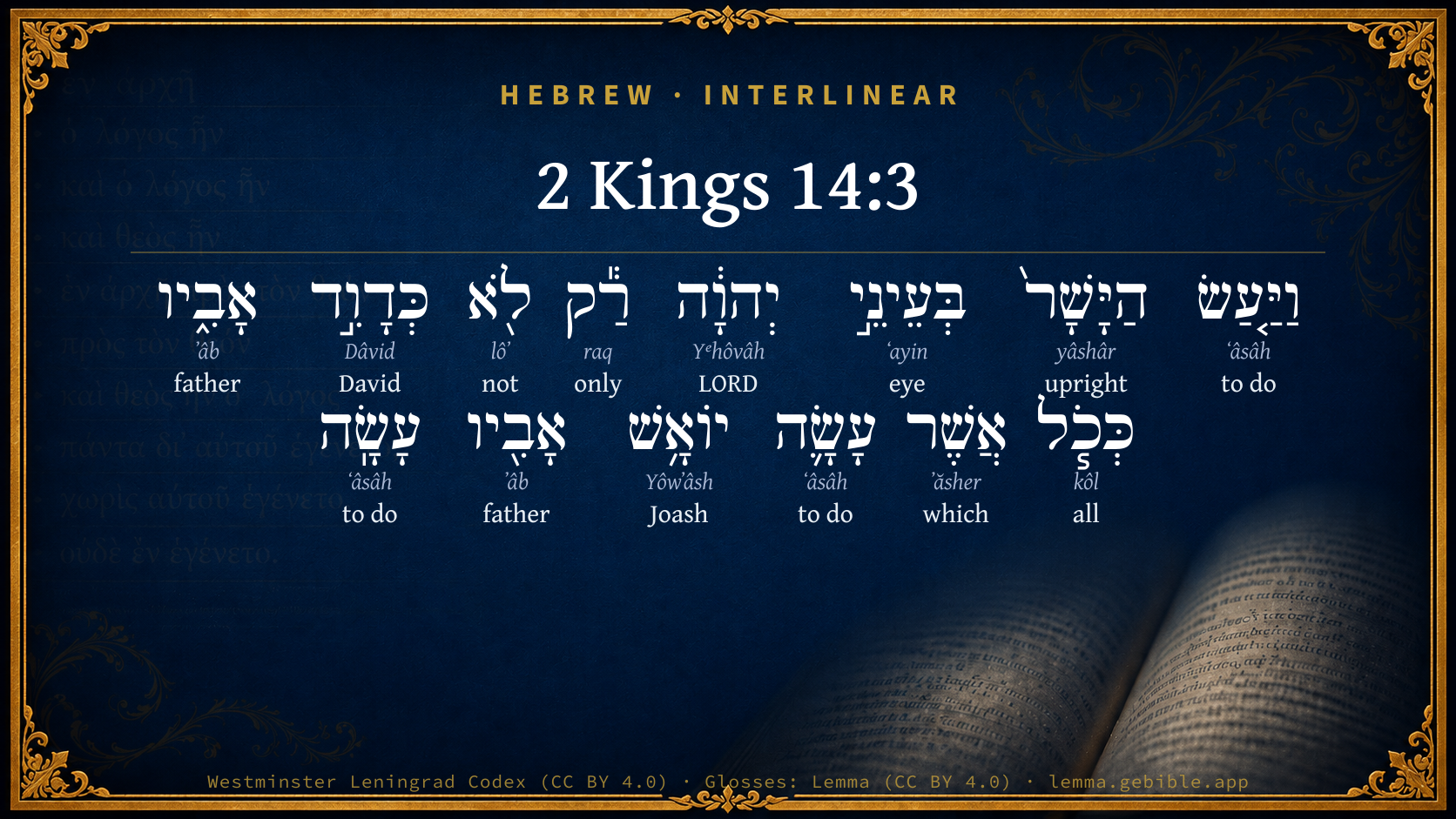
Hebrew (Westminster Leningrad Codex) 2 Kings 14:3 appears in the Hebrew Old Testament. The text above is from the Westminster Leningrad Codex. Each word links to its Strong’s number, a concise gloss, and parsing drawn from the Open Scriptures Hebrew Bible morphology. Click any word for its full Brown-Driver-Briggs (BDB) entry.
Download image
Cite this verse

2 Kings 14:3 (World English Bible). Public Domain. Lemma interlinear Bible study tool, https://lemma.gebible.app/v/2-kings/14/3.

Show BibTeX & RIS
BibTeX
RIS
English Translation
He did that which was right in the eyes of Yahweh, yet not like David his father: he did according to all that Joash his father had done.
World English Bible · Public Domain
Download a study sheet

One document with this verse’s original text, its word-by-word gloss line, the meaning frame, cross-references with their text, attributed commentary, and full source and license credits — printable, and it pastes into notes with its structure intact.

This verse Autodidact and up

Study sheet (.html) Plain text (.txt)

A passage Seminary Student

Up to 50 verses in one chapter. A passage sheet keeps up to 6 commentary sources and 12 cross-references per verse, in the order this page ranks them, and says so on the sheet whenever that leaves anything out. Ask for a single verse and you get the Autodidact verse sheet above.

Everything on this page stays free to read, with no account — the sheet is a download of what is already on screen, not access to it.

Want to remove ads? Support Godless Engineer
Compare translations 3

The same verse in 3 English versions, stacked beneath the original-language interlinear above. Click any original word for its lexicon entry.

Each is an independent rendering of the whole verse — the interlinear is not word-aligned to these translations.

Highlighted words mark where these versions differ — a whole-verse word diff, not a word-by-word alignment.

  • World English Bible Public Domain
    He did that which was right in the eyes of Yahweh, yet not like David his father: he did according to all that Joash his father had done.
  • King James Version Public Domain
    And he did that which was right in the sight of the LORD, yet not like David his father: he did according to all things as Joash his father did.
  • unfoldingWord Literal Text CC BY-SA 4.0
    And he did right in the eyes of Yahweh, only not like David his father. Like all that Joash his father did, he did.

unfoldingWord Literal Text — © unfoldingWord, licensed CC BY-SA 4.0. Word-aligned USFM3 via Door43 (git.door43.org/unfoldingWord/en_ult).

Versions to compare (up to 4)

3 of 4 selected

Show all 18 translations

Every available English version of this verse, each an independent rendering of the whole verse.

  • World English Bible Public Domain
    He did that which was right in the eyes of Yahweh, yet not like David his father: he did according to all that Joash his father had done.
  • Berean Standard Bible Public Domain
    And he did what was right in the eyes of the LORD, but not as his father David had done. He did everything as his father Joash had done.
  • Majority Standard Bible Public Domain
    And he did what was right in the eyes of the LORD, but not as his father David had done. He did everything as his father Joash had done.
  • King James Version Public Domain
    And he did that which was right in the sight of the LORD, yet not like David his father: he did according to all things as Joash his father did.
  • American Standard Version (1901) Public Domain
    And he did that which was right in the eyes of Jehovah, yet not like David his father: he did according to all that Joash his father had done.
  • Revised Version (1885) Public Domain
    And he did that which was right in the eyes of the LORD, yet not like David his father: he did according to all that Joash his father had done.
  • Geneva Bible (1599) Public Domain
    And he did vprightly in the sight of the Lord, yet not like Dauid his father, but did according to all that Ioash his father had done.
  • Douay-Rheims (1899) Public Domain
    And he did that which was right before the Lord, but yet not like David his father. He did according to all things that Joas his father did:
  • Young's Literal Translation Public Domain
    and he doth that which `is' right in the eyes of Jehovah, only not like David his father, according to all that Joash his father did he hath done,
  • Literal Standard Version CC BY-SA 4.0
    and he does that which [is] right in the eyes of YHWH, only not like his father David; he has done according to all that his father Joash did,
  • Unlocked Literal Bible CC BY-SA 4.0
    He did what was right in the eyes of Yahweh, yet not like David his father. He did everything that Joash, his father, had done.
  • unfoldingWord Literal Text CC BY-SA 4.0
    And he did right in the eyes of Yahweh, only not like David his father. Like all that Joash his father did, he did.
  • Darby Bible Public Domain
    And he did what was right in the sight of Jehovah, yet not like David his father: he did according to all that Joash his father had done.
  • World Messianic Bible Public Domain
    He did that which was right in the LORD’s eyes, yet not like David his father. He did according to all that Joash his father had done.
  • Webster's Bible Public Domain
    And he did that which was right in the sight of the LORD, yet not like David his father: he did according to all things as Joash his father did.
  • Free Bible Version CC BY-SA 4.0
    He did what was right in the Lord's sight, but not in the same way as his forefather David had. He did everything just as his father Joash had done.
  • Bible in Basic English Public Domain
    He did what was right in the eyes of the Lord, though not like David his father; he did as Joash his father had done.
  • JPS Tanakh (1917) Public Domain
    And he did that which was right in the eyes of the LORD, yet not like David his father; he did according to all that Joash his father had done.

Literal Standard Version (2020), Covenant Press — licensed CC BY-SA 4.0. Text via the HelloAO Bible API (eBible.org). Unlocked Literal Bible (unfoldingWord) — licensed CC BY-SA 4.0. Text via the HelloAO Bible API (eBible.org). unfoldingWord Literal Text — © unfoldingWord, licensed CC BY-SA 4.0. Word-aligned USFM3 via Door43 (git.door43.org/unfoldingWord/en_ult). Free Bible Version, Dr. Jonathan Gallagher — licensed CC BY-SA 4.0. Text via the HelloAO Bible API (eBible.org).

Word by word

More ways to search: Search by grammar → Find every occurrence → Compare this word →

Practice this passage: Drill this verse → Learn its vocabulary →

יוֹאָ֥שׁ
Yôwʼâsh
H3101
“Joash”
Noun, Proper
Part of Speech
Noun
Type
Proper
Full BDB Definition

Origin: a form of H3060

TWOT: None

Joash = "given by the Lord" - son of king Ahaziah and the 8th king of Judah - son of king Jehoahaz and the 12th king of the northern kingdom of Israel - father of Gideon - a son of king Ahab - a descendant of Shelah the son of Judah; either the son of Shelah or the son of Jokim - son of Shemaah of Gibeah who resorted to David at Ziklag
  1. וַיַּ֤עַשׂ ʻâsâh H6213 “and · to do” Conjunction + Verb, Qal, Sequential Imperfect, 3rd Person, Masculine, Singular
  2. הַיָּשָׁר֙ yâshâr H3477 “the · upright” Particle, Definite Article + Adjective, Adjective, Masculine, Singular, Absolute
  3. בְּעֵינֵ֣י ʻayin H5869 “in/at · eyes of” Preposition + Noun, Common, Both, Dual, Construct
  4. יְהוָ֔ה Yᵉhôvâh H3068 “LORD” Noun, Proper
  5. רַ֕ק raq H7535 “only” Particle, Accusative
  6. לֹ֖א lôʼ H3808 “not” Particle, Negative
  7. כְּדָוִ֣ד Dâvid H1732 “like/as · David” Preposition + Noun, Proper
  8. אָבִ֑יו ʼâb H1 “father · his” Noun, Common, Masculine, Singular, Construct + Suffix, Personal, 3rd Person, Masculine, Singular
  9. כְּכֹ֧ל kôl H3605 “like/as · all” Preposition + Noun, Common, Masculine, Singular, Absolute
  10. אֲשֶׁר ʼăsher H834 “which” Particle, Relative
  11. עָשָׂ֛ה ʻâsâh H6213 “to do” Verb, Qal, Perfect, 3rd Person, Masculine, Singular
  12. אָבִ֖יו ʼâb H1 “father · his” Noun, Common, Masculine, Singular, Construct + Suffix, Personal, 3rd Person, Masculine, Singular
  13. עָשָֽׂה ʻâsâh H6213 “to do” Verb, Qal, Perfect, 3rd Person, Masculine, Singular

About this verse

These counts appear in no published source. They are computed here, from the morphology-tagged text and Lemma’s own curated glosses. What Lemma adds →

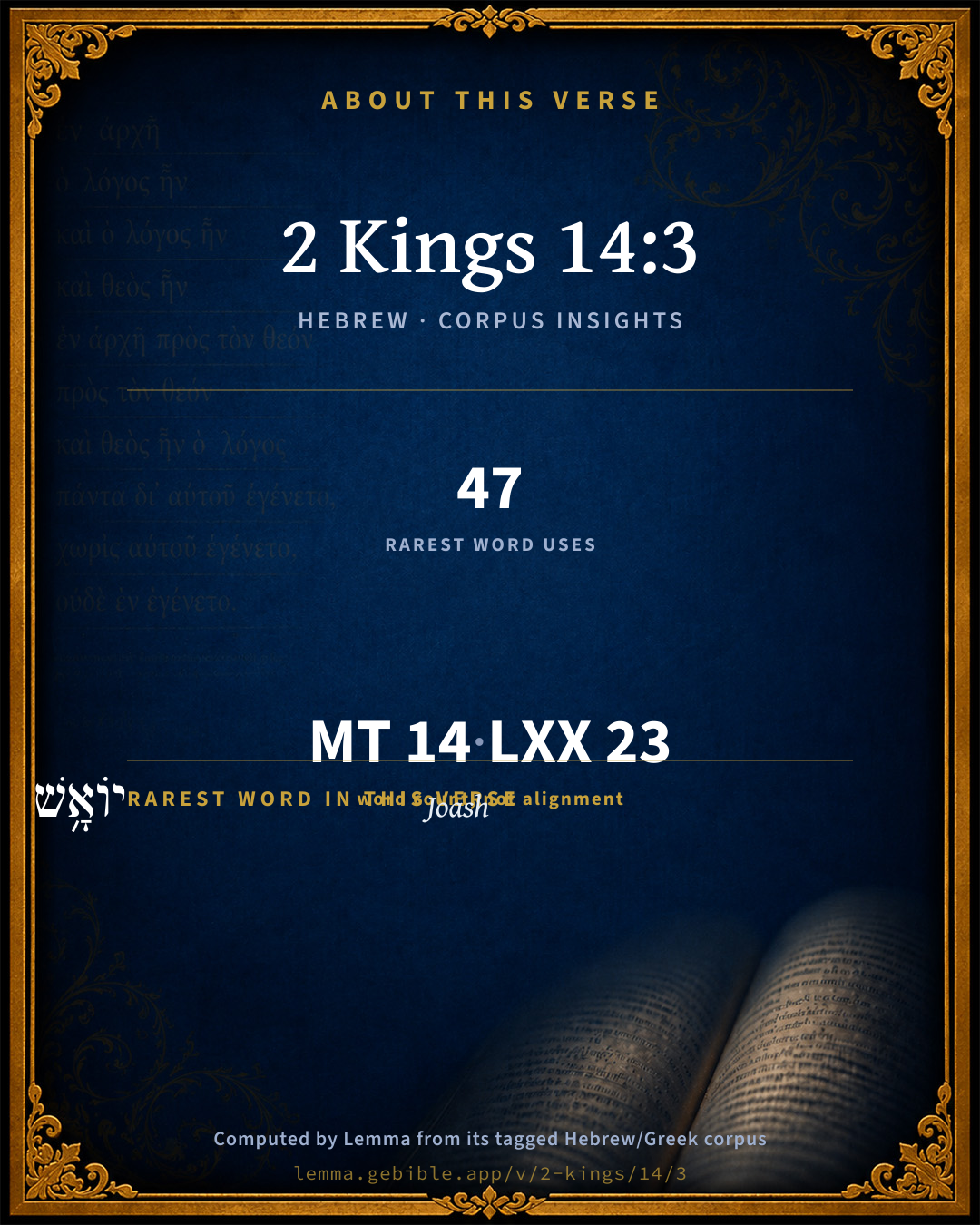
14
words
11
distinct lemmas
Historical
section

Shared distinctive vocabulary

יוֹאָ֥שׁ Joash H3101 occurs in 41 verses of the Hebrew Bible. Also found in:

Grammatical profile

  • 3 verbs
  • 7 nouns
  • 1 adjective
  • 3 particles

Verb forms

  • וַיַּ֤עַשׂ Qal · Sequential Imperfect
  • עָשָׂ֛ה Qal · Perfect
  • עָשָֽׂה Qal · Perfect

Repetition

Words recur within this verse — often emphatic in Hebrew:

  • וַיַּ֤עַשׂ to do H6213 ×3
  • אָבִ֑יו father H1 ×2

Hebrew & Septuagint length

In English translation the verse runs 28 words from the Hebrew and 30 from the Septuagint (LXX English) — closely comparable.

A rough comparison of the two English renderings, which tokenize alike — not a word-level alignment.

Word counts can differ between the Hebrew and the Greek without any difference in meaning — e.g. the Hebrew direct-object marker אֵת has no separate Greek word, and Greek often adds the article ὁ.

In the original languages it is 14 Hebrew tokens and 23 Greek tokens — but the two are counted differently (Hebrew bundles its prefixes and suffixes into one token; the Greek is in lemma form), so that isn’t a like-for-like length.

Cross-references

10

Topical passages linked to 2 Kings 14:3 in the Treasury of Scripture Knowledge — connected by theme and wording, ordered by reader-vote popularity; previews shown in the World English Bible.

  • 2 Chronicles 25:2–3 He did that which was right in the eyes of Yahweh, but not with a perfect heart.
  • 1 Kings 11:4 For it happened, when Solomon was old, that his wives turned away his heart after other gods; and his heart was not perfect with Yahweh his God, as was the heart of David his father.
  • 1 Kings 15:3 He walked in all the sins of his father, which he had done before him; and his heart was not perfect with Yahweh his God, as the heart of David his father.
  • 2 Kings 12:2 Jehoash did that which was right in the eyes of Yahweh all his days in which Jehoiada the priest instructed him.
  • 2 Chronicles 24:2 Joash did that which was right in the eyes of Yahweh all the days of Jehoiada the priest.
  • 2 Chronicles 24:17 Now after the death of Jehoiada came the princes of Judah, and made obeisance to the king. Then the king listened to them.
  • 2 Chronicles 25:14–16 Now it happened, after that Amaziah was come from the slaughter of the Edomites, that he brought the gods of the children of Seir, and set them up to be his gods, and bowed down himself before them, and burned incense to them.
  • Jeremiah 16:19 Yahweh, my strength, and my stronghold, and my refuge in the day of affliction, to you shall the nations come from the ends of the earth, and shall say, Our fathers have inherited nothing but lies, [even] vanity and things in which there is no profit.
  • Zechariah 1:4–6 Don't you be like your fathers, to whom the former prophets proclaimed, saying: Thus says Yahweh of hosts, 'Return now from your evil ways, and from your evil doings;' but they did not hear, nor listen to me, says Yahweh.
  • 1 Peter 1:18 knowing that you were redeemed, not with corruptible things, with silver or gold, from the useless way of life handed down from your fathers,

Cross-references courtesy of OpenBible.info (CC BY 4.0).

Hebrew and Greek witnesses Masoretic Hebrew ↔ Greek Septuagint

The same verse in the two great witnesses to the Old Testament, shown verse-for-verse.

These are two independent witnesses, not word-aligned to each other, and the Septuagint is shown in lemma (dictionary) form.

Hebrew 2 Kings 14:3 Masoretic · Westminster Leningrad Codex

וַיַּ֤עַשׂ הַיָּשָׁר֙ בְּעֵינֵ֣י יְהוָ֔ה רַ֕ק לֹ֖א כְּדָוִ֣ד אָבִ֑יו כְּכֹ֧ל אֲשֶׁר עָשָׂ֛ה יוֹאָ֥שׁ אָבִ֖יו עָשָֽׂה

He did that which was right in the eyes of Yahweh, yet not like David his father: he did according to all that Joash his father had done.

World English Bible · Public Domain

Greek LXX 2 Kings 14:3 Septuagint · lemma form

καί ποιέω ὁ εὐθής ἐν ὀφθαλμός κύριος πλήν οὐ ὡς δαυίδ ὁ πατήρ αὐτός κατά πᾶς ὅσος ποιέω ιωας ὁ πατήρ αὐτός ποιέω

And he did that which was right in the sight of the Lord, but not as David his father: he did according to all things that his father Joas did.

LXX2012 (modern English Septuagint) · Public Domain

Hebrew: Westminster Leningrad Codex (CC BY 4.0). Greek: Septuagint (public domain); English from LXX2012 (modern English Septuagint) (Public Domain). How the Septuagint differs from the Hebrew →

Targum (Aramaic paraphrase)

1

The Targum is the ancient Jewish Aramaic paraphrase of the Hebrew Scriptures — an interpretive translation, not the Hebrew text itself. Onkelos (literal) and Pseudo-Jonathan (expansive) render the Torah, and Jonathan the Prophets. Coverage is partial: where no permissively-licensed English translation exists for a verse, only the Aramaic is shown. This is verse-level text, not a word-by-word alignment to the Hebrew.

  1. Targum Jonathan Prophets (Joshua–Malachi)
    וַעֲבַד דְכָשַׁר קֳדָם יְיָ לְחוֹד לָא כְּדָוִד אֲבוּהִי כְּכָל דַעֲבַד יוֹאָשׁ אֲבוּהִי עֲבַד:

    (no public-domain English translation for this verse)

    Targum Jonathan — Aramaic: “Mikraot Gedolot” (public domain). English: “Sefaria Community Translation” (CC0 1.0 (public-domain dedication)); “London "Chaldee Paraphrase," 1871” (public domain). Text via Sefaria.

Commentary

Notes on 2 Kings 14:3 from classic Christian and Jewish commentators (each source and its license shown beneath its notes). The classic Christian expositions comment on the surrounding passage and are grouped to its opening verse, so a note may address several verses; the Jewish commentaries on the Tanakh (Rashi and others) are per-verse, so they appear only where the commentator wrote on this verse.

Lemma curates 59 commentaries, every one of them public domain or Creative Commons licensed, each selected and text-cleaned for this edition rather than reprinted as found. About our sources →

Trapp's Complete Commentary

John Trapp

2Ki 14:3 And he did [that which was] right in the sight of the LORD, yet not like David his father: he did according to all things as Joash his father did.

Ver. 3. Yet not like David his father.] Who did all the wills of God {Act 13:22} with a perfect heart. {1Sa 13:14} Not so Amaziah, who had a good name, but answered it not; as the Emperor Probus did, witness Flav. Vopiscus.

John Trapp, A Commentary or Exposition upon All the Books of the Old and New Testament (1647–1656) — public domain. Text from a community e-Sword module.

Joseph Benson's Commentary

2Ki 14:3-4. He did right in the sight of the Lord — In many respects, attending on God’s altars, and attending to his word: yet not like David his father — Or progenitor: not obeying in the same spirit of faith and devotion, and with the same sincerity, resolution, and perseverance. As Joash his father did — Who, for a time, served God aright; but afterward fell away to idolatry. Thus did Amaziah, 2Ch 25:14. Howbeit, the high places, &c. — Though he did what was right, yet the high places were not taken away — For it is difficult to get clear of those corruptions which by long usage have gained prescription.

Joseph Benson's Commentary on the Old and New Testaments (1811–1818) — public domain. Text from a community e-Sword module.

Tyndale Open Study Notes

Tyndale Open Resources

14:3-4 While Amaziah’s basic spiritual evaluation was satisfactory, he did not serve the Lord wholeheartedly as his ancestor David had (2 Chr 25:2). David continued to be the spiritual standard for evaluating the kings of Judah (2 Kgs 16:2; 18:3; 1 Kgs 15:5, 11). Tolerance for long-established pagan shrines remained a stumbling block for Judah (2 Kgs 12:3; 1 Kgs 14:23; 15:14; 22:43).

Tyndale Open Study Notes — © Tyndale Open Resources, licensed CC BY-SA 4.0. Text via the HelloAO Bible API.

Geneva Bible (1599)

Geneva Bible translators

In the beginning of his reign he seemed to have an outward show of godliness, but afterward he became an idolater and worshipped the idols of the Idumeans.

Geneva Bible (1599) marginal notes — public domain. Text via Bolls.life.

Ellicott's Commentary for English Readers

(3) Yet not like David his father.—The chronicler paraphrases this reference to the ideal king of Israel: “yet not with a perfect heart.”

A Bible Commentary for English Readers, edited by Charles John Ellicott (1878–1897) — public domain. Text from a community e-Sword module.

The Cambridge Bible for Schools and Colleges

gen. ed. J. J. S. Perowne

3. yet not like David his father] The Chronicler merely gives ‘but not with a perfect heart’, making no mention of Amaziah’s resemblance to Joash, nor of his falling short of David.

according to all things as Joash his father did] R.V. had done. Of course this can only refer to the general resemblance not to the various parts of Amaziah’s conduct. The next verse, which is almost word for word the same as is said in 2Ki_12:3 concerning Joash, shews how Amaziah walked in his father’s footsteps.

The Cambridge Bible for Schools and Colleges (gen. ed. J. J. S. Perowne; Cambridge University Press, 1878–1918) — public domain. Text from a community e-Sword module.

John Gill's Exposition

Howbeit the high places were not taken away,.... Though he first did that which was right before God; nor did his father take them away; see Kg2 12:3.

.

2 Kings 14:5

kg2 14:5

kg2 14:5

kg2 14:5And it came to pass, as soon as the kingdom was strengthened in his hand,.... That he was well settled on the throne, and had a share in the affection of the people, and the idolatry and murder his father had committed were worn off of the minds of the people, and the friends of the conspirators against him were become few or none:

that he slew his servants that had slain the king his father; charged them with the murder in a court of judicature, obtained a sentence against them, and had them executed.

John Gill's Exposition of the Whole Bible (1746–1763) — public domain (CC PDM 1.0). Text via the HelloAO Bible API.

Albert Barnes' Notes on the Bible

He did ... as Joash - There is a curious parity between the lives of Joash and Amaziah. Both were zealous for Yahweh in the earlier portion of their reigns, but in the latter part fell away; both disregarded the rebukes of prophets; and both, having forsaken God, were in the end conspired against and slain (compare 2Ch 24:25; 2Ch 25:27).

Albert Barnes' Notes on the Bible (1834–1885) — public domain. Text from a community e-Sword/MySword module.

Haydock's Catholic Bible Commentary

David. Yet not with a perfect heart, 2 Paralipomenon xxv. 2. --- Father. He imitated his early piety, as well as his miserable end. (Calmet)

George Leo Haydock (1774–1849), Haydock's Catholic Family Bible and Commentary, 1859 edition — public domain. Excludes Psalms (Douay-Rheims chapter numbering differs from Protestant) and Deuterocanonical books (Catholic canon only).

Matthew Poole's English Annotations

Right in the sight of the Lord; that which was in some sort agreeable to God’s will.

Not like David his father; not sincerely, 2Ch 25:2.

He did according to all things as Joash his father did, i.e. for a time served God aright, but afterwards fell to idolatry, 2Ch 25:14, as Joash had done, 2Ki 12:3.

Matthew Poole's English Annotations on the Holy Bible (1683–1685) — public domain. Text from a community e-Sword/MySword module.

Whedon's Commentary on the Bible

Daniel D. Whedon

3. He did according to all things as Joash — That is, says Wordsworth, “he began well, and ended ill.” He had the true theocratic spirit, but not a perfect heart. Not only did he fail to remove the high places, but, according to 2Ch_25:14, he worshipped and burned incense to the gods of Edom.

Daniel D. Whedon (gen. ed.), Commentary on the Old and New Testaments (1874–1909) — public domain. Text from a community e-Sword module.

The Pulpit Commentary

And he did that which was right in the sight of the Lord, yet not like David his father. Only one King of Judah hitherto, viz. Asa, had obtained the praise that he "did that which was right in the eyes of the Lord, as did David his father". (1Ki_15:11) All the others had fallen short more or less; and Amaziah fell short in many respects. He was wanting in "a perfect heart", (2Ch_25:2) i.e. a fixed intention to do God"s will; he was proud and boastful (ver. 10); he gave way to idolatry in his later years, (2Ch_25:14) and he despised the reproof of the prophet who was sent to rebuke his sin. (2Ch_25:16) Though placed among the "good kings" by the authors of both Kings and Chronicles, it is, as it were, under protest, with a distinct intimation that, although better than most of his predecessors, he did not reach a high standard. He did according to all things as Joash his father did. There is something of Oriental hyperbole in this statement, which must be understood in the spirit, not in the letter. The two kings were differently circumstanced, and history did not "repeat itself" in their reigns. The position of Joash with respect to Jehoiada finds no parallel in the circumstances of the life of Amaziah. Still, the lives are parallel to some extent. Both kings began better than they ended. Both were zealous for Jehovah at first, but turned to idolatry at last. Both opposed themselves to prophets, and treated their rebukes with scorn. Both reused conspiracy against them by their misconduct, and were murdered by the malcontents. Further, both were unsuccessful in war, had to withstand a siege of their capital, and bought off their enemy by the surrender of the greater part of its wealth, including the treasures of the temple. (comp. 2Ki_12:18 2Ki_14:14)

HOMILETICS.

Vers. 3, 4. A father"s evil example no justification for a son"s misconduct.

Amaziah "did according to all things as Joash his father did." Like his father, he was half-hearted. In his earlier years he kept to the worship of Jehovah, and "did that which was right in the sight of the Lord," yet not with any zeal or energy. Afterwards he fell away, introduced idolatry, (2Ch_25:14) and when a prophet rebuked him for his evil courses, answered him with scoffs and threatenings. (2Ch_25:15, 2Ch_25:16) His father Joash had done even worse after the death of Jehoiada. He had not only sanctioned idolatries, (2Ch_24:17, 2Ch_24:18) but had had the servant of God who rebuked them put to death. (2Ch_24:21) This, however, is not held by the sacred writer to be any justification or excuse for Amaziah. The reasons are manifest.

I NO MAN IS TO BE CALLED MASTER, NOT EVEN A FATHER. God gives men in his Law and in their conscience a standard of right, which they are to follow. He nowhere bids them take any man but the "God-Man" for pattern. He warns them that men are, all of them, more or less imperfect. He requires that parents shall be "honored," not imitated.

II THE EVIL EXAMPLE OF A FATHER IS A WARNING TO SONS, WHICH SHOULD LEAD TO AVOIDANCE, NOT IMITATION. The sight of a drunken father should disgust sons with drunkenness. Blasphemous and violent words should so shock them as to suggest an exactly opposite behavior. Looseness of morals should breed in them a determination never to offend in a way so absolutely revolting. Given that simplicity which is natural to youth, and every fault of a father should so keenly wound and vex their souls as to bend them in the exactly contrary direction. Sin is so ugly, so offensive, so coarse, that in another it naturally disgusts us; and the more plainly it is revealed, the closer it is brought to us, the more are we naturally provoked and angered by it.

III THE PUNISHMENT WHICH SIN DRAWS AFTER IT SHOULD COME ESPECIALLY HOME TO THOSE WHOSE HOMES ARE CURSED WITH IT, AND ACT AS A DETERRENT. Disease, decay, the loss of others" respect, the severing of friendships, general dislike and aversion, in some cases contempt, dog the footsteps of sin, and mark it as a thing to be avoided. Sons are naturally sensitive with regard to their fathers" honor, and keen to mark whether they are held in respect or no. There can be no natural deterrent from evil courses stronger than the perception that one with whom we are bound up is deteriorating from day to day, not merely in character, but in reputation, falling in men"s esteem, becoming a mark for their scorn. The father"s fall should thus not produce the son"s, but rather stimulate the son to rise to greater and greater heights of virtue.

The Pulpit Commentary (1880–1919), ed. H.D.M. Spence-Jones & Joseph S. Exell — public domain. Text from a community e-Sword module.

Lesson kit

Teaching starters — assembled from the data on this page, not authored interpretation. Every prompt links to the verse data it draws on. Edit before teaching.

2 Kings, in the Historical, opens this verse with 14 words (11 distinct Hebrew lemmas). Its most distinctive word is Yôwʼâsh (“Joash”). A historical commentator’s framing appears above. Read the whole chapter for the surrounding context.

Discussion questions

  1. The word Yôwʼâsh carries the sense “Joash.” How does it shape the verse?
  2. Judges 6:11 shares the word «Joash» with this verse. How do the two illuminate each other?
  3. “to do” occurs 3× in this one verse. What is the effect of the repetition?
  4. The translations on this page render this verse differently — a whole-verse word diff, not a word-by-word alignment. What might account for the different wordings?
  5. The verb «וַיַּ֤עַשׂ» is Qal Sequential Imperfect. How does its form color the action?
  6. Reading how Trapp's Complete Commentary and Joseph Benson's Commentary read this verse, where do the two commentators agree and where do they part?

Things to notice

Reading settings

Reading text

Shown beneath each verse's original-language words.

Old Testament
Old Testament edition

Read the OT as the Masoretic Hebrew (MT) or the Greek Septuagint (LXX).

English shown for the Greek Septuagint (in the Hebrew ↔ Greek comparison).

Comparing translations? Open the Compare panel on any verse page to stack up to four side by side.