
Psalms 107:7

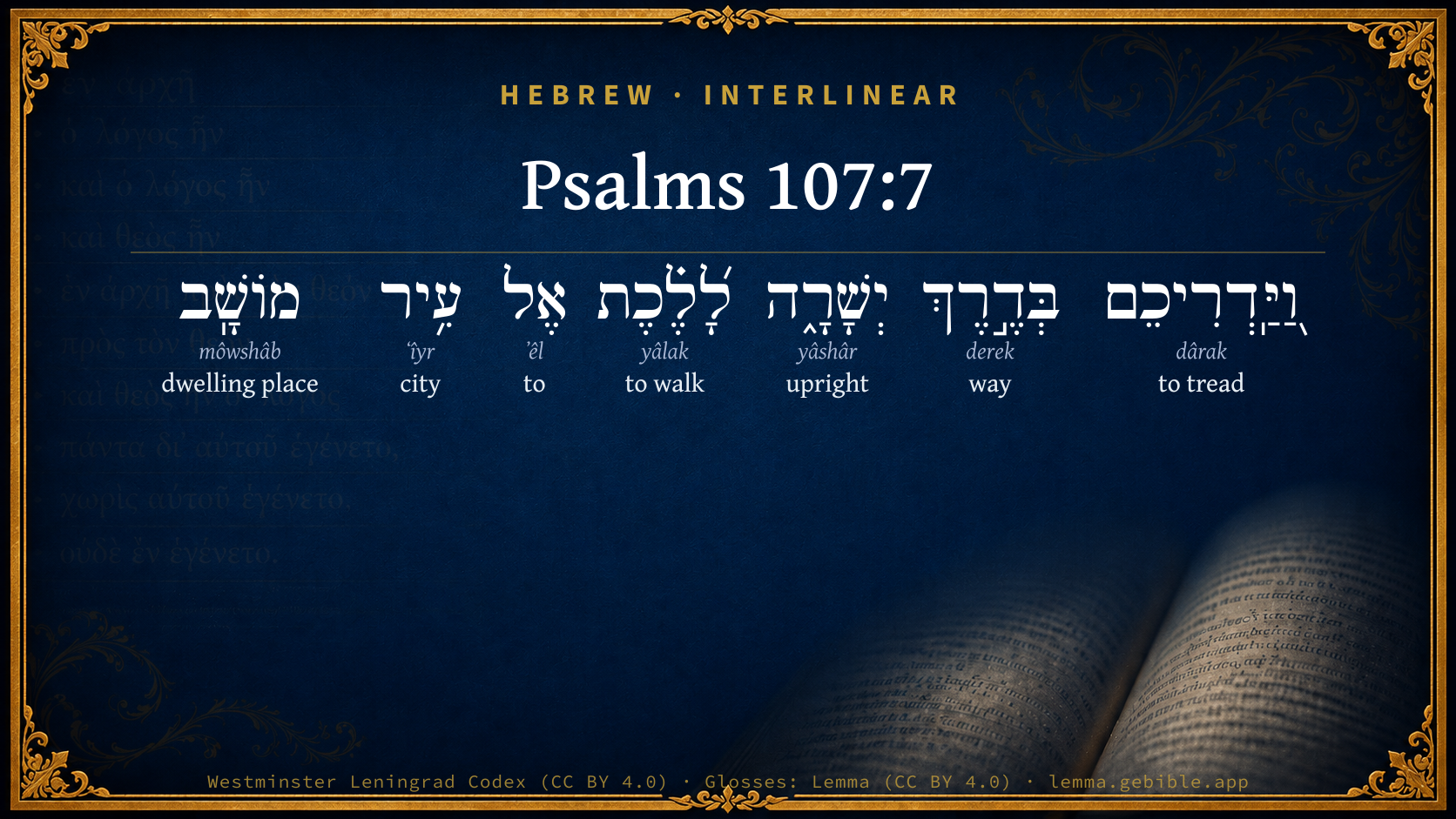
Hebrew (Westminster Leningrad Codex) Psalms 107:7 appears in the Hebrew Old Testament. The text above is from the Westminster Leningrad Codex. Each word links to its Strong’s number, a concise gloss, and parsing drawn from the Open Scriptures Hebrew Bible morphology. Click any word for its full Brown-Driver-Briggs (BDB) entry.
Download image
Cite this verse

Psalms 107:7 (World English Bible). Public Domain. Lemma interlinear Bible study tool, https://lemma.gebible.app/v/psalms/107/7.

Show BibTeX & RIS
BibTeX
RIS
English Translation
He led them also by a straight way, That they might go to a city to live in.
World English Bible · Public Domain
Download a study sheet

One document with this verse’s original text, its word-by-word gloss line, the meaning frame, cross-references with their text, attributed commentary, and full source and license credits — printable, and it pastes into notes with its structure intact.

This verse Autodidact and up

Study sheet (.html) Plain text (.txt)

A passage Seminary Student

Up to 50 verses in one chapter. A passage sheet keeps up to 6 commentary sources and 12 cross-references per verse, in the order this page ranks them, and says so on the sheet whenever that leaves anything out. Ask for a single verse and you get the Autodidact verse sheet above.

Everything on this page stays free to read, with no account — the sheet is a download of what is already on screen, not access to it.

Want to remove ads? Support Godless Engineer
Compare translations 3

The same verse in 3 English versions, stacked beneath the original-language interlinear above. Click any original word for its lexicon entry.

Each is an independent rendering of the whole verse — the interlinear is not word-aligned to these translations.

Highlighted words mark where these versions differ — a whole-verse word diff, not a word-by-word alignment.

  • World English Bible Public Domain
    He led them also by a straight way, That they might go to a city to live in.
  • King James Version Public Domain
    And he led them forth by the right way, that they might go to a city of habitation.
  • unfoldingWord Literal Text CC BY-SA 4.0
    He led them by a direct path to go to a city of dwelling.

unfoldingWord Literal Text — © unfoldingWord, licensed CC BY-SA 4.0. Word-aligned USFM3 via Door43 (git.door43.org/unfoldingWord/en_ult).

Versions to compare (up to 4)

3 of 4 selected

Show all 18 translations

Every available English version of this verse, each an independent rendering of the whole verse.

  • World English Bible Public Domain
    He led them also by a straight way, That they might go to a city to live in.
  • Berean Standard Bible Public Domain
    He led them on a straight path to reach a city where they could live.
  • Majority Standard Bible Public Domain
    He led them on a straight path to reach a city where they could live.
  • King James Version Public Domain
    And he led them forth by the right way, that they might go to a city of habitation.
  • American Standard Version (1901) Public Domain
    He led them also by a straight way, That they might go to a city of habitation.
  • Revised Version (1885) Public Domain
    He led them also by a straight way, that they might go to a city of habitation.
  • Geneva Bible (1599) Public Domain
    And led them forth by the right way, that they might goe to a citie of habitation.
  • Douay-Rheims (1899) Public Domain
    And he led them into the right way: that they might go to a city of habitation.
  • Young's Literal Translation Public Domain
    And causeth them to tread in a right way, To go unto a city of habitation.
  • Literal Standard Version CC BY-SA 4.0
    And causes them to tread in a right way, || To go to a city of habitation.
  • Unlocked Literal Bible CC BY-SA 4.0
    He led them by a direct path so that they would go to a city to live in.
  • unfoldingWord Literal Text CC BY-SA 4.0
    He led them by a direct path to go to a city of dwelling.
  • Darby Bible Public Domain
    And he led them forth by a right way, that they might go to a city of habitation.
  • World Messianic Bible Public Domain
    He led them also by a straight way, that they might go to a city to live in.
  • Webster's Bible Public Domain
    And he led them forth by the right way, that they might go to a city of habitation.
  • Free Bible Version CC BY-SA 4.0
    He led them along a straight way to a city where they could live.
  • Bible in Basic English Public Domain
    Guiding them in the right way, so that they might come into the town of their resting-place.
  • JPS Tanakh (1917) Public Domain
    And He led them by a straight way, that they might go to a city of habitation.

Literal Standard Version (2020), Covenant Press — licensed CC BY-SA 4.0. Text via the HelloAO Bible API (eBible.org). Unlocked Literal Bible (unfoldingWord) — licensed CC BY-SA 4.0. Text via the HelloAO Bible API (eBible.org). unfoldingWord Literal Text — © unfoldingWord, licensed CC BY-SA 4.0. Word-aligned USFM3 via Door43 (git.door43.org/unfoldingWord/en_ult). Free Bible Version, Dr. Jonathan Gallagher — licensed CC BY-SA 4.0. Text via the HelloAO Bible API (eBible.org).

Word by word

More ways to search: Search by grammar → Find every occurrence → Compare this word →

Practice this passage: Drill this verse → Learn its vocabulary →

About this verse

These counts appear in no published source. They are computed here, from the morphology-tagged text and Lemma’s own curated glosses. What Lemma adds →

7
words
7
distinct lemmas
Wisdom
section

Shared distinctive vocabulary

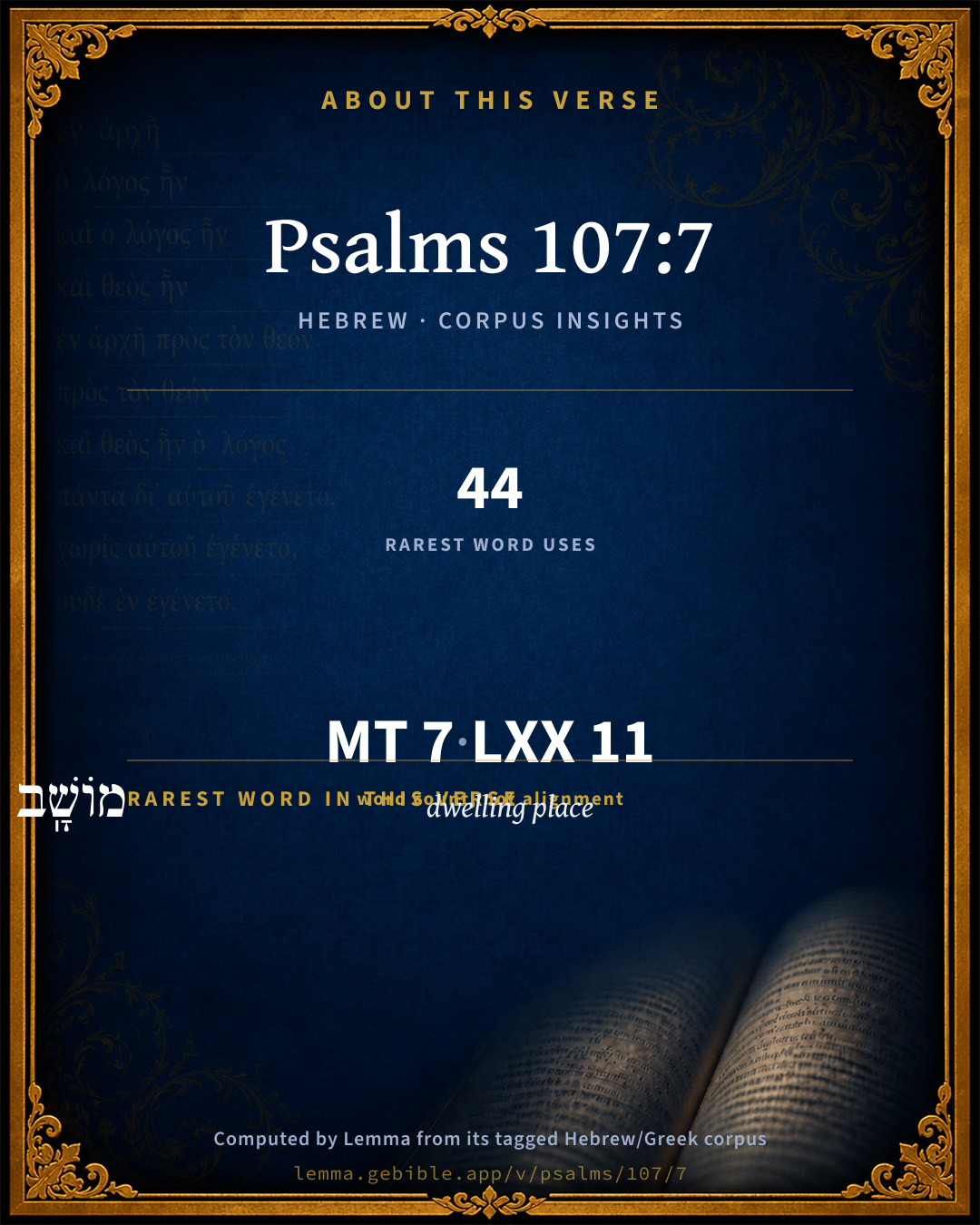
מוֹשָֽׁב dwelling place H4186 occurs in 43 verses of the Hebrew Bible. Also found in:

Grammatical profile

  • 2 verbs
  • 3 nouns
  • 1 adjective
  • 1 preposition

Verb forms

  • וַ֭יַּֽדְרִיכֵם Hiphil · Sequential Imperfect
  • לָ֝לֶ֗כֶת Qal · Infinitive Construct

Hebrew & Septuagint length

In English translation the verse runs 18 words from the Hebrew and 17 from the Septuagint (LXX English) — closely comparable.

A rough comparison of the two English renderings, which tokenize alike — not a word-level alignment.

Word counts can differ between the Hebrew and the Greek without any difference in meaning — e.g. the Hebrew direct-object marker אֵת has no separate Greek word, and Greek often adds the article ὁ.

In the original languages it is 7 Hebrew tokens and 11 Greek tokens — but the two are counted differently (Hebrew bundles its prefixes and suffixes into one token; the Greek is in lemma form), so that isn’t a like-for-like length.

Cross-references

24

Topical passages linked to Psalms 107:7 in the Treasury of Scripture Knowledge — connected by theme and wording, ordered by reader-vote popularity; previews shown in the World English Bible.

  • Jeremiah 31:9 They shall come with weeping; and with petitions will I lead them: I will cause them to walk by rivers of waters, in a straight way in which they shall not stumble; for I am a father to Israel, and Ephraim is my firstborn.
  • Ezra 8:21–23 Then I proclaimed a fast there, at the river Ahava, that we might humble ourselves before our God, to seek of him a straight way for us, and for our little ones, and for all our substance.
  • Psalms 77:20 You led your people like a flock, By the hand of Moses and Aaron.
  • Hebrews 11:9–10 By faith, he lived as an alien in the land of promise, as in a land not his own, dwelling in tents, with Isaac and Jacob, the heirs with him of the same promise.
  • Hebrews 12:22 But you have come to Mount Zion, and to the city of the living God, the heavenly Jerusalem, and to innumerable hosts of angels,
  • Nehemiah 11:3 Now these are the chiefs of the province who lived in Jerusalem: but in the cities of Judah lived everyone in his possession in their cities, [to wit], Israel, the priests, and the Levites, and the Nethinim, and the children of Solomon's servants.
  • Psalms 78:52 But he led forth his own people like sheep, And guided them in the wilderness like a flock.
  • Psalms 107:4 They wandered in the wilderness in a desert way. They found no city to live in.
  • Psalms 107:36 There he makes the hungry live, That they may prepare a city to live in,
  • Isaiah 30:21 and your ears shall hear a word behind you, saying, This is the way, walk you in it; when you turn to the right hand, and when you turn to the left.
  • Isaiah 49:8–11 Thus says Yahweh, In an acceptable time have I answered you, and in a day of salvation have I helped you; and I will preserve you, and give you for a covenant of the people, to raise up the land, to make them inherit the desolate heritage:
  • Jeremiah 33:10–13 Thus says Yahweh: Yet again there shall be heard in this place, about which you say, It is waste, without man and without animal, even in the cities of Judah, and in the streets of Jerusalem, that are desolate, without man and without inhabitant and without animal,
  • Hebrews 11:16 But now they desire a better country, that is, a heavenly one. Therefore God is not ashamed of them, to be called their God, for he has prepared a city for them.
  • 2 Peter 2:15 forsaking the right way, they went astray, having followed the way of Balaam the son of Beor, who loved the wages of wrong-doing;
  • Isaiah 48:17 Thus says Yahweh, your Redeemer, the Holy One of Israel: I am Yahweh your God, who teaches you to profit, who leads you by the way that you should go.
  • Isaiah 63:13–14 who led them through the depths, as a horse in the wilderness, so that they didn't stumble?
  • Jeremiah 6:16 Thus says Yahweh, Stand you in the ways and see, and ask for the old paths, where is the good way; and walk therein, and you shall find rest for your souls: but they said, We will not walk [therein].
  • Jeremiah 31:24 Judah and all the cities of it shall dwell therein together, the farmers, and those who go about with flocks.
  • Jeremiah 31:38–40 Behold, the days come, says Yahweh, that the city shall be built to Yahweh from the tower of Hananel to the gate of the corner.
  • 2 Peter 2:21 For it would be better for them not to have known the way of righteousness, than, after knowing it, to turn back from the holy commandment delivered to them.
  • Revelation 21:2–4 I saw the holy city, New Jerusalem, coming down out of heaven from God, made ready like a bride adorned for her husband.
  • Revelation 21:10–27 He carried me away in the Spirit to a great and high mountain, and showed me the holy city, Jerusalem, coming down out of heaven from God,
  • Psalms 136:16 To him who led his people through the wilderness; For his loving kindness endures forever:
  • Isaiah 35:8–10 A highway shall be there, and a way, and it shall be called The way of holiness. The unclean shall not pass over it, but is shall be for for him who walks in the Way. Wicked fools will not go there.

Cross-references courtesy of OpenBible.info (CC BY 4.0).

Hebrew and Greek witnesses Masoretic Hebrew ↔ Greek Septuagint

The same verse in the two great witnesses to the Old Testament, shown verse-for-verse.

You’re reading Greek Psalm 106 (Hebrew Psalm 107). The Septuagint counts the superscription, so verse numbers can differ from the Hebrew — chapter-level alignment, not verse-by-verse. Numbering follows Rahlfs.

These are two independent witnesses, not word-aligned to each other, and the Septuagint is shown in lemma (dictionary) form.

Hebrew Psalms 107:7 Masoretic · Westminster Leningrad Codex

וַ֭יַּֽדְרִיכֵם בְּדֶ֣רֶךְ יְשָׁרָ֑ה לָ֝לֶ֗כֶת אֶל עִ֥יר מוֹשָֽׁב

He led them also by a straight way, That they might go to a city to live in.

World English Bible · Public Domain

Greek LXX Greek Psalm 106:7 Septuagint · lemma form

καί ὁδηγέω αὐτός εἰς ὁδός εὐθύς ὁ πορεύομαι εἰς πόλις κατοικητήριον

And he guided them into a straight path, that they might go to a city of habitation.

LXX2012 (modern English Septuagint) · Public Domain

Hebrew: Westminster Leningrad Codex (CC BY 4.0). Greek: Septuagint (public domain); English from LXX2012 (modern English Septuagint) (Public Domain). How the Septuagint differs from the Hebrew →

Commentary

Notes on Psalms 107:7 from classic Christian and Jewish commentators (each source and its license shown beneath its notes). The classic Christian expositions comment on the surrounding passage and are grouped to its opening verse, so a note may address several verses; the Jewish commentaries on the Tanakh (Rashi and others) are per-verse, so they appear only where the commentator wrote on this verse.

Lemma curates 59 commentaries, every one of them public domain or Creative Commons licensed, each selected and text-cleaned for this edition rather than reprinted as found. About our sources →

Trapp's Complete Commentary

John Trapp

Psa 107:7 And he led them forth by the right way, that they might go to a city of habitation.

Ver. 7. And he led them forth by the right way] Better than that Dea Vibilia among the Romans, of whom they fancied that she set them right when out of the way at any time; or Minerva among the Athenians, who, they said, turned all their evil counsels to the best unto them.

That they might go to a city of habitation] Grow to a state of settlement, to Jerusalem, saith the Chaldee; to that city which hath a foundation, may we say, whose maker and founder is God, Heb 11:10.

John Trapp, A Commentary or Exposition upon All the Books of the Old and New Testament (1647–1656) — public domain. Text from a community e-Sword module.

The Biblical Illustrator

Joseph S. Exell

Psa_107:7

He led them forth by the right way.

The way and guide to heaven

I. The end for which the people of God were led forth from Egypt was that they might come to a city of habitation; in other words, to a city, or cities, which they might inhabit. Are you by faith in Christ Jesus the sons of God? He, who has given you the adoption of sons here, will not withhold the inheritance of sons hereafter.

II. The way by which the believer is led to that city of habitation.

1. It is not the nearest. His heavenly Father knows t.hat it is expedient for him, as for Israel, to be led about and instructed.

2. It is not the pleasantest. Like a wilderness, it is a dry and thirsty land. The soil is barren--its waters are bitter and often fail. The road is the narrow way, intricate to discover, difficult, to pursue, and having but few that find it.

3. To all appearance, it is not the safest. An enemys country. A snare at every step.

4. Yet it is the only sure road to those pleasures which are for evermore.

III. The guide.

1. He is experienced.

2. He is fitted to sympathize with those who are toiling along the difficult road, in that He Himself hath suffered, being tempted.

3. He is a watchful, careful Guide.

4. He is also a supporting and upholding Guide; not merely leading His people through every difficulty, but either removing every impediment, or enabling the pilgrim to overcome it.

Conclusion:

1. See the necessity of a guide in the journey of life.

2. Is the wilderness the right way to the city of habitation? Then how easy should it make us under all the discouragements, weariness, temptations, dangers of the journey!

3. Remember that none reach that city but the redeemed of the Lord. Is this your character? (R. Davies, M.A.)

The way of the redeemed

I. The way of the redeemed.

1. Long.

2. Difficult.

3. Lonely.

4. A desert way.

II. The rectitude of the way. It is the right way.

1. It is the Divine way.

2. To what it leads: the city of habitation.

Two lessons.

1. Take an enlarged view of the Divine conduct. Remember the end of it all.

2. Ever seek the Divine guidance. God goes before; follow, trust Him. (Preachers Analyst.)

The right way

The psalm is a series of pictures; and they are not pictures of light and joy. They are scenes of distress and uttermost extremity. The lost traveller, ready to die in the silence of the wilderness! the reeling sailor, dashed with spray, and watching every coming billow in the fear that it may be his grave! the fettered prisoner, weeping his life away in the darkness of the dungeon! the sick and dying man, clinging still to this life, but looking fearfully or to another!--such scenes of extremity the psalmist paints; and while we are thinking that no deliverance is possible, lo! the deliverance is wrought;--the traveller is on his way; the sailor is in his haven; the prisoner is looking down to the dungeon where he lay; the sick and dying soul is filled again with life! Such are the wonders wrought by Divine goodness!

I. The company. Any considerable company of men is imposing. Nothing more quickly raises our interest than a large assemblage of human beings. The march of an army, the movement of a procession, the gathering of some great multitude for deliberation or for worship, even the rush of a common city crowd, will make the heart throb with unusual emotion. But here is a company more illustrious than any other upon earth, a company overwhelming in its vastness, and yet ever growing in numbers--calm in aspect, and yet irresistible in power--aiming at the noblest objects, manifesting the purest character, adorned with supernatural symbols of distinction, and pursuing her sublime and silent march from time into eternity under the direction of a guide invisible to all but her!

II. The leader. The leader of this ransomed company is the Lord himself. The Bible abounds with intimations of the nearness of God, and particularly with assurances of His actual and perpetual presence with His people as their guide, and guard, and everlasting friend (Isa_48:17; Isa_41:10; Mat_28:20.)

III. The way. Happily to some it is covered with the clouds of disappointment; to others it is bleak and cold with the gales of adversity; to others it is drenched with the rains of sorrow. It has places of heart-wringing separation from fellow-pilgrims, and even deep, dark gulfs of sin; but netwithstanding all its mystery, and all the wrongness put into it by ourselves and others, as Gods way, it is always right--right in shade as well as in sunshine,--right in winter as well as in summer,--right to all alike who are in the way,--and right on to the end.

IV. The end. The idea chiefly brought before us is that of heaven as a fixed and settled home, a peaceable habitation, a sure dwelling, a quiet resting-place for ever. The way is narrow, but it leads on to the large and wealthy place. It is rugged; but it opens at last into green pastures, and winds beside still waters, over which no blight or blast can come. It is a way of ceaseless toil and watchfulness; but they will be repaid by the rest that cannot be broken, by the joy that cannot end. It is long--at least in our days of suffering and dreariness we think so; but seen in retrospect, and when it has been all trodden, it will look but like the journey of a day. (A. Raleigh, D.D.)

The right way

This old Hebrew history is turned into a parable of our Christian life. There is a prophecy at the heart of it, and this prophecy says, Judge not by the feeble glimmering light of human judgment. Gods ways are higher than your ways; they take in higher issues, and immortal results. The Father will lead you by the right way. Press forward, for, as Quarles says, he goeth back that continueth not.

I. The moral side of life is higher than the material. To please self is the aim of most men, yet most patent is the fact, that to deny self-indulgence to ourselves is beneficial. The very physical frame, its laws of health and vigour, declare that! It requires, however, little self-denial to give up what is simply pleasant to the taste or to the eye. These are mere outward things. The more thoughtful student of life will see that God places human life under a higher and more searching discipline. A man is placed where his pride must be denied, his mental prepossessions laid aside, his will subordinated, his inmost purpose chastened.

II. The pilgrim side of life is always prospective. It is no mere maze. We never return. Ours may be a long way, a winding way, but it is forward. A Christian man will feel with modesty, and yet with certainty, that his path is progress, that he does know more of the love of Christ, that his affections are more set on heaven, that salvation is nearer than when he believed, that the pilgrimage is one of temptation conquered, grace bestowed, and glory nearer to the soul. Spiritual pilgrimage is not a deceit in the moral sense. God is not allowing us to experience all these emotions merely that the circle of our little life may complete itself in the grave. We are nearing home, we shall soon be with Christ, which is far better.

III. The leadership of life is in the hands of Christ. Tell me who is leader, and I can also tell you much. Men admire sacrifice of ease and wealth, absence of bribe and advantage; and in Greece they glorified Socrates and Aristides, and in Rome, Quintus Curtius and Regulus. Men crave leaders, and can appreciate courage and self-control; only too often, alas, men do not ponder on the sacredness of the cause, the end of the ambition, the spirit of the campaign or pilgrimage. What we have to teach and to live in this age is that the Christ-led way is the right way.

IV. The pilgrimage ends in the fellowship of home. The discontinuance of things here below is the saddest of all experiences. Vessels keep coming and going out of this little bay of life. Along the roads new pilgrims appear where others rested; they loose their sandals, refresh themselves at the wells, and rise betimes for their onward way. We are quiet spectators of such pictures, and note the effects of change and time on others. For us, too, there is change and discontinuance. What we want is permanence! It is the beauty of the Christian Revelation that it uses all the symbols of a home to give our hearts rest in the thought of departure; that is what we want, that has been dearest after all to judge and soldier, merchant and statesman, monarch and peasant--the home! Yes, no image of court or temple is so inspiring as this--my Fathers house. (W. M. Statham.)

The right road

I. The right road. Christianity is much more than sentiment; it is right living. The road that leads to the Cross of Christ.

II. The leader. We need these elements in a leader:

1. Strength. Who is stronger than this mighty King of kings? etc.

2. Wisdom. He knoweth all things, etc.

3. Tenderness. Christ taketh in His arms the little helpless child.

III. The end of this road.

1. There is no entrance to the Eternal City except by this right way.

2. The Bible is the only guide-book for the pilgrim in this way.

3. The Christian who is helped by his Leader should also freely help all weak and overloaded brethren in this way.

4. Always bear in mind the end of your journey--heaven. (T. L. Cuyler, D.D.)

The right in life

God is the leader of humanity. The way He leads is always the right way. There are many wrong ways; there is only one right.

I. The right way is always Gods way.

1. His existence is the foundation of right.

2. His will is the law of right.

3. His Son is the revelation of His will to fallen man.

II. The right way is always a trying way. That is, always trying to fallen man. It involves great struggles, and often much anguish. It involves the abandonment of the old and the adoption of the new.

III. The right way is ever the prosperous way. Right is always expedient. The path of duty is at once the path of safety and success.

IV. The right way is always supernatural. (Homilist.)

Present dispensations the right way to glory

I. The happy place to which every true believer is taking his journey. How great a satisfaction does it afford, to the weary pilgrim that has borne the burden in the heat of the day, to hear of a rest to which he shall soon arrive? a city of habitation, where he shall for ever dwell? a crown of glory which he shall ever wear? And this is the lot not only of some, but of all Gods children; they shall not always be tossed with tempests.

II. The intermediate space through which the believer is to pass, in his way to this city of habitation.

1. This present world is a state of distance, and in this respect it may be fitly compared to a wilderness.

2. This present world through which we were passing may be justly styled a wilderness, as it is a solitary and barren way.

3. This present world through which we are passing is also properly compared to a wilderness, as it is likewise a dangerous way.

III. God leads his people by the right way to the city of habitation. Let us only take a view of three particular seasons, wherein we are most apt to question the lovingkindness of our God, and we may by them determine the happy issue of all the rest.

1. Let us begin with the melancholy state and condition of those from whom God hides the light of His countenance. Were He never to hide His face, we should live upon the streams rather than the fountain; we should be too ready to say with the three disciples, Lord, it is good for us to be here; without pressing after any further manifestations in a better world.

2. Concerning the various outward afflictions with which the believer is exercised. They are all of them, let them arise from what quarter soever, useful to us, and necessary for us.

3. The temptations of Satan every one of them answer the same general end. The powers of darkness are suffered to dwell amongst us, for the same reason that some of the Canaanites were left among the people of Israel; that is, to try us, and show us how weak we are without Christ; and how strong we are when we depend upon that grace which is treasured up in Him.

IV. Practical remarks.

1. Has God prepared for His people a city of habitation? how great then is that grace, how free and sovereign is that love, to which this was originally owing.

2. Are we to pass through the wilderness to this city of habitation? How much need have we of a guide to show us the way, and how thankful should we be to Him who has undertaken to perform this kind office for us.

3. Is the way of the wilderness the right way to a city of habitation? How easy should this make us under all the temptations, trials, and afflictions with which we are now exercised.

4. Can none get admission into this city of habitation but the redeemed of the Lord? (verse 2). Let this lead us to Christ Jesus, the only person who is of God made unto us wisdom, righteousness, sanctification and redemption (1Co_1:30). (John Hill.)

The Leader and the way to heaven

I. The leader. Every true man is proud of his leader. If we had asked those brave men who lately sailed to the far north whom they followed, they would have uttered, with flashing eye, the name of their captain; if we could have asked those who fought at Waterloo who was their general, they would have answered, with eager pride, Wellington! So we, if the world asks us of our leader, can answer Jesus, Name which is above every Name, Name of victory, Name of power, Name of love, Name of sweetness.

II. The right way. There is but one way to heaven, that which God chooses for us, and where Jesus leads. That way may take us through various scenes and circumstances. Some amongst us are destined to be rich, others poor; for some the way of life lies in active scenes, for others in quiet retirement; some are frequently exposed to the fierce sun of trouble, others are more sheltered from the storms of life. Still, through whatever scenes our way of life may tend, we must strive to make it the right way. What, then, is this right way? It is the Kings highway, the way of holiness. (Anon.)

The Leader and the way in providence

The way by which God led them was--

I. A long way. For example, the answer to prayer is sometimes long delayed; but if the blessing tarry, wait for it,--it is worth waiting for, and will come at last.

II. A desolate way. Your way to heaven lies through the wilderness--the wilderness of His world. There is no other way, and there could be no better way. There might be a smoother, easier, more flowery, less thorny path; but such a path might lead you to lose sight of your journeys end, and of your own character as pilgrims.

III. A difficult way. All our powers are improved by exercise; the very muscles of our bodies require labour to form and bring them to their full strength. So it is with our powers of mind; their education consists in meeting and overcoming difficulties. So it is in regard to the higher powers of the soul; they are matured and perfected by the labours and difficulties that meet us in the way to heaven In all our labours we have a direct object in view, which may often seem very ignoble and temporary. Much of our time and effort are engaged in securing the bread that perisheth, gold that perisheth, and other things that perish in the using. But in this very labour, God has another object in view--our preparation for the active duties of heaven, and the forming in us of qualities that may fit us to act our part there.

IV. A dangerous way. Our pilgrimage, like theirs, is a warfare. We wrestle not against flesh and blood, but against the principalities and powers of darkness. Therefore we must not only be strong in the Lord, but take to ourselves the whole armour of God.

V. An unknown way. (C. G. Scott.)

A trustworthy guide

A famous Swiss guide recently interviewed by a magazine writer is reported as saying: There are guides and guides. One takes you up and trusts to luck. He is ready for anything, but does not know what is coming, he guesses where he is, when you ask: How far off is the peak? I never do that. Before I start on a new track, or one I have not made before, I study it fully. I make a map of it. I watch it through the glass until I know it. When I say Go, then I can see what is before me. On the mountain I must always know where I am. Im not scientific, but I must carry my map with me and point: We are here. I never start without my compass, thermometer, and aneroid, so that when you come to me at any moment and ask: Where are we? I can say: Here, and it is so many feet from the top. So is it with the souls great Guide. Jesus knows every inch of the way, has never failed a single traveller, and can say: None lost, or ever shall be. (H. O. Mackey.)

The Biblical Illustrator, edited by Joseph S. Exell (c. 1880s–1900s) — public domain. Text from a community e-Sword module.

J. A. Alexander on Psalms

Joseph Addison Alexander

7. (Psa 107:7) And he led them in a straight course, to go to a city of habitation. No exact version can preserve or imitate the paronomasia arising from the etymological affinity of the first verb and noun, analogous to that between the English walk and to walk, though the Hebrew forms are only similar and not identical. The idea of physical rectitude or straightness necessarily suggests that of moral rectitude or honesty, commonly denoted by the Hebrew word.

Joseph Addison Alexander, The Psalms Translated and Explained (1850) — public domain. Text from a community e-Sword module.

Tyndale Open Study Notes

Tyndale Open Resources

107:7-8 God led them like a shepherd (see 23:1). • Verse 8 is a refrain that is repeated in 107:15, 21, 31.

Tyndale Open Study Notes — © Tyndale Open Resources, licensed CC BY-SA 4.0. Text via the HelloAO Bible API.

Adam Clarke's Commentary

Verse 7. That they might go to a city of habitation.] God stirred up the heart of Cyrus to give them liberty to return to their own land: and Zerubbabel, Ezra, and Nehemiah, at different times, brought many of them back to Judea.

Adam Clarke's Commentary on the Bible (1810–1826) — public domain. Text from a community e-Sword/MySword module.

Ellicott's Commentary for English Readers

(7) By the right way.—Better, in a straight way. Even in the pathless wilderness “there is a hand that guides.”

A Bible Commentary for English Readers, edited by Charles John Ellicott (1878–1897) — public domain. Text from a community e-Sword module.

The Cambridge Bible for Schools and Colleges

gen. ed. J. J. S. Perowne

7. And he guided them in a straight way,

That they might go to a city of habitation.

The Cambridge Bible for Schools and Colleges (gen. ed. J. J. S. Perowne; Cambridge University Press, 1878–1918) — public domain. Text from a community e-Sword module.

John Gill's Exposition

O that men would praise the Lord for his goodness,.... For his providential goodness, in providing food and drink for them, when fainting; in directing them to their right way, when they had lost it; and in bringing them safe to the place they were bound for: and particularly for his special grace and goodness, in redemption and effectual calling; for bringing out of a wilderness state and condition, and supplying them with all spiritual provisions, and putting them in the right way to eternal glory and happiness.

And for his wonderful works to the children of men! as all the above things are wonderful ones, both in providence and grace. This verse is repeated at the close of each of the instances produced; in which the goodness of God appears to persons in distress, and who being delivered, ought to acknowledge it, and be thankful for it: or "confess": that is, declare to God his goodness, and to the children of men his wonderful works; so the Targum.

John Gill's Exposition of the Whole Bible (1746–1763) — public domain (CC PDM 1.0). Text via the HelloAO Bible API.

Albert Barnes' Notes on the Bible

And he led them forth by the right way - A literal version, if the term necessary to express it might be allowable, would be,” He wayed them in a straight way;” he made a way for them, and that was a straight way. He conducted them in the most direct path to the land to which they were going.

That they might go to a city of habitation - A city where they might permanently dwell. The word “city” here seems to be used in the sense of “abode;” and the idea is, that he led them to a land where they might cease to be wanderers, and might find a settled home.

Albert Barnes' Notes on the Bible (1834–1885) — public domain. Text from a community e-Sword/MySword module.

Matthew Poole's English Annotations

Led them forth out of the wilderness, where they had lost their way, Psa 107:4.

A city of habitation: See Poole "Psa 107:4".

Matthew Poole's English Annotations on the Holy Bible (1683–1685) — public domain. Text from a community e-Sword/MySword module.

The Treasury of David

Charles H. Spurgeon

Ver. 7. And he led them forth by the right way. There are many wrong ways, but only one right one, and into this none can lead us but God himself. When the Lord is leader the way is sure to be right; we never need question that. Forth from the pathless mazes of the desert he conducted the lost ones; he found the way, made the way, and enabled them to walk along it, faint and hungry as they were.

That they might go to a city of habitation. The end was worthy of the way: he did not lead them from one desert to another, but he gave the wanderers an abode, the weary ones a place of rest. They found no city to dwell in, but he found one readily enough. What we can do and what God can do are two very different things. What a difference it made to them to leave their solitude for a city, their trackless path for well frequented streets, and their faintness of heart for the refreshment of a home! Far greater are the changes which divine love works in the condition of sinners when God answers their prayers and brings them to Jesus. Shall not the Lord be magnified for such special mercies? Can we who have enjoyed them sit down in ungrateful silence?

Ver. 7. He led them forth. Forth out of the worldforth out of a professionforth out of a name to liveforth out of every thing hateful in his holy and pure eyes. J.C. Philpot.

Ver. 7. And he led them forth by the right way, etc. Alexander translates this verse"And he led them in a straight course, to go to a city of habitation"; and adds, "No exact version can preserve or imitate the paronomasia arising from the etymological affinity of the first verb and noun, analogous to that between the English walk and to walk, though the Hebrew forms are only similar and not identical. The idea of physical rectitude or straightness necessarily suggests that of moral rectitude or honesty, commonly denoted by the Hebrew word."

Ver. 7. A city of habitation. Not a city of inspection! Many (Eternal God, will it be any of this company?) will look in; and "there shall be weeping and wailing and gnashing of teeth, when they shall see Abraham, Isaac, and Jacob in the kingdom of God, and they themselves shut out." Not a city of visitation. Christians shall not only enter, but abide. They shall go no more outit is "a city of habitation." This conveys the idea of repose. The Christian is now a traveller; then he will be a resident: he is now on the road; he will then be at home: "there remaineth a rest for the people of God." It reminds us of a social state. It is not a solitary condition; we shall partake of it with an innumerable company of angels, with all the saved from among men, with patriarchs, prophets, apostles, martyrs, our kindred in Christ. "These are fellow citizens of the saints, and of the household of God." It suggests magnificence. It is not a village, or a town, but a city of habitation. A city is the highest representation of civil community. There have been famous cities; but what are they all to this! William Jay.

Ver. 7. Divine grace stimulating our exertions. "He led them forth ...that they might go."

Psalms 107:8*

Charles H. Spurgeon's The Treasury of David (1869–1885) — public domain. Psalms only. Text from a community e-Sword/MySword module.

Whedon's Commentary on the Bible

Daniel D. Whedon

7. He led them forth by the right way—See Ezr_8:21-23; Ezr_8:31-32.

City of habitation—A city of permanent abode, as opposed to their life of wandering.

Daniel D. Whedon (gen. ed.), Commentary on the Old and New Testaments (1874–1909) — public domain. Text from a community e-Sword module.

The Pulpit Commentary

And he led them forth by the right way; or, "by a straight way a way in which there was no crookedness. That they might go to a city of habitation. The same phrase as in ver. 4. A city suitable for habitation is meant.

The Pulpit Commentary (1880–1919), ed. H.D.M. Spence-Jones & Joseph S. Exell — public domain. Text from a community e-Sword module.

John Wesley's Explanatory Notes

Forth - Out of the wilderness.

John Wesley, Explanatory Notes Upon the Whole Bible (1754–1765) — public domain. Text via the GEBible commentary corpus.

Rashi

Rabbi Shlomo Yitzchaki (Rashi)

And He led them And He led them; therefore, they shall give thanks to the Lord for His kindness.

Rashi on the Tanakh — English translations: “The Judaica Press complete Tanach with Rashi, translated by A. J. Rosenberg” (CC BY 4.0); “Pentateuch with Rashi's commentary by M. Rosenbaum and A.M. Silbermann, 1929-1934” (public domain); “The Metsudah Tanach series, Lakewood, N.J” (CC BY 4.0); and “The Book of Joshua, Metsudah Publications, 1997” (CC BY 4.0). Text via Sefaria.

Lesson kit

Teaching starters — assembled from the data on this page, not authored interpretation. Every prompt links to the verse data it draws on. Edit before teaching.

Psalms, in the Wisdom, opens this verse with 7 words (7 distinct Hebrew lemmas). Its most distinctive word is môwshâb (“dwelling place”). A historical commentator’s framing appears above. Read the whole chapter for the surrounding context.

Discussion questions

  1. The word môwshâb carries the sense “dwelling place.” How does it shape the verse?
  2. How does Genesis 10:30, which shares the word «dwelling place», read alongside this verse?
  3. These translations render this verse differently; the difference is in the English rendering, not the original. What questions does that raise?
  4. «וַ֭יַּֽדְרִיכֵם» is a Hiphil Sequential Imperfect verb. How does that grammatical form shape the action described?
  5. Compare how Trapp's Complete Commentary and The Biblical Illustrator read this verse. Where do they agree or differ?

Things to notice

Reading settings

Reading text

Shown beneath each verse's original-language words.

Old Testament
Old Testament edition

Read the OT as the Masoretic Hebrew (MT) or the Greek Septuagint (LXX).

English shown for the Greek Septuagint (in the Hebrew ↔ Greek comparison).

Comparing translations? Open the Compare panel on any verse page to stack up to four side by side.