
Proverbs 2:7

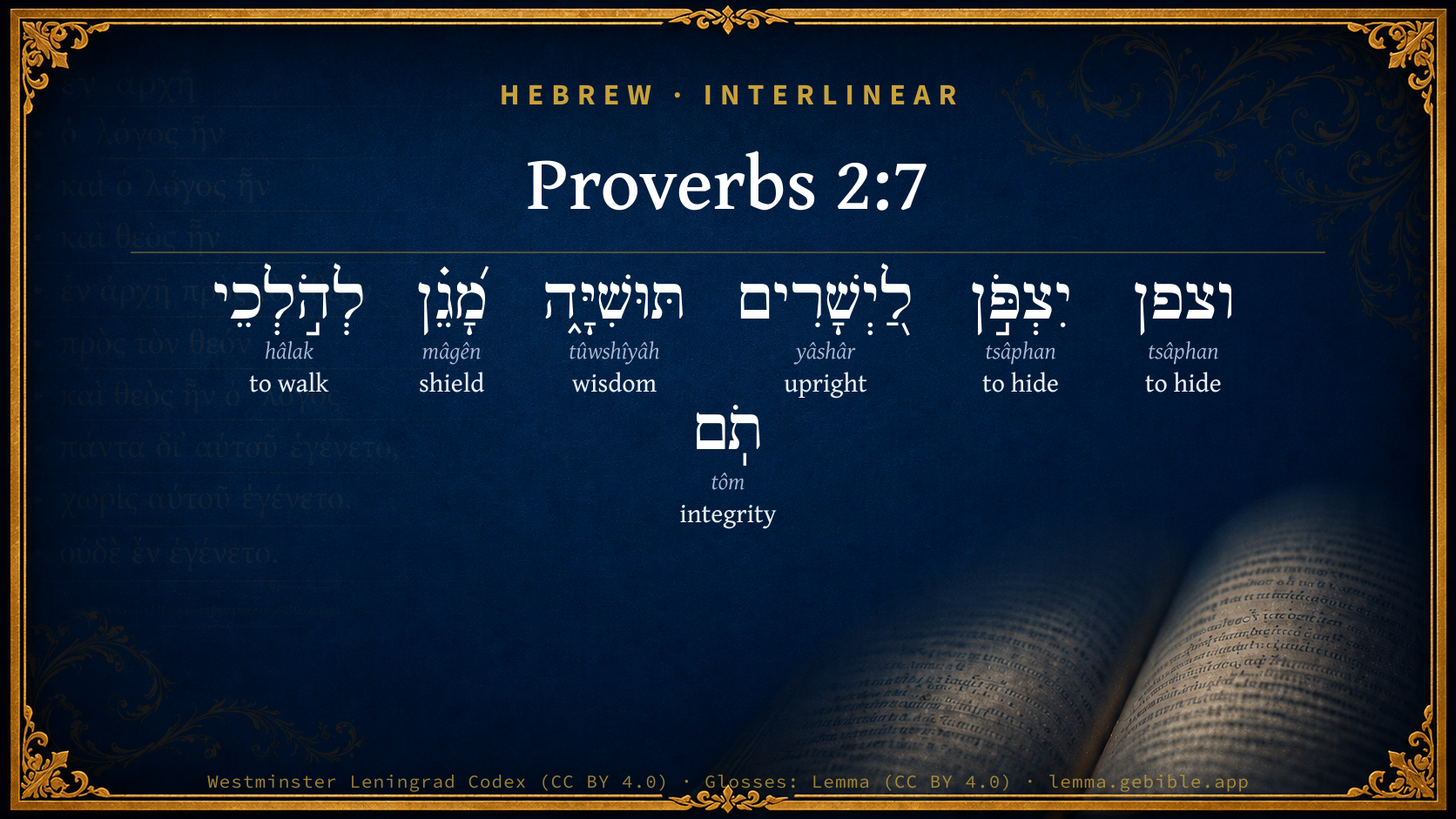
Hebrew (Westminster Leningrad Codex) Proverbs 2:7 appears in the Hebrew Old Testament. The text above is from the Westminster Leningrad Codex. Each word links to its Strong’s number, a concise gloss, and parsing drawn from the Open Scriptures Hebrew Bible morphology. Click any word for its full Brown-Driver-Briggs (BDB) entry.
Download image
Cite this verse

Proverbs 2:7 (World English Bible). Public Domain. Lemma interlinear Bible study tool, https://lemma.gebible.app/v/proverbs/2/7.

Show BibTeX & RIS
BibTeX
RIS
English Translation
He lays up sound wisdom for the upright. He is a shield to those who walk in integrity;
World English Bible · Public Domain
Download a study sheet

One document with this verse’s original text, its word-by-word gloss line, the meaning frame, cross-references with their text, attributed commentary, and full source and license credits — printable, and it pastes into notes with its structure intact.

This verse Autodidact and up

Study sheet (.html) Plain text (.txt)

A passage Seminary Student

Up to 50 verses in one chapter. A passage sheet keeps up to 6 commentary sources and 12 cross-references per verse, in the order this page ranks them, and says so on the sheet whenever that leaves anything out. Ask for a single verse and you get the Autodidact verse sheet above.

Everything on this page stays free to read, with no account — the sheet is a download of what is already on screen, not access to it.

Want to remove ads? Support Godless Engineer
Compare translations 3

The same verse in 3 English versions, stacked beneath the original-language interlinear above. Click any original word for its lexicon entry.

Each is an independent rendering of the whole verse — the interlinear is not word-aligned to these translations.

Highlighted words mark where these versions differ — a whole-verse word diff, not a word-by-word alignment.

  • World English Bible Public Domain
    He lays up sound wisdom for the upright. He is a shield to those who walk in integrity;
  • King James Version Public Domain
    He layeth up sound wisdom for the righteous: he is a buckler to them that walk uprightly.
  • unfoldingWord Literal Text CC BY-SA 4.0
    And he stores up for the upright ones sound wisdom; a shield for those walking integrity,

unfoldingWord Literal Text — © unfoldingWord, licensed CC BY-SA 4.0. Word-aligned USFM3 via Door43 (git.door43.org/unfoldingWord/en_ult).

Versions to compare (up to 4)

3 of 4 selected

Show all 18 translations

Every available English version of this verse, each an independent rendering of the whole verse.

  • World English Bible Public Domain
    He lays up sound wisdom for the upright. He is a shield to those who walk in integrity;
  • Berean Standard Bible Public Domain
    He stores up sound wisdom for the upright; He is a shield to those who walk with integrity,
  • Majority Standard Bible Public Domain
    He stores up sound wisdom for the upright; He is a shield to those who walk with integrity,
  • King James Version Public Domain
    He layeth up sound wisdom for the righteous: he is a buckler to them that walk uprightly.
  • American Standard Version (1901) Public Domain
    He layeth up sound wisdom for the upright; `He is' a shield to them that walk in integrity;
  • Revised Version (1885) Public Domain
    He layeth up sound wisdom for the upright, he is a shield to them that walk in integrity;
  • Geneva Bible (1599) Public Domain
    He preserueth the state of the righteous: he is a shielde to them that walke vprightly,
  • Douay-Rheims (1899) Public Domain
    He will keep the salvation of the righteous, and protect them that walk in simplicity.
  • Young's Literal Translation Public Domain
    Even to lay up for the upright substance, A shield for those walking uprightly.
  • Literal Standard Version CC BY-SA 4.0
    Even to lay up substance for the upright, || A shield for those walking uprightly.
  • Unlocked Literal Bible CC BY-SA 4.0
    He stores up sound wisdom for those who please him, he is a shield for those who walk in integrity,
  • unfoldingWord Literal Text CC BY-SA 4.0
    And he stores up for the upright ones sound wisdom; a shield for those walking integrity,
  • Darby Bible Public Domain
    He layeth up sound wisdom for the upright; [he] is a shield to them that walk in integrity;
  • World Messianic Bible Public Domain
    He lays up sound wisdom for the upright. He is a shield to those who walk in integrity,
  • Webster's Bible Public Domain
    He layeth up sound wisdom for the righteous: he is a buckler to them that walk uprightly.
  • Free Bible Version CC BY-SA 4.0
    He gives good judgment to those who live right; he defends those who have good sense.
  • Bible in Basic English Public Domain
    He has salvation stored up for the upright, he is a breastplate to those in whom there is no evil;
  • JPS Tanakh (1917) Public Domain
    He layeth up sound wisdom for the upright, He is a shield to them that walk in integrity;

Literal Standard Version (2020), Covenant Press — licensed CC BY-SA 4.0. Text via the HelloAO Bible API (eBible.org). Unlocked Literal Bible (unfoldingWord) — licensed CC BY-SA 4.0. Text via the HelloAO Bible API (eBible.org). unfoldingWord Literal Text — © unfoldingWord, licensed CC BY-SA 4.0. Word-aligned USFM3 via Door43 (git.door43.org/unfoldingWord/en_ult). Free Bible Version, Dr. Jonathan Gallagher — licensed CC BY-SA 4.0. Text via the HelloAO Bible API (eBible.org).

Word by word

More ways to search: Search by grammar → Find every occurrence → Compare this word →

Practice this passage: Drill this verse → Learn its vocabulary →

About this verse

These counts appear in no published source. They are computed here, from the morphology-tagged text and Lemma’s own curated glosses. What Lemma adds →

7
words
6
distinct lemmas
Wisdom
section

Notable vocabulary

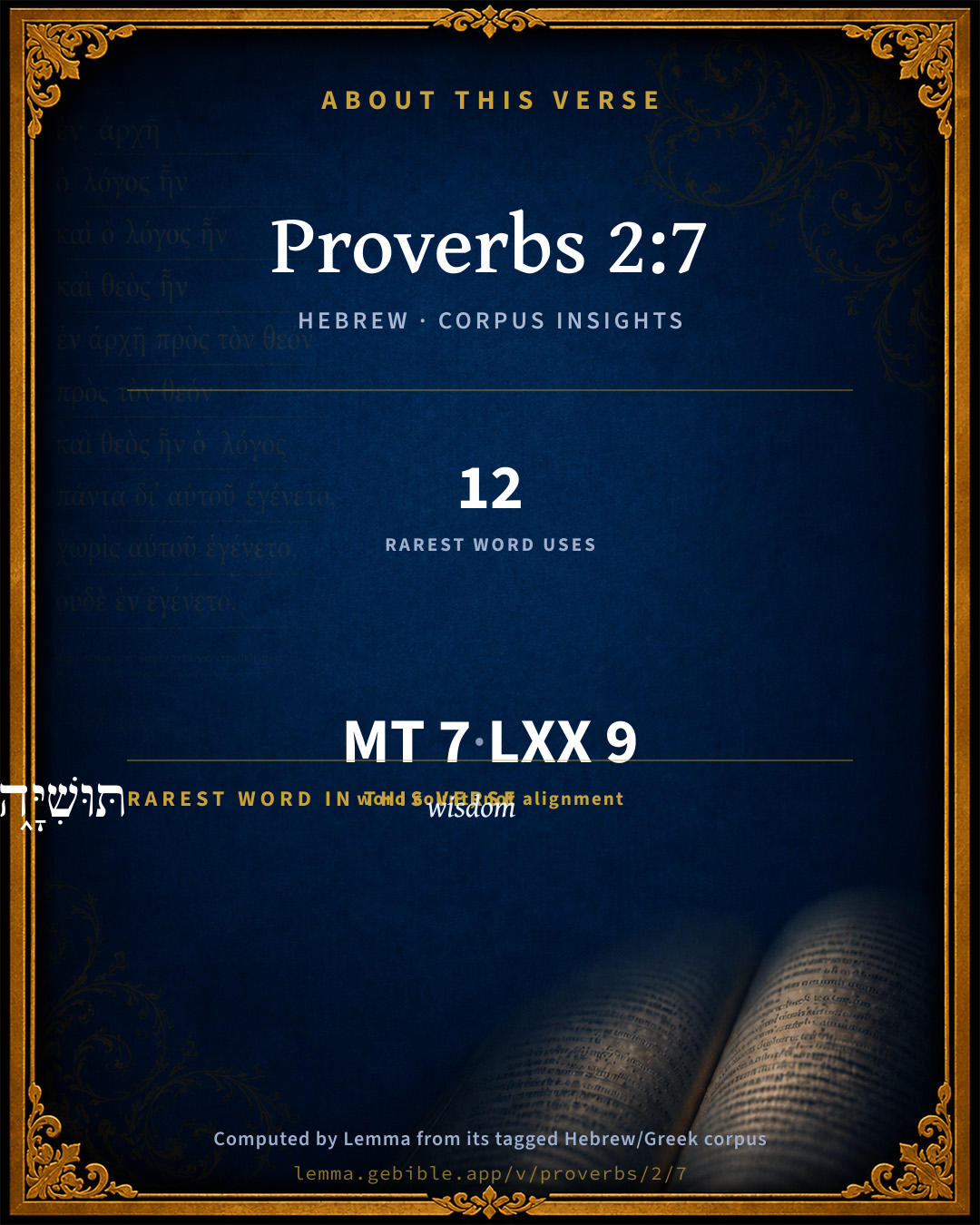
The rarest word here is תּוּשִׁיָּ֑ה wisdom H8454 — appearing just 12 times in the whole Hebrew Bible.

Shared distinctive vocabulary

תּוּשִׁיָּ֑ה wisdom H8454 occurs in 12 verses of the Hebrew Bible. Also found in:

Grammatical profile

  • 3 verbs
  • 3 nouns
  • 1 adjective

Verb forms

  • וצפן Qal · Sequential Perfect
  • יִצְפֹּ֣ן Qal · Imperfect
  • לְהֹ֣לְכֵי Qal · Participle Active

Repetition

A word recurs within this verse — often emphatic in Hebrew:

  • וצפן to hide H6845 ×2

Hebrew & Septuagint length

In English translation the verse runs 18 words from the Hebrew and 15 from the Septuagint (LXX English) — closely comparable.

A rough comparison of the two English renderings, which tokenize alike — not a word-level alignment.

Word counts can differ between the Hebrew and the Greek without any difference in meaning — e.g. the Hebrew direct-object marker אֵת has no separate Greek word, and Greek often adds the article ὁ.

In the original languages it is 7 Hebrew tokens and 9 Greek tokens — but the two are counted differently (Hebrew bundles its prefixes and suffixes into one token; the Greek is in lemma form), so that isn’t a like-for-like length.

Cross-references

14

Topical passages linked to Proverbs 2:7 in the Treasury of Scripture Knowledge — connected by theme and wording, ordered by reader-vote popularity; previews shown in the World English Bible.

  • James 3:15–17 This wisdom is not that which comes down from above, but is earthly, sensual, and demonic.
  • Proverbs 30:5 "Every word of God is flawless. He is a shield to those who take refuge in him.
  • Psalms 84:11 For Yahweh God is a sun and a shield. Yahweh will give grace and glory. He withholds no good thing from those who walk blamelessly.
  • 1 Corinthians 3:18–19 Let no one deceive himself. If anyone thinks that he is wise among you in this world, let him become a fool, that he may become wise.
  • 1 Corinthians 1:19 For it is written, "I will destroy the wisdom of the wise, I will bring the discernment of the discerning to nothing."
  • 2 Timothy 3:15–17 From infancy, you have known the sacred writings which are able to make you wise for salvation through faith, which is in Christ Jesus.
  • 1 Corinthians 1:30 But of him, you are in Christ Jesus, who was made to us wisdom from God, and righteousness and sanctification, and redemption:
  • Proverbs 28:18 Whoever walks blamelessly is kept safe; But one with perverse ways will fall suddenly.
  • Psalms 144:2 My loving kindness, my fortress, My high tower, my deliverer, My shield, and he in whom I take refuge; Who subdues my people under me.
  • Proverbs 14:8 The wisdom of the prudent is to think about his way, But the folly of fools is deceit.
  • 1 Corinthians 2:6–7 We speak wisdom, however, among those who are full grown; yet a wisdom not of this world, nor of the rulers of this world, who are coming to nothing.
  • Colossians 2:3 in whom are all the treasures of wisdom and knowledge hidden.
  • Proverbs 8:14 Counsel and sound knowledge are mine. I have understanding and power.
  • 1 Corinthians 1:24 but to those who are called, both Jews and Greeks, Christ is the power of God and the wisdom of God.

Cross-references courtesy of OpenBible.info (CC BY 4.0).

Hebrew and Greek witnesses Masoretic Hebrew ↔ Greek Septuagint

The same verse in the two great witnesses to the Old Testament, shown verse-for-verse.

These are two independent witnesses, not word-aligned to each other, and the Septuagint is shown in lemma (dictionary) form.

Hebrew Proverbs 2:7 Masoretic · Westminster Leningrad Codex

וצפן יִצְפֹּ֣ן לַ֭יְשָׁרִים תּוּשִׁיָּ֑ה מָ֝גֵ֗ן לְהֹ֣לְכֵי תֹֽם

He lays up sound wisdom for the upright. He is a shield to those who walk in integrity;

World English Bible · Public Domain

Greek LXX Proverbs 2:7 Septuagint · lemma form

καί θησαυρίζω ὁ καταὀρθόω σωτηρία ὑπερἀσπίζω ὁ πορεία αὐτός

and he treasures up salvation for them that walk uprightly: he will protect their way;

LXX2012 (modern English Septuagint) · Public Domain

On this verse, The Pulpit Commentary discusses the Septuagint’s reading. Read the note in Commentary ↓

Hebrew: Westminster Leningrad Codex (CC BY 4.0). Greek: Septuagint (public domain); English from LXX2012 (modern English Septuagint) (Public Domain). How the Septuagint differs from the Hebrew →

Commentary

Notes on Proverbs 2:7 from classic Christian and Jewish commentators (each source and its license shown beneath its notes). The classic Christian expositions comment on the surrounding passage and are grouped to its opening verse, so a note may address several verses; the Jewish commentaries on the Tanakh (Rashi and others) are per-verse, so they appear only where the commentator wrote on this verse.

Lemma curates 59 commentaries, every one of them public domain or Creative Commons licensed, each selected and text-cleaned for this edition rather than reprinted as found. About our sources →

Trapp's Complete Commentary

John Trapp

Pro 2:7 He layeth up sound wisdom for the righteous: [he is] a buckler to them that walk uprightly.

Ver. 7. He layeth up sound wisdom.] Heb., Substance, reality; that which hath a true being, in opposition to that which is not; so riches are described. {Pro 23:5} Heaven only hath a "foundation"; {Heb 11:10} earth hath none, but is "hanged upon nothing." {Job 16:7} Grace hath solid substance in it and true worth; whereas opinion only sets the price upon all outward things. The prophet Amos complains of the epicures of his time, that they "ate the lambs out of the flock, and the calves out of the midst of the stall; they drank wine in bowls, and chanted to the sound of viols." {Amo 6:4-6} This to some might seem brave and desirable. But {Pro 2:13} the prophet, in true judgment, thus speaks to them: "Ye which rejoice in a thing of nought," ye embrace a shadow, ye pursue after things that profit not, but perish in the use; for "Meats for the belly, and the belly for meats: but God will destroy both it and them." {1Co 6:13} Some sense the text thus: The Lord lays up when he is in distress, then he hath such quietness of spirit, soundness and presence of mind, that in the midst of his straits he is in a sufficiency. Not so the wicked. {Job 20:22}

He is a buckler to them.] The body cannot be wounded, but through the buckler, if skilfully handled: "Happy art thou, O Israel; who is like unto thee, O people saved by the Lord, the shield of thy help?" {Deu 33:29}

John Trapp, A Commentary or Exposition upon All the Books of the Old and New Testament (1647–1656) — public domain. Text from a community e-Sword module.

The Biblical Illustrator

Joseph S. Exell

Pro_2:7

He layeth up sound wisdom for the righteous.

Good men and their God

I. The character of good men.

1. They are spoken of as the righteous. The moral code of the universe may be reduced to two words: Be just. Be just to yourselves, to others, and to God. Virtue, morality, and religion constitute a righteous man.

2. They are spoken of as walking uprightly. Goodness in all moral creatures is not stationary, but progressive.

3. They are spoken of as saints. They are consecrated to Gods service, set apart to His use; they are the living and imperishable temples of the Holy Ghost.

II. The God of good men.

1. His relation to creation generally. He is the great original, central, exhaustless fountain of intelligence. The Father of lights--the light of instinct, reason, genius, conscience. Wherever there is a ray of truth, a beam of intelligence, a gleam of virtue, there is God, and in them He should be recognised and worshipped.

2. His relation to the good in particular. He makes special provision for them. He provides for their instruction. He is their buckler, their shield, and their enemies must strike through Him to injure them. He superintends their career. He vouchsafes their ultimate perfection. (David Thomas, D. D.)

Importance of wisdom

Not more necessary are constant supplies of water to the growth of vegetation in the sultry regions of the East than the influence of Divine truth to the existence of human happiness. If a tree, planted by the margin of a refreshing river, is proof against the heat of the sun or the unfavourableness of the seasons, he also who, into a well-prepared heart, receives continual infusions of religious wisdom, is flourishing and happy amidst all the inconveniences of life. (Bp. Jebb.)

A buckler to them that walk uprightly.

God the safeguard of wisdom

We are ill keepers of our own goodness and wisdom. God therefore is pleased to lay it up for us, and that it may be safe, Himself is the buckler and safeguard of it. But it must be sound and real wisdom and goodness, or else He careth not for it. The word translated sound wisdom signifieth essence or being; but it is used also to signify virtue, wisdom, and the law of God, because other things pass away, but they have a durable being--they make the well-being of man, they support the being of all things that are. As a buckler taketh the blows on itself which are directed to another, so God taketh the wrongs done to the righteous as done to Himself, and so doth receive them, as that He taketh away the hurt from His servants. The buckler also shows that they who will live uprightly must strive and fight. Let every one resist the enemy valiantly, for he that resisteth shall have an unwearied helper, and triumphing shall not want a bountiful rewarder. God will defend and preserve those that walk uprightly from falling into errors in seeking for wisdom. It is from God, by fearing Him, that wisdom is obtained, and that wisdom so obtained is alone sound wisdom. The paths of judgment God will keep for Himself, the ways of holiness He will preserve for His saints; and He preserving the ways of holiness, the ways will preserve them that walk in them. The words may, however, mean, He will so keep judgment that He will preserve mercy; He will so preserve mercy that He will keep judgment. The ways cross not so much in themselves but that they can meet in Him. Note that they are but paths, narrow paths of judgment, which the Lord keepeth, but it is a broad way of mercy which He preserveth. The force of Pro_2:8 is that God, who is Himself exact righteousness, guideth His servants in the ways of righteousness. The word understanding may seem to be derived from standing, according as the Greek word also hath its derivation. Clemens Alexandrinus giveth the reason of the derivation, because understanding doth stay and settle the mind, which, before being unresolved, was carried hither and thither. But though this be true of a natural understanding, yet a spiritual understanding doth rather consist in walking the paths that lead from earthly things to heavenly. To understand righteousness is from a civil righteousness to walk to a religious righteousness. (M. Jermin.)

The Biblical Illustrator, edited by Joseph S. Exell (c. 1880s–1900s) — public domain. Text from a community e-Sword module.

The Pulpit Commentary

Wisdom which is the foundation of security and safety, and hence is sound wisdom, is that which God treasures up for the righteous. The teacher passes to another phase of the Divine character. God is not only the Source of wisdom; he is also the Ensurer of safety, the Source of salvation to those who act uprightly. It will be noted that the use of the word is confined to the Proverbs and Job, with the exception of the two passages in Isaiah and Micah. Buckler. Besides storing up the treasures of sound wisdom, which the righteous may use and so obtain security in their uprightness, God is himself a Buckler, or Shield (gem, magen), to those who walk in innocence. This aspect of God"s directly protecting power is met with in other parts of Scripture. In Gen_15:1 he encourages Abram with the assurance, "I am thy Shield." In Psa_33:20 Psa_84:11 Psa_89:18 Psa_144:2, Jehovah is called a Shield to his saints. He renders them security against the assaults of their enemies, and especially against the fiery darts of the wicked one. Again, in Pro_30:5, it is said, "God is a Shield (magen) up to them that walk uprightly." It is incorrect to take gem (magen) either as an accusative after the verb or in apposition with "sound wisdom." To them that walk uprightly; literally, to the walkers in innocence ( ykelejol, l"khol"key thom). (thom) is "integrity of mind," "moral faultlessness," "innocence." "To walk uprightly" is to maintain a course of life regulated by right principles, and directed to right ends. He "walks uprightly who lives with the fear of God as his principle, the Word of God as his rule, and the glory of God as his end" (Wardlaw). The completeness of the moral and religious character is involved in the expression which is found also in Pro_10:9 and Psa_84:11. The Vulgate translates the latter clause of the verse, proteget gradientes simpliciter, "he will protect those who walk in simplicity;" cf. 2Co_1:12 in illustration of the phrase. He layeth up; i.e. he treasures up (LXX, yhsaurizein ), or preserves and protects (custodire , Vulgate), as a person does "treasure or jewel, that it may not be stolen" (Zockler). The majority of commentators read the Keri (poxyi, "he will treasure up," future of px) in preference to the Khetib (px, perfect of same verb, with prefix w, "and he treasured up"), and this is the; reading adopted in the Authorized Version. The Keri implies that God does treasure up sound wisdom, while the Khetib, as Delitzsch observes, has the force of the aorist, and so represents the treasuring up as an accomplished fact. The same verb occurs in Pro_2:1, where it is translated in the Authorized Version by "hide," and also in Pro_7:1 and Pro_10:14 by "lay up." The laying up, or treasuring, points to the preciousness of that which is treasured, "sound wisdom." Sound wisdom. A great variety of opinions exists as to the true meaning of the word in the original, hyviWt (tvushiyyah), of which "sound wisdom" is an interpretation. Zockler explains it as "wisdom, reflection;" Delitzsch, as "advancement and promotion;" Dathe, as "solid fortune;" Gesenius, as "aid." The proper meaning of the word seems to he "substance," from the root hvy, "to be, to exist, to be firm." Professor Lee remarks on the word, "From the places in which it occurs, either wealth, thought, or some such sense it manifestly requires. It occurs in Job_6:13, in parallelism with "help;" in Pro_2:7, with a "shield;" in Job_1:6, with "wisdom;" in Job_12:16, with "strength;" in Pro_3:21, with "discretion;" in Pro_8:14, with "counsel" and "understanding;" in Isa_28:29, with "counsel;" and so in Job_26:3. In Job_30:22 and Mic_6:9, "entirely" or the like seems to suit the context; see also Pro_18:1, and generally "excess," or "abundance," taken either in a good or bad sense, and varied by other considerations, seems to prevail in every case in which this word is used". (see Professor Lee, on Job_5:12) The parallelism of the passage before us seems to require that it should be understood in the sense of security; and transferring the idea to wisdom as the means of security. This idea is reproduced in the LXX swthria , the Vulgate salus, and the Targum incolumitas .

The Pulpit Commentary (1880–1919), ed. H.D.M. Spence-Jones & Joseph S. Exell — public domain. Text from a community e-Sword module.

Tyndale Open Study Notes

Tyndale Open Resources

2:7-8 Here, common sense is intuitive understanding built through listening to God’s words and observing his world. God is a shield who guards and protects those who live in relationship with him.

Tyndale Open Study Notes — © Tyndale Open Resources, licensed CC BY-SA 4.0. Text via the HelloAO Bible API.

Geneva Bible (1599)

Geneva Bible translators

Or, hideth the salvation.

Geneva Bible (1599) marginal notes — public domain. Text via Bolls.life.

Jamieson, Fausset & Brown

Robert Jamieson, A. R. Fausset & David Brown

sound wisdom--literally, "substance," opposed to what is fictitious. According to the context, this may be assistance, as here corresponding with

buckler--or safety, or wisdom, which procures it (compare Pro 3:21; Pro 8:14; Pro 18:1; Job 6:13; Job 12:13).

layeth up--provides, ever ready.

Jamieson, Fausset & Brown — Commentary Critical and Explanatory on the Whole Bible (1871) — public domain (CC PDM 1.0). Text via the HelloAO Bible API.

Adam Clarke's Commentary

Verse 7. He layeth up sound wisdom] תושיה tushiyah. We have met with this word in Job; see Job 5:12; Job 6:13; Job 11:6; Job 12:16. See especially Clarke's note on "Job 11:6", where the different acceptations of the word are given. Coverdale translates, "He preserveth the welfare of the righteous." It is difficult to find, in any language, a term proper to express the original meaning of the word; its seems to mean generally the essence or substance of a thing, THE thing itself - that which is chief of its kind. He layeth up WHAT IS ESSENTIAL for the righteous.

Adam Clarke's Commentary on the Bible (1810–1826) — public domain. Text from a community e-Sword/MySword module.

Ellicott's Commentary for English Readers

(7) Sound wisdom.—Literally, furtherance, advancement (Comp. “Whosoever hath, unto him shall be given, and he shall have more abundance,” Mat_13:12.)

A Bible Commentary for English Readers, edited by Charles John Ellicott (1878–1897) — public domain. Text from a community e-Sword module.

The Cambridge Bible for Schools and Colleges

gen. ed. J. J. S. Perowne

7. layeth up] Lit. hideth, as a treasure too precious to be left exposed, therefore it must be searched for (Pro_2:4). But he layeth it up for, not from, the upright; therefore the search shall be successful (Pro_2:5).

He is a buckler] So R.V. except, instead of buckler, more accurately, shield, the smaller weapon.

The rendering, And a shield, R.V. marg.; or better, which (sc. wisdom) is a shield, is admissible, and is supported by such passages as Ecc_7:12; Eph_6:16, where wisdom and faith are compared to a shield. But the frequent comparison of God Himself to a shield or buckler in the O.T. (e.g. Gen_15:1; Deu_33:29; Psa_59:11; Psa_84:11, in all which places the Heb. word for shield is the same as here) is in favour of regarding Jehovah (Pro_2:6) as the subject of this, as of the former, clause of the verse.

The Cambridge Bible for Schools and Colleges (gen. ed. J. J. S. Perowne; Cambridge University Press, 1878–1918) — public domain. Text from a community e-Sword module.

John Gill's Exposition

He layeth up sound wisdom for the righteous,.... In order to give it to them that seek for it; which is another encouragement to search after it. By "sound wisdom" may be meant, not the law, as Kimchi and Ben Melech; so called, because it endures for ever, when all beings are defective and come to nothing; but the Gospel, which is sound doctrine, pure and not corrupt; true and real wisdom, in opposition to that which has only the show of wisdom, and is science falsely so called; and this was hid in God, in Christ, and laid up as a treasure in the sacred Scriptures: or else the true grace of God, in distinction from that which is counterfeit; and is that goodness of his, which he has laid up in his heart, and in the covenant of his grace; and the fulness of grace which he has laid up in Christ for them Psa 31:19; or eternal glory and happiness. The word here used signifies "essence", "substance" (o); that which really is, and is solid and substantial; and such are the glories of the other world the crown of righteousness, the hope laid up in heaven, and the inheritance reserved there, Col 1:5. These are real things, though invisible, and are rich and valuable; and have substance and solidity in them, in opposition to earthly riches, which are a vain show, and are things that are not, and at best temporal and perishing; but these are an enduring substance, Pro 8:21. The Septuagint render it by "salvation", and the Targum by a word which signifies "glory" and "honour"; all which may well be understood of eternal life which is laid up and reserved "for the righteous": not for such who are only so in show and imagination, but for those who are really and truly so; not for those who are legally, but evangelically righteous; or not for such that seek righteousness by the law, but by faith in Christ; for such who are made righteous by the righteousness of Christ imputed to them, and by faith receive it, and lay hold on it as their righteousness; and in consequence of this live soberly and righteously: for these only eternal life is prepared; they only have a right unto it, and a meetness for it, and shall enjoy it;

he is a buckler to them that walk uprightly; who are sincere in their deportment before God and men; who walk according to the rule of the divine word; who walk by faith on Christ, and walk on in him as they have received him; and go on living by faith on his righteousness, which is walking in his uprightness, till they come to be with him for ever in heaven. To these the Lord is a "buckler" or shield; he covers them with the "shield of faith", his own Son, his blood righteousness, and sacrifice; which faith lays hold on and uses as a shield against Satan's fiery darts; and gives them "the shield of salvation" which secures them from sin and wrath and every enemy; and encompasses them about with his "favour", as a "shield", which is immutable and invariable; and keeps them by his power through faith unto salvation, Eph 6:16; with this compare Gen 15:1, Psa 3:3. Some (p) read these words by way of apposition, and understand them of sound wisdom; that that is a buckler or shield to the persons here described; see Ecc 7:12.

(o) "essentiam", Pagninus, Montanus, Tigurine version, Mercerus, Gejerus; "quicquid revera est", Junius & Tremellius; "solidam firmamque substantiam", Baynus; "solidum, vel solidam rem", Schultens. (p) So Mercerus, Piscator, Schultens. Gussetius chooses to take the word for a verb, and renders it, "he delivers it"; that is, sound wisdom to them that walk uprightly; Ebr. Comment. p. 454.

John Gill's Exposition of the Whole Bible (1746–1763) — public domain (CC PDM 1.0). Text via the HelloAO Bible API.

Albert Barnes' Notes on the Bible

Sound wisdom - “Soundness,” an idea which passes on into that of health and safety. Compare “sound doctrine” in 1Ti 1:10; 2Ti 4:3.

Albert Barnes' Notes on the Bible (1834–1885) — public domain. Text from a community e-Sword/MySword module.

Haydock's Catholic Bible Commentary

Salvation. Protestants, "sound wisdom." Tushiya (Haydock) often occurs in this book, and is very comprehensive, (Calmet) denoting the substance (Haydock) of goodness, virtue, &c., Job v. 12.

George Leo Haydock (1774–1849), Haydock's Catholic Family Bible and Commentary, 1859 edition — public domain. Excludes Psalms (Douay-Rheims chapter numbering differs from Protestant) and Deuterocanonical books (Catholic canon only).

Matthew Poole's English Annotations

Sound wisdom, Heb. essence or substance; either,

1. Solid and true felicity, opposed to the vain enjoyments of this world, which are said to have no substance or being, Pro 23:5. Or,

2. True and substantial wisdom, which is satisfactory and everlasting, opposed to worldly wisdom, which is but an empty shadow of wisdom, and perisheth with us.

A buckler to them, to protect and save them from that mischief and ruin which shall befall all wicked men.

Matthew Poole's English Annotations on the Holy Bible (1683–1685) — public domain. Text from a community e-Sword/MySword module.

Whedon's Commentary on the Bible

Daniel D. Whedon

7. Sound wisdom — תושׁיה, (tushiyyah.) The word is uncertain; it corresponds to sound doctrine. 1Ti_1:10; 2Ti_4:3. It may mean the essence, substance, or reality of things, as opposed to all merely seeming good. This sense harmonizes well with the other member of the hemistich; God treasures up all real good for the righteous, and protects them from all harm.

A buckler to… walk uprightly — Literally, he is a shield, a defence, to the walkers of perfectness — perfect walkers; persons of integrity, of soundness of morals and religion. It stands in parallelism with ישׁרים, (yesharim,) the righteous, and applies to the same class. Conant renders, “He has help in store for the upright, a shield for those who walk in integrity.” Geneva Bible, first clause: “He preserveth the state of the righteous.”

Daniel D. Whedon (gen. ed.), Commentary on the Old and New Testaments (1874–1909) — public domain. Text from a community e-Sword module.

Bridges on Proverbs

Charles Bridges

Vanity (Ecc 1:18 ) and foolishness (1Co 3:19 ) are the stamp on the wisdom of this world. Here is sound wisdom. It looks at things not in their notions, but in their proper substance. It is sound, because it is practical. It is indeed a hid treasure (Pro 2:4 ); so safe, that no spoiler can reach it; yet so free, that every sinner may have access to it. Yes; in the Son of God himself "are hid all the treasures of wisdom and knowledge." All these treasures in him are laid up for the righteous — made over to them. (Col 2:3 . 1Co 1:30 .) Oh let us draw upon this infinite treasure daily, hourly, for light to direct an upright walk. ’To those that are true and upright in heart, he will in his own good time reveal true and saving knowledge, and that sound spiritual wisdom, which shall make them eternally happy.’†1 Our faithful God is a buckler to them that walk uprightly. (Pro 30:5 . Psa 84:11 .) His wisdom covers us from that subtle sophistry, which would spoil us of our treasure. (Pro 22:12 .) The way of the saints is indeed fraught with danger; beset with temptation; yet is it safe (Pro 4:11 ; Pro 8:20 . Deu 33:26-29 . 1Sa 2:9 . Psa 37:23-24 ; Psa 56:9 ) — kept and preserved by Almighty power, even on the very edge of the enemy’s ground. (1Sa 25:39 ; 1Sa 27:1, with 1Sa 29:1-11 . 2Co 12:7-9 .)

Such also is the completeness of this godly privilege, that not only does it enlarge our knowledge of God (Pro 2:5 ), but it brings us to a full understanding of every practical obligation. Indeed that only is sound wisdom, that guides our feet into every good path; that "makes the man of God perfect, throughly furnished unto all good works." (2Ti 3:15-17 .) The gracious wisdom that saves the soul, sanctifies the heart and life. (Tit 2:11-12 .)

Footnotes

†1 Bishop Hall.

Charles Bridges, An Exposition of the Book of Proverbs (1846) — public domain. Text from a community e-Sword module.

Rashi

Rabbi Shlomo Yitzchaki (Rashi)

He lays up sound wisdom for the upright The Holy One, blessed be He, hid it [wisdom] with Him for twenty-six generations until He gave it to the generation of the desert.

a shield for those who walk in integrity (He lays up a shield for those who walk with integrity); i.e., it will be a shield for you.

Rashi on the Tanakh — English translations: “The Judaica Press complete Tanach with Rashi, translated by A. J. Rosenberg” (CC BY 4.0); “Pentateuch with Rashi's commentary by M. Rosenbaum and A.M. Silbermann, 1929-1934” (public domain); “The Metsudah Tanach series, Lakewood, N.J” (CC BY 4.0); and “The Book of Joshua, Metsudah Publications, 1997” (CC BY 4.0). Text via Sefaria.

Lesson kit

Teaching starters — assembled from the data on this page, not authored interpretation. Every prompt links to the verse data it draws on. Edit before teaching.

Proverbs, in the Wisdom, opens this verse with 7 words (6 distinct Hebrew lemmas). Its most distinctive word is tûwshîyâh (“wisdom”). A historical commentator’s framing appears above. Read the whole chapter for the surrounding context.

Discussion questions

  1. The word tûwshîyâh carries the sense “wisdom.” How does it shape the verse?
  2. Job 5:12 shares the word «wisdom» with this verse. How do the two illuminate each other?
  3. “to hide” occurs 2× in this one verse. What is the effect of the repetition?
  4. The translations on this page render this verse differently — a whole-verse word diff, not a word-by-word alignment. What might account for the different wordings?
  5. The verb «וצפן» is Qal Sequential Perfect. How does its form color the action?
  6. Reading how Trapp's Complete Commentary and The Biblical Illustrator read this verse, where do the two commentators agree and where do they part?

Things to notice

Reading settings

Reading text

Shown beneath each verse's original-language words.

Old Testament
Old Testament edition

Read the OT as the Masoretic Hebrew (MT) or the Greek Septuagint (LXX).

English shown for the Greek Septuagint (in the Hebrew ↔ Greek comparison).

Comparing translations? Open the Compare panel on any verse page to stack up to four side by side.