
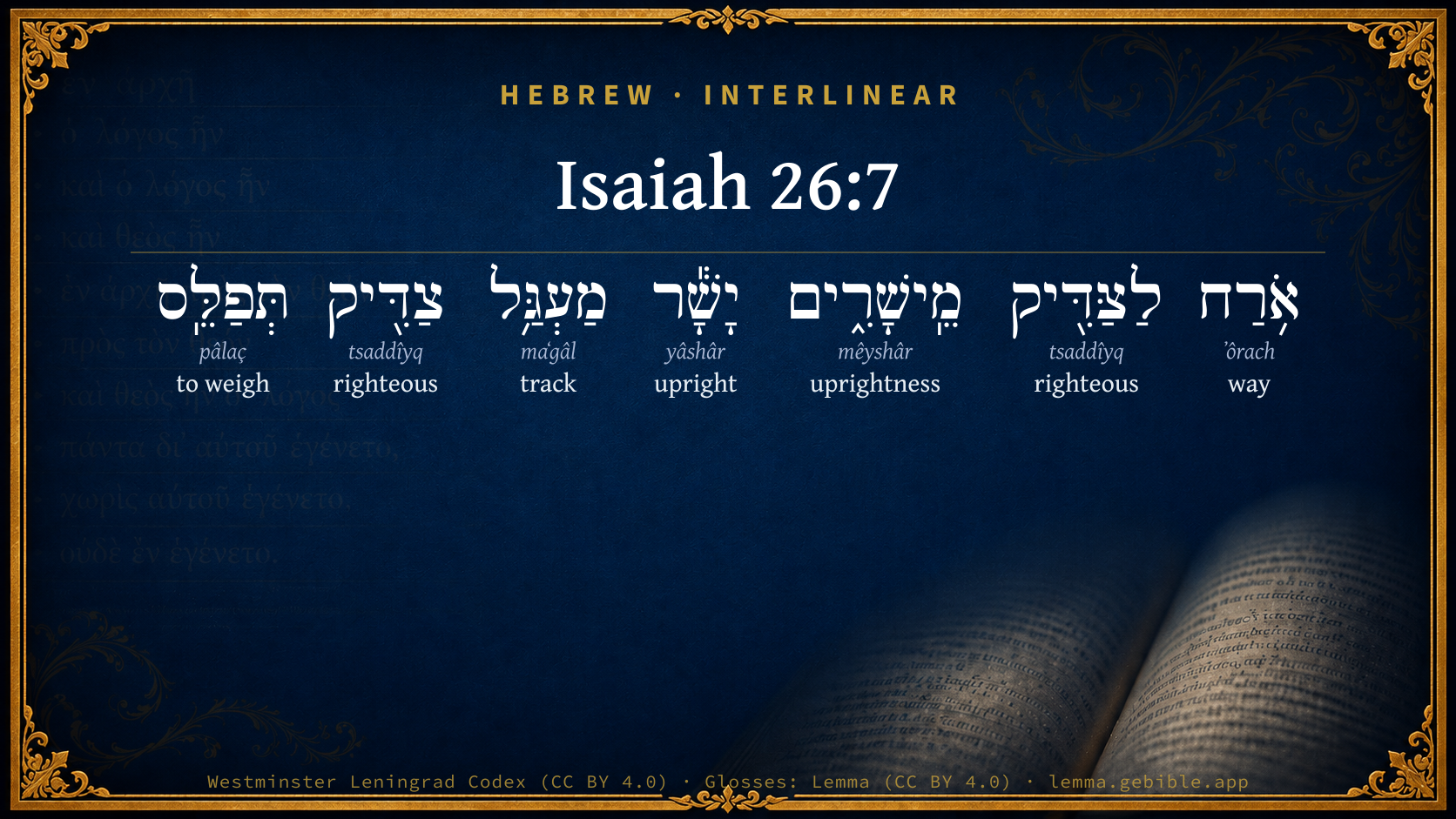
Isaiah 26:7

Hebrew (Westminster Leningrad Codex) Isaiah 26:7 appears in the Hebrew Old Testament. The text above is from the Westminster Leningrad Codex. Each word links to its Strong’s number, a concise gloss, and parsing drawn from the Open Scriptures Hebrew Bible morphology. Click any word for its full Brown-Driver-Briggs (BDB) entry.
Download image
Cite this verse

Isaiah 26:7 (World English Bible). Public Domain. Lemma interlinear Bible study tool, https://lemma.gebible.app/v/isaiah/26/7.

Show BibTeX & RIS
BibTeX
RIS
English Translation
The way of the just is uprightness: you that are upright do direct the path of the just.
World English Bible · Public Domain
Download a study sheet

One document with this verse’s original text, its word-by-word gloss line, the meaning frame, cross-references with their text, attributed commentary, and full source and license credits — printable, and it pastes into notes with its structure intact.

This verse Autodidact and up

Study sheet (.html) Plain text (.txt)

A passage Seminary Student

Up to 50 verses in one chapter. A passage sheet keeps up to 6 commentary sources and 12 cross-references per verse, in the order this page ranks them, and says so on the sheet whenever that leaves anything out. Ask for a single verse and you get the Autodidact verse sheet above.

Everything on this page stays free to read, with no account — the sheet is a download of what is already on screen, not access to it.

Want to remove ads? Support Godless Engineer
Compare translations 3

The same verse in 3 English versions, stacked beneath the original-language interlinear above. Click any original word for its lexicon entry.

Each is an independent rendering of the whole verse — the interlinear is not word-aligned to these translations.

Highlighted words mark where these versions differ — a whole-verse word diff, not a word-by-word alignment.

  • World English Bible Public Domain
    The way of the just is uprightness: you that are upright do direct the path of the just.
  • King James Version Public Domain
    The way of the just is uprightness: thou, most upright, dost weigh the path of the just.
  • unfoldingWord Literal Text CC BY-SA 4.0
    The path for the righteous evenness; Upright One, you level the course of the righteous.

unfoldingWord Literal Text — © unfoldingWord, licensed CC BY-SA 4.0. Word-aligned USFM3 via Door43 (git.door43.org/unfoldingWord/en_ult).

Versions to compare (up to 4)

3 of 4 selected

Show all 18 translations

Every available English version of this verse, each an independent rendering of the whole verse.

  • World English Bible Public Domain
    The way of the just is uprightness: you that are upright do direct the path of the just.
  • Berean Standard Bible Public Domain
    The path of the righteous is level; You clear a straight path for the upright.
  • Majority Standard Bible Public Domain
    The path of the righteous is level; You clear a straight path for the upright.
  • King James Version Public Domain
    The way of the just is uprightness: thou, most upright, dost weigh the path of the just.
  • American Standard Version (1901) Public Domain
    The way of the just is uprightness: thou that art upright dost direct the path of the just.
  • Revised Version (1885) Public Domain
    The way of the just is uprightness: thou that art up right dost direct the path of the just.
  • Geneva Bible (1599) Public Domain
    The way of the iust is righteousnesse: thou wilt make equall the righteous path of the iust.
  • Douay-Rheims (1899) Public Domain
    The way of the just is right, the path of the just is right to walk in.
  • Young's Literal Translation Public Domain
    The path for the righteous `is' uprightness, O upright One, The path of the righteous Thou dost ponder.
  • Literal Standard Version CC BY-SA 4.0
    The path for the righteous [is] uprightness, || O upright One, || You ponder the path of the righteous.
  • Unlocked Literal Bible CC BY-SA 4.0
    The path of the righteous is level, Righteous One; the path of the righteous you make straight.
  • unfoldingWord Literal Text CC BY-SA 4.0
    The path for the righteous evenness; Upright One, you level the course of the righteous.
  • Darby Bible Public Domain
    The way of the just is uprightness: thou, the Upright, dost make the path of the just even.
  • World Messianic Bible Public Domain
    The way of the just is uprightness. You who are upright make the path of the righteous level.
  • Webster's Bible Public Domain
    The way of the just is uprightness: thou, most upright, dost weigh the path of the just.
  • Free Bible Version CC BY-SA 4.0
    You God, do what is right, and you straighten out the way for those who live right; you smooth out their path.
  • Bible in Basic English Public Domain
    The way of the good man is straight; the road of the upright is made smooth by you.
  • JPS Tanakh (1917) Public Domain
    The way of the just is straight; Thou, Most Upright, makest plain the path of the just.

Literal Standard Version (2020), Covenant Press — licensed CC BY-SA 4.0. Text via the HelloAO Bible API (eBible.org). Unlocked Literal Bible (unfoldingWord) — licensed CC BY-SA 4.0. Text via the HelloAO Bible API (eBible.org). unfoldingWord Literal Text — © unfoldingWord, licensed CC BY-SA 4.0. Word-aligned USFM3 via Door43 (git.door43.org/unfoldingWord/en_ult). Free Bible Version, Dr. Jonathan Gallagher — licensed CC BY-SA 4.0. Text via the HelloAO Bible API (eBible.org).

Word by word

More ways to search: Search by grammar → Find every occurrence → Compare this word →

Practice this passage: Drill this verse → Learn its vocabulary →

About this verse

These counts appear in no published source. They are computed here, from the morphology-tagged text and Lemma’s own curated glosses. What Lemma adds →

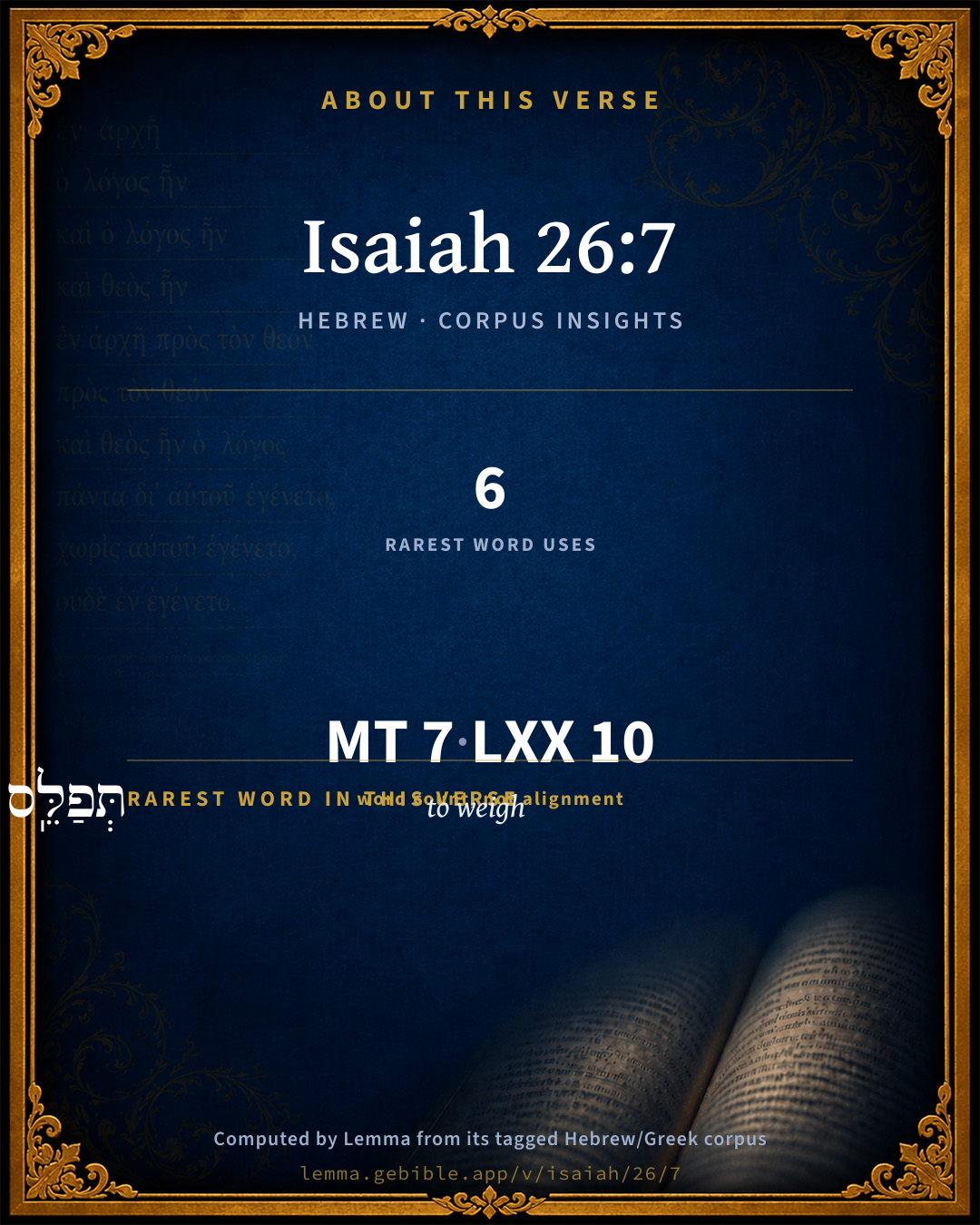
7
words
6
distinct lemmas
Prophets
section

Notable vocabulary

The rarest word here is תְּפַלֵּֽס to weigh H6424 — appearing just 6 times in the whole Hebrew Bible.

Shared distinctive vocabulary

תְּפַלֵּֽס to weigh H6424 occurs in 6 verses of the Hebrew Bible. Also found in:

Grammatical profile

  • 1 verb
  • 3 nouns
  • 3 adjectives

Verb forms

  • תְּפַלֵּֽס Piel · Imperfect

Repetition

A word recurs within this verse — often emphatic in Hebrew:

  • לַצַּדִּ֖יק righteous H6662 ×2

Hebrew & Septuagint length

In English translation the verse runs 18 words from the Hebrew and 16 from the Septuagint (LXX English) — closely comparable.

A rough comparison of the two English renderings, which tokenize alike — not a word-level alignment.

Word counts can differ between the Hebrew and the Greek without any difference in meaning — e.g. the Hebrew direct-object marker אֵת has no separate Greek word, and Greek often adds the article ὁ.

In the original languages it is 7 Hebrew tokens and 10 Greek tokens — but the two are counted differently (Hebrew bundles its prefixes and suffixes into one token; the Greek is in lemma form), so that isn’t a like-for-like length.

Cross-references

17

Topical passages linked to Isaiah 26:7 in the Treasury of Scripture Knowledge — connected by theme and wording, ordered by reader-vote popularity; previews shown in the World English Bible.

  • Ephesians 2:10 For we are his workmanship, created in Christ Jesus for good works, which God prepared before that we would walk in them.
  • Isaiah 42:16 I will bring the blind by a way that they don't know; in paths that they don't know will I lead them; I will make darkness light before them, and crooked places straight. These things will I do, and I will not forsake them.
  • 2 Corinthians 1:12 For our boasting is this: the testimony of our conscience, that in holiness and sincerity of God, not in fleshly wisdom but in the grace of God we behaved ourselves in the world, and more abundantly toward you.
  • 1 John 3:7 Little children, let no one lead you astray. He who does righteousness is righteous, even as he is righteous.
  • 1 John 3:10 In this the children of God are revealed, and the children of the devil. Whoever doesn't do righteousness is not of God, neither is he who doesn't love his brother.
  • Job 27:5–6 Far be it from me that I should justify you. Until I die I will not put away my integrity from me.
  • Psalms 11:7 For Yahweh is righteous. He loves righteousness. The upright shall see his face.
  • Proverbs 20:7 A righteous man walks in integrity. Blessed are his children after him.
  • 1 Samuel 2:2–4 There is none holy as Yahweh; For there is none besides you, Neither is there any rock like our God.
  • 1 Chronicles 29:17 I know also, my God, that you try the heart, and have pleasure in uprightness. As for me, in the uprightness of my heart I have willingly offered all these things: and now have I seen with joy your people, that are present here, offer willingly to you.
  • Job 31:6 (Let me be weighed in an even balance, That God may know my integrity);
  • Psalms 1:6 For Yahweh knows the way of the righteous, But the way of the wicked shall perish.
  • Psalms 18:23–26 I was also blameless with him. I kept myself from my iniquity.
  • Isaiah 35:8 A highway shall be there, and a way, and it shall be called The way of holiness. The unclean shall not pass over it, but is shall be for for him who walks in the Way. Wicked fools will not go there.
  • 1 Corinthians 4:5 Therefore judge nothing before the time, until the Lord comes, who will both bring to light the hidden things of darkness, and reveal the counsels of the hearts. Then each man will get his praise from God.
  • Psalms 11:4 Yahweh is in his holy temple. Yahweh is on his throne in heaven. His eyes observe. His eyes examine the children of men.
  • Zephaniah 3:5 Yahweh, in the midst of her, is righteous. He will do no wrong. Every morning he brings his justice to light. He doesn't fail, but the unjust know no shame.

Cross-references courtesy of OpenBible.info (CC BY 4.0).

Hebrew and Greek witnesses Masoretic Hebrew ↔ Greek Septuagint

The same verse in the two great witnesses to the Old Testament, shown verse-for-verse.

These are two independent witnesses, not word-aligned to each other, and the Septuagint is shown in lemma (dictionary) form.

Hebrew Isaiah 26:7 Masoretic · Westminster Leningrad Codex

אֹ֥רַח לַצַּדִּ֖יק מֵֽישָׁרִ֑ים יָשָׁ֕ר מַעְגַּ֥ל צַדִּ֖יק תְּפַלֵּֽס

The way of the just is uprightness: you that are upright do direct the path of the just.

World English Bible · Public Domain

Greek LXX Isaiah 26:7 Septuagint · lemma form

ὁδός εὐσεβής εὐθύς γίγνομαι καί παρασκευάζω ὁ ὁδός ὁ εὐσεβής

The way of the godly is made straight: the way of the godly is also prepared.

LXX2012 (modern English Septuagint) · Public Domain

Hebrew: Westminster Leningrad Codex (CC BY 4.0). Greek: Septuagint (public domain); English from LXX2012 (modern English Septuagint) (Public Domain). How the Septuagint differs from the Hebrew →

Targum (Aramaic paraphrase)

1

The Targum is the ancient Jewish Aramaic paraphrase of the Hebrew Scriptures — an interpretive translation, not the Hebrew text itself. Onkelos (literal) and Pseudo-Jonathan (expansive) render the Torah, and Jonathan the Prophets. Coverage is partial: where no permissively-licensed English translation exists for a verse, only the Aramaic is shown. This is verse-level text, not a word-by-word alignment to the Hebrew.

  1. Targum Jonathan Prophets (Joshua–Malachi)
    אוֹרְחַת צַדִיקַיָא כַּוָנָן אַף עֲבַדוּ אוֹרְחַת צַדִיקַיָא תְּתַקֵן:

    The paths of the righteous are right: thou wilt establish the works of the ways of the just.

    Targum Jonathan — Aramaic: “Mikraot Gedolot” (public domain). English: “Sefaria Community Translation” (CC0 1.0 (public-domain dedication)); “London "Chaldee Paraphrase," 1871” (public domain). Text via Sefaria.

Commentary

Notes on Isaiah 26:7 from classic Christian and Jewish commentators (each source and its license shown beneath its notes). The classic Christian expositions comment on the surrounding passage and are grouped to its opening verse, so a note may address several verses; the Jewish commentaries on the Tanakh (Rashi and others) are per-verse, so they appear only where the commentator wrote on this verse.

Lemma curates 59 commentaries, every one of them public domain or Creative Commons licensed, each selected and text-cleaned for this edition rather than reprinted as found. About our sources →

Trapp's Complete Commentary

John Trapp

Isa 26:7 The way of the just [is] uprightness: thou, most upright, dost weigh the path of the just.

Ver. 7. The way of the just is uprightness.] Heb., Uprightnesses - that is, just and straight courses. They turn not aside to crooked and wry ways, as do the workers of iniquity, {Psa 125:5} but hold on in an even way, without windings or writhings; {Pro 4:26-27} the king’s highway to heaven is their road, and this leadeth them to that city of God. {Isa 26:1-2}

Thou most upright dost weigh the path of the just.] Or, Thou dost by levelling make the just man’s path even. By thy preventing grace thou makest him just and upright, and by thy subsequent grace thou strengthenest and directest him, that he may run and not be weary, walk and not faint. {Isa 40:31}

John Trapp, A Commentary or Exposition upon All the Books of the Old and New Testament (1647–1656) — public domain. Text from a community e-Sword module.

Joseph Benson's Commentary

Isa 26:7. The way of the just is uprightness — Hebrew, מישׁרים, righteousness. The just proceed steadily on in the practice of the various duties of righteousness, which they owe to God and man; or, their way is evenness, or plainness, as the word may be rendered. It is their constant care and endeavour to walk with God in an even, steady course of obedience and holy conversation. Bishop Lowth translates the clause, the way of the righteous is perfectly straight, not crooked, involved, and intricate, like that of the wicked. Thou, most upright, dost weigh the path of the just — Dost mark and consider it, and observe the various difficulties and dangers that will occur in it, and wilt give them grace sufficient for them; or, thou dost examine it. Thou, who art most upright in all thy ways, and therefore a lover of uprightness, and of all upright men, dost weigh, dost narrowly observe and ponder, the path of the just; the whole course of their actions, and, which is implied, dost approve of them, and direct them to a happy issue. This seems to be the most common meaning of the word פלס, here rendered to weigh: see Pro 4:26; Pro 5:21. It bears, however, another sense, Psa 78:50, namely, to make the way plain, or, to remove obstructions out of it. In this sense Bishop Lowth understands it here, and therefore translates the clause, thou most exactly levellest the path of the righteous. While the way of the wicked is perplexed, and rugged, and full of obstructions, God makes the way of the righteous plain and easy before them, by preventing or removing those things that would be stumbling-blocks to them, so that they walk safely and comfortably forward in the path of duty.

Joseph Benson's Commentary on the Old and New Testaments (1811–1818) — public domain. Text from a community e-Sword module.

The Preacher's Complete Homiletical Commentary

Joseph S. Exell (gen. ed.)

THE RIGHTEOUSNESS OF GOD AND HIS PEOPLE

Isa_26:7. The way of the just, &c.

Isaiah foretold the captivity of Judah in Babylon, also its termination. This chapter is a song ready for the occasion. It relates the story, and it unfolds the principles that underlie the events.

Our text is thoroughly practical. It reminds us,—

I. That righteousness is the personal characteristic of God and of His redeemed people.

1. God is righteous. “Thou most upright.” He is perfectly righteous. It is essential to the Divine nature; the contrary cannot be supposed; as heat is natural to fire. God Himself, His laws, His providential government, even His redeeming mercy, are all characterised by perfect rectitude. So prominent is this idea that we are taught to exercise simple faith in God, and assume that we are imperfectly informed if we are unable to reconcile anything in our experience with His perfect righteousness.

2. His people also are righteous—here called “the just.” It is suggestive when God’s people are thus called by a name similar to His own. They share in the same righteousness, although in different degrees. More is intended than that they are in a justified state. That is implied. They are justified by the grace of God through faith in the Lord Jesus Christ. But the text refers to the righteousness which assimilates them to the Divine nature. The grace of God produces a new nature. Saul of Tarsus became a new man on his conversion. A savage adopts the habits and forms the tastes of civilised Christian life. It is a new nature. 1Jn_4:4 : “Ye are of God.” As children partake the nature of their parents, His nature is in them, though not yet perfected. Their sympathies are with Him. In so far as they are unrighteous, they are inconsistent with their true selves. The life of God in the regenerated soul is a principle ever tending toward the perfect righteousness of the Divine nature from which it came.

II. When righteousness characterises a person, it will dictate his conduct.

1. The conduct of the righteous man. “The way of the just is uprightness;” his course of life. He is erect in his moral manhood, as contrasted with one who is bent and crooked. Men’s ideas of uprightness are apt to become partial and one sided. Some seem to imagine that all demands of righteousness are met by the acceptance of Christ and the experience of spiritual feeling, while they overlook the demands of human relationships. Others confine their view to men. They imagine all demands are met, when they are fair and honourable in their dealings with men, while God is left out of consideration. The Divine idea of righteousness is not thus partial. It takes in the whole of our moral relations, our relations both to God and man. And the good man strives to bring his whole life into conformity to it. [Work this out in detail: “The way of the just is uprightness”

(1), in regard to God;

(2), in regard to man].

2. The conduct of the righteous God. “Thou most upright dost weigh the path of the just.” At first sight like confusion of metaphor. It means to ponder it. The heathen symbol of Divine righteousness is that of justice holding the scales (Dan_5:27). The conduct of the righteous is weighed. God observes it; His honour is concerned in it. He will eventually pronounce upon it (2Co_5:10).

Examine, then:—

1. Are you among the just? Have you experienced a change of heart?

2. Are you pursuing the path of the just? This applies to your actual dealing with God and with man. Consider how far imperfection may be consistent with reality. Do not try how far you may go safely. There comes a point at which a man must be condemned, at which he must condemn himself. At that point he will either repent or harden himself. Let us cultivate the highest measures of practical uprightness.—J. Rawlinson.

THE JUST MAN’S SECURITY

Isa_26:7. Thou most upright, dost weigh the path of the just.

We can scarcely find anywhere a more touching description of the God of our salvation than that furnished by Job (Isa_25:10). God has always given His people songs in the night, and in the night-time of affliction He has furnished them with songs of consolation and confidence. Our text is a part of one of those songs. The Chaldean power threatened God’s people. They were instructed to cherish a firm faith in God. Not a breath of despair was to reach the camp of the enemy; rather they were taught a scornful defiance of that proud king who had defied the armies of the living God (Isa_37:22).

“In that day shall this song be sung.” The connection may teach us that it is wisdom to treasure up a source of consolation against the day of adversity. It is in spring that we are to prepare for winter; in the morning of life to prepare for old age. The oil must be ready for the midnight hour. No good soldier will run for his armour “when the enemy comes in like a flood.”

The text suggests the Christian’s reasons for security and repose under the various events of life. These are—

I. The perfect wisdom and rectitude which marks God’s universal government. “Thou most upright, dost weigh,” &c. This world is not a neglected province of the Divine Dominions. That impression of the Divine supremacy which inspires the songs of seraphs quickens the joy of frail humanity. While thrones, principalities, and powers exclaim as with the voice of many waters, “Alleluia, for the Lord God Omnipotent reigneth,” the inhabitants of the earth roll back the response, “The Lord reigneth: let the earth rejoice.”

The Christian knows no such Deity as Chance or Fate. This is God’s world, nor has He left it like an ocean weed to float at random on the dark and shoreless ocean of uncertainty. What was worthy His creation must be worth His control. God’s method of government partakes of His own perfections, and is therefore infinitely wise and good. We rejoice that God ruleth over all, and keeps the dominion of the world in His own hands. The remotest consequences of things are all seen by Him; whatever evil occurs He permits; whatever good arises He originates; whatever series of causes come to a final issue, the train was laid by His wisdom, conducted by His power, controlled by His goodness. This topic, therefore, furnishes a ground of security and repose to the Christian. Amidst the shakings of the nations and the storms of life, it is delightful to know that the sceptre of universal power is in the hand of Infinite Love. He reigneth, be the earth ever so unquiet.

II. The minute attention which God pays to the individual interests of His people. This comes out whichever interpretation you put upon the word here translated “weigh.” It may mean, to weigh as in scales or a balance (Psa_58:3); but it may also mean, and does usually, to make straight, or smooth, or level (Psa_78:50, &c.) (Barnes). “He ‘weighs’ or ‘ponders’ (s. w. a. in Pro_4:26; Pro_5:21) the path, with a view to keeping it straight and level” (Kay).

1. The idea of “weighing” implies careful impression. The balance is held with a careful hand, and a keen eye is on both the scales. This is a source of comfort to the just, and to them alone.

2. The same minute, condescending observance is implied in the other interpretation. God will make a plain, level way for His people to walk in. All obstacles to their progress shall be removed. They never have any need to turn aside from the well-constructed road of God’s commandments into “crooked ways” of man’s devising (Psa_17:3-5). They shall reach their destination in the better world. Samuel Thodey.

The Preacher's Complete Homiletical Commentary (gen. ed. Joseph S. Exell; Funk & Wagnalls, c. 1892) — public domain (pre-1929). A full-Bible homiletical/sermon-outline anthology covering 65 of 66 books (2 John is absent from the source module). Text from a community e-Sword module.

Tyndale Open Study Notes

Tyndale Open Resources

26:7-21 The godly pray for the end of oppression and the full establishment of God’s kingdom. Isaiah encouraged the godly to persevere as they wait for their final vindication and the resurrection of the body.

26:7 God will do what is right for those who walk in his way, even if they have to suffer a while longer (see 24:16). One day, they will experience harmony and integrity (see Prov 2:8-9; 15:19).

Tyndale Open Study Notes — © Tyndale Open Resources, licensed CC BY-SA 4.0. Text via the HelloAO Bible API.

Jamieson, Fausset & Brown

Robert Jamieson, A. R. Fausset & David Brown

uprightness--rather, "is direct," that is, is directed by God to a prosperous issue, however many be their afflictions in the meantime (as in the case of the Jewish exiles); the context requires this sense (Psa 34:19; Pro 3:6; Pro 11:5), [MAURER]: thus "way" means God's dealings with the righteous (Psa 37:23).

most upright-- (Deu 32:4).

dost weigh-- (Sa1 2:3; Pro 5:21). Rather, "thou dost make plain and level" [MAURER], removing all obstacles (Isa 40:3-4).

Jamieson, Fausset & Brown — Commentary Critical and Explanatory on the Whole Bible (1871) — public domain (CC PDM 1.0). Text via the HelloAO Bible API.

Ellicott's Commentary for English Readers

(7) The way of the just is uprightness.—The English version seems somewhat tautologous. Better, is straight, or is even—i.e., leads on without interruption to its appointed end. So, in the second clause, instead of “thou shalt weigh the path,” which conveys a not very intelligible thought, we render, makest smooth the path. Probably, too, the word translated, “most upright,” as if it were a vocative, should be taken adverbially. The verse is, as it were, an echo of Pro_4:26; Pro_5:6; Pro_5:21.

A Bible Commentary for English Readers, edited by Charles John Ellicott (1878–1897) — public domain. Text from a community e-Sword module.

The Cambridge Bible for Schools and Colleges

gen. ed. J. J. S. Perowne

7. The verse should probably be read: The way of the righteous is straightness; the path of the righteous Thou directest straight. The “way” of the righteous is here not his inward life-purpose, but his outward lot. dost weigh] lit. “levellest”; as in Pro_4:26; Pro_5:6; Pro_5:21 (R.V.).

7, 8. That the way of the righteous is made straight by Jehovah, is a fundamental principle of religion (Pro_3:6; Pro_15:19, &c.), but the principle is upheld only by Jehovah moving in His own way of judgment; therefore the “righteous nation” has waited impatiently for His judicial interposition.

The Cambridge Bible for Schools and Colleges (gen. ed. J. J. S. Perowne; Cambridge University Press, 1878–1918) — public domain. Text from a community e-Sword module.

John Gill's Exposition

The way of the just is uprightness,.... Or, "the way for the just is uprightnesses" (s), most upright; the way which is appointed for him, and which he is directed to walk in, is a way of righteousness and holiness, and in which he does walk; he walks uprightly, according to the rules of the word, becoming the Gospel of Christ, and worthy of his calling: or, it is "evennesses"; a most plain and even way, in which men, though fools, shall not err, Isa 35:8 or, "the way" of the Lord "to the just is uprightnesses", or "evennesses"; most upright, or most even; there is no inequality in it, though sometimes so charged, Eze 18:25 it is entirely agreeable to justice, equity, and truth; regular and even, and suited to all his perfections of wisdom, goodness, &c. (t):

thou most upright; these words are addressed to God, and contain an appellation and description of him, who is upright, just, and true, and loves upright and righteous persons; so Kimchi and Ben Melech take the word to be in the vocative case, and as an address to God; though some render them, "he is upright" (u); that is, the just man is upright, whose way is uprightness; but the former sense best agrees with what follows:

dost weigh the path of the just; observe, consider, and approve of it, as being according to rule, and agreeable to his mind and will, Psa 1:6 or, "thou dost level" or "make even the path of the just" (w); remove all impediments and obstructions out of it, direct his goings, order his steps, and cause him to walk in a straight way, wherein he shall not stumble, Jer 31:9 and so this is a reason given why the way of the just is even, because it is made so by the Lord himself.

(s) "via justo rectitudines", Vatablus. (t) For this note, I am indebted to my learned, pious, and ingenious friend, the Rev. Mr. Hervey; see Theron and Aspasio, vol 2. Dialog. 13. p. 225. Ed 3. (u) "rectus est", De Dieu. (w) "aequabis", Vatablus. So Ben Melech explains it by making a thing plain and even.

John Gill's Exposition of the Whole Bible (1746–1763) — public domain (CC PDM 1.0). Text via the HelloAO Bible API.

Albert Barnes' Notes on the Bible

The way of the just is uprightness - The Hebrew is literally, ‘The way to the just is uprightness;’ the word ‘way’ probably refers to God’s way, or his dealings with the righteous. The sentiment is, that his dealings with them are just; that though they are afflicted and oppressed, yet that his ways are right, and they will yet perceive it. This is language supposed to be used by the captive Jews after they had seen the proud city of Babylon taken, and after God had come forth to restore them to their own land. The word ‘uprightness’ in the original is in the plural number, but is often used in the sense of straightness Pro 23:31; Son 7:10; of sincerity, or uprightness Son 1:4; or of righteousness as a judge Psa 9:9; Psa 58:2; Psa 99:4.

Thou most upright - Evidently an address to God, as being most just, and as having now evinced his uprightness in the deliverance of his people. The same epithet is applied to him in Deu 32:4; Psa 25:8; 92:16.

Dost weigh the path of the just - The word used here (פלס pâlac) may mean to weigh as in a balance Psa 58:3; but it may also mean, and does usually, to make straight or smooth; to beat a path; to make level Psa 78:50; Pro 4:26; Pro 5:21. Here it probably means, that God had made the way smooth, or exactly level. He had removed all obstacles, and had conducted his people in a plain and leveled way (see the notes at Isa 40:3-4).

Albert Barnes' Notes on the Bible (1834–1885) — public domain. Text from a community e-Sword/MySword module.

Haydock's Catholic Bible Commentary

In. God will remove every obstacle, at their return.

George Leo Haydock (1774–1849), Haydock's Catholic Family Bible and Commentary, 1859 edition — public domain. Excludes Psalms (Douay-Rheims chapter numbering differs from Protestant) and Deuterocanonical books (Catholic canon only).

Matthew Poole's English Annotations

Is uprightness; or, most even or plain. Heb. evenness or plainness. Which is understood either,

1. Of the rectitude or goodness of his actions or course; or rather,

2. Of the good success of his affairs; for this suits best with the coherence. When the way of the wicked is rugged, in which they easily stumble and fall into mischief, of which he spoke, Isa 26:5,6, the path of just men is plain and smooth, and they walk safely and comfortably in it.

Thou, most upright, dost weigh the path of the just: the sense of the words thus rendered is, Thou, O God, who art most upright in all thy ways, and therefore a lover of uprightness. and of all upright men, dost weigh (i.e. examine) the path of the just, the course of his actions, and, which is implied, dost approve of them, and therefore direct them to a happy issue. But the words are otherwise rendered by some late learned interpreters, to this purpose, Thou dost level or make plain (as this very word signifies, Psa 78:50) the path of the just exactly, Heb. with evenness, or evenly, so as to make it very even. Thus the first clause declares that it was even or plain, and this showeth whence or by whom it is made such, even by God.

Matthew Poole's English Annotations on the Holy Bible (1683–1685) — public domain. Text from a community e-Sword/MySword module.

The Pulpit Commentary

The way of the just is uprightness; or, the path for the just is straight. It is one of the main blessings of the righteous that God "makes their way straight before their face", (Psa_4:8) "leads them in a plain, (Psa_27:11) "shows them the way they are to walk in", (Psa_143:8) so that they are for the most part free from doubt and perplexity as to the line of conduct which it behooves them to, pursue. If this is so in the present life, still more will it be the uniform condition of the just in another sphere. Then God will of a surety "direct all their paths". (Pro_3:6) Thou, most upright, dost weigh; literally, O upright One, thou dost weigh. The term "upright" is applied to God in Deu_32:4 Psa_25:8; and Psa_92:1-6. By "weighing the path of the just" is meant keeping it, as Justice keeps her scales, straight and level.

The level path of the good man.

This verse would better read, "The way of the just is evenness; thou, most upright, dost make even the path of the just." This suggests the two topics

(1) the prevailing feature of the good man"s conduct;

(2) the aid which God gives towards maintaining that feature.

I THE PREVAILING FEATURE OF THE GOOD MAN"S CONDUCT EVENNESS. The idea of the word may be expressed in New Testament language as "patient continuance in well-doing." The triumph of the good man"s life is steady walking, never running, and never dragging, in the way of righteousness. Evenness may suggest "rectitude the ruling of all conduct and relations by the sensitiveness to that which is right and kind. Or it may suggest "consistency a shaping of all actions into the harmony of godly principles. Or it may suggest the correction of the varying experience, now of mountain heights of emotion, and now of dark valleys of depression; the good man learns to prefer the level road. Or it may suggest the quietness of the good man"s life. It flows on like the smooth river, that never roars in flood, always breathing out its blessing, always singing its low sweet song, always moving on to the ocean of God. But to describe any man"s life as evenness reminds us at once that evenness is something won; it is not sinful man"s natural state, it is a triumph out of struggle. The man who gains it at last must have known much leveling of mountains, raising of valleys, and making rough places plain. This may be illustrated by the labor and skill demanded in the making of a good plain level road through a country of hills and marshes. Compare Bunyan"s figure of the varied pilgrim-path of Christian." Many of us can only say, Our path should be level, and we wish it were.

II THE AID WHICH GOD GIVES TOWARDS MAINTAINING THIS FEATURE. We might have said, gaining and maintaining it; for only through grace can we win the true consistency of goodness, or continue in it. Isaiah comforts good people with the assurance that God is ever "making even" their path; working with them, and working through them, to this good end. He removes stumbling-blocks which are too big for them. It reveals to them the things that make their way uneven. He maintains within them the desire for righteousness. He guides every practical endeavor after goodness and charity. He makes the "plain path for our feet." If any man would be holding fast his integrity, he may be sure that God"s hard is upon his hand. R.T.

The Pulpit Commentary (1880–1919), ed. H.D.M. Spence-Jones & Joseph S. Exell — public domain. Text from a community e-Sword module.

John Wesley's Explanatory Notes

Thou - O God, who art upright in all thy ways, and therefore a lover of uprightness, and of all upright men, dost weigh (examine) the path of the just, the course of his actions, and, which is implied, dost approve of them, and therefore direct them to an happy issue.

John Wesley, Explanatory Notes Upon the Whole Bible (1754–1765) — public domain. Text via the GEBible commentary corpus.

Keil & Delitzsch

C. F. Keil & F. Delitzsch

The righteous, who go astray according to the judgment of the world, thus arrive at a goal from which their way appears in a very different light. "The path that the righteous man takes is smoothness; Thou makest the course of the righteous smooth." ישׁר is an accusative predicate: Thou rollest it, i.e., Thou smoothest it, so that it is just as if it had been bevelled with a rule, and leads quite straight (on the derivative peles, a level, see at Job 37:16) and without interruption to the desired end. The song has here fallen into the language of a mashal of Solomon (vid., Pro 4:26; Pro 5:6, Pro 5:21). It pauses here to reflect, as if at the close of a strophe.

Keil & Delitzsch — Biblical Commentary on the Old Testament (1861–1891) — public domain (CC PDM 1.0). Text via the HelloAO Bible API. (Old Testament only.)

J. A. Alexander on Isaiah

Joseph Addison Alexander

“The way for the righteous is straight (or level); Thou most upright wilt level (or rectify) the path of the righteous.” A man’s way is a common scriptural figure for his course of life. A straight or level way is a prosperous life. It is here declared that the course of the righteous is a prosperous one, because God makes it so. The primary idea of the word here translated level, is to render even; it is therefore applied both to balances and paths; but the two applications are not to be confounded; paths may be made even, but they cannot be weighed.

Joseph Addison Alexander, The Prophecies of Isaiah (1846–1847; New York: Scribner, 1870–1878) — public domain. Text from a community e-Sword module.

unfoldingWord translationNotes

Door43 World Missions Community

The path of the righteous is level ... the path of the righteous you make straight

These two phrases mean basically the same thing. People obeying Yahweh is spoken of as if they were walking on his path. Yahweh ensuring the people that what they do is right is spoken of as if he were making the path level and straight for them. (See: Parallelism and Metaphor)

in the path of your judgments, Yahweh, we wait for you

Doing what Yahweh judged to be right is spoken of walking on his path. AT: "we wait for you, Yahweh, as we continue to do what you judged to be right" (See: Metaphor)

of your judgments

"of your laws" or "of your teachings"

we wait

Here "we" refers to Isaiah and all righteous people who are speaking to Yahweh. (See: Exclusive and Inclusive "We")

your name and your reputation are our desire

Here "name" and "reputation" represent Yahweh's character which represents Yahweh himself. AT: "our only desire is to honor you" (See: Metonymy)

my spirit within me seeks you earnestly

Wanting to know Yahweh and his laws better is spoken of as if the person were seeking to find Yahweh. AT: "I earnestly want to know you better" (See: Metaphor)

my spirit within me seeks you earnestly

Here "spirit" represents the speaker as a whole. (See: Synecdoche)

translationWords

righteous

judge

Yahweh

name

spirit

unfoldingWord translationNotes — © Distant Shores Media and the Door43 World Missions Community, licensed CC BY-SA 4.0. Source: git.door43.org/Door43/en_tn.

Rashi

Rabbi Shlomo Yitzchaki (Rashi)

The way of the righteous that is straight A way that is straight for the reception of the reward of the righteous You, O God, Who are an upright God, shall weigh the path of the righteous man, to lead him in that way, that he receive his reward. The righteous man is Jacob and his descendants. We must render in this manner: the straight way for the righteous man. ([Printed editions read:] The way for the righteous man to receive the reward for the upright deeds he performed.)

O Upright One You, the Holy One, blessed be He, the path of the feet of the righteous man, You shall weigh that way for him. This weighing is an expression of kontrepajjs in O.F., You counterbalance, equalize. Like a king who sits and thinks and weighs in his mind, which way is better, this one or that one. So, judge with equity to lead him in the way of receiving the reward for performing his deeds before You with propriety.

Rashi on the Tanakh — English translations: “The Judaica Press complete Tanach with Rashi, translated by A. J. Rosenberg” (CC BY 4.0); “Pentateuch with Rashi's commentary by M. Rosenbaum and A.M. Silbermann, 1929-1934” (public domain); “The Metsudah Tanach series, Lakewood, N.J” (CC BY 4.0); and “The Book of Joshua, Metsudah Publications, 1997” (CC BY 4.0). Text via Sefaria.

Ibn Ezra

Rabbi Abraham ibn Ezra

The way of the just, etc. And why is all this? because there is no path for the righteous but that of rectitude,

and Thou, O Lord, art most upright and dost weigh the path of the just.

תפלס Thou weighest.

Ibn Ezra on the Tanakh — English translations: “Sefaria Community Translation” (CC0 1.0 (public-domain dedication)); “Yalkut, Sifsei Chachomim Chumash, Metsudah Publications, 2009” (CC BY 4.0); and “Commentary of Ibn Ezra on Isaiah - trans. by M. Friedlander, 1873” (public domain). Text via Sefaria.

Lesson kit

Teaching starters — assembled from the data on this page, not authored interpretation. Every prompt links to the verse data it draws on. Edit before teaching.

Isaiah, in the Prophets, opens this verse with 7 words (6 distinct Hebrew lemmas). Its most distinctive word is pâlaç (“to weigh”). A historical commentator’s framing appears above. Read the whole chapter for the surrounding context.

Discussion questions

  1. What does “to weigh” (pâlaç) contribute to the verse as a whole?
  2. Psalms 58:2 shares the word «to weigh» with this verse. How do the two illuminate each other?
  3. “righteous” occurs 2× in this one verse. What is the effect of the repetition?
  4. These translations render this verse differently; the difference is in the English rendering, not the original. What questions does that raise?
  5. The verb «תְּפַלֵּֽס» is Piel Imperfect. How does its form color the action?
  6. Reading how Trapp's Complete Commentary and Joseph Benson's Commentary read this verse, where do the two commentators agree and where do they part?

Things to notice

Reading settings

Reading text

Shown beneath each verse's original-language words.

Old Testament
Old Testament edition

Read the OT as the Masoretic Hebrew (MT) or the Greek Septuagint (LXX).

English shown for the Greek Septuagint (in the Hebrew ↔ Greek comparison).

Comparing translations? Open the Compare panel on any verse page to stack up to four side by side.