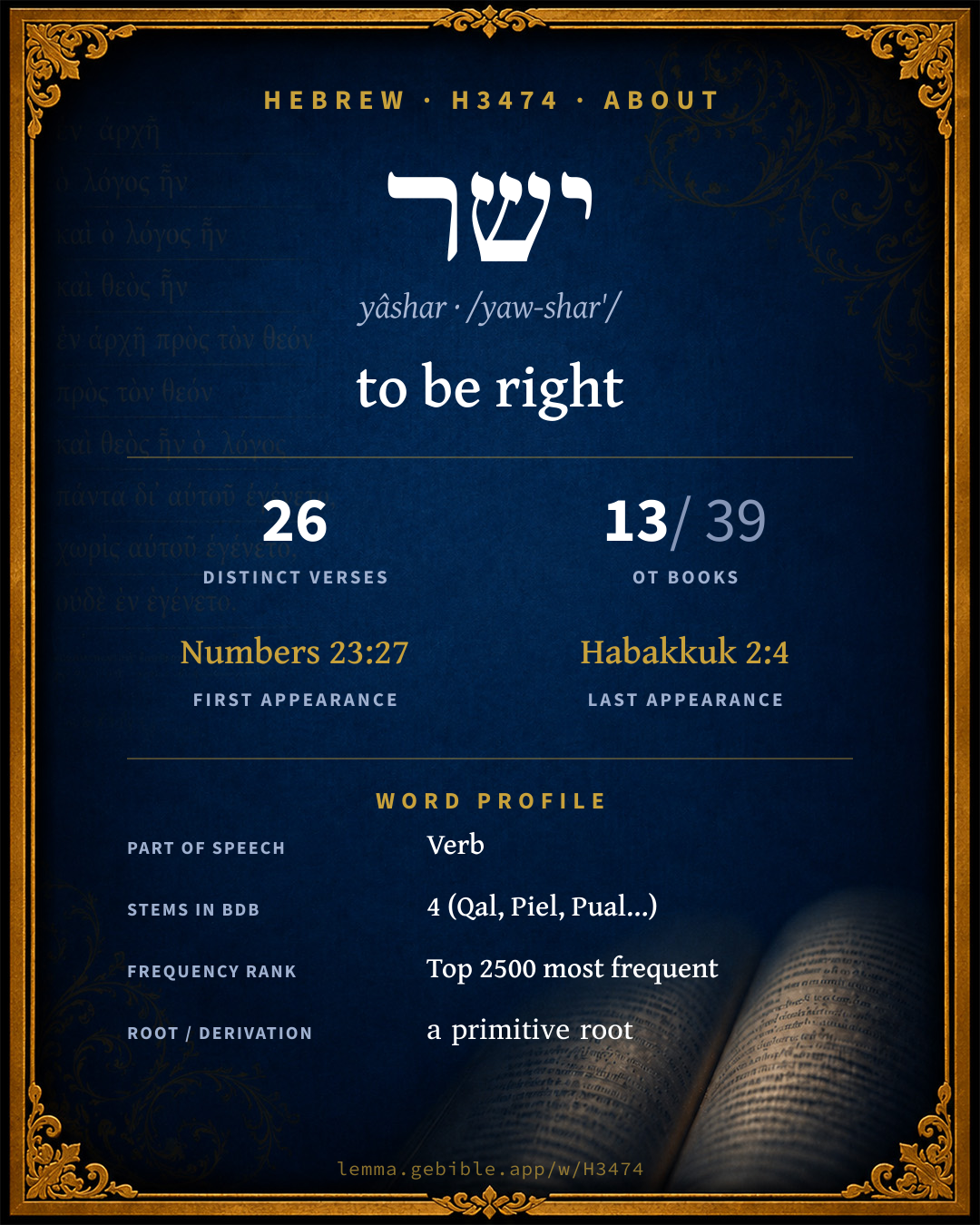
יָשַׁר
to be right
also: be straight, be level, be upright, be just fuller range ↓
Full lexicon entry — Brown-Driver-Briggs (BDB)
From Brown-Driver-Briggs (BDB)
Where this word appears
See every Qal verb in the Hebrew Bible →
Grammar key — what these labels mean
Part of speech
- Verb
- An action or state-of-being word.
Stem
- Qal
- The basic, simple active stem — the plain form of the verb (“he wrote”). Here: ‘go straight’
- Hiphil
- The causative active stem (“he caused / brought about”).
- Piel
- An intensive or resultative active stem. Here: ‘make smooth’
- Pual
- The passive counterpart of the Piel.
Form
- Sequential Imperfect
- An imperfect with prefixed waw — the standard past-narrative form (waw-consecutive imperfect).
- Perfect
- A completed action or state — Hebrew marks aspect (completeness) more than strict tense (“he wrote”).
- Imperative
- A direct command (“write!”).
- Imperfect
- An incomplete, ongoing, or future action (“he will / would write”).
- Participle Active
- A verbal adjective expressing ongoing or characteristic action (“writing / one who writes”).
- Participle Passive
- A verbal adjective expressing action received (“written”).
- Jussive
- A third- or second-person volitional form expressing wish or command (“let him write”).
State
- Absolute
- The independent form of a noun, not bound to a following word.
Person
- 3rd Person
- The one spoken about (“he / she / it / they”).
- 2nd Person
- The one addressed (“you”).
- 1st Person
- The speaker (“I / we”).
Gender
- Masculine
- Grammatically masculine.
- Common
- Either gender — not distinguished for this form.
- Feminine
- Grammatically feminine.
Number
- Singular
- One.
- Plural
- More than one (in Hebrew, generally three or more).
Grammatical forms 18 distinct
- Verb, Qal, Sequential Imperfect, 3rd Person, Masculine, Singular 4 times (14%)
- Verb, Qal, Perfect, 3rd Person, Masculine, Singular 3 times (11%)
- Verb, Hiphil, Imperative, 2nd Person, Masculine, Singular 2 times (7%)
- Verb, Piel, Imperfect, 1st Person, Common, Singular 2 times (7%)
- Verb, Piel, Imperfect, 3rd Person, Masculine, Singular 2 times (7%)
- Verb, Qal, Perfect, 3rd Person, Feminine, Singular 2 times (7%)
- Verb, Qal, Imperfect, 3rd Person, Masculine, Singular 2 times (7%)
- Verb, Piel, Sequential Imperfect, 3rd Person, Masculine, Singular 1 time (4%)
+10 more forms (10 occurrences)
Parsed forms decoded from the imported morphology (morphhb / Westminster Leningrad Codex — WLC text public domain, morphhb tagging CC BY 4.0), counted across 28 parsed occurrences — not distinct verses.
Every verse where H3474 appears — 26 distinct verses across 13 books. Click any verse to open its interlinear word-by-word view. Verse text shown in the World English Bible for context — . Each verse’s Hebrew form is shown with its reference; the English is not keyword-highlighted, since the data carries no word-level English alignment. Use “Compare translations” on any verse to read it across multiple English versions. This concordance covers the Hebrew Bible; Septuagint (Greek Old Testament) occurrences are not indexed here.
Numbers 1 verse
Judges 2 verses
- Judges 14:3 יָשְׁרָ֥ה Qal pf 3fs Then his father and his mother said to him, Is there never a woman among the daughters of your brothers, or among all my people, that you go to take a wife of the uncircumcised Philistines? Samson said to his father, Get her for me; for she pleases me well.
- Judges 14:7 וַ/תִּישַׁ֖ר conj + Qal wimpf 3fs He went down, and talked with the woman, and she pleased Samson well.
1 Samuel 3 verses
- 1 Samuel 6:12 וַ/יִשַּׁ֨רְנָה conj + Qal wimpf 3fp The cattle took the straight way by the way to Beth-shemesh; they went along the highway, lowing as they went, and didn't turn aside to the right hand or to the left; and the lords of the Philistines went after them to the border of Beth-shemesh.
- 1 Samuel 18:20 וַ/יִּשַׁ֥ר conj + Qal wimpf 3ms Michal, Saul's daughter, loved David: and they told Saul, and the thing pleased him.
- 1 Samuel 18:26 וַ/יִּשַׁ֤ר conj + Qal wimpf 3ms When his servants told David these words, it pleased David well to be the king's son-in-law. The days were not expired;
2 Samuel 1 verse
1 Kings 2 verses
1 Chronicles 1 verse
2 Chronicles 2 verses
- 2 Chronicles 30:4 וַ/יִּישַׁ֥ר conj + Qal wimpf 3ms The thing was right in the eyes of the king and of all the assembly.
- 2 Chronicles 32:30 וַֽ/יַּישְּׁרֵ֥/ם conj + Piel wimpf 3ms + sfx pers 3mp This same Hezekiah also stopped the upper spring of the waters of Gihon, and brought them straight down on the west side of the city of David. Hezekiah prospered in all his works.
Job 1 verse
Psalms 2 verses
Proverbs 5 verses
- Proverbs 3:6 יְיַשֵּׁ֥ר Piel impf 3ms In all your ways acknowledge him, And he will direct your paths.
- Proverbs 4:25 יַיְשִׁ֥רוּ Hiphil juss 3mp Let your eyes look straight ahead. Fix your gaze directly before you.
- Proverbs 9:15 הַֽ֝/מְיַשְּׁרִ֗ים ptcl def.art + Piel ptcp.act mp To call to those who pass by, Who go straight on their ways,
- Proverbs 11:5 תְּיַשֵּׁ֣ר Piel impf 3fs The righteousness of the blameless will direct his way, But the wicked shall fall by his own wickedness.
- Proverbs 15:21 יְיַשֶׁר Piel impf 3ms Folly is joy to one who is void of wisdom, But a man of understanding keeps his way straight.
Isaiah 3 verses
- Isaiah 40:3 יַשְּׁרוּ֙ Piel impv 2mp The voice of one who cries, Prepare you in the wilderness the way of Yahweh; make level in the desert a highway for our God.
- Isaiah 45:2 אושר אֲיַשֵּׁ֑ר Hiphil impf 1cs Piel impf 1cs I will go before you, and make the rough places smooth; I will break in pieces the doors of brass, and cut in sunder the bars of iron;
- Isaiah 45:13 אֲיַשֵּׁ֑ר Piel impf 1cs I have raised him up in righteousness, and I will make straight all his ways: he shall build my city, and he shall let my exiles go free, not for price nor reward, says Yahweh of Hosts.
Jeremiah 2 verses
- Jeremiah 18:4 יָשַׁ֛ר Qal pf 3ms When the vessel that he made of the clay was marred in the hand of the potter, he made it again another vessel, as seemed good to the potter to make it.
- Jeremiah 27:5 יָשַׁ֥ר Qal pf 3ms I have made the earth, the men and the animals that are on the surface of the earth, by my great power and by my outstretched arm; and I give it to whom it seems right to me.
Habakkuk 1 verse
About this entry
At a glance — auto-summarized from this page’s data, not written by a person. Every figure links to its source below. This summary describes the numbers; it doesn’t interpret them.
At its core, ישר (yâshar) means “to be right.” Read the stem: it spans 4 stems, including Qal and Piel. It turns up in 26 verses across 13 books, a moderately common footprint. Scripture first uses it in Numbers 23:27. It shares a root with ישר, ישר and מישור. Dig into 26-verse concordance and the renderings breakdown below.
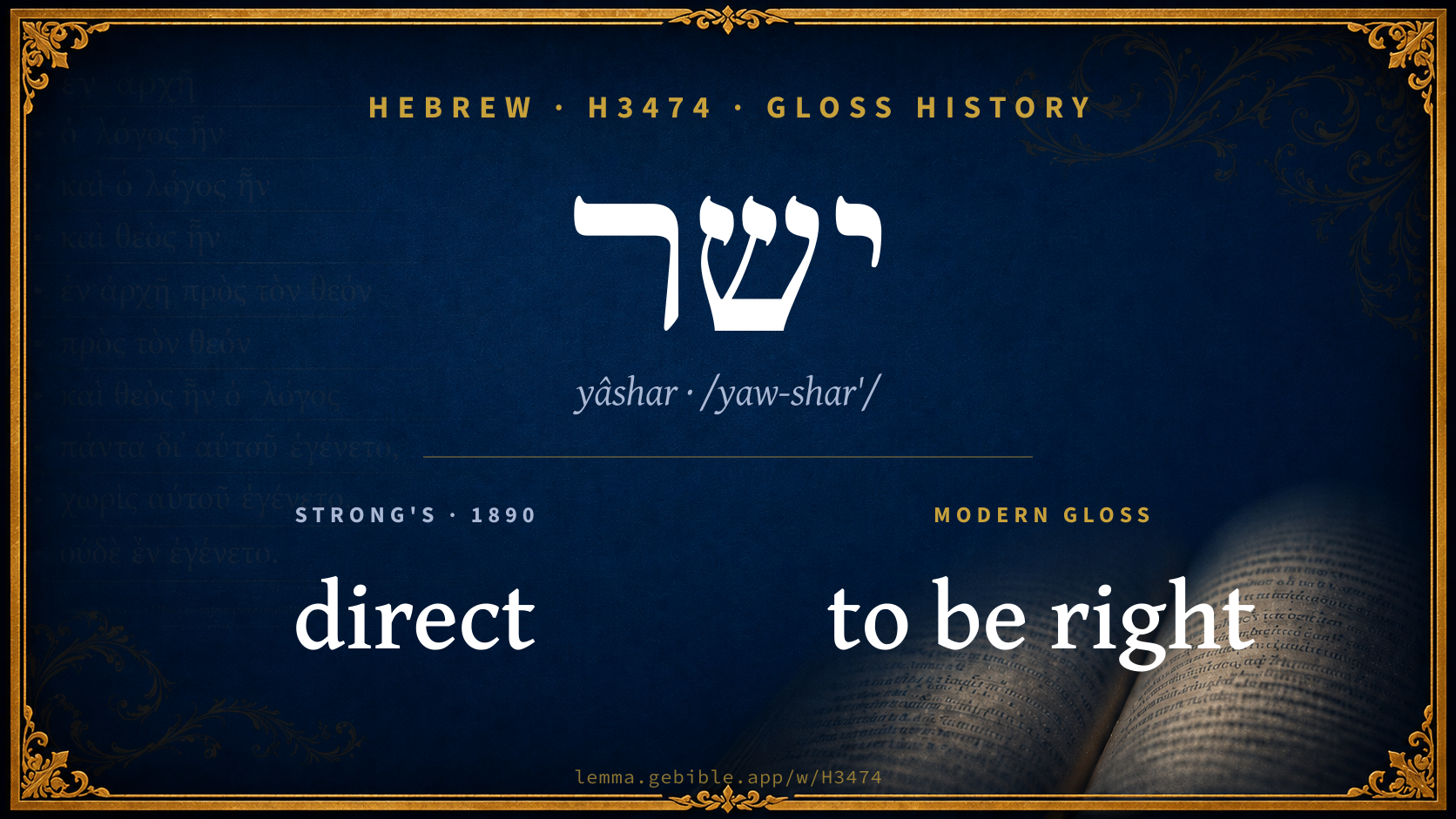
Gloss history
Strong's 1890 vs modern scholarship
About this word
Strong's H3474 catalogs a Hebrew word from the Hebrew Old Testament.
These counts are not copied from any lexicon or concordance. They are computed here, from the morphology-tagged Hebrew Old Testament. What Lemma adds →
- 26
- distinct verses
- The word appears in 26 distinct verses.
- 13 / 39
- OT books
- The word appears in 13 of 39 Old Testament books.
- #1,190
- by frequency
- Top 2500 most frequent Hebrew words (rank 1,190 of 8,640 Hebrew words by occurrence).
View all 26 occurrences in the concordance →
By section of the Old Testament
By traditional corpus
Conventional, traditional groupings — biblical authorship is debated, so this is a traditional corpus grouping, not an authorship claim. Each share is this word’s portion of its verses in that division of the Hebrew canon. Each figure is a share of the word’s 26 distinct verses.
- Prophets (Nevi'im) 14 verses · 54%
- Writings (Ketuvim) 11 verses · 42%
- Torah (Pentateuch) 1 verse · 4%
How translations render this word
Counts come from each version’s own published word-to-Strong’s tagging or interlinear alignment — an approximate guide to how each version renders this word, not a word-level alignment the data otherwise carries. Because each total is that version’s own tagged count, the per-version totals vary from one another and need not match the appearance or distinct-verse counts above. These counts may also differ from a printed concordance because Lemma counts each distinctly tagged rendering and does not collapse phrase taggings into a single head-word total. This is a fixed set of word-tagged versions (KJV, ASV, BSB, ULT) and does not change with the reading translation you choose elsewhere. Each version’s license is shown beside its name below (and on Sources).
BDB lists this Strong’s number as 2 distinct words (homographs). Each count above pools all of them and is not split by sense — see the Senses section below. A low-frequency rendering may belong to a different one of those words, not the primary meaning.
- King James Version†: Pleased 4×, Straight 2×
- American Standard Version†: Him 2×, Was right 2×
- Berean Standard Bible†: Pleased 2×
- unfoldingWord Literal Text†: Was right 6×, And 5×, Is right 2×
King James Version Public Domain
Renders H3474 across 28† tagged occurrences — most commonly:
Plus 22 renderings that appear only once — usually multi-word phrases or single function words the recovered tagging swept in, not distinct renderings. Not rendered by a distinct English word in 1 further occurrence.
American Standard Version Public Domain
Renders H3474 across 27† tagged occurrences — most commonly:
Plus 23 renderings that appear only once — usually multi-word phrases or single function words the recovered tagging swept in, not distinct renderings.
Berean Standard Bible Public Domain
Renders H3474 across 25† tagged occurrences — most commonly:
Plus 23 renderings that appear only once — usually multi-word phrases or single function words the recovered tagging swept in, not distinct renderings.
unfoldingWord Literal Text CC BY-SA 4.0
Renders H3474 across 38† tagged occurrences — most commonly:
Plus 21 renderings that appear only once — usually multi-word phrases or single function words the recovered tagging swept in, not distinct renderings.
12 senses and sub-senses in the full BDB
Hebrew verbs can shift meaning by stem (binyan): Qal is the basic action, Niphal is often passive or reflexive, Piel often intensifies or makes it factitive, and Hiphil is typically causative. The senses below are grouped under the stem BDB assigns to each. This entry also uses Pual (the passive of Piel).
What do BDB’s symbols mean?
BDB uses these scholarly abbreviations:
| Symbol | Meaning |
|---|---|
| 𝔊 | the Septuagint (the ancient Greek translation, LXX) |
| 𝔙 | the Vulgate (the Latin translation) |
| 𝔖 | the Syriac version (the Peshitta) |
| 𝔗 | the Targum (the Aramaic translation) |
| ψ | the Psalms |
| √ | root (the underlying root or stem) |
| ‖ | parallel passage (a synonymous or contrasted parallel) |
| † | the dagger: every passage where the word occurs is cited |
The 12 senses and sub-senses the full Brown-Driver-Briggs lexicon distinguishes for this word, in lexicon order (not ranked by frequency), with BDB’s own verbatim wording and sub-sense lettering. Shown in Hebrew script with BDB’s own scholarly abbreviations. The condensed entry is in the Lexicon Entry tab. See also the Forms in the corpus table below.
ישר I be smooth, straight, right (NH id., and deriv.
Qal
- Pf. יָשַׁר Je 18:4 + 2 times; 3 f. יָשְֽׁרָה Ju 14:3; Hb 2:4; 3 mpl. יָֽשְׁרוּ 1 K 9:12; Impf. יִישַׁר Nu 23:27 + 2 times; יִשַׁר 1 S 18:20, 26; 3 fs. תִּישַׁר Ju 14:7; 3 fpl. יִשַּׁרְנָה 1 S 6:12 (Ges§ 47 k 71)— e.g. Jeremiah 18:4
- 1. go straight, בַּדֶּרֶךְ in the way 1 S 6:12. e.g. 1 Samuel 6:12
- 2. fig., be pleasing, agreeable, right (בְּעֵינֵי in the eyes of); said of a woman Ju 14:3, 7; a man Je 27:5; of matters and things (הַדָּבָר) 1 S 18:20, 26; 2 S 17:4; 1 Ch 13:4; 2 Ch 30:4; of cities 1 K 9:12; a place בְּעֵינֵי הָאֱלֹהִים Nu 23:27 (E); with כַּאֲשֶׁר Je 18:4. e.g. Judges 14:3
- 3. in ethical sense, straightforward, upright; לֹא־יָֽשְׁרָה נַפְשׁוֹ בּוֹ Hb 2:4 his soul is not upright in him (opp. עֻפְּלָה swollen). e.g. Habakkuk 2:4
Piel
- Pf. 1 יִשָּׁ֑רְתִּי ψ 119:128 (יִשְׁרֵהוּ Jb 37:3, 3 m. sf. Thes; but שָׁרָה); Impf. יְיַשֵּׁר Pr 3:6; יְיַשֶּׁר־ 15:21; sf. וַיְיַשְּׁרֵם (Mas abbrev. וַּיַּשְּׁרֵם) 2 Ch 32:30; 3 fs. תְּיַשֵּׁר Pr 11:4; 1 s. אֲיַשֵּׁר Is 45:13; אֲיַשֵּׁר v 2 Qr (Kt Hiph. אוֹשִׁר Ges§70, 2 doubtless copyist’s error); Imv. pl. יַשְּׁרוּ 40:3; Pt. pl. מְיַשְּׁרִים Pr 9:15;— e.g. Psalms 119:128
- 1. make smooth, straight, acc. מְסִלָּה Is 40:3; הֲדוּרִים 45:2; fig., with דֶּרֶךְ, make smooth or straight, i.e. free from obstacles, successful v 13 Pr 11:5, אֹרַח 3:6; in ethical sense, הַמְיַשְּׁרִים אָרְחוֹתָם 9:15 those making straight their paths, going straightforward on their paths; יְיַשֶּׁר־לָ֑כֶת 15:21 maketh straight his going, goeth straightforwards. e.g. Isaiah 40:3
- 2. lead straight along, direct, waters of an aqueduct 2 Ch 32:30; (of the thunder Jb 37:3 according to some; but v. rather שָׁרָה). e.g. 2 Chronicles 32:30
- 3. esteem right, approve ψ 119:128 (read כל פקודיך לי יִשָּׁ֑רְתִּי). e.g. Psalms 119:128
Pual
- Pt. זָהָד מְיָֻּר עַל־הַמְּחֻקֶּה 1 K 6:35 gold made level, laid smoothly out, upon the graven work. e.g. 1 Kings 6:35
Hiphil
- Impf. 3 pl. עַפְעַפֶּיךָ יַיְשִׁרוּ נֶגְדֶּ֑ךָ Pr 4:25 let thine eyelids look straight before thee; Imv. הַיְ֯שַׁר דַּרְכֶּךָ֑ make thy way even ψ 5:9 Qr (Kt הוֹשַׁר; v. Ges 70 (2)). e.g. Proverbs 4:25
ישר II let loose (NH id., dissolve
Qal
- Impf. 3 ms. sf. יִשְׁרֵ֫הוּ Jb 37:3 he (God) lets it loose (i.e. the thunder). e.g. Job 37:3
Piel
- Pf. 1 s. sf. שֵׁרִיתִ֫ךָ Je 15:11 Qr I will set thee free (cf. 40:4 𝔗 𝔖), but dub.; Kt שרותך (i.e. שָׁרוֹתִךָ, √ שׁרר), Thes Gie I vex thee [שַׁרַר = צָרַר, very dub.]; Ew al. RV strengthen thee; this yields best sense, but as Aramaic שׁרר is intrans., read then שֵׁרַרְתִּךָ or הֲשֵׁרוֹתִךָ, Dr; Jerome Rabb read שֵׁרִיתְךָ = שְׁאֵרִיתְךָ thy remnant (AV). e.g. Jeremiah 15:11
Senses from the full Brown-Driver-Briggs lexicon (Brown, Driver, Briggs; Oxford 1906 — public domain), digitized via Sefaria, supplemented by the OpenScriptures HebrewLexicon (CC BY 4.0). Full attribution on Sources.
Word origin
I. vb. be smooth, straight, right (NH id., and deriv.; Arabic يَسَرَ be gentle, tractable, easy, ii. make easy; يَسَرٌ manageable, easy; but Sab. ותֿר, הותֿר, אהל יתֿרן OsZMG 1865, 270 CIS iv, 29, 2; Assyrian išâru, be or go straight, right, mêšêru, justice, mêšêriš, righteously, DlHWB 310)—
I. vb. let loose (NH id., dissolve; Assyrian šarû, Pi. open (building, for use), dedicate it; tašr̂tu, dedication; Old Aramaic שרה loose, so Aramaic שְׁרָא, ܫܪܳܐ; Ethiopic ሰረየ; remit, condone);—
— Brown-Driver-Briggs (Oxford 1906, public domain), digitized via Sefaria, supplemented by the OpenScriptures HebrewLexicon (CC BY 4.0). See Sources.
Origin: a primitive root
Jastrow Dictionary
A second Hebrew/Aramaic lexicon for comparison, covering Aramaic and post-biblical (Talmudic, Targumic, Midrashic) usage that the biblical-Hebrew BDB does not. Matched by lemma rather than by Strong’s number, so a lemma may carry more than one Jastrow headword (shown separately below), and the entries cover usage well beyond the Bible.
יָשַׁר
- to be firm, strong, healthy; to be straight, right. יִישַׁר כֹּחֲךָ or חֵילְךָ ‘may thy strength (health) be firm’, a phrase of approval and thanks. Sabb. 87ᵃ, a. fr. (play on אֲשֶׁר, Ex. XXXIV, 1) י׳ כ׳ ששברת, be thanked for having broken (the tablets). Gen. R. s. 54 (play on וישרנה, I Sam. VI, 12) י׳ חילכם; a. e.—(יֵשַׁר) יִישַׁר (sub. כחך) thanks! right! Ber. 42ᵇ; Sabb. 53ᵃ; Erub. 32ᵇ; a. fr.—Cmp. אַיְשַׁר. e.g. Exodus 34:1
- to straighten, direct, to make firm. Ex. R. s. 1 (ref. to יֵשֶׁר, I Chr. II, 18) זה כלב שיי׳ את עצמו that is Caleb who kept himself straight (did not yield to the rest of the spies). Num. R. s. 8 (ref. to Ps. L, 23 ושם דרך) המְיַישֵּׁר אורחותיו וכ׳ he who directs his ways straight (pays regard to his doings).—Part. pass. מְיוּשָּׁר, f. מְיוּשֶּׁרֶת. Pirké d’R. El. ch. X דרכי מי׳ לפני my way is levelled before me.—Meg. 18ᵇ (ref. to יישרו, Prov. IV, 25) מְיוּשָּׁרִין הן אצל וכ׳ they remain firm with (in the memory of) &c. e.g. 1 Chronicles 2:18
יְשַׁר
- Targ. II Esth. VII, 9 יִישַׁר חילך (Var. יִשַּׁר). [Cant. R. to I, 4 ישריין, v. next w.]
- to be strengthened. Targ. Y. Deut. X, 2, v. אֲשַׁר.
יָשָׁר
- preced.) firm, sound; straight, right, upright. Gen. R. s. 49 אברהם זה י׳ מן היְשָׁרִים this Abraham is firmer than all the firm (angels); Yalk. ib. 82 אברהם זה י׳; Midr. Till. to Ps. XI, 7 קודם לִישָׁרוֹ של עולם וכ׳ before they see the Right One of the world, they (the pious) shall behold the faces of the firm (believers); a. fr.—Pl. יְשָׁרִים, יְשָׁרִין. Cant. R. to I, 4 מה ישריין רחמיך, [read as:] Yalk. ib. 982 מה ישרים וכ׳, expl. מה תקיפין וכ׳ how strong are thy mercies. Midr. Till. l. c. איזו כת … זו כת י׳ which is the highest class among those who will greet the countenance of the Divine Presence (in the hereafter)? The class of the firm believers. Midr. Till. to Ps. XXV, 14 … בתחלה ואה"כ נתן לי׳ first the secret of the Lord is communicated to those who fear him (human beings), and then to the firm ones (the angels, cmp. יְצוּקִים s. v. יָצַק); Gen. R. s. 49; a. e.—Fem. יְשָׁרָה, pl. יְשָׁרוֹת (sub בעיניו; with ref. to Deut. XII, 8) [right in the eyes of the offerer,] free-will offerings (opp. חוֹבָה). Zeb. 114ᵃ י׳ תקריבו וכ׳ free-will sacrifices you may offer (on the bamoth, v. בָּמָה), but no obligatory offerings; ib. 117ᵇ. Ib. י׳ נינהו they belong to the class of free-will offerings. Ib. 118ᵃ; a. fr.—סֵפֶר הַיָּשָׁר the Book Yashar, a lost book (Josh. X, 13; II Sam. I, 18). Ab. Zar. 25ᵃ. Y. Sot. I, end, 17ᶜ e.g. Deuteronomy 12:8
A Dictionary of the Targumim, the Talmud Babli and Yerushalmi, and the Midrashic Literature (Marcus Jastrow; London, Luzac, 1903) — Public Domain. Digitized via Sefaria. Digitized via Sefaria. Full attribution on Sources.
Forms in the corpus
The 24 distinct written forms H3474 takes in the Hebrew Bible, most frequent first — each parse links to that stem’s occurrences in the concordance. Hebrew forms include their vowel points and cantillation, so a single lemma takes many written forms.
Same root — word family
Other BDB entries built from the same root as H3474, grouped by Strong’s listed origin. These share a root / origin per the lexicon — not necessarily a shared meaning. Each links to that word’s own entry.
Derived from this word
- ישר yôsher H3476 uprightness
- ישר yâshâr H3477 upright
- מישור mîyshôwr H4334 plain
- מישר mêyshâr H4339 uprightness
Proper names from this root
People and places named from this root — a name, not an additional meaning of the word.
Compare all same-root words → Showing 4 of 8 — not the complete family. 3 of the same-root words are proper names (people or places). They share a root, not necessarily a meaning.
Septuagint verse parallels
This word appears in 23 verses that also exist in the Greek Old Testament (Septuagint), out of the 26 Hebrew verses it occurs in. You can read those verses in Greek by switching the Old Testament edition to the Septuagint.
Read these verses in the Septuagint
- Numbers 23:27
- Judges 14:3
- 1 Samuel 6:12
- 2 Samuel 17:4
- 1 Kings 6:35
- 1 Chronicles 13:4
- 2 Chronicles 30:4
- Job 37:3
- Psalms 5:8
- Proverbs 3:6
- Isaiah 40:3
- Jeremiah 18:4
This is a verse-level parallel only — the same verses exist in both the Hebrew and Greek Old Testaments. No word-level Hebrew↔Greek correspondence is claimed: the data carries no such alignment, so no Greek word is shown as this Hebrew word’s translation. Coverage is not total — the Septuagint omits the deuterocanon and renumbers the Psalms, so some Hebrew verses have no direct Greek parallel.