
Proverbs 21:2

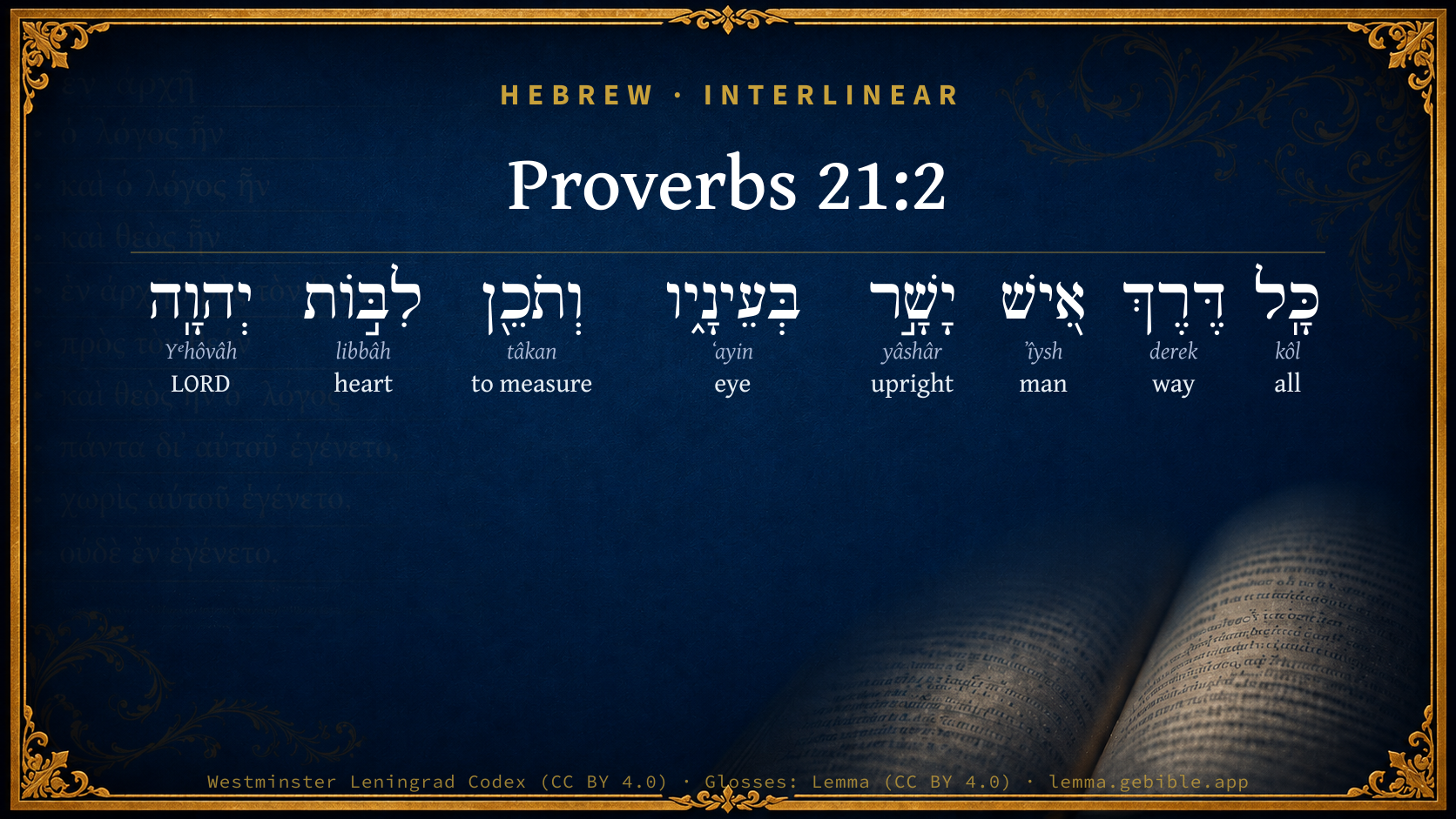
Hebrew (Westminster Leningrad Codex) Proverbs 21:2 appears in the Hebrew Old Testament. The text above is from the Westminster Leningrad Codex. Each word links to its Strong’s number, a concise gloss, and parsing drawn from the Open Scriptures Hebrew Bible morphology. Click any word for its full Brown-Driver-Briggs (BDB) entry.
Download image
Cite this verse

Proverbs 21:2 (World English Bible). Public Domain. Lemma interlinear Bible study tool, https://lemma.gebible.app/v/proverbs/21/2.

Show BibTeX & RIS
BibTeX
RIS
English Translation
Every way of a man is right in his own eyes, But Yahweh weighs the hearts.
World English Bible · Public Domain
Download a study sheet

One document with this verse’s original text, its word-by-word gloss line, the meaning frame, cross-references with their text, attributed commentary, and full source and license credits — printable, and it pastes into notes with its structure intact.

This verse Autodidact and up

Study sheet (.html) Plain text (.txt)

A passage Seminary Student

Up to 50 verses in one chapter. A passage sheet keeps up to 6 commentary sources and 12 cross-references per verse, in the order this page ranks them, and says so on the sheet whenever that leaves anything out. Ask for a single verse and you get the Autodidact verse sheet above.

Everything on this page stays free to read, with no account — the sheet is a download of what is already on screen, not access to it.

Want to remove ads? Support Godless Engineer
Compare translations 3

The same verse in 3 English versions, stacked beneath the original-language interlinear above. Click any original word for its lexicon entry.

Each is an independent rendering of the whole verse — the interlinear is not word-aligned to these translations.

Highlighted words mark where these versions differ — a whole-verse word diff, not a word-by-word alignment.

  • World English Bible Public Domain
    Every way of a man is right in his own eyes, But Yahweh weighs the hearts.
  • King James Version Public Domain
    Every way of a man is right in his own eyes: but the LORD pondereth the hearts.
  • unfoldingWord Literal Text CC BY-SA 4.0
    Every way of a man right in his eyes, but Yahweh examines hearts.

unfoldingWord Literal Text — © unfoldingWord, licensed CC BY-SA 4.0. Word-aligned USFM3 via Door43 (git.door43.org/unfoldingWord/en_ult).

Versions to compare (up to 4)

3 of 4 selected

Show all 18 translations

Every available English version of this verse, each an independent rendering of the whole verse.

  • World English Bible Public Domain
    Every way of a man is right in his own eyes, But Yahweh weighs the hearts.
  • Berean Standard Bible Public Domain
    All a man’s ways seem right to him, but the LORD weighs the heart.
  • Majority Standard Bible Public Domain
    All a man’s ways seem right to him, but the LORD weighs the heart.
  • King James Version Public Domain
    Every way of a man is right in his own eyes: but the LORD pondereth the hearts.
  • American Standard Version (1901) Public Domain
    Every way of a man is right in his own eyes; But Jehovah weigheth the hearts.
  • Revised Version (1885) Public Domain
    Every way of a man is right in his own eyes: but the LORD weigheth the hearts.
  • Geneva Bible (1599) Public Domain
    Euery way of a man is right in his owne eyes: but the Lord pondereth the hearts.
  • Douay-Rheims (1899) Public Domain
    Every way of a man seemeth right to himself: but the Lord weigheth the hearts.
  • Young's Literal Translation Public Domain
    Every way of a man `is' right in his own eyes, And Jehovah is pondering hearts.
  • Literal Standard Version CC BY-SA 4.0
    Every way of a man [is] right in his own eyes, || And YHWH is pondering hearts.
  • Unlocked Literal Bible CC BY-SA 4.0
    Every person's way is right in his own eyes, but it is Yahweh who weighs the hearts.
  • unfoldingWord Literal Text CC BY-SA 4.0
    Every way of a man right in his eyes, but Yahweh examines hearts.
  • Darby Bible Public Domain
    Every way of a man is right in his own eyes; but Jehovah weigheth the hearts.
  • World Messianic Bible Public Domain
    Every way of a man is right in his own eyes, but the LORD weighs the hearts.
  • Webster's Bible Public Domain
    Every way of a man is right in his own eyes: but the LORD pondereth the hearts.
  • Free Bible Version CC BY-SA 4.0
    People think that whatever they do is fine, but the Lord looks at their motives.
  • Bible in Basic English Public Domain
    Every way of a man seems right to himself, but the Lord is the tester of hearts.
  • JPS Tanakh (1917) Public Domain
    Every way of a man is right in his own eyes; but the LORD weigheth the hearts.

Literal Standard Version (2020), Covenant Press — licensed CC BY-SA 4.0. Text via the HelloAO Bible API (eBible.org). Unlocked Literal Bible (unfoldingWord) — licensed CC BY-SA 4.0. Text via the HelloAO Bible API (eBible.org). unfoldingWord Literal Text — © unfoldingWord, licensed CC BY-SA 4.0. Word-aligned USFM3 via Door43 (git.door43.org/unfoldingWord/en_ult). Free Bible Version, Dr. Jonathan Gallagher — licensed CC BY-SA 4.0. Text via the HelloAO Bible API (eBible.org).

Word by word

More ways to search: Search by grammar → Find every occurrence → Compare this word →

Practice this passage: Drill this verse → Learn its vocabulary →

About this verse

These counts appear in no published source. They are computed here, from the morphology-tagged text and Lemma’s own curated glosses. What Lemma adds →

8
words
8
distinct lemmas
Wisdom
section

Notable vocabulary

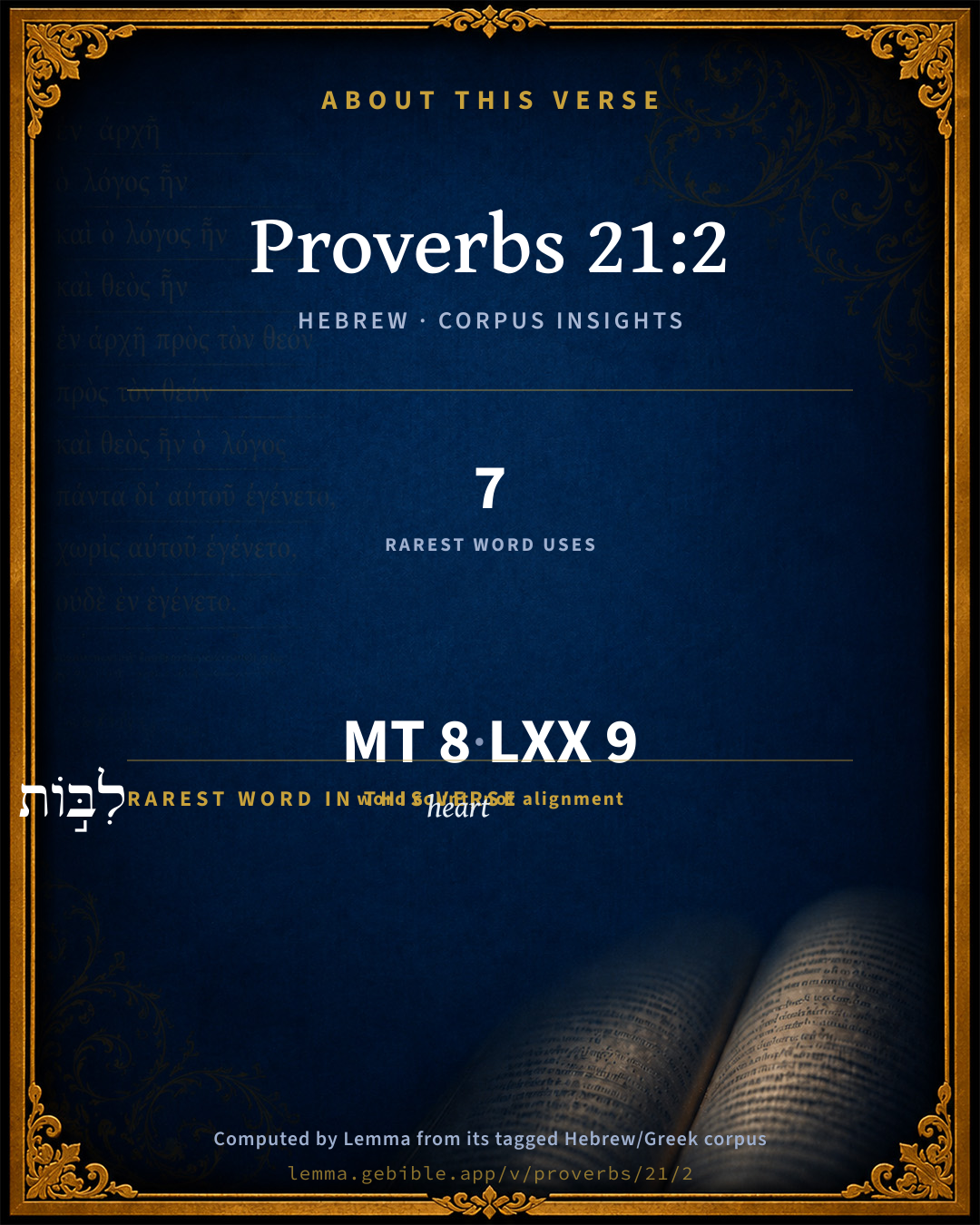
The rarest word here is לִבּ֣וֹת heart H3826 — appearing just 7 times in the whole Hebrew Bible.

Shared distinctive vocabulary

לִבּ֣וֹת heart H3826 occurs in 7 verses of the Hebrew Bible. Also found in:

Grammatical profile

  • 1 verb
  • 6 nouns
  • 1 adjective

Verb forms

  • וְתֹכֵ֖ן Qal · Participle Active

Hebrew & Septuagint length

In English translation the verse runs 16 words from the Hebrew and 12 from the Septuagint (LXX English) — closely comparable.

A rough comparison of the two English renderings, which tokenize alike — not a word-level alignment.

Word counts can differ between the Hebrew and the Greek without any difference in meaning — e.g. the Hebrew direct-object marker אֵת has no separate Greek word, and Greek often adds the article ὁ.

In the original languages it is 8 Hebrew tokens and 9 Greek tokens — but the two are counted differently (Hebrew bundles its prefixes and suffixes into one token; the Greek is in lemma form), so that isn’t a like-for-like length.

Cross-references

14

Topical passages linked to Proverbs 21:2 in the Treasury of Scripture Knowledge — connected by theme and wording, ordered by reader-vote popularity; previews shown in the World English Bible.

  • Proverbs 16:2 All the ways of a man are clean in his own eyes; But Yahweh weighs the motives.
  • Proverbs 16:25 There is a way which seems right to a man, But in the end it leads to death.
  • Luke 16:15 He said to them, "You are those who justify yourselves in the sight of men, but God knows your hearts. For that which is exalted among men is an abomination in the sight of God.
  • Jeremiah 17:10 I, Yahweh, search the mind, I try the heart, even to give every man according to his ways, according to the fruit of his doings.
  • 1 Samuel 16:7 But Yahweh said to Samuel, "Don't look on his face, or on the height of his stature; because I have rejected him: for [Yahweh sees] not as man sees; for man looks at the outward appearance, but Yahweh looks at the heart."
  • Proverbs 30:12 There is a generation that is pure in their own eyes, Yet are not washed from their filthiness.
  • Proverbs 24:12 If you say, "Behold, we didn't know this;" Doesn't he who weighs the hearts consider it? He who keeps your soul, doesn't he know it? Shall he not render to every man according to his work?
  • Psalms 36:2 For he flatters himself in his own eyes, Too much to detect and hate his sin.
  • James 1:22 But be doers of the word, and not only hearers, deluding your own selves.
  • Luke 18:11–12 The Pharisee stood and prayed to himself like this: 'God, I thank you, that I am not like the rest of men, extortioners, unrighteous, adulterers, or even like this tax collector.
  • Galatians 6:3 For if a man thinks himself to be something when he is nothing, he deceives himself.
  • Proverbs 20:6 Many men claim to be men of unfailing love, But who can find a faithful man?
  • John 2:24–25 But Jesus didn't trust himself to them, because he knew everyone,
  • Revelation 2:23 I will kill her children with Death, and all the assemblies will know that I am he who searches the minds and hearts. I will give to each one of you according to your deeds.

Cross-references courtesy of OpenBible.info (CC BY 4.0).

Hebrew and Greek witnesses Masoretic Hebrew ↔ Greek Septuagint

The same verse in the two great witnesses to the Old Testament, shown verse-for-verse.

These are two independent witnesses, not word-aligned to each other, and the Septuagint is shown in lemma (dictionary) form.

Hebrew Proverbs 21:2 Masoretic · Westminster Leningrad Codex

כָּֽל דֶּרֶךְ אִ֭ישׁ יָשָׁ֣ר בְּעֵינָ֑יו וְתֹכֵ֖ן לִבּ֣וֹת יְהוָֽה

Every way of a man is right in his own eyes, But Yahweh weighs the hearts.

World English Bible · Public Domain

Greek LXX Proverbs 21:2 Septuagint · lemma form

πᾶς ἀνήρ φαίνω ἑαυτοῦ δίκαιος καταεὐθύνω δέ καρδία κύριος

Every man seems to himself righteous; but the Lord directs the hearts.

LXX2012 (modern English Septuagint) · Public Domain

On this verse, John Gill's Exposition discusses the Septuagint’s reading. Read the note in Commentary ↓

Hebrew: Westminster Leningrad Codex (CC BY 4.0). Greek: Septuagint (public domain); English from LXX2012 (modern English Septuagint) (Public Domain). How the Septuagint differs from the Hebrew →

Commentary

Notes on Proverbs 21:2 from classic Christian and Jewish commentators (each source and its license shown beneath its notes). The classic Christian expositions comment on the surrounding passage and are grouped to its opening verse, so a note may address several verses; the Jewish commentaries on the Tanakh (Rashi and others) are per-verse, so they appear only where the commentator wrote on this verse.

Lemma curates 59 commentaries, every one of them public domain or Creative Commons licensed, each selected and text-cleaned for this edition rather than reprinted as found. About our sources →

Trapp's Complete Commentary

John Trapp

Pro 21:2 Every way of a man [is] right in his own eyes: but the LORD pondereth the hearts.

Ver. 2. Every way of a man is right in his own eyes.] {See Trapp on "Pro 16:2"} Such is our sinful self-love, that, Suffenus-like, we easily admire that little nothing of any good that is in us; we so clasp and hug the barn of our own brain, with the ape, that we strangle it; we set up a counter for a thousand pounds, and boast of those graces whereunto we are perfect strangers. We turn the perspective telescope, and gladly see ourselves larger, others smaller than they are: we flatter our own souls as Micah did his. {Jdg 17:13} Wherein it often happens as it did with the riflers of Semiramis’ tomb, who, where they expected to find the richest treasure, met with a deadly poison. Seem we never so just, because first in our own cause, God - as Solomon saith of a man’s neighhour - comes and searches us, and then things appear otherwise. {Luk 16:15}

John Trapp, A Commentary or Exposition upon All the Books of the Old and New Testament (1647–1656) — public domain. Text from a community e-Sword module.

Joseph Benson's Commentary

Pro 21:2-3. Every way of a man, &c. — See on Pro 16:2, where this same thing was declared. To do justice and judgment — The conscientious performance of all our duties to men; is more acceptable to the Lord than sacrifice — Than the most costly outward services offered to God, joined with the neglect of religious and moral duties to God or men: see 1Sa 15:22; Hos 6:6; Mic 6:7-8.

Joseph Benson's Commentary on the Old and New Testaments (1811–1818) — public domain. Text from a community e-Sword module.

Keil & Delitzsch

C. F. Keil & F. Delitzsch

The next group extends from Pro 21:2 to Pro 21:8, where it closes as it began.

2 Every way of a man is right in his own eyes;

But a weigher of hearts is Jahve.

A proverb similar to Pro 16:2 (where דּרכי, for דּרך, זך for ישׁר, רוּחות for לבּות). God is also, Pro 17:3, called a trier, בּחן, of hearts, as He is here called a weigher, תּכן. The proverb indirectly admonishes us of the duty of constant self-examination, according to the objective norm of the revealed will of God, and warns us against the self-complacency of the fool, of whom Pro 12:15 says (as Trimberg in "Renner"): "all fools live in the pleasant feeling that their life is the best," and against the self-deception which walks in the way of death and dreams of walking in the way of life, Pro 14:12 (Pro 16:25).

Keil & Delitzsch — Biblical Commentary on the Old Testament (1861–1891) — public domain (CC PDM 1.0). Text via the HelloAO Bible API. (Old Testament only.)

Tyndale Open Study Notes

Tyndale Open Resources

21:2 This proverb is repeated almost verbatim in 16:2.

Tyndale Open Study Notes — © Tyndale Open Resources, licensed CC BY-SA 4.0. Text via the HelloAO Bible API.

Matthew Henry's Commentary

Note, 1. We are all apt to be partial in judging of ourselves and our own actions, and to think too favourably of our own character, as if there was nothing amiss in it: Every way of a man, even his by-way, is right in his own eyes. The proud heart is very ingenious in putting a fair face upon a foul matter, and in making that appear right to itself which is far from being so, to stop the mouth of conscience. 2. We are sure that the judgment of God concerning us is according to truth. Whatever our judgment is concerning ourselves, the Lord ponders the heart. God looks at the heart, and judges of men according to that, of their actions according to their principles and intentions; and his judgment of that is as exact as ours is of that which we ponder most, and more so; he weighs it in an unerring balance, Pro 16:2.

Matthew Henry's Commentary on the Whole Bible (1708–1710) — public domain (CC PDM 1.0). Text via the HelloAO Bible API.

Jamieson, Fausset & Brown

Robert Jamieson, A. R. Fausset & David Brown

(Compare Pro 14:2; Pro. 16:2-25).

Jamieson, Fausset & Brown — Commentary Critical and Explanatory on the Whole Bible (1871) — public domain (CC PDM 1.0). Text via the HelloAO Bible API.

Adam Clarke's Commentary

Verse 2. The Lord pondereth the hearts.] Every man feels strongly attached to his own opinions, modes of acting, c. and though he will not easily give up any thing to the judgment of a neighbour, whom he will naturally consider at least as fallible as himself, yet he should consider that the unerring eye of God is upon him; and he should endeavour to see that what he does is acceptable in the eye of his Maker and Judge.

Adam Clarke's Commentary on the Bible (1810–1826) — public domain. Text from a community e-Sword/MySword module.

Ellicott's Commentary for English Readers

(2) Every way of a man is right in his own eyes.—See above, on Pro_16:2.

A Bible Commentary for English Readers, edited by Charles John Ellicott (1878–1897) — public domain. Text from a community e-Sword module.

The Cambridge Bible for Schools and Colleges

gen. ed. J. J. S. Perowne

2. Repeated almost exactly from Pro_16:2.

The Cambridge Bible for Schools and Colleges (gen. ed. J. J. S. Perowne; Cambridge University Press, 1878–1918) — public domain. Text from a community e-Sword module.

John Gill's Exposition

Every way of a man is right in his own eyes,.... This is repeated, from Pro 16:2; for the confirmation of it; and that it might be observed and taken notice of, and men be brought under a conviction of it; which is not easily done, it being what affects all men: every man is conceited of himself and his own way, and is not easily persuaded off of it; his sinful ways are agreeable to him promising him pleasure, profit, or honour; and his self-righteous ways suit with the vain opinion he has of himself, whereby he promises himself eternal life and happiness. The Septuagint and Arabic versions render it to this sense,

"every man seems righteous to himself;''

but the Lord pondereth the hearts: weighs them in the balance of righteousness and truth; considers them, having a perfect knowledge of them, and all the springs of action in them; and knows that every way of man is not right, though they may seem so to him.

John Gill's Exposition of the Whole Bible (1746–1763) — public domain (CC PDM 1.0). Text via the HelloAO Bible API.

Matthew Poole's English Annotations

This was said Pro 16:2, where it is explained, and is here repeated, either for the great importance and usefulness of it, or because he perceived that the Israelites were very prone to self-deceit.

Matthew Poole's English Annotations on the Holy Bible (1683–1685) — public domain. Text from a community e-Sword/MySword module.

Whedon's Commentary on the Bible

Daniel D. Whedon

2. Pondereth — Weighs or proves.

The hearts — Compare Pro_14:12; Pro_16:2; Pro_16:25. “The trier of hearts is Jehovah.” — Conant.

Daniel D. Whedon (gen. ed.), Commentary on the Old and New Testaments (1874–1909) — public domain. Text from a community e-Sword module.

The Pulpit Commentary

This is similar to Pro_16:2. (where see note. Comp. also Pro_14:12 Pro_16:25 Pro_20:24) See here a warning against self-deception and that silly self-complacency which thinks its own ways the best. Septuagint, "Every man appears to himself righteous, but the Lord directs the hearts.

See homily on Pro_16:2. C.

The Pulpit Commentary (1880–1919), ed. H.D.M. Spence-Jones & Joseph S. Exell — public domain. Text from a community e-Sword module.

Bridges on Proverbs

Charles Bridges

Let me be thankful for the repetition (Pro 16:2 ) of this weighty Proverb; most valuable for the close probing of my heart, and the testing of the vital spirituality of my profession. So "deceitful is the heart above all things" (Jer 17:9 ), that it deceives, not others only, but — what even Satan never does — itself. Every intelligent Christian bears painful witness to this self-deception. How differently do we judge of the same action in others, and in ourselves! Often do we palliate, if not justify, in ourselves the very habits, which we condemn in others. Never therefore is the prayer out of season — "Search me, O God; know me, try me; shew me to myself." (Psa 139:23 .) There are no persons in the world, about whom we make so many mistakes as ourselves. But, Oh! to be approved of God in heart, and in sincerity, is no common mercy!

Hid as the self-deluded professor is from himself, his way is right in his own eyes. But is it right in God’s eyes? The LORD pondereth the heart. Solemn and awakening recollection! He thoroughly reads every heart. And what defilement does he see in those ways of a man that are most right in his own eyes! Saul thought that he was serving God acceptably. But the all-searching eye discovered pride, covetousness, disobedient rejection of his God.†1 What more self-satisfying than the soul’s strict fast and humiliation? But the defective motive marred the sacrifice. "Did ye at all fast to me, even to me?"†2 Little did the self-complacent ruler suspect the spiritual pride, false confidence, and worldliness, which this heart-searching God brought to view.†3 And how much base alloy is hidden even in a sound-hearted profession! The disciples covered their own spirit under the pretense of vehement zeal for their Master. (Luk 9:54-55 .) The LORD pondereth the heart. He "weigheth the spirits" (Pro 16:2 ); proving exactly what is of himself, and what is of a baser kind; what, and how much, there is of God, what of man. The principles of the heart lie deep. The work may be good in itself. But what are the ends? The same work, according to its end, may be accepted, or be cast away. Jehonadab and Jehu both were engaged in the same exterminating work. With the one it was right service; with the other, vile hypocrisy. (2Ki 10:15 .) Self-distrust is therefore the wisdom of true godliness (Pro 28:26 ); daily, hourly, trembling in ourselves; yet boldly grounding our confidence in God! But for the covering of the High Priest, how could we stand for one moment under the piercing eye of our Judge? Did our dearest earthly friend know what was passing in our thoughts at any one hour, could he ever deem us worthy of confidence? Must not his heart revolt from contact with such vileness? Yet does our gracious LORD, while pondering our hearts, and privy to all their hidden corruptions, forgive, accept, yea — rejoice in us as his people.

Footnotes:

†1 1Sa 15:13-26 .

†2 Zec 7:6. Isa 58:5 . Jer 2:35 .

†3 Mat 19:21.

Charles Bridges, An Exposition of the Book of Proverbs (1846) — public domain. Text from a community e-Sword module.

Kretzmann's Popular Commentary

Paul E. Kretzmann

v. 2. Every way of a man Is right in his own eyes, he is inclined to self-satisfaction, which may lead him astray; but the Lord pondereth the hearts, He weighs them and thus determines the direction which their plans should take. cf Pro 16:2.

Paul E. Kretzmann, Popular Commentary of the Bible (1921–1924) — public domain. Text from a community e-Sword module.

Rashi

Rabbi Shlomo Yitzchaki (Rashi)

Man’s every way is straight in his own eyes, but the Lord counts Heb. ותכן.

Rashi on the Tanakh — English translations: “The Judaica Press complete Tanach with Rashi, translated by A. J. Rosenberg” (CC BY 4.0); “Pentateuch with Rashi's commentary by M. Rosenbaum and A.M. Silbermann, 1929-1934” (public domain); “The Metsudah Tanach series, Lakewood, N.J” (CC BY 4.0); and “The Book of Joshua, Metsudah Publications, 1997” (CC BY 4.0). Text via Sefaria.

Lesson kit

Teaching starters — assembled from the data on this page, not authored interpretation. Every prompt links to the verse data it draws on. Edit before teaching.

Proverbs, in the Wisdom, opens this verse with 8 words (8 distinct Hebrew lemmas). Its most distinctive word is libbâh (“heart”). A historical commentator’s framing appears above. Read the whole chapter for the surrounding context.

Discussion questions

  1. How does “heart” (libbâh) shape what this verse is saying?
  2. Psalms 7:9 shares the word «heart» with this verse. How do the two illuminate each other?
  3. These translations render this verse differently. What is at stake in choosing one wording over another?
  4. The verb «וְתֹכֵ֖ן» is Qal Participle Active. How does its form color the action?
  5. Reading how Trapp's Complete Commentary and Joseph Benson's Commentary read this verse, where do the two commentators agree and where do they part?

Things to notice

Reading settings

Reading text

Shown beneath each verse's original-language words.

Old Testament
Old Testament edition

Read the OT as the Masoretic Hebrew (MT) or the Greek Septuagint (LXX).

English shown for the Greek Septuagint (in the Hebrew ↔ Greek comparison).

Comparing translations? Open the Compare panel on any verse page to stack up to four side by side.