2 Kings 10:3

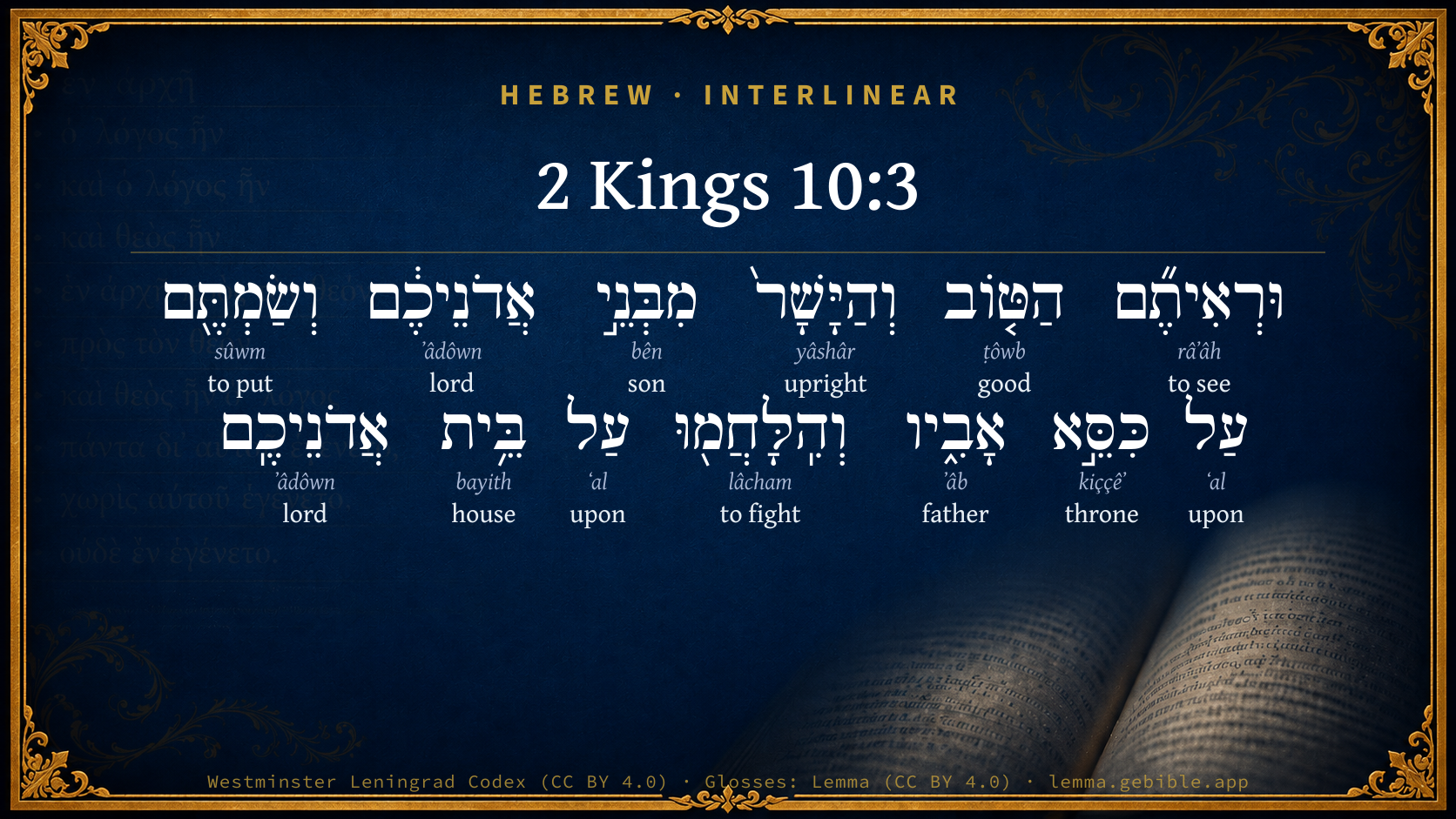
Hebrew (Westminster Leningrad Codex) 2 Kings 10:3 appears in the Hebrew Old Testament. The text above is from the Westminster Leningrad Codex. Each word links to its Strong’s number, a concise gloss, and parsing drawn from the Open Scriptures Hebrew Bible morphology. Click any word for its full Brown-Driver-Briggs (BDB) entry.
Download image
Cite this verse

2 Kings 10:3 (World English Bible). Public Domain. Lemma interlinear Bible study tool, https://lemma.gebible.app/v/2-kings/10/3.

Show BibTeX & RIS
BibTeX
RIS
English Translation
look you out the best and meet of your master's sons, and set him on his father's throne, and fight for your master's house.
World English Bible · Public Domain
Download a study sheet

One document with this verse’s original text, its word-by-word gloss line, the meaning frame, cross-references with their text, attributed commentary, and full source and license credits — printable, and it pastes into notes with its structure intact.

This verse Autodidact and up

Study sheet (.html) Plain text (.txt)

A passage Seminary Student

Up to 50 verses in one chapter. A passage sheet keeps up to 6 commentary sources and 12 cross-references per verse, in the order this page ranks them, and says so on the sheet whenever that leaves anything out. Ask for a single verse and you get the Autodidact verse sheet above.

Everything on this page stays free to read, with no account — the sheet is a download of what is already on screen, not access to it.

Want to remove ads? Support Godless Engineer
Compare translations 3

The same verse in 3 English versions, stacked beneath the original-language interlinear above. Click any original word for its lexicon entry.

Each is an independent rendering of the whole verse — the interlinear is not word-aligned to these translations.

Highlighted words mark where these versions differ — a whole-verse word diff, not a word-by-word alignment.

  • World English Bible Public Domain
    look you out the best and meet of your master's sons, and set him on his father's throne, and fight for your master's house.
  • King James Version Public Domain
    Look even out the best and meetest of your master's sons, and set him on his father's throne, and fight for your master's house.
  • unfoldingWord Literal Text CC BY-SA 4.0
    then you shall look for the good and right from the sons of your master, and you shall set on the throne of his father, and you shall fight for the house of your master.”

unfoldingWord Literal Text — © unfoldingWord, licensed CC BY-SA 4.0. Word-aligned USFM3 via Door43 (git.door43.org/unfoldingWord/en_ult).

Versions to compare (up to 4)

3 of 4 selected

Show all 18 translations

Every available English version of this verse, each an independent rendering of the whole verse.

  • World English Bible Public Domain
    look you out the best and meet of your master's sons, and set him on his father's throne, and fight for your master's house.
  • Berean Standard Bible Public Domain
    select the best and most worthy son of your master, set him on his father’s throne, and fight for your master’s house.”
  • Majority Standard Bible Public Domain
    select the best and most worthy son of your master, set him on his father’s throne, and fight for your master’s house.”
  • King James Version Public Domain
    Look even out the best and meetest of your master's sons, and set him on his father's throne, and fight for your master's house.
  • American Standard Version (1901) Public Domain
    look ye out the best and meetest of your master's sons, and set him on his father's throne, and fight for your master's house.
  • Revised Version (1885) Public Domain
    look ye out the best and meetest of your master’s sons, and set him on his father’s throne, and fight for your master’s house.
  • Geneva Bible (1599) Public Domain
    Consider therefore which of your masters sonnes is best and most meete, and set him on his fathers throne, and fight for your masters house.
  • Douay-Rheims (1899) Public Domain
    Choose the best, and him that shall please you most of your master's sons, and set him on his father's throne, and fight for the house of your master.
  • Young's Literal Translation Public Domain
    and ye have seen the best and the uprightest of the sons of your lord, and have set `him' on the throne of his father, and fight ye for the house of your lord.'
  • Literal Standard Version CC BY-SA 4.0
    that you have seen the best and the most upright of the sons of your lord, and have set [him] on the throne of his father, and fight for the house of your lord.”
  • Unlocked Literal Bible CC BY-SA 4.0
    select the best and most deserving of your master's descendants and set him on his father's throne, and fight for your master's royal line.”
  • unfoldingWord Literal Text CC BY-SA 4.0
    then you shall look for the good and right from the sons of your master, and you shall set on the throne of his father, and you shall fight for the house of your master.”
  • Darby Bible Public Domain
    look out the best and worthiest of your master's sons, and set him on his father's throne, and fight for your master's house.
  • World Messianic Bible Public Domain
    select the best and fittest of your master’s sons, set him on his father’s throne, and fight for your master’s house.”
  • Webster's Bible Public Domain
    Look out the best and meetest of your master's sons, and set him on his father's throne, and fight for your master's house.
  • Free Bible Version CC BY-SA 4.0
    choose the best and most appropriate son of your master, place him on his father's throne, and fight for your master's house.”
  • Bible in Basic English Public Domain
    Take the best and most upright of your master's sons, and make him king in his father's place, and put up a fight for your master's family.
  • JPS Tanakh (1917) Public Domain
    look ye out the best and meetest of your master's sons, and set him on his father's throne, and fight for your master's house.'

Literal Standard Version (2020), Covenant Press — licensed CC BY-SA 4.0. Text via the HelloAO Bible API (eBible.org). Unlocked Literal Bible (unfoldingWord) — licensed CC BY-SA 4.0. Text via the HelloAO Bible API (eBible.org). unfoldingWord Literal Text — © unfoldingWord, licensed CC BY-SA 4.0. Word-aligned USFM3 via Door43 (git.door43.org/unfoldingWord/en_ult). Free Bible Version, Dr. Jonathan Gallagher — licensed CC BY-SA 4.0. Text via the HelloAO Bible API (eBible.org).

Word by word

More ways to search: Search by grammar → Find every occurrence → Compare this word →

Practice this passage: Drill this verse → Learn its vocabulary →

וְהַיָּשָׁר֙
yâshâr
H3477
“and · the · upright”
Conjunction + Particle, Definite Article + Adjective, Adjective, Masculine, Singular, Absolute
Part of Speech
Conjunction + Particle + Adjective
Type
Adjective
Gender
Masculine
Number
Singular
State
Absolute
Full BDB Definition

Origin: from H3474

TWOT: 930a

straight, upright, correct, right - straight, level - right, pleasing, correct - straightforward, just, upright, fitting, proper - uprightness, righteous, upright - that which is upright (substantive)
  1. וּרְאִיתֶ֞ם râʼâh H7200 “and · to see” Conjunction + Verb, Qal, Sequential Perfect, 2nd Person, Masculine, Plural
  2. הַטּ֤וֹב ṭôwb H2896 “the · good” Particle, Definite Article + Adjective, Adjective, Masculine, Singular, Absolute
  3. מִבְּנֵ֣י bên H1121 “from · sons of” Preposition + Noun, Common, Masculine, Plural, Construct
  4. אֲדֹנֵיכֶ֔ם ʼâdôwn H113 “lords · your” Noun, Common, Masculine, Plural, Construct + Suffix, Personal, 2nd Person, Masculine, Plural
  5. וְשַׂמְתֶּ֖ם sûwm H7760 “and · to put” Conjunction + Verb, Qal, Sequential Perfect, 2nd Person, Masculine, Plural
  6. עַל ʻal H5921 “upon” Preposition
  7. כִּסֵּ֣א kiççêʼ H3678 “throne of” Noun, Common, Masculine, Singular, Construct
  8. אָבִ֑יו ʼâb H1 “father · his” Noun, Common, Masculine, Singular, Construct + Suffix, Personal, 3rd Person, Masculine, Singular
  9. וְהִֽלָּחֲמ֖וּ lâcham H3898 “and · fight” Conjunction + Verb, Niphal, Imperative, 2nd Person, Masculine, Plural
  10. עַל ʻal H5921 “upon” Preposition
  11. בֵּ֥ית bayith H1004 “house of” Noun, Common, Masculine, Singular, Construct
  12. אֲדֹנֵיכֶֽם ʼâdôwn H113 “lords · your” Noun, Common, Masculine, Plural, Construct + Suffix, Personal, 2nd Person, Masculine, Plural

About this verse

These counts appear in no published source. They are computed here, from the morphology-tagged text and Lemma’s own curated glosses. What Lemma adds →

13
words
11
distinct lemmas
Historical
section

Grammatical profile

  • 3 verbs
  • 6 nouns
  • 2 adjectives
  • 2 prepositions

Verb forms

  • וּרְאִיתֶ֞ם Qal · Sequential Perfect
  • וְשַׂמְתֶּ֖ם Qal · Sequential Perfect
  • וְהִֽלָּחֲמ֖וּ Niphal · Imperative

Repetition

Words recur within this verse — often emphatic in Hebrew:

  • אֲדֹנֵיכֶ֔ם lord H113 ×2
  • עַל upon H5921 ×2

Hebrew & Septuagint length

In English translation the verse runs 24 words from the Hebrew and 30 from the Septuagint (LXX English) — closely comparable.

A rough comparison of the two English renderings, which tokenize alike — not a word-level alignment.

Word counts can differ between the Hebrew and the Greek without any difference in meaning — e.g. the Hebrew direct-object marker אֵת has no separate Greek word, and Greek often adds the article ὁ.

Cross-references

8

Topical passages linked to 2 Kings 10:3 in the Treasury of Scripture Knowledge — connected by theme and wording, ordered by reader-vote popularity; previews shown in the World English Bible.

  • Deuteronomy 17:14–15 When you are come to the land which Yahweh your God gives you, and shall possess it, and shall dwell therein, and shall say, I will set a king over me, like all the nations that are round about me;
  • 1 Samuel 10:24 Samuel said to all the people, "You see him whom Yahweh has chosen, that there is none like him among all the people?" All the people shouted, and said, [Long] live the king.
  • 1 Samuel 11:15 All the people went to Gilgal; and there they made Saul king before Yahweh in Gilgal; and there they offered sacrifices of peace-offerings before Yahweh; and there Saul and all the men of Israel rejoiced greatly.
  • 2 Samuel 2:8–9 Now Abner the son of Ner, captain of Saul's host, had taken Ish-bosheth the son of Saul, and brought him over to Mahanaim;
  • 2 Samuel 2:12–17 Abner the son of Ner, and the servants of Ish-bosheth the son of Saul, went out from Mahanaim to Gibeon.
  • 1 Kings 1:24–25 Nathan said, My lord, king, have you said, Adonijah shall reign after me, and he shall sit on my throne?
  • 1 Kings 12:20–21 It happened, when all Israel heard that Jeroboam was returned, that they sent and called him to the congregation, and made him king over all Israel: there was none who followed the house of David, but the tribe of Judah only.
  • John 18:36 Jesus answered, "My Kingdom is not of this world. If my Kingdom were of this world, then my servants would fight, that I wouldn't be delivered to the Jews. But now my Kingdom is not from here."

Cross-references courtesy of OpenBible.info (CC BY 4.0).

Hebrew and Greek witnesses Masoretic Hebrew ↔ Greek Septuagint

The same verse in the two great witnesses to the Old Testament, shown verse-for-verse.

These are two independent witnesses, not word-aligned to each other, and the Septuagint is shown in lemma (dictionary) form.

Hebrew 2 Kings 10:3 Masoretic · Westminster Leningrad Codex

וּרְאִיתֶ֞ם הַטּ֤וֹב וְהַיָּשָׁר֙ מִבְּנֵ֣י אֲדֹנֵיכֶ֔ם וְשַׂמְתֶּ֖ם עַל כִּסֵּ֣א אָבִ֑יו וְהִֽלָּחֲמ֖וּ עַל בֵּ֥ית אֲדֹנֵיכֶֽם

look you out the best and meet of your master's sons, and set him on his father's throne, and fight for your master's house.

World English Bible · Public Domain

Greek LXX 2 Kings 10:3 Septuagint · lemma form

καί ὁράω ὁ ἀγαθός καί ὁ εὐθής ἐν ὁ υἱός ὁ κύριος σύ καί καταἵστημι αὐτός ἐπί ὁ θρόνος ὁ πατήρ αὐτός καί πολεμέω ὑπέρ ὁ οἶκος ὁ κύριος σύ

do you⌃ accordingly look out the best and fit among your master's sons, and set him on the throne of his father, and fight for the house of your master.

LXX2012 (modern English Septuagint) · Public Domain

Hebrew: Westminster Leningrad Codex (CC BY 4.0). Greek: Septuagint (public domain); English from LXX2012 (modern English Septuagint) (Public Domain). How the Septuagint differs from the Hebrew →

Targum (Aramaic paraphrase)

1

The Targum is the ancient Jewish Aramaic paraphrase of the Hebrew Scriptures — an interpretive translation, not the Hebrew text itself. Onkelos (literal) and Pseudo-Jonathan (expansive) render the Torah, and Jonathan the Prophets. Coverage is partial: where no permissively-licensed English translation exists for a verse, only the Aramaic is shown. This is verse-level text, not a word-by-word alignment to the Hebrew.

  1. Targum Jonathan Prophets (Joshua–Malachi)
    וְתֶחֱזוּן דְתַקִין וְדִכְשַׁר מִבְּנֵי רִבּוֹנְכוֹן וּתְשַׁווּן עַל כּוּרְסֵי מַלְכוּתָא דַאֲבוּהִי וְתַגִיחוּן קְרָב עַל בֵּית רִבּוֹנְכוֹן:

    (no public-domain English translation for this verse)

    Targum Jonathan — Aramaic: “Mikraot Gedolot” (public domain). English: “Sefaria Community Translation” (CC0 1.0 (public-domain dedication)); “London "Chaldee Paraphrase," 1871” (public domain). Text via Sefaria.

Commentary

Notes on 2 Kings 10:3 from classic Christian and Jewish commentators (each source and its license shown beneath its notes). The classic Christian expositions comment on the surrounding passage and are grouped to its opening verse, so a note may address several verses; the Jewish commentaries on the Tanakh (Rashi and others) are per-verse, so they appear only where the commentator wrote on this verse.

Lemma curates 59 commentaries, every one of them public domain or Creative Commons licensed, each selected and text-cleaned for this edition rather than reprinted as found. About our sources →

Trapp's Complete Commentary

John Trapp

2Ki 10:3 Look even out the best and meetest of your master’s sons, and set [him] on his father’s throne, and fight for your master’s house.

Ver. 3. Look even out the best, &c.] All this Jehu speaketh ironice, or, at least, tentative: that he might feel their pulses and find how they stood affected.

John Trapp, A Commentary or Exposition upon All the Books of the Old and New Testament (1647–1656) — public domain. Text from a community e-Sword module.

Joseph Benson's Commentary

2Ki 10:3. Fight ye for your master’s house — This he said, because, perhaps, he had received notice of their intentions to do so, and that they were consulting about a successor to Joram: or to try them, whether they would do so, or would be true to him and his designs: or, which is still more likely, he insults over them, and denounces war against them with scorn and derision, being secure of the event, and knowing that they were not able to oppose him.

Joseph Benson's Commentary on the Old and New Testaments (1811–1818) — public domain. Text from a community e-Sword module.

Geneva Bible (1599)

Geneva Bible translators

He wrote this, to prove them whether they would take his part or no.

Geneva Bible (1599) marginal notes — public domain. Text via Bolls.life.

Ellicott's Commentary for English Readers

(3) The best and meetest—i.e., the one you think best qualified in every sense (not merely in the moral sense).

Your master’s sons.—“Your master” need not mean Jehoram. The story relates to Ahab (2Ki_10:1).

His father’s throne—i.e., Ahab’s throne. (Comp. 2Ch_17:3; 2Ch_21:12; 2Ch_29:2, where David is called the father of Jehoshaphat, Jehoram, and Hezekiah in turn.)

Fight for your master’s house.—Jehu thus declares his own warlike intentions, leaving the nobles, whom his prompt and decisive action had taken by surprise, no choice between improvised resistance and instant submission. Knowing Jehu’s character as a soldier, they chose the latter.

A Bible Commentary for English Readers, edited by Charles John Ellicott (1878–1897) — public domain. Text from a community e-Sword module.

The Cambridge Bible for Schools and Colleges

gen. ed. J. J. S. Perowne

3. look even [R.V. look ye] out the best] The insertion of ‘even’ gives a false emphasis, and the conjunction of the original is merely the mark of the apodosis, and is properly left unrendered in English. No doubt in the popular mind some prince had been marked out as heir to the throne, and some order of succession may have been indicated by Ahab himself, if his elder sons died without issue, but at such a juncture he would be chosen who would rally to him most assistance. Jehu sends his message like one perfectly confident in the effect it will produce.

The Cambridge Bible for Schools and Colleges (gen. ed. J. J. S. Perowne; Cambridge University Press, 1878–1918) — public domain. Text from a community e-Sword module.

John Gill's Exposition

Look even out the best and meetest of your master's sons,.... Most fit for government, whether on account of age or proper qualifications, and wisdom, courage, &c.

and set him on his father's throne; proclaim him king:

and fight for your master's house; that the crown may continue in his family; all which he did not desire might be, but in this sarcastic and sneering manner dares them to do it.

John Gill's Exposition of the Whole Bible (1746–1763) — public domain (CC PDM 1.0). Text via the HelloAO Bible API.

Albert Barnes' Notes on the Bible

Jehu, placing his adversaries’ advantages before them in the most favorable light, called upon them to decide what they would do. The unscrupulous soldier shows shrewdness as well as courage, a sharp wit as well as a bold heart.

Albert Barnes' Notes on the Bible (1834–1885) — public domain. Text from a community e-Sword/MySword module.

Haydock's Catholic Bible Commentary

Master. Jehu would lead them into a snare, and insultingly challenges them to battle, shewing how little he feared their power. (Calmet) --- He speaks ironically. (Du Hamel)

George Leo Haydock (1774–1849), Haydock's Catholic Family Bible and Commentary, 1859 edition — public domain. Excludes Psalms (Douay-Rheims chapter numbering differs from Protestant) and Deuterocanonical books (Catholic canon only).

Matthew Poole's English Annotations

Thus he speaks, either because he had some notice of their intentions thus to do; or to make trial of them, whether they would do so, or would be true to him and his designs; or to signify to them his intentions of fighting against them, if they did so, that by the terror hereof he might bring them to a compliance with him.

Matthew Poole's English Annotations on the Holy Bible (1683–1685) — public domain. Text from a community e-Sword/MySword module.

The Pulpit Commentary

Look even out the belt and meetest of your master"s sons, and set him on his father"s throne. "Choose," i.e. , "among the sons of Joram the strongest, the boldest, and the ablest, and make him king in his father"s zoom; take him for your leader against me; do not hesitate and beat about the bush; but at once make up your minds, and let me know what I have to expect." And fight for your master"s house. There had been a civil war before the dynasty of Omri succeeded in settling itself on the throne. (1Ki_16:21, 1Ki_16:22) Jehu believes, or affects to believe, that there will now be another. He does not deprecate it, but invites it. Probably he felt tolerably confident that the garrison of Samaria, even if called upon by the municipality, would not venture to take up arms against the army of Ramoth-Gilead, which had declared itself in his favor. Still, supposing that it did, he was not fearful of the result.

The Pulpit Commentary (1880–1919), ed. H.D.M. Spence-Jones & Joseph S. Exell — public domain. Text from a community e-Sword module.

Lesson kit

Teaching starters — assembled from the data on this page, not authored interpretation. Every prompt links to the verse data it draws on. Edit before teaching.

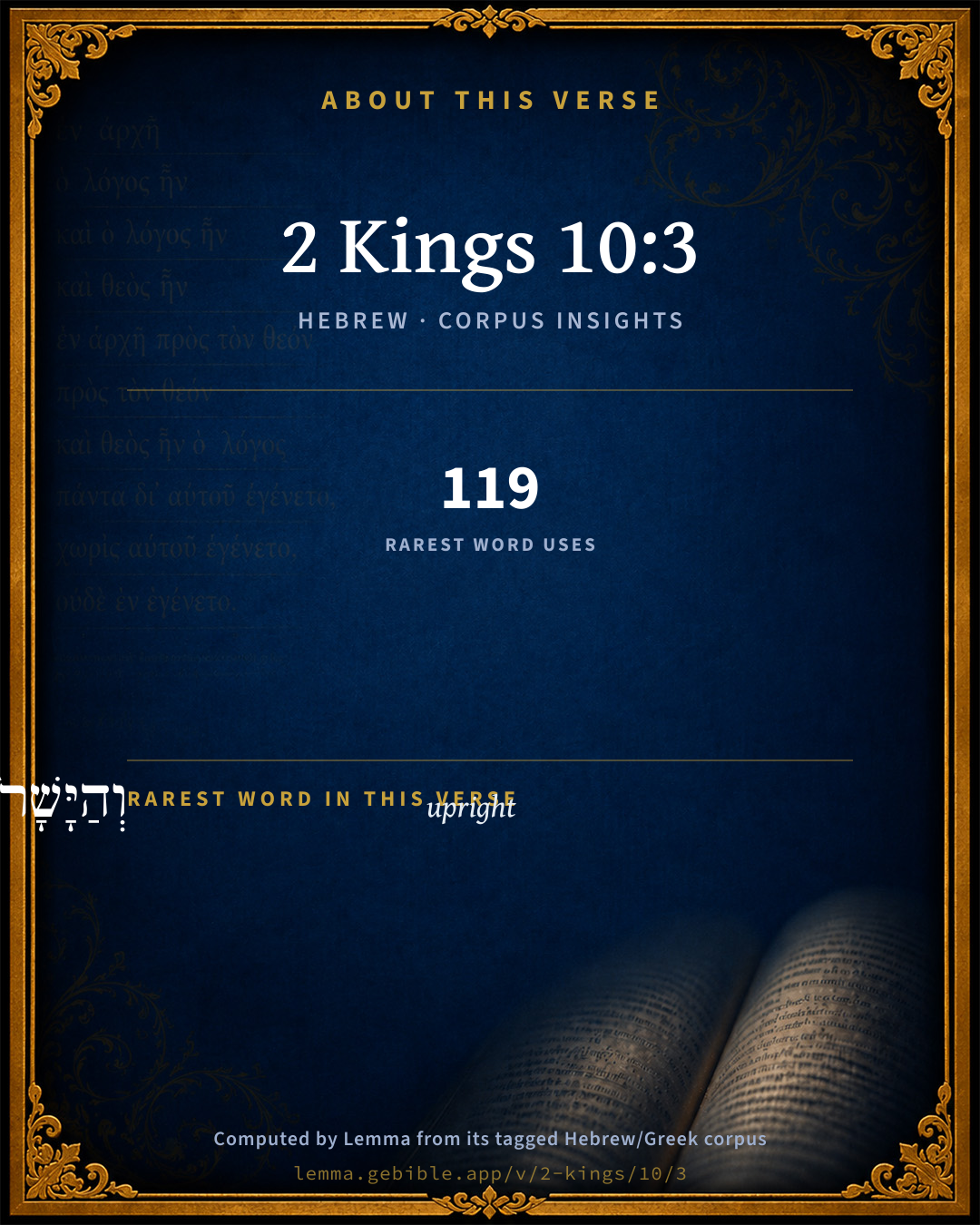
2 Kings, in the Historical, opens this verse with 13 words (11 distinct Hebrew lemmas). Its most distinctive word is yâshâr (“upright”). A historical commentator’s framing appears above. Read the whole chapter for the surrounding context.

Discussion questions

  1. What does “upright” (yâshâr) contribute to the verse as a whole?
  2. Deuteronomy 17:14–15 shares this passage’s theme. How do the two illuminate each other?
  3. “lord” occurs 2× in this one verse. What is the effect of the repetition?
  4. The translations on this page render this verse differently — a whole-verse word diff, not a word-by-word alignment. What might account for the different wordings?
  5. The verb «וּרְאִיתֶ֞ם» is Qal Sequential Perfect. How does its form color the action?
  6. Reading how Trapp's Complete Commentary and Joseph Benson's Commentary read this verse, where do the two commentators agree and where do they part?

Things to notice

Reading settings

Reading text

Shown beneath each verse's original-language words.

Old Testament
Old Testament edition

Read the OT as the Masoretic Hebrew (MT) or the Greek Septuagint (LXX).

English shown for the Greek Septuagint (in the Hebrew ↔ Greek comparison).

Comparing translations? Open the Compare panel on any verse page to stack up to four side by side.