

Proverbs 15:19

Hebrew (Westminster Leningrad Codex) Proverbs 15:19 appears in the Hebrew Old Testament. The text above is from the Westminster Leningrad Codex. Each word links to its Strong’s number, a concise gloss, and parsing drawn from the Open Scriptures Hebrew Bible morphology. Click any word for its full Brown-Driver-Briggs (BDB) entry.
Download image
Cite this verse

Proverbs 15:19 (World English Bible). Public Domain. Lemma interlinear Bible study tool, https://lemma.gebible.app/v/proverbs/15/19.

Show BibTeX & RIS
BibTeX
RIS
English Translation
The way of the sluggard is like a thorn patch, But the path of the upright is a highway.
World English Bible · Public Domain
Highlights
  • 2 first appearances in the Hebrew Bible
Full analysis ↓
Download a study sheet

One document with this verse’s original text, its word-by-word gloss line, the meaning frame, cross-references with their text, attributed commentary, and full source and license credits — printable, and it pastes into notes with its structure intact.

This verse Autodidact and up

Study sheet (.html) Plain text (.txt)

A passage Seminary Student

Up to 50 verses in one chapter. A passage sheet keeps up to 6 commentary sources and 12 cross-references per verse, in the order this page ranks them, and says so on the sheet whenever that leaves anything out. Ask for a single verse and you get the Autodidact verse sheet above.

Everything on this page stays free to read, with no account — the sheet is a download of what is already on screen, not access to it.

Want to remove ads? Support Godless Engineer
Compare translations 3

The same verse in 3 English versions, stacked beneath the original-language interlinear above. Click any original word for its lexicon entry.

Each is an independent rendering of the whole verse — the interlinear is not word-aligned to these translations.

Highlighted words mark where these versions differ — a whole-verse word diff, not a word-by-word alignment.

  • World English Bible Public Domain
    The way of the sluggard is like a thorn patch, But the path of the upright is a highway.
  • King James Version Public Domain
    The way of the slothful man is as an hedge of thorns: but the way of the righteous is made plain.
  • unfoldingWord Literal Text CC BY-SA 4.0
    The way of the lazy like a hedge of briar, but the path of the upright a built-up highway.

unfoldingWord Literal Text — © unfoldingWord, licensed CC BY-SA 4.0. Word-aligned USFM3 via Door43 (git.door43.org/unfoldingWord/en_ult).

Versions to compare (up to 4)

3 of 4 selected

Show all 18 translations

Every available English version of this verse, each an independent rendering of the whole verse.

  • World English Bible Public Domain
    The way of the sluggard is like a thorn patch, But the path of the upright is a highway.
  • Berean Standard Bible Public Domain
    The way of the slacker is like a hedge of thorns, but the path of the upright is a highway.
  • Majority Standard Bible Public Domain
    The way of the slacker is like a hedge of thorns, but the path of the upright is a highway.
  • King James Version Public Domain
    The way of the slothful man is as an hedge of thorns: but the way of the righteous is made plain.
  • American Standard Version (1901) Public Domain
    The way of the sluggard is as a hedge of thorns; But the path of the upright is made a highway.
  • Revised Version (1885) Public Domain
    The way of the sluggard is as an hedge of thorns: but the path of the upright is made an highway.
  • Geneva Bible (1599) Public Domain
    The way of a slouthfull man is as an hedge of thornes: but the way of the righteous is plaine.
  • Douay-Rheims (1899) Public Domain
    The way of the slothful is as a hedge of thorns; the way of the just is without offence.
  • Young's Literal Translation Public Domain
    The way of the slothful `is' as a hedge of briers, And the path of the upright is raised up.
  • Literal Standard Version CC BY-SA 4.0
    The way of the slothful [is] as a hedge of briers, || And the path of the upright is raised up.
  • Unlocked Literal Bible CC BY-SA 4.0
    The path of the sluggard is like a place with a hedge of thorns, but the path of the upright is a built-up highway.
  • unfoldingWord Literal Text CC BY-SA 4.0
    The way of the lazy like a hedge of briar, but the path of the upright a built-up highway.
  • Darby Bible Public Domain
    The way of the sluggard is as a hedge of thorns; but the path of the upright is made plain.
  • World Messianic Bible Public Domain
    The way of the sluggard is like a thorn patch, but the path of the upright is a highway.
  • Webster's Bible Public Domain
    The way of the slothful man is as a hedge of thorns: but the way of the righteous is made plain.
  • Free Bible Version CC BY-SA 4.0
    The way of lazy people is overgrown with thorns, but the path of the good is an open highway.
  • Bible in Basic English Public Domain
    Thorns are round the way of the hater of work; but the road of the hard worker becomes a highway.
  • JPS Tanakh (1917) Public Domain
    The way of the sluggard is as though hedged by thorns; but the path of the upright is even.

Literal Standard Version (2020), Covenant Press — licensed CC BY-SA 4.0. Text via the HelloAO Bible API (eBible.org). Unlocked Literal Bible (unfoldingWord) — licensed CC BY-SA 4.0. Text via the HelloAO Bible API (eBible.org). unfoldingWord Literal Text — © unfoldingWord, licensed CC BY-SA 4.0. Word-aligned USFM3 via Door43 (git.door43.org/unfoldingWord/en_ult). Free Bible Version, Dr. Jonathan Gallagher — licensed CC BY-SA 4.0. Text via the HelloAO Bible API (eBible.org).

Word by word

More ways to search: Search by grammar → Find every occurrence → Compare this word →

Practice this passage: Drill this verse → Learn its vocabulary →

About this verse

These counts appear in no published source. They are computed here, from the morphology-tagged text and Lemma’s own curated glosses. What Lemma adds →

7
words
7
distinct lemmas
Wisdom
section

Notable vocabulary

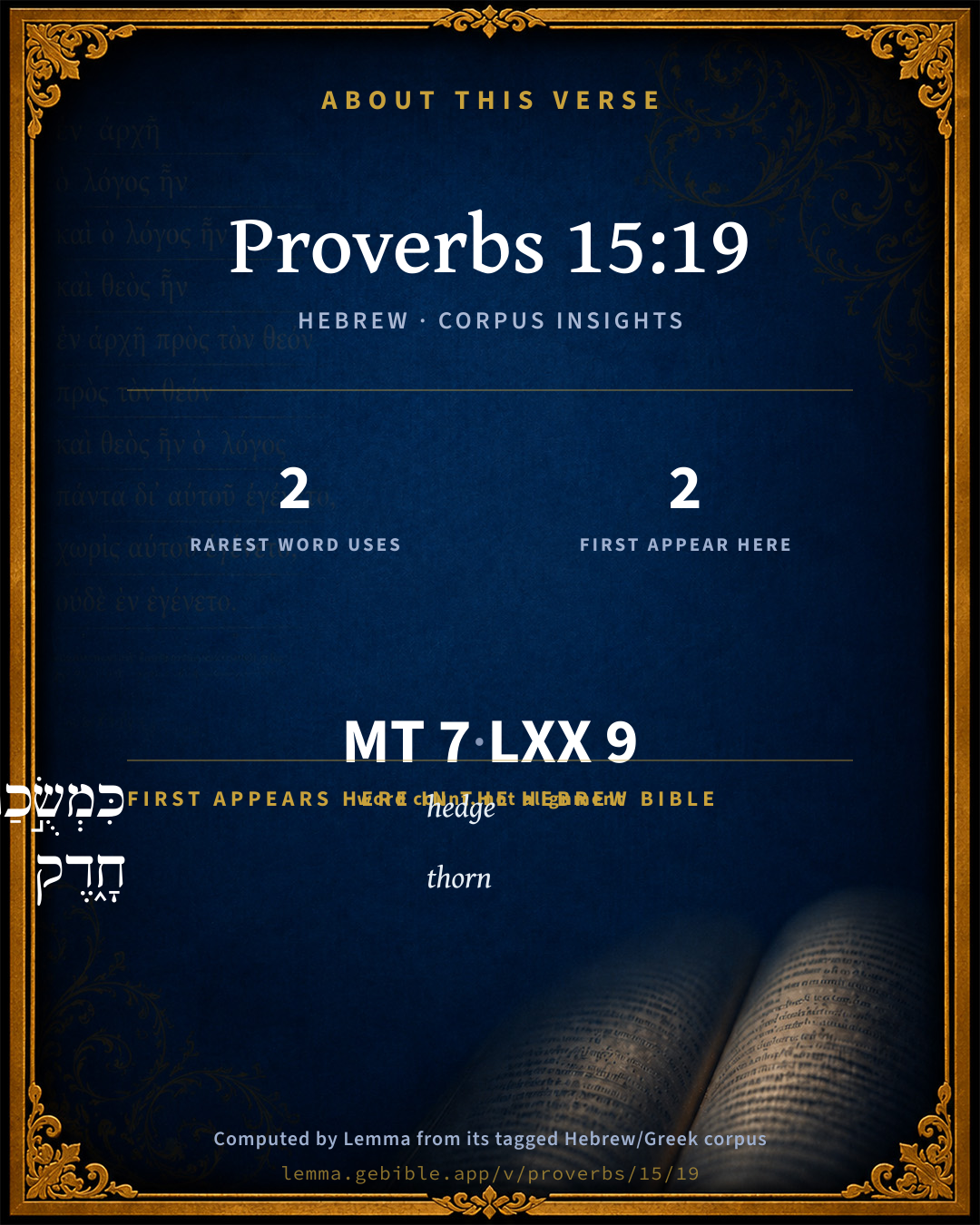
The rarest word here is כִּמְשֻׂ֣כַת hedge H4881 — appearing just 2 times in the whole Hebrew Bible.

First appearance in Scripture

These words make their first canonical appearance in the Hebrew Bible here:

  • כִּמְשֻׂ֣כַת hedge H4881
  • חָ֑דֶק thorn H2312

Shared distinctive vocabulary

כִּמְשֻׂ֣כַת hedge H4881 occurs in 2 verses of the Hebrew Bible. Also found in:

Grammatical profile

  • 1 verb
  • 4 nouns
  • 2 adjectives

Verb forms

  • סְלֻלָֽה Qal · Participle Passive

Hebrew & Septuagint length

In English translation the verse runs 19 words from the Hebrew and 16 from the Septuagint (LXX English) — closely comparable.

A rough comparison of the two English renderings, which tokenize alike — not a word-level alignment.

Word counts can differ between the Hebrew and the Greek without any difference in meaning — e.g. the Hebrew direct-object marker אֵת has no separate Greek word, and Greek often adds the article ὁ.

In the original languages it is 7 Hebrew tokens and 9 Greek tokens — but the two are counted differently (Hebrew bundles its prefixes and suffixes into one token; the Greek is in lemma form), so that isn’t a like-for-like length.

Cross-references

14

Topical passages linked to Proverbs 15:19 in the Treasury of Scripture Knowledge — connected by theme and wording, ordered by reader-vote popularity; previews shown in the World English Bible.

  • Isaiah 35:8 A highway shall be there, and a way, and it shall be called The way of holiness. The unclean shall not pass over it, but is shall be for for him who walks in the Way. Wicked fools will not go there.
  • Proverbs 22:5 Thorns and snares are in the path of the wicked: Whoever guards his soul stays from them.
  • Proverbs 22:13 The sluggard says, "There is a lion outside! I will be killed in the streets!"
  • Proverbs 26:13 The sluggard says, "There is a lion in the road! A fierce lion roams the streets!"
  • Isaiah 30:21 and your ears shall hear a word behind you, saying, This is the way, walk you in it; when you turn to the right hand, and when you turn to the left.
  • Numbers 14:1–3 All the congregation lifted up their voice, and cried; and the people wept that night.
  • Psalms 27:11 Teach me your way, Yahweh. Lead me in a straight path, because of my enemies.
  • Proverbs 8:9 They are all plain to him who understands, Right to those who find knowledge.
  • Numbers 14:7–9 and they spoke to all the congregation of the children of Israel, saying, The land, which we passed through to spy it out, is an exceeding good land.
  • Psalms 5:8 Lead me, Yahweh, in your righteousness because of my enemies. Make your way straight before my face.
  • Psalms 25:8–9 Good and upright is Yahweh, Therefore he will instruct sinners in the way.
  • Psalms 25:12 What man is he who fears Yahweh? He shall instruct him in the way that he shall choose.
  • Proverbs 3:6 In all your ways acknowledge him, And he will direct your paths.
  • Isaiah 57:14 He will say, Cast up, cast up, prepare the way, take up the stumbling-block out of the way of my people.

Cross-references courtesy of OpenBible.info (CC BY 4.0).

Hebrew and Greek witnesses Masoretic Hebrew ↔ Greek Septuagint

The same verse in the two great witnesses to the Old Testament, shown verse-for-verse.

These are two independent witnesses, not word-aligned to each other, and the Septuagint is shown in lemma (dictionary) form.

Hebrew Proverbs 15:19 Masoretic · Westminster Leningrad Codex

דֶּ֣רֶךְ עָ֭צֵל כִּמְשֻׂ֣כַת חָ֑דֶק וְאֹ֖רַח יְשָׁרִ֣ים סְלֻלָֽה

The way of the sluggard is like a thorn patch, But the path of the upright is a highway.

World English Bible · Public Domain

Greek LXX Proverbs 15:19 Septuagint · lemma form

ὁδός ἀεργός στόρνυμι ἄκανθα ὁ δέ ὁ ἀνδρεῖος τρίβω

The ways of sluggards are strewn with thorns; but those of the diligent are made smooth.

LXX2012 (modern English Septuagint) · Public Domain

On this verse, John Gill's Exposition discusses the Septuagint’s reading. Read the note in Commentary ↓

Hebrew: Westminster Leningrad Codex (CC BY 4.0). Greek: Septuagint (public domain); English from LXX2012 (modern English Septuagint) (Public Domain). How the Septuagint differs from the Hebrew →

Commentary

Notes on Proverbs 15:19 from classic Christian and Jewish commentators (each source and its license shown beneath its notes). The classic Christian expositions comment on the surrounding passage and are grouped to its opening verse, so a note may address several verses; the Jewish commentaries on the Tanakh (Rashi and others) are per-verse, so they appear only where the commentator wrote on this verse.

Lemma curates 59 commentaries, every one of them public domain or Creative Commons licensed, each selected and text-cleaned for this edition rather than reprinted as found. About our sources →

Trapp's Complete Commentary

John Trapp

Pro 15:19 The way of the slothful [man is] as an hedge of thorns: but the way of the righteous [is] made plain.

Ver. 19. The way of a slothful man is as a hedge of thorns.] Perplexed and letsome, so that he gets no ground, makes no riddance; he goes as if he were shackled when he is to go upon any good course; so many perils he casts, and so many excuses he makes; this he wants, and that he wants, when in truth it is a heart only that he wants, being woefully hampered and enthralled in the invisible chains of the kingdom of darkness, and driven about by the devil at his pleasure. This will be a bodkin at these men’s hearts one day, to think I had a price in my hand, but no heart to make use of it; I foolishly held that a little with ease was best, and so "neglected so great salvation," shifting off him that "spake to me from heaven," {Heb 12:25} and pretending some "lion in the way," some ‘goose at the gate,’ {a} When I was to do anything for my soul’s health. Never any came to hell, saith one, but had some pretence for their coming thither.

But the way of the righteous is made plain.] Or, Is cast up as a causeway, {b} a Gabbatha, {Joh 19:13} a road raised above the rest. There seems to be an illusion to that bank or causeway that went from the king’s house to the temple; {1Ch 26:16; 1Ch 26:18 1Ki 10:5 2Ch 9:4} and the sense is, that the godly, by much practice of piety, having gotten a habit, despatch duty with delight, and come off with comfort. {Isa 40:31}

{a} Germani dicunt, Anser est in porta.

{b} Via strata.

John Trapp, A Commentary or Exposition upon All the Books of the Old and New Testament (1647–1656) — public domain. Text from a community e-Sword module.

Joseph Benson's Commentary

Pro 15:19. The way of the slothful man — The way in which he does or ought to walk; any good work which he pretends or desires to undertake; is as a hedge of thorns — As a way hedged up with thorns, (see Hos 2:6,) troublesome, perplexed, and full of such difficulties as he despairs, and therefore never strives to overcome; but the way of the righteous — Who is always diligent in his calling, (this being one branch of his righteousness,) and, therefore, is fitly opposed to the slothful, who is joined with the wicked, Mat 25:26, and censured as wicked both in the Scriptures and in heathen authors, idleness being both in itself a sin, and leading the way to many other sins; is made plain — Is easy and pleasant to him, notwithstanding all its difficulties.

Joseph Benson's Commentary on the Old and New Testaments (1811–1818) — public domain. Text from a community e-Sword module.

The Preacher's Complete Homiletical Commentary

Joseph S. Exell (gen. ed.)

CRITICAL NOTES.—

Pro_15:19. Made plain, “is paved,” or “is a highway.”

MAIN HOMILETICS OF Pro_15:19

THE WAY OF THE SLOTHFUL AND THE RIGHTEOUS

I. The one thing common to these opposite characters—a “way.” The eagle and the snail have both a way of motion, although the one swiftly cleaves the air, and the other drags itself slowly along the ground. Unlike as they are in form and in habit, they are both impelled to some kind of motion. So with the sluggard and the man who complies willingly with God’s ordinance of labour—they are both compelled to some exercise of their bodily and mental organs, but there is as great a contrast in the way in which they exercise them as there is between the way of the snail and the eagle.

II. The contrast between the ways of these opposite characters.

1. That of the sluggard is a way of self-prevention. He lessens his power by neglecting to use it. The man who has power to pull against a rapid at a certain point of the stream and will not use it, but allows his boat to drift on until he comes into a current against which he can make no headway, has thrown away his power, and is his own destroyer. The effort which he neglected to put forth at a time when it would have been effectual, is of no avail now that the time has passed. Every man in health of body and mind has physical, and mental, and moral powers which at a certain period in his life are equal to the overcoming of all ordinary obstacles to his moral and physical well-being. But if he neglects to use them the tide against him will grow stronger, because his power will decrease, and his neglect and inertness, whether in material or in spiritual things, will raise around him a hedge of thorns, which will require much extraordinary and painful effort to break through. A thorn-hedge in its beginnings may be easily stepped over, or it may be almost as easily uprooted; but if it is allowed to grow and strengthen itself for several years it makes an almost impassable barrier—at least, a barrier which cannot be overcome without a great and painful effort. So with the sluggard, temptations to indolence—to neglect of powers which God has given him to be used—might once have been easily overcome, and have been so completely conquered as to cease to be temptations. But yielded to until they have become habits, they form around him as impassable a barrier, or one which can be broken through only by as great and as painful exertion as a hedge of thorns. Often we hear him complaining of the difficulties in the way, and truly they are there, but they are mainly of his own creation, the hedge is about him, but it is of his own planting—the lion is there (chap. Pro_26:13), but the lion was placed there by the man who is afraid to face him.

2. The way of the righteous—of him who is willing to strive after his moral and physical well-being—is a way in which it is easier to walk the longer it is pursued. It is “made plain,” or it is a “paved way.” (a) God helps to smooth his way, because it is a Divinely ordained way. He who rules the world has ordained that many material gifts and all the most [precious mental and moral gifts shall be the reward of those only who earnestly strive after them. The way of diligent continuance in well-doing is as old as God Himself, and it is the way in which He requires His creatures to walk. This being so, those who tread it may rely upon His help to exalt the valleys, to level the mountains, and to make the rough places plain which lie in their road, (b) The way is made plain by the man himself. The continued repetition of acts makes habit, and he who pushes boldly and fearlessly forward in the way of righteous exertion finds the hard become easier and the stony places smoother by the very constitution of his nature. He makes his way plain by his resolution to walk in it, he leaps the hedge while his slothful neighbour is counting the number of feet it is from the ground. It is well to look before we leap, but some look so long that they never take the leap, and the slothful man looks so long at the difficulties in his way that he never finds courage enough to grapple with them. But the very resolve to try brings strength for action, and the power grows by use until what is a hedge of thorns to an indolent man is a level road to his righteous neighbour. The word righteous being here placed in antithesis to slothful shows how great a sin it is to neglect to use the opportunities which God has given to men to ensure their real and highest interests. (See also on chap. Pro_13:4, page 296.)

OUTLINES AND SUGGESTIVE COMMENTS

God’s Word recognises the universal law of work. By frequent precept and cheering promises, it consecrates our daily labour. Mindful of the old Latin maxim, “Laborare est orare,” “toil is prayer,” the Christian learns from the record of God’s will that honest, faithful, diligent, God-fearing, and God-honouring work is itself a worship acceptable to the great All-worker. Toil, hard toil, is duty. Even the heathen world confessed that the gods gave nothing to men without it had been earned by severe exertion … God enjoins diligence upon us by precept and by example. About us, all things perform their allotment of work, and of it promptly and without a thought of delay. The winds sweep over the face of the earth, attent alone on the fulfilment of their appointed mission. Here they come on silent pinions, to bear away the rising exhalation of death from the lowlands or the pest-house; there they carpet the earth with the sere and yellow leaves of autumn, covering the earth with russet and gold. Now their task is the flushing of some sick one’s pale cheek, as they rustle through the spring blossoms, laden with sweet health. There they hinder and destroy the else invincible Armada, creeping forth on its purpose of spreading far and wide destruction and death. Thus, too, the never-resting sea. Lashing its worn and rugged shore, the incoming tides bear on their bosom the wealth of trade; or else, lifting its waves in its fury, it engulfs those who go down into the sea to do business in the deep waters. Thus, too, the hidden fires of earth, ever smouldering within, ever restless in their workings—now tossing the foam and spray of the geysers in their play, or now opening in wide fissures of molten death, to scorch the surface of the earth with the poisonous sulphur smoke, or bury for centuries in dust and ashes, and under the lava tide, the homes and haunts of the men of the past. Thus God teaches men by His own ceaseless workings through ten thousand ever busy forces. And revelation utters the same bidding to unremitting toil.… Diligent hands are speedily rendered expert. Long use gives practice and perfection, until that which was at first the toilsome labour of hours becomes the easily attained result of a few moments’ application. And the diligent hand teaches and trains the wary and observant eye.—Life Lessons from the Book of Proverbs, by Dr. Perry, Bishop of Iowa.

The wise man mentions righteousness in this place rather than diligence, because the latter is included in the former, and is not sufficient without it to make a man’s way plain.—Lawson.

Observe God’s estimate of the slothful man. He contrasts with him not the diligent, but the righteous, marking him as a “wicked, because a slothful, servant” (Mat_25:26). The difficulties are far more in the mind than in the path. For while the slothful man sits down by his hedge-side in despair, the way of the righteous (in itself not more easy) is made plain. He does not expect God to work for him in an indolent habit. But he finds that God helps those that help themselves.… Following His commands, feeding upon His promises, continuing in prayer, in waiting and watching for an answer to prayer, his way is raised up before him. He believes what is written, and acts upon it without delay. As soon as ever the light comes into his mind, at the very first dawn, this determines the direction of his steps, and the order of his proceedings. Thus his stumbling-blocks are removed (Num_13:30; Num_14:6-9; Isa_57:14).—Bridges.

Grace has not only a brighter (Pro_15:15) but an easier time. We see the like in worldly matters. Nothing is more striking than the ease with which a prompt man works. His tackle is all right, so is his ground, it has been made smooth by his last year’s toil. His hands are not blistered. His lazy neighbour admires, and longs after his chance. Laziness begets labour. In the round year, the sluggard fevers himself more than the diligent; while, in the spiritual world, the proverb is more signal still. Just where the upright stands there is a smooth path—and let it be observed the upright means the smooth, the level. Just where the sinner stands is a thorn hedge. He cannot enter into life; so he imagines. And yet he is a sluggard, for he will not do the plainest duties. The proverb is right, therefore, that it is the principle of sluggardism to create “a hedge of thorns;” and that it is far smoother to take hold of the faith by the right handle, and at once, than to be eternally kicking against the pricks of the Gospel.—Miller.

Because the latter part of the verse speaketh of the righteous, we may by the slothful understand the wicked; for it is slothfulness in not using the graces of God offered that maketh to be wicked.… God giveth the righteous pleasure, even in the troubles of serving Him.… In their conversation, by the lightsomeness and leap, as it were, of eternal hope and internal contemplation, they do pass over the impediments of temporal adversity.—Jermin.

The way of a slothful man is perplexed and letsome, so that he gets no ground, makes no riddance; he goes as if he were shackled when he is to go upon any good course, so many perils he casts and so many excuses he makes—this he wants, and that he wants, when in truth it is a heart only that he wants, being wofully hampered and enthralled in the invisible chains of the kingdom of darkness, and driven about by the devil at his pleasure.… Never any came to hell, saith one, but had some pretence for their coming hither.—Trapp.

Every good service is hard or easy, according as men’s wills are inclined unto it. He that hath his mind pressed and ready to the practice of any duty, either of piety, justice, or mercy, will observe all the inducements that may lead him to the same: and he that is averse and backward, will look to all the impediments that may discourage him from it. That Israel should root out the Canaanites, the unfaithful spies thought it no less impossible, than for grasshoppers to overcome giants; but Caleb and Joshua knew it to be no more unlikely than for armed soldiers to vanquish naked people, or for hungry persons to eat up meat. First, the one is fortified by the force of love, which is unresistable and strong as death, that nothing can withstand it: and the other being destitute of all love to any goodness, is likewise void of all power to proceed in, and go through with any work that is good. Secondly, faith showeth to the one what help God will minister, and what reward He will render to all them that apply themselves to His service. And infidelity persuadeth the other that well-doing is needless and fruitless, or chargeable and troublesome.—Dod.

For Homiletics on Pro_15:20, see on Chapter Pro_10:1, page 136.

OUTLINES AND SUGGESTIVE COMMENTS

One particular in which children show themselves wise or else foolish and so can gladden or else sadden their parents is by giving or withholding due honour. “A foolish man.” No age or state exempts children from honouring their parents. Grown young men are sometimes apt to look with some contempt on their mothers, because of the weakness of the feminine mind.—Fausset.

As for him that despiseth his mother—and who doth not so that despiseth her careful admonition?—he is not a son, the spirit of God doth not here style him to be so: he is a foolish man. For how can he be otherwise, who knoweth his own mother so little as that he doth despise her?—Jermin.

The Preacher's Complete Homiletical Commentary (gen. ed. Joseph S. Exell; Funk & Wagnalls, c. 1892) — public domain (pre-1929). A full-Bible homiletical/sermon-outline anthology covering 65 of 66 books (2 John is absent from the source module). Text from a community e-Sword module.

Tyndale Open Study Notes

Tyndale Open Resources

15:19 A lazy person can find all kinds of obstacles (e.g., a path blocked with briers) to avoid work (see 10:4, 26; 12:11, 14; 13:4; 14:4).

Tyndale Open Study Notes — © Tyndale Open Resources, licensed CC BY-SA 4.0. Text via the HelloAO Bible API.

Geneva Bible (1599)

Geneva Bible translators

That is, he ever findeth some let or stay, and dare not go forward.

Geneva Bible (1599) marginal notes — public domain. Text via Bolls.life.

Matthew Henry's Commentary

See here, 1. Whence those difficulties arise which men pretend to meet with in the way of their duty, and to be insuperable; they arise not from any thing in the nature of the duty, but from the slothfulness of those that have really no mind to it. Those that have no heart to their work pretend that their way is hedged up with thorns, and they cannot do their work at all (as if God were a hard Master, reaping where he had not sown), at least that their way is strewed with thorns, that they cannot do their work without a great deal of hardship and danger; and therefore they go about it with as much reluctance as if they were to go barefoot through a thorny hedge. 2. How these imaginary difficulties may be conquered. An honest desire and endeavour to do our duty will, by the grace of God, make it easy, and we shall find it strewed with roses: The way of the righteous is made plain; it is easy to be trodden and not rough, easy to be found, and not intricate.

Matthew Henry's Commentary on the Whole Bible (1708–1710) — public domain (CC PDM 1.0). Text via the HelloAO Bible API.

Jamieson, Fausset & Brown

Robert Jamieson, A. R. Fausset & David Brown

The difficulties of the slothful result from want of energy; the righteous find a

plain [and open] way--literally, "a highway," by diligence (Sa1 10:7; Psa 1:3).

Jamieson, Fausset & Brown — Commentary Critical and Explanatory on the Whole Bible (1871) — public domain (CC PDM 1.0). Text via the HelloAO Bible API.

Adam Clarke's Commentary

Verse 19. The way of the slothful man is as a hedge of thorns] Because he is slothful, he imagines ten thousand difficulties in the way which cannot be surmounted; but they are all the creatures of his own imagination, and that imagination is formed by his sloth.

Adam Clarke's Commentary on the Bible (1810–1826) — public domain. Text from a community e-Sword/MySword module.

Ellicott's Commentary for English Readers

(19) As a hedge of thorns.—Every difficulty in his path serves as an excuse for inaction (comp. Pro_22:13); while the upright man, who does his duty as in the sight of God, goes “from strength to strength” (Psa_84:7), along the path of life smoothed for him (Isa_26:7), performing the “just works” appointed for him to do.

A Bible Commentary for English Readers, edited by Charles John Ellicott (1878–1897) — public domain. Text from a community e-Sword module.

The Cambridge Bible for Schools and Colleges

gen. ed. J. J. S. Perowne

19. a hedge of thorns] which may be either of his own making (Pro_24:30-31), or of his own imagining (Pro_22:13).

made plain] “Heb. raised up as a causey” (archaic form of causeway), A.V. marg.; made a high way, R.V. Comp. Isa_57:14; Isa_62:10, where the same Heb. word occurs.

The Cambridge Bible for Schools and Colleges (gen. ed. J. J. S. Perowne; Cambridge University Press, 1878–1918) — public domain. Text from a community e-Sword module.

John Gill's Exposition

The way of the slothful man is as an hedge of thorns,.... Or, "strewed with thorns", as the Septuagint and Arabic versions; the Targum is,

"the ways of the slothful are briers and thorns.''

Either really being made so by his own conduct; who, by his slothfulness, has implicated and entangled himself in such difficulties, that he cannot extricate himself; his way is not passable, at least not very easily; it is as it were hedged up with thorns; see Hos 2:6; or in his own apprehensions; who raises such difficulties about doing business, which to him seem insurmountable; at least which discourage him from attempting it, it being like breaking through thorns and briers; hence he will not plough because of the cold, nor go abroad because there is a lion in the streets, Pro 20:4; or the way of his duty, especially of virtue and religion, is as troublesome and disagreeable to him as breaking through a thorn hedge, or treading upon briers and thorns; to attend the duties of public worship, prayer, and hearing the word, is very irksome to him; to be present at family worship, at prayer, and hearing the Scriptures or religious discourses read, is like sitting upon thorns unto him. This, as Aben Ezra observes, is to be understood of a wicked man, as the opposition in the next clause shows;

but the way of the righteous is made plain: it is a castup way, as the word (p) signifies; a causeway, a highway, and a plain one, in which a truly righteous and good man finds no difficulty; yea, it is so plain, that men, though fools in other respects, shall not err therein, Isa 35:8; nor is it grievous and troublesome, but, on the contrary, very delightful, as the ways of Christ and wisdom are; his commandments are not grievous, his yoke is easy, and his paths pleasant; and the righteous man walks at liberty and with pleasure in them; and without offence or stumbling, as the Vulgate Latin version renders it.

(p) "aggestum", Junius & Tremellius, Piscator; "eleveta", Mercerus, Gejerus; "strata", Montanus.

John Gill's Exposition of the Whole Bible (1746–1763) — public domain (CC PDM 1.0). Text via the HelloAO Bible API.

Albert Barnes' Notes on the Bible

The slothful goes on his journey, and for him the path is thick set with thorns, briars, fences, through which he cannot force his way. For the “righteous” (better, upright), the same path is as the broad raised causeway of the king’s highway. Compare Isa 40:3.

Albert Barnes' Notes on the Bible (1834–1885) — public domain. Text from a community e-Sword/MySword module.

Haydock's Catholic Bible Commentary

Thorns. All seems to them impossible. (Calmet) --- In agriculture, however, (Haydock) "in domestic affairs, negligence is attended with more labour than diligence." (Colum. xii. 2.)

George Leo Haydock (1774–1849), Haydock's Catholic Family Bible and Commentary, 1859 edition — public domain. Excludes Psalms (Douay-Rheims chapter numbering differs from Protestant) and Deuterocanonical books (Catholic canon only).

Matthew Poole's English Annotations

The way of the slothful man, the way in which he doth or ought to walk, any good work which he pretends or desires to undertake,

is as an hedge of thorns; as a way hedged up with thorns, as it is expressed, Hos 2:6, troublesome and perplexed, and full, of such difficulties as he despaireth, and therefore never striveth, to overcome.

The way of the righteous, who is always diligent in his calling, which is one branch of righteousness, and therefore is fitly opposed to the slothful, who is joined with the wicked, Mat 25:26, and censured as such both in Scripture and heathen authors, because idleness is both in itself a sin, and it leads the way to many other wickednesses.

Is made plain; is easy and pleasant to him, notwithstanding all his discouragements and difficulties.

Matthew Poole's English Annotations on the Holy Bible (1683–1685) — public domain. Text from a community e-Sword/MySword module.

Whedon's Commentary on the Bible

Daniel D. Whedon

19. The way of the slothful man is as a hedge of thorns — That is, seems so to him; a barrier that he cannot get over.

Made plain — Rather, is cast up; a plain highway. Culpable indolence sees an insurmountable obstacle where honest effort finds only a highway. Compare Pro_6:10; Pro_10:26; Pro_10:28; Isa_40:3.

Daniel D. Whedon (gen. ed.), Commentary on the Old and New Testaments (1874–1909) — public domain. Text from a community e-Sword module.

The Pulpit Commentary

The way of the slothful man is as a hedge of thorns. The indolent sluggard is always finding or imagining difficulties and hindrances in his path, which serve as excuses for his laziness. The word for "thorn" here is chedek. It occurs elsewhere only in Mic_7:4, where the Authorized Version has "briar;" but the particular plant intended is not ascertained. Most writers consider it to be some spinous specimen of the solanum. The word refers, it is thought, to a class of plants the name of one of which, at least, the miscalled "apple of Sodom," is well known in poetry, and is a proverbial expression for anything which promises fair but utterly disappoints on trial. "This plant, which is really a kind of potato, grows everywhere in the warmer parts of Palestine, rising to a widely branching shrub from three to five feet high; the wood thickly set with spines; the flower like that of the potato, and the fruit, which is larger than the potato apple, perfectly round, and changing from yellow to bright red as it ripens.... The osher of the Arab is the true apple of Sodom. A very tropical-looking plant, its fruit is like a large smooth apple or orange, and hangs in clusters of three or four together. When ripe, it is yellow, and looks fair and attractive, and is soft to the touch, but if pressed, it bursts with a crack, and only the broken shell and a raw of small seeds in a half-open pod, with a few dry filaments, remain in the hand" (Geikie, "Holy Land and Bible," 2:74, 117). Cato, "Dist.," 54:3, 5"Segnitiem fugito, quae vitae ignavia fertur; Nam quum animus languet, consumit inertia corpus.

To the sluggard is opposed the righteous in the second member, because indolence is a grievous sin, and the greatest contrast to the active industry of the man who fears God and does his duty. The way of the righteous is made plain; " is a raised causeway;" selulah, as Pro_16:17 Isa_40:3 Isa_49:11. The upright man, who treads the path appointed forhim resolutely and trustfully, finds all difficulties vanish; before him the thorns yield a passage; and that which the sluggard regarded as dangerous and impassable becomes to him as the king"s highway. Vulgate, "The path of the just is without impediment;" Septuagint, "The roads of the manly (andreiwn ) are well beaten." St. Gregory ("Moral.," 30:51), "Whatever adversity may have fallen in their way of life, the righteous stumble not against it. Because with the bound of eternal hope, and of eternal contemplation, they leap over the obstacles of temporal adversity". (comp. Psa_18:29)

The Pulpit Commentary (1880–1919), ed. H.D.M. Spence-Jones & Joseph S. Exell — public domain. Text from a community e-Sword module.

John Wesley's Explanatory Notes

An hedge - As a way hedged up with thorns, troublesome, perplexed, and full of difficulties. Plain - Is easy and pleasant to him, notwithstanding all its difficulties.

John Wesley, Explanatory Notes Upon the Whole Bible (1754–1765) — public domain. Text via the GEBible commentary corpus.

Keil & Delitzsch

C. F. Keil & F. Delitzsch

19 The way of the slothful is as hedged with thorns;

But the path of the righteous is paved.

Hitzig misses the contrast between אצל (slothful) and ישׁרים (upright), and instead of the slothful reads עריץ, the tyrannical. But is then the slothful ישׁר? The contrast is indeed not that of contradiction, but the slothful is one who does not act uprightly, a man who fails to fulfil the duty of labour common to man, and of his own special calling. The way of such an one is כּמשׂכת חדק, like a fencing with thorns (from חדק, R. חד, to be pointed, sharp, distinguished from Arab. hadḳ, to surround, and in the meaning to fix with the look, denom. of khadaḳt, the apple of the eye), so that he goes not forwards, and sees hindrances and difficulties everywhere, which frighten him back, excusing his shunning his work, his remissness of will, and his doing nothing; on the contrary, the path of those who wait truly and honestly on their calling, and prosecute their aim, is raised up like a skilfully made street, so that unhindered and quickly they go forward (סלוּלה, R. סל, aggerare, cf. Jer 18:15 with Isa 49:11 and Isa 49:4 :8, סלסל, which was still in use in the common language of Palestine in the second cent., Rosch haschana, 26b).

Keil & Delitzsch — Biblical Commentary on the Old Testament (1861–1891) — public domain (CC PDM 1.0). Text via the HelloAO Bible API. (Old Testament only.)

Bridges on Proverbs

Charles Bridges

19 The way of the slothful man is as an hedge of thorns: but the way of the righteous is made plain. {is made...: Heb. is raised up as a causey†a}

Another picture of the slothful man drawn to life! He plants his own hedge, and then complains of its hindrance. He is always at a stand. Every effort is like forcing his way through a hedge of thorns, where every thorn-bush tears his flesh. Indecision, delay, and sluggishness, add to his difficulties, and paralyze his exertion; so that after a feeble struggle of conscience, with much to do, but no heart to do anything, he gives up the effort.

This sloth is ruinous in temporals. One or two hills vigorously climbed make the way plain for future triumph. But to put half the soul to the work; to drag to it as an unavoidable task; to avoid present difficulties in order to find a smoother path, makes a hedge of thorns, harassing to the end of the journey.

Much more ruinous is this evil in the Christian life. The sluggard in religion is never at ease. He knows that he needs a change. He makes and effort to pray; or he takes up a good book. But all withers for want of purpose of heart. Exertion is to him impossible. He sees no hope of overcoming, and sinks again.

Nor is this merely the beginning of his path. It is his way — his whole course. The righteous may loiter or decline, but it is not his way. The slothful man may have a fit — sometimes an astonishing fit — of exertion; but he relapses to his former state (Pro 12:27 ), still surrounded by a hedge of thorns, unable to force his way, pierced, disheartened to the end.

Observe God’s estimate of him. He contrasts with him, not the diligent, but the righteous; marking him as a "wicked, because a slothful servant." (Mat 25:26 .) The difficulties are far more in the mind than in the path. For while the slothful sits down by his hedge-side in despair, the way of the righteous, in itself not more easy, is made plain. He does not expect God to work for him in an indolent habit. But he finds that God helps those that help themselves. Working with diligence, he finds that he can work in comfort. Following his commands, feeding upon his promises, continuing in prayer, in waiting and watching for an answer to prayer — his way is raised up, before him. He believes what is written, and acts upon it without disputing, without delay. As soon as ever the light comes into his mind — at the very first dawn — this determines the direction of his steps, and the order of his proceedings. Thus his stumbling-blocks are removed. (Num 13:30 ; Num 14:6-9 . Isa 57:14 .) Industrious wisdom performs what lazy foolishness deemed impossible. Thorns there are doubtless in the way, but not an impassable hedge of thorns; only such, as while they pierce his flesh, are overruled as a blessing to his soul. (2Co 12:7-8 .)

Now to apply this to myself — to my great work. Of infinite moment it is for me to have my way made plain. For this — confidence of success is indispensable. Let me then examine my ground. Suppose up to this moment I have been living in enmity with God; yet now he "willeth not my death;"†1 he invites me to come to him;†2 he assures my acceptance.†3 I have his word to depend upon. Why should "I stagger in unbelief"? His truth claims my confidence, and warrants my expectation of the certain blessing. I do not begin, hoping to amend for past neglect, but believing in him for free pardon and strength. The physician heals my helplessness. Faith expels slavish fear, and "the way of the LORD," instead of a hedge of thorns, is "strength to the upright." (Pro 10:29 .) The prospect brightens, and instead of "the hard man," which the slothful pictures to himself, a reconciled God appears before me. (Mat 25:24 . 2Co 5:19 .)

This is no easy way. What fluctuation of faith! — What weariness and discouragement! But at length the way is made plain. Difficulties are faced, surmounted, carried by assault, and what cannot be removed is endured. The mountains are leveled before Zerubbabel. (Zec 4:7 .) The feeble worm threshes them by the energy of faith. (Isa 41:15 .) Hope, love, and joy, are conquering principles. Religion, with all its crosses, is found to be a practicable thing. (Php 4:13 .) The victory over sloth opens a happy and triumphant way to heaven. (Mat 11:12 .)

The slothful man has enjoyed the same advantages. But he has not gone through the thorn-hedge of his own corruptions. He has never learnt, that the cross is the discipline to the end of the way. He does not think what is spoken to faith, but what is agreeable to feeling. He has never broken through the thorn of unbelief. He has compromised and failed in the unreserved trust and surrender of himself to his Savior. He never therefore comes to God in confidence. All his service is with a festering conscience, and with that timidity and delay which ensures defeat. His way at every turn is restless trouble; struggling with a hedge of thorns to the very last.

Child of God! beware of a sluggish spirit. Even the morbid, scrupulous strife about your state may sometimes be a slothful indulgence in direct opposition to the plainest declarations of God. Let not unbelief wrest the promise from your hand, or paralyze the hand that holds it. If the way has been made plain, sit not down in the indulgent comfort of it. But "go in this thy strength" to more important advantage. Prize every particle of success obtained by exertion. Oh! it is worth everything, if we have suffered ourselves to be entangled by spiritual sloth, to rise, though it be at the setting of the sun, and clear away the clouds, that "in the evening time there may be light." (Zec 14:7 .) Happy indeed will it be to be quickened, though at the last, to a firmer confidence; to be brought, though only a step nearer to Christ, — to have one thorn less to conflict with in the struggle of death.

Footnotes:

†a ’A highway — a path so formed, as to be easy to the foot of the traveler’ — French and Skinner. Compare Isa 35:8. Also 2Ch 9:11, margin.

†1 Eze 33:11.

†2 Mat 11:28.

†3 Joh 6:37.

Charles Bridges, An Exposition of the Book of Proverbs (1846) — public domain. Text from a community e-Sword module.

Kretzmann's Popular Commentary

Paul E. Kretzmann

v. 19. The way of the slothful man is as an hedge of thorns, since he is always meeting with obstructions and hindrances; but the way of the righteous is made plain, like an open highway, for his diligence and the blessing of the Lord combine in making the accomplishment of life’s tasks easy.

Paul E. Kretzmann, Popular Commentary of the Bible (1921–1924) — public domain. Text from a community e-Sword module.

unfoldingWord translationNotes

Door43 World Missions Community

The path of the sluggard ... the path of the upright

The writer speaks of a person's life as if it were a path on which the person walks. AT: "The life of the sluggard ... the life of the upright" (See: Metaphor)

The path of the sluggard is like a place with a hedge of thorns

The writer compares the lifestyle of the sluggard with trying to walk through a hedge of thorns. Both cause the person to suffer pain. AT: "The life of the sluggard is like a person trying to walk through a hedge of thorns" (See: Simile)

the path of the upright is a built-up highway

The writer speaks of the blessings that upright people experience in life as if they were walking on a smooth road. (See: Metaphor)

built-up highway

This is a road that is wide, flat, and without obstacles or potholes.

translationWords

righteous

wise

son

joy

fool

unfoldingWord translationNotes — © Distant Shores Media and the Door43 World Missions Community, licensed CC BY-SA 4.0. Source: git.door43.org/Door43/en_tn.

Rashi

Rabbi Shlomo Yitzchaki (Rashi)

The way of a lazy man is like a hedge of thorns In his eyes, it appears as though the roads are fenced before him with a fence of thorns.

like a hedge of Heb. כמשכת. A fence, as in (Isa. 5:5): “I will remove its hedge (משוכתו).”

thorns Heb. חדק, thorns. but the path of the upright is even סללה, trodden and cleared. The Midrash Aggadah (Pesikta d’Rav Kahana 11a) states: The way of Esau is like a thorn entangled in a fleece of wool. If you extract it from here, it catches on here. Likewise, no one can extricate himself from his false accusations without money.

Rashi on the Tanakh — English translations: “The Judaica Press complete Tanach with Rashi, translated by A. J. Rosenberg” (CC BY 4.0); “Pentateuch with Rashi's commentary by M. Rosenbaum and A.M. Silbermann, 1929-1934” (public domain); “The Metsudah Tanach series, Lakewood, N.J” (CC BY 4.0); and “The Book of Joshua, Metsudah Publications, 1997” (CC BY 4.0). Text via Sefaria.

Lesson kit

Teaching starters — assembled from the data on this page, not authored interpretation. Every prompt links to the verse data it draws on. Edit before teaching.

Proverbs, in the Wisdom, opens this verse with 7 words (7 distinct Hebrew lemmas). Its most distinctive word is mᵉsûwkâh (“hedge”). A historical commentator’s framing appears above. Read the whole chapter for the surrounding context.

Discussion questions

  1. How does “hedge” (mᵉsûwkâh) shape what this verse is saying?
  2. 2 words make their first appearance in Scripture here. What does this debut establish?
  3. How does Isaiah 5:5, which shares the word «hedge», read alongside this verse?
  4. The translations on this page render this verse differently — a whole-verse word diff, not a word-by-word alignment. What might account for the different wordings?
  5. «סְלֻלָֽה» is a Qal Participle Passive verb. How does that grammatical form shape the action described?
  6. Compare how Trapp's Complete Commentary and Joseph Benson's Commentary read this verse. Where do they agree or differ?

Things to notice

Reading settings

Reading text

Shown beneath each verse's original-language words.

Old Testament
Old Testament edition

Read the OT as the Masoretic Hebrew (MT) or the Greek Septuagint (LXX).

English shown for the Greek Septuagint (in the Hebrew ↔ Greek comparison).

Comparing translations? Open the Compare panel on any verse page to stack up to four side by side.