
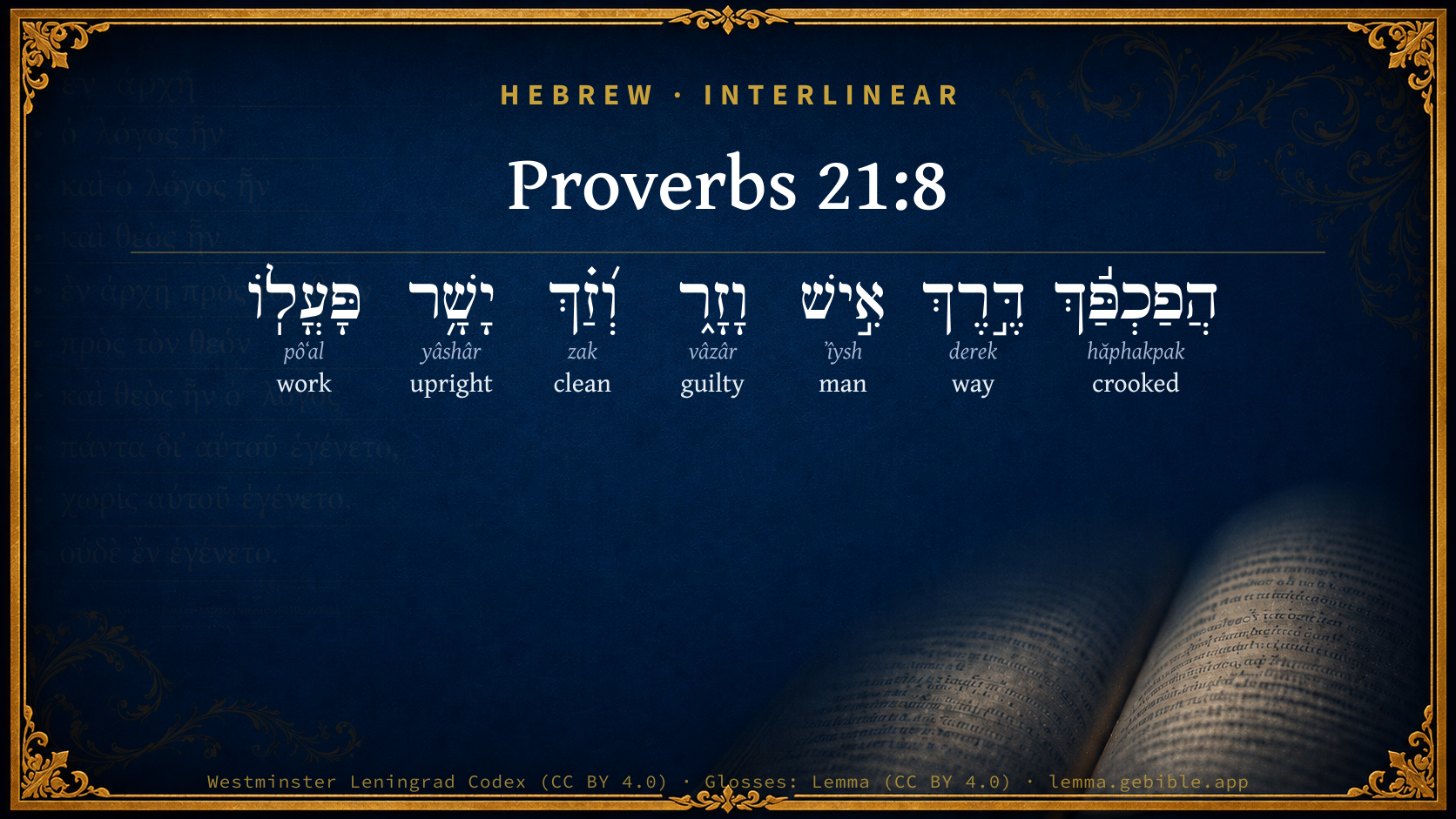
Proverbs 21:8

Hebrew (Westminster Leningrad Codex) Proverbs 21:8 appears in the Hebrew Old Testament. The text above is from the Westminster Leningrad Codex. Each word links to its Strong’s number, a concise gloss, and parsing drawn from the Open Scriptures Hebrew Bible morphology. Click any word for its full Brown-Driver-Briggs (BDB) entry.
Download image
Cite this verse

Proverbs 21:8 (World English Bible). Public Domain. Lemma interlinear Bible study tool, https://lemma.gebible.app/v/proverbs/21/8.

Show BibTeX & RIS
BibTeX
RIS
English Translation
The way of the guilty is devious, But the conduct of the innocent is upright.
World English Bible · Public Domain
Highlights
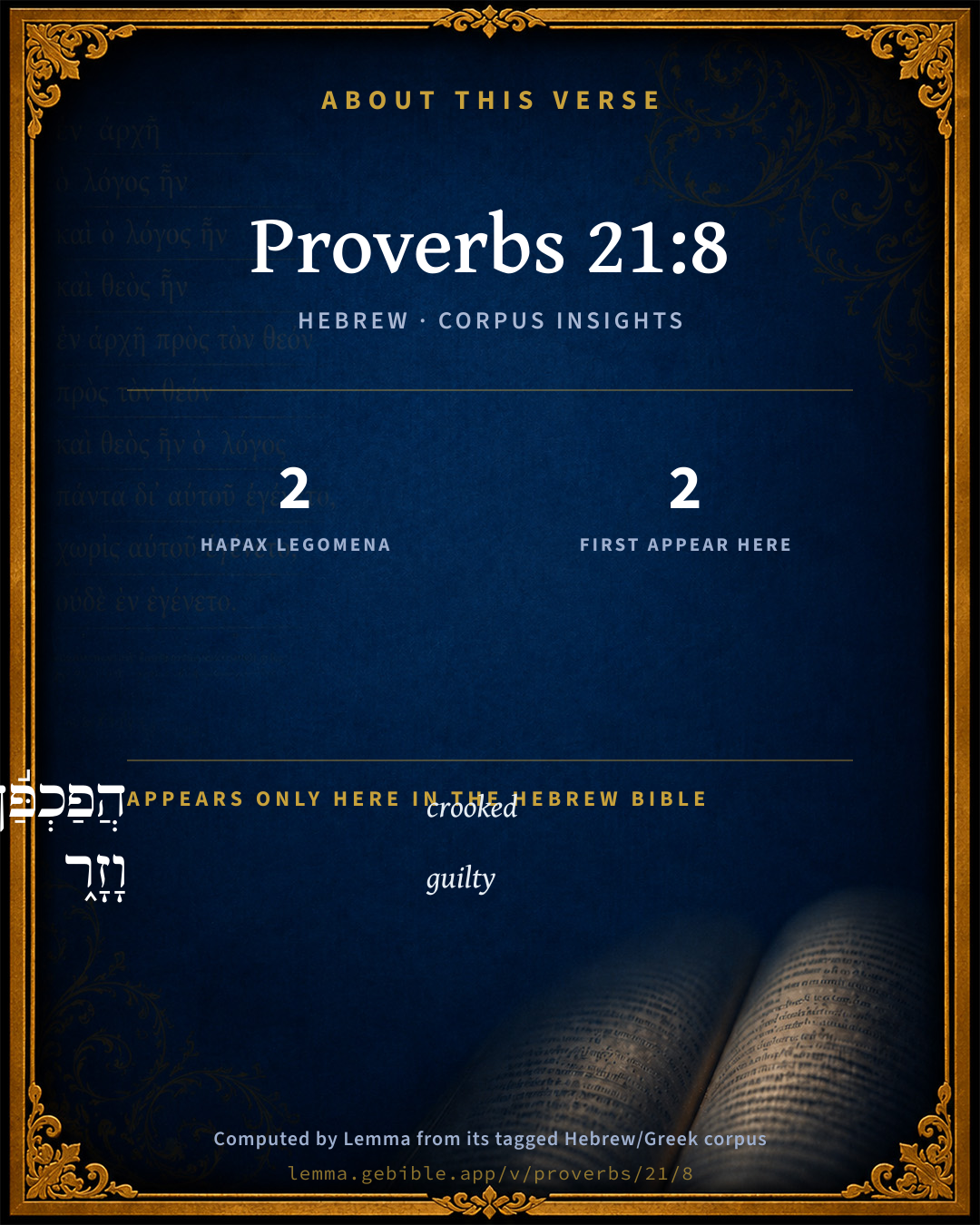
  • 2 hapax legomena — only here in the Hebrew Bible
  • 2 first appearances in the Hebrew Bible
Full analysis ↓
Download a study sheet

One document with this verse’s original text, its word-by-word gloss line, the meaning frame, cross-references with their text, attributed commentary, and full source and license credits — printable, and it pastes into notes with its structure intact.

This verse Autodidact and up

Study sheet (.html) Plain text (.txt)

A passage Seminary Student

Up to 50 verses in one chapter. A passage sheet keeps up to 6 commentary sources and 12 cross-references per verse, in the order this page ranks them, and says so on the sheet whenever that leaves anything out. Ask for a single verse and you get the Autodidact verse sheet above.

Everything on this page stays free to read, with no account — the sheet is a download of what is already on screen, not access to it.

Want to remove ads? Support Godless Engineer
Compare translations 3

The same verse in 3 English versions, stacked beneath the original-language interlinear above. Click any original word for its lexicon entry.

Each is an independent rendering of the whole verse — the interlinear is not word-aligned to these translations.

Highlighted words mark where these versions differ — a whole-verse word diff, not a word-by-word alignment.

  • World English Bible Public Domain
    The way of the guilty is devious, But the conduct of the innocent is upright.
  • King James Version Public Domain
    The way of man is froward and strange: but as for the pure, his work is right.
  • unfoldingWord Literal Text CC BY-SA 4.0
    Perverse the way of a guilty man, but the pure, upright his behavior.

unfoldingWord Literal Text — © unfoldingWord, licensed CC BY-SA 4.0. Word-aligned USFM3 via Door43 (git.door43.org/unfoldingWord/en_ult).

Versions to compare (up to 4)

3 of 4 selected

Show all 18 translations

Every available English version of this verse, each an independent rendering of the whole verse.

  • World English Bible Public Domain
    The way of the guilty is devious, But the conduct of the innocent is upright.
  • Berean Standard Bible Public Domain
    The way of a guilty man is crooked, but the conduct of the innocent is upright.
  • Majority Standard Bible Public Domain
    The way of a guilty man is crooked, but the conduct of the innocent is upright.
  • King James Version Public Domain
    The way of man is froward and strange: but as for the pure, his work is right.
  • American Standard Version (1901) Public Domain
    The way of him that is laden with guilt is exceeding crooked; But as for the pure, his work is right.
  • Revised Version (1885) Public Domain
    The way of him that is laden with guilt is exceeding crooked: but as for the pure, his work is right.
  • Geneva Bible (1599) Public Domain
    The way of some is peruerted and strange: but of the pure man, his worke is right.
  • Douay-Rheims (1899) Public Domain
    The perverse way of a man is strange: but as for him that is pure, his work is right.
  • Young's Literal Translation Public Domain
    Froward `is' the way of a man who is vile, And the pure -- upright `is' his work.
  • Literal Standard Version CC BY-SA 4.0
    The way of a man who is vile [is] contrary, || And the pure—his work [is] upright.
  • Unlocked Literal Bible CC BY-SA 4.0
    The way of a guilty person is crooked, but the one who is pure does what is right.
  • unfoldingWord Literal Text CC BY-SA 4.0
    Perverse the way of a guilty man, but the pure, upright his behavior.
  • Darby Bible Public Domain
    Very crooked is the way of a guilty man; but as for the pure, his work is upright.
  • World Messianic Bible Public Domain
    The way of the guilty is devious, but the conduct of the innocent is upright.
  • Webster's Bible Public Domain
    The way of man is froward and strange: but as for the pure, his work is right.
  • Free Bible Version CC BY-SA 4.0
    Guilty people live crooked lives, but the innocent follow straight paths.
  • Bible in Basic English Public Domain
    Twisted is the way of him who is full of crime; but as for him whose heart is clean, his work is upright.
  • JPS Tanakh (1917) Public Domain
    The way of man is froward and strange; but as for the pure, his work is right.

Literal Standard Version (2020), Covenant Press — licensed CC BY-SA 4.0. Text via the HelloAO Bible API (eBible.org). Unlocked Literal Bible (unfoldingWord) — licensed CC BY-SA 4.0. Text via the HelloAO Bible API (eBible.org). unfoldingWord Literal Text — © unfoldingWord, licensed CC BY-SA 4.0. Word-aligned USFM3 via Door43 (git.door43.org/unfoldingWord/en_ult). Free Bible Version, Dr. Jonathan Gallagher — licensed CC BY-SA 4.0. Text via the HelloAO Bible API (eBible.org).

Word by word

More ways to search: Search by grammar → Find every occurrence → Compare this word →

Practice this passage: Drill this verse → Learn its vocabulary →

About this verse

These counts appear in no published source. They are computed here, from the morphology-tagged text and Lemma’s own curated glosses. What Lemma adds →

7
words
7
distinct lemmas
Wisdom
section

Notable vocabulary

2 hapax legomena — words that appear only here in the entire Hebrew Bible:

  • הֲפַכְפַּ֬ךְ crooked H2019
  • וָזָ֑ר guilty H2054

First appearance in Scripture

These words make their first canonical appearance in the Hebrew Bible here:

  • הֲפַכְפַּ֬ךְ crooked H2019
  • וָזָ֑ר guilty H2054

Shared distinctive vocabulary

וְ֝זַ֗ךְ clean H2134 occurs in 11 verses of the Hebrew Bible. Also found in:

Grammatical profile

  • 3 nouns
  • 4 adjectives

Hebrew & Septuagint length

In English translation the verse runs 15 words from the Hebrew and 14 from the Septuagint (LXX English) — closely comparable.

A rough comparison of the two English renderings, which tokenize alike — not a word-level alignment.

Word counts can differ between the Hebrew and the Greek without any difference in meaning — e.g. the Hebrew direct-object marker אֵת has no separate Greek word, and Greek often adds the article ὁ.

Cross-references

22

Topical passages linked to Proverbs 21:8 in the Treasury of Scripture Knowledge — connected by theme and wording, ordered by reader-vote popularity; previews shown in the World English Bible.

  • Psalms 14:2–3 Yahweh looked down from heaven on the children of men, To see if there were any who did understand, Who did seek after God.
  • Proverbs 2:15 Who are crooked in their ways, And wayward in their paths:
  • Daniel 12:10 Many shall purify themselves, and make themselves white, and be refined; but the wicked shall do wickedly; and none of the wicked shall understand; but those who are wise shall understand.
  • 1 Corinthians 3:3 for you are still fleshly. For insofar as there is jealousy, strife, and factions among you, aren't you fleshly, and don't you walk in the ways of men?
  • 1 John 2:29 If you know that he is righteous, you know that everyone who practices righteousness is born of him.
  • 1 John 3:3 Everyone who has this hope set on him purifies himself, even as he is pure.
  • Genesis 6:5–6 Yahweh saw that the wickedness of man was great in the earth, and that every imagination of the thoughts of his heart was only evil continually.
  • Genesis 6:12 God saw the earth, and saw that it was corrupt, for all flesh had corrupted their way on the earth.
  • Job 15:14–16 What is man, that he should be clean? He who is born of a woman, that he should be righteous?
  • Proverbs 15:26 Yahweh detests the thoughts of the wicked, But the thoughts of the pure are pleasing.
  • Proverbs 30:12 There is a generation that is pure in their own eyes, Yet are not washed from their filthiness.
  • Ecclesiastes 7:29 Behold, this only have I found: that God made man upright; but they search for many schemes.
  • Ecclesiastes 9:3 This is an evil in all that is done under the sun, that there is one event to all: yes also, the heart of the sons of men is full of evil, and madness is in their heart while they live, and after that they go to the dead.
  • Matthew 5:8 Blessed are the pure in heart, For they shall see God.
  • Matthew 12:33 "Either make the tree good, and its fruit good, or make the tree corrupt, and its fruit corrupt; for the tree is known by its fruit.
  • Acts 15:9 He made no distinction between us and them, cleansing their hearts by faith.
  • Ephesians 2:2–3 in which you once walked according to the course of this world, according to the prince of the powers of the air, the spirit who now works in the children of disobedience;
  • Titus 1:15 To the pure, all things are pure; but to those who are defiled and unbelieving, nothing is pure; but both their mind and their conscience are defiled.
  • Titus 2:14 who gave himself for us, that he might redeem us from all iniquity, and purify for himself a people for his own possession, zealous for good works.
  • Titus 3:3 For we were also once foolish, disobedient, deceived, serving various lusts and pleasures, living in malice and envy, hateful, and hating one another.
  • Titus 3:5 not by works of righteousness, which we did ourselves, but according to his mercy, he saved us, through the washing of regeneration and renewing by the Holy Spirit,
  • 1 Peter 1:22–23 Seeing you have purified your souls in your obedience to the truth through the Spirit in sincere brotherly affection, love one another from the heart fervently:

Cross-references courtesy of OpenBible.info (CC BY 4.0).

Hebrew and Greek witnesses Masoretic Hebrew ↔ Greek Septuagint

The same verse in the two great witnesses to the Old Testament, shown verse-for-verse.

These are two independent witnesses, not word-aligned to each other, and the Septuagint is shown in lemma (dictionary) form.

Hebrew Proverbs 21:8 Masoretic · Westminster Leningrad Codex

הֲפַכְפַּ֬ךְ דֶּ֣רֶךְ אִ֣ישׁ וָזָ֑ר וְ֝זַ֗ךְ יָשָׁ֥ר פָּעֳלֽוֹ

The way of the guilty is devious, But the conduct of the innocent is upright.

World English Bible · Public Domain

Greek LXX Proverbs 21:8 Septuagint · lemma form

πρός ὁ σκολιός σκολιός ὁδός ἀποστέλλω ὁ θεός ἁγνός γάρ καί ὀρθός ὁ ἔργον αὐτός

To the froward God sends froward ways; for his works are pure and right.

LXX2012 (modern English Septuagint) · Public Domain

On this verse, John Gill's Exposition discusses the Septuagint’s reading. Read the note in Commentary ↓

Hebrew: Westminster Leningrad Codex (CC BY 4.0). Greek: Septuagint (public domain); English from LXX2012 (modern English Septuagint) (Public Domain). How the Septuagint differs from the Hebrew →

Commentary

Notes on Proverbs 21:8 from classic Christian and Jewish commentators (each source and its license shown beneath its notes). The classic Christian expositions comment on the surrounding passage and are grouped to its opening verse, so a note may address several verses; the Jewish commentaries on the Tanakh (Rashi and others) are per-verse, so they appear only where the commentator wrote on this verse.

Lemma curates 59 commentaries, every one of them public domain or Creative Commons licensed, each selected and text-cleaned for this edition rather than reprinted as found. About our sources →

Trapp's Complete Commentary

John Trapp

Pro 21:8 The way of man [is] froward and strange: but [as for] the pure, his work [is] right.

Ver. 8. The way of man is froward and strange.] And therefore strange, because froward, various, and voluble, so that you know not where to have him, be is so unconstant, nor what to make of him, he is so uncertain and unsettled; "double minded," {Jas 1:8} double tongued; {1Ti 3:8} versutulus et versatilis -

“ Qui tantum constans in levitate sua. ”

Folieta Galeazo reports of Sforza, Duke of Milan, that he was a very monster, made up and compact of virtue and vice. Such of old were Alcibiades, and likewise Julian, the apostate, of whom Marcellinus saith, that by his vicious errors, obnubilabat gloriae multiplices cursus, he stained his many praiseworthy parts and practices. Galba, and our Richard III are said to have been bad men - good princes. And of King Henry VIII saith Mr Camden, Fuerunt quidem in eo rege magnae virtutes, nec minora vitia, confuso quodam temperamento mixtae - that is, there was a strange mixture of great virtues, and no less vices found in this king.

But as for the pure, his work is right.] For what reason? He works by rule, and therefore all his actions are uniform. He is also one and the same in all estates of life; as gold is purged in the fire, shines in the water. "Did I use lightness?" saith St Paul, "or is there with me yea yea, and nay nay?" No; "But as God is true, so our word toward you was not yea and nay?" {2Co 1:17-18} I did not say and unsay, do and undo, &c.

John Trapp, A Commentary or Exposition upon All the Books of the Old and New Testament (1647–1656) — public domain. Text from a community e-Sword module.

The Biblical Illustrator

Joseph S. Exell

Pro_21:8

The way of man is froward and strange; but as for the pure, his work is right.

Pure

I. The nature of the man of God. It is pure. It is a grand thing to be clean in character. Take care that your words are clean. The very looks of a man of God are pure. The word pure implies that there is no wrong mixture in the composition of the righteous man. The nature of the pure man is genuine. The pure man is one who acts according to rule. He carries that rule in his conscience.

II. The nature of the work of the man of God. It is right, and therefore reliable. The man of God works as faithfully behind your back as before your face. He is always ready for any good work. His work is for the benefit of others. The man who sincerely desires to be pure in his motives and life is upheld by Divine power. The man of God has an inward source of happiness which does not depend on outward things. (W. Birch.)

The works of the righteous

A Christian is like the rose that drinks the dew as the sunbeam opens all its folds, then sheds a grateful fragrance on the wings of every gentle breeze which blows across it. Like also the rose, which spreads its varied colours to the sight of each beholding eye, proclaiming thus His glory; the glory of Him who sustains the shining sun, and sends refreshing morn and evening dew. So, the believer drinking of the flowing streams of love Divine, the heart-cheering promises of grace, with generous heart and bounteous hand, diffuses blessings like a fragrance around him, and blesses the place where he dwells. (H. G. Salter.)

The Biblical Illustrator, edited by Joseph S. Exell (c. 1880s–1900s) — public domain. Text from a community e-Sword module.

The Preacher's Complete Homiletical Commentary

Joseph S. Exell (gen. ed.)

MAIN HOMILETICS OF Pro_21:8

TWO WAYS

I. The way of fallen man. It is a froward or refractory way in relation to God. When we look at man’s ways and compare them with the ways of all the creatures below him and inferior to him, we note a remarkable contrast. The sun, which was created to give him light and heat, never turns aside from its ordained path, and the moon never forsakes her orbit, but, with the rest of the heavenly bodies, continue in the way ordained for them at the creation, and impress us with a sense of order, and regularity, and obedience. And the living creatures beneath man remain true to their instincts, and manifestly fulfil their destinies in ministering to the wants of the human race. But when we come to man we come to a law-breaking, perverse creature—to a being who resists the law of God as written in his conscience, and the commands of God as given in revelation, and the very pleadings of self-love which often urge him to submission. The way of the Hebrew people under special Divine tuition is a specimen of the frowardness of all men in their natural condition, which is indeed a most unnatural condition, seeing that it is out of harmony with all the rest of creation. Delivered from bondage by miracle and fed and guided by the same miraculous love and power for nearly half a century, and again and again after their settlement in Canaan delivered from the consequences of their disobedience by the same mighty hand, the testimony against them was, “Ephraim, is joined unto idols, let him alone” (Hos_4:15). Neither appeals to their conscience or their reason, or even to their own self-interest, nor promises nor threatenings, could induce them to choose God’s way in preference to their own, and when He appeared among them in flesh, and after He had risen from the grave and the full meaning of His incarnation and death was unfolded to them by His apostles, they still perversely chose to go about “to establish their own righteousness” rather than “submit themselves unto the righteousness of God” (Rom_10:3). And man in general is as froward, as perverse, as was this froward people. Though their reason, and conscience, and self-love are all on the side of God’s way they persist in walking in their own.

II. The way of renewed man. It is a direct or straight way (see Critical Notes), because it is an obedient way. No man but a godly man keeps in one undeviating course, for none but he has but one aim and goal. The unrenewed man may be swayed by passion to-day, and by worldly interest to-morrow; but with him who has been born to a new and higher life one principle lies behind all his actions; and whatever his secondary plans and purposes, they are all subordinated to the one ruling law—the will of God. His work—whatever it may be—whether that of the judge upon the bench, the minister in the pulpit, the tradesman behind the counter, or the sailor at the mast-head, has one end and aim above all others, viz., to glorify God; and this gives to it a directness and straightforwardness which is not an element in the walk and work of the ungodly. See also on chap. Pro_10:9-10, page 153, and on chap. Pro_11:3, page 196.

OUTLINES AND SUGGESTIVE COMMENTS

No one is such a stranger in any land as man is in the land of righteousness; neither is any stranger so ignorant of his way, as man is of the way of virtue. Wherefore, man and purity are rightly opposed in our translation. For what is more froward, more impure, than man’s way is? And he that is pure, how little man must he have in him. How must he put off man to put on purity. Wherefore, if in the whole way of man there be a right work, it is not the work of man, as he is man, but the grace of God.—Jermin.

It is too natural for us to think that, if we are no worse than the generality of our neighbours, we are safe. But Solomon and Paul teach us, that, to walk as men, is not to walk like saints (Cor. Pro_3:3). Whilst we are following the course of this world, we are walking in the broad road that leadeth to destruction, and not in the narrow way that leadeth unto life.—Lawson.

The Preacher's Complete Homiletical Commentary (gen. ed. Joseph S. Exell; Funk & Wagnalls, c. 1892) — public domain (pre-1929). A full-Bible homiletical/sermon-outline anthology covering 65 of 66 books (2 John is absent from the source module). Text from a community e-Sword module.

Tyndale Open Study Notes

Tyndale Open Resources

21:8 The crooked path of foolishness ends with death; the straight road of wisdom leads to life.

Tyndale Open Study Notes — © Tyndale Open Resources, licensed CC BY-SA 4.0. Text via the HelloAO Bible API.

Matthew Henry's Commentary

This shows that as men are so is their way. 1. Evil men have evil ways. If the man be froward, his way also is strange; and this is the way of most men, such is the general corruption of mankind. They have all gone aside (Psa 14:2, Psa 14:3); all flesh have perverted their way. But the froward man, the man of deceit, that acts by craft and trick in all he does, his way is strange, contrary to all the rules of honour and honesty. It is strange, for you know not where to find him nor when you have him; it is strange, for it is alienated from all good and estranges men from God and his favour. It is what he behold afar off, and so do all honest men. 2. Men that are pure are proved to be such by their work, for it is right, it is just and regular; and they are accepted of God and approved of men. The way of mankind in their apostasy is froward and strange; but as for the pure, those that by the grace of God are recovered out of that state, of which there is here and there one, their work is right, as Noah's was in the old world, Gen 7:1.

Matthew Henry's Commentary on the Whole Bible (1708–1710) — public domain (CC PDM 1.0). Text via the HelloAO Bible API.

Jamieson, Fausset & Brown

Robert Jamieson, A. R. Fausset & David Brown

of man--any one; his way is opposed to truth, and also estranged from it. The pure proves himself such by his right conduct.

Jamieson, Fausset & Brown — Commentary Critical and Explanatory on the Whole Bible (1871) — public domain (CC PDM 1.0). Text via the HelloAO Bible API.

Ellicott's Commentary for English Readers

(8) The way of man is froward and strange.—The words may also mean “Tortuous is the way of a man who is laden with sin.” (Comp. Pro_2:15.)

A Bible Commentary for English Readers, edited by Charles John Ellicott (1878–1897) — public domain. Text from a community e-Sword module.

The Cambridge Bible for Schools and Colleges

gen. ed. J. J. S. Perowne

8. The way of man is froward and strange] Rather, very crooked is the way of a man laden with guilt; as was the way of David when he was laden with the guilt of adultery, 2 Samuel 11. The annals of crime in every land and age illustrate the proverb.

The Cambridge Bible for Schools and Colleges (gen. ed. J. J. S. Perowne; Cambridge University Press, 1878–1918) — public domain. Text from a community e-Sword module.

John Gill's Exposition

The way of man is froward and strange,.... Not the way of any and every man; not the way of righteous and good men, of believers in Christ; who know him, the way, and walk in him and after him, and being led by him; who have his spirit to be their guide, and do walk in his ways, and find pleasure in them; the way of such is not froward or perverse, but upright and even, and is not strange, for the Lord knows and approves of it: but the way of wicked and impure men, as may be learned from the opposition in the next clause; the way of unregenerate men, who are gone out of the good way, and turned to their own way, which is according to the course of the world, and after the prince of it, and according to the flesh, and dictates of corrupt nature, which is the common and broad road that leads to destruction. This is a "froward" or perverse way, a way contrary to reason and truth; contrary to the word of God, and the directions of it; it is a crooked distorted path; it is not according to rule; it is a deviation from the way of God's commandment, and is a "strange" one; the Scriptures know nothing of it, and do not point and direct unto it; it estranges a man from God, and carries him further and further off from him. It may be rendered, "perverse is the way of a man, even of a stranger" (t); of one that is a stranger to God and godliness; to Christ and his Gospel; to the Spirit, and the operations of his grace on the heart; to his own heart, and his state and condition by nature; and to all good men, and all that is good;

but as for the pure, his work is right. God is pure, purity itself, in comparison of whom nothing is pure; and his work in creation, providence, and grace, is right; there is no unrighteousness in him; and this sense is favoured by the Septuagint and Arabic versions: or rather every good man, who, through the pure righteousness of Christ imputed to him, and through his precious blood being sprinkled on him, or rather through being washed in it, and through the grace of God bestowed on him, is pure, wholly cleansed from sin; has a pure heart, speaks a pure language, and holds the mystery of faith in a pure conscience or conversation: and his work, or the work of God upon him, is right and good; or his work of faith, which he exercises on God, is hearty and genuine: and even his works, as the Targum, Septuagint, Syriac, and Arabic versions, have it in the plural number; all his good works are right; being done from love, in faith, in the name and strength of Christ, and to the glory of God.

(t) "et alieni", Pagninus, Montanus; "et extranei", Vatablus; so Jarchi, Kimchi, and Ben Melech.

John Gill's Exposition of the Whole Bible (1746–1763) — public domain (CC PDM 1.0). Text via the HelloAO Bible API.

Albert Barnes' Notes on the Bible

Or, “Perverse is the way of a sin burdened man.”

Albert Barnes' Notes on the Bible (1834–1885) — public domain. Text from a community e-Sword/MySword module.

Haydock's Catholic Bible Commentary

Strange. Unknown, impure way, Leviticus x. 1., and Deuteronomy xvii. 15. (Calmet)

George Leo Haydock (1774–1849), Haydock's Catholic Family Bible and Commentary, 1859 edition — public domain. Excludes Psalms (Douay-Rheims chapter numbering differs from Protestant) and Deuterocanonical books (Catholic canon only).

Matthew Poole's English Annotations

The way of man; the course of his life. Of man; of every man; of man by nature and in his corrupt estate; of a wicked or impure man, to whom the pure is opposed in the next clause.

Strange; estranged from God and from man’s primitive integrity, and from the rule of his actions, reason and Scripture; in which respects wicked men are called strangers, Psa 54:3; Eze 44:7, and elsewhere.

But as for the pure, his work is right; but he whose heart is pure and upright, his conversation is agreeable to it.

Matthew Poole's English Annotations on the Holy Bible (1683–1685) — public domain. Text from a community e-Sword/MySword module.

Whedon's Commentary on the Bible

Daniel D. Whedon

8. Froward, etc. — Better, winding, crooked. Stuart says, guilty. Zockler renders: “Crooked is the way of the guilty,” etc. It might be translated: “Unsteady is the way of a man laden with guilt, but, as to the pure, his work is straight.” We cannot leave this somewhat uncertain proverb without giving Conant’s rendering: “A man of crooked way turns aside: but the pure, his work is straight.”

Daniel D. Whedon (gen. ed.), Commentary on the Old and New Testaments (1874–1909) — public domain. Text from a community e-Sword module.

The Pulpit Commentary

The way of man is froward and strange; Vulgate, Perversa via viri, aliens est. Both this and the Authorized Version miss the antithesis between the guilty and the pure man, which is intended. In rzw, translated "and strange" (which seems to mean "alien from what is right"), the vav is not the copulative, but part of the word, which is an adjective signifying "laden with guilt;" so that the clause ought to be rendered, "Crooked is the way of a guilty man". (see note on Pro_2:15, where, however, the word is different, though the idea is analogous) An evil man"s way of life is not open and straightforward, simple and uniform, but stealthy, crooked, perverse, whither his evil inclinations lead him. Septuagint, "To the crooked (skoliouv ) God sendeth crooked ways;" which recalls Psa_18:26, "With the pure thou wilt show thyself pure; and with the perverse thou wilt show thyself froward." God allows the wicked to punish themselves by falling into mischief. As for the pure, his work is right; or, straight. (Pro_20:11) The pure in heart will be right in action; he follows his conscience and God"s law, and goes direct on his course without turning or hesitation. The LXX refers the clause to God: "for pure and right are his ways."

The Pulpit Commentary (1880–1919), ed. H.D.M. Spence-Jones & Joseph S. Exell — public domain. Text from a community e-Sword module.

John Wesley's Explanatory Notes

The way - Of every man by nature. Strange - Estranged from God. Right - But he whose heart is pure, his conversation is agreeable to it.

John Wesley, Explanatory Notes Upon the Whole Bible (1754–1765) — public domain. Text via the GEBible commentary corpus.

Keil & Delitzsch

C. F. Keil & F. Delitzsch

8 Winding is the way of a man laden with guilt;

But the pure - his conduct is right.

Rightly the accentuation places together "the way of a man" as subject, and "winding" as predicate: if the poet had wished to say (Schultens, Bertheau) "one crooked in his way" (quoad viam), he would have contented himself with the phrase נחפּך דּרך. But, on the other hand, the accentuation is scarcely correct (the second Munach is a transformed Mugrash), for it interprets וזר as a second pred.; but וזר is adj. to אישׁ. As הפכפּך (synon. פּתלתּל, עקלקל) is a hapax leg., so also vazar, which is equivalent to (Arab.) mawzwr, crimine onustus, from wazria, crimen committere, properly to charge oneself with a crime. The ancient interpreters have, indeed, no apprehension of this meaning before them; the lxx obtain from the proverb a thought reminding us of Psa 18:27, in which vazar does not at all appear; the Syr. and Targ. translate as if the vav of vazar introduces the conclusion: he is a barbarian (nuchrojo); Luther: he is crooked; Jerome also sets aside the syntax: perversa via viri aliena est; but, syntactically admissible, the Venet. and Kimchi, as the Jewish interpreters generally, διαστροφωτάτη ὁδὸς ἀνδρὸς καὶ ἀλλόκοτος. Fleischer here even renounces the help of the Arab., for he translates: Tortuosa est via viri criminibus onusti, qui autem sancte vivit, is recte facit; but he adds thereto the remark that "vazar thus explained, with Cappellus, Schultens, and Gesenius, would, it is true, corresponding to the Arab. wazar, have first the abstract meaning of a verbal noun from wazira;

(Note: The n. act formed from wazara is wazr, wizr, wizat. These three forms would correspond to the Heb. vězěr, vēzěr, and zěrěth (z'rāh, cf. rěděth, r'dah, Gen 46:3).)

the old explanation is therefore perhaps better: tortuosa est via viri et deflectens (scil. a recta linea, thus devia est), when the 'viri' is to be taken in the general sense of 'many, this and that one;' the closer definition is reflected from the זך of the second clause." But (1) זר as an adj. signifies peregrinus; one ought thus rather to expect סר, degenerated, corrupt, although that also does not rightly accord; (2) the verbal noun also, e.g., 'all, passes over into a subst. and adj. signification (the latter without distinction of number and gender); (3) וזר, after its adj. signification, is related to (Arab.) wazyr, as חכם is to ḥakym, רזב to rahyb; it is of the same form as ענו, with which it has in common its derivation from a root of similar meaning, and its ethical signification. In 8b, וזך is rightly accented as subj. of the complex pred. זך is the pure in heart and of a good conscience. The laden with guilt (guilty) strikes out all kinds of crooked ways; but the pure needs not stealthy ways, he does not stand under the pressure of the bondage of sin, the ban of the guilt of sin; his conduct is straightforward, directed by the will of God, and not by cunning policy. Schultens: Integer vitae scelerisque purus non habet cur vacillet, cur titubet, cur sese contorqueat. The choice of the designation וזך [and the pure] may be occasioned by וזר (Hitzig); the expression 8b reminds us of Pro 20:11.

Keil & Delitzsch — Biblical Commentary on the Old Testament (1861–1891) — public domain (CC PDM 1.0). Text via the HelloAO Bible API. (Old Testament only.)

Bridges on Proverbs

Charles Bridges

Observe the striking contrast — man by nature; and man by grace. Who will say that a man is now, as he first came from his Maker’s hands? (Ecc 7:29 .) How is he born? Froward, "as a wild ass’s colt." (Job 11:12 .) How soon does he develop his nature! "Foolishness is bound up in the heart of a child; childhood any youth are vanity."†1 Need we add, that this is a strange way? How strange from the God, who made and loved him! Turned from God; "turned to his own way" (Isa 53:6 ); with no law but his lust, no rule but his will (Eph 2:3 . Tit 3:3 ); loving his own liberty, but despising true liberty; made by his own self-delusion "the servant of corruption" (2Pe 2:19 ); ignorant, licentious, wanton; desiring only to be the fountain of his own happiness, the maker of his own sufficiency.

Take him in his noblest path — the pursuit of wisdom. Here, too, his way is froward and strange. Is not forbidden wisdom his delight — wisdom, not as wisdom, but as forbidden; "intruding" into the counsels, prying into the ark, of God? (Col 2:18 .) Such was the first appetite of frowardness, not desiring to know God, which "is life eternal" (Joh 17:3 ); but to know as God (Gen 3:5 ), which was pride in its principle, and death in its issue.

But man, by grace made pure, new "created in the image of his God" (Eph 4:24 ) — mark him well. His will is now conformed to God; his actions are regulated by this perfect standard. Therefore, his rule and aim being right, his work is right. (Tit 1:15 .) He lives now, as does his Divine Savior, "to God." (Rom 6:10-11 .) Such is the dignity of his great object! Such his fellowship with his glorious Head! Such his earnest of heaven, and growing meetness for it! Oh! the mercy of being turned from our own froward and strange way to the pure service of our God! Yet such remains of the frowardness still; such intricacies of self-deceitfulness; such twisted workings of depravity! ’O heart, heart’ — cries a deep-taught experimental Christian†2 — ’what art thou? The vainest, craftiest, wickedest thing in nature!’ And truly, when the stroke goes deep into the soul, when the inner circle, the very center of being, is reached and probed, what hidden evils come to light! O my God! shew me to myself, so far as I can bear the sight, that I may be kept humbled and self-abased; always near my Savior; always applying his precious blood; always covering myself in his pure and perfect work of righteousness!

Footnotes:

†1 Pro 22:15. Ecc 11:10 .

†2 Rev. John Berridge.

Charles Bridges, An Exposition of the Book of Proverbs (1846) — public domain. Text from a community e-Sword module.

Kretzmann's Popular Commentary

Paul E. Kretzmann

v. 8. The way of man is froward and strange, literally, "Twisted is the way of the guilt-laden," for the vicious man has only wickedness in mind; but as for the pure, one who is clean in his conduct, his work is right, in agreement with the will of God.

Paul E. Kretzmann, Popular Commentary of the Bible (1921–1924) — public domain. Text from a community e-Sword module.

Rashi

Rabbi Shlomo Yitzchaki (Rashi)

A man’s way is changeable and he is strange A man who is strange, turning away from the commandment—his way is changeable.

Rashi on the Tanakh — English translations: “The Judaica Press complete Tanach with Rashi, translated by A. J. Rosenberg” (CC BY 4.0); “Pentateuch with Rashi's commentary by M. Rosenbaum and A.M. Silbermann, 1929-1934” (public domain); “The Metsudah Tanach series, Lakewood, N.J” (CC BY 4.0); and “The Book of Joshua, Metsudah Publications, 1997” (CC BY 4.0). Text via Sefaria.

Lesson kit

Teaching starters — assembled from the data on this page, not authored interpretation. Every prompt links to the verse data it draws on. Edit before teaching.

Proverbs, in the Wisdom, opens this verse with 7 words (7 distinct Hebrew lemmas). Its most distinctive word is hăphakpak (“crooked”). A historical commentator’s framing appears above. Read the whole chapter for the surrounding context.

Discussion questions

  1. How does “crooked” (hăphakpak) shape what this verse is saying?
  2. This verse holds 2 words here found nowhere else in the Hebrew Bible. What might the rare words draw attention to?
  3. 2 words here appear for the first time in Scripture. What is being introduced at this debut?
  4. Exodus 27:20 shares the word «clean» with this verse. How do the two illuminate each other?
  5. The translations on this page render this verse differently — a whole-verse word diff, not a word-by-word alignment. What might account for the different wordings?
  6. Reading how Trapp's Complete Commentary and The Biblical Illustrator read this verse, where do the two commentators agree and where do they part?

Things to notice

  • 2 words in this verse appear nowhere else in the Hebrew Bible.
  • 2 words make their first canonical appearance in Scripture here.
  • These translations choose different wording for 13 words in this verse.
  • 7 distinct Hebrew lemmas span 7 words in this verse.

Reading settings

Reading text

Shown beneath each verse's original-language words.

Old Testament
Old Testament edition

Read the OT as the Masoretic Hebrew (MT) or the Greek Septuagint (LXX).

English shown for the Greek Septuagint (in the Hebrew ↔ Greek comparison).

Comparing translations? Open the Compare panel on any verse page to stack up to four side by side.