
Proverbs 2:21

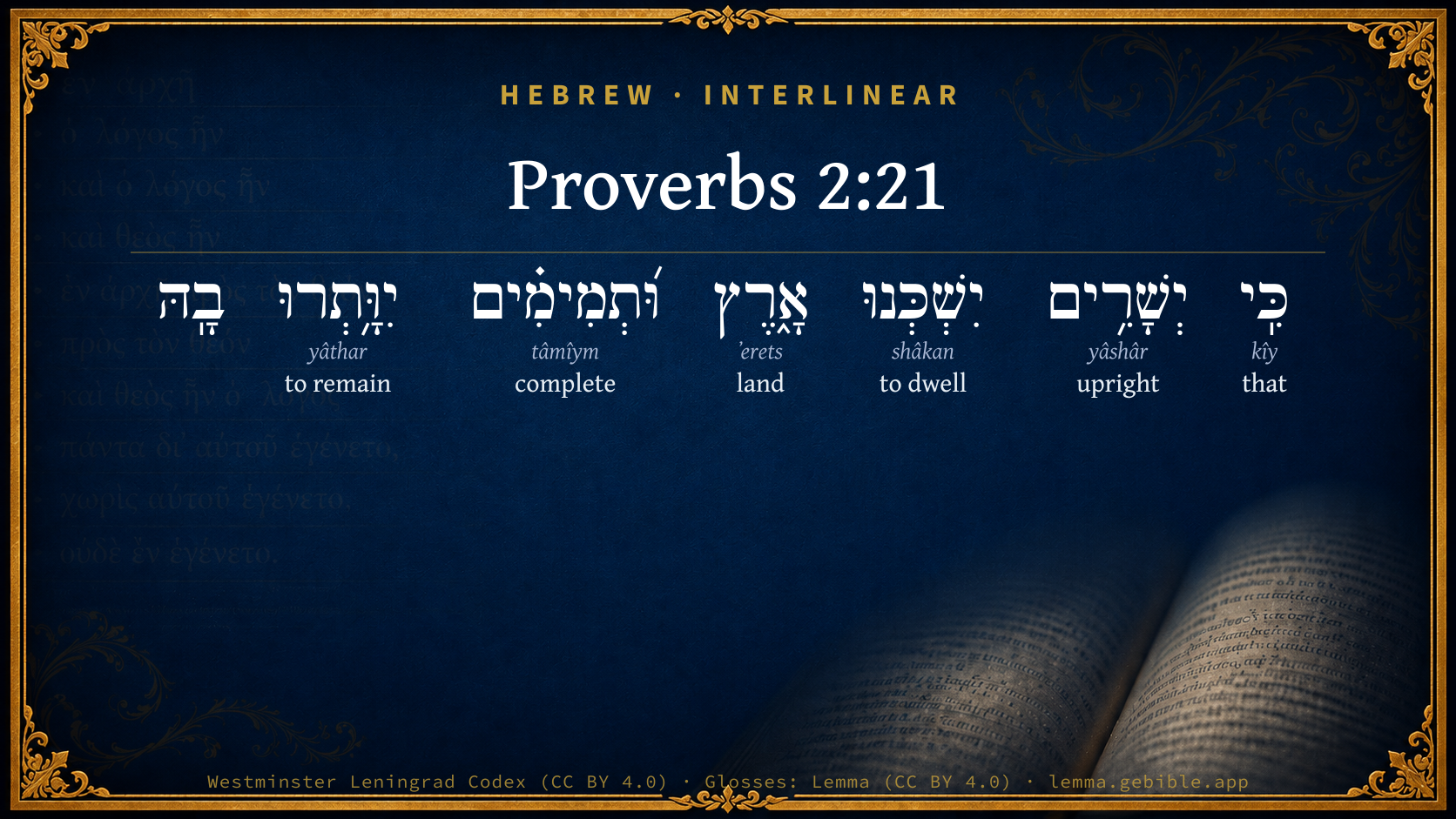
Hebrew (Westminster Leningrad Codex) Proverbs 2:21 appears in the Hebrew Old Testament. The text above is from the Westminster Leningrad Codex. Each word links to its Strong’s number, a concise gloss, and parsing drawn from the Open Scriptures Hebrew Bible morphology. Click any word for its full Brown-Driver-Briggs (BDB) entry.
Download image
Cite this verse

Proverbs 2:21 (World English Bible). Public Domain. Lemma interlinear Bible study tool, https://lemma.gebible.app/v/proverbs/2/21.

Show BibTeX & RIS
BibTeX
RIS
English Translation
For the upright will dwell in the land. The perfect will remain in it.
World English Bible · Public Domain
Download a study sheet

One document with this verse’s original text, its word-by-word gloss line, the meaning frame, cross-references with their text, attributed commentary, and full source and license credits — printable, and it pastes into notes with its structure intact.

This verse Autodidact and up

Study sheet (.html) Plain text (.txt)

A passage Seminary Student

Up to 50 verses in one chapter. A passage sheet keeps up to 6 commentary sources and 12 cross-references per verse, in the order this page ranks them, and says so on the sheet whenever that leaves anything out. Ask for a single verse and you get the Autodidact verse sheet above.

Everything on this page stays free to read, with no account — the sheet is a download of what is already on screen, not access to it.

Want to remove ads? Support Godless Engineer
Compare translations 3

The same verse in 3 English versions, stacked beneath the original-language interlinear above. Click any original word for its lexicon entry.

Each is an independent rendering of the whole verse — the interlinear is not word-aligned to these translations.

Highlighted words mark where these versions differ — a whole-verse word diff, not a word-by-word alignment.

  • World English Bible Public Domain
    For the upright will dwell in the land. The perfect will remain in it.
  • King James Version Public Domain
    For the upright shall dwell in the land, and the perfect shall remain in it.
  • unfoldingWord Literal Text CC BY-SA 4.0
    For the upright will dwell the land, and the blameless will remain in it,

unfoldingWord Literal Text — © unfoldingWord, licensed CC BY-SA 4.0. Word-aligned USFM3 via Door43 (git.door43.org/unfoldingWord/en_ult).

Versions to compare (up to 4)

3 of 4 selected

Show all 18 translations

Every available English version of this verse, each an independent rendering of the whole verse.

  • World English Bible Public Domain
    For the upright will dwell in the land. The perfect will remain in it.
  • Berean Standard Bible Public Domain
    For the upright will inhabit the land, and the blameless will remain in it;
  • Majority Standard Bible Public Domain
    For the upright will inhabit the land, and the blameless will remain in it;
  • King James Version Public Domain
    For the upright shall dwell in the land, and the perfect shall remain in it.
  • American Standard Version (1901) Public Domain
    For the upright shall dwell in the land, And the perfect shall remain in it.
  • Revised Version (1885) Public Domain
    For the upright shall dwell in the land, and the perfect shall remain in it.
  • Geneva Bible (1599) Public Domain
    For the iust shall dwell in the land, and the vpright men shall remaine in it.
  • Douay-Rheims (1899) Public Domain
    For they that are upright shall dwell in the earth, and the simple shall continue in it.
  • Young's Literal Translation Public Domain
    For the upright do inhabit the earth, And the perfect are left in it,
  • Literal Standard Version CC BY-SA 4.0
    For the upright inhabit the earth, || And the perfect are left in it,
  • Unlocked Literal Bible CC BY-SA 4.0
    For those doing right will make a home in the land, and those with integrity will remain in it.
  • unfoldingWord Literal Text CC BY-SA 4.0
    For the upright will dwell the land, and the blameless will remain in it,
  • Darby Bible Public Domain
    For the upright shall dwell in the land, and the perfect shall remain in it;
  • World Messianic Bible Public Domain
    For the upright will dwell in the land. The perfect will remain in it.
  • Webster's Bible Public Domain
    For the upright shall dwell in the land, and the perfect shall remain in it.
  • Free Bible Version CC BY-SA 4.0
    For only people who live right will live in the land; only honest people will remain there.
  • Bible in Basic English Public Domain
    For the upright will be living in the land, and the good will have it for their heritage.
  • JPS Tanakh (1917) Public Domain
    For the upright shall dwell in the land, and the whole-hearted shall remain in it.

Literal Standard Version (2020), Covenant Press — licensed CC BY-SA 4.0. Text via the HelloAO Bible API (eBible.org). Unlocked Literal Bible (unfoldingWord) — licensed CC BY-SA 4.0. Text via the HelloAO Bible API (eBible.org). unfoldingWord Literal Text — © unfoldingWord, licensed CC BY-SA 4.0. Word-aligned USFM3 via Door43 (git.door43.org/unfoldingWord/en_ult). Free Bible Version, Dr. Jonathan Gallagher — licensed CC BY-SA 4.0. Text via the HelloAO Bible API (eBible.org).

Word by word

More ways to search: Search by grammar → Find every occurrence → Compare this word →

Practice this passage: Drill this verse → Learn its vocabulary →

וּ֝תְמִימִ֗ים
tâmîym
H8549
“and · complete”
Conjunction + Adjective, Adjective, Masculine, Plural, Absolute
Part of Speech
Conjunction + Adjective
Type
Adjective
Gender
Masculine
Number
Plural
State
Absolute
Full BDB Definition

Origin: from H8552

TWOT: 2522d

complete, whole, entire, sound - complete, whole, entire - whole, sound, healthful - complete, entire (of time) - sound, wholesome, unimpaired, innocent, having integrity - what is complete or entirely in accord with truth and fact (neuter adjective/substantive)
  1. כִּֽי kîy H3588 “that” Conjunction
  2. יְשָׁרִ֥ים yâshâr H3477 “upright” Adjective, Adjective, Masculine, Plural, Absolute
  3. יִשְׁכְּנוּ shâkan H7931 “to dwell” Verb, Qal, Imperfect, 3rd Person, Masculine, Plural
  4. אָ֑רֶץ ʼerets H776 “land” Noun, Common, Both, Singular, Absolute
  5. יִוָּ֥תְרוּ yâthar H3498 “to remain” Verb, Niphal, Imperfect, 3rd Person, Masculine, Plural

About this verse

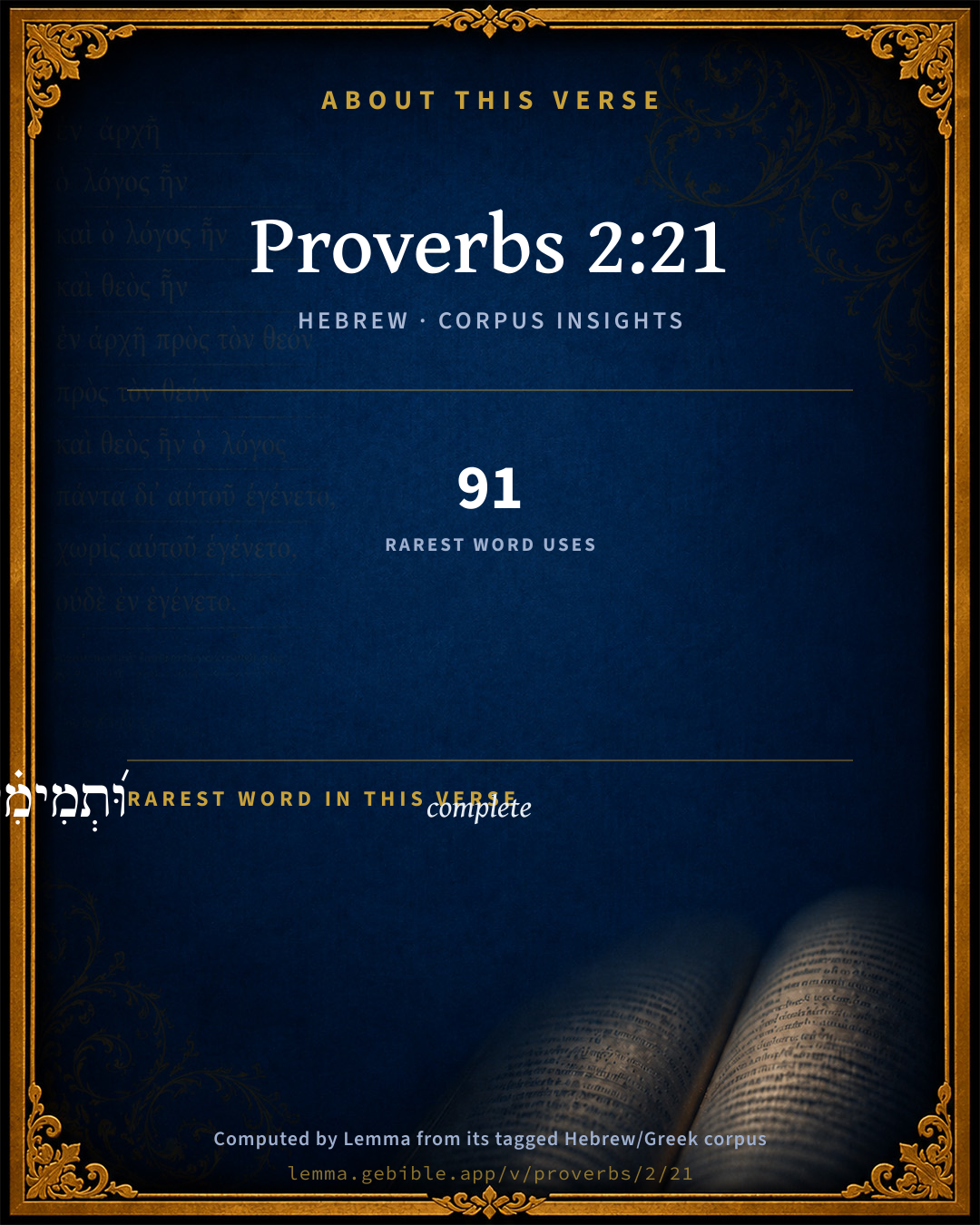
These counts appear in no published source. They are computed here, from the morphology-tagged text and Lemma’s own curated glosses. What Lemma adds →

7
words
6
distinct lemmas
Wisdom
section

Grammatical profile

  • 2 verbs
  • 1 noun
  • 2 adjectives
  • 1 preposition
  • 1 conjunction

Verb forms

  • יִשְׁכְּנוּ Qal · Imperfect
  • יִוָּ֥תְרוּ Niphal · Imperfect

Hebrew & Septuagint length

In English translation the verse runs 14 words from the Hebrew and 17 from the Septuagint (LXX English) — closely comparable.

A rough comparison of the two English renderings, which tokenize alike — not a word-level alignment.

Word counts can differ between the Hebrew and the Greek without any difference in meaning — e.g. the Hebrew direct-object marker אֵת has no separate Greek word, and Greek often adds the article ὁ.

Cross-references

10

Topical passages linked to Proverbs 2:21 in the Treasury of Scripture Knowledge — connected by theme and wording, ordered by reader-vote popularity; previews shown in the World English Bible.

  • Psalms 84:11 For Yahweh God is a sun and a shield. Yahweh will give grace and glory. He withholds no good thing from those who walk blamelessly.
  • Psalms 37:9 For evildoers shall be cut off, But those who wait for Yahweh shall inherit the land.
  • Psalms 37:29 The righteous shall inherit the land, And live in it forever.
  • Proverbs 10:30 The righteous will never be removed, But the wicked will not dwell in the land.
  • Job 42:12 So Yahweh blessed the latter end of Job more than his beginning. He had fourteen thousand sheep, six thousand camels, one thousand yoke of oxen, and a thousand female donkeys.
  • Psalms 37:3 Trust in Yahweh, and do good. Dwell in the land, and enjoy safe pasture.
  • Psalms 37:11 But the humble shall inherit the land, And shall delight themselves in the abundance of peace.
  • Psalms 37:22 For such as are blessed by him shall inherit the land. Those who are cursed by him shall be cut off.
  • Job 1:1 There was a man in the land of Uz, whose name was Job. That man was blameless and upright, and one who feared God, and turned away from evil.
  • Psalms 112:4–6 Light dawns in the darkness for the upright, Gracious, merciful, and righteous.

Cross-references courtesy of OpenBible.info (CC BY 4.0).

Hebrew and Greek witnesses Masoretic Hebrew ↔ Greek Septuagint

The same verse in the two great witnesses to the Old Testament, shown verse-for-verse.

These are two independent witnesses, not word-aligned to each other, and the Septuagint is shown in lemma (dictionary) form.

Hebrew Proverbs 2:21 Masoretic · Westminster Leningrad Codex

כִּֽי יְשָׁרִ֥ים יִשְׁכְּנוּ אָ֑רֶץ וּ֝תְמִימִ֗ים יִוָּ֥תְרוּ בָֽהּ

For the upright will dwell in the land. The perfect will remain in it.

World English Bible · Public Domain

Greek LXX Proverbs 2:21 Septuagint · lemma form

χρηστός εἰμί οἰκήτωρ γῆ ἄκακος δέ ὑπολείπω ἐν αὐτός ὅτι εὐθύς κατασκηνόω γῆ καί ὅσιος ὑπολείπω ἐν αὐτός

For the upright shall dwell in the earth, and the holy shall be left behind in it.

LXX2012 (modern English Septuagint) · Public Domain

On this verse, The Pulpit Commentary discusses the Septuagint’s reading. Read the note in Commentary ↓

Hebrew: Westminster Leningrad Codex (CC BY 4.0). Greek: Septuagint (public domain); English from LXX2012 (modern English Septuagint) (Public Domain). How the Septuagint differs from the Hebrew →

Commentary

Notes on Proverbs 2:21 from classic Christian and Jewish commentators (each source and its license shown beneath its notes). The classic Christian expositions comment on the surrounding passage and are grouped to its opening verse, so a note may address several verses; the Jewish commentaries on the Tanakh (Rashi and others) are per-verse, so they appear only where the commentator wrote on this verse.

Lemma curates 59 commentaries, every one of them public domain or Creative Commons licensed, each selected and text-cleaned for this edition rather than reprinted as found. About our sources →

Trapp's Complete Commentary

John Trapp

Pro 2:21 For the upright shall dwell in the land, and the perfect shall remain in it.

Ver. 21. For the upright shall dwell in the land.] Of Canaan, a type of heaven; for by these outward and corporeal things, inward, spiritual, and eternal are understood. Here the wise man speaks after the manner of Moses’ law, under which he lived; {Deu 11:8} and howsoever upright men suffer hardship and hunger here, yet they enjoy great tranquillity and felicity, as seeing God in all, and depending wholly upon him for help. "Well for the present, and it will be better hereafter"; - this is the upright man’s motto. Heaven, thinks he, will make amends for all. He that sees visions of glory will not matter, with St Stephen, a shower of stones. How much less will he think much, though "the Lord give him the bread of adversity, and water of affliction." {Isa 30:20}

John Trapp, A Commentary or Exposition upon All the Books of the Old and New Testament (1647–1656) — public domain. Text from a community e-Sword module.

The Preacher's Complete Homiletical Commentary

Joseph S. Exell (gen. ed.)

MAIN HOMILETICS OF THE PARAGRAPH.—Pro_2:21-22

THE CONTRAST IN THE END FROM THE CONTRAST IN THE WAY

If men walk in two directly opposite directions they cannot possibly arrive at the same goal.

I. The historic illustration of this truth. The first inhabitants of Canaan were allowed to dwell in the land until they defiled it to so great an extent by their sins that they were “rooted out,” to be replaced by the Hebrew people. These, in their turn, became “transgressors” of God’s law, and consequently forfeited their inheritance.

II. The reasonableness of this dealing. Uprightness leads to industry, and the land which is industriously cultivated fulfils the end for which God gave it to the children of men. Uprightness leads to the rightful dividing of the land or of its produce among all its inhabitants. It is God’s will that none of his creatures should suffer bodily want: if all men were truly upright and godly, the poor and needy, if they did not cease out of the land (Deu_15:2) would have a much larger share of its good things than they at present enjoy. The Hebrew civil and social laws show us what God’s intentions are in this matter. Therefore none ought to complain if they are deprived of a gift which they have mis-used.

III. The typical suggestion of the subject. Dwelling in the land of Canaan was typical of the eternal dwelling in the heavenly country. Some of the first inhabitants of that country have been “rooted out” because of sin (2Pe_2:4), others have dwelt safely there for ages, because they are, literally, perfect. This is the destined home of all just men made perfect (Heb_12:23; Heb_11:13-16; Mat_22:32).

OUTLINES AND SUGGESTIVE COMMENTS

Pro_2:21. The Israelite was, beyond the power of natural feeling, which makes home dear to every one, more closely bound to his ancestral soil by the whole form of the theocracy: torn from it he was in the inmost roots of his life itself, strained and broken.—Elster.

As surely a righteous man hath this right unto temporal things which a wicked man hath not, that God doth account him to be worthy of them … Wherefore it is observed, that in Scripture, although the wicked are said to possess the things of the earth, they are never said to inherit them; but the godly are said to inherit the good things of the earth as receiving them from the love of their heavenly Father.—Jermin.

Pro_2:22. The very earth casts out the wicked.… The whole has a typical meaning. This earth, many conjecture, is to be restored as heaven. In that event, the old Canaan types will be very perfect.—Miller.

Must not the righteous leave the earth too? Yes; but the earth is a very different thing to the righteous and to the wicked. To the latter it is all the heaven they ever have; to the righteous it is a place of preparation for heaven.—Lawson.

The event seemeth to be contrary to the promise here made, for the earth commonly is possessed by those who take evil ways, whilst in the mean season the godly are tossed up and down with many afflictions. But we must consider for our comfort, that the wicked wrongfully and unlawfully, as usurpers, possess the earth and the goods of this world; and again, that by many troubles, and by death in the end, they are put out of possession at last. As for the godly, they, by right, inherit the earth, so that, as Abraham was the heir to the land of promise even when he had not a foot of ground therein, in like manner all the godly are heirs of this world, according to the saying of the apostle, That all things are theirs (1Co_3:22); howsoever often here they possess little or nothing. In right they are heirs, and in part possessors, looking for a new heaven and a new earth, wherein the just shall dwell (2Pe_3:13).—Muffet.

Suddenly, when they have feathered their nests and set up their rest, the wicked may die sinning. The saints shall not die till the best time—not till the time when, if they were rightly informed, they would desire to die.—Trapp.

The Preacher's Complete Homiletical Commentary (gen. ed. Joseph S. Exell; Funk & Wagnalls, c. 1892) — public domain (pre-1929). A full-Bible homiletical/sermon-outline anthology covering 65 of 66 books (2 John is absent from the source module). Text from a community e-Sword module.

Geneva Bible (1599)

Geneva Bible translators

They shall enjoy the temporal and spiritual promises of God, as the wicked shall be void of them.

Geneva Bible (1599) marginal notes — public domain. Text via Bolls.life.

Jamieson, Fausset & Brown

Robert Jamieson, A. R. Fausset & David Brown

(Compare Psa 37:3, Psa 37:9, Psa 37:22, Psa 37:27).

Jamieson, Fausset & Brown — Commentary Critical and Explanatory on the Whole Bible (1871) — public domain (CC PDM 1.0). Text via the HelloAO Bible API.

Ellicott's Commentary for English Readers

(21) The upright shall dwell in the land—i.e., of Canaan, according to the old promise made to Abraham, renewed in the fifth commandment, and constantly repeated in the prophets.

A Bible Commentary for English Readers, edited by Charles John Ellicott (1878–1897) — public domain. Text from a community e-Sword module.

The Cambridge Bible for Schools and Colleges

gen. ed. J. J. S. Perowne

21, 22. land … earth] The Heb. word is the same, and should have the same rendering, either land or earth, in both verses. To a Jew this would of course mean “the land which the Lord, thy God, giveth thee” (Exo_20:12; comp. Psalms 37 passim); but in a Book, the colouring of which is not Jewish, but which addresses itself to all mankind, it is open to us to render, earth, with R.V. marg. See Pro_11:31.

The Cambridge Bible for Schools and Colleges (gen. ed. J. J. S. Perowne; Cambridge University Press, 1878–1918) — public domain. Text from a community e-Sword module.

John Gill's Exposition

For the upright shall dwell in the land,.... Such as are upright in heart, who have a right spirit renewed in them; whose hearts are right with God, have the truth of grace in them; whose faith is unfeigned, their love without dissimulation, and their hope without hypocrisy; and who are upright in their lives and conversations; these being Israelites according to the flesh, as well as Israelites indeed in a spiritual sense, shall dwell in the land of Canaan, which the Lord promised to such, and which good men enjoyed by virtue of it: or the sense is, that such shall dwell peaceably and quietly in the world, and possess the good things of it, though in a small quantity, in such a comfortable manner, with the love of God and a sense of it, as wicked men do not; or else they shall inhabit the world to come, as Jarchi interprets it; not only a future state of happiness in heaven, but the Messiah's kingdom on earth, the new heavens and new earth, wherein dwelleth righteousness, Pe2 3:13;

and the perfect shall remain in it; or "be left in it" (a); or shall be "strengthened" (b), confirmed, and established in it; or they shall dwell in it as a tent or tabernacle, bound with strong cords; see Isa 33:20; or continue there, when others should have no place in it, as follows. By the "perfect" are meant such as have all grace seminally implanted in them, though it is not come up to maturity; who have a perfection of parts, but not of degrees; are properly men in Christ, though they are not arrived to the measure of the stature of the fulness of Christ; are perfectly holy in Christ, though not in themselves; and are perfectly justified by his righteousness, and perfectly comely through his comeliness, though as yet imperfect in themselves; and those that shall dwell in the new heavens and new earth, and remain there a thousand years, shall be entirely perfect in soul and body, wholly without sin; and complete in knowledge, holiness, and peace: the Targum renders it, who are "without spot", undefiled persons; such who are not defiled with women, with the strange woman before mentioned; whose garments are not defiled, and who are free from the pollution of false doctrine, will worship, superstition, and idolatry, Rev 3:4.

(a) "superstites erunt", Tigurine version, Mercerus; "superstitabunt", Cocceius; "reliqui fient", Junius & Tremellius, Piscator; "relinquentur", Michaelis. (b) "Nervabuntur", Schultens.

John Gill's Exposition of the Whole Bible (1746–1763) — public domain (CC PDM 1.0). Text via the HelloAO Bible API.

Albert Barnes' Notes on the Bible

Noticeable here is the Hebrew love of home and love of country. To “dwell in the land” is (compare Exo 20:12; Lev 25:18, etc.) the highest blessing for the whole people and for individual men. contrast with it is the life of the sinner cut off from the land (not “earth”) of his fathers.

Albert Barnes' Notes on the Bible (1834–1885) — public domain. Text from a community e-Sword/MySword module.

Haydock's Catholic Bible Commentary

Earth. Happily. This was the wish of the carnal Jews. But the more enlightened raise their thoughts to heaven.

George Leo Haydock (1774–1849), Haydock's Catholic Family Bible and Commentary, 1859 edition — public domain. Excludes Psalms (Douay-Rheims chapter numbering differs from Protestant) and Deuterocanonical books (Catholic canon only).

Matthew Poole's English Annotations

Shall have a peaceable and comfortable abode in the land of Canaan, which also is a type of their everlasting felicity. See Psa 37:3,9,18,29.

Matthew Poole's English Annotations on the Holy Bible (1683–1685) — public domain. Text from a community e-Sword/MySword module.

Whedon's Commentary on the Bible

Daniel D. Whedon

21. The upright shall dwell in the land — According to God’s promise, (Deu_11:8-21,) those who keep his commandments shall inherit the land, and transmit it to their posterity.

Daniel D. Whedon (gen. ed.), Commentary on the Old and New Testaments (1874–1909) — public domain. Text from a community e-Sword module.

The Pulpit Commentary

For the upright shall dwell in the land. Much the same language is met with in Psa_37:29, "The righteous shall inherit the land, and dwell therein forever." It is the secure and peaceful dwelling in the land which is intended. (cf. Pro_10:30) To dwell in the land was always put forward as the reward of obedience to God"s commandments, (see Exo_20:12 Lev_25:18 Lev_26:5) and the phrase conveyed to the Hebrew mind the idea of one of the greatest, if not the greatest, of all temporal blessings. The love of country was a predominant characteristic of the race. Elster, quoted by Zockler, remarks, "The Israelite was beyond the power of natural feeling, which makes home dear to every one, more closely bound to the ancestral soil by the whole form of the theocracy; torn kern it, he was in the inmost roots of life strained and broken. Especially from psalms belonging to the period of the exile this patriotic feeling is breathed out in the fullest glow and intensity." The land (xra, arets) was the promised land, the land of Canaan. The word is not used here in the wider sense in which it occurs in Mat_5:5, "Blessed are the meek: for they shall inherit the earth." And the perfect shall remain in it; i.e. they shall not, as Rabbi Levi remarks, be driven thence nor caused to migrate. The perfect (, th"mimim), the holy (LXX, osioi ), the spotless (immaeulati, Targum), those without a staid (qui sine labe, Syriae), the guileless (simplices, Vulgate). Shall remain; WrtWyi (yivrath"ru), niph. future of rty; (yathar), properly "to be redundant," and in the niph. form, "to be left," or "to remain." LXX, upoleifyhsanti "shall remain;" permanebunt, Vulgate.

The Pulpit Commentary (1880–1919), ed. H.D.M. Spence-Jones & Joseph S. Exell — public domain. Text from a community e-Sword module.

Scofield Reference Notes

C. I. Scofield

perfect

(See Scofield "1Ki 8:61").

The Scofield Reference Bible (1917 edition), notes by C. I. Scofield — public domain. Text from a community e-Sword module.

Rashi

Rabbi Shlomo Yitzchaki (Rashi)

For the upright shall dwell in the land In the world to come.

shall remain therein when the wicked descend to Gehinnom.

Rashi on the Tanakh — English translations: “The Judaica Press complete Tanach with Rashi, translated by A. J. Rosenberg” (CC BY 4.0); “Pentateuch with Rashi's commentary by M. Rosenbaum and A.M. Silbermann, 1929-1934” (public domain); “The Metsudah Tanach series, Lakewood, N.J” (CC BY 4.0); and “The Book of Joshua, Metsudah Publications, 1997” (CC BY 4.0). Text via Sefaria.

Lesson kit

Teaching starters — assembled from the data on this page, not authored interpretation. Every prompt links to the verse data it draws on. Edit before teaching.

Proverbs, in the Wisdom, opens this verse with 7 words (6 distinct Hebrew lemmas). Its most distinctive word is tâmîym (“complete”). A historical commentator’s framing appears above. Read the whole chapter for the surrounding context.

Discussion questions

  1. The word tâmîym carries the sense “complete.” How does it shape the verse?
  2. Psalms 84:11 shares this passage’s theme. How do the two illuminate each other?
  3. These translations render this verse differently. What is at stake in choosing one wording over another?
  4. The verb «יִשְׁכְּנוּ» is Qal Imperfect. How does its form color the action?
  5. Reading how Trapp's Complete Commentary and The Preacher's Complete Homiletical Commentary read this verse, where do the two commentators agree and where do they part?

Things to notice

Reading settings

Reading text

Shown beneath each verse's original-language words.

Old Testament
Old Testament edition

Read the OT as the Masoretic Hebrew (MT) or the Greek Septuagint (LXX).

English shown for the Greek Septuagint (in the Hebrew ↔ Greek comparison).

Comparing translations? Open the Compare panel on any verse page to stack up to four side by side.