Micah 7:2

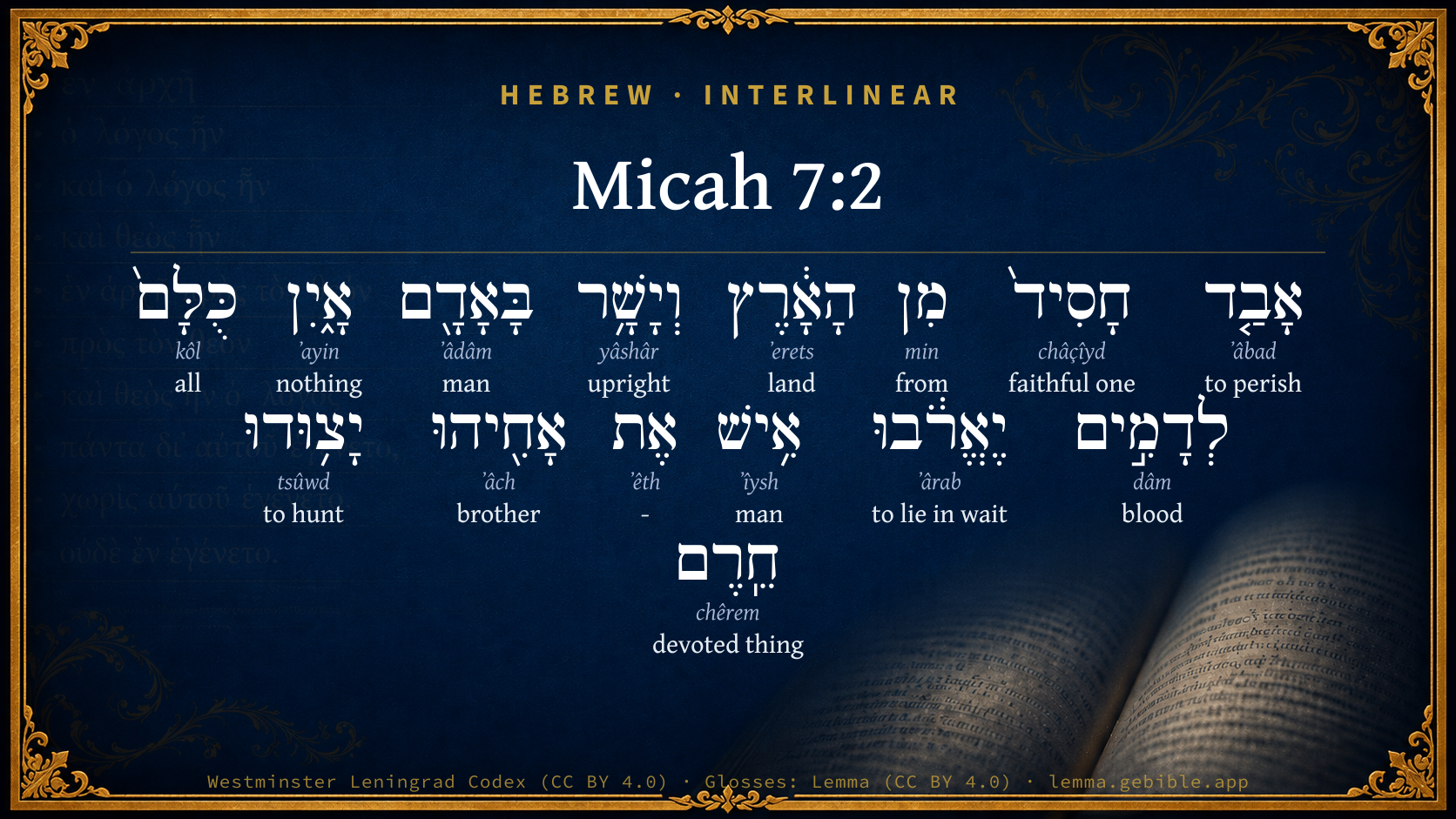
Hebrew (Westminster Leningrad Codex) Micah 7:2 appears in the Hebrew Old Testament. The text above is from the Westminster Leningrad Codex. Each word links to its Strong’s number, a concise gloss, and parsing drawn from the Open Scriptures Hebrew Bible morphology. Click any word for its full Brown-Driver-Briggs (BDB) entry.
Download image
Cite this verse

Micah 7:2 (World English Bible). Public Domain. Lemma interlinear Bible study tool, https://lemma.gebible.app/v/micah/7/2.

Show BibTeX & RIS
BibTeX
RIS
English Translation
The godly man has perished out of the earth, And there is no one upright among men. They all lie in wait for blood; Every man hunts his brother with a net.
World English Bible · Public Domain
Download a study sheet

One document with this verse’s original text, its word-by-word gloss line, the meaning frame, cross-references with their text, attributed commentary, and full source and license credits — printable, and it pastes into notes with its structure intact.

This verse Autodidact and up

Study sheet (.html) Plain text (.txt)

A passage Seminary Student

Up to 50 verses in one chapter. A passage sheet keeps up to 6 commentary sources and 12 cross-references per verse, in the order this page ranks them, and says so on the sheet whenever that leaves anything out. Ask for a single verse and you get the Autodidact verse sheet above.

Everything on this page stays free to read, with no account — the sheet is a download of what is already on screen, not access to it.

Want to remove ads? Support Godless Engineer
Compare translations 3

The same verse in 3 English versions, stacked beneath the original-language interlinear above. Click any original word for its lexicon entry.

Each is an independent rendering of the whole verse — the interlinear is not word-aligned to these translations.

Highlighted words mark where these versions differ — a whole-verse word diff, not a word-by-word alignment.

  • World English Bible Public Domain
    The godly man has perished out of the earth, And there is no one upright among men. They all lie in wait for blood; Every man hunts his brother with a net.
  • King James Version Public Domain
    The good man is perished out of the earth: and there is none upright among men: they all lie in wait for blood; they hunt every man his brother with a net.
  • unfoldingWord Literal Text CC BY-SA 4.0
    The faithful ones have disappeared from the land; there is no upright person in all mankind. They all lie in wait to shed blood; each one hunts his own brother with a net.

unfoldingWord Literal Text — © unfoldingWord, licensed CC BY-SA 4.0. Word-aligned USFM3 via Door43 (git.door43.org/unfoldingWord/en_ult).

Versions to compare (up to 4)

3 of 4 selected

Show all 18 translations

Every available English version of this verse, each an independent rendering of the whole verse.

  • World English Bible Public Domain
    The godly man has perished out of the earth, And there is no one upright among men. They all lie in wait for blood; Every man hunts his brother with a net.
  • Berean Standard Bible Public Domain
    The godly man has perished from the earth; there is no one upright among men. They all lie in wait for blood; they hunt one another with a net.
  • Majority Standard Bible Public Domain
    The godly man has perished from the earth; there is no one upright among men. They all lie in wait for blood; they hunt one another with a net.
  • King James Version Public Domain
    The good man is perished out of the earth: and there is none upright among men: they all lie in wait for blood; they hunt every man his brother with a net.
  • American Standard Version (1901) Public Domain
    The godly man is perished out of the earth, and there is none upright among men: they all lie in wait for blood; they hunt every man his brother with a net.
  • Revised Version (1885) Public Domain
    The godly man is perished out of the earth, and there is none upright among men: they all lie in wait for blood; they hunt every man his brother with a net.
  • Geneva Bible (1599) Public Domain
    The good man is perished out of the earth, and there is none righteous among men: they all lye in wayte for blood: euery man hunteth his brother with a net.
  • Douay-Rheims (1899) Public Domain
    The holy man is perished out of the earth, and there is none upright among men: they all lie in wait for blood, every one hunteth his brother to death.
  • Young's Literal Translation Public Domain
    Perished hath the kind out of the land, And upright among men -- there are none, All of them for blood lie in wait, Each his brother they hunt `with' a net.
  • Literal Standard Version CC BY-SA 4.0
    The kind have perished out of the land, || And upright among men—there are none, || All of them lie in wait for blood, || They each hunt his brother [with] a net.
  • Unlocked Literal Bible CC BY-SA 4.0
    Faithful people have disappeared from the land; there is no upright person in all mankind. They all lie in wait to shed blood; each one hunts his own brother with a net.
  • unfoldingWord Literal Text CC BY-SA 4.0
    The faithful ones have disappeared from the land; there is no upright person in all mankind. They all lie in wait to shed blood; each one hunts his own brother with a net.
  • Darby Bible Public Domain
    The godly [man] hath perished out of the land, and there is none upright among men: they all lie in wait for blood, they hunt every man his brother with a net.
  • World Messianic Bible Public Domain
    The godly man has perished out of the earth, and there is no one upright among men. They all lie in wait for blood; every man hunts his brother with a net.
  • Webster's Bible Public Domain
    The good man hath perished from the earth: and there is none upright among men: they all lie in wait for blood; they hunt every man his brother with a net.
  • Free Bible Version CC BY-SA 4.0
    All the good people in the country are gone, there's no one who does right left anywhere. Everyone is looking to murder others; they try to trap even their own brothers.
  • Bible in Basic English Public Domain
    The good man is gone from the earth, there is no one upright among men: they are all waiting secretly for blood, every man is going after his brother with a net.
  • JPS Tanakh (1917) Public Domain
    The godly man is perished out of the earth, and the upright among men is no more; they all lie in wait for blood; they hunt every man his brother with a net.

Literal Standard Version (2020), Covenant Press — licensed CC BY-SA 4.0. Text via the HelloAO Bible API (eBible.org). Unlocked Literal Bible (unfoldingWord) — licensed CC BY-SA 4.0. Text via the HelloAO Bible API (eBible.org). unfoldingWord Literal Text — © unfoldingWord, licensed CC BY-SA 4.0. Word-aligned USFM3 via Door43 (git.door43.org/unfoldingWord/en_ult). Free Bible Version, Dr. Jonathan Gallagher — licensed CC BY-SA 4.0. Text via the HelloAO Bible API (eBible.org).

Word by word

More ways to search: Search by grammar → Find every occurrence → Compare this word →

Practice this passage: Drill this verse → Learn its vocabulary →

יָצ֥וּדוּ
tsûwd
H6679
“to hunt”
Verb, Qal, Imperfect, 3rd Person, Masculine, Plural
Part of Speech
Verb
Stem
Qal
Form
Imperfect
Person
3rd Person
Gender
Masculine
Number
Plural
Full BDB Definition

Origin: a primitive root

TWOT: 1885

to hunt - (Qal) to hunt - (Poel) to hunt, hunt eagerly or keenly - (Hithpael) take provision
  1. אָבַ֤ד ʼâbad H6 “to perish” Verb, Qal, Perfect, 3rd Person, Masculine, Singular
  2. חָסִיד֙ châçîyd H2623 “faithful one” Adjective, Adjective, Masculine, Singular, Absolute
  3. מִן min H4480 “from” Preposition
  4. הָאָ֔רֶץ ʼerets H776 “the · land” Particle, Definite Article + Noun, Common, Both, Singular, Absolute
  5. וְיָשָׁ֥ר yâshâr H3477 “and · upright” Conjunction + Adjective, Adjective, Masculine, Singular, Absolute
  6. בָּאָדָ֖ם ʼâdâm H120 “in/at the · man” Preposition, Determined + Noun, Common, Masculine, Singular, Absolute
  7. אָ֑יִן ʼayin H369 “nothing” Particle, Negative
  8. כֻּלָּם֙ kôl H3605 “all · their” Noun, Common, Masculine, Singular, Construct + Suffix, Personal, 3rd Person, Masculine, Plural
  9. לְדָמִ֣ים dâm H1818 “to/for · blood” Preposition + Noun, Common, Masculine, Plural, Absolute
  10. יֶאֱרֹ֔בוּ ʼârab H693 “to lie in wait” Verb, Qal, Imperfect, 3rd Person, Masculine, Plural
  11. אִ֥ישׁ ʼîysh H376 “man” Noun, Common, Masculine, Singular, Absolute
  12. אֶת ʼêth H853 “-” Particle, Direct Object
  13. אָחִ֖יהוּ ʼâch H251 “brother · his” Noun, Common, Masculine, Singular, Construct + Suffix, Personal, 3rd Person, Masculine, Singular
  14. חֵֽרֶם chêrem H2764 “devoted thing” Noun, Common, Masculine, Singular, Absolute

About this verse

These counts appear in no published source. They are computed here, from the morphology-tagged text and Lemma’s own curated glosses. What Lemma adds →

15
words
15
distinct lemmas
Prophets
section

Notable vocabulary

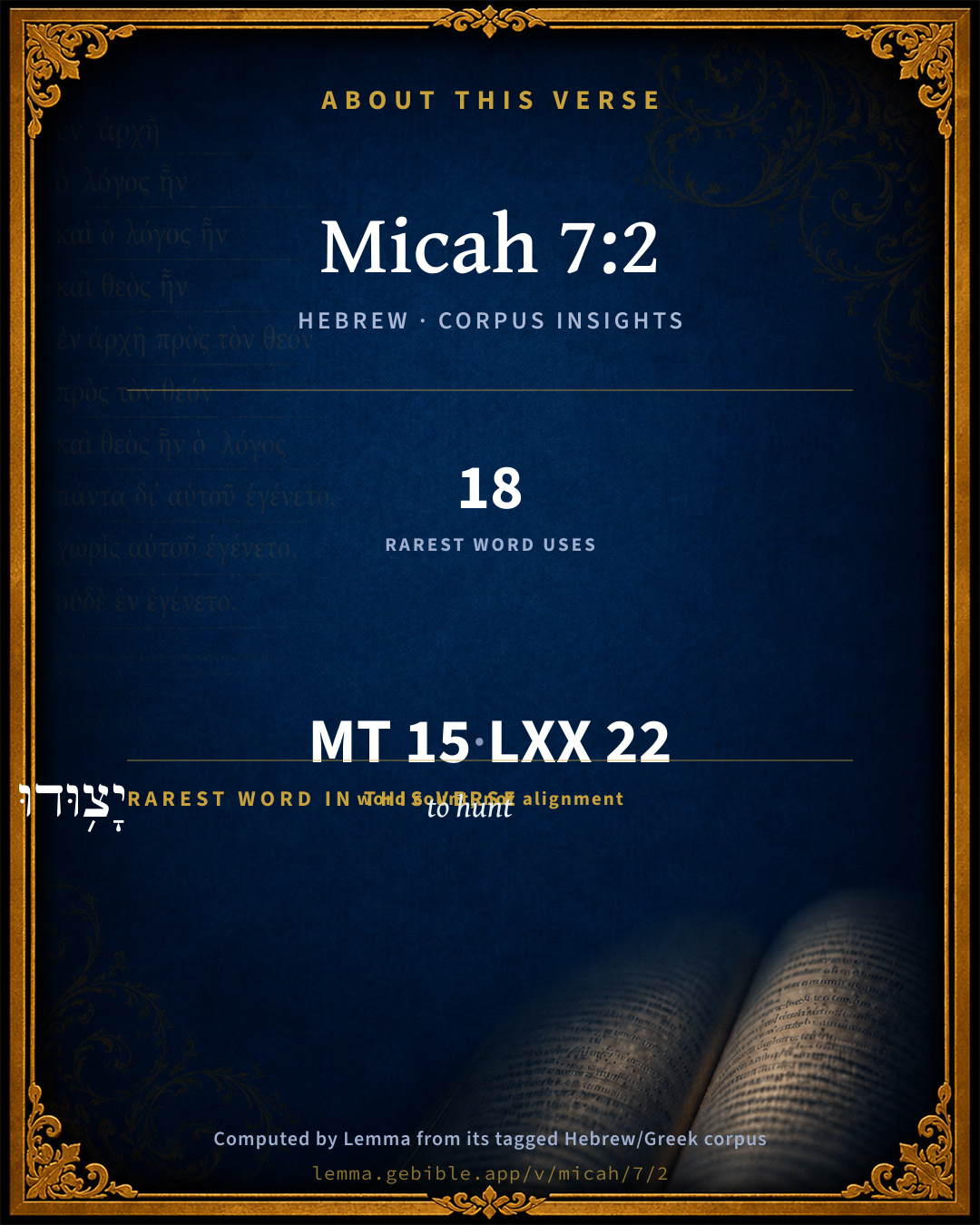
The rarest word here is יָצ֥וּדוּ to hunt H6679 — appearing just 18 times in the whole Hebrew Bible.

Shared distinctive vocabulary

יָצ֥וּדוּ to hunt H6679 occurs in 15 verses of the Hebrew Bible. Also found in:

Grammatical profile

  • 3 verbs
  • 7 nouns
  • 2 adjectives
  • 1 preposition
  • 2 particles

Verb forms

  • אָבַ֤ד Qal · Perfect
  • יֶאֱרֹ֔בוּ Qal · Imperfect
  • יָצ֥וּדוּ Qal · Imperfect

Hebrew & Septuagint length

In English translation the verse runs 32 words from the Hebrew and 32 from the Septuagint (LXX English) — the same length.

A rough comparison of the two English renderings, which tokenize alike — not a word-level alignment.

Word counts can differ between the Hebrew and the Greek without any difference in meaning — e.g. the Hebrew direct-object marker אֵת has no separate Greek word, and Greek often adds the article ὁ.

In the original languages it is 15 Hebrew tokens and 22 Greek tokens — but the two are counted differently (Hebrew bundles its prefixes and suffixes into one token; the Greek is in lemma form), so that isn’t a like-for-like length.

Cross-references

16

Topical passages linked to Micah 7:2 in the Treasury of Scripture Knowledge — connected by theme and wording, ordered by reader-vote popularity; previews shown in the World English Bible.

  • Psalms 12:1 Help, Yahweh; for the godly man ceases. For the faithful fail from among the children of men.
  • Psalms 14:1–3 The fool has said in his heart, "There is no God." They are corrupt. They have done abominable works. There is none who does good.
  • Isaiah 57:1 The righteous perishes, and no man lays it to heart; and merciful men are taken away, none considering that the righteous is taken away from the evil [to come].
  • Isaiah 59:7 Their feet run to evil, and they make haste to shed innocent blood: their thoughts are thoughts of iniquity; desolation and destruction are in their paths.
  • Jeremiah 5:26 For among my people are found wicked men: they watch, as fowlers lie in wait; they set a trap, they catch men.
  • Proverbs 1:11 If they say, "Come with us, Let's lay in wait for blood; Let's lurk secretly for the innocent without cause;
  • Jeremiah 16:16 Behold, I will send for many fishermen, says Yahweh, and they shall fish them up; and afterward I will send for many hunters, and they shall hunt them from every mountain, and from every hill, and out of the clefts of the rocks.
  • 1 Samuel 24:11 Moreover, my father, behold, yes, see the skirt of your robe in my hand; for in that I cut off the skirt of your robe, and didn't kill you, know you and see that there is neither evil nor disobedience in my hand, and I have not sinned against you, though you hunt after my life to take it.
  • 1 Samuel 26:20 Now therefore, don't let my blood fall to the earth away from the presence of Yahweh: for the king of Israel is come out to seek a flea, as when one does hunt a partridge in the mountains.
  • Psalms 57:6 They have prepared a net for my steps. My soul is bowed down. They dig a pit before me. They fall into the midst of it themselves. Selah.
  • Proverbs 12:6 The words of the wicked are about lying in wait for blood, But the speech of the upright rescues them.
  • Jeremiah 5:16 Their quiver is an open tomb, they are all mighty men.
  • Lamentations 4:18 They hunt our steps, so that we can't go in our streets: Our end is near, our days are fulfilled; for our end is come.
  • Micah 3:10 They build up Zion with blood, And Jerusalem with iniquity.
  • Habakkuk 1:15–17 He takes up all of them with the hook. He catches them in his net, and gathers them in his dragnet. Therefore he rejoices and is glad.
  • Romans 3:10–18 As it is written, "There is no one righteous. No, not one.

Cross-references courtesy of OpenBible.info (CC BY 4.0).

Hebrew and Greek witnesses Masoretic Hebrew ↔ Greek Septuagint

The same verse in the two great witnesses to the Old Testament, shown verse-for-verse.

These are two independent witnesses, not word-aligned to each other, and the Septuagint is shown in lemma (dictionary) form.

Hebrew Micah 7:2 Masoretic · Westminster Leningrad Codex

אָבַ֤ד חָסִיד֙ מִן הָאָ֔רֶץ וְיָשָׁ֥ר בָּאָדָ֖ם אָ֑יִן כֻּלָּם֙ לְדָמִ֣ים יֶאֱרֹ֔בוּ אִ֥ישׁ אֶת אָחִ֖יהוּ יָצ֥וּדוּ חֵֽרֶם

The godly man has perished out of the earth, And there is no one upright among men. They all lie in wait for blood; Every man hunts his brother with a net.

World English Bible · Public Domain

Greek LXX Micah 7:2 Septuagint · lemma form

ὅτι ἀποὀλλύω εὐλαβής ἀπό ὁ γῆ καί καταὀρθόω ἐν ἄνθρωπος οὐ ὑποἄρχω πᾶς εἰς αἷμα δικάζω ἕκαστος ὁ πλησίον αὐτός ἐκθλίβω ἐκθλίβω

For the godly is perished from the earth; and there is none among men that orders his way aright: they all quarrel even to blood: they grievously afflict every one his neighbor:

LXX2012 (modern English Septuagint) · Public Domain

On this verse, The Pulpit Commentary discusses the Septuagint’s reading. Read the note in Commentary ↓

Hebrew: Westminster Leningrad Codex (CC BY 4.0). Greek: Septuagint (public domain); English from LXX2012 (modern English Septuagint) (Public Domain). How the Septuagint differs from the Hebrew →

Targum (Aramaic paraphrase)

1

The Targum is the ancient Jewish Aramaic paraphrase of the Hebrew Scriptures — an interpretive translation, not the Hebrew text itself. Onkelos (literal) and Pseudo-Jonathan (expansive) render the Torah, and Jonathan the Prophets. Coverage is partial: where no permissively-licensed English translation exists for a verse, only the Aramaic is shown. This is verse-level text, not a word-by-word alignment to the Hebrew.

  1. Targum Jonathan Prophets (Joshua–Malachi)
    אָבָדוּ חֲסִידַיָא מִן אַרְעָא וּדְקָשִׁיט בֶּאֱנָשָׁא לֵית כּוּלְהוֹן לְמִשְׁפַּךְ דַם זַכַּאי כַּמְנִין גְבַר יַת אֲחוֹהִי מָסְרִין לִגְמִירָא:

    (no public-domain English translation for this verse)

    Targum Jonathan — Aramaic: “Mikraot Gedolot” (public domain). English: “Sefaria Community Translation” (CC0 1.0 (public-domain dedication)); “London "Chaldee Paraphrase," 1871” (public domain). Text via Sefaria.

Commentary

Notes on Micah 7:2 from classic Christian and Jewish commentators (each source and its license shown beneath its notes). The classic Christian expositions comment on the surrounding passage and are grouped to its opening verse, so a note may address several verses; the Jewish commentaries on the Tanakh (Rashi and others) are per-verse, so they appear only where the commentator wrote on this verse.

Lemma curates 59 commentaries, every one of them public domain or Creative Commons licensed, each selected and text-cleaned for this edition rather than reprinted as found. About our sources →

Trapp's Complete Commentary

John Trapp

Mic 7:2 The good [man] is perished out of the earth: and [there is] none upright among men: they all lie in wait for blood; they hunt every man his brother with a net.

Ver. 2. The good man is perished out of the earth] Heb. The saint, or, gracious man, that out of mercy obtained from God, can extend mercy to men. Rari quippe boni. Of such it may be said, as one doth of faithful friends in this age, that they are all (for the most part) gone on pilgrimage; and their return is uncertain.

And there is none upright among men] None (to speak of) that maketh straight paths for his feet, Heb 12:13, that foots it aright (ορθοπαδει), according to the truth of the gospel, Gal 2:14, that walketh evenly, Gen 17:1, and accurately (ακριβως), as it were by line and by rule, Eph 5:15, and that halts not between two opinions, as those Israelites; but is right in his judgment, and undefiled in his way, Psa 119:1, rather desiring to be good than to seem to be so: few such to be found surely; black swans you may count and call them.

“ Sed nec Brutus erit, Bruti nec avunculus usquam ”( Juven.).

They all lie in wait for blood] A company of sanguinaries, blood suckers, hunting for the precious lives of men; but especially of such as reprove them in the gate. If you touch them in their lusts, they will seek to touch you in your life, as Joash did Zechariah, and as the priests and people said of Jeremiah, This man worthy to die. All malice is bloody, and wisheth him out of the world whom it spiteth.

They hunt every man his brother with a net] They add fraud to their force and craft to their cruelty; these seldom go sundered: as some write of the asp, he never wanders alone without his companion with him; and as the Scripture speaks of those birds of prey and desolation, none of them shall want their mate, Isa 34:16. The matter is made the worse, because it is a brother whom they hunt: whether he be so by race, place, or grace, a brother should be better dealt with.

John Trapp, A Commentary or Exposition upon All the Books of the Old and New Testament (1647–1656) — public domain. Text from a community e-Sword module.

The Biblical Illustrator

Joseph S. Exell

Mic_7:2-6

The good man is perished out of the earth

The wail of a true patriot over the moral corruption of his country

He bemoans--

I.

The departure of excellence from his country. The good man is perished out of the earth. Probably they had emigrated to distant lands, perhaps they had gone into eternity. Goodmen are the lights of the world. Their influence penetrates the mass as salt, counteracts its tendency to corruption, removes its moral insipidity, gives it a new spirit--a spirit pungent and savoury.

II. The rampancy of avarice in this country.

1. The working amongst the general community. To get wealth for themselves was with them such a furious passion that the rights and lives of others were disregarded.

2. Its working amongst the higher classes. That they may do evil with broth hands earnestly, the prince asketh, and the judge asketh for a reward; and the great man, he uttereth his mischievous desire: so they wrap it up. The idea seems to be this: that the great man, the prince, for some corrupt motive, seeks the condemnation of some innocent person; and the judge, for a bribe, gratifies his wish. A judge from avarice will pronounce an innocent man guilty. All this is done very industriously, with two hands. Possible, lest some event should start up to thwart them; and when it is done they wrap it up. So they wrap it up. Avarice, like all sinful passions, seeks to wrap up its crimes.

III. The mischievousness of the best in his country. The best of them is as a briar; the most upright is sharper than a thorn hedge. There is a gradation of wickedness of the men in the country, but the best of them is like a prickly thorn, and worse than a thorn hedge. The prophet is so struck with this, that the thought of retribution takes hold of him, and he says, The day of thy watchmen and thy visitation cometh: now shall be their visitation. Another thing which the patriot here bemoans is--

IV. The lack of truthfulness in the country. Trust ye not in a friend, put ye not confidence in a guide, etc. Place no faith in a companion; trust not a familiar friend; from her that lieth in thy bosom guard the doors of thy mouth. For the son despiseth the father, the daughter riseth up against her mother, the daughter-in-law against her mother-in-law, a mans enemies are the members of his own family.--Henderson. All social faith was gone; a man had lost all confidence in his brother. Social scepticism and suspicion prevailed in all circles. No faith was to be put in a friend. (Homilist.)

The lack of good men

These words are the cause of the prophets sorrow. So deep a concern it was, that the words of Mic_7:1 may signify not only mourning but howling. It arises from the scarcity of men truly good. Such a passion as this for the want of good men became the prophet in all capacities, as a man, as a subject, and as a prophet. As a man, he could not but be concerned to see a nation of men so changed and degenerated by vice and luxury. As a subject, he could but consider what misery would suddenly betide the nation, for want of goodness and religion. As a prophet, he could but note how they slighted his errand, and were sturdy and resolute in their vices.

I. Wherein the goodness of this good man, the prophet mentions, did express itself. The Christian Church, as well as the prophet, may justly bewail her barren Christians, and the scarcity of men truly good. We call ourselves saints and elect, but where is the patience, the temper, and the spirit of them? Let our religion be never so primitive and apostolical, except it makes us really good it is but wrangling hypocrisy and noise.

1. True goodness doth express itself in plainness and sincerity in all our respective dealings with men.

2. Goodness expresses itself in the exercise of good nature, and charitable allowances for the errors of others.

3. The good man is of a spirit truly public, whose care and attention looks abroad.

4. The good man takes up religion only to serve a spiritual purpose. Religion without this good purpose is only fashion or faction, hypocrisy and formality, superstition or interest.

II. What grew up and prevailed in the prophets time in the place of true religion or goodness.

1. Superstition and false religion, which naturally produce trouble and disquiet in all governments.

2. Wicked lives in the professors of the true religion, which will surely cause misery and ruin in a nation.

3. Atheistical persuasions prevailed, or there was no religion at all.

III. What particular reasons may move us to bewail the want of real goodness.

1. The want of it is the principal cause of our distractions about religion.

2. Real goodness is the best way to unite us among ourselves. Real goodness purges our judgment, removes our prejudices. (Gregory Hascard, D. D.)

Ancient and modern pessimism

When we ourselves are down it is hard to believe that anybody else is up; when our prayer is choked in our throat it is easy to believe that God hears no prayer at all, nor cares for petitioning and supplicating men. We interpret all things by ourselves. There is a curious self-projection of the soul upon the disc of history, and we read according to the shadow which we throw upon that disc. This is what we call pessimism. We are always inventing strange words, and imagining that thereby we are making some kind of progress. Man has a fatal gift of giving names to things, and once give a name and it will be almost impossible to obliterate it. We call this pessimism,--that is, seeing all the wickedness, and none of the goodness; seeing all the darkness, and none of the light; seeing the utter desolation of all things, and not seeing in all the wilderness one green blade, one tiny flower, or hearing in the grim silence one trill of lark or soft note of thrush or nightingale. There are persons gifted with the genius of darkness. It may do us good to visit them occasionally; but on the whole it is better to live in the sunshine, and to hear the music, and to come under the influence of intelligent vivacity and cheerfulness. If people will shut themselves up in their own little houses--for the biggest house is little, the palace is a mere hut--and never keep any company but their own, they will go down. It is so ecclesiastically. There are persons who never see the universe except through their own church window, and as no window is as big as the horizon, there steals insidiously upon the mind a disposition to deny the existence of the horizon itself. It is so with reading. There are those who read only a certain set of books. They go down; there is no mental range, no scope, no variety, no mystery of colour, no hopefulness, no imagination. The very earth needs to have its crops changed. If you will go on growing the same crops you will cease to have any crop that is worth gathering. There is, on the other hand, what is termed optimism. That is the exact contrary of pessimism. Optimism sees the best of everything. There is a danger along that line also; the danger is that we may not be stern enough, real enough, penetrating enough, going into the heart and inmost fibre of things to find out reality and truth, how bad or good soever the case may be. (Joseph Parker, D. D.)

The Biblical Illustrator, edited by Joseph S. Exell (c. 1880s–1900s) — public domain. Text from a community e-Sword module.

Tyndale Open Study Notes

Tyndale Open Resources

7:2-6 The people of Israel were without law, justice, or righteousness. Everyone took advantage of others for self-aggrandizement; they had created a society in which all forms of oppression were the norm.

7:2 not one honest person is left: This complaint is frequent in the prophets (see Isa 59:16; Jer 5:1; Ezek 22:30). • In the ancient Near East, people fished and hunted by setting traps and using nets (cp. Ps 10:9; Prov 1:17; Isa 51:20). • their own brothers: All fellow Israelites were regarded as brothers.

Tyndale Open Study Notes — © Tyndale Open Resources, licensed CC BY-SA 4.0. Text via the HelloAO Bible API.

Geneva Bible (1599)

Geneva Bible translators

He showeth that the prince, the judge, and the rich man are linked together all to do evil, and to cloak the doings one of another.

Geneva Bible (1599) marginal notes — public domain. Text via Bolls.life.

Jamieson, Fausset & Brown

Robert Jamieson, A. R. Fausset & David Brown

The Hebrew expresses "one merciful and good in relation to man," rather than to God.

is perished out of the earth-- (Psa 12:1).

Jamieson, Fausset & Brown — Commentary Critical and Explanatory on the Whole Bible (1871) — public domain (CC PDM 1.0). Text via the HelloAO Bible API.

Adam Clarke's Commentary

Verse 2. The good man is perished out of the earth] A similar sentiment may be found, Ps 12:1; Isa 57:1. As the early fig of excellent flavour cannot be found in the advanced season of summer, or a choice cluster of grapes after vintage, so neither can the good and upright man be discovered by searching in Israel. This comparison, says Bp. Newcome, is beautifully implied.

They hunt every man his brother with a net.] This appears to be an allusion to the ancient mode of duel between the retiarius and secutor. The former had a casting net, which he endeavoured to throw over the head of his antagonist, that he might then despatch him with his short sword. The other parried the cast; and when the retiarius missed, he was obliged to run about the field to get time to set his net in right order for another throw. While he ran, the other followed, that he might despatch him before he should be able to recover the proper position of his net; and hence the latter was called secutor, the pursuer, as the other was called retiarius, or the net man. I have explained this before on Job, and other places; but because it is rarely noticed by commentators, I explain the allusion here once more. Abp. Newcome by not attending to this, has translated איש את אחיהו יצודו חרם ish eth achihu yatsudu cherem, "They hunt every man his brother for his destruction;" though he put net in the margin.

Adam Clarke's Commentary on the Bible (1810–1826) — public domain. Text from a community e-Sword/MySword module.

John Calvin's Commentaries

In the second verse he expresses more clearly his mind, Perished, he says, has the righteous from the land, and there is none upright among men. Here now he does not personify the land. It was indeed a forcible and an emphatic language, when he complained at the beginning, that he groaned as though the land was ashamed of its dearth: but the Prophet now performs the office of a teacher, Perished, he says, has the righteous from the land; there is no one upright among men; all lay in wait for blood; every one hunts his brother as with a net In this verse the Prophet briefly shows, that all were full both of cruelty and perfidy, that there was no care for justice; as though he said, In vain are good men sought among this people; for they are all bloody, they are all fraudulent. When he says, that they all did lay in wait for blood, he no doubt intended to set forth their cruelty, as though he had said, that they were thirsting for blood. But when he adds, that each did lay in wait for their brethren, he alludes to their frauds or to their perfidy.

We now then perceive the meaning of the Prophet: and the manner he adopts is more emphatical than if God, in his own name, had pronounced the words: for, as men were fixed, and as though drowned, in their own carelessness, the Prophet introduces here the land as speaking, which accuses its own children, and confesses its own guilt; yea, it anticipates God’s judgment, and acknowledges itself to be contaminated by its own inhabitants, so that nothing pure remained in it. It follows —

John Calvin's Commentaries (1540-1563) — public domain. Text from the Calvin Translation Society English edition (1840s-50s) via the Christian Classics Ethereal Library (ccel.org). Calvin's coverage is partial (roughly two-thirds of the Bible); uncommented books and verses are honest gaps, never fabricated. The 19th-century editor's footnotes and remarks are omitted so the notes are faithfully Calvin's own voice.

Ellicott's Commentary for English Readers

(2) With a net.—The net, which in the Hebrew term comes from a verb meaning to shut up, was used both by the fisherman and the fowler. “They lay wait for one another, as hunters for wild beasts.”

A Bible Commentary for English Readers, edited by Charles John Ellicott (1878–1897) — public domain. Text from a community e-Sword module.

The Cambridge Bible for Schools and Colleges

gen. ed. J. J. S. Perowne

2. The good man] More fully rendered, ‘The pious man,’ he who makes love his rule of action—love to God and love to man. ‘The idea of khâsîdh is not passive [he who experiences grace or love], for God Himself is called khâsîdh, Psa_145:17, but he who exercises khesedh (Pro_11:17), i.e. makes men, according to God’s will, and God Himself (comp. Jon_2:8, Psa_144:2) ‘the object of his loving endeavours’ (Delitzsch on Psa_16:10). Observe, ‘The pious man,’ not ‘pious men’ is the phrase employed, ‘indicating the fewness and isolation of these Abdiels.’ There is a striking parallel to the first half of this verse in Isa_57:1, ‘The righteous perisheth, and no man taketh it to heart, and men of piety are gathered,’ &c. Both passages must have been written in time of persecution.

they all lie in wait for blood] Not merely persecution, but anarchy seems to have been the order of the day: at least the rich and powerful were under no legal restraint; they did that which was right in their own eyes. Similar circumstances are described in many of the Psalms (see e. g. Psa_10:8-9).

every man his brother] Although, as children of Abraham, they ought to love each other; comp. Lev_19:18.

The Cambridge Bible for Schools and Colleges (gen. ed. J. J. S. Perowne; Cambridge University Press, 1878–1918) — public domain. Text from a community e-Sword module.

John Gill's Exposition

The good man is perished out of the earth,.... Here the prophet expresses in plain words what he had before delivered in figurative terms. The "good" or "godly" man, as in Psa 12:1; is one that has received the grace of God, and blessings of grace from him, and lives a godly life and conversation; who has the good work of grace begun in him and is found in the performance of good works, and does his duty both to God and man from godly principles; and particularly is kind and merciful to the poor and needy, and those in distress. The complaint is, that there were few, or scarce any, of this character in the earth, in the land of Israel, where there used to be great numbers of them, but now they were all dead and gone; for this is to be understood, not of the perishing of their graces or comforts, much less of their perishing in their sins, or perishing eternally, but of their corporeal death:

and there is none upright among men; that are upright in heart and life; that have right spirits renewed in them, are Israelites indeed, in whom there is no guile; and walk uprightly, according to the rule of the divine word, truly honest, faithful men; very few such were to be found, scarce any; see Psa 12:1;

they all lie in wait for blood; for the substance, wealth, and riches of men, which is as their blood and life; is their livelihood, that on which they live; this they wait for an opportunity to get from them, and, when it offers, greedily seize it; and stick not even to shed blood, and take away life, for the sake of gain:

they hunt every man his brother with a net; as men lay nets for fish, and fowl, and beasts, and hunt them till they have got them into them; so these men laid snares, not for strangers only, but for their own brethren, to entangle them in, and cheat and defraud them of their substance; and this they would do, even to the destruction of them, as some (s) render it; for the word also signifies "anathema", destruction, as well as a "net". So the Targum.

"betray or deliver his brother to destruction.''

(s) "ad necem", Tigurine version; "anathema, caedes", Drusius; "ad occasuinem", ibid.

John Gill's Exposition of the Whole Bible (1746–1763) — public domain (CC PDM 1.0). Text via the HelloAO Bible API.

Albert Barnes' Notes on the Bible

The, good - or godly, or merciful, the English margin

Man - The Hebrew word contains all. It is “he who loveth tenderly and piously” God, for His own sake, and man, for the sake of God. Mercy was probably chiefly intended, since it wits to this that the prophet had exhorted, and the sins which he proceeds to speak of, are against this. But imaginary love of God without love of man, or love of man without the love of God, is mere self-deceit. “Is perished out of the earth,” that is, by an untimely death. The good had either been withdrawn by God from the evil to come Isa 57:1, or had Leon cut off by those who laid wait for blood; in which case their death brought a double evil, through the guilt which such sin contracted, and then, through the loss of those who might be an example to others, and whose prayers God would hear. The loving and upright, all, who were men of mercy and truth, had ceased. They who were left, “all lie in wait for blood,” literally, bloods , that is, bloodshedding; all, as far as man can see; as Elijah complains that he was left alone.

Amid the vast number of the wicked, the righteous were as though they were not. Isaiah, at the same time, complains of the like sins, and that it was as though there were none righteous; “Your hands are defiled with blood, and your fingers with iniquity; your lips hate spoken lies, your tongue hath muttered perverseness. None calleth for justice, nor any pleadeth for truth” Isa 59:2-3. Indirectly, or directly, they destroyed life . To violence they add treachery. The good and loving had perished, and all is now violence; the upright had ceased, and all now is deceit. “They hunt every man his brother with a net.” Every man is the brother of every man, because he is man, born of the same first parent, children of the same Father: yet they lay wait for one another, as hunters for wild beasts (Compare Psa 35:7; Psa 57:7; Psa 140:6; Jer 5:26).

Albert Barnes' Notes on the Bible (1834–1885) — public domain. Text from a community e-Sword/MySword module.

Haydock's Catholic Bible Commentary

Holy man. Hebrew chasid, (Haydock) "the pious" Assidean, 2 Machabees xiv. 6. The disorder of Israel was great, though some were religious. (Calmet) --- Such expressions only mean that few could be found, and that the far greatest number rejected the prophet’s advice. (Worthington)

George Leo Haydock (1774–1849), Haydock's Catholic Family Bible and Commentary, 1859 edition — public domain. Excludes Psalms (Douay-Rheims chapter numbering differs from Protestant) and Deuterocanonical books (Catholic canon only).

Matthew Poole's English Annotations

The good man; who loves and is kind to men in need, and is so from the sense of God’s goodness, and in a designed imitation of God, is godly in the frame of his heart and course of life towards God, and beneficent to men for God’s sake.

Is perished; is dead and gone, and left no heir of his godlike virtues.

Out of the earth; out of Israel and Judah too, though Hezekiah was (probably) now their king.

None upright; an honest, plain-hearted man, who thinketh no deceit, but speaketh the truth, that is, without crooked and perverse designs; such a one may possibly, but not easily, be found among the people of the ten anti of the two tribes.

They all lie in wait for blood: this proves the prophet’s charge against this people, for the good and upright man imagineth not evil against any, but it is evident that in Israel (and Judah too) the temper of the most was sly, designing, and watching to do mischief, to the ruining of families, the murdering of. innocents, and seizing their estates, Ahab like, 1Ki 21; Pr 1:19.

They hunt; they proceed with all diligence, craft, and power, as a hunter that hath set his toils, and is now by all his arts endeavouring to bring the prey into the toils, that he may make his advantage by it.

Every man his brother; were they strangers they so hunted it were barbarous, but this is inhumanly barbarous, these bloody men hunt and destroy their brethren, the seed of Jacob, the worshippers of the God of Jacob, their own circumcised brethren.

With a net; which is spread beforehand, and laid close; so it is secret, premeditated cruelty and rapine they do universally exercise against each other.

Matthew Poole's English Annotations on the Holy Bible (1683–1685) — public domain. Text from a community e-Sword/MySword module.

The Pulpit Commentary

This verse explains the preceding comparison; the grape and the early fig represent the righteous man. The good man; LXX, eusebhv , the godly, pious man. The Hebrew word (khasidh) implies one who exercises love to others, who is merciful, loving, and righteous. Is perished out of the earth; has disappeared from the world. (comp. Psa_14:2, Psa_14:3; and especially Isa_57:1) They all lie in wait for blood. They all practise violence and rapine, and meditate how they may pursue their evil designs, even to the shedding of blood. LXX, pantev eiv aimata dikazontai , which narrows the charge to one special kind of iniquity, vie. committing judicial murders. They hunt every man his brother with a net. They ought to love their brethren, their fellow countrymen, partakers of the same hope and privileges. (Lev_19:18) Instead of this, they pursue them as the fowler traps birds, or the hunter beasts. The word rendered "net" (cherem) is in most versions translated "destruction." Thus, Septuagint, ekylibousin ekylibh : Vulgate, ad mortem venatur; so the Syriac and Chaldee. In the present connection it is best taken as "net". (Hab_1:15)

The Pulpit Commentary (1880–1919), ed. H.D.M. Spence-Jones & Joseph S. Exell — public domain. Text from a community e-Sword module.

Keil & Delitzsch

C. F. Keil & F. Delitzsch

"The godly man has disappeared from the earth, and there is no more a righteous man among men. All lie in wait for blood, they hunt every man his brother with the net. Mic 7:3. Their hands are after evil, to make it good. The prince asks, and the judge is for reward; and the great man, he speaks the evil of his soul: and they twist it together." The grape and the early fig signify the good and the righteous man. חסיד is not the God-fearing man, but, according to the context, the man who cherishes love and fidelity. אבד, not "to have perished," but to be lost, to have disappeared. מן הארץ, not "out of the land," but, as the parallel בּאדם shows, from the earth, out of the world. For the fact itself, compare Psa 12:2 and Isa 57:1. They all lie in wait for blood, i.e., not that they all go about committing murder, but simply that they set their minds upon quarrels, cheating, and treachery, that they may rob their neighbour of his means of existence, so that he must perish (cf. Mic 3:2-3; Mic 2:1-2); at the same time, even murderous thoughts are not excluded. The same thing is implied in the hunting with the net. אח, the brother, is the fellow-countryman (for this figure, compare Psa 10:9; Psa 35:7-8, etc.). In Mic 7:3 the words from על הרע to להיטיב are not to be joined to what follows so as to form one sentence. Such a combination is not only opposed to the accents, but is at variance with the structure of the whole verse, which consists of several short clauses, and it does not even yield a natural thought; consequently Ewald proposes to alter the text (שׁואל). הרע is hardly the inf. hiph. "to do evil," but most likely a noun with the article, "the evil;" and the thought is therefore either "both hands are (sc., busy) with evil," or "both hands are stretched out to evil," to make it good, i.e., to carry out the evil well (היטיב as in Jer 2:33), or to give evil such a form that it shall appear to be good, or right. This thought is then made special: the prince, the judge, and the great man, i.e., the rich man and mighty man (Lev 19:15; Sa1 25:2), weave a thing to make evil good. עבּת, to weave, to twist together, after עבות, twist or string. The subject to ויעבּתוּה is to be found in the three classes already named, and not merely in the judge and the great man. There is just as little reason for this limitation as for the assumption that the great man and the prince are one person. The way in which the three twist the thing or the evil plan together is indicated in the statements of the three previous clauses. The prince asks, sc. for the condemnation of a righteous or innocent man; and the judge grants this for recompense against compensation; and the rich man co-operates by speaking havvath napshō. Havvâh in most passages is universally allowed to signify hurt, mischief, destruction; and the only question is, whether this meaning is to be traced to הוה = אוה, to breathe (Hupfeld on Psa 5:10), or to הוה, to occur, an occurrence, then specially an evil occurrence (Hengstenberg, Diss. on the Pentateuch, vol. i. p. 252). Only in Pro 10:3 and the passage before us is havvâh said to signify desire in a bad sense, or evil lust. But, as Caspari has shown, the meaning is neither necessary nor established in either of these two passages. In Pro 10:3 the meaning aerumna activa aliisque inferenda is quite sufficient; and C. B. Michaelis has adopted it for the present passage: "The great man speaks the mischief of his soul," i.e., the injury or destruction of another, for which he cherishes a desire. Nephesh, the soul as the seat of desire. הוּא is not introduced to strengthen the suffix attached to נפשׁו, "of his, yea of his soul" (Ewald, Hitzig, Umbreit); for not only are the accents against this, but also the thought, which requires no such strengthening. It is an emphatic repetition of the subject haggâdōl. The great man weaves evil with the king and judge, by desiring it, and expressing the desire in the most open manner, and thereby giving to the thing an appearance of right.

Keil & Delitzsch — Biblical Commentary on the Old Testament (1861–1891) — public domain (CC PDM 1.0). Text via the HelloAO Bible API. (Old Testament only.)

Rashi

Rabbi Shlomo Yitzchaki (Rashi)

and there is no upright among men—There is no upright man among men.

each one hunts his brother with a net—They hunt with their net and with their trap.

Rashi on the Tanakh — English translations: “The Judaica Press complete Tanach with Rashi, translated by A. J. Rosenberg” (CC BY 4.0); “Pentateuch with Rashi's commentary by M. Rosenbaum and A.M. Silbermann, 1929-1934” (public domain); “The Metsudah Tanach series, Lakewood, N.J” (CC BY 4.0); and “The Book of Joshua, Metsudah Publications, 1997” (CC BY 4.0). Text via Sefaria.

Lesson kit

Teaching starters — assembled from the data on this page, not authored interpretation. Every prompt links to the verse data it draws on. Edit before teaching.

Micah, in the Prophets, opens this verse with 15 words (15 distinct Hebrew lemmas). Its most distinctive word is tsûwd (“to hunt”). A historical commentator’s framing appears above. Read the whole chapter for the surrounding context.

Discussion questions

  1. How does “to hunt” (tsûwd) shape what this verse is saying?
  2. How does Genesis 27:3, which shares the word «to hunt», read alongside this verse?
  3. The translations on this page render this verse differently — a whole-verse word diff, not a word-by-word alignment. What might account for the different wordings?
  4. «אָבַ֤ד» is a Qal Perfect verb. How does that grammatical form shape the action described?
  5. Compare how Trapp's Complete Commentary and The Biblical Illustrator read this verse. Where do they agree or differ?

Things to notice

Reading settings

Reading text

Shown beneath each verse's original-language words.

Old Testament
Old Testament edition

Read the OT as the Masoretic Hebrew (MT) or the Greek Septuagint (LXX).

English shown for the Greek Septuagint (in the Hebrew ↔ Greek comparison).

Comparing translations? Open the Compare panel on any verse page to stack up to four side by side.