
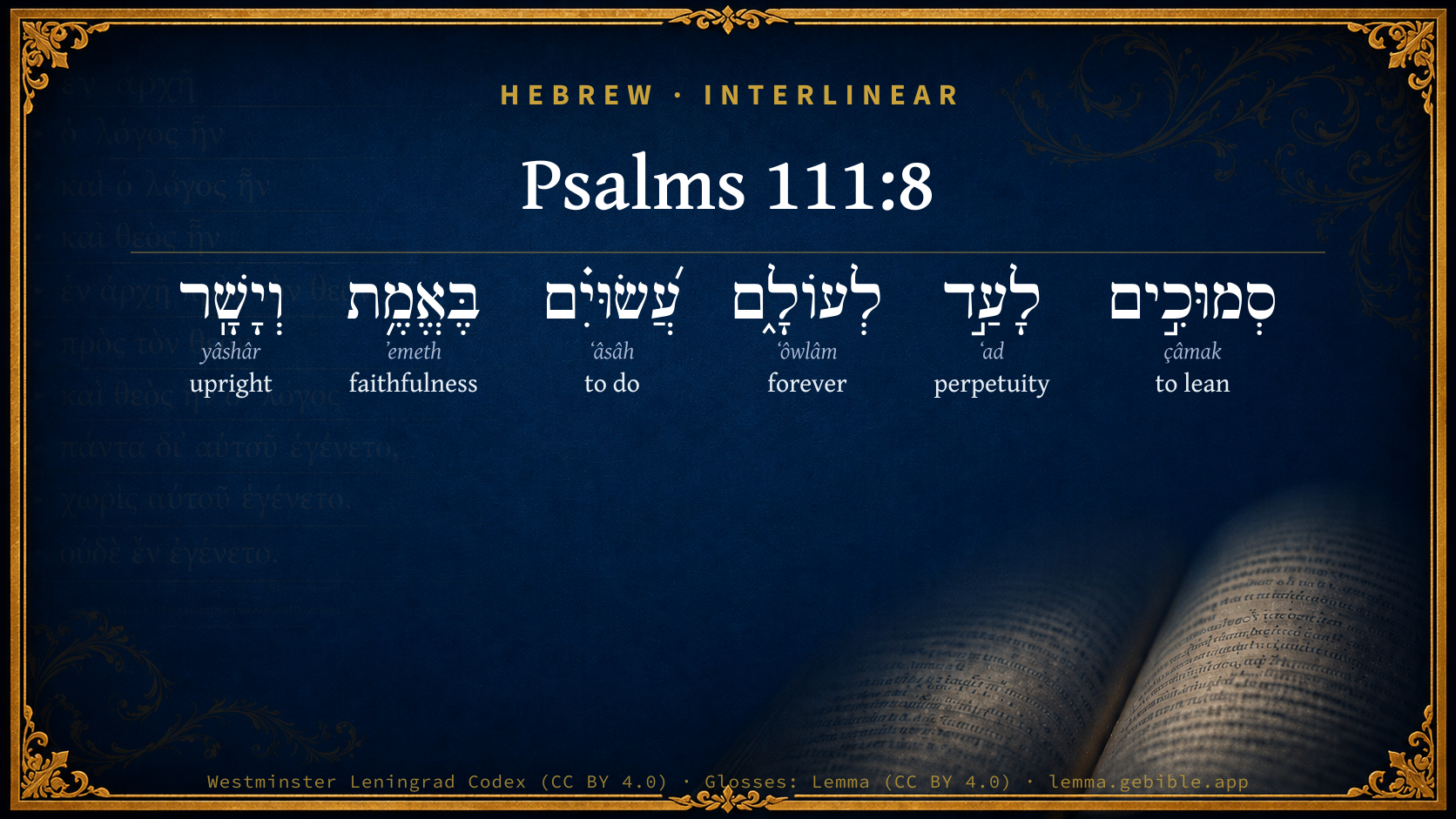
Psalms 111:8

Hebrew (Westminster Leningrad Codex) Psalms 111:8 appears in the Hebrew Old Testament. The text above is from the Westminster Leningrad Codex. Each word links to its Strong’s number, a concise gloss, and parsing drawn from the Open Scriptures Hebrew Bible morphology. Click any word for its full Brown-Driver-Briggs (BDB) entry.
Download image
Cite this verse

Psalms 111:8 (World English Bible). Public Domain. Lemma interlinear Bible study tool, https://lemma.gebible.app/v/psalms/111/8.

Show BibTeX & RIS
BibTeX
RIS
English Translation
They are established forever and ever. They are done in truth and uprightness.
World English Bible · Public Domain
Download a study sheet

One document with this verse’s original text, its word-by-word gloss line, the meaning frame, cross-references with their text, attributed commentary, and full source and license credits — printable, and it pastes into notes with its structure intact.

This verse Autodidact and up

Study sheet (.html) Plain text (.txt)

A passage Seminary Student

Up to 50 verses in one chapter. A passage sheet keeps up to 6 commentary sources and 12 cross-references per verse, in the order this page ranks them, and says so on the sheet whenever that leaves anything out. Ask for a single verse and you get the Autodidact verse sheet above.

Everything on this page stays free to read, with no account — the sheet is a download of what is already on screen, not access to it.

Want to remove ads? Support Godless Engineer
Compare translations 3

The same verse in 3 English versions, stacked beneath the original-language interlinear above. Click any original word for its lexicon entry.

Each is an independent rendering of the whole verse — the interlinear is not word-aligned to these translations.

Highlighted words mark where these versions differ — a whole-verse word diff, not a word-by-word alignment.

  • World English Bible Public Domain
    They are established forever and ever. They are done in truth and uprightness.
  • King James Version Public Domain
    They stand fast for ever and ever, and are done in truth and uprightness.
  • unfoldingWord Literal Text CC BY-SA 4.0
    They are established forever, for eternity, done in faithfulness, and upright.

unfoldingWord Literal Text — © unfoldingWord, licensed CC BY-SA 4.0. Word-aligned USFM3 via Door43 (git.door43.org/unfoldingWord/en_ult).

Versions to compare (up to 4)

3 of 4 selected

Show all 18 translations

Every available English version of this verse, each an independent rendering of the whole verse.

  • World English Bible Public Domain
    They are established forever and ever. They are done in truth and uprightness.
  • Berean Standard Bible Public Domain
    They are upheld forever and ever, enacted in truth and uprightness.
  • Majority Standard Bible Public Domain
    They are upheld forever and ever, enacted in truth and uprightness.
  • King James Version Public Domain
    They stand fast for ever and ever, and are done in truth and uprightness.
  • American Standard Version (1901) Public Domain
    They are established for ever and ever; They are done in truth and uprightness.
  • Revised Version (1885) Public Domain
    They are established for ever and ever, they are done in truth and uprightness.
  • Geneva Bible (1599) Public Domain
    They are stablished for euer and euer, and are done in trueth and equitie.
  • Douay-Rheims (1899) Public Domain
    All his commandments are faithful: confirmed for ever and ever, made in truth and equity.
  • Young's Literal Translation Public Domain
    They are sustained for ever to the age. They are made in truth and uprightness.
  • Literal Standard Version CC BY-SA 4.0
    They are sustained forever and for all time. They are made in truth and uprightness.
  • Unlocked Literal Bible CC BY-SA 4.0
    They are established forever, to be observed faithfully and properly.
  • unfoldingWord Literal Text CC BY-SA 4.0
    They are established forever, for eternity, done in faithfulness, and upright.
  • Darby Bible Public Domain
    Maintained for ever and ever, done in truth and uprightness.
  • World Messianic Bible Public Domain
    They are established forever and ever. They are done in truth and uprightness.
  • Webster's Bible Public Domain
    They stand fast for ever and ever, and are done in truth and uprightness.
  • Free Bible Version CC BY-SA 4.0
    They remain rock-solid forever. He was true and right in saying what should be done.
  • Bible in Basic English Public Domain
    They are fixed for ever and ever, they are done in faith and righteousness.
  • JPS Tanakh (1917) Public Domain
    They are established for ever and ever, they are done in truth and uprightness.

Literal Standard Version (2020), Covenant Press — licensed CC BY-SA 4.0. Text via the HelloAO Bible API (eBible.org). Unlocked Literal Bible (unfoldingWord) — licensed CC BY-SA 4.0. Text via the HelloAO Bible API (eBible.org). unfoldingWord Literal Text — © unfoldingWord, licensed CC BY-SA 4.0. Word-aligned USFM3 via Door43 (git.door43.org/unfoldingWord/en_ult). Free Bible Version, Dr. Jonathan Gallagher — licensed CC BY-SA 4.0. Text via the HelloAO Bible API (eBible.org).

Word by word

More ways to search: Search by grammar → Find every occurrence → Compare this word →

Practice this passage: Drill this verse → Learn its vocabulary →

About this verse

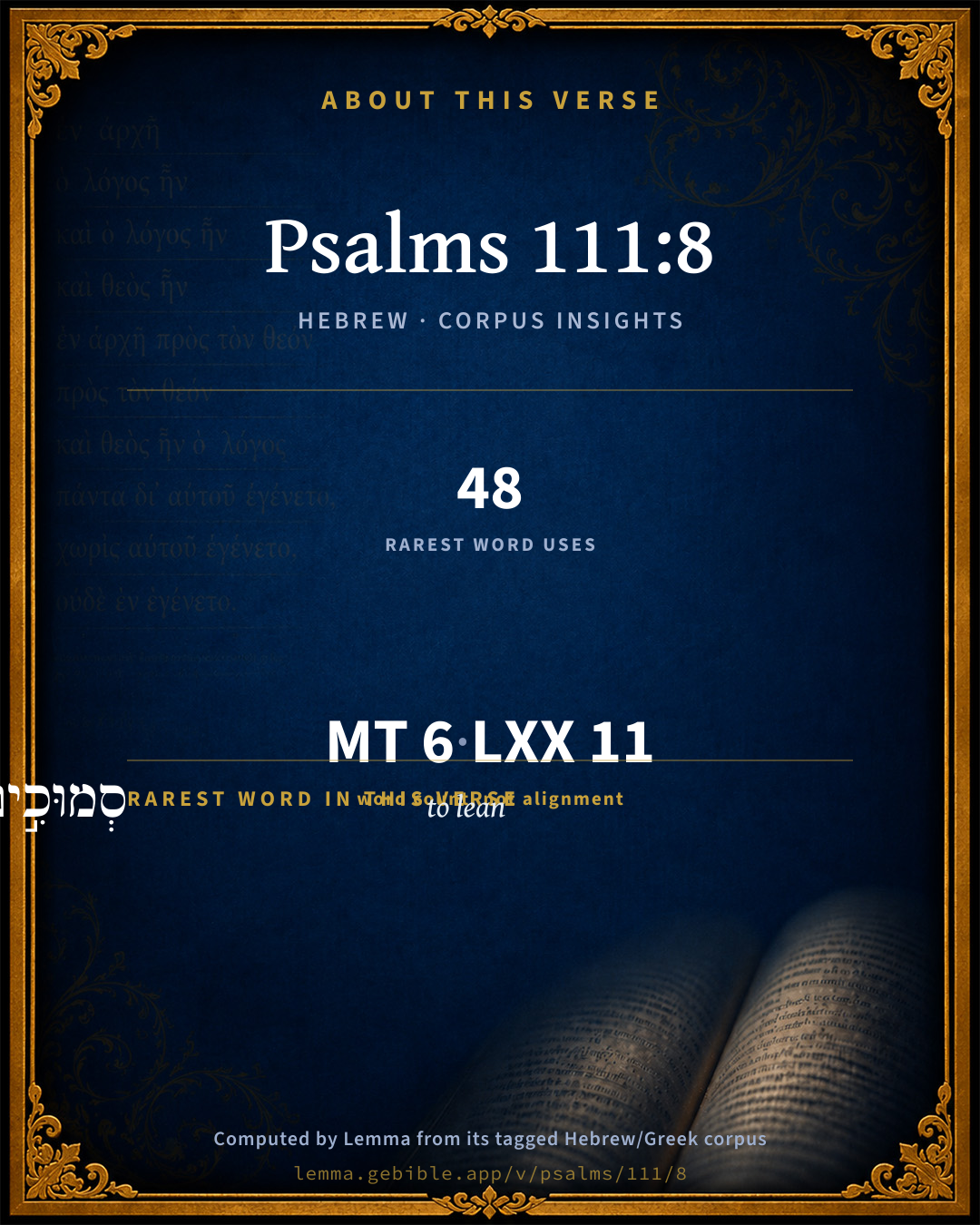
These counts appear in no published source. They are computed here, from the morphology-tagged text and Lemma’s own curated glosses. What Lemma adds →

6
words
6
distinct lemmas
Wisdom
section

Shared distinctive vocabulary

סְמוּכִ֣ים to lean H5564 occurs in 47 verses of the Hebrew Bible. Also found in:

Grammatical profile

  • 2 verbs
  • 3 nouns
  • 1 adjective

Verb forms

  • סְמוּכִ֣ים Qal · Participle Passive
  • עֲ֝שׂוּיִ֗ם Qal · Participle Passive

Hebrew & Septuagint length

In English translation the verse runs 13 words from the Hebrew and 10 from the Septuagint (LXX English) — closely comparable.

A rough comparison of the two English renderings, which tokenize alike — not a word-level alignment.

Word counts can differ between the Hebrew and the Greek without any difference in meaning — e.g. the Hebrew direct-object marker אֵת has no separate Greek word, and Greek often adds the article ὁ.

In the original languages it is 6 Hebrew tokens and 11 Greek tokens — but the two are counted differently (Hebrew bundles its prefixes and suffixes into one token; the Greek is in lemma form), so that isn’t a like-for-like length.

Cross-references

7

Topical passages linked to Psalms 111:8 in the Treasury of Scripture Knowledge — connected by theme and wording, ordered by reader-vote popularity; previews shown in the World English Bible.

  • Matthew 5:18 For most assuredly, I tell you, until heaven and earth pass away, not even one smallest letter or one tiny pen stroke shall in any way pass away from the law, until all things are accomplished.
  • Psalms 19:9 The fear of Yahweh is clean, enduring forever. Yahweh's ordinances are true, and righteous altogether.
  • Isaiah 40:8 The grass withers, the flower fades; but the word of our God shall stand forever.
  • Romans 7:12 Therefore the law indeed is holy, and the commandment holy, and righteous, and good.
  • Revelation 15:3 They sang the song of Moses, the servant of God, and the song of the Lamb, saying, "Great and marvelous are your works, Lord God, the Almighty; Righteous and true are your ways, you King of the nations.
  • Psalms 119:127–128 Therefore I love your commandments more than gold, Yes, more than pure gold.
  • Romans 3:31 Do we then nullify the law through faith? May it never be! No, we establish the law.

Cross-references courtesy of OpenBible.info (CC BY 4.0).

Hebrew and Greek witnesses Masoretic Hebrew ↔ Greek Septuagint

The same verse in the two great witnesses to the Old Testament, shown verse-for-verse.

You’re reading Greek Psalm 110 (Hebrew Psalm 111). The Septuagint counts the superscription, so verse numbers can differ from the Hebrew — chapter-level alignment, not verse-by-verse. Numbering follows Rahlfs.

These are two independent witnesses, not word-aligned to each other, and the Septuagint is shown in lemma (dictionary) form.

Hebrew Psalms 111:8 Masoretic · Westminster Leningrad Codex

סְמוּכִ֣ים לָעַ֣ד לְעוֹלָ֑ם עֲ֝שׂוּיִ֗ם בֶּאֱמֶ֥ת וְיָשָֽׁר

They are established forever and ever. They are done in truth and uprightness.

World English Bible · Public Domain

Greek LXX Greek Psalm 110:8 Septuagint · lemma form

στηρίζω εἰς ὁ αἰών ὁ αἰών ποιέω ἐν ἀλήθεια καί εὐθύτης

established for ever and ever, done in truth and uprightness.

LXX2012 (modern English Septuagint) · Public Domain

Hebrew: Westminster Leningrad Codex (CC BY 4.0). Greek: Septuagint (public domain); English from LXX2012 (modern English Septuagint) (Public Domain). How the Septuagint differs from the Hebrew →

Commentary

Notes on Psalms 111:8 from classic Christian and Jewish commentators (each source and its license shown beneath its notes). The classic Christian expositions comment on the surrounding passage and are grouped to its opening verse, so a note may address several verses; the Jewish commentaries on the Tanakh (Rashi and others) are per-verse, so they appear only where the commentator wrote on this verse.

Lemma curates 59 commentaries, every one of them public domain or Creative Commons licensed, each selected and text-cleaned for this edition rather than reprinted as found. About our sources →

Trapp's Complete Commentary

John Trapp

Psa 111:8 They stand fast for ever and ever, [and are] done in truth and uprightness.

Ver. 8. They stand fast for ever and ever] The promises are infallible, good sure hold, not yea and nay, but yea and amen.

And are done] i.e. Ordained, made, and ratified.

John Trapp, A Commentary or Exposition upon All the Books of the Old and New Testament (1647–1656) — public domain. Text from a community e-Sword module.

J. A. Alexander on Psalms

Joseph Addison Alexander

8. (Psa 111:8) Settled for ever and ever, done in truth and right. The subjects are the same as in Psa 111:7, but presented in an inverse order, the first clause relating to the precepts, the last to the works, of God. The former are settled, firmly supported, founded, or established, not capricious and precarious. The latter, by which they are recommended and attested (see above, on Psa 111:9), and works of faithfulness and rectitude. The last word in Hebrew is an adjective used as a neuter or abstract noun, in which respect the English right resembles it.

Joseph Addison Alexander, The Psalms Translated and Explained (1850) — public domain. Text from a community e-Sword module.

Adam Clarke's Commentary

Verse 8. They stand fast for ever] סמוכים semuchim, they are propped up, buttressed, for ever. They can never fail; for God's power supports his works, and his providence preserves the record of what he has done.

Adam Clarke's Commentary on the Bible (1810–1826) — public domain. Text from a community e-Sword/MySword module.

The Cambridge Bible for Schools and Colleges

gen. ed. J. J. S. Perowne

8. Stablished for ever and ever,

Made in truth and uprightness.

This verse further characterises Jehovah’s precepts, and to suit his acrostic the poet uses the word ‘ãsûyîm in the sense of ‘made,’ ‘enacted,’ not in its common sense of ‘done,’ ‘performed’ (Psa_103:18).

The Cambridge Bible for Schools and Colleges (gen. ed. J. J. S. Perowne; Cambridge University Press, 1878–1918) — public domain. Text from a community e-Sword module.

John Gill's Exposition

They stand fast for ever and ever,.... Not only the covenant and its promises do, but both law and Gospel, the commandments of the one and the doctrines of the other; the law is an eternal law, as to the matter of it, and is not made void by faith, but established; and the Gospel is an everlasting Gospel, which lives and abides for ever, being established upon the word of God, which cannot be broken; and is continued in the church, the pillar and ground of truth, from whence it can never be removed.

And are done in truth and uprightness; either made by the Lord according to the truth of things, the moral perfections of his nature and will, and the rectitude of it; or observed by men that truly fear the Lord with great truth and sincerity.

John Gill's Exposition of the Whole Bible (1746–1763) — public domain (CC PDM 1.0). Text via the HelloAO Bible API.

Albert Barnes' Notes on the Bible

They stand fast forever and ever - Margin, “established.” The Hebrew word means “sustained, supported.” They will not fail or fall. Whatever else may be shaken, his law, his word, and the principles of his administration, will not fail. See the notes at Mat 5:18. Compare Luk 16:17; Mat 24:35. The great principles of truth and righteousness will stand, and whatever is founded on those principles will endure forever.

And are done in truth and uprightness - Are based on truth, or on a just view of things; they are done in such a way that truth will be maintained and promoted. The word “uprightness” here means that all this is done on the principles of equity - of what “ought” to be done, or what is “best” to be done. Compare Psa 19:9.

Albert Barnes' Notes on the Bible (1834–1885) — public domain. Text from a community e-Sword/MySword module.

Matthew Poole's English Annotations

They stand fast, Heb. they are established upon the sure foundations of truth and uprightness, as it follows.

Are done; constituted or ordered.

Matthew Poole's English Annotations on the Holy Bible (1683–1685) — public domain. Text from a community e-Sword/MySword module.

The Treasury of David

Charles H. Spurgeon

Ver. 8. They stand fast for ever and ever. That is to say, his purposes, commands, and courses of action. The Lord is not swayed by transient motives, or moved by the circumstances of the hour; immutable principles rule in the courts of Jehovah, and he pursues his eternal purposes without the shadow of a turning. Our works are too often as wood, hay, and stubble, but his doings are as gold, silver, and precious stones. We take up a purpose for a while and then exchange it for another, but he is of one mind, and none can turn him: he acts in eternity and for eternity, and hence what he works abides for ever. Much of this lasting character arises out of the fact which is next mentioned, namely, that they

are done in truth and uprightness. Nothing stands but that which is upright. Falsehood soon vanishes, for it is a mere show, but truth has salt in it which preserves it from decay. God always acts according to the glorious principles of truth and integrity, and hence there is no need of alteration or revocation; his works will endure till the end of time.

Ver. 8. They stand fast for ever and ever. Mykwmo, semuchim, they are propped up, buttressed for ever. They can never fail; for God's power supports his works, and his providence preserves the record of what he has done. Adam Clarke.

Ver. 8. They stand fast, are established, for ever and ever, etc. This verse seems to have reference to the works of God mentioned in the former. His doings were not the demand of an occasion, they were in unison with a great and extensive purpose, with respect to the people of Israel and the Messiah. Not one jot or tittle shall pass from the law of his mouth, till all be fulfilled. W. Wilson.

Ver. 8. They are done in truth. It is impossible that any better way should be directed, than that which the Lord useth in the disposal of all things here below, for all the works of the Lord are done in truth. As the word of God is a word of truth, so all his works are works of truth; for his works are nothing else but the making good of his word, and they are answerable to a threefold word of his. First, to his word of prophecy. Whatsoever changes God makes in the world, they hit some word of prophecy. Secondly, the works of God are answerable to his word of threatening. God threatens before he smites, and he never smote any man with a rod or sword, but according to his threatening. Thirdly, the works of God are answerable to his word of promise. All mercies are promised, and every work of mercy is the fulfilling of some promise. Now seeing all the works of God are reducible, either to prophecies, threatenings, or promises; they "are done in truth"; and what can be better done than that which is done in truth? The Jewish doctors observe, that the word emeth here used for truth, consists of aleph, the first letter of the alphabet, mem, the middle letter thereof, and tau, the last; to shew, that as God is alpha and omega, so the truth of God is the all in all of our comfort. Grace and truth by Christ is the sum of all the good news in the world. Abraham Wright.

Ver. 8. Are done. Ps 111:7-8 contains a precious meaning for the soul whose rest is in the finished work of Christ. Jehovah has commanded, giving it in trust to Jesus to make sure, in perfect obedience, the word of truth and holiness. The commandment therefore has been "done." It has been done in truth and uprightness by him whose meat it was to do it; who willingly received it with a knowledge of its end, and in whose accomplishment of it the believing sinner finds his assurance of eternal peace. Joh 12:50. Jesus held the law within his heart, to keep it there for ever. As the fulfiller in truth of the commandment, he has become its end for righteousness to every believer in his name. Arthur Pridham.

Psalms 111:9*

Charles H. Spurgeon's The Treasury of David (1869–1885) — public domain. Psalms only. Text from a community e-Sword/MySword module.

Whedon's Commentary on the Bible

Daniel D. Whedon

8. They stand fast for ever and ever—Literally, They [both his works and his commandments, Psa_111:7,] are established from eternity to eternity. The idea of duration must here be taken in its widest sense.

Daniel D. Whedon (gen. ed.), Commentary on the Old and New Testaments (1874–1909) — public domain. Text from a community e-Sword module.

The Pulpit Commentary

They stand fast forever and ever. This is exegetical of the "sure" in ver. 7. In the sense in which they were given the spiritual sense underlying them not one jot or tittle of God"s commandments ever passes away. (Mat_5:18) And are done in truth and uprightness; rather, being done. It is the intrinsic truth and equity of the commandments that render them ever lasting and unchangeable (see Cudworth on "Immutable Morality").

The distinction between truth and uprightness.

"Are done in truth and equity" (Prayerbook Version). The usual contrast to equity is "justice." Justice represents the absolute right according to standard; equity represents the practical application of justice with due consideration of circumstance. Or we may say that justice is right in the sight of God, equity is right between man and man. This distinction seems to be expressed in the words of the text, "truth" and "uprightness." Truth stands for the absolutely right. Uprightness stands for the practically right. Truth God appraises, who can read heart and motive. Uprightness man appraises, who can only estimate conduct.

I THE WORKS OF GOD JUDGED BY THE ABSOLUTE STANDARD. "They are done in truth." There is no standard of truth or of righteousness separate from and independent of God. God himself is the Standard. We learn it by observing the things he has done. He has made his own standard. It is far above, out of reach, beyond our criticism. It embodies and expresses every virtue that we can imagine, and we look to find that all God"s works are up to the standard which God himself has set. But this comes to bewilder men It is vague, speculative. Men cannot grasp any absolute things; and God"s standard for himself is beyond intellectual grasp or imaginative setting. Therefore the absolute standard of truth and right is shown to us in the Person, words, and works of the Divine Son, the "Man Christ Jesus." And we can take that standard, apply it to the various works of God wrought in all the ages, and concerning everything we may say, "All his works are done in truth." It is so with the great work of redemption.

II THE WORKS OF GOD JUDGED BY THE PRACTICAL STANDARD. The practical standard is the conception of righteousness and right, as between man and man, which is entertained in each particular age and nation. It is never perfect; but it always represents the highest and best thought attainable. Now, the psalmist is confident that all God"s works, in their age, and in all ages, will even bear the testing of men"s standards. They are done in "equity" as well as in "truth. R.T.

The Pulpit Commentary (1880–1919), ed. H.D.M. Spence-Jones & Joseph S. Exell — public domain. Text from a community e-Sword module.

John Wesley's Explanatory Notes

Done - Constituted or ordered.

John Wesley, Explanatory Notes Upon the Whole Bible (1754–1765) — public domain. Text via the GEBible commentary corpus.

Rashi

Rabbi Shlomo Yitzchaki (Rashi)

Steadfast are His commandments, supported by might, strengthened with punishments and warnings, and the chapters are set one next to the other in sequence and to expound on them. This is what Solomon said (Song 5:15): “His thighs are pillars of marble, etc.”

Rashi on the Tanakh — English translations: “The Judaica Press complete Tanach with Rashi, translated by A. J. Rosenberg” (CC BY 4.0); “Pentateuch with Rashi's commentary by M. Rosenbaum and A.M. Silbermann, 1929-1934” (public domain); “The Metsudah Tanach series, Lakewood, N.J” (CC BY 4.0); and “The Book of Joshua, Metsudah Publications, 1997” (CC BY 4.0). Text via Sefaria.

Lesson kit

Teaching starters — assembled from the data on this page, not authored interpretation. Every prompt links to the verse data it draws on. Edit before teaching.

Psalms, in the Wisdom, opens this verse with 6 words (6 distinct Hebrew lemmas). Its most distinctive word is çâmak (“to lean”). A historical commentator’s framing appears above. Read the whole chapter for the surrounding context.

Discussion questions

  1. What does “to lean” (çâmak) contribute to the verse as a whole?
  2. How does Genesis 27:37, which shares the word «to lean», read alongside this verse?
  3. These translations render this verse differently. What is at stake in choosing one wording over another?
  4. «סְמוּכִ֣ים» is a Qal Participle Passive verb. How does that grammatical form shape the action described?
  5. Compare how Trapp's Complete Commentary and J. A. Alexander on Psalms read this verse. Where do they agree or differ?

Things to notice

Reading settings

Reading text

Shown beneath each verse's original-language words.

Old Testament
Old Testament edition

Read the OT as the Masoretic Hebrew (MT) or the Greek Septuagint (LXX).

English shown for the Greek Septuagint (in the Hebrew ↔ Greek comparison).

Comparing translations? Open the Compare panel on any verse page to stack up to four side by side.