
2 Chronicles 25:2

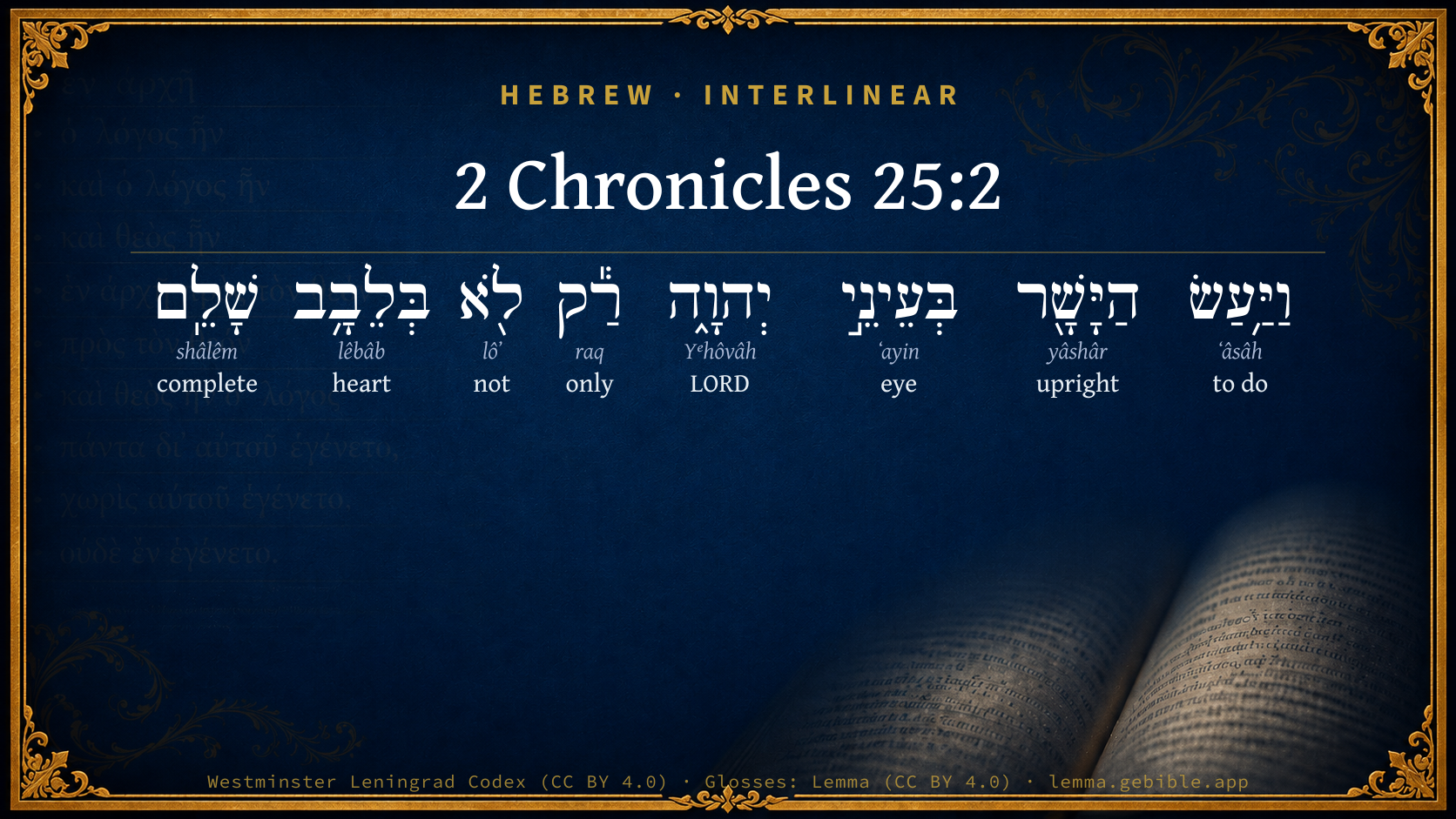
Hebrew (Westminster Leningrad Codex) 2 Chronicles 25:2 appears in the Hebrew Old Testament. The text above is from the Westminster Leningrad Codex. Each word links to its Strong’s number, a concise gloss, and parsing drawn from the Open Scriptures Hebrew Bible morphology. Click any word for its full Brown-Driver-Briggs (BDB) entry.
Download image
Cite this verse

2 Chronicles 25:2 (World English Bible). Public Domain. Lemma interlinear Bible study tool, https://lemma.gebible.app/v/2-chronicles/25/2.

Show BibTeX & RIS
BibTeX
RIS
English Translation
He did that which was right in the eyes of Yahweh, but not with a perfect heart.
World English Bible · Public Domain
Download a study sheet

One document with this verse’s original text, its word-by-word gloss line, the meaning frame, cross-references with their text, attributed commentary, and full source and license credits — printable, and it pastes into notes with its structure intact.

This verse Autodidact and up

Study sheet (.html) Plain text (.txt)

A passage Seminary Student

Up to 50 verses in one chapter. A passage sheet keeps up to 6 commentary sources and 12 cross-references per verse, in the order this page ranks them, and says so on the sheet whenever that leaves anything out. Ask for a single verse and you get the Autodidact verse sheet above.

Everything on this page stays free to read, with no account — the sheet is a download of what is already on screen, not access to it.

Want to remove ads? Support Godless Engineer
Compare translations 3

The same verse in 3 English versions, stacked beneath the original-language interlinear above. Click any original word for its lexicon entry.

Each is an independent rendering of the whole verse — the interlinear is not word-aligned to these translations.

Highlighted words mark where these versions differ — a whole-verse word diff, not a word-by-word alignment.

  • World English Bible Public Domain
    He did that which was right in the eyes of Yahweh, but not with a perfect heart.
  • King James Version Public Domain
    And he did that which was right in the sight of the LORD, but not with a perfect heart.
  • unfoldingWord Literal Text CC BY-SA 4.0
    And he did what was right in the eyes of Yahweh, only not with a complete heart.

unfoldingWord Literal Text — © unfoldingWord, licensed CC BY-SA 4.0. Word-aligned USFM3 via Door43 (git.door43.org/unfoldingWord/en_ult).

Versions to compare (up to 4)

3 of 4 selected

Show all 18 translations

Every available English version of this verse, each an independent rendering of the whole verse.

  • World English Bible Public Domain
    He did that which was right in the eyes of Yahweh, but not with a perfect heart.
  • Berean Standard Bible Public Domain
    And he did what was right in the eyes of the LORD, but not wholeheartedly.
  • Majority Standard Bible Public Domain
    And he did what was right in the eyes of the LORD, but not wholeheartedly.
  • King James Version Public Domain
    And he did that which was right in the sight of the LORD, but not with a perfect heart.
  • American Standard Version (1901) Public Domain
    And he did that which was right in the eyes of Jehovah, but not with a perfect heart.
  • Revised Version (1885) Public Domain
    And he did that which was right in the eyes of the LORD, but not with a perfect heart.
  • Geneva Bible (1599) Public Domain
    And he did vprightly in the eyes of the Lord, but not with a perfite heart.
  • Douay-Rheims (1899) Public Domain
    And he did what was good in the sight of the Lord: but yet not with a perfect heart.
  • Young's Literal Translation Public Domain
    and he doth that which is right in the eyes of Jehovah -- only, not with a perfect heart.
  • Literal Standard Version CC BY-SA 4.0
    and he does that which is right in the eyes of YHWH—only, not with a perfect heart.
  • Unlocked Literal Bible CC BY-SA 4.0
    He did what was right in the eyes of Yahweh, but not with a whole heart.
  • unfoldingWord Literal Text CC BY-SA 4.0
    And he did what was right in the eyes of Yahweh, only not with a complete heart.
  • Darby Bible Public Domain
    And he did what was right in the sight of Jehovah, yet not with a perfect heart.
  • World Messianic Bible Public Domain
    He did that which was right in the LORD’s eyes, but not with a perfect heart.
  • Webster's Bible Public Domain
    And he did that which was right in the sight of the LORD, but not with a perfect heart.
  • Free Bible Version CC BY-SA 4.0
    He did what was right in the Lord's sight but not with complete commitment.
  • Bible in Basic English Public Domain
    He did what was right in the eyes of the Lord, but his heart was not completely true to the Lord.
  • JPS Tanakh (1917) Public Domain
    And he did that which was right in the eyes of the LORD, but not with a whole heart.

Literal Standard Version (2020), Covenant Press — licensed CC BY-SA 4.0. Text via the HelloAO Bible API (eBible.org). Unlocked Literal Bible (unfoldingWord) — licensed CC BY-SA 4.0. Text via the HelloAO Bible API (eBible.org). unfoldingWord Literal Text — © unfoldingWord, licensed CC BY-SA 4.0. Word-aligned USFM3 via Door43 (git.door43.org/unfoldingWord/en_ult). Free Bible Version, Dr. Jonathan Gallagher — licensed CC BY-SA 4.0. Text via the HelloAO Bible API (eBible.org).

Word by word

More ways to search: Search by grammar → Find every occurrence → Compare this word →

Practice this passage: Drill this verse → Learn its vocabulary →

About this verse

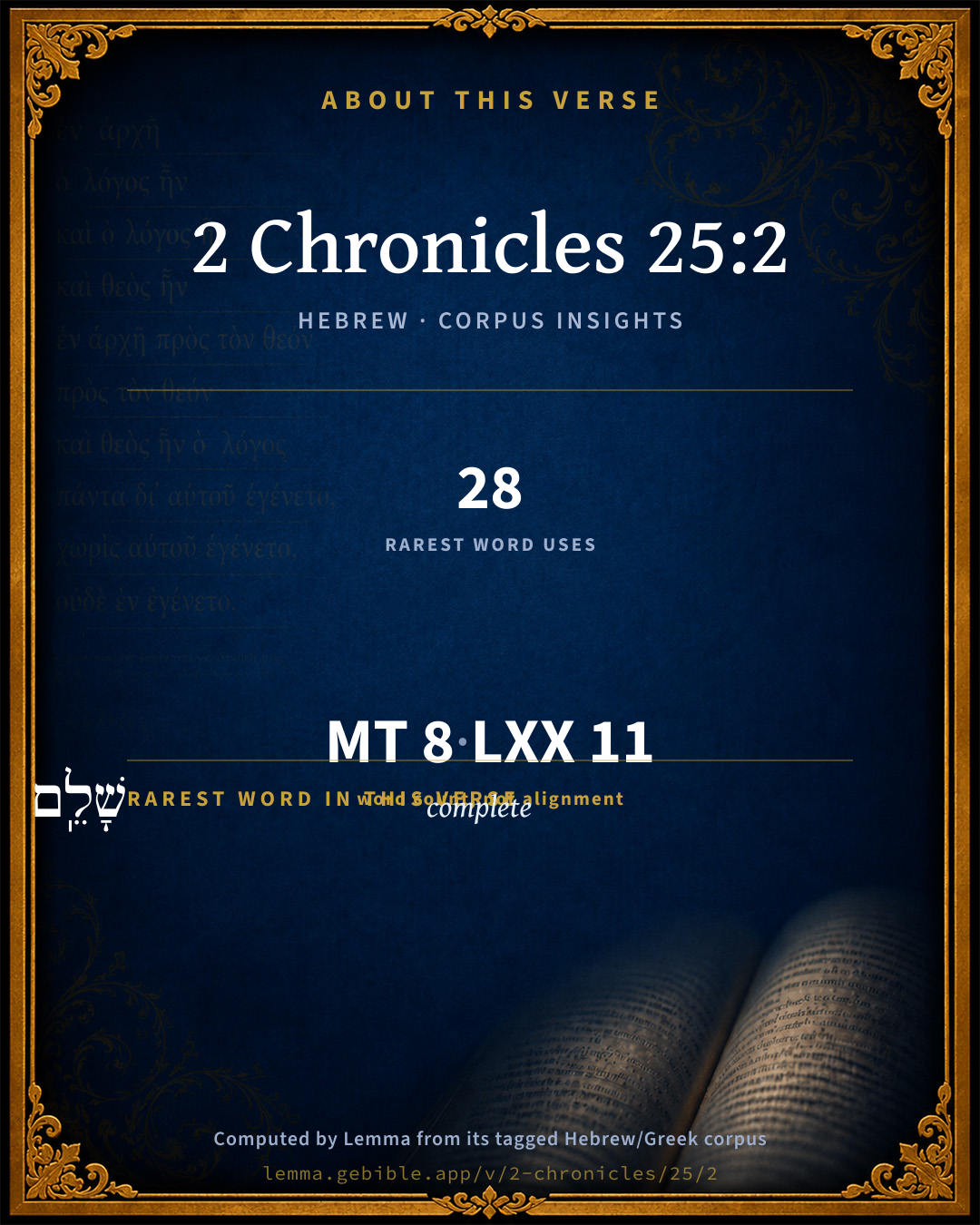
These counts appear in no published source. They are computed here, from the morphology-tagged text and Lemma’s own curated glosses. What Lemma adds →

8
words
8
distinct lemmas
Historical
section

Shared distinctive vocabulary

שָׁלֵֽם complete H8003 occurs in 27 verses of the Hebrew Bible. Also found in:

Grammatical profile

  • 1 verb
  • 3 nouns
  • 2 adjectives
  • 2 particles

Verb forms

  • וַיַּ֥עַשׂ Qal · Sequential Imperfect

Hebrew & Septuagint length

In English translation the verse runs 17 words from the Hebrew and 19 from the Septuagint (LXX English) — closely comparable.

A rough comparison of the two English renderings, which tokenize alike — not a word-level alignment.

Word counts can differ between the Hebrew and the Greek without any difference in meaning — e.g. the Hebrew direct-object marker אֵת has no separate Greek word, and Greek often adds the article ὁ.

In the original languages it is 8 Hebrew tokens and 11 Greek tokens — but the two are counted differently (Hebrew bundles its prefixes and suffixes into one token; the Greek is in lemma form), so that isn’t a like-for-like length.

Cross-references

11

Topical passages linked to 2 Chronicles 25:2 in the Treasury of Scripture Knowledge — connected by theme and wording, ordered by reader-vote popularity; previews shown in the World English Bible.

  • 2 Chronicles 25:14 Now it happened, after that Amaziah was come from the slaughter of the Edomites, that he brought the gods of the children of Seir, and set them up to be his gods, and bowed down himself before them, and burned incense to them.
  • James 4:8 Draw near to God, and he will draw near to you. Cleanse your hands, you sinners; and purify your hearts, you double-minded.
  • 2 Chronicles 24:2 Joash did that which was right in the eyes of Yahweh all the days of Jehoiada the priest.
  • Isaiah 29:13 The Lord said, Because this people draw near [to me], and with their mouth and with their lips to honor me, but have removed their heart far from me, and their fear of me is a commandment of men which has been taught [them];
  • Acts 8:21 You have neither part nor lot in this matter, for your heart isn't right before God.
  • 1 Samuel 16:7 But Yahweh said to Samuel, "Don't look on his face, or on the height of his stature; because I have rejected him: for [Yahweh sees] not as man sees; for man looks at the outward appearance, but Yahweh looks at the heart."
  • 2 Chronicles 26:4 He did that which was right in the eyes of Yahweh, according to all that his father Amaziah had done.
  • 2 Kings 14:4 However the high places were not taken away: the people still sacrificed and burnt incense in the high places.
  • Psalms 78:37 For their heart was not right with him, Neither were they faithful in his covenant.
  • Hosea 10:2 Their heart is divided. Now they will be found guilty. He will demolish their altars. He will destroy their sacred stones.
  • James 1:8 He is a double-minded man, unstable in all his ways.

Cross-references courtesy of OpenBible.info (CC BY 4.0).

Hebrew and Greek witnesses Masoretic Hebrew ↔ Greek Septuagint

The same verse in the two great witnesses to the Old Testament, shown verse-for-verse.

These are two independent witnesses, not word-aligned to each other, and the Septuagint is shown in lemma (dictionary) form.

Hebrew 2 Chronicles 25:2 Masoretic · Westminster Leningrad Codex

וַיַּ֥עַשׂ הַיָּשָׁ֖ר בְּעֵינֵ֣י יְהוָ֑ה רַ֕ק לֹ֖א בְּלֵבָ֥ב שָׁלֵֽם

He did that which was right in the eyes of Yahweh, but not with a perfect heart.

World English Bible · Public Domain

Greek LXX 2 Chronicles 25:2 Septuagint · lemma form

καί ποιέω ὁ εὐθής ἐνώπιον κύριος ἀλλά οὐ ἐν καρδία πλήρης

And he did that which was right in the sight of the Lord, but not with a perfect heart.

LXX2012 (modern English Septuagint) · Public Domain

Hebrew: Westminster Leningrad Codex (CC BY 4.0). Greek: Septuagint (public domain); English from LXX2012 (modern English Septuagint) (Public Domain). How the Septuagint differs from the Hebrew →

Commentary

Notes on 2 Chronicles 25:2 from classic Christian and Jewish commentators (each source and its license shown beneath its notes). The classic Christian expositions comment on the surrounding passage and are grouped to its opening verse, so a note may address several verses; the Jewish commentaries on the Tanakh (Rashi and others) are per-verse, so they appear only where the commentator wrote on this verse.

Lemma curates 59 commentaries, every one of them public domain or Creative Commons licensed, each selected and text-cleaned for this edition rather than reprinted as found. About our sources →

Trapp's Complete Commentary

John Trapp

2Ch 25:2 And he did [that which was] right in the sight of the LORD, but not with a perfect heart.

Ver. 2. And he did that which was right.] A hypocrite may do such works as are materially good, which yet may never prove so formally and eventually.

John Trapp, A Commentary or Exposition upon All the Books of the Old and New Testament (1647–1656) — public domain. Text from a community e-Sword module.

The Biblical Illustrator

Joseph S. Exell

2Ch_25:2

And he did that which was right in the sight of the Lord, but not with a perfect heart.

Half-hearted, and therefore a failure

It was not because Amaziah was not sinless that his life proved such a failure, but because he was not thorough going in his principle and piety. English life at present seems to be afflicted with a plague of levity. There is so much hollowness and unreality, so much veneer in character and work, that it behoves us to preach aloud the gospel of thoroughness. A short time ago some workmen were engaged in trying to remove a piece of old London wall. They tried with hammers, then with pick-axes, but to no purpose, the wall seemed to smile at all their efforts; at last they were obliged to have recourse to boring, and blowing it up like a piece of solid rock. That is hardly the way they build nowadays, for a man might almost push over some of our brick walls with his hand. Now, this is just an illustration of what I mean, the want of thoroughness in every branch of industry and in every walk of life. When a mans own character is not solid, permeated through and through with Christian principle, you cannot have any guarantee of the genuineness of his work. Shams abound everywhere. Gilt and paint carry the day. Ours is an age of tinsel. And the worst of it is that this unrealness characterises much of the religion amongst us. I sometimes meet with a horrible form of Antinomianism, which virtually says, Anything will do for me--I am a disciple of Christ; and so the work is actually more slovenly and imperfect because the individual claims to be not under the law, but under grace. Why, it is almost as monstrous as the proposal a good young man made to his landlady, that his own excellent Christian example should serve in lieu of weekly payment for his lodgings! A men--I dont care who he is--dishonours Christ when any other person is put to disadvantage by his piety. If you imagine you are more free to do slipshod work because you are a Christian, I say, it is precisely the reverse. It is just because you claim to be the Lords that any sort of work will not do. Bearing His name, you are responsible to Him for every detail of your daily life. If your secular duties are more imperfectly discharged because you are a believer, you do great wrong to the Redeemer. If you snatch a little of your employers time to scatter tracts, or prepare for a Sabbath class, or even to read your Bible; or if, in business hours, your thoughts are so given to spiritual themes that you cannot do justice to your work, in any of these cases you do real harm to religion. (J. T. Davidson, D.D.)

The character of Amaziah

This history is adduced to lead to self-scrutiny.

I. The act of assembling is in accordance with Gods revealed wishes; and therefore the act of assembling is a right act. But am I able to believe that every men and woman joins the assembly from such motives as would stand the test of Heaven? Not with a perfect heart.

II. Again, in the matter of listening to Gods Word preached. Some listen from the desire of passing away a dull hour--as a sort of religious entertainment. Alas for the perfect heart!

III. As to your conduct outside the walls of the sanctuary. You are upright and honourable in trade. But why? It is a sad thing when a mans actions are right because he wishes to be aggrandised, or because he wishes a high place in human estimation, and knows not the only right motive--a desire to please Him who hath loved us, and given Himself for us. (T. W. Thompson, B.A.)

Not with a perfect heart

Off Cape Horn we witnessed a singular sight. For some miles there was a narrow strip of water, where the great waves flew in broken spray and dashed high over the ship. On either side the sea was comparatively calm, whilst this boiled with fury, rolling and surging. Yet there was no rock about which the sea surged, nor was there any such fierce wind as to account for it. Overhead the air was thick with sea-fowl. Thousands of the birds dived into this troubled water. The smaller fish were, I suppose, flung up by the toss, and thus fell a prey to the birds. I asked, naturally, what was the reason of this strange sight, and found it was the point at which the tide met the strong current of the sea, and here they raged together. Within, the tide only ran, and it was calm. Without, the current prevailed, and there, too, was calm. On this troubled bit they met, and neither prevailed. It is the picture of those who are at once too religious to belong to the world--too worldly to belong to religion; torn by both and satisfied by neither. (Mark Guy Pearse.)

Whole-hearted religion required

At one of the conferences between the Northern and Southern States of America during the war of 1861-1866 the representatives of the Southern States stated what cession of territory they were prepared to make, provided that the independence of the portion that was not ceded to the Federal Government was secured. More and more attractive criers were made, the portions to be ceded being increased, and those to be retained in a state of independence being proportionately diminished. All the offers were met by a steadfast refusal. At last President Lincoln placed his hand on the map so as to cover all the Southern States, and in these emphatic words delivered his ultimatum: Gentlemen, this Government must have the whole. God cannot share us with the world. (A. Plummet, D.D.)

The Biblical Illustrator, edited by Joseph S. Exell (c. 1880s–1900s) — public domain. Text from a community e-Sword module.

Joseph Benson's Commentary

2Ch 25:2. But not with a perfect heart — He was not an enemy to religion, but a cool and indifferent friend. He was not a man of serious piety, for his heart was not whole with God. But of this, and the two following verses, see notes on 2Ki 14:1-7.

Joseph Benson's Commentary on the Old and New Testaments (1811–1818) — public domain. Text from a community e-Sword module.

Tyndale Open Study Notes

Tyndale Open Resources

25:2 but not wholeheartedly: See 2 Kgs 14:3-4 for further details.

Tyndale Open Study Notes — © Tyndale Open Resources, licensed CC BY-SA 4.0. Text via the HelloAO Bible API.

Geneva Bible (1599)

Geneva Bible translators

Meaning, in respect of his predecessors albeit he had his imperfections.

Geneva Bible (1599) marginal notes — public domain. Text via Bolls.life.

Adam Clarke's Commentary

Verse 2. He did that which was right] He began his reign well, but soon became an idolater, 2Ch 25:14-15.

Adam Clarke's Commentary on the Bible (1810–1826) — public domain. Text from a community e-Sword/MySword module.

Haydock's Catholic Bible Commentary

Heart, and with perseverance.

George Leo Haydock (1774–1849), Haydock's Catholic Family Bible and Commentary, 1859 edition — public domain. Excludes Psalms (Douay-Rheims chapter numbering differs from Protestant) and Deuterocanonical books (Catholic canon only).

The Pulpit Commentary

Not with a perfect heart. This is illustrated by his coming "to set up the gods of Edom" (vers. 14-16, 20); also by what the parallel supplies, that he resembled Joash rather than David, and did not suppress "the high places, sacrifices, and in-cense-burning". (2Ki_14:3, 2Ki_14:4) In almost all cases, the not perfect heart speaks of that which began well, but did not "endure unto the end.

HOMILIES BY W. CLARKSON

Ver. 2.

Doing right, but

It is well, indeed, when iniquity is qualified with some redeeming features, as we are thankful to think it often is. A man is ungodly, or cruel, or self-indulgent, or mercenary, but he has something in him which makes him much less condemnable than he would otherwise be. Unfortunately, goodness also is often qualified; of the man concerning whom we have much to say in praise there is something serious to say by way of detraction. Of every good man there may be something to record which is not favourable; but the qualification may be so slight that it is the mere "dust in the balance." Too often it has to be "written in heaven," and perhaps upon earth also, that he "did what was right, but not with a perfect heart." There are some

I DISCERNIBLE DEFICIENCIES IN CHRISTIAN CHARACTER. One Christian man is blameless in behaviour so far as the main features of morality are concerned, but he is so reserved and reticent, so unapproachable, that he exerts but very little influence. Another is very ardent and enthusiastic in the cause of Christ, very open-hearted and openhanded, but he is very irritable and ill-tempered, so that he is avoided or even disliked. A third is very tender and sympathetic in spirit, with a ready ear and an unselfish consideration for every tale of difficulty or distress, but he is very weak, pliant, credulous; no one can attach any weight to his judgment. A fourth is possessed of many of the virtues and graces of Christian character, but he is very weak in some one direction, much too open to temptation of one particular kind, and his friends are always apprehensive lest he should succumb, and fall quite seriously. These are defects

(1) to be pointed out by friends, and to be recognized frankly by those who are the subjects of them;

(2) to be carefully, conscientiously, devoutly corrected and removed, lest the "gospel of Christ be hindered," lest the Master himself be displeased and dishonoured. But there are

II MORE SERIOUS INCONSISTENCIES.

1. In Christian life. It may be that one who has considered himself, and who has been considered, a true disciple of Jesus Christ, falls back, falls down

(1) into condemnable self-indulgence; or

(2) into an arrogance of spirit and haughtiness of bearing which are as hateful to men as (we know) they are offensive to God; or

(3) into a lightness and irreverence of tone which cannot fail to be as displeasing to Christ as it is painful to the devout and earnest-minded among men; or

(4) into a serious selfishness of soul which has no eye for anything but its own personal and passing interests.

2. In Christian work. It may be that one who has shown much earnestness in the field of sacred usefulness, either

(1) loses all interest in that for which he once thought much and laboured hard, or

(2) becomes so opinionated and so peremptory that no one can co-operate with him, and he has to be left alone. He is practically disabled by his self-assertiveness. Now, there is too often found to be

III ONE SUPREME MISTAKE. It is that which was probably committed by Amaziah, viz. that of never yielding ourselves thoroughly to the service of God. It is likely that the King of Judah only gave half an heart to the worship of Jehovah; that his piety was superficial, formal, constrained, essentially and radically imperfect; that he was like the young man of the Gospel narrative, who had "kept the commandments from his youth up," but who was never so thoroughly in earnest as to be ready to give up everything to attain eternal life. (Mar_10:17-22) If we do not yield ourselves wholly to our Divine Saviour, we shall find, as we pursue our way, that at some important crisis our obedience will be at fault; or our devotion will fail; or our character will be blemished, and our reputation will break down; or we shall leave the field and lose our reward. (2Jn_1:8) Therefore:

1. Let us realize how great, how supreme, how prevailing, are the claims ofour Divine Redeemer.

2. Let us offer our hearts and lives to him in full and glad self-surrender.Then shall it not be written of us, that "we did right, but not with a perfect heart. C.

The Pulpit Commentary (1880–1919), ed. H.D.M. Spence-Jones & Joseph S. Exell — public domain. Text from a community e-Sword module.

John Wesley's Explanatory Notes

But not, &c. - He was not an enemy to religion, but a cool and indifferent friend. He was not a man of serious piety; for his heart was not whole with God.

John Wesley, Explanatory Notes Upon the Whole Bible (1754–1765) — public domain. Text via the GEBible commentary corpus.

Lesson kit

Teaching starters — assembled from the data on this page, not authored interpretation. Every prompt links to the verse data it draws on. Edit before teaching.

2 Chronicles, in the Historical, opens this verse with 8 words (8 distinct Hebrew lemmas). Its most distinctive word is shâlêm (“complete”). A historical commentator’s framing appears above. Read the whole chapter for the surrounding context.

Discussion questions

  1. The word shâlêm carries the sense “complete.” How does it shape the verse?
  2. How does Genesis 15:16, which shares the word «complete», read alongside this verse?
  3. These translations render this verse differently. What is at stake in choosing one wording over another?
  4. «וַיַּ֥עַשׂ» is a Qal Sequential Imperfect verb. How does that grammatical form shape the action described?
  5. Compare how Trapp's Complete Commentary and The Biblical Illustrator read this verse. Where do they agree or differ?

Things to notice

Reading settings

Reading text

Shown beneath each verse's original-language words.

Old Testament
Old Testament edition

Read the OT as the Masoretic Hebrew (MT) or the Greek Septuagint (LXX).

English shown for the Greek Septuagint (in the Hebrew ↔ Greek comparison).

Comparing translations? Open the Compare panel on any verse page to stack up to four side by side.