

Psalms 125:4

Hebrew (Westminster Leningrad Codex) Psalms 125:4 appears in the Hebrew Old Testament. The text above is from the Westminster Leningrad Codex. Each word links to its Strong’s number, a concise gloss, and parsing drawn from the Open Scriptures Hebrew Bible morphology. Click any word for its full Brown-Driver-Briggs (BDB) entry.
Download image
Cite this verse

Psalms 125:4 (World English Bible). Public Domain. Lemma interlinear Bible study tool, https://lemma.gebible.app/v/psalms/125/4.

Show BibTeX & RIS
BibTeX
RIS
English Translation
Do good, Yahweh, to those who are good, To those who are upright in their hearts.
World English Bible · Public Domain
Download a study sheet

One document with this verse’s original text, its word-by-word gloss line, the meaning frame, cross-references with their text, attributed commentary, and full source and license credits — printable, and it pastes into notes with its structure intact.

This verse Autodidact and up

Study sheet (.html) Plain text (.txt)

A passage Seminary Student

Up to 50 verses in one chapter. A passage sheet keeps up to 6 commentary sources and 12 cross-references per verse, in the order this page ranks them, and says so on the sheet whenever that leaves anything out. Ask for a single verse and you get the Autodidact verse sheet above.

Everything on this page stays free to read, with no account — the sheet is a download of what is already on screen, not access to it.

Want to remove ads? Support Godless Engineer
Compare translations 3

The same verse in 3 English versions, stacked beneath the original-language interlinear above. Click any original word for its lexicon entry.

Each is an independent rendering of the whole verse — the interlinear is not word-aligned to these translations.

Highlighted words mark where these versions differ — a whole-verse word diff, not a word-by-word alignment.

  • World English Bible Public Domain
    Do good, Yahweh, to those who are good, To those who are upright in their hearts.
  • King James Version Public Domain
    Do good, O LORD, unto those that be good, and to them that are upright in their hearts.
  • unfoldingWord Literal Text CC BY-SA 4.0
    Do good, Yahweh, to the good, and to the upright in their hearts.

unfoldingWord Literal Text — © unfoldingWord, licensed CC BY-SA 4.0. Word-aligned USFM3 via Door43 (git.door43.org/unfoldingWord/en_ult).

Versions to compare (up to 4)

3 of 4 selected

Show all 18 translations

Every available English version of this verse, each an independent rendering of the whole verse.

  • World English Bible Public Domain
    Do good, Yahweh, to those who are good, To those who are upright in their hearts.
  • Berean Standard Bible Public Domain
    Do good, O LORD, to those who are good, and to the upright in heart.
  • Majority Standard Bible Public Domain
    Do good, O LORD, to those who are good, and to the upright in heart.
  • King James Version Public Domain
    Do good, O LORD, unto those that be good, and to them that are upright in their hearts.
  • American Standard Version (1901) Public Domain
    Do good, O Jehovah, unto those that are good, And to them that are upright in their hearts.
  • Revised Version (1885) Public Domain
    Do good, O LORD, unto those that be good, and to them that are upright in their hearts.
  • Geneva Bible (1599) Public Domain
    Doe well, O Lord, vnto those that be good and true in their hearts.
  • Douay-Rheims (1899) Public Domain
    perhaps the waters had swallowed us up.
  • Young's Literal Translation Public Domain
    Do good, O Jehovah, to the good, And to the upright in their hearts.
  • Literal Standard Version CC BY-SA 4.0
    Do good, O YHWH, to the good, || And to the upright in their hearts.
  • Unlocked Literal Bible CC BY-SA 4.0
    Do good, Yahweh, to those who are good and to those who are upright in their hearts.
  • unfoldingWord Literal Text CC BY-SA 4.0
    Do good, Yahweh, to the good, and to the upright in their hearts.
  • Darby Bible Public Domain
    Do good, O Jehovah, unto the good, and to them that are upright in their hearts.
  • World Messianic Bible Public Domain
    Do good, LORD, to those who are good, to those who are upright in their hearts.
  • Webster's Bible Public Domain
    Do good, O LORD, to those that are good, and to them that are upright in their hearts.
  • Free Bible Version CC BY-SA 4.0
    Lord, please do good to those who do good, those who sincerely do what is right.
  • Bible in Basic English Public Domain
    Do good, O Lord, to those who are good, and to those who are upright in heart.
  • JPS Tanakh (1917) Public Domain
    Do good, O LORD, unto the good, and to them that are upright in their hearts.

Literal Standard Version (2020), Covenant Press — licensed CC BY-SA 4.0. Text via the HelloAO Bible API (eBible.org). Unlocked Literal Bible (unfoldingWord) — licensed CC BY-SA 4.0. Text via the HelloAO Bible API (eBible.org). unfoldingWord Literal Text — © unfoldingWord, licensed CC BY-SA 4.0. Word-aligned USFM3 via Door43 (git.door43.org/unfoldingWord/en_ult). Free Bible Version, Dr. Jonathan Gallagher — licensed CC BY-SA 4.0. Text via the HelloAO Bible API (eBible.org).

Word by word

More ways to search: Search by grammar → Find every occurrence → Compare this word →

Practice this passage: Drill this verse → Learn its vocabulary →

About this verse

These counts appear in no published source. They are computed here, from the morphology-tagged text and Lemma’s own curated glosses. What Lemma adds →

5
words
5
distinct lemmas
Wisdom
section

Notable vocabulary

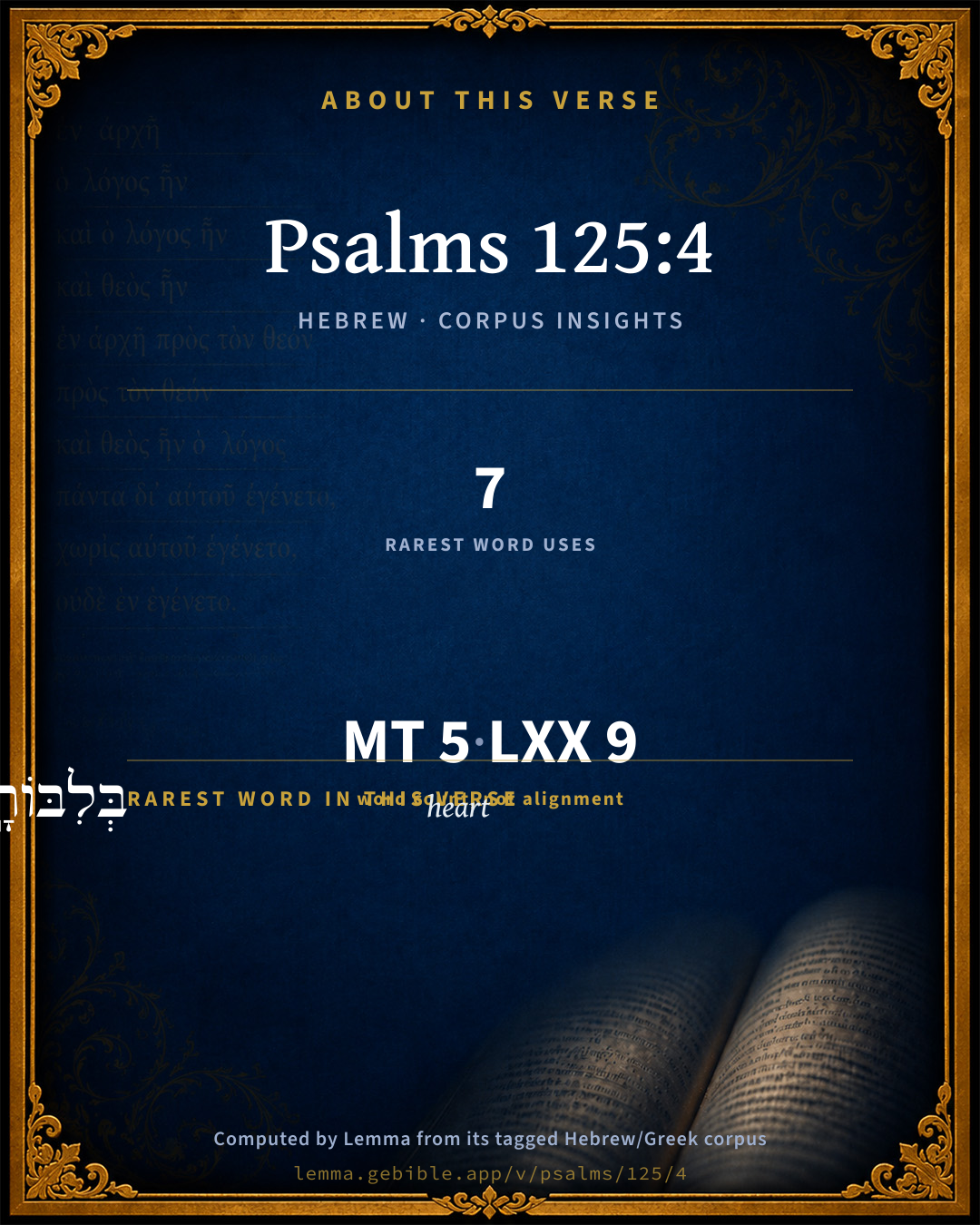
The rarest word here is בְּלִבּוֹתָֽם heart H3826 — appearing just 7 times in the whole Hebrew Bible.

Shared distinctive vocabulary

בְּלִבּוֹתָֽם heart H3826 occurs in 7 verses of the Hebrew Bible. Also found in:

Grammatical profile

  • 1 verb
  • 2 nouns
  • 2 adjectives

Verb forms

  • הֵיטִ֣יבָה Hiphil · Imperative

Hebrew & Septuagint length

In English translation the verse runs 16 words from the Hebrew and 17 from the Septuagint (LXX English) — closely comparable.

A rough comparison of the two English renderings, which tokenize alike — not a word-level alignment.

Word counts can differ between the Hebrew and the Greek without any difference in meaning — e.g. the Hebrew direct-object marker אֵת has no separate Greek word, and Greek often adds the article ὁ.

In the original languages it is 5 Hebrew tokens and 9 Greek tokens — but the two are counted differently (Hebrew bundles its prefixes and suffixes into one token; the Greek is in lemma form), so that isn’t a like-for-like length.

Cross-references

16

Topical passages linked to Psalms 125:4 in the Treasury of Scripture Knowledge — connected by theme and wording, ordered by reader-vote popularity; previews shown in the World English Bible.

  • Psalms 7:10 My shield is with God, Who saves the upright in heart.
  • Psalms 84:11 For Yahweh God is a sun and a shield. Yahweh will give grace and glory. He withholds no good thing from those who walk blamelessly.
  • Psalms 94:15 For judgment will return to righteousness. All the upright in heart shall follow it.
  • Psalms 119:68 You are good, and do good. Teach me your statutes.
  • Psalms 36:10 Oh continue your loving kindness to those who know you, Your righteousness to the upright in heart.
  • Psalms 51:18 Do well in your good pleasure to Zion. Build the walls of Jerusalem.
  • Psalms 119:80 Let my heart be blameless toward your decrees, That I may not be disappointed.
  • Psalms 32:2 Blessed is the man to whom Yahweh doesn't impute iniquity, In whose spirit there is no deceit.
  • Psalms 73:1 Surely God is good to Israel, To those who are pure in heart.
  • Isaiah 58:10–11 and if you draw out your soul to the hungry, and satisfy the afflicted soul: then shall your light rise in darkness, and your obscurity be as the noonday;
  • Lamentations 3:25 Yahweh is good to those who wait for him, to the soul that seeks him.
  • John 1:47 Jesus saw Nathanael coming to him, and said about him, "Behold, an Israelite indeed, in whom is no deceit!"
  • Hebrews 6:10 For God is not unrighteous, so as to forget your work and the labor of love which you showed toward his name, in that you served the saints, and still do serve them.
  • 1 John 3:17–24 But whoever has the world's goods, and sees his brother in need, and closes his heart of compassion against him, how does the love of God remain in him?
  • Revelation 14:5 In their mouth was found no lie, for they are blameless.
  • Psalms 41:1–3 Blessed is he who considers the poor: Yahweh will deliver him in the day of evil.

Cross-references courtesy of OpenBible.info (CC BY 4.0).

Hebrew and Greek witnesses Masoretic Hebrew ↔ Greek Septuagint

The same verse in the two great witnesses to the Old Testament, shown verse-for-verse.

You’re reading Greek Psalm 124 (Hebrew Psalm 125). The Septuagint counts the superscription, so verse numbers can differ from the Hebrew — chapter-level alignment, not verse-by-verse. Numbering follows Rahlfs.

These are two independent witnesses, not word-aligned to each other, and the Septuagint is shown in lemma (dictionary) form.

Hebrew Psalms 125:4 Masoretic · Westminster Leningrad Codex

הֵיטִ֣יבָה יְ֭הוָה לַטּוֹבִ֑ים וְ֝לִֽישָׁרִ֗ים בְּלִבּוֹתָֽם

Do good, Yahweh, to those who are good, To those who are upright in their hearts.

World English Bible · Public Domain

Greek LXX Greek Psalm 124:4 Septuagint · lemma form

ἀγαθύνω κύριος ὁ ἀγαθός καί ὁ εὐθύς ὁ καρδία

Do good, O Lord, to them that are good, and to them that are upright in heart.

LXX2012 (modern English Septuagint) · Public Domain

On this verse, Keil & Delitzsch discusses the Septuagint’s reading. Read the note in Commentary ↓

Hebrew: Westminster Leningrad Codex (CC BY 4.0). Greek: Septuagint (public domain); English from LXX2012 (modern English Septuagint) (Public Domain). How the Septuagint differs from the Hebrew →

Commentary

Notes on Psalms 125:4 from classic Christian and Jewish commentators (each source and its license shown beneath its notes). The classic Christian expositions comment on the surrounding passage and are grouped to its opening verse, so a note may address several verses; the Jewish commentaries on the Tanakh (Rashi and others) are per-verse, so they appear only where the commentator wrote on this verse.

Lemma curates 59 commentaries, every one of them public domain or Creative Commons licensed, each selected and text-cleaned for this edition rather than reprinted as found. About our sources →

Matthew Henry's Commentary

Here is, 1. The prayer the psalmist puts up for the happiness of those that are sincere and constant (Psa 125:4): Do good, O Lord! unto those that are good. This teaches us to pray for all good people, to make supplication for all saints; and we may pray in faith for them, being assured that those who do well shall certainly be well dealt with. Those that are as they should be shall be as they would be, provided they be upright in heart, that they be really as good as they seem to be. With the upright God will show himself upright. He does not say, Do good, O Lord! to those that are perfect, that are sinless and spotless, but to those that are sincere and honest. God's promises should quicken our prayers. It is comfortable wishing well to those for whom God has engaged to do well. 2. The prospect he has of the ruin of hypocrites and deserters; he does not pray for it (I have not desired the woeful day, thou knowest), but he predicts it: As for those, who having known the way of righteousness, for fear of the rod of the wicked, basely turn aside out of it to their wicked ways, use indirect ways to prevent trouble or extricate themselves out of it, or those who, instead of reforming, grow worse and worse and are more obstinate and daring in their impieties, God shall send them away, cast them out, and lead them forth with the workers of iniquity, that is, he will appoint them their portion with the worst of sinners. Note, (1.) Sinful ways are crooked ways; sin is the perverting of that which is right. (2.) The doom of those who turn aside to those crooked ways out of the right way will be the same with theirs who have all along walked in them, nay, and more grievous, for if any place in hell be hotter than another that shall be the portion of hypocrites and apostates. God shall lead them forth, as prisoners are led forth to execution. Go, you cursed, into everlasting fire; and these shall go away; all their former righteousness shall not be mentioned unto them. The last words, Place upon Israel, may be taken as a prayer: "God preserve his Israel in peace, when his judgments are abroad reckoning with evil-doers." We read them as a promise: Peace shall be upon Israel; that is, [1.] When those who have treacherously deserted the ways of God meet with their own destruction those who faithfully adhere to them, though they may have trouble in their way, shall have peace in the end. [2.] The destruction of those who walk in crooked ways will contribute to the peace and safety of the church. When Herod was cut off the word of God grew, Act 12:23, Act 12:24. [3.] The peace and happiness of God's Israel will be the vexation, and will add much to the torment, of those who perish in their wickedness, Luk 13:28; Isa 65:13. My servants shall rejoice, but you shall be ashamed.

Matthew Henry's Commentary on the Whole Bible (1708–1710) — public domain (CC PDM 1.0). Text via the HelloAO Bible API.

Trapp's Complete Commentary

John Trapp

Psa 125:4 Do good, O LORD, unto [those that be] good, and [to them that are] upright in their hearts.

Ver. 4. Do good, O Lord, unto those that be good] But afflicted by those men of thy hand, Psa 17:14, who are the rod in thine hand, Isa 10:5. Do good in thy good pleasure (for nothing can be claimed by the very best) to such, according to thy promise, Psa 125:3, which here I put in suit for them; let the Lord be with the good, 2Ch 19:11.

And to them that are upright in their hearts] For such only are good indeed, and approved in Christ, as was Apelles, Rom 16:10, and Nathanael, Joh 1:47, notwithstanding their infirmities. Hypocrisy imbaseth the purest metal, turneth gold into rusty iron; sincerity doth the contrary by a divine kind of alchemy.

John Trapp, A Commentary or Exposition upon All the Books of the Old and New Testament (1647–1656) — public domain. Text from a community e-Sword module.

The Biblical Illustrator

Joseph S. Exell

Psa_125:4

Do good, O Lord, unto those that be good.

--Two principles may be deduced from this prayer.

1. If you desire good, you must first be good. Do good, O Lord, unto those that be good. It is generally understood that if we would do good to others we should first become good ourselves. But it is here stated that human goodness, with all ire imperfections, has an attractive power, and is the best possible condition for obtaining more good. The rule is universal: Unto every one that hath, it shall be given, and he shall have abundance. Grace once received, prepares the way for a larger supply. Having tasted and felt that the Lord is gracious, our desires are enlarged, and our capacities for knowing more of the fulness of God are increased in a corresponding degree. The nearer we approach perfection, the higher we would climb. The more conformed we become to the image of Gods Son, the more do we long for a complete transformation, through the Lord, the Spirit.

2. The Divine promises furnish the best encouragement for prayer. The present intercession has its basis in the preceding verses. They that trust in the Lord shall be as Mount Zion, which cannot be removed. The Lord is round about His people from henceforth even for ever. Nothing can be clearer and more decided than the promise; and will any one assert that prayer is thus rendered unnecessary, if not presumptuous? Shall we say, The promise is made, and God may safely be left to accomplish His own designs? No! The argument runs in the opposite direction. Holy boldness in prayer proceeds upon the principle that God has a sincere desire to bestow the very blessing for which intercession is made. (N. McMichael.)

The Biblical Illustrator, edited by Joseph S. Exell (c. 1880s–1900s) — public domain. Text from a community e-Sword module.

The Treasury of David

Charles H. Spurgeon

Ver. 4. Do good, O LORD, unto those that be good, and to them that are upright in their hearts. Men to be good at all must be good at heart. Those who trust in the Lord are good; for faith is the root of righteousness, and the evidence of uprightness. Faith in God is a good and upright thing, and its influence makes the rest of the man good and upright. To such God will do good: the prayer of the text is but another form of promise, for that which the Lord prompts us to ask he virtually promises to give. Jehovah will take off evil from his people, and in the place thereof will enrich them with all manner of good. When the rod of the wicked is gone his own rod and staff shall comfort us. Meanwhile it is for us to pray that it may be well with all the upright who are now among men. God bless them, and do them good in every possible form. We wish well to those who do well. We are so plagued by the crooked that we would pour benedictions upon the upright.

Ver. 4. Do good, O Lord, unto those that be good. The Midrash here calls to mind a Talmudic riddle: There came a good one (Moses Ex 2:2) and received a good thing (the Thra, or Law, Pr 4:2) from the good One (God, Ps 145:9) for the good ones (Israel, Ps 125:4). Franz Delitzsch, 1871.

Ver. 4. Do good, O LORD, unto those that be good. A favourite thought with Nehemiah. See Ne 2:8, 18 5:19 13:14, 31: "Remember me, O my God, for good", the concluding words of his book. Christopher Wordsworth, 1872.

Ver. 4. Do good, O LORD, unto those that be good. They consult their own good best, who do most good. I may say these three things of those who do good (and what is serving God but doing of good? or what is doing good but serving God?). First, they shall receive true good. Secondly, they shall for ever hold the best good, the chief good; they shall not only spend their days and years in good; but when their days and years are spent, they shall have good, and a greater good than any they had, in spending the days and years of this life. They shall have good in death, they shall come to a fuller enjoyment of God, the chief good, when they have left and let fall the possession of all earthly goods. Thirdly, they that do good shall find all things working together for their good; if they have a loss they shall receive good by it; if they bear a cross, that cross shall bear good to them. Joseph Caryl, 1602-1673.

Ver. 4. Do good, O LORD, unto those that be good, etc. Perhaps it may not prove unprofitable to enquire, with some minuteness, who are the persons for whom prayer is presented, and who have an interest in the Divine promises. They are brought before us under different denominations. In Ps 125:1, they are described as trusting in the Lord: in Ps 125:2, they are described as the Lord's people: in Ps 125:3, they are called the righteous: in Ps 125:4, they are called good and upright in heart: and in Ps 125:5, they are called Israel. Let us collect these terms together, and endeavour to ascertain from them, what is their true condition and character, for whose security the Divine perfections are pledged. And while a rapid sketch is thus drawn, let each breathe the silent prayer, "Search me, O God, and know my heart; try me, and know my thoughts; and see if there be any wicked Way in me, and lead me in the way everlasting." N. M'Michael, in "The Pilgrim Psalms", 1860.

Ver. 4. Do good, O LORD, unto those that be good. Believers are described as "good". The name is explained by the Spirit as implying the indwelling of the Holy Ghost and of faith. It is proof that no guile is harboured in their hearts. Prayer is made that God would visit them with goodness. This prayer incited by the Spirit amounts to a heavenly promise that they shall receive such honour. Henry Law, in "Family Devotion", 1878.

Ver. 4. Them that be good. Oh, brethren, the good in us is God in us. The inwardness makes the outwardness, the godliness the beauty. It is indisputable that it is Christ in us that makes all our Christianity. Oh, Christians who have no Christ in themsuch Christians are poor, cheap imitations, and hollow shamsand Christ will, with infinite impatience, even infinite love, fling them away. Charles Stanord, in a Sermon preached before the Baptist Union, 1876.

Ver. 4. Upright in their hearts. All true excellence has its seat here. It is not the good action which makes the good man: it is the good man who does the good action. The merit of an action depends entirely upon the motives which have prompted its performance; and, tried by this simple test, how many deeds, which have wrung from the world its admiration and its glory, might well be described in old words, as nothing better than splendid sins. When the heart is wrong, all is wrong. When the heart is right, all is right. N. M'Michael.

Ver. 4. Upright. Literally, straight, straightforward, as opposed to all moral obliquity whatever. Joseph Addison Alexander (1809-1860), in "The Psalms Translated and Explained."

Ver. 4.

1. What it is to be good.

2. What it is for God to do us good.

Psalms 125:5*

Charles H. Spurgeon's The Treasury of David (1869–1885) — public domain. Psalms only. Text from a community e-Sword/MySword module.

Joseph Benson's Commentary

Psa 125:4-5. Do good unto those that be good — As thou hast promised to keep thy people from evil, (Psa 125:3,) be pleased, also, to vouchsafe unto them those blessings which will be good for them. Deal well with those that are truly good, and reward the fidelity of them that are upright in their hearts — Who, notwithstanding the calamities with which they are chastised and tried, still persist in thy ways and preserve their integrity.

As for such as turn aside unto their crooked ways — But, as for those unstable persons who, either through fear of the rod, mentioned Psa 125:3, or for other considerations, shall turn aside from those good ways, which, for a time, they professed to walk in, unto sinful courses, and who, instead of growing better by the Lord’s chastisements, decline more and more from the paths of righteousness; the Lord shall lead them forth — Namely, unto punishment, as malefactors are led to the place of execution; with the workers of iniquity — With the most obstinate and profligate sinners, with whom he will appoint them their portion; for, as they partook of their sins, they shall also partake of their plagues. But peace shall be upon Israel — Upon the true Israel of God. When those that have treacherously deserted the ways of God meet with their own destruction, they that faithfully adhere to them, though they may have trouble in their way, they shall have peace in their end.

Joseph Benson's Commentary on the Old and New Testaments (1811–1818) — public domain. Text from a community e-Sword module.

Keil & Delitzsch

C. F. Keil & F. Delitzsch

On the ground of the strong faith in Psa 125:1. and of the confident hope in Psa 125:3, the petition now arises that Jahve would speedily bestow the earnestly desired blessing of freedom upon the faithful ones, and on the other hand remove the cowardly lit. those afraid to confess God and those who have fellowship with apostasy, together with the declared wicked ones, out of the way. For such is the meaning of Psa 125:4. טובים (in Proverbs alternating with the "righteous," Pro 2:20, the opposite being the "wicked," רשׁעים, Pro 14:19) are here those who truly believe and rightly act in accordance with the good will of God,

(Note: The Midrash here calls to mind a Talmudic riddle: There came a good one (Moses, Exo 2:2) and received a good thing (the Tra, Pro 4:2) from the good One (God, Psa 145:9) for the good ones (Israel, Psa 125:4).)

or, as the parallel member of the verse explains (where לישׁרים did not require the article on account of the addition), those who in the bottom of their heart are uprightly disposed, as God desires to have it. The poet supplicates good for them, viz., preservation against denying God and deliverance out of slavery; for those, on the contrary, who bend (הטּה) their crooked paths, i.e., turn aside their paths in a crooked direction from the right way (עקלקלּותם, cf. Jdg 5:6, no less than in Amo 2:7; Pro 17:23, an accusative of the object, which is more natural than that it is the accusative of the direction, after Num 22:23 extrem., cf. Job 23:11; Isa 30:11) - for these he wishes that Jahve would clear them away (הוליך like Arab. ahlk, perire facere = perdere) together with the workers of evil, i.e., the open, manifest sinners, to whom these lukewarm and sly, false and equivocal ones are in no way inferior as a source of danger to the church. lxx correctly: τοὺς δὲ ἐκκλίνοντας εἰς τάς στραγγαλιὰς (Aquila διαπλοκάς, Symmachus σκολιότητας, Theodotion διεστραμμένα) ἀπάξει κύριος μετὰ κ. τ. λ.. Finally, the poet, stretching out his hand over Israel as if pronouncing the benediction of the priest, gathers up all his hopes, prayers, and wishes into the one prayer: "Peace be upon Israel." He means "the Israel of God," Gal 6:16. Upon this Israel he calls down peace from above. Peace is the end of tyranny, hostility, dismemberment, unrest, and terror; peace is freedom and harmony and unity and security and blessedness.

Keil & Delitzsch — Biblical Commentary on the Old Testament (1861–1891) — public domain (CC PDM 1.0). Text via the HelloAO Bible API. (Old Testament only.)

J. A. Alexander on Psalms

Joseph Addison Alexander

4. (Psa 125:4) Do good, O Jehovah, to the good, and to (those) upright in their hearts. These are additional descriptions of the true church, or spiritual Israel, to whom alone the promise of divine favour and protection had been given. Upright, literally straight, straightforward, as opposed to all moral obliquity whatever. See above, on Psa 7:1). The prayer involves a pro phetic declaration, that to such and such only, God will do good or act kindly in the highest sense. See above, on Psa 73:1.

Joseph Addison Alexander, The Psalms Translated and Explained (1850) — public domain. Text from a community e-Sword module.

Tyndale Open Study Notes

Tyndale Open Resources

125:4-5 People who reject the straight path of the upright are fools (Prov 2:12-15). God pours out his goodness on the godly (see Ps 122:6-9).

Tyndale Open Study Notes — © Tyndale Open Resources, licensed CC BY-SA 4.0. Text via the HelloAO Bible API.

Adam Clarke's Commentary

Verse 4. Do good, O Lord, unto those that be good] Let the upright ever find thee his sure defence! Increase the goodness which thou hast already bestowed upon them; and let all who are upright in heart find thee to be their stay and their support!

Adam Clarke's Commentary on the Bible (1810–1826) — public domain. Text from a community e-Sword/MySword module.

John Calvin's Commentaries

4. Do good, O Jehovah to the good. The Prophet has already promised to all the faithful the seasonable help of God; but still he has recourse to prayer, and that not without cause; for although faith may sustain us, yet, as our carnal sense and reason are wavering, we ought to mingle prayers for our confirmation. Let us then follow this rule of the Prophet, who, having exhorted all the faithful to cherish confidence, teaches them at the same time, that instead of sitting in listless inactivity, they should betake themselves to God, earnestly beseeching him by prayer, for what he has bidden them hope for by his word. And assuredly the importance of using this remedy is apparent from the consideration, that amidst the darkness of afflictions, the aid of God is not discerned, but that he rather seems to make no difference between the righteous and the wicked. Nor does the Psalmist simply pray that God would deal graciously with the good, he also defines the goodness by which they are characterized, as what proceeds from sincere affection of heart. It would not be enough for the children of God to abstain from all wrong-doing, were they not distinguished by corresponding integrity of heart, or rather did it not govern their whole life.

John Calvin's Commentaries (1540-1563) — public domain. Text from the Calvin Translation Society English edition (1840s-50s) via the Christian Classics Ethereal Library (ccel.org). Calvin's coverage is partial (roughly two-thirds of the Bible); uncommented books and verses are honest gaps, never fabricated. The 19th-century editor's footnotes and remarks are omitted so the notes are faithfully Calvin's own voice.

The Cambridge Bible for Schools and Colleges

gen. ed. J. J. S. Perowne

4. Do good] We are reminded of Nehemiah’s prayer, Neh_5:19; Neh_13:31. The good and the upright in their hearts are the loyal, honest, straightforward Israelites. The variation from the usual phrase “upright of heart” emphasises their thorough sincerity.

4, 5. A prayer for the faithful and a warning to renegades.

The Cambridge Bible for Schools and Colleges (gen. ed. J. J. S. Perowne; Cambridge University Press, 1878–1918) — public domain. Text from a community e-Sword module.

John Gill's Exposition

Do good, O Lord, unto those that be good,.... That are made so by the Spirit and grace of God; for none are naturally good, but evil; only such who are regenerated and made new creatures, who have a good work of grace begun in them; who have the good Spirit of God, and his good graces, and the good word of God in them, and are filled with all goodness; and which is known by the good fruits which they bear, or the good works done by them. For these the psalmist prays the Lord would do good to them, not only in a providential way, as he does to all; but in a way of special grace, bestowing the blessings of his goodness on them, and causing all things to work for their good: and as saints should pray for one another, or supplication should be made for all saints, such a prayer as this may be the prayer of faith; for it is not to be doubted but God will do good to those he makes good. Aben Ezra says this may be considered either as a prayer or a prophecy; it may have respect unto the church in the latter day, and to the good things spoken of concerning it; which God will accomplish in due time, and should be prayed for; see Psa 51:18;

and to them that are upright in their hearts; which is a further description of good men, from the integrity and sincerity of their hearts; who do all they do before God and men, in the uprightness of their souls, cordially and sincerely, from right principles, and with right views.

John Gill's Exposition of the Whole Bible (1746–1763) — public domain (CC PDM 1.0). Text via the HelloAO Bible API.

Albert Barnes' Notes on the Bible

Do good, O Lord, unto those that be good ... - To the good; to the pious. Let them be under the divine protection. Possibly this is not merely a prayer, but is expressive of the belief of the psalmist as to what would occur under the divine administration - that the favor of God would rest upon his people.

Albert Barnes' Notes on the Bible (1834–1885) — public domain. Text from a community e-Sword/MySword module.

Matthew Poole's English Annotations

As thou hast promised to keep thy people from evil, Psa 125:3, be pleased also to vouchsafe unto them those blessings which are good for them. Or thus, having declared God’s tender care of his people, and his promise made to them, he now prayeth for the execution of the said promises.

Matthew Poole's English Annotations on the Holy Bible (1683–1685) — public domain. Text from a community e-Sword/MySword module.

Whedon's Commentary on the Bible

Daniel D. Whedon

4. Do good… unto those… good—The true Israel. An evident distinction between true and false Israelites. Though the whole nation, by profession and covenant, were holy, yet it was well understood that “they were not all Israel that were of Israel,” (Rom_9:6,) and the Old Testament everywhere draws this line of distinction. See notes on Psa_115:9; Psa_115:11

Daniel D. Whedon (gen. ed.), Commentary on the Old and New Testaments (1874–1909) — public domain. Text from a community e-Sword module.

The Pulpit Commentary

Do good, O Lord, unto those that be good. Give them their deservings. For their "goodness" repay them with "goodness." And to them that are upright in their hearts. Exegetical of the preceding clause. Only the upright in heart" are really "good.

The claim of the upright.

"Do good, O Lord, unto those that be good, and to them that are upright in their hearts." The upright man has a right to plead on the ground of his uprightness. But observe that the right to plead is quite different from the right to demand; and that the claim of the upright is based on the Divine mercy, consideration, and promise. The man is what God would have him be. The man may claim God"s promises of blessing to those who are what he would have them be.

I THE CLAIM OF THE UPRIGHT IS BASED ON HIS RECEPTIVITY. The man wants God"s blessing, is ready for it, and is open to receive it. But this is something new for self-satisfied, self-serving man. It indicates another spirit. This man will be prepared to make the best of God"s blessings when they come. The hindrances of self-will, divided interests, and insincerity are taken out of the way. It is as if the photographic plate were now made sensitive to the Divine blessing. The real reason for the holding off of Divine blessing is usually our unfitness to receive. Therefore is the culture of our inward moods of such first and supreme importance. God is to us as we are.

II THE CLAIM OF THE UPRIGHT IS BASED ON THE NATURE OF THINGS. Like ever comes to like. Like is kin with like. Just as friends and true lovers come together by a kind of natural affinity, so do things. Clean things come to clean. Intelligent things come to intelligent persons. Sincere things come to sincere persons. Truth comes to men of truth. God"s goodness comes to men of goodness. This is embodied in familiar sayings, such as this, "Virtue is its own reward." True, here are disturbances which break into the natural order; but we do well to keep in mind that the working of the natural order continues, nevertheless. "Righteousness tendeth unto life.

III THE CLAIM OF THE UPRIGHT IS BASED ON THE DIVINE PROMISES. Here we may think of the special, but conditional, promises given to the restored Israelite nation. But the special thought, running in the line of the previous suggestions, is

(1) that the Divine promises assure to us the continued working of the natural order; and

(2) that the Divine promises assure the intervention of Divine wisdom and love in those things which disturb, and tend to break up, the natural order. "To the upright thou wilt show thyself upright. R.T.

The Pulpit Commentary (1880–1919), ed. H.D.M. Spence-Jones & Joseph S. Exell — public domain. Text from a community e-Sword module.

unfoldingWord translationNotes

Door43 World Missions Community

Do good, Yahweh

This is a request. AT: "Yahweh, please do good things" or "Yahweh, I beg you to do good things"

are upright in their hearts

Here, "hearts" refers to their desires. AT: "desire to do the right" (See: Metonymy)

turn aside

Refusing to obey Yahweh is spoken of as turning away from a good path. AT: "leave good and go" (See: Metaphor)

their crooked ways

Here wicked ways are spoken of as if they were a path that is not straight. AT: "their wicked ways" (See: Metaphor)

lead them away

People are lead away in order to punish them. The full meaning of this statement can be made clear. AT: "lead them away to punish them" (See: Assumed Knowledge and Implicit Information)

translationWords

good

righteous

heart

turn

evildoer

peace

Israel

unfoldingWord translationNotes — © Distant Shores Media and the Door43 World Missions Community, licensed CC BY-SA 4.0. Source: git.door43.org/Door43/en_tn.

Lesson kit

Teaching starters — assembled from the data on this page, not authored interpretation. Every prompt links to the verse data it draws on. Edit before teaching.

Psalms, in the Wisdom, opens this verse with 5 words (5 distinct Hebrew lemmas). Its most distinctive word is libbâh (“heart”). A historical commentator’s framing appears above. Read the whole chapter for the surrounding context.

Discussion questions

  1. What does “heart” (libbâh) contribute to the verse as a whole?
  2. Psalms 7:9 shares the word «heart» with this verse. How do the two illuminate each other?
  3. These translations render this verse differently. What is at stake in choosing one wording over another?
  4. The verb «הֵיטִ֣יבָה» is Hiphil Imperative. How does its form color the action?
  5. Reading how Matthew Henry's Commentary and Trapp's Complete Commentary read this verse, where do the two commentators agree and where do they part?

Things to notice

Reading settings

Reading text

Shown beneath each verse's original-language words.

Old Testament
Old Testament edition

Read the OT as the Masoretic Hebrew (MT) or the Greek Septuagint (LXX).

English shown for the Greek Septuagint (in the Hebrew ↔ Greek comparison).

Comparing translations? Open the Compare panel on any verse page to stack up to four side by side.