2 Kings 12:2

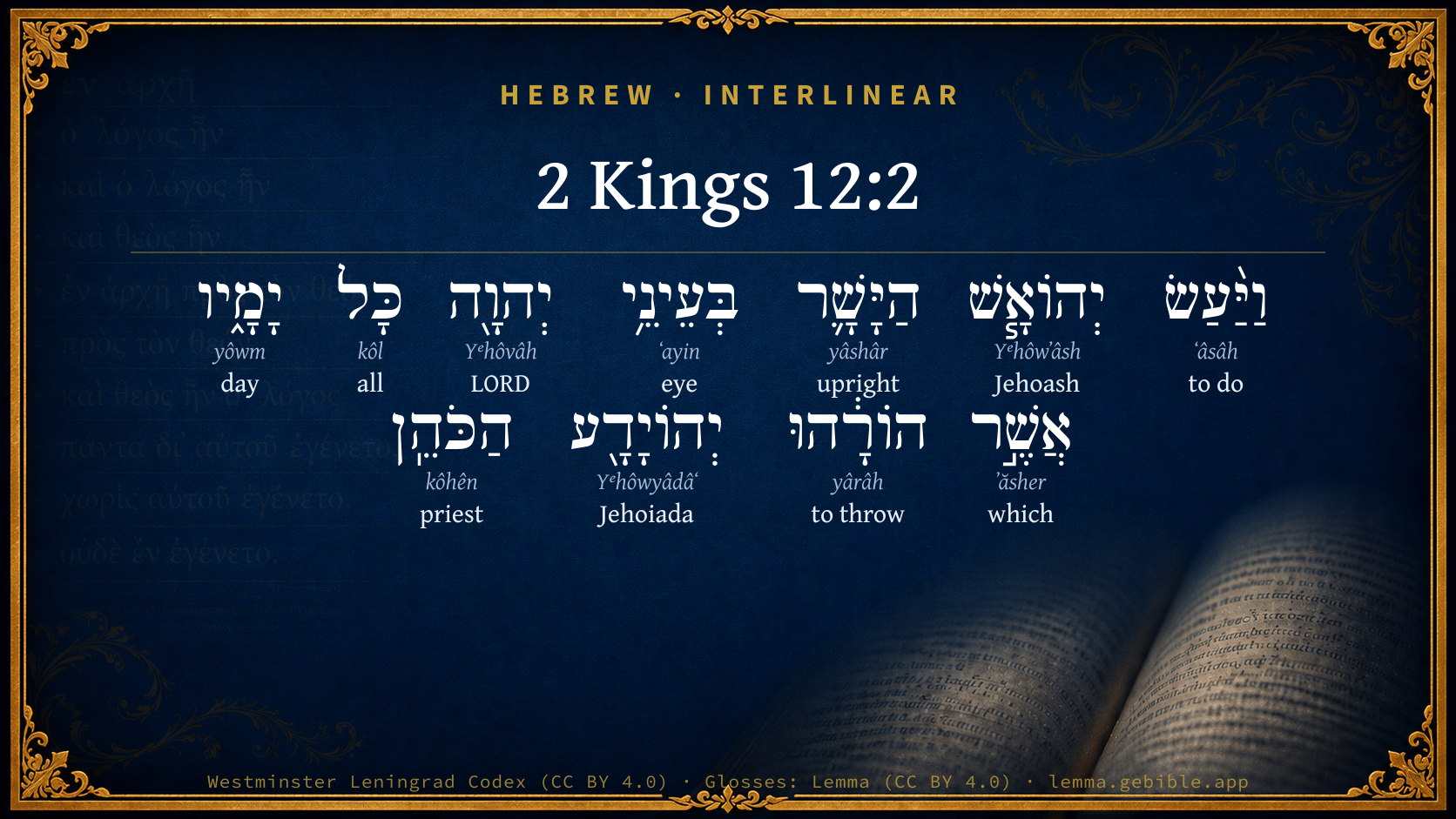
Hebrew (Westminster Leningrad Codex) 2 Kings 12:2 appears in the Hebrew Old Testament. The text above is from the Westminster Leningrad Codex. Each word links to its Strong’s number, a concise gloss, and parsing drawn from the Open Scriptures Hebrew Bible morphology. Click any word for its full Brown-Driver-Briggs (BDB) entry.
Download image
Cite this verse

2 Kings 12:2 (World English Bible). Public Domain. Lemma interlinear Bible study tool, https://lemma.gebible.app/v/2-kings/12/2.

Show BibTeX & RIS
BibTeX
RIS
English Translation
Jehoash did that which was right in the eyes of Yahweh all his days in which Jehoiada the priest instructed him.
World English Bible · Public Domain
Download a study sheet

One document with this verse’s original text, its word-by-word gloss line, the meaning frame, cross-references with their text, attributed commentary, and full source and license credits — printable, and it pastes into notes with its structure intact.

This verse Autodidact and up

Study sheet (.html) Plain text (.txt)

A passage Seminary Student

Up to 50 verses in one chapter. A passage sheet keeps up to 6 commentary sources and 12 cross-references per verse, in the order this page ranks them, and says so on the sheet whenever that leaves anything out. Ask for a single verse and you get the Autodidact verse sheet above.

Everything on this page stays free to read, with no account — the sheet is a download of what is already on screen, not access to it.

Want to remove ads? Support Godless Engineer
Compare translations 3

The same verse in 3 English versions, stacked beneath the original-language interlinear above. Click any original word for its lexicon entry.

Each is an independent rendering of the whole verse — the interlinear is not word-aligned to these translations.

Highlighted words mark where these versions differ — a whole-verse word diff, not a word-by-word alignment.

  • World English Bible Public Domain
    Jehoash did that which was right in the eyes of Yahweh all his days in which Jehoiada the priest instructed him.
  • King James Version Public Domain
    And Jehoash did that which was right in the sight of the LORD all his days wherein Jehoiada the priest instructed him.
  • unfoldingWord Literal Text CC BY-SA 4.0
    And Joash did right in the eyes of Yahweh all of his days because Jehoiada the priest instructed him.

unfoldingWord Literal Text — © unfoldingWord, licensed CC BY-SA 4.0. Word-aligned USFM3 via Door43 (git.door43.org/unfoldingWord/en_ult).

Versions to compare (up to 4)

3 of 4 selected

Show all 18 translations

Every available English version of this verse, each an independent rendering of the whole verse.

  • World English Bible Public Domain
    Jehoash did that which was right in the eyes of Yahweh all his days in which Jehoiada the priest instructed him.
  • Berean Standard Bible Public Domain
    And Joash did what was right in the eyes of the LORD all the days he was instructed by Jehoiada the priest.
  • Majority Standard Bible Public Domain
    And Joash did what was right in the eyes of the LORD all the days he was instructed by Jehoiada the priest.
  • King James Version Public Domain
    And Jehoash did that which was right in the sight of the LORD all his days wherein Jehoiada the priest instructed him.
  • American Standard Version (1901) Public Domain
    And Jehoash did that which was right in the eyes of Jehovah all his days wherein Jehoiada the priest instructed him.
  • Revised Version (1885) Public Domain
    And Jehoash did that which was right in the eyes of the LORD all his days wherein Jehoiada the priest instructed him.
  • Geneva Bible (1599) Public Domain
    And Iehoash did that which was good in the sight of the Lord all his time that Iehoiada the Priest taught him.
  • Douay-Rheims (1899) Public Domain
    And Joas did that which was right before the Lord all the days that Joiada the priest taught him.
  • Young's Literal Translation Public Domain
    and Jehoash doth that which is right in the eyes of Jehovah all his days in which Jehoiada the priest directed him,
  • Literal Standard Version CC BY-SA 4.0
    and Jehoash does that which is right in the eyes of YHWH all his days in which Jehoiada the priest directed him,
  • Unlocked Literal Bible CC BY-SA 4.0
    Joash did what was right in the eyes of Yahweh all the time, because Jehoiada the priest was instructing him.
  • unfoldingWord Literal Text CC BY-SA 4.0
    And Joash did right in the eyes of Yahweh all of his days because Jehoiada the priest instructed him.
  • Darby Bible Public Domain
    And Jehoash did what was right in the sight of Jehovah, all the days wherein Jehoiada the priest instructed him.
  • World Messianic Bible Public Domain
    Jehoash did that which was right in the LORD’s eyes all his days in which Jehoiada the priest instructed him.
  • Webster's Bible Public Domain
    And Jehoash did that which was right in the sight of the LORD all his days wherein Jehoiada the priest instructed him.
  • Free Bible Version CC BY-SA 4.0
    Joash did what was right in the Lord's sight during the years that Jehoiada the priest advised him.
  • Bible in Basic English Public Domain
    Jehoash did what was right in the eyes of the Lord all his days, because he was guided by the teaching of Jehoiada the priest.
  • JPS Tanakh (1917) Public Domain
    (12-3) And Jehoash did that which was right in the eyes of the LORD all his days wherein Jehoiada the priest instructed him.

Literal Standard Version (2020), Covenant Press — licensed CC BY-SA 4.0. Text via the HelloAO Bible API (eBible.org). Unlocked Literal Bible (unfoldingWord) — licensed CC BY-SA 4.0. Text via the HelloAO Bible API (eBible.org). unfoldingWord Literal Text — © unfoldingWord, licensed CC BY-SA 4.0. Word-aligned USFM3 via Door43 (git.door43.org/unfoldingWord/en_ult). Free Bible Version, Dr. Jonathan Gallagher — licensed CC BY-SA 4.0. Text via the HelloAO Bible API (eBible.org).

Word by word

More ways to search: Search by grammar → Find every occurrence → Compare this word →

Practice this passage: Drill this verse → Learn its vocabulary →

יְהוֹאָ֧שׁ
Yᵉhôwʼâsh
H3060
“Jehoash”
Noun, Proper
Part of Speech
Noun
Type
Proper
Full BDB Definition

Origin: from H3068 and (perhaps) H784

TWOT: None

Jehoash = "given by the Lord" - son of king Ahaziah and the 8th king of Judah - son of king Jehoahaz and the 12th king of the northern kingdom of Israel
  1. וַיַּ֨עַשׂ ʻâsâh H6213 “and · to do” Conjunction + Verb, Qal, Sequential Imperfect, 3rd Person, Masculine, Singular
  2. הַיָּשָׁ֛ר yâshâr H3477 “the · upright” Particle, Definite Article + Adjective, Adjective, Masculine, Singular, Absolute
  3. בְּעֵינֵ֥י ʻayin H5869 “in/at · eyes of” Preposition + Noun, Common, Both, Dual, Construct
  4. יְהוָ֖ה Yᵉhôvâh H3068 “LORD” Noun, Proper
  5. כָּל kôl H3605 “all of” Noun, Common, Masculine, Singular, Construct
  6. יָמָ֑יו yôwm H3117 “days · his” Noun, Common, Masculine, Plural, Construct + Suffix, Personal, 3rd Person, Masculine, Singular
  7. אֲשֶׁ֣ר ʼăsher H834 “which” Particle, Relative
  8. הוֹרָ֔הוּ yârâh H3384 “to throw · him” Verb, Hiphil, Perfect, 3rd Person, Masculine, Singular + Suffix, Personal, 3rd Person, Masculine, Singular
  9. יְהוֹיָדָ֖ע Yᵉhôwyâdâʻ H3077 “Jehoiada” Noun, Proper
  10. הַכֹּהֵֽן kôhên H3548 “the · priest” Particle, Definite Article + Noun, Common, Masculine, Singular, Absolute

About this verse

These counts appear in no published source. They are computed here, from the morphology-tagged text and Lemma’s own curated glosses. What Lemma adds →

11
words
11
distinct lemmas
Historical
section

Notable vocabulary

The rarest word here is יְהוֹאָ֧שׁ Jehoash H3060 — appearing just 17 times in the whole Hebrew Bible.

Shared distinctive vocabulary

יְהוֹאָ֧שׁ Jehoash H3060 occurs in 16 verses of the Hebrew Bible. Also found in:

Grammatical profile

  • 2 verbs
  • 7 nouns
  • 1 adjective
  • 1 particle

Verb forms

  • וַיַּ֨עַשׂ Qal · Sequential Imperfect
  • הוֹרָ֔הוּ Hiphil · Perfect

Hebrew & Septuagint length

In English translation the verse runs 21 words from the Hebrew and 22 from the Septuagint (LXX English) — closely comparable.

A rough comparison of the two English renderings, which tokenize alike — not a word-level alignment.

Word counts can differ between the Hebrew and the Greek without any difference in meaning — e.g. the Hebrew direct-object marker אֵת has no separate Greek word, and Greek often adds the article ὁ.

Cross-references

5

Topical passages linked to 2 Kings 12:2 in the Treasury of Scripture Knowledge — connected by theme and wording, ordered by reader-vote popularity; previews shown in the World English Bible.

  • 2 Kings 14:3 He did that which was right in the eyes of Yahweh, yet not like David his father: he did according to all that Joash his father had done.
  • 2 Chronicles 24:2 Joash did that which was right in the eyes of Yahweh all the days of Jehoiada the priest.
  • 2 Chronicles 24:17–22 Now after the death of Jehoiada came the princes of Judah, and made obeisance to the king. Then the king listened to them.
  • 2 Chronicles 25:2 He did that which was right in the eyes of Yahweh, but not with a perfect heart.
  • 2 Chronicles 26:4 He did that which was right in the eyes of Yahweh, according to all that his father Amaziah had done.

Cross-references courtesy of OpenBible.info (CC BY 4.0).

Hebrew and Greek witnesses Masoretic Hebrew ↔ Greek Septuagint

The same verse in the two great witnesses to the Old Testament, shown verse-for-verse.

These are two independent witnesses, not word-aligned to each other, and the Septuagint is shown in lemma (dictionary) form.

Hebrew 2 Kings 12:2 Masoretic · Westminster Leningrad Codex

וַיַּ֨עַשׂ יְהוֹאָ֧שׁ הַיָּשָׁ֛ר בְּעֵינֵ֥י יְהוָ֖ה כָּל יָמָ֑יו אֲשֶׁ֣ר הוֹרָ֔הוּ יְהוֹיָדָ֖ע הַכֹּהֵֽן

Jehoash did that which was right in the eyes of Yahweh all his days in which Jehoiada the priest instructed him.

World English Bible · Public Domain

Greek LXX 2 Kings 12:2 Septuagint · lemma form

ἐν ἔτος ἕβδομος ὁ ιου βασιλεύω ιωας καί τεσσαράκοντα ἔτος βασιλεύω ἐν ἰερουσαλήμ καί ὄνομα ὁ μήτηρ αὐτός αβια ἐκ ὁ βηρσαβεε

And Joas did that which was right in the sight of the Lord all the days that Jodae the priest instructed him.

LXX2012 (modern English Septuagint) · Public Domain

On this verse, Ellicott's Commentary for English Readers discusses the Septuagint’s reading. Read the note in Commentary ↓

Hebrew: Westminster Leningrad Codex (CC BY 4.0). Greek: Septuagint (public domain); English from LXX2012 (modern English Septuagint) (Public Domain). How the Septuagint differs from the Hebrew →

Targum (Aramaic paraphrase)

1

The Targum is the ancient Jewish Aramaic paraphrase of the Hebrew Scriptures — an interpretive translation, not the Hebrew text itself. Onkelos (literal) and Pseudo-Jonathan (expansive) render the Torah, and Jonathan the Prophets. Coverage is partial: where no permissively-licensed English translation exists for a verse, only the Aramaic is shown. This is verse-level text, not a word-by-word alignment to the Hebrew.

  1. Targum Jonathan Prophets (Joshua–Malachi)
    בִּשְׁנַת שְׁבַע לְיֵהוּא מְלַךְ יְהוֹאָשׁ וְאַרְבְּעִין שְׁנִין מְלַךְ בִּירוּשְׁלֵם וְשׁוּם אִימֵהּ צִבְיָה מִבְּאֵר שָׁבַע:

    (no public-domain English translation for this verse)

    Targum Jonathan — Aramaic: “Mikraot Gedolot” (public domain). English: “Sefaria Community Translation” (CC0 1.0 (public-domain dedication)); “London "Chaldee Paraphrase," 1871” (public domain). Text via Sefaria.

Commentary

Notes on 2 Kings 12:2 from classic Christian and Jewish commentators (each source and its license shown beneath its notes). The classic Christian expositions comment on the surrounding passage and are grouped to its opening verse, so a note may address several verses; the Jewish commentaries on the Tanakh (Rashi and others) are per-verse, so they appear only where the commentator wrote on this verse.

Lemma curates 59 commentaries, every one of them public domain or Creative Commons licensed, each selected and text-cleaned for this edition rather than reprinted as found. About our sources →

Trapp's Complete Commentary

John Trapp

2Ki 12:2 And Jehoash did [that which was] right in the sight of the LORD all his days wherein Jehoiada the priest instructed him.

Ver. 2. All his days wherein Jehoiada the priest instructed him.] As when Jehoiada died, Jehoash revolted from the Lord. Nero, while he would be instructed by Seneca and Burrhus, was of so good a carriage that Trajan was wont to say, None ever came near him; but this lasted for five years only. In Apostatis -

“ Principium fervet, medium tepet, exitus alger. ”

John Trapp, A Commentary or Exposition upon All the Books of the Old and New Testament (1647–1656) — public domain. Text from a community e-Sword module.

The Biblical Illustrator

Joseph S. Exell

2Ki_12:2

And Jehoash did that which was right in the sight of the Lord.

Influence

For the right understanding of the character and reign of Jehoash we should consult not only the account given in the present chapter, but also that in the parallel chapter in the book of Chronicles; the narrative in the book of Kings being more full of matters pertaining to the early piety of the monarch, while that of the Chronicles details with more minuteness the causes that led to his declension, and the occasion of his shameful fall. During the minority of Jehoash the affairs of the kingdom went on comparatively well. His beginnings were full of promise, and even for several years after he was of full age the young king seemed chiefly anxious to carry out the plans and projects of Jehoiada; not only on account of the comfort he would naturally feel in leaning on a stronger arm, but in some degree, no doubt, from gratitude to one to whom he felt he was indebted both for his life and his throne. So that, as both histories inform us, All the days of Jehoiada, Jehoash did that which was right in the sight of the Lord. But while the king was yet in his prime, his faithful adviser died, and very soon other and far different counsels were in the ascendant. The princes of Judah, knowing that a want of self-reliance was a great infirmity of the kings character, seeing that his prop was gone, and persuaded that he was as much dependant upon that prop for his religion as upon anything else, plied him with audacious proposals to forsake the temple of God, and to transfer his worship to the idols of the grove And he hearkened to them. From this time his fall was rapid. The moral of it, the point which stands out from all others, is the evil of a religion which is based upon the influence of another mind; which has no root in itself, but which, being unstable as water, and flexible as a reed shaken with the wind, will neither bear fruit unto holiness, nor have its end in everlasting life.

1. And, first, let us advert to the habit of mind itself against which we are cautioned, in order that we may detach from it for separate consideration so much as may be due to a constitutional weakness of character--to a natural diffidence end dread of having to go alone, which, as not coming within the scope of our moral powers entirely to eradicate, we must believe either the mercy of God will pardon, or His grace will rectify and render harmless. We cannot doubt that the existence of this is a common form of mental infirmity, which allies itself to intellects of the highest reach, and to souls of the most indomitable and commanding power. That tyrant, who at the beginning of the present century made more than half the nations of Europe tremble, had as little of the self-reliant element in his nature as the lowest subaltern he ever ordered to the field. True, when he had resolved upon a step, neither difficulty nor danger moved him; but to make him resolve upon it he must have the consents of some trusted and approving mind; in private life, being as much influenced by his empress, as in public matters, he leaned on the counsels of Talleyrand. If this practical subjugation to the will and counsel of another, this tendency to hang on, and hold on by what is felt to be a stronger judgment, be found among the higher and more towering spirits of our race, how much more shall we look for it in the humbler and more dependant ranks. Some men are born into the world with a soft, pliant, treacherous debility of will. They must have somebody to think after, and speak after, and act after. They hold their wills, as it were, by feudal tenure under other peoples will, changing both Lord and service, if need be, seven times a day. Such persons appear, at first sight, to be a good deal at the mercy of their providential lot, in the power of those accidents and associations which shall bring them under the permanent ascendant of a better or of a more corrupt mind; of a Jehoiada who will lead them in the good and the right way, or of the dissolute princes of Judah who will be as oracles to mislead, and as guides to destroy. But we allow not that our souls life can be suspended on any such precarious issues we must not make a god of temperament, nor a god of circumstances; but we must believe of original tendencies of character as of any other cause which may be injurious to our moral steadfastness, that there is provided for us, in the economy of grace, a way of escape, an ordained antidote to our natures evil, whereby God may get honour upon our infirmities, and out of weakness make us strong. But passing from the case of any constitutional liability to be influenced by other minds, let us address ourselves to the evil of the habit itself, when it allows others to think and act for us in the great concerns of personal religion. And proceeding upon the example furnished by our text, we ought to take a case where the influencing or ascendant mind is, according to our common human estimates, a strong mind, a good mind, a mind formed to lead, and honestly and earnestly bent on leading right. In many cases, no doubt, this may be a great advantage. It is a happy thing for young people setting out in life to be under the instruction and control of one whose desire is always to lead them in the good and the right way. And yet we ought to show that if our religion stands only in the power which this mental control wields over us, and goes no lower down to the depths of our moral being than that example can reach, or that influence can minister to, such religion will be vain, will never become more than a surface religion, will not keep itself fixed and fastened in the roots of our moral nature, and consequently in time of temptation we shall fall away. The relation out of which this subordinating influence arises, makes no difference in the evil and danger of becoming enslaved to it. It may be that of a parent exercising a control over the filial conscience which belongs to him by the eternal prescription of heaven; or that of a husband drawing the wife into assimilations of thought and feeling, almost before she is aware of it--affection promoting the influence, and the marriage sanctities giving to it the force of law. Or it may be that of a pastor, having begotten us, in Christ Jesus through the Gospel. You will ask me why? I answer, first, because such a religion is essentially false and defective in principle. It originates neither in love to God, nor gratitude to Christ, nor deep views of sin, nor in delight in holy service, nor in aspirations after the sanctity and bliss of heaven; but chiefly in a desire to approve itself to some dominant and controlling influence. Water cannot rise above its level; and as Jehoiada, whether from temperament or policy, had done nothing to remove the high places of sacrifice, though confessedly a reproach to the temple service, Jehoash would do nothing either; and so the eulogium, even of his early goodness, has to be qualified by the remark, But the high places were not taken away. The examples are rare where, in the race of goodness, the disciple outstrips his chosen guide; and if he does so, it is because a better guide has taken him in hand, and the master influence has become merged in the mightier power of the Spirit of God. But, as a rule, the subject mind will keep below the religious standards and measures of its superior. All its goodness is derived goodness, and it shines only in a borrowed light. And as the standard of piety is low, so the acts of which it specially consists are prompted, often by a feeble sentimentality, or perhaps with a view to the praise of men. Conspicuous among the pious acts of Jehoash was his zeal in setting about the repairs of the temple, injured less by the hand of time than by the sacrilegious spoliations of idolators. It were easy to account for this zeal on other grounds than those of personal goodness. That temple was very dear to him. How natural to address himself vigorously to a work so gratifying to Jehoiada, so easily mistaken by himself for the dictate of pious emotion, and so calculated to gain him favour with his subjects for a loving attachment to the truth of God. And so, also, it may be with us, while our religion is in others keeping. We may love the temple, have joy in ordinances, feel a thrill of sacred pleasure under the power of the Word, and for the largeness of our alms be called the repairer of the breach, the restorer of the path to dwell in, while of any principle of vital godliness we may be as destitute as Jehoash was. Rooted and grounded in the depths of the carnal heart may be hidden the seeds of an unsuspected idolatry, which wait bus the scorching sun of temptation to develop into pernicious fruit, to turn the repairer of the temple into a worshipper of the grove, and lead a lover of faithful teaching to slay between the temple and the altar a servant of the living God.

2. But, secondly, we say of a religion that owes its being to any merely mental deferences, that it will always be feeble and languid, and inefficient in itself, that it will leave its possessor unprepared for the struggles, and temptations, and rough discipline of life, a prey to the first evil influence that shall try to make a captive of him, and to be overcome by the first afflictive trial which shall send him to the foundation of his trusts. So weak was the hold which the religion of Jehoash had upon his conscience, that he yielded to the most visible and transparent lure ever mans soul was taken withal, namely, the fawning sycophancy of a few unprincipled courtiers, asking as the boon price of their service, that he should cast off the worship of his fathers, violate the covenant of his God, and bow the knee only before the divinities of the grove. And the king hearkened to them. Yes, for why should he not? His religion had all along been the creature of influence, and therefore, must change as often as the ascendant influence changed. Strength of its own, such religion has none, either to resist or attack. It is impotent as the autumn leaf, now lifted up in circling eddies by the blast, now waiting in passive helplessness the first footstep that shall crush it to the earth. And hence, I say in all this religion obtained at second hand, this derived Christianity of another mind, there will generally be found a sickly irresolution Of purpose, a sort of letting out of ones moral powers to the highest and most powerful bidder. The man who trusts in it is not his own master; he is the property of the first strong will that shall think the appendage worth having. But true religion, that which is rooted in a Divine principle and a Divine influence, is a hardy thing, a manly thing. It is furnished for the cloudy and dark day, and expects its coming. Deep in the springs of its unseen life is an element of strength which gives dignity to the character, composure to the spirit, a settledness and perseverance to the once-formed resolve which nothing can bend, nothing can turn aside.

3. But the text suggests a third reason for predicting the inevitable miscarriage of a religion which is dependant for its life on surrounding influences, namely, that the very friends that helped to make us as good as we are, may, in the providence of God be taken away. Jehoash did that which was right in the sight of the Lord all his days wherein Jehoiada the priest instructed him. But Jehoiada died; and what did he do then? Why, evil, and evil only. The morning cloud disperseth not sooner, nor the early dew when it passeth away, than did that fabric of gossamer and unsubstantial goodness, which a breath was to destroy even as a breath had made. And it seems to be in obedience to a law, as if it was a Nemesis of God on the mind that leans on human trusts, that Jehoash became more impious and profane for having known something of the semblance of piety before. Just as the emperor Nero, conspicuous for humanity and virtue while he had the counsels of Seneca to guide him, went down to the grave a monster with the execration of posterity upon his head. Some lessons arise from this aspect of our subject brethren, whether as applied to those who consciously and of purpose have joined themselves to the train of a superior mind, and, only to please him, kept up a show of goodness, or to those who, having a loving and leaning confidence in anothers wisdom and piety, have been content to draw from him all their souls life and strength, and, unconsciously to themselves, to let him be to them instead of God. To the former Jehoash leaves the lesson that it would have been better for them never to have known good things at all. They are fretting under a yoke for a season, only to indulge in more unrestrained licence as soon as it shall be taken off. The instant the weight is lifted off, the bent bow will fly back with more violent rebound. There may be love for a season, zeal for a season, concern for holy things for a season, but when Jehoiada is dead, the long pent-up energies of evil will burst forth, and like the heir long kept out of the expected inheritance, the heart plunges into the thick of its carnal thoughts, and as if to take revenge on itself for its forced early goodness, the man endeavours to crowd as much iniquity as he can into the remainder of his days. But there is a lesson also to those who do not fret under their mental subjection, who, in heart love their Jehoiada, and indeed, whose chief danger is that they love him too much, and who, therefore, think within themselves, If he should be taken away what good will our lives be to us, or what power shall keep us faithful unto our pious work? So may reason the son, who, breathing from his youth the pure atmosphere of domestic piety, has seen in the life of his parents all that could ennoble godliness, and all that could make virtue loved. But I must conclude with a few practical counsels, am helpful to guide us from the danger of which this history warns us.

(1) And first, I would say, have a care of being deceived as to your spiritual state, by what may be called the amiabilities of religion. Cradled in the sanctuary, nursed by a pious aunt, his early years watched over by a faithful servant of God, it had been a wonder if the early outward life of Jehoash had not been full of grace and promise.

(2) A second counsel I would offer, is, see to it that there be no holding an undecided course in your religion. Jehoash does not seem to have actually joined the princes of Judah. But, he hearkened to them, and from that they knew his mind. He that wavereth is like a wave of the sea, saith St. James, driven of the wind and tossed--an unsettled, divided heart, the absence of all serenity and repose, and an acute sensitiveness to every disturbing influence, a never continuing in one stay. Lastly, as ye would have a goodness that shall stand with us in time, and shall abide the ordeal of that fire which is to try every mans work of what sort it is, see that ye have an inward experience of the vital realities of religion--the regenerate will, the renewed mind, the revival of that spiritual image upon the conscience which, after God, is created in righteousness and true holiness. You cannot be too severe, too searching in ascertaining your personal participation in these essentials of the spiritual character. (D. Moore, M. A.)

The fruit of wise guardianship seen in later life

At Frogmore, on the 16th of March 1861, the Duchess of Kent, mother of our beloved Queen, passed tranquilly into eternity at the ripe age of seventy-five. Her husband, the Duke of Kent, died six days before his father, George III., leaving the presumptive heir to Englands crown in charge of the Duchess, his wife. I do nominate, constitute, and appoint my beloved wife Victoria, Duchess of Kent, said the Duke in his will, to be sole guardian of our dear child, Princess Alexandra Victoria, to all intents and for all purposes whatsoever. During the seventeen years which elapsed between her husbands death and the accession of her daughter, the Duchess devoted heart and soul to the responsible but honourable task committed to her, and she lived to see the blessed results of her labour of love. It is to the wise, virtuous, and self-sacrificing discharge of her maternal duties, under the blessing of God, that this country is largely indebted for possessing a Queen whose life illustrates all that we most love in woman, and whose reign exemplifies all that we most respect in a Sovereign. (William Francis.)

A lean-to religion

Many men owe their religion, not to grace, but to the favour of the times; they follow it because it is in fashion, and they can profess it at a cheap rate, because none contradict it. They do not build upon the rock, but set up a shed leaning to another mans house, which costs them nothing. The idea of a lean-to religion is somewhat rough, hut eminently suggestive. Weak characters cannot stand alone, like mansions; but must needs lean on others, like the miserable shops which nestle under certain Continental cathedrals. Under the eaves of old customs many build their plaster-nests, like swallows. Such are good, if good at all, because their patrons made virtue the price of their patronage. They love honesty because it proves to be the best policy, and piety because it serves as an introduction to trade with saints. Their religion is little more than courtesy to other mens opinions, civility to godliness. (C. H. Spurgeon.)

The Biblical Illustrator, edited by Joseph S. Exell (c. 1880s–1900s) — public domain. Text from a community e-Sword module.

Joseph Benson's Commentary

2Ki 12:2. Jehoash did what was right, &c. — Having, 1st, such a good director as Jehoiada was, so wise, experienced, and faithful: and, 2d, so much wisdom as to hearken to him, and be directed by him. Here we learn of what advantage it is to princes, especially while they are young, and indeed to young people in general, to have good instructers and counsellors about them. And they then act wisely for themselves, when they are willing to be counselled and ruled by such.

Joseph Benson's Commentary on the Old and New Testaments (1811–1818) — public domain. Text from a community e-Sword module.

Tyndale Open Study Notes

Tyndale Open Resources

12:2-3 Joash’s indebtedness to Jehoiada, the priest who instructed him, kept him faithful to the Lord while Jehoiada was alive. However, after Jehoiada’s death, godless leaders influenced Joash to forsake the Lord and follow Canaanite practices (see 2 Chr 24:17-22). • Joash’s failure to destroy the pagan shrines later became a source of spiritual compromise. Royal tolerance of such shrines in Judah had previously provoked God’s anger (1 Kgs 14:23-26) and would do so again in Joash’s day (2 Chr 24:23-24).

Tyndale Open Study Notes — © Tyndale Open Resources, licensed CC BY-SA 4.0. Text via the HelloAO Bible API.

Geneva Bible (1599)

Geneva Bible translators

So long as rulers give ear to the true ministers of God, they prosper.

Geneva Bible (1599) marginal notes — public domain. Text via Bolls.life.

Adam Clarke's Commentary

Verse 2. Jehoash did - right in the sight of the Lord] While Jehoiada the priest, who was a pious, holy man, lived, Jehoash walked uprightly; but it appears from 2Ch 24:17-18, that he departed from the worship of the true God after the death of this eminent high priest, lapsed into idolatry, and seems to have had a share in the murder of Zechariah, who testified against his transgressions, and those of the princes of Judah. See above, 2Kg 24:20-22.

O how few of the few who begin to live to God continue unto the end!

Adam Clarke's Commentary on the Bible (1810–1826) — public domain. Text from a community e-Sword/MySword module.

Ellicott's Commentary for English Readers

(2) All his days wherein Jehoiada the priest instructed him.—The Hebrew is ambiguous, but may certainly mean this, which is the rendering of the LXX. and Vulg. (The accent dividing the verse ought to fall on “the Lord” rather than on “his days.”) Perhaps the peculiar form of the sentence arose in this way: the writer first set down the usual statement concerning kings who supported the worship of Jehovah, and then, remembering the evils which ensued upon the death of the high priest (2Ch_24:17), added as a correction of that statement, “during which Jehoiada the priest instructed him.” Thenius says the words can only be rendered, all his life long, because Jehoiada had instructed him. They certainly can, however, be rendered as our version renders them, and further, thus: “And Jehoash did . . . all his days, whom Jehoiada the priest instructed.” But the ambiguity of the statement gave an opportunity for discrediting the chronicler.

A Bible Commentary for English Readers, edited by Charles John Ellicott (1878–1897) — public domain. Text from a community e-Sword module.

The Cambridge Bible for Schools and Colleges

gen. ed. J. J. S. Perowne

2. all his days] In the original there is a division here in the verse, and the pronoun which both A.V. and R.V. render ‘wherein’ should, as the text stands, be translated ‘because’. This statement that Jehoash did what was right all his days is opposed to the narrative in Chronicles. The LXX. appears not to have had ‘his’ in connexion with ‘days’, for the rendering is ‘he did what was right all the days during which Jehoiada instructed him’. The necessity for being consistent with Chronicles has led to the rendering of the relative by ‘wherein’.

The Cambridge Bible for Schools and Colleges (gen. ed. J. J. S. Perowne; Cambridge University Press, 1878–1918) — public domain. Text from a community e-Sword module.

John Gill's Exposition

And Jehoash did that which was right in the sight of the Lord all his days,.... Worshipping the only true God, and ruling and walking according to the law of God:

wherein Jehoiada the priest instructed him; and so long as he observed his instructions, and as long as that priest lived, he reigned well; for to that period "all his days must be limited"; for after his death he was seduced by the princes of Judah to idolatry, and lived scandalously, and died ignominiously; see Ch2 24:2.

John Gill's Exposition of the Whole Bible (1746–1763) — public domain (CC PDM 1.0). Text via the HelloAO Bible API.

Albert Barnes' Notes on the Bible

All his days ... - i. e., so long as Jehoiada was his adviser” (compare 2Ch 24:15-22). Jehoida was, practically speaking, regent during the minority of Jehoash, i. e., 10 or 12 years. An increase of power to the priestly order was the natural consequence. Jehoiada bore the title of “high priest” 2Ki 12:10, which had been dropped since the time of Eleazar Jos 20:6, and the Levitical order from this time became more mixed up with public affairs and possessed greater influence than previously. Jehoiada’s successors traced their office to him rather than to Aaron Jer 29:26.

Albert Barnes' Notes on the Bible (1834–1885) — public domain. Text from a community e-Sword/MySword module.

Haydock's Catholic Bible Commentary

Taught him. Joiada lived, at least, till the 23d year of the reign of Joas, (ver. 6.) and the king seems to have persevered some time longer in virtue.

George Leo Haydock (1774–1849), Haydock's Catholic Family Bible and Commentary, 1859 edition — public domain. Excludes Psalms (Douay-Rheims chapter numbering differs from Protestant) and Deuterocanonical books (Catholic canon only).

Matthew Poole's English Annotations

To wit, for the matter of it, though not with an honest and sincere mind, but only by the influence of his good tutor and restorer, as the words here following plainly imply.

Matthew Poole's English Annotations on the Holy Bible (1683–1685) — public domain. Text from a community e-Sword/MySword module.

Whedon's Commentary on the Bible

Daniel D. Whedon

2. All his days wherein Jehoiada… instructed him — As long as he remained true to the counsels of the high priest he did right and prospered. The words imply, though the fact is not stated, that he afterwards departed from the instructions of his benefactor. How this came to pass is told in Chronicles.

Daniel D. Whedon (gen. ed.), Commentary on the Old and New Testaments (1874–1909) — public domain. Text from a community e-Sword module.

The Pulpit Commentary

And Jehoash did that which was right in the sight of the Lord all his days wherein Jehoiada the priest instructed him. So the Septuagint, the Vulgate, Luther, De Wette, Keil, Bahr, and our Revisers. Only Ewald and Thenius attempt to make the passage contradict Chronicles by translating, "Jehoash did that which was right in the sight of the Lord all his days, because Jehoiada the priest had instructed him." But this translation is very forced and unnatural. The writer evidently intended to add a qualifying clause to his statement that Joash reigned well "all his days," but did not wish to draw too much attention to it.

Ver. 2. Weakness in a monarch almost as bad as wickedness.

The most prominent trait in the character of Joash was his lack of independence and moral weakness. He had no strength of will, no stamina; in the expressive, if inelegant, language of our times, "no backbone." He must always lean upon some one. Let us look at Joash

I IN HIS YOUTH. At this time he was so fortunate as to have a natural prop and support in Jehoiada, his uncle by marriage, and his guardian during the years of his minority. Jehoiada"s was a strong character, and the life of Joash, while Jehoiada guided his steps, if not marked by any strikingly great actions, was correct, exemplary, worthy of praise. There was piety and right feeling in the pains, which he took to promote the restoration of the temple, and prudence in the measures whereby he succeeded in effecting his purpose. The measures may have been probably were suggested by Jehoiada; but the king deserves some credit for adopting them.

Outov menmanaristov, o aujtonta noeitai Frassomenov ta epeita kailov ejstinw jEsqlokeinov, o eu eijponti piqhtai

As the writer of Kings says, "Joash did that which was right in the sight of the Lord all his days wherein Jehoiada the priest instructed him" (ver. 2). But Jehoiada could not live forever. He reached a very advanced age; but at last he "waxed old and died", (2Ch_24:15) and Joash was left to manage as he might without him. Let us look at him now

II IN HIS MIDDLE AGE, AFTER THE DEATH OF JEHOIADA. Apparently his weakness is known, and it is at once assumed that he must put himself under directors. The "princes of Judah" go to him, pay him court, flatter him probably, at any rate offer him unusual honors. And at once he succumbs, and places himself under their influence. We cannot suppose him not to have been aware of what he was doing. He must have known the leanings of the "princes," and have understood that, in adopting them as his advisers, he was giving up all the traditions of his earlier life, and taking a new departure. Such lightness would not have been surprising in a mere youth; but Joash was now at least thirty years of age, probably more, and might have been expected to have formed and settled his principles and his character. Still, experience shows that even thirty years of a pious life, if it has been passed "under tutors and governors," does not fix a man"s future in the same line nay, often leads him to an almost irrepressible desire for revolt, and for departing widely from his antecedents. The desire is a temptation of the devil, and, if yielded to, has devilish results; but it is very often yielded to. Nero"s outbreak after he had got rid of Seneca is the most palpable historical example; but the experience of most persons must have shown them scores of instances of men, trained and brought up in good courses till middle life, and then suddenly set free to take their own line, who have plunged into dissipation, impiety, and wickedness of all kinds. The case of Joash is extraordinary, not in its general features, but in the lengths to which he went. Under the influence of the "princes," he allowed the Baal-worship to be reintroduced, and gave it free tolerance.

When prophets remonstrated, and Zechariah denounced God"s vengeance on those who had forsaken him, (2Ch_24:19, 2Ch_24:20) then Joash, unaccustomed to opposition, was so exasperated that he went the length of murder murder of a high priest within the precincts of the temple, by the cruet death of stoning, and murder of one for whom he ought to have had a special kindness, in remembrance of the vast benefits which he had received from his father. (2Ch_29:22) It is quite possible nay, probable that Joash (like Henry II in the case of Becket) did not deliberately determine on the murder that hasty words, uttered in extreme exasperation, were seized upon (Stanley) by his too-officious servants, and carried out in act before he could retract them. But this only emphasizes his weakness. A well-intentioned prince, yielding to evil influences, sanctions the most atrocious crime that the temple ever witnessed (Mat_23:35) and through Ms wellness involves the nation in guilt greater than any that had been incurred by the doings of the most wicked of preceding monarchs.

The Pulpit Commentary (1880–1919), ed. H.D.M. Spence-Jones & Joseph S. Exell — public domain. Text from a community e-Sword module.

Lesson kit

Teaching starters — assembled from the data on this page, not authored interpretation. Every prompt links to the verse data it draws on. Edit before teaching.

2 Kings, in the Historical, opens this verse with 11 words (11 distinct Hebrew lemmas). Its most distinctive word is Yᵉhôwʼâsh (“Jehoash”). A historical commentator’s framing appears above. Read the whole chapter for the surrounding context.

Discussion questions

  1. How does “Jehoash” (Yᵉhôwʼâsh) shape what this verse is saying?
  2. How does 2 Kings 11:21, which shares the word «Jehoash», read alongside this verse?
  3. These translations render this verse differently; the difference is in the English rendering, not the original. What questions does that raise?
  4. «וַיַּ֨עַשׂ» is a Qal Sequential Imperfect verb. How does that grammatical form shape the action described?
  5. Compare how Trapp's Complete Commentary and The Biblical Illustrator read this verse. Where do they agree or differ?

Things to notice

Reading settings

Reading text

Shown beneath each verse's original-language words.

Old Testament
Old Testament edition

Read the OT as the Masoretic Hebrew (MT) or the Greek Septuagint (LXX).

English shown for the Greek Septuagint (in the Hebrew ↔ Greek comparison).

Comparing translations? Open the Compare panel on any verse page to stack up to four side by side.