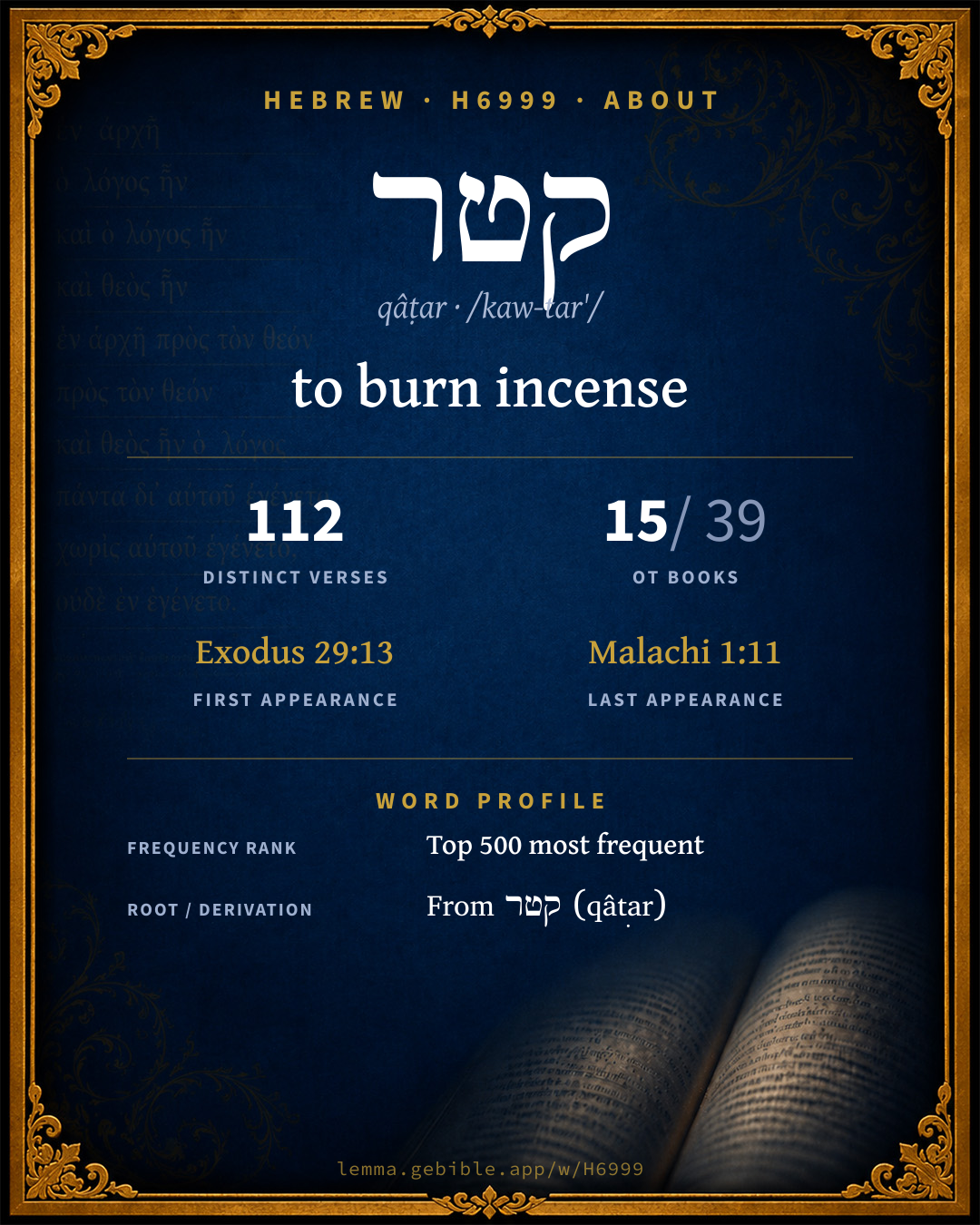
קָטַר
to burn incense
‘to burn incense’ is one of 3 main senses fuller range ↓
Full lexicon entry — Brown-Driver-Briggs (BDB)
From Brown-Driver-Briggs (BDB)
Where this word appears
See every Hiphil verb in the Hebrew Bible →
Grammar key — what these labels mean
Part of speech
- Verb
- An action or state-of-being word.
Noun type
- Common
- A common noun — a general class of person, place, or thing (“king,” “city,” “water”), not a specific name.
Stem
- Hiphil
- The causative active stem (“he caused / brought about”). Here: ‘make sacrifices smoke’
- Piel
- An intensive or resultative active stem.
- Hophal
- The passive counterpart of the Hiphil (“he was caused to…”). Here: ‘be made to smoke as a sacrifice’
- Pual
- The passive counterpart of the Piel.
Form
- Sequential Perfect
- A perfect with prefixed waw continuing a preceding imperfect or command (waw-consecutive perfect).
- Infinitive Construct
- A bound verbal noun, frequently with prepositions (“to write / in writing”).
- Sequential Imperfect
- An imperfect with prefixed waw — the standard past-narrative form (waw-consecutive imperfect).
- Participle Active
- A verbal adjective expressing ongoing or characteristic action (“writing / one who writes”).
- Perfect
- A completed action or state — Hebrew marks aspect (completeness) more than strict tense (“he wrote”).
- Infinitive Absolute
- An unbound verbal noun, often intensifying or standing in for a finite verb.
- Imperfect
- An incomplete, ongoing, or future action (“he will / would write”).
- Participle Passive
- A verbal adjective expressing action received (“written”).
- Jussive
- A third- or second-person volitional form expressing wish or command (“let him write”).
- Imperative
- A direct command (“write!”).
State
- Absolute
- The independent form of a noun, not bound to a following word.
- Construct
- A noun bound to a following noun in a possessive / “of” relationship (the construct chain).
Person
- 3rd Person
- The one spoken about (“he / she / it / they”).
- 2nd Person
- The one addressed (“you”).
Gender
- Masculine
- Grammatically masculine.
- Common
- Either gender — not distinguished for this form.
- Feminine
- Grammatically feminine.
Number
- Singular
- One.
- Plural
- More than one (in Hebrew, generally three or more).
Grammatical forms 33 distinct
- Verb, Hiphil, Sequential Perfect, 3rd Person, Masculine, Singular 20 times (17%)
- Verb, Hiphil, Infinitive Construct 12 times (10%)
- Verb, Hiphil, Sequential Imperfect, 3rd Person, Masculine, Singular 10 times (9%)
- Verb, Piel, Participle Active, Masculine, Plural, Absolute 10 times (9%)
- Verb, Piel, Infinitive Construct 9 times (8%)
- Verb, Piel, Sequential Imperfect, 3rd Person, Masculine, Plural 5 times (4%)
- Verb, Piel, Perfect, 3rd Person, Common, Plural 4 times (3%)
- Verb, Hiphil, Participle Active, Masculine, Plural, Absolute 4 times (3%)
+25 more forms (43 occurrences)
Parsed forms decoded from the imported morphology (morphhb / Westminster Leningrad Codex — WLC text public domain, morphhb tagging CC BY 4.0), counted across 117 parsed occurrences — not distinct verses.
Every verse where H6999 appears — 112 distinct verses across 15 books. Click any verse to open its interlinear word-by-word view. Verse text shown in the World English Bible for context — . Each verse’s Hebrew form is shown with its reference; the English is not keyword-highlighted, since the data carries no word-level English alignment. Use “Compare translations” on any verse to read it across multiple English versions. This concordance covers the Hebrew Bible; Septuagint (Greek Old Testament) occurrences are not indexed here.
Exodus 7 verses
- Exodus 29:13 וְ/הִקְטַרְתָּ֖ conj + Hiphil wpf 2ms You shall take all the fat that covers the innards, the cover of the liver, the two kidneys, and the fat that is on them, and burn them on the altar.
- Exodus 29:18 וְ/הִקְטַרְתָּ֤ conj + Hiphil wpf 2ms You shall burn the whole ram on the altar: it is a burnt offering to Yahweh; it is a sweet savor, an offering made by fire to Yahweh.
- Exodus 29:25 וְ/הִקְטַרְתָּ֥ conj + Hiphil wpf 2ms You shall take them from their hands, and burn them on the altar on the burnt offering, for a sweet savor before Yahweh: it is an offering made by fire to Yahweh.
- Exodus 30:7 וְ/הִקְטִ֥יר יַקְטִירֶֽ/נָּה conj + Hiphil wpf 3ms Hiphil impf 3ms + sfx pers 3fs Aaron shall burn incense of sweet spices on it every morning. When he tends the lamps, he shall burn it.
- Exodus 30:8 יַקְטִירֶ֑/נָּה Hiphil impf 3ms + sfx pers 3fs When Aaron lights the lamps at evening, he shall burn it, a perpetual incense before Yahweh throughout your generations.
- Exodus 30:20 לְ/הַקְטִ֥יר prep + Hiphil inf.cs When they go into the tent of meeting, they shall wash with water, that they not die; or when they come near to the altar to minister, to burn an offering made by fire to Yahweh.
- Exodus 40:27 וַ/יַּקְטֵ֥ר conj + Hiphil wimpf 3ms and he burnt incense of sweet spices on it, as Yahweh commanded Moses.
Leviticus 33 verses
- Leviticus 1:9 וְ/הִקְטִ֨יר conj + Hiphil wpf 3ms but its innards and its legs he shall wash with water. The priest shall burn the whole on the altar, for a burnt offering, an offering made by fire, of a sweet savor to Yahweh.
- Leviticus 1:13 וְ/הִקְטִ֣יר conj + Hiphil wpf 3ms but the innards and the legs he shall wash with water. The priest shall offer the whole, and burn it on the altar. It is a burnt offering, an offering made by fire, of a sweet savor to Yahweh.
- Leviticus 1:15 וְ/הִקְטִ֖יר conj + Hiphil wpf 3ms The priest shall bring it to the altar, and wring off its head, and burn it on the altar; and its blood shall be drained out on the side of the altar;
- Leviticus 1:17 וְ/הִקְטִ֨יר conj + Hiphil wpf 3ms He shall tear it by its wings, but shall not divide it apart. The priest shall burn it on the altar, on the wood that is on the fire. It is a burnt offering, an offering made by fire, of a sweet savor to Yahweh.
- Leviticus 2:2 וְ/הִקְטִ֨יר conj + Hiphil wpf 3ms He shall bring it to Aaron's sons the priests; and he shall take his handful of its fine flour, and of its oil, with all its frankincense; and the priest shall burn the memorial of it on the altar, an offering made by fire, of a sweet savor to Yahweh.
- Leviticus 2:9 וְ/הִקְטִ֖יר conj + Hiphil pf 3ms The priest shall take from the meal offering its memorial, and shall burn it on the altar, an offering made by fire, of a sweet savor to Yahweh.
- Leviticus 2:11 תַקְטִ֧ירוּ Hiphil impf 2mp "'No meal offering, which you shall offer to Yahweh, shall be made with yeast; for you shall burn no yeast, nor any honey, as an offering made by fire to Yahweh.
- Leviticus 2:16 וְ/הִקְטִ֨יר conj + Hiphil wpf 3ms The priest shall burn as its memorial, part of its bruised grain, and part of its oil, along with all its frankincense: it is an offering made by fire to Yahweh.
- Leviticus 3:5 וְ/הִקְטִ֨ירוּ conj + Hiphil wpf 3cp Aaron's sons shall burn it on the altar on the burnt offering, which is on the wood that is on the fire: it is an offering made by fire, of a sweet savor to Yahweh.
- Leviticus 3:11 וְ/הִקְטִיר֥/וֹ conj + Hiphil wpf 3ms + sfx pers 3ms The priest shall burn it on the altar: it is the food of the offering made by fire to Yahweh.
- Leviticus 3:16 וְ/הִקְטִירָ֥/ם conj + Hiphil wpf 3ms + sfx pers 3mp The priest shall burn them on the altar: it is the food of the offering made by fire, for a sweet savor; all the fat is Yahweh's.
- Leviticus 4:10 וְ/הִקְטִירָ/ם֙ conj + Hiphil wpf 3ms + sfx pers 3mp as it is taken off of the ox of the sacrifice of peace offerings. The priest shall burn them on the altar of burnt offering.
- Leviticus 4:19 וְ/הִקְטִ֖יר conj + Hiphil wpf 3ms All its fat he shall take from it, and burn it on the altar.
- Leviticus 4:26 יַקְטִ֣יר Hiphil impf 3ms All its fat he shall burn on the altar, like the fat of the sacrifice of peace offerings; and the priest shall make atonement for him concerning his sin, and he will be forgiven.
- Leviticus 4:31 וְ/הִקְטִ֤יר conj + Hiphil wpf 3ms All its fat he shall take away, like the fat is taken away from off of the sacrifice of peace offerings; and the priest shall burn it on the altar for a sweet savor to Yahweh; and the priest shall make atonement for him, and he will be forgiven.
- Leviticus 4:35 וְ/הִקְטִ֨יר conj + Hiphil wpf 3ms All its fat he shall take away, like the fat of the lamb is taken away from the sacrifice of peace offerings; and the priest shall burn them on the altar, on the offerings of Yahweh made by fire; and the priest shall make atonement for him concerning his sin that he has sinned, and he will be forgiven.
- Leviticus 5:12 וְ/הִקְטִ֣יר conj + Hiphil wpf 3ms He shall bring it to the priest, and the priest shall take his handful of it as the memorial portion, and burn it on the altar, on the offerings of Yahweh made by fire. It is a sin offering.
- Leviticus 6:12 וְ/הִקְטִ֥יר conj + Hiphil wpf 3ms The fire on the altar shall be kept burning on it, it shall not go out; and the priest shall burn wood on it every morning: and he shall lay the burnt offering in order upon it, and shall burn on it the fat of the peace offerings.
- Leviticus 6:15 וְ/הִקְטִ֣יר conj + Hiphil wpf 3ms He shall take from there his handful of the fine flour of the meal offering, and of its oil, and all the frankincense which is on the meal offering, and shall burn it on the altar for a sweet savor, as its memorial, to Yahweh.
- Leviticus 6:22 תָּקְטָֽר Hophal impf 3fs The anointed priest that will be in his place from among his sons shall offer it. By a statute forever, it shall be wholly burnt to Yahweh.
- Leviticus 7:5 וְ/הִקְטִ֨יר conj + Hiphil wpf 3ms and the priest shall burn them on the altar for an offering made by fire to Yahweh: it is a trespass offering.
- Leviticus 7:31 וְ/הִקְטִ֧יר conj + Hiphil wpf 3ms The priest shall burn the fat on the altar, but the breast shall be Aaron's and his sons'.
- Leviticus 8:16 וַ/יַּקְטֵ֥ר conj + Hiphil wimpf 3ms He took all the fat that was on the innards, and the cover of the liver, and the two kidneys, and their fat; and Moses burned it on the altar.
- Leviticus 8:20 וַ/יַּקְטֵ֤ר conj + Hiphil wimpf 3ms He cut the ram into its pieces; and Moses burned the head, and the pieces, and the fat.
- Leviticus 8:21 וַ/יַּקְטֵר֩ conj + Hiphil wimpf 3ms He washed the innards and the legs with water; and Moses burned the whole ram on the altar. It was a burnt offering for a sweet savor. It was an offering made by fire to Yahweh; as Yahweh commanded Moses.
- Leviticus 8:28 וַ/יַּקְטֵ֥ר conj + Hiphil wimpf 3ms Moses took them from their hands, and burned them on the altar on the burnt offering. They were a consecration for a sweet savor. It was an offering made by fire to Yahweh.
- Leviticus 9:10 הִקְטִ֖יר Hiphil pf 3ms but the fat, and the kidneys, and the cover from the liver of the sin offering, he burned upon the altar; as Yahweh commanded Moses.
- Leviticus 9:13 וַ/יַּקְטֵ֖ר conj + Hiphil wimpf 3ms They delivered the burnt offering to him, piece by piece, and the head: and he burned them upon the altar.
- Leviticus 9:14 וַ/יַּקְטֵ֥ר conj + Hiphil wimpf 3ms He washed the innards and the legs, and burned them on the burnt offering on the altar.
- Leviticus 9:17 וַ/יַּקְטֵ֖ר conj + Hiphil wimpf 3ms He presented the meal offering, and filled his hand from there, and burned it upon the altar, besides the burnt offering of the morning.
- Leviticus 9:20 וַ/יַּקְטֵ֥ר conj + Hiphil wimpf 3ms and they put the fat upon the breasts, and he burned the fat on the altar:
- Leviticus 16:25 יַקְטִ֥יר Hiphil impf 3ms The fat of the sin offering he shall burn on the altar.
- Leviticus 17:6 וְ/הִקְטִ֣יר conj + Hiphil wpf 3ms The priest shall sprinkle the blood on the altar of Yahweh at the door of the Tent of Meeting, and burn the fat for a sweet savor to Yahweh.
Numbers 3 verses
- Numbers 5:26 וְ/הִקְטִ֖יר conj + Hiphil wpf 3ms The priest shall take a handful of the meal offering, as the memorial of it, and burn it on the altar, and afterward shall make the woman drink the water.
- Numbers 16:40 לְ/הַקְטִ֥יר prep + Hiphil inf.cs to be a memorial to the children of Israel, to the end that no stranger, who isn't of the seed of Aaron, comes near to burn incense before Yahweh; that he not be as Korah, and as his company: as Yahweh spoke to him by Moses.
- Numbers 18:17 תַּקְטִ֔יר Hiphil impf 2ms But the firstborn of a cow, or the firstborn of a sheep, or the firstborn of a goat, you shall not redeem; they are holy: you shall sprinkle their blood on the altar, and shall burn their fat for an offering made by fire, for a sweet savor to Yahweh.
1 Samuel 3 verses
- 1 Samuel 2:15 יַקְטִר֣וּ/ן Hiphil impf 3mp + sfx n Yes, before they burnt the fat, the priest's servant came, and said to the man who sacrificed, Give flesh to roast for the priest; for he will not have boiled flesh of you, but raw.
- 1 Samuel 2:16 קַטֵּ֨ר יַקְטִיר֤וּ/ן Piel inf.abs Hiphil juss 3mp + sfx n If the man said to him, They will surely burn the fat first, and then take as much as your soul desires; then he would say, No, but you shall give it me now: and if not, I will take it by force.
- 1 Samuel 2:28 לְ/הַקְטִ֥יר prep + Hiphil inf.cs and did I choose him out of all the tribes of Israel to be my priest, to go up to my altar, to burn incense, to wear an ephod before me? and did I give to the house of your father all the offerings of the children of Israel made by fire?
1 Kings 7 verses
- 1 Kings 3:3 וּ/מַקְטִֽיר conj + Hiphil ptcp.act ms Solomon loved Yahweh, walking in the statutes of David his father: only he sacrificed and burnt incense in the high places.
- 1 Kings 9:25 וְ/הַקְטֵ֣יר conj + Hiphil inf.abs Three times a year did Solomon offer burnt offerings and peace-offerings on the altar which he built to Yahweh, burning incense therewith, [on the altar] that was before Yahweh. So he finished the house.
- 1 Kings 11:8 מַקְטִיר֥וֹת Hiphil ptcp.act fp So did he for all his foreign wives, who burnt incense and sacrificed to their gods.
- 1 Kings 12:33 לְ/הַקְטִֽיר prep + Hiphil inf.cs He went up to the altar which he had made in Bethel on the fifteenth day in the eighth month, even in the month which he had devised of his own heart: and he ordained a feast for the children of Israel, and went up to the altar, to burn incense.
- 1 Kings 13:1 לְ/הַקְטִֽיר prep + Hiphil inf.cs Behold, there came a man of God out of Judah by the word of Yahweh to Beth El: and Jeroboam was standing by the altar to burn incense.
- 1 Kings 13:2 הַ/מַּקְטִרִ֣ים ptcl def.art + Hiphil ptcp.act mp He cried against the altar by the word of Yahweh, and said, altar, altar, thus says Yahweh: Behold, a son shall be born to the house of David, Josiah by name; and on you shall he sacrifice the priests of the high places who burn incense on you, and men's bones shall they burn on you.
- 1 Kings 22:43 וּֽ/מְקַטְּרִ֖ים conj + Piel ptcp.act mp He walked in all the way of Asa his father; He didn't turn aside from it, doing that which was right in the eyes of Yahweh: however the high places were not taken away; the people still sacrificed and burnt incense in the high places.
2 Kings 12 verses
- 2 Kings 12:3 וּֽ/מְקַטְּרִ֖ים conj + Piel ptcp.act mp However the high places were not taken away; the people still sacrificed and burnt incense in the high places.
- 2 Kings 14:4 וּֽ/מְקַטְּרִ֖ים conj + Piel ptcp.act mp However the high places were not taken away: the people still sacrificed and burnt incense in the high places.
- 2 Kings 15:4 וּֽ/מְקַטְּרִ֖ים conj + Piel ptcp.act mp However the high places were not taken away: the people still sacrificed and burnt incense in the high places.
- 2 Kings 15:35 וּֽ/מְקַטְּרִ֖ים conj + Piel ptcp.act mp However the high places were not taken away: the people still sacrificed and burned incense in the high places. He built the upper gate of the house of Yahweh.
- 2 Kings 16:4 וַ/יְקַטֵּ֛ר conj + Piel wimpf 3ms He sacrificed and burnt incense in the high places, and on the hills, and under every green tree.
- 2 Kings 16:13 וַ/יַּקְטֵ֤ר conj + Hiphil wimpf 3ms He burnt his burnt offering and his meal-offering, and poured his drink-offering, and sprinkled the blood of his peace-offerings, on the altar.
- 2 Kings 16:15 הַקְטֵ֣ר Hiphil impv 2ms King Ahaz commanded Urijah the priest, saying, On the great altar burn the morning burnt offering, and the evening meal-offering, and the king's burnt offering, and his meal-offering, with the burnt offering of all the people of the land, and their meal-offering, and their drink-offerings; and sprinkle on it all the blood of the burnt offering, and all the blood of the sacrifice: but the brazen altar shall be for me to inquire by.
- 2 Kings 17:11 וַ/יְקַטְּרוּ conj + Piel wimpf 3mp and there they burnt incense in all the high places, as did the nations whom Yahweh carried away before them; and they worked wicked things to provoke Yahweh to anger;
- 2 Kings 18:4 מְקַטְּרִ֣ים Piel ptcp.act mp He removed the high places, and broke the pillars, and cut down the Asherah: and he broke in pieces the brazen serpent that Moses had made; for to those days the children of Israel did burn incense to it; and he called it Nehushtan.
- 2 Kings 22:17 וַֽ/יְקַטְּרוּ֙ conj + Piel wimpf 3mp Because they have forsaken me, and have burned incense to other gods, that they might provoke me to anger with all the work of their hands, therefore my wrath shall be kindled against this place, and it shall not be quenched.
- 2 Kings 23:5 וַ/יְקַטֵּ֤ר הַֽ/מְקַטְּרִ֣ים conj + Piel wimpf 3ms ptcl def.art + Piel ptcp.act mp He put down the idolatrous priests, whom the kings of Judah had ordained to burn incense in the high places in the cities of Judah, and in the places round about Jerusalem; those also who burned incense to Baal, to the sun, and to the moon, and to the planets, and to all the host of the sky.
- 2 Kings 23:8 קִטְּרוּ Piel pf 3cp He brought all the priests out of the cities of Judah, and defiled the high places where the priests had burned incense, from Geba to Beersheba; and he broke down the high places of the gates that were at the entrance of the gate of Joshua the governor of the city, which were on a man's left hand at the gate of the city.
1 Chronicles 2 verses
- 1 Chronicles 6:49 מַקְטִירִ֨ים Hiphil ptcp.act mp But Aaron and his sons offered on the altar of burnt offering, and on the altar of incense, for all the work of the most holy place, and to make atonement for Israel, according to all that Moses the servant of God had commanded.
- 1 Chronicles 23:13 לְ/הַקְטִיר֩ prep + Hiphil inf.cs The sons of Amram: Aaron and Moses; and Aaron was separated, that he should sanctify the most holy things, he and his sons, forever, to burn incense before Yahweh, to minister to him, and to bless in his name, forever.
2 Chronicles 15 verses
- 2 Chronicles 2:4 לְ/הַקְטִ֣יר prep + Hiphil inf.cs Behold, I am about to build a house for the name of Yahweh my God, to dedicate it to him, and to burn before him incense of sweet spices, and for the continual show bread, and for the burnt offerings morning and evening, on the Sabbaths, and on the new moons, and on the set feasts of Yahweh our God. This is [an ordinance] forever to Israel.
- 2 Chronicles 2:6 לְ/הַקְטִ֥יר prep + Hiphil inf.cs But who is able to build him a house, seeing heaven and the heaven of heavens can't contain him? who am I then, that I should build him a house, save only to burn incense before him?
- 2 Chronicles 13:11 וּ/מַקְטִרִ֣ים conj + Hiphil ptcp.act mp and they burn to Yahweh every morning and every evening burnt offerings and sweet incense: the show bread also [set they] in order on the pure table; and the lampstand of gold with the lamps of it, to burn every evening: for we keep the charge of Yahweh our God; but you have forsaken him.
- 2 Chronicles 25:14 יְקַטֵּֽר Piel impf 3ms Now it happened, after that Amaziah was come from the slaughter of the Edomites, that he brought the gods of the children of Seir, and set them up to be his gods, and bowed down himself before them, and burned incense to them.
- 2 Chronicles 26:16 לְ/הַקְטִ֖יר prep + Hiphil inf.cs But when he was strong, his heart was lifted up, so that he did corruptly, and he trespassed against Yahweh his God; for he went into the temple of Yahweh to burn incense on the altar of incense.
- 2 Chronicles 26:18 לְ/הַקְטִיר֙ לְ/הַקְטִ֑יר prep + Hiphil inf.cs prep + Hiphil inf.cs and they withstood Uzziah the king, and said to him, It pertains not to you, Uzziah, to burn incense to Yahweh, but to the priests the sons of Aaron, who are consecrated to burn incense: go out of the sanctuary; for you have trespassed; neither shall it be for your honor from Yahweh God.
- 2 Chronicles 26:19 לְ/הַקְטִ֑יר prep + Hiphil inf.cs Then Uzziah was angry; and he had a censer in his hand to burn incense; and while he was angry with the priests, the leprosy broke forth in his forehead before the priests in the house of Yahweh, beside the altar of incense.
- 2 Chronicles 28:3 הִקְטִ֖יר Hiphil pf 3ms Moreover he burnt incense in the valley of the son of Hinnom, and burnt his children in the fire, according to the abominations of the nations whom Yahweh cast out before the children of Israel.
- 2 Chronicles 28:4 וַ/יְקַטֵּ֛ר conj + Piel wimpf 3ms He sacrificed and burnt incense in the high places, and on the hills, and under every green tree.
- 2 Chronicles 28:25 לְ/קַטֵּ֖ר prep + Piel inf.cs In every city of Judah he made high places to burn incense to other gods, and provoked to anger Yahweh, the God of his fathers.
- 2 Chronicles 29:7 הִקְטִ֑ירוּ Hiphil pf 3cp Also they have shut up the doors of the porch, and put out the lamps, and have not burned incense nor offered burnt offerings in the holy place to the God of Israel.
- 2 Chronicles 29:11 וּ/מַקְטִרִֽים conj + Hiphil ptcp.act mp My sons, don't be negligent now; for Yahweh has chosen you to stand before him, to minister to him, and that you should be his ministers, and burn incense.
- 2 Chronicles 30:14 הַֽ/מְקַטְּרוֹת֙ ptcl def.art + n c fp They arose and took away the altars that were in Jerusalem, and all the altars for incense took they away, and cast them into the brook Kidron.
- 2 Chronicles 32:12 תַּקְטִֽירוּ Hiphil impf 2mp Has not the same Hezekiah taken away his high places and his altars, and commanded Judah and Jerusalem, saying, You shall worship before one altar, and on it shall you burn incense?
- 2 Chronicles 34:25 ו/יקטירו וַֽ/יְקַטְּרוּ֙ conj + Hiphil wimpf 3mp conj + Piel wimpf 3mp Because they have forsaken me, and have burned incense to other gods, that they might provoke me to anger with all the works of their hands; therefore is my wrath poured out on this place, and it shall not be quenched.
Song of Solomon 1 verse
Isaiah 2 verses
- Isaiah 65:3 וּֽ/מְקַטְּרִ֖ים conj + Piel ptcp.act mp a people who provoke me to my face continually, sacrificing in gardens, and burning incense on bricks;
- Isaiah 65:7 קִטְּרוּ֙ Piel pf 3cp your own iniquities, and the iniquities of your fathers together, says Yahweh, who have burned incense on the mountains, and blasphemed me on the hills; therefore will I first measure their work into their bosom.
Jeremiah 21 verses
- Jeremiah 1:16 וַֽ/יְקַטְּרוּ֙ conj + Piel wimpf 3mp I will utter my judgments against them touching all their wickedness, in that they have forsaken me, and have burned incense to other gods, and worshiped the works of their own hands.
- Jeremiah 7:9 וְ/קַטֵּ֣ר conj + Piel inf.abs Will you steal, murder, and commit adultery, and swear falsely, and burn incense to Baal, and walk after other gods that you have not known,
- Jeremiah 11:12 מְקַטְּרִ֖ים Piel ptcp.act mp Then shall the cities of Judah and the inhabitants of Jerusalem go and cry to the gods to which they offer incense: but they will not save them at all in the time of their trouble.
- Jeremiah 11:13 לְ/קַטֵּ֥ר prep + Piel inf.cs For according to the number of your cities are your gods, Judah; and according to the number of the streets of Jerusalem have you set up altars to the shameful thing, even altars to burn incense to Baal.
- Jeremiah 11:17 לְ/קַטֵּ֥ר prep + Piel inf.cs For Yahweh of Hosts, who planted you, has pronounced evil against you, because of the evil of the house of Israel and of the house of Judah, which they have worked for themselves in provoking me to anger by offering incense to Baal.
- Jeremiah 18:15 יְקַטֵּ֑רוּ Piel impf 3mp For my people have forgotten me, they have burned incense to false [gods]; and they have been made to stumble in their ways, in the ancient paths, to walk in byways, in a way not built up;
- Jeremiah 19:4 וַ/יְקַטְּרוּ conj + Piel wimpf 3mp Because they have forsaken me, and have estranged this place, and have burned incense in it to other gods, that they didn't know, they and their fathers and the kings of Judah; and have filled this place with the blood of innocents,
- Jeremiah 19:13 קִטְּר֜וּ Piel pf 3cp and the houses of Jerusalem, and the houses of the kings of Judah, which are defiled, shall be as the place of Topheth, even all the houses on whose roofs they have burned incense to all the host of the sky, and have poured out drink-offerings to other gods.
- Jeremiah 32:29 קִטְּר֨וּ Piel pf 3cp and the Chaldeans, who fight against this city, shall come and set this city on fire, and burn it, with the houses, on whose roofs they have offered incense to Baal, and poured out drink-offerings to other gods, to provoke me to anger.
- Jeremiah 33:18 וּ/מַקְטִ֥יר conj + Hiphil ptcp.act ms neither shall the priests the Levites want a man before me to offer burnt offerings, and to burn meal-offerings, and to do sacrifice continually.
- Jeremiah 44:3 לְ/קַטֵּ֔ר prep + Piel inf.cs because of their wickedness which they have committed to provoke me to anger, in that they went to burn incense, [and] to serve other gods, that they didn't know, neither they, nor you, nor your fathers.
- Jeremiah 44:5 קַטֵּ֖ר Piel inf.cs But they didn't listen, nor inclined their ear to turn from their wickedness, to burn no incense to other gods.
- Jeremiah 44:8 לְ/קַטֵּ֞ר prep + Piel inf.cs in that you provoke me to anger with the works of your hands, burning incense to other gods in the land of Egypt, where you are gone to sojourn; that you may be cut off, and that you may be a curse and a reproach among all the nations of the earth?
- Jeremiah 44:15 מְקַטְּר֤וֹת Piel ptcp.act fp Then all the men who knew that their wives burned incense to other gods, and all the women who stood by, a great assembly, even all the people who lived in the land of Egypt, in Pathros, answered Jeremiah, saying,
- Jeremiah 44:17 לְ/קַטֵּ֞ר prep + Piel inf.cs But we will certainly perform every word that is gone forth out of our mouth, to burn incense to the queen of the sky, and to pour out drink-offerings to her, as we have done, we and our fathers, our kings and our princes, in the cities of Judah, and in the streets of Jerusalem; for then had we plenty of food, and were well, and saw no evil.
- Jeremiah 44:18 לְ/קַטֵּ֨ר prep + Piel inf.cs But since we left off burning incense to the queen of the sky, and pouring out drink-offerings to her, we have wanted all things, and have been consumed by the sword and by the famine.
- Jeremiah 44:19 מְקַטְּרִים֙ Piel ptcp.act mp When we burned incense to the queen of the sky, and poured out drink-offerings to her, did we make her cakes to worship her, and pour out drink-offerings to her, without our husbands?
- Jeremiah 44:21 קִטַּרְתֶּ֜ם Piel pf 2mp The incense that you burned in the cities of Judah, and in the streets of Jerusalem, you and your fathers, your kings and your princes, and the people of the land, didn't Yahweh remember them, and didn't it come into his mind?
- Jeremiah 44:23 קִטַּרְתֶּ֜ם Piel pf 2mp Because you have burned incense, and because you have sinned against Yahweh, and have not obeyed the voice of Yahweh, nor walked in his law, nor in his statutes, nor in his testimonies; therefore this evil is happened to you, as it is this day.
- Jeremiah 44:25 לְ/קַטֵּר֙ prep + Piel inf.cs Thus says Yahweh of Hosts, the God of Israel, saying, You and your wives have both spoken with your mouths, and with your hands have fulfilled it, saying, We will surely perform our vows that we have vowed, to burn incense to the queen of the sky, and to pour out drink-offerings to her: establish then your vows, and perform your vows.
- Jeremiah 48:35 וּ/מַקְטִ֖יר conj + Hiphil ptcp.act ms Moreover I will cause to cease in Moab, says Yahweh, him who offers in the high place, and him who burns incense to his gods.
Hosea 3 verses
- Hosea 2:13 תַּקְטִ֣יר Hiphil impf 3fs I will visit on her the days of the Baals, To which she burned incense, When she decked herself with her earrings and her jewels, And went after her lovers, And forgot me," says Yahweh.
- Hosea 4:13 יְקַטֵּ֔רוּ Piel impf 3mp They sacrifice on the tops of the mountains, And burn incense on the hills, under oaks and poplars and terebinths, Because its shade is good. Therefore your daughters play the prostitute, And your brides commit adultery.
- Hosea 11:2 יְקַטֵּרֽוּ/ן Piel impf 3mp + sfx n They called to them, so they went from them. They sacrificed to the Baals, And burned incense to engraved images.
Amos 1 verse
Habakkuk 1 verse
Malachi 1 verse
About this entry
At a glance — auto-summarized from this page’s data, not written by a person. Every figure links to its source below. This summary describes the numbers; it doesn’t interpret them.
קטר — transliterated qâṭar — is a Hebrew word carrying the sense “to burn incense.” Translators differ — “burn incense” in the King James Version, then “burn” (Berean Standard Bible) and “become smoke” (unfoldingWord Literal Text), as the renderings breakdown shows. With 112 verses in 15 books, it is a common word in the Hebrew Bible. Its uses concentrate in Leviticus (29% of all occurrences). It is not a single-sense word — see its full sense range. See the sense tree, 112-verse concordance, and the renderings breakdown below.
Gloss history
Strong's 1890 vs modern scholarship
About this word
Strong's H6999 catalogs a Hebrew word from the Hebrew Old Testament.
These counts are not copied from any lexicon or concordance. They are computed here, from the morphology-tagged Hebrew Old Testament. What Lemma adds →
- 112
- distinct verses
- The word appears in 112 distinct verses.
- 15 / 39
- OT books
- The word appears in 15 of 39 Old Testament books.
- #372
- by frequency
- Top 500 most frequent Hebrew words (rank 372 of 8,640 Hebrew words by occurrence).
View all 112 occurrences in the concordance →
Most concentrated in
- Leviticus 33 verses 29%
- Jeremiah 21 verses 19%
- 2 Chronicles 15 verses 13%
By section of the Old Testament
By traditional corpus
Conventional, traditional groupings — biblical authorship is debated, so this is a traditional corpus grouping, not an authorship claim. Each share is this word’s portion of its verses in that division of the Hebrew canon. Each figure is a share of the word’s 112 distinct verses.
- Prophets (Nevi'im) 51 verses · 46%
- Torah (Pentateuch) 43 verses · 38%
- Writings (Ketuvim) 18 verses · 16%
How translations render this word
Counts come from each version’s own published word-to-Strong’s tagging or interlinear alignment — an approximate guide to how each version renders this word, not a word-level alignment the data otherwise carries. Because each total is that version’s own tagged count, the per-version totals vary from one another and need not match the appearance or distinct-verse counts above. These counts may also differ from a printed concordance because Lemma counts each distinctly tagged rendering and does not collapse phrase taggings into a single head-word total. This is a fixed set of word-tagged versions (KJV, ASV, BSB, ULT) and does not change with the reading translation you choose elsewhere. Each version’s license is shown beside its name below (and on Sources).
BDB lists this Strong’s number as 3 distinct words (homographs). Each count above pools all of them and is not split by sense — see the Senses section below. A low-frequency rendering may belong to a different one of those words, not the primary meaning.
- King James Version†: Burn incense 19×, Shall burn 14×, Burnt incense 9×
- American Standard Version†: Burn incense 16×, Shall burn 13×, Burnt incense 8×
- Berean Standard Bible†: Burn 15×, Burn incense 12×, Burned incense 11×
- unfoldingWord Literal Text†: Become smoke 27×, And 16×, Shall cause 9×
King James Version Public Domain
Renders H6999 across 116† tagged occurrences — most commonly:
Plus other, less common renderings. Plus 33 renderings that appear only once — usually multi-word phrases or single function words the recovered tagging swept in, not distinct renderings. Not rendered by a distinct English word in 1 further occurrence.
American Standard Version Public Domain
Renders H6999 across 118† tagged occurrences — most commonly:
Plus other, less common renderings. Plus 41 renderings that appear only once — usually multi-word phrases or single function words the recovered tagging swept in, not distinct renderings.
Berean Standard Bible Public Domain
Renders H6999 across 114† tagged occurrences — most commonly:
Plus other, less common renderings. Plus 29 renderings that appear only once — usually multi-word phrases or single function words the recovered tagging swept in, not distinct renderings. Not rendered by a distinct English word in 2 further occurrences.
unfoldingWord Literal Text CC BY-SA 4.0
Renders H6999 across 152† tagged occurrences — most commonly:
Plus other, less common renderings. Plus 39 renderings that appear only once — usually multi-word phrases or single function words the recovered tagging swept in, not distinct renderings.
10 senses and sub-senses in the full BDB
Hebrew verbs can shift meaning by stem (binyan): Qal is the basic action, Niphal is often passive or reflexive, Piel often intensifies or makes it factitive, and Hiphil is typically causative. The senses below are grouped under the stem BDB assigns to each. This entry also uses Pual (the passive of Piel) and Hophal (the passive of Hiphil).
What do BDB’s symbols mean?
BDB uses these scholarly abbreviations:
| Symbol | Meaning |
|---|---|
| 𝔊 | the Septuagint (the ancient Greek translation, LXX) |
| 𝔙 | the Vulgate (the Latin translation) |
| 𝔖 | the Syriac version (the Peshitta) |
| 𝔗 | the Targum (the Aramaic translation) |
| ψ | the Psalms |
| √ | root (the underlying root or stem) |
| ‖ | parallel passage (a synonymous or contrasted parallel) |
| † | the dagger: every passage where the word occurs is cited |
The 10 senses and sub-senses the full Brown-Driver-Briggs lexicon distinguishes for this word, in lexicon order (not ranked by frequency), with BDB’s own verbatim wording and sub-sense lettering. Shown in Hebrew script with BDB’s own scholarly abbreviations. The condensed entry is in the Lexicon Entry tab. See also the Forms in the corpus table below.
קטר I denom. Pi. Hiph. make sacrifices smoke, send them up in smoke (proposes produce קְטֹרֶת, v StaZAW vi (1886), 298 f.)
Piel
- Pf. 3 mpl. קִטְּרוּ Je 19:13 +, קִטַּרְתֶּם Je 44:21, 23; Impf. 3 ms. יְקַטֵּר Hb 1:16 +; 3 mpl. יְקַטֵּר֑וּן Ho 11:2, etc.; Inf. abs. קַטֵּר 1 S 2:16 +; cstr. Je 11:13 +, Pt. pl. מְקַטְּרִים Is 65:3 +, etc.;—make sacrifices smoke, offer them by burning: to י׳, 1 S 2:16 (where prob. read יְקַטְּרוּן [and so v 15] Stal.c. 299): elsewhere to other gods or in illegal worship, Je 44:23; c. acc. קִטֵּר (but see this, infr.) Je 44:21 (here [and al. in some other passages] of incense), תּוֹדָה Am 4:5; place is usually c. ב, e.g. בַּבָּמוֹת 2 K 17:11; 23:5; עוֹד הָעָם מְזַבְּחִים וּמְקַטְּרִים בַּבָּמוֹת 1 K 22:44; 2 K 12:4; 14:4; 15:4, 35 (R), cf. 2 K 16:4 = 2 Ch 28:4 (cf. RSSem. i. 471; 2nd ed. 490); הַבּ׳ אֲשֶׁר קִטְּרוּ שָׁמָּה 2 K 23:8; c. עַל e.g. על הגבעות Ho 4:13, על גג(ו)ת Je 19:13; 32:29, על הלבנים Is 65:3, על ההרים v 7; c. לְ of deity, Ho 11:2; Je 1:16 + 14 times Je (+ 19:13; 32:29 supr.), Hb 1:16; 2 K 22:17; 23:5; 2 Ch 25:14; 28:25; 34:25 Qr (> Kt Hiph.), to the brazen serpent 2 K 18:4. e.g. Jeremiah 19:13
Pual
- Pt. מְקֻטֶּרֶת מֹר וגו׳ Ct 3:6 fumigated with myrrh, etc. (Aq. 𝔙 Schlottm מִקְטֹרֶת). e.g. Song of Solomon 3:6
Hiphil
- Pf. 3 ms. הִקְטִיר Lv 9:10 +; 2 ms. הִקְטַרְתָּ Ex 29:13, 18, 25, etc.; Impf. 3 ms. יַקְטִיר Lv 4:26; 16:25, וַיַּקְטֵר Ex 40:27 +, etc.: Imv. ms. הַקְטֵר 2 K 16:15; Inf. abs. הַקְטֵיר 1 K 9:25; cstr. לְהַקְטִיר Ex 30:20 +; Pt. מַקְטִיר Je 33:18 +, etc. e.g. Leviticus 9:10
- 1. make sacrifices smoke, usually
- a. in worship of י׳: abs. 1 K 12:33; 13:1; 2 Ch 29:11; c. acc. חלב Lv 17:6; Nu 18:17; 1 S 2:15, 16, עלת 2 K 16:13, 15; 2 Ch 13:11, אִשֶּׁה Ex 30:20; Lv 2:11; Nu 18:17, מנחה Je 33:18; רֹאשׁ etc. Lv 8:20 אַזְכָּרָה Lv 2:16; חלבי השׁלמים Lv 6:5; קטרת 1 S 2:28; on 1 K 9:25 v. Klo Benz; place is על מזבח Lv 4:10 + 5 times, הַמִּזְבֵּ֫חָה Ex 29:13, 18, 25 + 23 times Lv, Nu 5:26 (all P); c. הַמִּזְבֵּחַ (acc.) Lv 6:8; בַּבָּמוֹת 1 K 3:3; בגיא בן הִנִּם 2 Ch 28:3. e.g. 1 Kings 12:33
- b. less often in worship of other gods. לאלהיהן (gods of Sol.’s wives) 1 K 11:8, לאלהיו (of Moab) Je 48:35, להם (Baalim) Ho 2:15;—2 Ch 34:25 read Qr Piʿel. e.g. 1 Kings 11:8
- 2. cause incense to smoke, offer incense abs. 2 Ch 2:5; 26:18(×2), 19; c. עַל of altar 2 Ch 26:16; Ex 30:7; 40:27; c. acc. יַקְטִירֶנָּה 30:7, 8, קטרת סמים 30:7; 40:27; 2 Ch 2:3, קטרת תמיד Ex 30:8, הק׳ קטרת Nu 17:5; 2 Ch 29:7. e.g. 2 Chronicles 2:5
- 3. make smoke upon (על) both altars (of burnt-offering and of incense) 1 Ch 6:34, cf. also 23:13. e.g. 1 Chronicles 6:34
Hophal
- be made to smoke as a sacrifice: Impf. 3 fs. תָּקְטָ֑ר Lv 6:15;Pt. מֻקְמָר Mal 1:11 (Ew Ke al.[Ges§ 121 b]; We Now read מ׳ לִשְׁמִי מִנְחָה; but v. מֻקְטָר). e.g. Leviticus 6:15
קטר II incense
קטר III dubious word
Qal
- Pt. pass. pl. חֲצֵרוֹת קְטֻרוֹת Ez 46:22 enclosed courts (cf. interpr. in LevyNHWB, and ܒܳܬܶܐ ܩܛܺܝܪܶܐ PS3589), but read prob. קְטַנּוֹת small, 𝔊 𝔖 Co Toy Berthol Krae. e.g. Ezekiel 46:22
Senses from the full Brown-Driver-Briggs lexicon (Brown, Driver, Briggs; Oxford 1906 — public domain), digitized via Sefaria, supplemented by the OpenScriptures HebrewLexicon (CC BY 4.0). Full attribution on Sources.
Word origin
I. vb.denom. Pi. Hiph. make sacrifices smoke, send them up in smoke (proposes produce קְטֹרֶת, v StaZAW vi (1886), 298 f.);—
I. n.m. incense;—abs. מ׳ Mal 1:11 (Thes Hi MartiKau GASm Köiii, § 307).
II. vb. dubious word; si vera l. appar. = shut in, enclose (𝔗 קְטַר, Syriac ܩܛܰܪ bind, ܩܶܛܪܳܐ chain);—
— Brown-Driver-Briggs (Oxford 1906, public domain), digitized via Sefaria, supplemented by the OpenScriptures HebrewLexicon (CC BY 4.0). See Sources.
Derived from קטר (qâṭar) (H7000) — enclosed.
Jastrow Dictionary
A second Hebrew/Aramaic lexicon for comparison, covering Aramaic and post-biblical (Talmudic, Targumic, Midrashic) usage that the biblical-Hebrew BDB does not. Matched by lemma rather than by Strong’s number, so a lemma may carry more than one Jastrow headword (shown separately below), and the entries cover usage well beyond the Bible.
קָטַר I
- [to circle,] to rise in circles, to smoke. Ker. 6ᵇ דבר שקוֹטֵר ועולה וריחו וכ׳ (not שקיטר) something which circles and rises, and whose savor spreads. Ib. מה לשון קטרת דבר שקוטר ועולה ḳ’ṭoreth means something which circles &c.
- to offer incense (mostly with ref. to idolatrous rites). Tosef. Snh. X, 2 אחד העובד … ואחד המְקַטֵּר וכ׳ whether one worships (an idol), or sacrifices, or offers incense &c.; Ker. 3ᵇ. Ib. מקטר לשד וכ׳ who makes incense rise to a demon in order to exorcise him; Snh. 65ᵃ. Ber. 53ᵃ, v. כֶּשֶׁף. Lev. R. s. 7, v. infra; a. fr.—Part. pass. מְקוּטָּר; f. מְקוּטֶּרֶת perfumed. Pirké d’R. El. ch. XXX (play on קטורה) שהיתה מק׳ מכל וכ׳ she was (through her good deeds) more savory than all kinds of spices; Gen. R. s. 61 שמק׳ מצות וכ׳ she was perfumed with godly deeds and good works (v. קָטַר II).
- same (mostly with ref. to the Lord). [Tosef. Snh. X, 3 והמקטיר, prob. to be read: והמְקַטֵּיר.] Men. 110ᵃ (ref. to Mal. I, 11) אלו … כאילו מַקְטִירִין וכ׳ this refers to the students engaged in the Law; wherever it be, I account it to them as if they were offering incense and bringing sacrifices to my Name. Lev. R. s. 7 (ref. to מקטר קטרת, Ex. XXX, 1) מִתְקַטֵּר בקטרת אין כתיב כאן אלא מְקטֵּר … המזבח היה מַקְטִיר וכ׳ it says not ‘being perfumed with incense’, but ‘perfuming with incense’, the altar gave forth incense of itself. Ber. 7ᵃ פעם … לְהַקְטִיר קטרת וכ׳ once I entered to let incense rise in the Holy of Holies; a. fr. e.g. Malachi 1:11
- to be perfumed, v. supra.
קְטַר
- v. infra.
- to let incense rise. Targ. O. Ex. XXX, 1. Ib. 7 (Y. some ed. Pe.). Targ. O. ib. XL, 27; a. e.
קָטַר II
- v. preced.) to wreathe, tie. Gen. R. s. 61 (play on קטורה) קָטְרָה מצות וכ׳ Ar. (ed. שמקוטרת, v. קָטַר I) she wreathed (made a crown of) godly deeds &c.; Yalk. ib. 109; Yalk. Chr. 1073.—[Gen. R. l. c. מן קטר, a grammatical gloss, v. Yalk. Gen. l. c., and Ar. s. v. קטר 2.]—Part. pass. קָטוּר; f. קְטוּרָה &c. Midd. II, 5 (ref. to קְטֻרוֹת, Ez. XLVI, 22) אין קְטוּרוֹת אלא שאינן מקורות ‘fenced in’ means that they were not roofed; Yalk. Ez. 381. e.g. Ezekiel 46:22
קְטַר ²
- , to tie. Targ. Jud. XV, 4. Targ. Gen. XXXVIII, 28; a. fr.—Part. pass. קְטִיר; f. קְטִירָא, קְטִירַת &c. Targ. Y. ib. XXII, 4 (ed. Amst. קָטֵר, read: קָטִר). Targ. Prov. XXII, 15; a. fr.—Koh. R. to III, 2 [read:] הן דאת קָטֵיר לולבך קְטֹר אלפך when thou tiest thy Lulab, tie thy ship; Gen. R. s. 6, a. e., v. לוּלָבָא. Ber. 16ᵃ, v. גְּנוּנָא. Bekh. 31ᵃ דאתו קטיר, v. תַּכְתַּקָּא. Koh. R. to IX, 10 אייתון … וקַטְרוּ ברגלי get a rope and tie it to my feet. Y. Erub. X, 26ᶜ top קטיר בגמי (not קטר) tied with reed-grass. Y. Gitt. IV, 46ᵃ (we must not help captives to escape) מפני … דלא יהוון קַטְרִינוֹן this law is made for the benefit of the (remaining) captives, that they (the captors) may not chain them; a. fr.—2) (v. קָשַׁר) to gather, be covered. Ber. 59ᵃ, v. עֵיבָא a. עֲנָנָא.
- same. Part. pass. מְקַטַּר, מְקַטְּרָא &c. Targ. Ez. XLVI, 22 מְקַטְּרָן fenced in (v. preced.).—Y. Ned. VI, 39ᵈ top חלבא מקטרא bound (curdled) milk, v. קוֹם.
A Dictionary of the Targumim, the Talmud Babli and Yerushalmi, and the Midrashic Literature (Marcus Jastrow; London, Luzac, 1903) — Public Domain. Digitized via Sefaria. Digitized via Sefaria. Full attribution on Sources.
Forms in the corpus
The 81 distinct written forms H6999 takes in the Hebrew Bible, most frequent first — each parse links to that stem’s occurrences in the concordance. Hebrew forms include their vowel points and cantillation, so a single lemma takes many written forms.
The 60 most common forms are shown; 21 rarer forms follow in the full concordance.
Same root — word family
Other BDB entries built from the same root as H6999, grouped by Strong’s listed origin. These share a root / origin per the lexicon — not necessarily a shared meaning. Each links to that word’s own entry.
Derives from
Shares the same root
Derived from this word
- מקטר miqṭâr H4729 altar
- קטורה qᵉṭôwrâh H6988 incense
- קטר qiṭṭêr H7002 incense
- קטרת qᵉṭôreth H7004 incense
- קיטור qîyṭôwr H7008 thick smoke
Proper names from this root
People and places named from this root — a name, not an additional meaning of the word.
Compare all same-root words → Showing 4 of 10 — not the complete family. 2 of the same-root words are proper names (people or places). They share a root, not necessarily a meaning.
Septuagint verse parallels
This word appears in 106 verses that also exist in the Greek Old Testament (Septuagint), out of the 112 Hebrew verses it occurs in. You can read those verses in Greek by switching the Old Testament edition to the Septuagint.
Read these verses in the Septuagint
- Exodus 29:13
- Leviticus 1:9
- Numbers 5:26
- 1 Samuel 2:15
- 1 Kings 3:3
- 2 Kings 12:3
- 1 Chronicles 6:49
- 2 Chronicles 2:4
- Song of Solomon 3:6
- Isaiah 65:3
- Jeremiah 1:16
- Hosea 2:13
This is a verse-level parallel only — the same verses exist in both the Hebrew and Greek Old Testaments. No word-level Hebrew↔Greek correspondence is claimed: the data carries no such alignment, so no Greek word is shown as this Hebrew word’s translation. Coverage is not total — the Septuagint omits the deuterocanon and renumbers the Psalms, so some Hebrew verses have no direct Greek parallel.