
Jeremiah 18:15

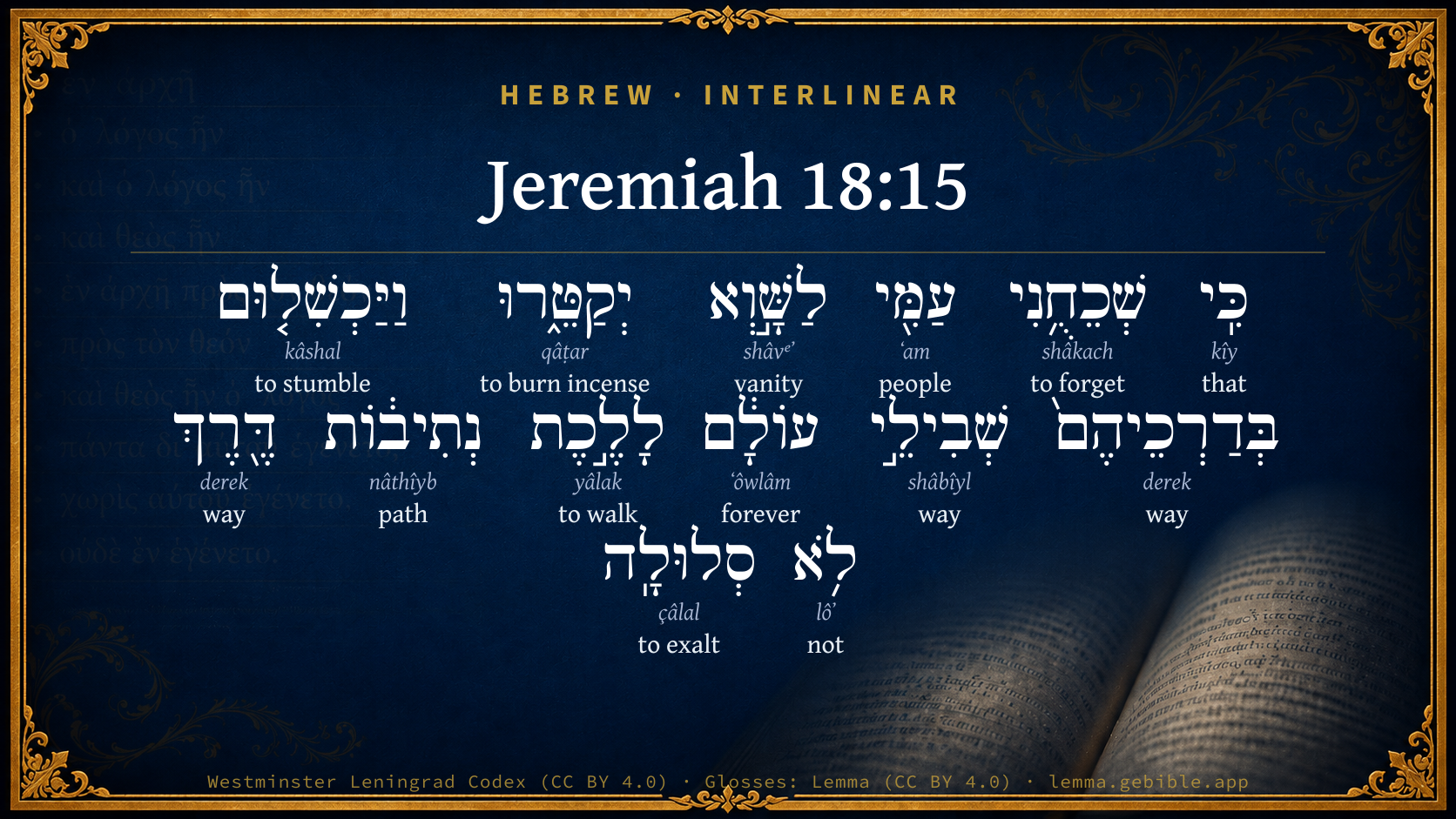
Hebrew (Westminster Leningrad Codex) Jeremiah 18:15 appears in the Hebrew Old Testament. The text above is from the Westminster Leningrad Codex. Each word links to its Strong’s number, a concise gloss, and parsing drawn from the Open Scriptures Hebrew Bible morphology. Click any word for its full Brown-Driver-Briggs (BDB) entry.
Download image
Cite this verse

Jeremiah 18:15 (World English Bible). Public Domain. Lemma interlinear Bible study tool, https://lemma.gebible.app/v/jeremiah/18/15.

Show BibTeX & RIS
BibTeX
RIS
English Translation
For my people have forgotten me, they have burned incense to false [gods]; and they have been made to stumble in their ways, in the ancient paths, to walk in byways, in a way not built up;
World English Bible · Public Domain
Download a study sheet

One document with this verse’s original text, its word-by-word gloss line, the meaning frame, cross-references with their text, attributed commentary, and full source and license credits — printable, and it pastes into notes with its structure intact.

This verse Autodidact and up

Study sheet (.html) Plain text (.txt)

A passage Seminary Student

Up to 50 verses in one chapter. A passage sheet keeps up to 6 commentary sources and 12 cross-references per verse, in the order this page ranks them, and says so on the sheet whenever that leaves anything out. Ask for a single verse and you get the Autodidact verse sheet above.

Everything on this page stays free to read, with no account — the sheet is a download of what is already on screen, not access to it.

Want to remove ads? Support Godless Engineer
Compare translations 3

The same verse in 3 English versions, stacked beneath the original-language interlinear above. Click any original word for its lexicon entry.

Each is an independent rendering of the whole verse — the interlinear is not word-aligned to these translations.

Highlighted words mark where these versions differ — a whole-verse word diff, not a word-by-word alignment.

  • World English Bible Public Domain
    For my people have forgotten me, they have burned incense to false [gods]; and they have been made to stumble in their ways, in the ancient paths, to walk in byways, in a way not built up;
  • King James Version Public Domain
    Because my people hath forgotten me, they have burned incense to vanity, and they have caused them to stumble in their ways from the ancient paths, to walk in paths, in a way not cast up;
  • unfoldingWord Literal Text CC BY-SA 4.0
    Yet my people have forgotten me; they burn incense to worthlessness, and they have caused themselves to stumble in their ways, the paths of old, to walk paths, a way not being built up,

unfoldingWord Literal Text — © unfoldingWord, licensed CC BY-SA 4.0. Word-aligned USFM3 via Door43 (git.door43.org/unfoldingWord/en_ult).

Versions to compare (up to 4)

3 of 4 selected

Show all 18 translations

Every available English version of this verse, each an independent rendering of the whole verse.

  • World English Bible Public Domain
    For my people have forgotten me, they have burned incense to false [gods]; and they have been made to stumble in their ways, in the ancient paths, to walk in byways, in a way not built up;
  • Berean Standard Bible Public Domain
    Yet My people have forgotten Me. They burn incense to worthless idols that make them stumble in their ways, leaving the ancient roads to walk on rutted bypaths instead of on the highway.
  • Majority Standard Bible Public Domain
    Yet My people have forgotten Me. They burn incense to worthless idols that make them stumble in their ways, leaving the ancient roads to walk on rutted bypaths instead of on the highway.
  • King James Version Public Domain
    Because my people hath forgotten me, they have burned incense to vanity, and they have caused them to stumble in their ways from the ancient paths, to walk in paths, in a way not cast up;
  • American Standard Version (1901) Public Domain
    For my people have forgotten me, they have burned incense to false `gods'; and they have been made to stumble in their ways, in the ancient paths, to walk in bypaths, in a way not cast up;
  • Revised Version (1885) Public Domain
    For my people hath forgotten me, they have burned incense to vanity; and they have caused them to stumble in their ways, in the ancient paths, to walk in bypaths, in a way not cast up;
  • Geneva Bible (1599) Public Domain
    Because my people hath forgotten me, and haue burnt incense to vanitie, and their prophets haue caused them to stumble in their wayes from the auncient wayes, to walke in the pathes and way that is not troden,
  • Douay-Rheims (1899) Public Domain
    Because my people have forgotten me, sacrificing in vain, and stumbling in their ways, in ancient paths, to walk by them in a way not trodden:
  • Young's Literal Translation Public Domain
    But My people have forgotten Me, to a vain thing they make perfume, And they cause them to stumble in their ways -- paths of old, To walk in paths -- a way not raised up,
  • Literal Standard Version CC BY-SA 4.0
    But My people have forgotten Me, they make incense to a vain thing, || And they cause them to stumble in their ways—paths of old, || To walk in paths—a way not raised up,
  • Unlocked Literal Bible CC BY-SA 4.0
    Yet my people have forgotten me. They have made offerings to useless idols and been made to stumble in their paths; they have left the ancient paths to walk lesser paths.
  • unfoldingWord Literal Text CC BY-SA 4.0
    Yet my people have forgotten me; they burn incense to worthlessness, and they have caused themselves to stumble in their ways, the paths of old, to walk paths, a way not being built up,
  • Darby Bible Public Domain
    For my people hath forgotten me: they burn incense to vanity; and they have caused them to stumble in their ways, the ancient paths, to walk in by-paths of a way not cast up;
  • World Messianic Bible Public Domain
    For my people have forgotten me. They have burned incense to false gods. They have been made to stumble in their ways in the ancient paths, to walk in byways, in a way not built up,
  • Webster's Bible Public Domain
    Because my people hath forgotten me, they have burned incense to vanity, and they have caused them to stumble in their ways from the ancient paths, to walk in paths, in a way not cast up;
  • Free Bible Version CC BY-SA 4.0
    But my people have rejected me! They burn incense to useless idols which trip them up, making them leave the old roads in order to walk down unmade paths instead of the highway.
  • Bible in Basic English Public Domain
    For my people have put me out of their memory, burning perfumes to that which is nothing; and because of this, I will put a cause of falling in their ways, even in the old roads, and will make them go on side-roads, in a way not lifted up;
  • JPS Tanakh (1917) Public Domain
    For My people hath forgotten Me, they offer unto vanity; and they have been made to stumble in their ways, in the ancient paths, to walk in bypaths, in a way not cast up;

Literal Standard Version (2020), Covenant Press — licensed CC BY-SA 4.0. Text via the HelloAO Bible API (eBible.org). Unlocked Literal Bible (unfoldingWord) — licensed CC BY-SA 4.0. Text via the HelloAO Bible API (eBible.org). unfoldingWord Literal Text — © unfoldingWord, licensed CC BY-SA 4.0. Word-aligned USFM3 via Door43 (git.door43.org/unfoldingWord/en_ult). Free Bible Version, Dr. Jonathan Gallagher — licensed CC BY-SA 4.0. Text via the HelloAO Bible API (eBible.org).

Word by word

More ways to search: Search by grammar → Find every occurrence → Compare this word →

Practice this passage: Drill this verse → Learn its vocabulary →

שְׁבִילֵ֣י
shâbîyl
H7635
“ways of”
Noun, Common, Masculine, Plural, Construct
Part of Speech
Noun
Type
Common
Gender
Masculine
Number
Plural
State
Construct
Full BDB Definition

Origin: from the same as H7640

TWOT: 2316d

way, path
  1. כִּֽי kîy H3588 “that” Conjunction
  2. שְׁכֵחֻ֥נִי shâkach H7911 “to forget · me” Verb, Qal, Perfect, 3rd Person, Common, Plural + Suffix, Personal, 1st Person, Common, Singular
  3. עַמִּ֖י ʻam H5971 “people · my” Noun, Common, Masculine, Singular, Construct + Suffix, Personal, 1st Person, Common, Singular
  4. לַשָּׁ֣וְא shâvᵉʼ H7723 “to/for the · vanity” Preposition, Determined + Noun, Common, Masculine, Singular, Absolute
  5. יְקַטֵּ֑רוּ qâṭar H6999 “to burn incense” Verb, Piel, Imperfect, 3rd Person, Masculine, Plural
  6. וַיַּכְשִׁל֤וּם kâshal H3782 “and · to stumble · them” Conjunction + Verb, Hiphil, Sequential Imperfect, 3rd Person, Masculine, Plural + Suffix, Personal, 3rd Person, Masculine, Plural
  7. בְּדַרְכֵיהֶם֙ derek H1870 “in/at · ways · their” Preposition + Noun, Common, Both, Plural, Construct + Suffix, Personal, 3rd Person, Masculine, Plural
  8. עוֹלָ֔ם ʻôwlâm H5769 “forever” Noun, Common, Masculine, Singular, Absolute
  9. לָלֶ֣כֶת yâlak H3212 “to walk” Preposition + Verb, Qal, Infinitive Construct
  10. נְתִיב֔וֹת nâthîyb H5410 “paths” Noun, Common, Both, Plural, Absolute
  11. דֶּ֖רֶךְ derek H1870 “way” Noun, Common, Both, Singular, Absolute
  12. לֹ֥א lôʼ H3808 “not” Particle, Negative
  13. סְלוּלָֽה çâlal H5549 “exalted” Verb, Qal, Participle Passive, Feminine, Singular, Absolute

About this verse

These counts appear in no published source. They are computed here, from the morphology-tagged text and Lemma’s own curated glosses. What Lemma adds →

14
words
13
distinct lemmas
Prophets
section

Notable vocabulary

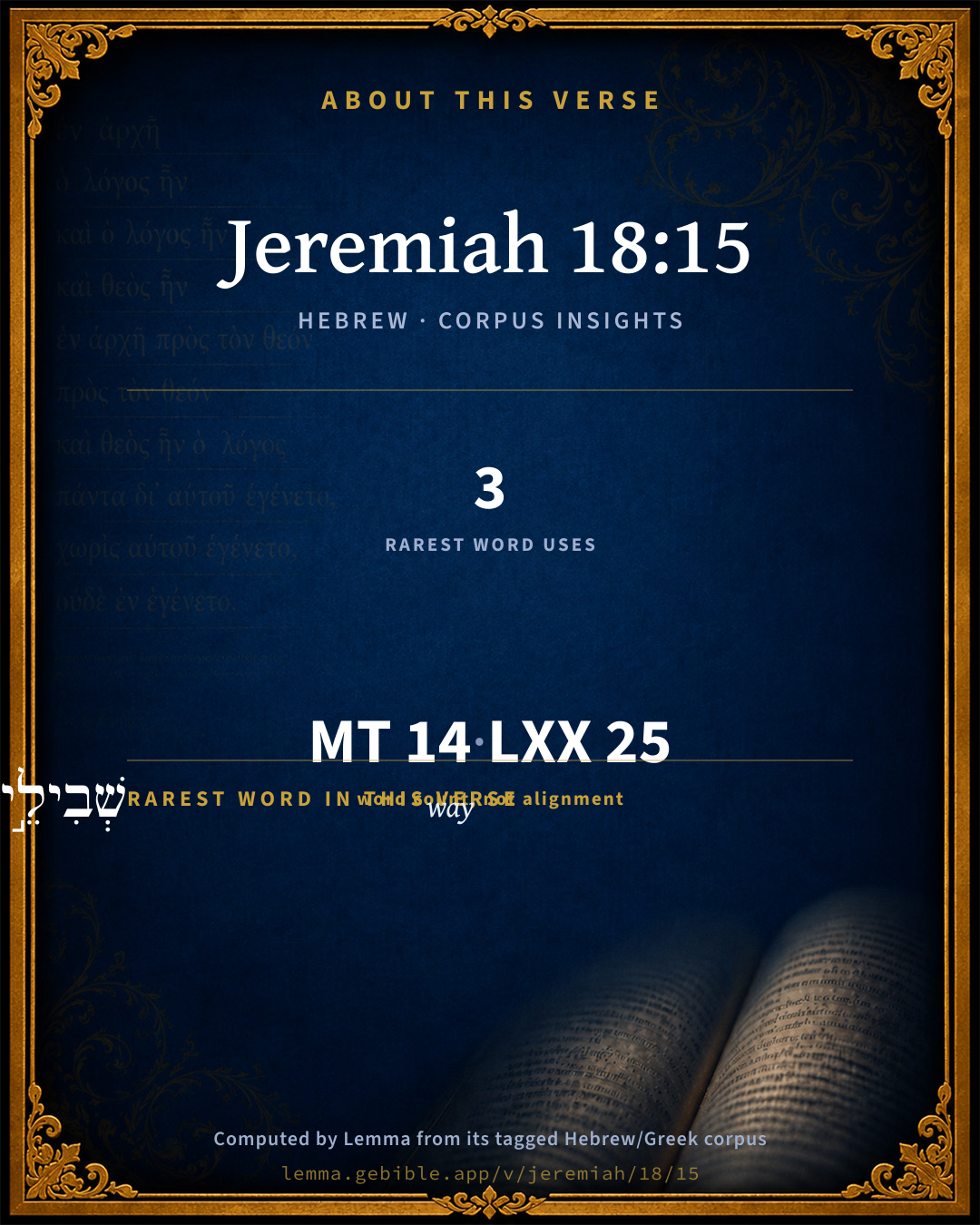
The rarest word here is שְׁבִילֵ֣י way H7635 — appearing just 3 times in the whole Hebrew Bible.

Shared distinctive vocabulary

שְׁבִילֵ֣י way H7635 occurs in 2 verses of the Hebrew Bible. Also found in:

Grammatical profile

  • 5 verbs
  • 7 nouns
  • 1 conjunction
  • 1 particle

Verb forms

  • שְׁכֵחֻ֥נִי Qal · Perfect
  • יְקַטֵּ֑רוּ Piel · Imperfect
  • וַיַּכְשִׁל֤וּם Hiphil · Sequential Imperfect
  • לָלֶ֣כֶת Qal · Infinitive Construct
  • סְלוּלָֽה Qal · Participle Passive

Repetition

A word recurs within this verse — often emphatic in Hebrew:

  • בְּדַרְכֵיהֶם֙ way H1870 ×2

Hebrew & Septuagint length

In the original languages it is 14 Hebrew tokens and 25 Greek tokens — but the two are counted differently (Hebrew bundles its prefixes and suffixes into one token; the Greek is in lemma form), so that isn’t a like-for-like length.

Cross-references

23

Topical passages linked to Jeremiah 18:15 in the Treasury of Scripture Knowledge — connected by theme and wording, ordered by reader-vote popularity; previews shown in the World English Bible.

  • Jeremiah 6:16 Thus says Yahweh, Stand you in the ways and see, and ask for the old paths, where is the good way; and walk therein, and you shall find rest for your souls: but they said, We will not walk [therein].
  • Jeremiah 2:32 Can a virgin forget her ornaments, or a bride her attire? yet my people have forgotten me days without number.
  • Isaiah 57:14 He will say, Cast up, cast up, prepare the way, take up the stumbling-block out of the way of my people.
  • Hosea 11:2 They called to them, so they went from them. They sacrificed to the Baals, And burned incense to engraved images.
  • Jeremiah 2:13 For my people have committed two evils: they have forsaken me, the spring of living waters, and hewed them out cisterns, broken cisterns, that can hold no water.
  • Malachi 2:8 But you have turned aside out of the way. You have caused many to stumble in the law. You have corrupted the covenant of Levi," says Yahweh of Hosts.
  • Isaiah 41:29 Behold, all of them, their works are vanity [and] nothing; their molten images are wind and confusion.
  • Jeremiah 10:15 They are vanity, a work of delusion: in the time of their visitation they shall perish.
  • Jeremiah 17:13 Yahweh, the hope of Israel, all who forsake you shall be disappointed. Those who depart from me shall be written in the earth, because they have forsaken Yahweh, the spring of living waters.
  • Jeremiah 3:21 A voice is heard on the bare heights, the weeping [and] the petitions of the children of Israel; because they have perverted their way, they have forgotten Yahweh their God.
  • Jeremiah 13:25 This is your lot, the portion measured to you from me, says Yahweh; because you have forgotten me, and trusted in falsehood.
  • Jeremiah 16:19 Yahweh, my strength, and my stronghold, and my refuge in the day of affliction, to you shall the nations come from the ends of the earth, and shall say, Our fathers have inherited nothing but lies, [even] vanity and things in which there is no profit.
  • Hosea 2:13 I will visit on her the days of the Baals, To which she burned incense, When she decked herself with her earrings and her jewels, And went after her lovers, And forgot me," says Yahweh.
  • Matthew 15:6 he shall not honor his father or mother.' You have made the commandment of God void because of your tradition.
  • Isaiah 3:12 As for my people, children are their oppressors, And women rule over them. My people, those who lead you cause you to err, And destroy the way of your paths.
  • Isaiah 9:16 For those who lead this people cause them to err; and those who are led of them are destroyed.
  • Isaiah 62:10 Go through, go through the gates; prepare you the way of the people; cast up, cast up the highway; gather out the stones; lift up an ensign for the peoples.
  • Jeremiah 19:5 and have built the high places of Baal, to burn their sons in the fire for burnt offerings to Baal; which I didn't command, nor spoke it, neither came it into my mind:
  • Jeremiah 44:15–19 Then all the men who knew that their wives burned incense to other gods, and all the women who stood by, a great assembly, even all the people who lived in the land of Egypt, in Pathros, answered Jeremiah, saying,
  • Jeremiah 44:25 Thus says Yahweh of Hosts, the God of Israel, saying, You and your wives have both spoken with your mouths, and with your hands have fulfilled it, saying, We will surely perform our vows that we have vowed, to burn incense to the queen of the sky, and to pour out drink-offerings to her: establish then your vows, and perform your vows.
  • Romans 14:21 It is good to not eat meat, drink wine, nor do anything by which your brother stumbles, is offended, or is made weak.
  • Isaiah 65:7 your own iniquities, and the iniquities of your fathers together, says Yahweh, who have burned incense on the mountains, and blasphemed me on the hills; therefore will I first measure their work into their bosom.
  • Jeremiah 2:19 Your own wickedness shall correct you, and your backsliding shall reprove you: know therefore and see that it is an evil thing and a bitter, that you have forsaken Yahweh your God, and that my fear is not in you, says the Lord, Yahweh of Hosts.

Cross-references courtesy of OpenBible.info (CC BY 4.0).

Hebrew and Greek witnesses Masoretic Hebrew ↔ Greek Septuagint

The same verse in the two great witnesses to the Old Testament, shown verse-for-verse.

These are two independent witnesses, not word-aligned to each other, and the Septuagint is shown in lemma (dictionary) form.

Hebrew Jeremiah 18:15 Masoretic · Westminster Leningrad Codex

כִּֽי שְׁכֵחֻ֥נִי עַמִּ֖י לַשָּׁ֣וְא יְקַטֵּ֑רוּ וַיַּכְשִׁל֤וּם בְּדַרְכֵיהֶם֙ שְׁבִילֵ֣י עוֹלָ֔ם לָלֶ֣כֶת נְתִיב֔וֹת דֶּ֖רֶךְ לֹ֥א סְלוּלָֽה

For my people have forgotten me, they have burned incense to false [gods]; and they have been made to stumble in their ways, in the ancient paths, to walk in byways, in a way not built up;

World English Bible · Public Domain

Greek LXX Structure differs

In the Septuagint, Jeremiah is about an eighth shorter than the Hebrew and arranges its material differently — the Oracles Against the Nations (Hebrew chapters 46–51) appear in the middle of the Greek book, after 25:13. Because the chapter and verse boundaries do not line up, a verse-for-verse comparison with the Hebrew is not shown.

A verse-for-verse comparison isn’t shown here because the chapters and verses don’t line up. Switch to the LXX edition with the MT / LXX toggle above to read the Greek directly.

On this verse, The Cambridge Bible for Schools and Colleges discusses the Septuagint’s reading. Read the note in Commentary ↓

Hebrew: Westminster Leningrad Codex (CC BY 4.0). Greek: Septuagint (public domain); English from a public-domain English Septuagint. How the Septuagint differs from the Hebrew →

Targum (Aramaic paraphrase)

1

The Targum is the ancient Jewish Aramaic paraphrase of the Hebrew Scriptures — an interpretive translation, not the Hebrew text itself. Onkelos (literal) and Pseudo-Jonathan (expansive) render the Torah, and Jonathan the Prophets. Coverage is partial: where no permissively-licensed English translation exists for a verse, only the Aramaic is shown. This is verse-level text, not a word-by-word alignment to the Hebrew.

  1. Targum Jonathan Prophets (Joshua–Malachi)
    אֲרֵי שְׁבָקוּ פּוּלְחַנִי עַמִי לָא לַהֲנָאָה אַסִיקוּ בּוּסְמִין וְאַטְעִיאוּנוּן בְּאוֹרְחַתְהוֹן בִּישְׁתָא מִשְׁבִילִין תַקְנָן דְמִן עַלְמָא לְמֵיזָל בְּאוֹרְחָן דְלָא תַקְנָן בִּשְׁבִילִין דְלָא מְכַבְשִׁין:

    (no public-domain English translation for this verse)

    Targum Jonathan — Aramaic: “Mikraot Gedolot” (public domain). English: “Sefaria Community Translation” (CC0 1.0 (public-domain dedication)); “London "Chaldee Paraphrase," 1871” (public domain). Text via Sefaria.

Commentary

Notes on Jeremiah 18:15 from classic Christian and Jewish commentators (each source and its license shown beneath its notes). The classic Christian expositions comment on the surrounding passage and are grouped to its opening verse, so a note may address several verses; the Jewish commentaries on the Tanakh (Rashi and others) are per-verse, so they appear only where the commentator wrote on this verse.

Lemma curates 59 commentaries, every one of them public domain or Creative Commons licensed, each selected and text-cleaned for this edition rather than reprinted as found. About our sources →

Trapp's Complete Commentary

John Trapp

Jer 18:15 Because my people hath forgotten me, they have burned incense to vanity, and they have caused them to stumble in their ways [from] the ancient paths, to walk in paths, [in] a way not cast up;

Ver. 15. Because my people hath forgotten me.] Not forsaken me only. Of all things God cannot abide to be forgotten; this is that very horrible thing, {Jer 18:13} this is filthiness in virgin Israel, which is most abominable.

From the ancient paths.] Chalked out by the law, and walked in by the patriarchs and prophets; Heb., Paths of antiquity or of eternity. Set a jealous eye upon novelties, and shun untrodden paths, as dangerous. {a}

{a} Vepreta avia.

John Trapp, A Commentary or Exposition upon All the Books of the Old and New Testament (1647–1656) — public domain. Text from a community e-Sword module.

Joseph Benson's Commentary

Jer 18:15-17. Because my people have forgotten me — The fountain of living waters; have forgotten what I am in myself, and what I have been, and am still ready to be to them; have lost their knowledge of me, and their remembrance of what I have done for them; they have burned incense to vanity — To vain idols, the products of men’s vain imaginations, and serving no good purpose whatever; and they have caused them to stumble, &c. — “The worship of idols hath perverted them from following the old, beaten track, plainly set forth in the law of Moses, and in the examples of former ages; (see Jer 6:16;) and hath engaged them in such new and untried ways of worship as will end in their ruin.” — Lowth. To make their land desolate — Though the Jews did not practise idolatry and other sins with this view for they wished nothing less than the desolation of their country; yet they acted as if they wished it, and God had sufficiently warned them it was an effect which would follow upon their conduct. And a perpetual hissing — To be hissed at perpetually by way of insult and scorn, by those who pass by. I will scatter them as with an east wind, &c. — The east wind, being dry and blasting, is commonly used to express the calamities of war, and such like wasting judgments. But the words may perhaps be more intelligibly rendered, As the east wind the stubble, so will I scatter them before the enemy. And I will show them the back and not the face — I will manifest the same aversion from them which they have shown from me; I will not favour but be against them. The metaphor is taken from the custom of kings and princes, which is, to turn their backs on, or go away from, those supplicants whose petitions they will not grant.

Joseph Benson's Commentary on the Old and New Testaments (1811–1818) — public domain. Text from a community e-Sword module.

Geneva Bible (1599)

Geneva Bible translators

That is, the way of truth which God had taught by his law, read Jer. 6:16.

Geneva Bible (1599) marginal notes — public domain. Text via Bolls.life.

Jamieson, Fausset & Brown

Robert Jamieson, A. R. Fausset & David Brown

Because--rather, "And yet"; in defiance of the natural order of things.

forgotten me-- (Jer 2:32). This implies a previous knowledge of God, whereas He was unknown to the Gentiles; the Jews' forgetting of God, therefore, arose from determined perversity.

they have caused . . . to stumble--namely the false prophets and idolatrous priests have.

ancient paths-- (Jer 6:16): the paths which their pious ancestors trod. Not antiquity indiscriminately, but the example of the fathers who trod the right way, is here commended.

them--the Jews.

not cast up--not duly prepared: referring to the raised center of the road. CALVIN translates, "not trodden." They had no precedent of former saints to induce them to devise for themselves a new worship.

Jamieson, Fausset & Brown — Commentary Critical and Explanatory on the Whole Bible (1871) — public domain (CC PDM 1.0). Text via the HelloAO Bible API.

John Calvin's Commentaries

We now perceive the meaning of this passage. It is doubtless natural for all to be satisfied with present blessings, especially when nothing better can anywhere else be found. When one has a fountain in his own field, why should he go elsewhere to drink? This would be monstrous. Dost thou want water? God supplies thee with it; take it from thine own fountain. If one objects and says, “That fountain I dislike; I wish to know whether better waters can be found at a distance.” This we see is a proof of brutal stupidity; for if the water which flows he cold and pure, and he dislikes it, because he wishes to go to the spring, he shews his own folly, whoever he may be. If, for instance, any one at this day would not drink the waters of the Rhone, which flows by here, and would not taste of the springs, but would run to the fountain and spring-head of the Rhone, would he not deserve to perish through thirst? God then shews that the Jews were so void of all sense and reason, that they ought to have been deemed detestable by all; and therefore in the application, when he says, My people have forgotten me, both clauses ought to be repeated. This indeed by itself would have been obscure, or at least not sufficiently explicit; but God here in substance repeats what he had said before, that he is the fountain of living water which was offered to the Jews; and also that his bounty flowed through various channels like living and cold waters. As then the people forgat God they were doubly ungrateful, for they refused to drink of the fountain itself, and disdained the cold and flowing waters, which were not hot to occasion a nausea; they were also pure and liquid, having no impure mixture in them.

He again calls them his people, but for the sake of reproaching them; for the less excusable was their perverseness, when God in an especial manner offered himself to them, and they refused his offered bounty. Had this been done by heathens it would have been no small sin, though God had not favored them with any remarkable privilege, but when the Jews had been chosen in preference to all others, it was as it were a monstrous thing that they forgot God, even him whom they had known. He was unknown to heathens, but he had made himself known to the Jews; hence this forgetfulness, with which the Prophet charged them, could not have proceeded from ignorance, but from determined perverseness.

He afterwards adds, In vain they burn incense to me, since to stumble, etc., (the copulative is to be rendered as a causal particle.) When he says, in vain they burn incense, it is to anticipate an objection. For we know that the Jews trusted in their ceremonial rites, so when they were reproved by the Prophets they had ever ready this answer, “We are the worshippers of God, for we constantly go up to the Temple, and he has promised that the incense which we offer shall be to him a sweet odor.” He at the same time includes under this word all the sacrifices, for it is said generally of them all, “A sweet odor shall ascend before the Lord.” Then by mentioning one thing he denotes all that external worship in which the Jews were sufficiently assiduous. But as the whole was nothing but hypocrisy, when the integrity of the heart was absent, the Prophet here dissipates this vain objection, and says, “In vain do they set forth their ceremonial rites, that they attend very regularly to their sacrifices, and that they do not neglect anything in the external worship of God: it is all in vain,” he says.

This truth is often referred to by the Prophets, and ought to be well known by the godly; yet we see how difficult it is to bring the world to believe it. Hypocrisy ever prevails, and men think that they perform all that is required of them when some kind of religion appears among them. But God, as we have before seen, has regard to the heart itself or integrity; yet this is what the world cannot comprehend. Therefore the Prophets do not without reason so often inculcate the truth, that inward piety, connected with integrity of heart, alone pleases God.

He afterwards mentions the cause — that they made them to stumble in their ways He means here no doubt the false teachers, who allured the people from the true and simple worship of God, and corrupted wholesome doctrine by their many fictions. And it is a common thing in Hebrew to leave a word, as we have said elsewhere, to be understood: they then made them to stumble, or to fall. The meaning is, that the sacrifices of the people could not be approved by God, because the whole of religion was corrupted. And the crime the Prophet names was, that the people were drawn aside from the right way, that is, from the law, which is alone the rule of piety and uprightness.

But we hence learn how frivolous is the excuse of those who say, that they follow what they have learnt from the fathers, and what has been delivered to them from the ancients, and received by universal consent; for God here declares, that the destruction of the people would follow, because they suffered themselves to be deceived by false prophets.

As to the words in their ways, or in their own ways, interpreters differ, and many apply the pronoun הם, em, to the false Prophets; but I prefer the other view, that they made them to stumble in their right ways, for by errors they led them away from the right course. When therefore he says, in their ways, the words are to be taken in a good sense; for God had pointed out the right way to the people. He then calls the doctrine of the law the ways to which the people had been accustomed. Then follows the expression, the paths of ages, which is to be taken in the same sense. But we must notice the contrast between those paths, and the way not trodden

This brevity may be deemed obscure; I will therefore give a more explicit explanation. The Prophet calls those the ways of the people in which they had been fully taught; and this took away every color of defense; for the people could not object and say that they had been deceived, as though they had not known what was right; for they had not only been taught, but had also been led as it were by the hand, so that the way of the law ought to have been well known by them. Then he adds, the paths of ages; for as the law had not been introduced a short time before, but for many ages, this antiquity ought to have strengthened their faith in God’s law. We now see how these two things bear on what is said, that the Jews, being deceived by false teachers, fell or stumbled in those ways to which they had been accustomed; and then in the paths of ages, that is, in the doctrine long before received, and whose authority had been for many ages established. On the other hand, he says that the Jews had been drawn to paths and to a way not trodden, that is, had been led from the right way into error. And he farther aggravates their sin by saying, that they preferred to go astray rather than to keep the way which had been trodden by their fathers.

But it may be here asked, whether this change in itself ought to be condemned, since we despise antiquity, or rather regard what is right? To this the easy reply is, that the Prophet speaks here in the name of God’ therefore this principle ought to be maintained, that there is no right way but what God himself has pointed out. Had any one else come and boasted antiquity, the Prophet would have laughed to scorn such boasting, and why? for what antiquity can be in men who vanish away? and when we count many ages, there is nothing constant and sure among men. It ought then to be noticed, that God. was the author of that way which the Prophet complains had been forsaken by the people, how the things which follow harmonize together, that the people had strayed from the way which they had long kept; for the Jews, as it has been said, had not followed any men, but God himself, who had been pleased to stretch forth his hand to them and to shew them the sure way of salvation; and we must also observe what sort of people were the fathers, even such as had followed God, and when they had such examples, they ought to have been more and more stimulated to imitate them.

It was therefore an inexcusable wickedness to forsake a way found good by long experience, the way of ages, which had been approved for a long time, and to depart into paths not trodden, for by no example, of the saints who were alone the true fathers, had they been led to devise for themselves new and fictitious modes of worship, and also to depart from the plain doctrine of the law. Had any one answered, that these ways had been long trodden, because they had both the Assyrians and the Egyptians as associates in their superstitions, such an exception could not be admitted, for the Prophet, as I have said, does not speak indiscriminately of any kind of examples, but of the examples of the fathers, who had been ruled and led by the Lord. It follows —

John Calvin's Commentaries (1540-1563) — public domain. Text from the Calvin Translation Society English edition (1840s-50s) via the Christian Classics Ethereal Library (ccel.org). Calvin's coverage is partial (roughly two-thirds of the Bible); uncommented books and verses are honest gaps, never fabricated. The 19th-century editor's footnotes and remarks are omitted so the notes are faithfully Calvin's own voice.

Ellicott's Commentary for English Readers

(15) Vanity.—The word is not that commonly so translated (as in Jer_2:5; Jer_10:8; Ecc_1:2, et al., q. 5), but that which had been used of idols in Jer_2:30; Jer_4:30; Jer_6:29, rendered “in vain.” See also Eze_13:6; Eze_13:8-9.

They have caused.—No persons have been named, but the prophet clearly has in view the prophets and teachers who had led the people astray.

To stumble in their ways from the ancient paths.—The preposition “from” is not in the Hebrew, and does not improve the sense. The words “the ancient paths,” literally, the paths of the age, or of eternity, are in apposition with “their ways,” and point to the old immemorial faith of the patriarchs, a faith not of to-day or yesterday. The second “paths” is a different word from the first, and implies rather the “by-ways,” as contrasted with the “way cast up,” the raised causeway, the “king’s highway,” on which a man could not well lose his way.

A Bible Commentary for English Readers, edited by Charles John Ellicott (1878–1897) — public domain. Text from a community e-Sword module.

The Cambridge Bible for Schools and Colleges

gen. ed. J. J. S. Perowne

15. For] This continues the thought of the 13th v., Jer_18:14 being parenthetic.

vanity] lit. unreality, meaning idols, but a different word from that used in Jer_2:5, where see notes. Here the sense is materially or morally unsubstantial or groundless. See Dr. Parallel Psalter, p. 464.

they have caused] The pronoun must refer to the idols (2Ch_28:23); but it is better, as the LXX’s rendering suggests, to translate have stumbled, thus retaining “the people” as the subject.

in the ancient paths] Cp. ch. Jer_6:16.

not cast up] not raised above the inequalities and obstructions of the adjoining fields.

The Cambridge Bible for Schools and Colleges (gen. ed. J. J. S. Perowne; Cambridge University Press, 1878–1918) — public domain. Text from a community e-Sword module.

John Gill's Exposition

I will scatter them as with an east wind before the enemy,.... As the east wind, which is generally strong and boisterous, drives the chaff and stubble, and anything that is light, before it, and scatters it here and there; so the Lord threatens to scatter the people of the Jews over the face of the earth, before their enemies, whom they should not be able to withstand. It denotes the power of the enemy God would make use of; the ease with which this should be done; and the utter dispersion of them; and is their present case:

I will show them the back, and not the face, in the day of their calamity; that is, will not look upon them in a favourable way, nor with any pity and compassion for them, nor hear their cries; but turn his back upon them, and a deaf ear unto them, and give them no help and relief, or deliver them out of their calamities; but suffer them to continue upon them, and them to sink under them; see Pro 1:26; which refers to the same time of calamity as here.

John Gill's Exposition of the Whole Bible (1746–1763) — public domain (CC PDM 1.0). Text via the HelloAO Bible API.

Albert Barnes' Notes on the Bible

Because - “For.” Jeremiah returns to, and continues the words of, Jer 18:13.

Vanity - A word meaning “falsehood,” which signifies that the worship of idols is not merely useless but injurious.

They have caused them to stumble - Judah’s prophets and priests were they who made her to err Jer 5:31. The idols were of themselves powerless for good or evil.

In their ways ... - Or, “in their ways, the everlasting paths, to walk in byways, in a road not cast up. The paths of eternity” carry back the mind not to the immediate but to the distant past, and suggest the good old ways in which the patriarchs used to walk. The “road cast up” means one raised sufficiently to keep it out of the reach of floods etc.

Albert Barnes' Notes on the Bible (1834–1885) — public domain. Text from a community e-Sword/MySword module.

Haydock's Catholic Bible Commentary

Ancient; followed by the patriarchs, chap. vi. 16.

George Leo Haydock (1774–1849), Haydock's Catholic Family Bible and Commentary, 1859 edition — public domain. Excludes Psalms (Douay-Rheims chapter numbering differs from Protestant) and Deuterocanonical books (Catholic canon only).

Matthew Poole's English Annotations

Forgotten and forsaken are much the same thing, differing only as the cause and the effect; for if men remembered God as they ought to do, they would not forsake him. By

vanity he means idols; which are called vanity, not only because they are in themselves nothing of what they are pretended to be, and because the worshipping of them is a high degree of sin, which is often called vanity in Scripture, but because the service of them is of no use nor profit, or advantage; and any expectations from them are idle and vain, for which there is no ground at all. Whether the false prophets or the idols are here said to cause them to stumble by receding from the

ancient paths is uncertain. The words may either be translated paths of eternity, or paths of antiquity; the most and best translate it as we do. Quid veturn primurn, The ways of truth are the most ancient ways; the ways wherein Noah, Abraham, Isaac, and Jacob, and all the ancient patriarchs did walk.

To walk in paths, or in a way not cast up, not fitting for God’s people to walk in. Pro 15:19, The way of the righteous is said to be a way made plain, Heb. raised up as a causey. Wicked men, in opposition to these ways, are said to walk

in a way not cast up.

Matthew Poole's English Annotations on the Holy Bible (1683–1685) — public domain. Text from a community e-Sword/MySword module.

Whedon's Commentary on the Bible

Daniel D. Whedon

15. They have caused — The construction here is impersonal — men have caused, etc. In all probability the reference is to Judah’s false prophets and false priests who really made her to err. Jer_5:31. The idols in themselves were powerless for either good or evil.

Ancient paths — Literally, paths of eternity: those ways which are laid in truth and so are changeless.

Not cast up — Raised up so as to be above the reach of the floods.

Daniel D. Whedon (gen. ed.), Commentary on the Old and New Testaments (1874–1909) — public domain. Text from a community e-Sword module.

The Pulpit Commentary

Because my people hath forgotten me; rather, Surely, etc.; or better still, Yet surely. It is not uncommon for a particle of asseveration to acquire a contrasting force from the context; see e.g. Jer_3:20 Isa_53:4; and, still more completely parallel, Isa_2:6 Jer_9:1, where Authorized Version, with substantial correctness, has "nevertheless." Israel "forgot" Jehovah; (as Jer_2:32) no doubt he was responsible for so doing, but still it was not "of malice response." To vanity; i.e. to the unreal idol-gods. And they have caused them to stumble; viz. the idol-gods; these are responsible (for they have a real existence in the consciousness of their worshippers) for this interruption of Israel"s spiritual progress. (comp. 2Ch_28:23) In their ways from the ancient paths. "From," however, is interpolated by the Authorized Version; the Hebrew places "the ancient paths" in apposition to "their ways," "Stand ye in the ways," Jeremiah cried at an earlier period, "and see, and ask for the old paths, which is the good way". (Jer_6:16) These "old" or "ancient" paths were ideally "their ways," the ways appointed for the Jews to walk in. To walk in paths; rather, in tracks, footpaths leading up and down and often ending in nothing; or, in other terms, in a way not cast up. (Isa_40:3, Isa_40:4, gives a graphic picture of the operation of "casting up a way

The Pulpit Commentary (1880–1919), ed. H.D.M. Spence-Jones & Joseph S. Exell — public domain. Text from a community e-Sword module.

John Wesley's Explanatory Notes

Vanity - Idols. Ancient paths - The ways wherein Noah, Abraham, Isaac, and Jacob, and all the ancient patriarchs walked. To walk - In a way not cast up, not fit for God's people to walk in.

John Wesley, Explanatory Notes Upon the Whole Bible (1754–1765) — public domain. Text via the GEBible commentary corpus.

unfoldingWord translationNotes

Door43 World Missions Community

been made to stumble in their paths

Yahweh speaks of a person's lifestyle as if it were a path along which he walks, and of living unfaithfully to him as if the person stumbled along the path. This can be stated in active form. AT: "this caused them to stumble in their paths" or "it is like they stumbled while walking on a path" (See: Metaphor and Active or Passive)

they have left the ancient paths to walk lesser paths

Yahweh speaks of a person's lifestyle as if it were a path along which he walks. Here, "the ancient paths" represents the way that Yahweh had told their ancestors to live and "lesser paths" represents living unfaithfully to Yahweh. (See: Metaphor)

will become a horror

The word "horror" may be translated with a verbal phrase. AT: "will become something that horrifies people" (See: Abstract Nouns)

an object of everlasting hissing

The word "hissing" refers to a sound that shows strong disapproval and can be translated with a verbal phrase. AT: "an object at which people will always hiss"

passes by her

Here the word "her" refers to "Their land."

I will scatter them before their enemies like an eastern wind

Yahweh speaks of causing the people to flee before their enemies as if he were an eastern wind that scatters dust and debris. AT: "I will be like an eastern wind and scatter them before their enemies" or "I will scatter them before their enemies like an eastern wind scatters dust and debris" (See: Metaphor)

will scatter them

Here the word "them" refers to "my people."

I will show them my back, and not my face

"I will turn my back toward them, and not my face." Turning one's back towards someone is a symbolic action that represents rejection and turning one's face towards someone is a symbolic action that represents favor. AT: "I will reject them and not act favorably towards them" (See: Symbolic Action)

translationWords

people of God

sacrifice

false god

stumble

walk

horror

eternity

adversary

unfoldingWord translationNotes — © Distant Shores Media and the Door43 World Missions Community, licensed CC BY-SA 4.0. Source: git.door43.org/Door43/en_tn.

Rashi

Rabbi Shlomo Yitzchaki (Rashi)

For so have My people done, that they have forgotten Me and burnt incense to vanity.

ancient paths The proper paths they said that they are a stumbling block, in order to go...[on] a way that is not trodden down Heb. סְלוּלָה.

Rashi on the Tanakh — English translations: “The Judaica Press complete Tanach with Rashi, translated by A. J. Rosenberg” (CC BY 4.0); “Pentateuch with Rashi's commentary by M. Rosenbaum and A.M. Silbermann, 1929-1934” (public domain); “The Metsudah Tanach series, Lakewood, N.J” (CC BY 4.0); and “The Book of Joshua, Metsudah Publications, 1997” (CC BY 4.0). Text via Sefaria.

Lesson kit

Teaching starters — assembled from the data on this page, not authored interpretation. Every prompt links to the verse data it draws on. Edit before teaching.

Jeremiah, in the Prophets, opens this verse with 14 words (13 distinct Hebrew lemmas). Its most distinctive word is shâbîyl (“way”). A historical commentator’s framing appears above. Read the whole chapter for the surrounding context.

Discussion questions

  1. What does “way” (shâbîyl) contribute to the verse as a whole?
  2. Psalms 77:19 shares the word «way» with this verse. How do the two illuminate each other?
  3. “way” occurs 2× in this one verse. What is the effect of the repetition?
  4. These translations render this verse differently; the difference is in the English rendering, not the original. What questions does that raise?
  5. The verb «שְׁכֵחֻ֥נִי» is Qal Perfect. How does its form color the action?
  6. Reading how Trapp's Complete Commentary and Joseph Benson's Commentary read this verse, where do the two commentators agree and where do they part?

Things to notice

Reading settings

Reading text

Shown beneath each verse's original-language words.

Old Testament
Old Testament edition

Read the OT as the Masoretic Hebrew (MT) or the Greek Septuagint (LXX).

English shown for the Greek Septuagint (in the Hebrew ↔ Greek comparison).

Comparing translations? Open the Compare panel on any verse page to stack up to four side by side.