
2 Chronicles 26:19

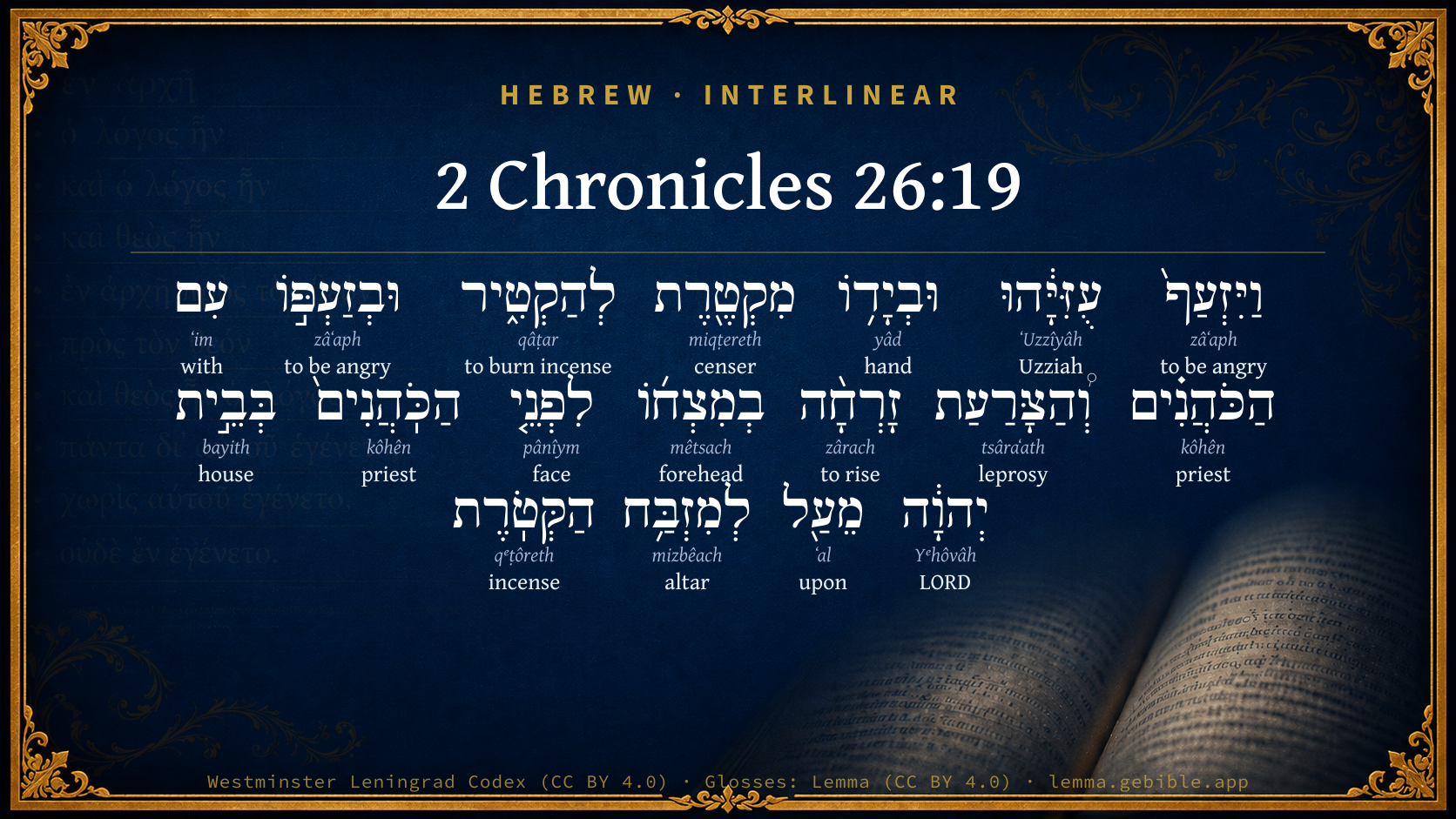
Hebrew (Westminster Leningrad Codex) 2 Chronicles 26:19 appears in the Hebrew Old Testament. The text above is from the Westminster Leningrad Codex. Each word links to its Strong’s number, a concise gloss, and parsing drawn from the Open Scriptures Hebrew Bible morphology. Click any word for its full Brown-Driver-Briggs (BDB) entry.
Download image
Cite this verse

2 Chronicles 26:19 (World English Bible). Public Domain. Lemma interlinear Bible study tool, https://lemma.gebible.app/v/2-chronicles/26/19.

Show BibTeX & RIS
BibTeX
RIS
English Translation
Then Uzziah was angry; and he had a censer in his hand to burn incense; and while he was angry with the priests, the leprosy broke forth in his forehead before the priests in the house of Yahweh, beside the altar of incense.
World English Bible · Public Domain
Highlights
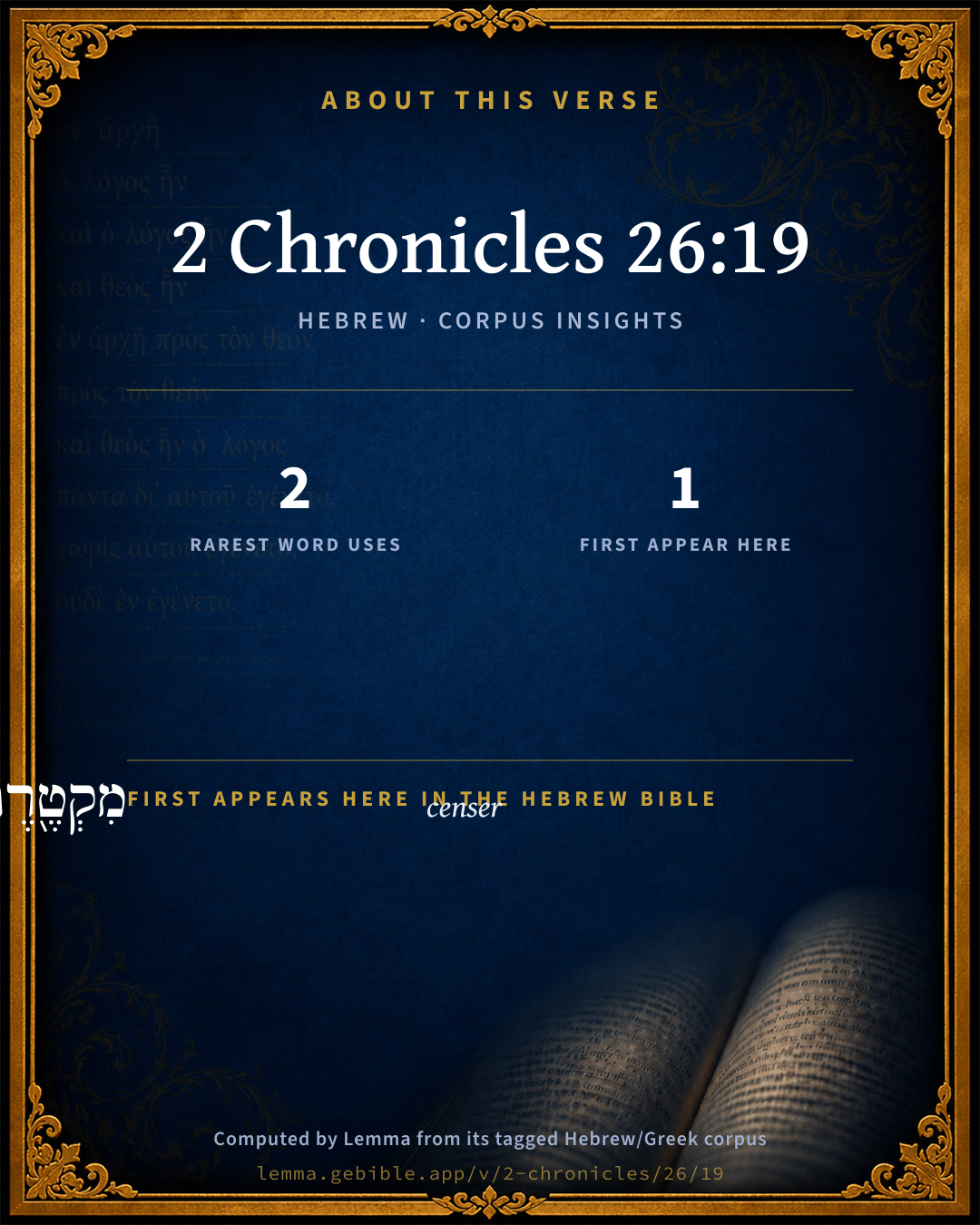
  • 1 first appearance in the Hebrew Bible
Full analysis ↓
Download a study sheet

One document with this verse’s original text, its word-by-word gloss line, the meaning frame, cross-references with their text, attributed commentary, and full source and license credits — printable, and it pastes into notes with its structure intact.

This verse Autodidact and up

Study sheet (.html) Plain text (.txt)

A passage Seminary Student

Up to 50 verses in one chapter. A passage sheet keeps up to 6 commentary sources and 12 cross-references per verse, in the order this page ranks them, and says so on the sheet whenever that leaves anything out. Ask for a single verse and you get the Autodidact verse sheet above.

Everything on this page stays free to read, with no account — the sheet is a download of what is already on screen, not access to it.

Want to remove ads? Support Godless Engineer
Compare translations 3

The same verse in 3 English versions, stacked beneath the original-language interlinear above. Click any original word for its lexicon entry.

Each is an independent rendering of the whole verse — the interlinear is not word-aligned to these translations.

Highlighted words mark where these versions differ — a whole-verse word diff, not a word-by-word alignment.

  • World English Bible Public Domain
    Then Uzziah was angry; and he had a censer in his hand to burn incense; and while he was angry with the priests, the leprosy broke forth in his forehead before the priests in the house of Yahweh, beside the altar of incense.
  • King James Version Public Domain
    Then Uzziah was wroth, and had a censer in his hand to burn incense: and while he was wroth with the priests, the leprosy even rose up in his forehead before the priests in the house of the LORD, from beside the incense altar.
  • unfoldingWord Literal Text CC BY-SA 4.0
    And Uzziah raged, and in his hand was a censer to sacrifice. And when he raged against the priests, and the leprosy, it appeared on his forehead before the priests in the house of Yahweh from beside the altar of incense.

unfoldingWord Literal Text — © unfoldingWord, licensed CC BY-SA 4.0. Word-aligned USFM3 via Door43 (git.door43.org/unfoldingWord/en_ult).

Versions to compare (up to 4)

3 of 4 selected

Show all 18 translations

Every available English version of this verse, each an independent rendering of the whole verse.

  • World English Bible Public Domain
    Then Uzziah was angry; and he had a censer in his hand to burn incense; and while he was angry with the priests, the leprosy broke forth in his forehead before the priests in the house of Yahweh, beside the altar of incense.
  • Berean Standard Bible Public Domain
    Uzziah, with a censer in his hand to offer incense, was enraged. But while he raged against the priests in their presence in the house of the LORD before the altar of incense, leprosy broke out on his forehead.
  • Majority Standard Bible Public Domain
    Uzziah, with a censer in his hand to offer incense, was enraged. But while he raged against the priests in their presence in the house of the LORD before the altar of incense, leprosy broke out on his forehead.
  • King James Version Public Domain
    Then Uzziah was wroth, and had a censer in his hand to burn incense: and while he was wroth with the priests, the leprosy even rose up in his forehead before the priests in the house of the LORD, from beside the incense altar.
  • American Standard Version (1901) Public Domain
    Then Uzziah was wroth; and he had a censer in his hand to burn incense; and while he was wroth with the priests, the leprosy brake forth in his forehead before the priests in the house of Jehovah, beside the altar of incense.
  • Revised Version (1885) Public Domain
    Then Uzziah was wroth; and he had a censer in his hand to burn incense; and while he was wroth with the priests, the leprosy brake forth in his forehead before the priests in the house of the LORD, beside the altar of incense.
  • Geneva Bible (1599) Public Domain
    Then Vzziah was wroth, and had incense in his hand to burne it: and while he was wroth with the Priestes, the leprosie rose vp in his forehead before the Priestes in the house of the Lord beside the incense altar.
  • Douay-Rheims (1899) Public Domain
    And Ozias was angry, and holding in his hand the censer to burn incense, threatened the priests. And presently there rose a leprosy in his forehead before the priests, in the house of the Lord at the altar of incense.
  • Young's Literal Translation Public Domain
    And Uzziah is wroth, and in his hand `is' a censer to make perfume, and in his being wroth with the priests -- the leprosy hath risen in his forehead, before the priests, in the house of Jehovah, from beside the altar of perfume.
  • Literal Standard Version CC BY-SA 4.0
    And Uzziah is angry, and in his hand [is] a censer to make incense, and in his being angry with the priests—the leprosy has risen in his forehead, before the priests, in the house of YHWH, from beside the altar of incense.
  • Unlocked Literal Bible CC BY-SA 4.0
    Then Uzziah became angry. He was holding a censer in his hand to burn incense. While he was angry with the priests, leprosy broke out on his forehead before the priests in the house of Yahweh, beside the altar of incense.
  • unfoldingWord Literal Text CC BY-SA 4.0
    And Uzziah raged, and in his hand was a censer to sacrifice. And when he raged against the priests, and the leprosy, it appeared on his forehead before the priests in the house of Yahweh from beside the altar of incense.
  • Darby Bible Public Domain
    And Uzziah was wroth; and he had a censer in his hand to burn incense; and while he was wroth with the priests, the leprosy rose up in his forehead before the priests in the house of Jehovah, beside the incense altar.
  • World Messianic Bible Public Domain
    Then Uzziah was angry. He had a censer in his hand to burn incense, and while he was angry with the priests, the leprosy broke out on his forehead before the priests in the LORD’s house, beside the altar of incense.
  • Webster's Bible Public Domain
    Then Uzziah was wroth, and had a censer in his hand to burn incense: and while he was wroth with the priests, the leprosy even rose up in his forehead before the priests in the house of the LORD, from beside the incense altar.
  • Free Bible Version CC BY-SA 4.0
    Uzziah, who was holding a censer in his hand to offer incense, became furious. But as he raged at the priests in the Lord's Temple in front of the altar of incense, leprosy appeared on his forehead.
  • Bible in Basic English Public Domain
    Then Uzziah was angry; and he had in his hand a vessel for burning perfume; and while his wrath was bitter against the priests, the mark of the leper's disease came out on his brow, before the eyes of the priests in the house of the Lord by the altar of perfumes.
  • JPS Tanakh (1917) Public Domain
    Then Uzziah was wroth; and he had a censer in his hand to burn incense; and while he was wroth with the priests, the leprosy broke forth in his forehead before the priests in the house of the LORD, beside the altar of incense.

Literal Standard Version (2020), Covenant Press — licensed CC BY-SA 4.0. Text via the HelloAO Bible API (eBible.org). Unlocked Literal Bible (unfoldingWord) — licensed CC BY-SA 4.0. Text via the HelloAO Bible API (eBible.org). unfoldingWord Literal Text — © unfoldingWord, licensed CC BY-SA 4.0. Word-aligned USFM3 via Door43 (git.door43.org/unfoldingWord/en_ult). Free Bible Version, Dr. Jonathan Gallagher — licensed CC BY-SA 4.0. Text via the HelloAO Bible API (eBible.org).

Word by word

More ways to search: Search by grammar → Find every occurrence → Compare this word →

Practice this passage: Drill this verse → Learn its vocabulary →

מִקְטֶ֖רֶת
miqṭereth
H4730
“censer”
Noun, Common, Feminine, Singular, Absolute
Part of Speech
Noun
Type
Common
Gender
Feminine
Number
Singular
State
Absolute
Full BDB Definition

Origin: from H4729

TWOT: 2011f

censer
  1. וַיִּזְעַף֙ zâʻaph H2196 “and · to be angry” Conjunction + Verb, Qal, Sequential Imperfect, 3rd Person, Masculine, Singular
  2. עֻזִּיָּ֔הוּ ʻUzzîyâh H5818 “Uzziah” Noun, Proper
  3. וּבְיָד֥וֹ yâd H3027 “and · in/at · hand · his” Conjunction + Preposition + Noun, Common, Both, Singular, Construct + Suffix, Personal, 3rd Person, Masculine, Singular
  4. לְהַקְטִ֑יר qâṭar H6999 “to burn incense” Preposition + Verb, Hiphil, Infinitive Construct
  5. וּבְזַעְפּ֣וֹ zâʻaph H2196 “and · in/at · to be angry · him” Conjunction + Preposition + Verb, Qal, Infinitive Construct + Suffix, Personal, 3rd Person, Masculine, Singular
  6. עִם ʻim H5973 “with” Preposition
  7. הַכֹּהֲנִ֗ים kôhên H3548 “the · priests” Particle, Definite Article + Noun, Common, Masculine, Plural, Absolute
  8. וְ֠הַצָּרַעַת tsâraʻath H6883 “and · the · leprosy” Conjunction + Particle, Definite Article + Noun, Common, Feminine, Singular, Absolute
  9. זָרְחָ֨ה zârach H2224 “to rise” Verb, Qal, Perfect, 3rd Person, Feminine, Singular
  10. בְמִצְח֜וֹ mêtsach H4696 “in/at · forehead · his” Preposition + Noun, Common, Masculine, Singular, Construct + Suffix, Personal, 3rd Person, Masculine, Singular
  11. לִפְנֵ֤י pânîym H6440 “to/for · face(s) of” Preposition + Noun, Common, Both, Plural, Construct
  12. הַכֹּֽהֲנִים֙ kôhên H3548 “the · priests” Particle, Definite Article + Noun, Common, Masculine, Plural, Absolute
  13. בְּבֵ֣ית bayith H1004 “in/at · house of” Preposition + Noun, Common, Masculine, Singular, Construct
  14. יְהוָ֔ה Yᵉhôvâh H3068 “LORD” Noun, Proper
  15. מֵעַ֖ל ʻal H5921 “from · upon” Preposition + Preposition
  16. לְמִזְבַּ֥ח mizbêach H4196 “to/for · altar of” Preposition + Noun, Common, Masculine, Singular, Construct
  17. הַקְּטֹֽרֶת qᵉṭôreth H7004 “the · incense” Particle, Definite Article + Noun, Common, Feminine, Singular, Absolute

About this verse

These counts appear in no published source. They are computed here, from the morphology-tagged text and Lemma’s own curated glosses. What Lemma adds →

18
words
16
distinct lemmas
Historical
section

Notable vocabulary

The rarest word here is מִקְטֶ֖רֶת censer H4730 — appearing just 2 times in the whole Hebrew Bible.

First appearance in Scripture

This word makes its first canonical appearance in the Hebrew Bible here:

  • מִקְטֶ֖רֶת censer H4730

Shared distinctive vocabulary

מִקְטֶ֖רֶת censer H4730 occurs in 2 verses of the Hebrew Bible. Also found in:

Grammatical profile

  • 4 verbs
  • 12 nouns
  • 2 prepositions

Verb forms

  • וַיִּזְעַף֙ Qal · Sequential Imperfect
  • לְהַקְטִ֑יר Hiphil · Infinitive Construct
  • וּבְזַעְפּ֣וֹ Qal · Infinitive Construct
  • זָרְחָ֨ה Qal · Perfect

Repetition

Words recur within this verse — often emphatic in Hebrew:

  • וַיִּזְעַף֙ to be angry H2196 ×2
  • הַכֹּהֲנִ֗ים priest H3548 ×2

Hebrew & Septuagint length

In English translation the verse runs 43 words from the Hebrew and 47 from the Septuagint (LXX English) — closely comparable.

A rough comparison of the two English renderings, which tokenize alike — not a word-level alignment.

Word counts can differ between the Hebrew and the Greek without any difference in meaning — e.g. the Hebrew direct-object marker אֵת has no separate Greek word, and Greek often adds the article ὁ.

Cross-references

4

Topical passages linked to 2 Chronicles 26:19 in the Treasury of Scripture Knowledge — connected by theme and wording, ordered by reader-vote popularity; previews shown in the World English Bible.

  • Numbers 12:10 The cloud removed from over the Tent; and, behold, Miriam was leprous, as [white as] snow: and Aaron looked at Miriam, and, behold, she was leprous.
  • 2 Kings 5:25–27 But he went in, and stood before his master. Elisha said to him, Whence come you, Gehazi? He said, Your servant went no where.
  • 2 Chronicles 25:16 It happened, as he talked with him, that [the king] said to him, Have we made you of the king's counsel? Stop! Why should you be struck down? Then the prophet stopped, and said, I know that God has determined to destroy you, because you have done this, and have not listened to my counsel.
  • 2 Chronicles 16:10 Then Asa was angry with the seer, and put him in the prison-house; for he was in a rage with him because of this thing. Asa oppressed some of the people at the same time.

Cross-references courtesy of OpenBible.info (CC BY 4.0).

Hebrew and Greek witnesses Masoretic Hebrew ↔ Greek Septuagint

The same verse in the two great witnesses to the Old Testament, shown verse-for-verse.

These are two independent witnesses, not word-aligned to each other, and the Septuagint is shown in lemma (dictionary) form.

Hebrew 2 Chronicles 26:19 Masoretic · Westminster Leningrad Codex

וַיִּזְעַף֙ עֻזִּיָּ֔הוּ וּבְיָד֥וֹ מִקְטֶ֖רֶת לְהַקְטִ֑יר וּבְזַעְפּ֣וֹ עִם הַכֹּהֲנִ֗ים וְ֠הַצָּרַעַת זָרְחָ֨ה בְמִצְח֜וֹ לִפְנֵ֤י הַכֹּֽהֲנִים֙ בְּבֵ֣ית יְהוָ֔ה מֵעַ֖ל לְמִזְבַּ֥ח הַקְּטֹֽרֶת

Then Uzziah was angry; and he had a censer in his hand to burn incense; and while he was angry with the priests, the leprosy broke forth in his forehead before the priests in the house of Yahweh, beside the altar of incense.

World English Bible · Public Domain

Greek LXX 2 Chronicles 26:19 Septuagint · lemma form

καί θυμόω οζιας καί ἐν ὁ χείρ αὐτός ὁ θυμιατήριον ὁ θυμιάω ἐν ὁ ναός καί ἐν ὁ θυμόω αὐτός πρός ὁ ἱερεύς καί ὁ λέπρα ἀνατέλλω ἐν ὁ μέτωπον αὐτός ἐναντίον ὁ ἱερεύς ἐν οἶκος κύριος ἐπάνω ὁ θυσιαστήριον ὁ θυμίαμα

And Ozias was angry, and in his hand was the censer to burn incense in the temple: and when he was angry with the priests, then the leprosy rose up in his forehead before the priests in the house of the Lord, over the altar of incense.

LXX2012 (modern English Septuagint) · Public Domain

Hebrew: Westminster Leningrad Codex (CC BY 4.0). Greek: Septuagint (public domain); English from LXX2012 (modern English Septuagint) (Public Domain). How the Septuagint differs from the Hebrew →

Commentary

Notes on 2 Chronicles 26:19 from classic Christian and Jewish commentators (each source and its license shown beneath its notes). The classic Christian expositions comment on the surrounding passage and are grouped to its opening verse, so a note may address several verses; the Jewish commentaries on the Tanakh (Rashi and others) are per-verse, so they appear only where the commentator wrote on this verse.

Lemma curates 59 commentaries, every one of them public domain or Creative Commons licensed, each selected and text-cleaned for this edition rather than reprinted as found. About our sources →

Trapp's Complete Commentary

John Trapp

2Ch 26:19 Then Uzziah was wroth, and [had] a censer in his hand to burn incense: and while he was wroth with the priests, the leprosy even rose up in his forehead before the priests in the house of the LORD, from beside the incense altar.

Ver. 19. Then Uzziah was wroth.] See on 2Ch 24:21; 2Ch 24:20.

The leprosy even rose up in his forehead.] Let our lay preachers look to it, though not presently punished, as here God will maintain his own order set by himself in Church or State, and take an order, sooner or later, with such as violate the same. See 2Ki 15:5.

Before the priests.] To show that he sideth with them.

From beside the incense altar.] Or, From upon; which showeth, saith one, {a} that by some visible sign - as by some vapour or ashes stirred up, &c., against Uzziah’s face - God manifested that this leprosy was immediately sent from him. Josephus saith that that terrible earthquake {Amo 1:1 Zec 14:5} happened at this time, with other prodigies.

{a} Diod.

John Trapp, A Commentary or Exposition upon All the Books of the Old and New Testament (1647–1656) — public domain. Text from a community e-Sword module.

The Biblical Illustrator

Joseph S. Exell

2Ch_26:19

Then Uzziah was wroth.

Impatience of reproof

How often is the sinner only provoked to greater wickedness by the obstacles which Divine grace opposes to his wrong-doing! How few men will tolerate the suggestion that their intentions are cruel, selfish, or dishonourable! Remonstrance is an insult, an offence against their personal dignity; they feel that their self-respect demands that they should persevere in their purpose, and that they should resent and punish any one who has tried to thwart them. The most dramatic feature of this episode, the sudden frost of leprosy in the kings forehead, is not without its spiritual antitype. Mens anger at well-merited reproof has often blighted their lives once for all with ineradicable moral leprosy. In the madness of passion they have broken bonds which have hitherto restrained them and committed themselves beyond recall to evil pursuits and fatal friendships. (W. H. Bennett, M.A.)

.

The Biblical Illustrator, edited by Joseph S. Exell (c. 1880s–1900s) — public domain. Text from a community e-Sword module.

Joseph Benson's Commentary

2Ch 26:19. Then Uzziah was wroth — With the priests. While he was wroth the leprosy rose up in his forehead — So that he could not hide his shame: though it is probable it was also in the rest of his body. From beside the incense-altar — By a stroke from an invisible hand, coming from the altar; that he might be assured this was the effect of God’s displeasure.

Joseph Benson's Commentary on the Old and New Testaments (1811–1818) — public domain. Text from a community e-Sword module.

Ellicott's Commentary for English Readers

(19) Then.—And.

Was wroth.—Zaʻaf i.e., foamed with anger.

And had.—And in his hand was a censer (Eze_8:11).

Even.—Omit.

Rose up.—Zarah. The word is not used in this sense elsewhere.

From beside—i.e., near, hard by.

Uzziah’s punishment was the same as that which fell upon Miriam (Num_12:10) and Gehazi (2Ki_5:27). Thenius, while asserting the historical character of Uzziah’s invasion of the sanctuary, declares that the chronicler has followed traditional exegesis in making the king’s leprosy a judgment upon his offence. At all events, we may be sure that the chronicler has given the story as he found it in the history of Uzziah, to which he alludes in 2Ch_26:22.

In Josephus the story is further embellished by the statements that the great earthquake mentioned in Amo_1:1 happened at the moment when Uzziah threatened the opposing priests; and that a ray of sunlight falling upon the king’s face through the Temple roof, which was cloven by the shock, produced the leprosy. (Comp. Amo_4:11; Zec_14:4-5.)

A Bible Commentary for English Readers, edited by Charles John Ellicott (1878–1897) — public domain. Text from a community e-Sword module.

The Cambridge Bible for Schools and Colleges

gen. ed. J. J. S. Perowne

19. and had] R.V. and he had.

even rose up] R.V. brake forth.

The Cambridge Bible for Schools and Colleges (gen. ed. J. J. S. Perowne; Cambridge University Press, 1878–1918) — public domain. Text from a community e-Sword module.

John Gill's Exposition

And Uzziah the king was a leper unto the day of his death, and dwelt in a several house, being a leper,.... See Gill on Kg2 15:5,

for he was cut off from the house of the Lord; not, suffered to enter into that, because of his uncleanness:

and Jotham his son was over the king's house, judging the people of the land; see Kg2 15:5.

John Gill's Exposition of the Whole Bible (1746–1763) — public domain (CC PDM 1.0). Text via the HelloAO Bible API.

Haydock's Catholic Bible Commentary

Forehead. So that it could not be concealed. According to the rigour of the law, such an offender was to be slain, Num. iii. 10., and xviii. 7. The leprosy was considered as equivalent, and is styled destruction, (v. 16,) and death, Isaias vi. 1. M. See 4 K. xv. 6.

George Leo Haydock (1774–1849), Haydock's Catholic Family Bible and Commentary, 1859 edition — public domain. Excludes Psalms (Douay-Rheims chapter numbering differs from Protestant) and Deuterocanonical books (Catholic canon only).

Matthew Poole's English Annotations

Uzziah was wroth with the priests. The leprosy even rose up in his forehead; so as he could not hide his shame; though it is probable it was also in the rest of his body.

From beside the incense altar; by a stroke from an invisible hand coming from the altar, that he might be assured that this was the effect of God’s just displeasure against him.

Matthew Poole's English Annotations on the Holy Bible (1683–1685) — public domain. Text from a community e-Sword/MySword module.

Whedon's Commentary on the Bible

Daniel D. Whedon

19. The leprosy even rose up in his forehead — A judgment as sudden and signal as that which smote Miriam and Gehazi. Num_12:10; 2Ki_5:27. The offence was such as to demand swift and signal retribution.

Daniel D. Whedon (gen. ed.), Commentary on the Old and New Testaments (1874–1909) — public domain. Text from a community e-Sword module.

The Pulpit Commentary

Render, Then Uzziah was wrath, and in his hand (at that moment) was a censer to burn incense, etc. From the most literal rendering of the Hebrew text, not unfrequently the most forcible Bible English results. From beside; render, at the very side of. (comp. 2Ki_5:27)

The Pulpit Commentary (1880–1919), ed. H.D.M. Spence-Jones & Joseph S. Exell — public domain. Text from a community e-Sword module.

John Wesley's Explanatory Notes

His forehead - So that he could not hide his shame: though it is probable it was also in the rest of his body. From beside - By a stroke from an invisible hand coming from the altar; that he might be assured this was the effect of God's displeasure.

John Wesley, Explanatory Notes Upon the Whole Bible (1754–1765) — public domain. Text via the GEBible commentary corpus.

unfoldingWord translationNotes

Door43 World Missions Community

censer

This is a special pan or bowl used for burning incense.

behold, he had become leprous

The word "behold" here shows that the priests were surprised by what they saw.

They quickly drove him out of there

"They quickly forced him out of there" or "They quickly made him leave"

Yahweh had struck him

This speaks of Yahweh making him sick as if Yahweh had hit him. AT: "Yahweh had made him ill" (See: Metaphor)

translationWords

anger

leper

altar

chief priests

unfoldingWord translationNotes — © Distant Shores Media and the Door43 World Missions Community, licensed CC BY-SA 4.0. Source: git.door43.org/Door43/en_tn.

Rashi

Rabbi Shlomo Yitzchaki (Rashi)

and in his hand was a censer to burn and he wished to strike the priest who prevented him from burning incense.

Rashi on the Tanakh — English translations: “The Judaica Press complete Tanach with Rashi, translated by A. J. Rosenberg” (CC BY 4.0); “Pentateuch with Rashi's commentary by M. Rosenbaum and A.M. Silbermann, 1929-1934” (public domain); “The Metsudah Tanach series, Lakewood, N.J” (CC BY 4.0); and “The Book of Joshua, Metsudah Publications, 1997” (CC BY 4.0). Text via Sefaria.

Lesson kit

Teaching starters — assembled from the data on this page, not authored interpretation. Every prompt links to the verse data it draws on. Edit before teaching.

2 Chronicles, in the Historical, opens this verse with 18 words (16 distinct Hebrew lemmas). Its most distinctive word is miqṭereth (“censer”). A historical commentator’s framing appears above. Read the whole chapter for the surrounding context.

Discussion questions

  1. The word miqṭereth carries the sense “censer.” How does it shape the verse?
  2. The word “censer” first appears here in Scripture. What is being introduced at this debut?
  3. Ezekiel 8:11 shares the word «censer» with this verse. How do the two illuminate each other?
  4. “to be angry” occurs 2× in this one verse. What is the effect of the repetition?
  5. These translations render this verse differently; the difference is in the English rendering, not the original. What questions does that raise?
  6. The verb «וַיִּזְעַף֙» is Qal Sequential Imperfect. How does its form color the action?
  7. Reading how Trapp's Complete Commentary and The Biblical Illustrator read this verse, where do the two commentators agree and where do they part?

Things to notice

  • 1 word makes its first canonical appearance in Scripture here.
  • These translations choose different wording for 17 words in this verse.
  • “to be angry” occurs 2× in this single verse.
  • 16 distinct Hebrew lemmas span 18 words in this verse.

Reading settings

Reading text

Shown beneath each verse's original-language words.

Old Testament
Old Testament edition

Read the OT as the Masoretic Hebrew (MT) or the Greek Septuagint (LXX).

English shown for the Greek Septuagint (in the Hebrew ↔ Greek comparison).

Comparing translations? Open the Compare panel on any verse page to stack up to four side by side.