
Jeremiah 11:17

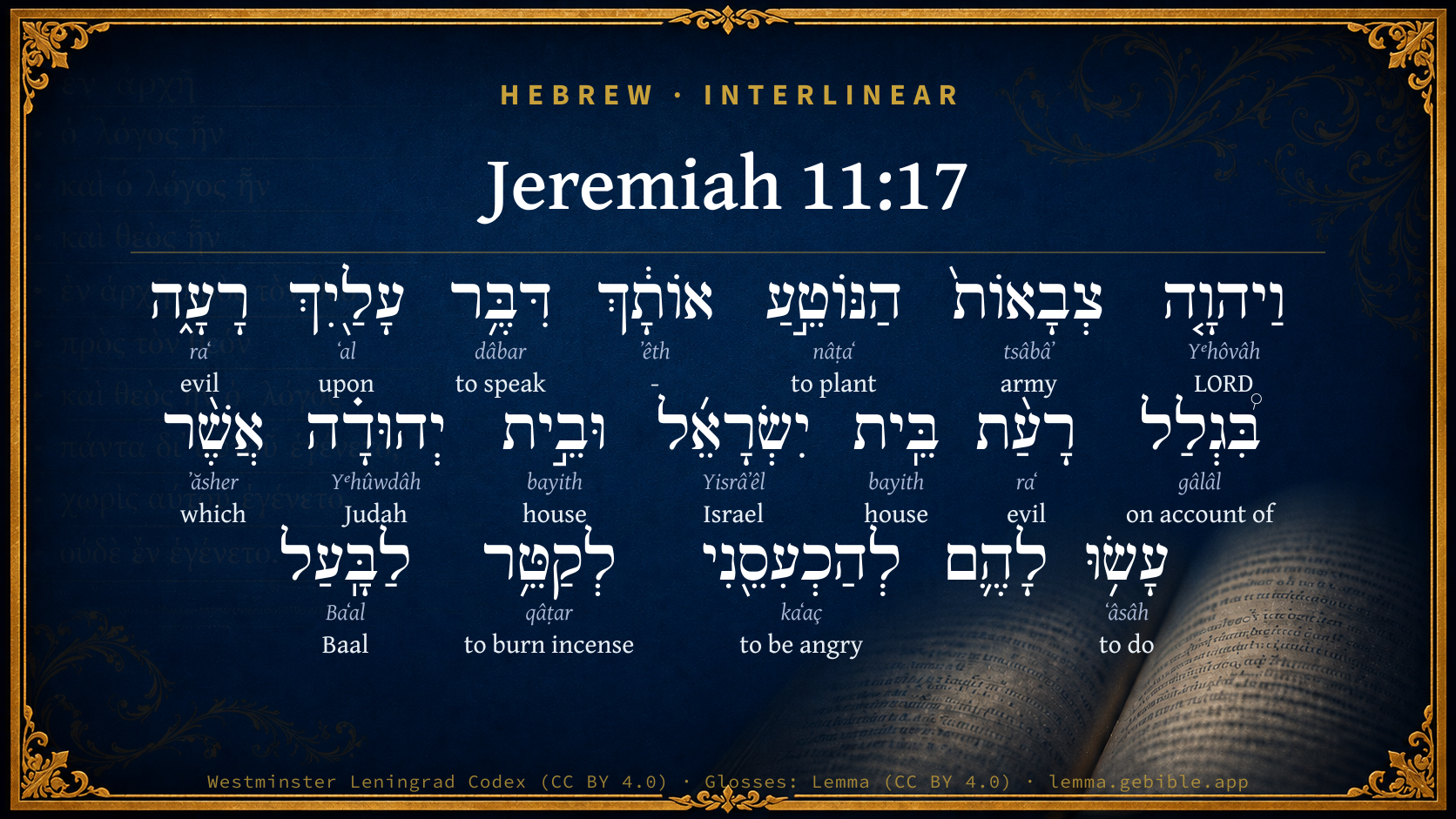
Hebrew (Westminster Leningrad Codex) Jeremiah 11:17 appears in the Hebrew Old Testament. The text above is from the Westminster Leningrad Codex. Each word links to its Strong’s number, a concise gloss, and parsing drawn from the Open Scriptures Hebrew Bible morphology. Click any word for its full Brown-Driver-Briggs (BDB) entry.
Download image
Cite this verse

Jeremiah 11:17 (World English Bible). Public Domain. Lemma interlinear Bible study tool, https://lemma.gebible.app/v/jeremiah/11/17.

Show BibTeX & RIS
BibTeX
RIS
English Translation
For Yahweh of Hosts, who planted you, has pronounced evil against you, because of the evil of the house of Israel and of the house of Judah, which they have worked for themselves in provoking me to anger by offering incense to Baal.
World English Bible · Public Domain
Download a study sheet

One document with this verse’s original text, its word-by-word gloss line, the meaning frame, cross-references with their text, attributed commentary, and full source and license credits — printable, and it pastes into notes with its structure intact.

This verse Autodidact and up

Study sheet (.html) Plain text (.txt)

A passage Seminary Student

Up to 50 verses in one chapter. A passage sheet keeps up to 6 commentary sources and 12 cross-references per verse, in the order this page ranks them, and says so on the sheet whenever that leaves anything out. Ask for a single verse and you get the Autodidact verse sheet above.

Everything on this page stays free to read, with no account — the sheet is a download of what is already on screen, not access to it.

Want to remove ads? Support Godless Engineer
Compare translations 3

The same verse in 3 English versions, stacked beneath the original-language interlinear above. Click any original word for its lexicon entry.

Each is an independent rendering of the whole verse — the interlinear is not word-aligned to these translations.

Highlighted words mark where these versions differ — a whole-verse word diff, not a word-by-word alignment.

  • World English Bible Public Domain
    For Yahweh of Hosts, who planted you, has pronounced evil against you, because of the evil of the house of Israel and of the house of Judah, which they have worked for themselves in provoking me to anger by offering incense to Baal.
  • King James Version Public Domain
    For the LORD of hosts, that planted thee, hath pronounced evil against thee, for the evil of the house of Israel and of the house of Judah, which they have done against themselves to provoke me to anger in offering incense unto Baal.
  • unfoldingWord Literal Text CC BY-SA 4.0
    For Yahweh of hosts, the one who planted you, has spoken calamity against you because of the evil of the house of Israel and the house of Judah which they have done to anger me, offering to Baal.’”

unfoldingWord Literal Text — © unfoldingWord, licensed CC BY-SA 4.0. Word-aligned USFM3 via Door43 (git.door43.org/unfoldingWord/en_ult).

Versions to compare (up to 4)

3 of 4 selected

Show all 18 translations

Every available English version of this verse, each an independent rendering of the whole verse.

  • World English Bible Public Domain
    For Yahweh of Hosts, who planted you, has pronounced evil against you, because of the evil of the house of Israel and of the house of Judah, which they have worked for themselves in provoking me to anger by offering incense to Baal.
  • Berean Standard Bible Public Domain
    The LORD of Hosts, who planted you, has decreed disaster against you on account of the evil that the house of Israel and the house of Judah have brought upon themselves, provoking Me to anger by burning incense to Baal.”
  • Majority Standard Bible Public Domain
    The LORD of Hosts, who planted you, has decreed disaster against you on account of the evil that the house of Israel and the house of Judah have brought upon themselves, provoking Me to anger by burning incense to Baal.”
  • King James Version Public Domain
    For the LORD of hosts, that planted thee, hath pronounced evil against thee, for the evil of the house of Israel and of the house of Judah, which they have done against themselves to provoke me to anger in offering incense unto Baal.
  • American Standard Version (1901) Public Domain
    For Jehovah of hosts, who planted thee, hath pronounced evil against thee, because of the evil of the house of Israel and of the house of Judah, which they have wrought for themselves in provoking me to anger by offering incense unto Baal.
  • Revised Version (1885) Public Domain
    For the LORD of hosts, that planted thee, hath pronounced evil against thee, because of the evil of the house of Israel and of the house of Judah, which they have wrought for themselves in provoking me to anger by offering incense unto Baal.
  • Geneva Bible (1599) Public Domain
    For the Lord of hostes that planted thee, hath pronounced a plague against thee, for the wickednes of the house of Israel, and of the house of Iudah, which they haue done against themselues to prouoke me to anger in offering incense vnto Baal.
  • Douay-Rheims (1899) Public Domain
    And the Lord of hosts that planted thee, hath pronounced evil against thee: for the evils of the house of Israel, and the house of Juda, which they have done to themselves, to provoke me, offering sacrifice to Baalim.
  • Young's Literal Translation Public Domain
    And Jehovah of Hosts, who is planting thee, Hath spoken evil concerning thee, For the evil of the house of Israel, and of the house of Judah, That they have done to themselves, To provoke Me to anger, to make perfume to Baal.
  • Literal Standard Version CC BY-SA 4.0
    And YHWH of Hosts, who is planting you, || Has spoken calamity concerning you, || For the evil of the house of Israel, and of the house of Judah, || That they have done to themselves, || To provoke Me to anger, to make incense to Ba‘al.”
  • Unlocked Literal Bible CC BY-SA 4.0
    For Yahweh of hosts, the one who planted you, has decreed disaster against you because of the wicked acts that the house of Israel and the house of Judah have committed—they have angered me by giving offerings to Baal.'”
  • unfoldingWord Literal Text CC BY-SA 4.0
    For Yahweh of hosts, the one who planted you, has spoken calamity against you because of the evil of the house of Israel and the house of Judah which they have done to anger me, offering to Baal.’”
  • Darby Bible Public Domain
    For Jehovah of hosts, that planted thee, hath pronounced evil against thee, for the evil of the house of Israel and of the house of Judah, which they have done for themselves, to provoke me to anger in burning incense unto Baal.
  • World Messianic Bible Public Domain
    For the LORD of Hosts, who planted you, has pronounced evil against you, because of the evil of the house of Israel and of the house of Judah, which they have done to themselves in provoking me to anger by offering incense to Baal.
  • Webster's Bible Public Domain
    For the LORD of hosts, that planted thee, hath pronounced evil against thee, for the evil of the house of Israel and of the house of Judah, which they have done against themselves to provoke me to anger in offering incense to Baal.
  • Free Bible Version CC BY-SA 4.0
    I, the Lord Almighty, was the one who planted you, but I have announced you will be destroyed because of the evil that the people of Israel and Judah have committed, making me angry by burning incense to Baal.
  • Bible in Basic English Public Domain
    For the Lord of armies, by whom you were planted, has given his decision for evil against you, because of the evil which the people of Israel and the people of Judah have done, In moving me to wrath by offering perfumes to the Baal.
  • JPS Tanakh (1917) Public Domain
    For the LORD of hosts, that planted thee, hath pronounced evil against thee, because of the evil of the house of Israel and of the house of Judah, which they have wrought for themselves in provoking Me by offering unto Baal.

Literal Standard Version (2020), Covenant Press — licensed CC BY-SA 4.0. Text via the HelloAO Bible API (eBible.org). Unlocked Literal Bible (unfoldingWord) — licensed CC BY-SA 4.0. Text via the HelloAO Bible API (eBible.org). unfoldingWord Literal Text — © unfoldingWord, licensed CC BY-SA 4.0. Word-aligned USFM3 via Door43 (git.door43.org/unfoldingWord/en_ult). Free Bible Version, Dr. Jonathan Gallagher — licensed CC BY-SA 4.0. Text via the HelloAO Bible API (eBible.org).

Word by word

More ways to search: Search by grammar → Find every occurrence → Compare this word →

Practice this passage: Drill this verse → Learn its vocabulary →

בִּ֠גְלַל
gâlâl
H1558
“in/at · on account of of”
Preposition + Noun, Common, Masculine, Singular, Construct
Part of Speech
Preposition + Noun
Type
Common
Gender
Masculine
Number
Singular
State
Construct
Full BDB Definition

Origin: from H1556

TWOT: 352

on account of, for the sake of
  1. וַיהוָ֤ה Yᵉhôvâh H3068 “and · LORD” Conjunction + Noun, Proper
  2. צְבָאוֹת֙ tsâbâʼ H6635 “armies” Noun, Common, Both, Plural, Absolute
  3. הַנּוֹטֵ֣עַ nâṭaʻ H5193 “the · planting” Particle, Definite Article + Verb, Qal, Participle Active, Masculine, Singular, Absolute
  4. אוֹתָ֔ךְ ʼêth H853 “- · you” Particle, Direct Object + Suffix, Personal, 2nd Person, Feminine, Singular
  5. דִּבֶּ֥ר dâbar H1696 “to speak” Verb, Piel, Perfect, 3rd Person, Masculine, Singular
  6. עָלַ֖יִךְ ʻal H5921 “upon · you” Preposition + Suffix, Personal, 2nd Person, Feminine, Singular
  7. רָעָ֑ה raʻ H7451 “evil” Noun, Common, Feminine, Singular, Absolute
  8. רָעַ֨ת raʻ H7451 “evil of” Noun, Common, Feminine, Singular, Construct
  9. בֵּֽית bayith H1004 “house of” Noun, Common, Masculine, Singular, Construct
  10. יִשְׂרָאֵ֜ל Yisrâʼêl H3478 “Israel” Noun, Proper
  11. וּבֵ֣ית bayith H1004 “and · house of” Conjunction + Noun, Common, Masculine, Singular, Construct
  12. יְהוּדָ֗ה Yᵉhûwdâh H3063 “Judah” Noun, Proper
  13. אֲשֶׁ֨ר ʼăsher H834 “which” Particle, Relative
  14. עָשׂ֥וּ ʻâsâh H6213 “to do” Verb, Qal, Perfect, 3rd Person, Common, Plural
  15. לְהַכְעִסֵ֖נִי kaʻaç H3707 “to be angry · me” Preposition + Verb, Hiphil, Infinitive Construct + Suffix, Personal, 1st Person, Common, Singular
  16. לְקַטֵּ֥ר qâṭar H6999 “to burn incense” Preposition + Verb, Piel, Infinitive Construct
  17. לַבָּֽעַל Baʻal H1168 “to/for the · Baal” Preposition, Determined + Noun, Proper

About this verse

These counts appear in no published source. They are computed here, from the morphology-tagged text and Lemma’s own curated glosses. What Lemma adds →

19
words
16
distinct lemmas
Prophets
section

Notable vocabulary

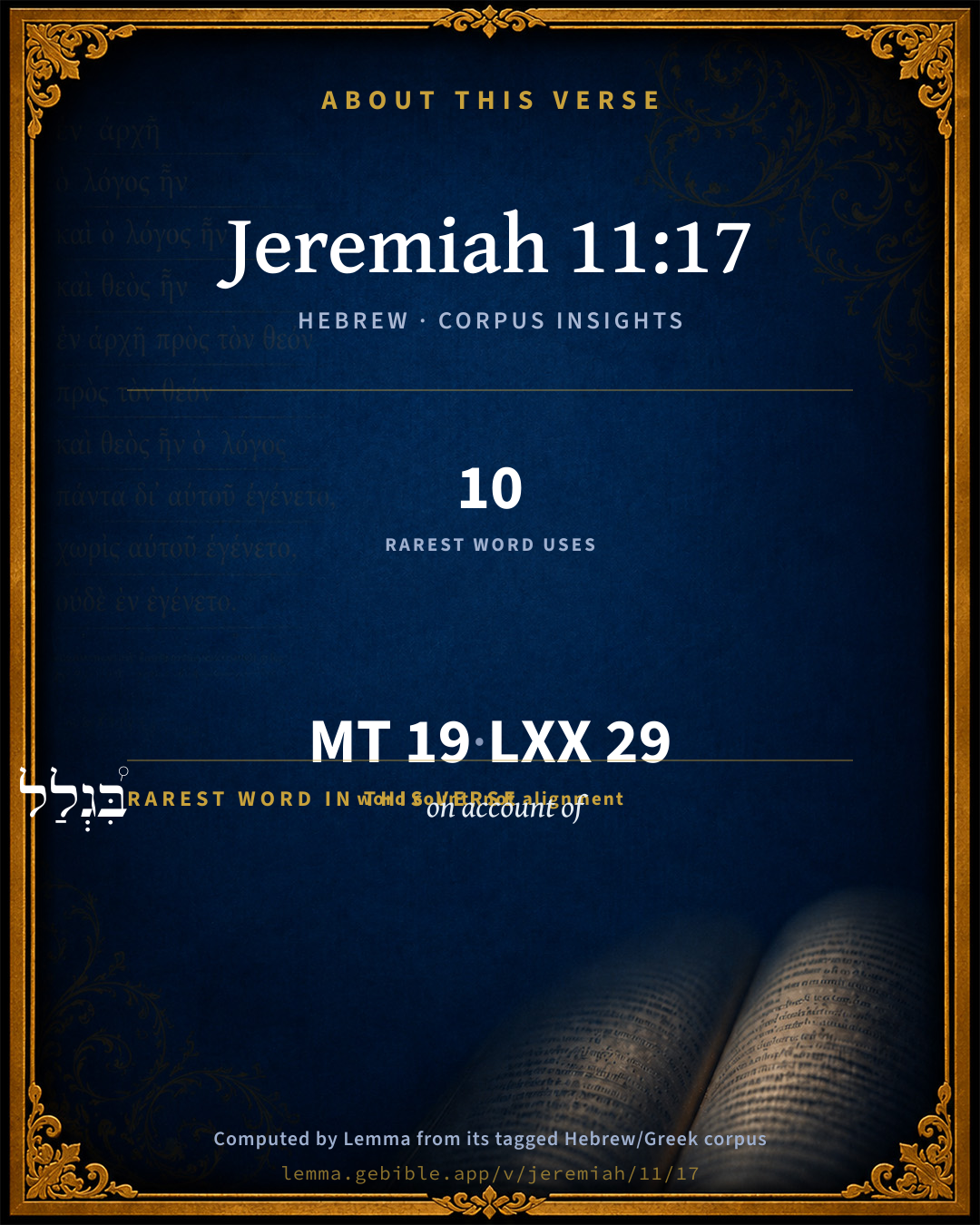
The rarest word here is בִּ֠גְלַל on account of H1558 — appearing just 10 times in the whole Hebrew Bible.

Shared distinctive vocabulary

בִּ֠גְלַל on account of H1558 occurs in 10 verses of the Hebrew Bible. Also found in:

Grammatical profile

  • 5 verbs
  • 10 nouns
  • 2 prepositions
  • 2 particles

Verb forms

  • הַנּוֹטֵ֣עַ Qal · Participle Active
  • דִּבֶּ֥ר Piel · Perfect
  • עָשׂ֥וּ Qal · Perfect
  • לְהַכְעִסֵ֖נִי Hiphil · Infinitive Construct
  • לְקַטֵּ֥ר Piel · Infinitive Construct

Repetition

Words recur within this verse — often emphatic in Hebrew:

  • רָעָ֑ה evil H7451 ×2
  • בֵּֽית house H1004 ×2

Hebrew & Septuagint length

In the original languages it is 19 Hebrew tokens and 29 Greek tokens — but the two are counted differently (Hebrew bundles its prefixes and suffixes into one token; the Greek is in lemma form), so that isn’t a like-for-like length.

Cross-references

22

Topical passages linked to Jeremiah 11:17 in the Treasury of Scripture Knowledge — connected by theme and wording, ordered by reader-vote popularity; previews shown in the World English Bible.

  • Isaiah 5:2 He dug it up, Gathered out its stones, Planted it with the choicest vine, Built a tower in its midst, And also cut out a winepress therein. He looked for it to yield grapes, But it yielded wild grapes.
  • Jeremiah 2:21 Yet I had planted you a noble vine, wholly a right seed: how then are you turned into the degenerate branches of a foreign vine to me?
  • Jeremiah 12:2 You have planted them, yes, they have taken root; they grow, yes, they bring forth fruit: you are near in their mouth, and far from their heart.
  • Jeremiah 19:15 Thus says Yahweh of Hosts, the God of Israel, Behold, I will bring on this city and on all its towns all the evil that I have pronounced against it; because they have made their neck stiff, that they may not hear my words.
  • 2 Samuel 7:10 I will appoint a place for my people Israel, and will plant them, that they may dwell in their own place, and be moved no more; neither shall the children of wickedness afflict them any more, as at the first,
  • Psalms 44:2 You drove out the nations with your hand, But you planted them. You afflicted the peoples, But you spread them abroad.
  • Psalms 80:8 You brought a vine out of Egypt. You drove out the nations, and planted it.
  • Psalms 80:15 The stock which your right hand planted, The branch that you made strong for yourself.
  • Isaiah 61:3 to appoint to those who mourn in Zion, to give to them a garland for ashes, the oil of joy for mourning, the garment of praise for the spirit of heaviness; that they may be called trees of righteousness, the planting of Yahweh, that he may be glorified.
  • Jeremiah 7:9 Will you steal, murder, and commit adultery, and swear falsely, and burn incense to Baal, and walk after other gods that you have not known,
  • Jeremiah 11:11 Therefore thus says Yahweh, Behold, I will bring evil on them, which they shall not be able to escape; and they shall cry to me, but I will not listen to them.
  • Jeremiah 16:10–11 It shall happen, when you shall show this people all these words, and they shall tell you, Why has Yahweh pronounced all this great evil against us? or what is our iniquity? or what is our sin that we have committed against Yahweh our God?
  • Jeremiah 18:8 if that nation, concerning which I have spoken, turn from their evil, I will repent of the evil that I thought to do to them.
  • Jeremiah 24:6 For I will set my eyes on them for good, and I will bring them again to this land: and I will build them, and not pull them down; and I will plant them, and not pluck them up.
  • Jeremiah 26:13 Now therefore amend your ways and your doings, and obey the voice of Yahweh your God; and Yahweh will repent him of the evil that he has pronounced against you.
  • Jeremiah 26:19 Did Hezekiah king of Judah and all Judah put him to death? Didn't he fear Yahweh, and entreat the favor of Yahweh, and Yahweh repented him of the evil which he had pronounced against them? Thus should we commit great evil against our own souls.
  • Jeremiah 35:17 therefore thus says Yahweh, the God of hosts, the God of Israel: Behold, I will bring on Judah and on all the inhabitants of Jerusalem all the evil that I have pronounced against them; because I have spoken to them, but they have not heard; and I have called to them, but they have not answered.
  • Jeremiah 36:7 It may be they will present their supplication before Yahweh, and will return everyone from his evil way; for great is the anger and the wrath that Yahweh has pronounced against this people.
  • Jeremiah 40:2 The captain of the guard took Jeremiah, and said to him, Yahweh your God pronounced this evil on this place;
  • Jeremiah 42:10 If you will still abide in this land, then will I build you, and not pull you down, and I will plant you, and not pluck you up; for I repent me of the evil that I have done to you.
  • Jeremiah 45:4 Thus shall you tell him, Thus says Yahweh: Behold, that which I have built will I break down, and that which I have planted I will pluck up; and this in the whole land.
  • Ezekiel 17:5 He took also of the seed of the land, and planted it in a fruitful soil; he placed it beside many waters; he set it as a willow tree.

Cross-references courtesy of OpenBible.info (CC BY 4.0).

Hebrew and Greek witnesses Masoretic Hebrew ↔ Greek Septuagint

The same verse in the two great witnesses to the Old Testament, shown verse-for-verse.

These are two independent witnesses, not word-aligned to each other, and the Septuagint is shown in lemma (dictionary) form.

Hebrew Jeremiah 11:17 Masoretic · Westminster Leningrad Codex

וַיהוָ֤ה צְבָאוֹת֙ הַנּוֹטֵ֣עַ אוֹתָ֔ךְ דִּבֶּ֥ר עָלַ֖יִךְ רָעָ֑ה בִּ֠גְלַל רָעַ֨ת בֵּֽית יִשְׂרָאֵ֜ל וּבֵ֣ית יְהוּדָ֗ה אֲשֶׁ֨ר עָשׂ֥וּ לָהֶ֛ם לְהַכְעִסֵ֖נִי לְקַטֵּ֥ר לַבָּֽעַל

For Yahweh of Hosts, who planted you, has pronounced evil against you, because of the evil of the house of Israel and of the house of Judah, which they have worked for themselves in provoking me to anger by offering incense to Baal.

World English Bible · Public Domain

Greek LXX Structure differs

In the Septuagint, Jeremiah is about an eighth shorter than the Hebrew and arranges its material differently — the Oracles Against the Nations (Hebrew chapters 46–51) appear in the middle of the Greek book, after 25:13. Because the chapter and verse boundaries do not line up, a verse-for-verse comparison with the Hebrew is not shown.

A verse-for-verse comparison isn’t shown here because the chapters and verses don’t line up. Switch to the LXX edition with the MT / LXX toggle above to read the Greek directly.

On this verse, John Gill's Exposition discusses the Septuagint’s reading. Read the note in Commentary ↓

Hebrew: Westminster Leningrad Codex (CC BY 4.0). Greek: Septuagint (public domain); English from a public-domain English Septuagint. How the Septuagint differs from the Hebrew →

Targum (Aramaic paraphrase)

1

The Targum is the ancient Jewish Aramaic paraphrase of the Hebrew Scriptures — an interpretive translation, not the Hebrew text itself. Onkelos (literal) and Pseudo-Jonathan (expansive) render the Torah, and Jonathan the Prophets. Coverage is partial: where no permissively-licensed English translation exists for a verse, only the Aramaic is shown. This is verse-level text, not a word-by-word alignment to the Hebrew.

  1. Targum Jonathan Prophets (Joshua–Malachi)
    וַיָי צְבָאוֹת דְקַיֵם יָתִיךְ גְזַר לְאַיְתָאָה עֲלָךְ בִּישָׁא בְּדִיל חוֹבֵי בֵּית יִשְׂרָאֵל וּבֵית יְהוּדָה דַעֲבַדוּ לְהוֹן לְאַרְגָזָא קֳדָמַי לְאַסָקָא בּוּסְמִין לְבַעֲלָא:

    (no public-domain English translation for this verse)

    Targum Jonathan — Aramaic: “Mikraot Gedolot” (public domain). English: “Sefaria Community Translation” (CC0 1.0 (public-domain dedication)); “London "Chaldee Paraphrase," 1871” (public domain). Text via Sefaria.

Commentary

Notes on Jeremiah 11:17 from classic Christian and Jewish commentators (each source and its license shown beneath its notes). The classic Christian expositions comment on the surrounding passage and are grouped to its opening verse, so a note may address several verses; the Jewish commentaries on the Tanakh (Rashi and others) are per-verse, so they appear only where the commentator wrote on this verse.

Lemma curates 59 commentaries, every one of them public domain or Creative Commons licensed, each selected and text-cleaned for this edition rather than reprinted as found. About our sources →

Trapp's Complete Commentary

John Trapp

Jer 11:17 For the LORD of hosts, that planted thee, hath pronounced evil against thee, for the evil of the house of Israel and of the house of Judah, which they have done against themselves to provoke me to anger in offering incense unto Baal.

Ver. 17. For the evil of the house of Israel.] That "evil" by a specialty, that land desolating sin of idolatry.

John Trapp, A Commentary or Exposition upon All the Books of the Old and New Testament (1647–1656) — public domain. Text from a community e-Sword module.

Jamieson, Fausset & Brown

Robert Jamieson, A. R. Fausset & David Brown

that planted thee-- (Jer 2:21; Isa 5:2).

against themselves--The sinner's sin is to his own hurt (see on Jer 7:19).

Jamieson, Fausset & Brown — Commentary Critical and Explanatory on the Whole Bible (1871) — public domain (CC PDM 1.0). Text via the HelloAO Bible API.

John Calvin's Commentaries

But the next verse must be joined, For Jehovah of hosts, who hath planted thee, etc.; as though he had said, “Your beauty and whatever that is valuable in you, is it from you? Surely, all your dignity and excellency have proceeded from the gratuitous kindness of God: know ye then that nothing comes from you, but from God and from his good pleasure. Then Jehovah, who has planted you, can, when he pleases, pull up by the roots a tree which he has himself planted.”

He says that it was a green olive, fair in fruit and form How so? Because God had favored them with much honor. This similitude is found in many other places, but yet it is various as to its meaning. It might indeed with regard to God’s dealings be applied to the whole people; but as hypocrites deserved to be spoiled and stripped of their privileges, so that which was offered to all in common, could only be really applied to the faithful, according to what David says,

“I am a fruitful olive in the house of God.” (Psalm 52:8)

He then no doubt separated himself from hypocrites, as though he had said, “Even hypocrites seek to have a place in God’s Temple, and are as it were tall trees, but they are unfruitful: I shall then be a green olive in the house of God; but they will wither.” But the Prophet, as I have said, compares the Jews to a green olive on account of their adoption and the free favor shewn to them; for God had raised them unto a high state of excellency and honor.

But after having thus spoken by way of concession, he then adds, At the sound of a great tumult, or of a great word, he will kindle his fire upon it, and broken shall be its branches Some, as I have said, render the last clause, “and they have broken its branches.” As to what is intended, there is nothing dubious; but if we take the verb in an active sense, something must be understood, that is, that enemies, who will be like fire, shall break its branches. Then follows what I have said to be a confirmation, — that Jehovah, who had planted it, had spoken of or pronounced an evil, or a calamity against it. He thus shews that there was no reason for them to trust in their present beauty; for they had it not from themselves, but possessed it only at the will of another; for God who had planted them, could also destroy them. But on this subject more shall be said.

John Calvin's Commentaries (1540-1563) — public domain. Text from the Calvin Translation Society English edition (1840s-50s) via the Christian Classics Ethereal Library (ccel.org). Calvin's coverage is partial (roughly two-thirds of the Bible); uncommented books and verses are honest gaps, never fabricated. The 19th-century editor's footnotes and remarks are omitted so the notes are faithfully Calvin's own voice.

Ellicott's Commentary for English Readers

(17) The Lord of hosts, that planted thee.—As in Jer_2:21, stress is laid on the fact that Jehovah had planted the tree and bestowed on it all the conditions of fruitfulness, and that it was He who now passed the sentence of condemnation.

A Bible Commentary for English Readers, edited by Charles John Ellicott (1878–1897) — public domain. Text from a community e-Sword module.

The Cambridge Bible for Schools and Colleges

gen. ed. J. J. S. Perowne

17. Considered by Co., Du. and others, owing to its style, to be due to a later hand.

The Cambridge Bible for Schools and Colleges (gen. ed. J. J. S. Perowne; Cambridge University Press, 1878–1918) — public domain. Text from a community e-Sword module.

John Gill's Exposition

And the Lord hath given me knowledge of it,.... Either of what he had been declaring as the sins of these people; and of what he had been prophesying concerning punishment for their sins; what he had said was not of himself, did not arise from any pique or resentment in him against them; but it was of God, that knows all things, and had made known these things to him; and he had only faithfully related them as he had received them; or else of the malicious designs of the men of Anathoth to take away his life, after mentioned:

and I know it; and am sure of it; having it by divine revelation, and from that God that cannot lie, and will not deceive:

then thou shewedst me their doings. Some versions, as the Septuagint, Syriac; and Arabic, take the former words to be a prayer of the prophet's, "O Lord, make me know, or show me, or teach me, that I may know"; and these signify that his prayer was answered. The Lord showed him the sins of these people, and what punishments they deserved, and would be inflicted on them; or rather what they were doing in the dark, and what schemes they were contriving and attempting to put in execution against his life; but God was careful of it, and would not suffer them to do him any harm; and therefore made all known unto him; see Psa 105:15.

John Gill's Exposition of the Whole Bible (1746–1763) — public domain (CC PDM 1.0). Text via the HelloAO Bible API.

Matthew Poole's English Annotations

This verse expounds what was metaphorically expressed in the former verse, viz. that God had declared his will to his prophet; that he would destroy his people, the blame of which must lie upon themselves, for they had by idolatry most highly provoked him, and had therein done against themselves, as indeed all sinning is but an acting against ourselves. God is invulnerable, we cannot hurt him, though we may provoke his justice to take vengeance upon us for our iniquities. And the prophet tells them that the Lord that planted them would do this, thereby hinting to them both his power to do it, and also that they had no reason to be confident, that because God had made them, he would not destroy them; or because he had planted them in that good land, therefore he would not pluck them up and throw them out of it: see Isa 27:11.

Matthew Poole's English Annotations on the Holy Bible (1683–1685) — public domain. Text from a community e-Sword/MySword module.

The Pulpit Commentary

The Lord of hosts, that planted thee; He who "planted" Israel (comp. Jer_2:21) could also uproot it; and though, for the sake of his covenant with Abraham, he would not destroy it utterly, yet he could not but interpose as Judge to punish its manifold transgressions. Israel and Judah are mentioned together; for the prophets, so far as we know them from their works, did not recognize the separation of the two kingdoms. Against themselves ; rather, for themselves; i.e. to please themselves.

The limits of long-suffering love.

I GOD"S DEALINGS WITH HIS ANCIENT PEOPLE WERE THOSE OF LOVE. That he should have chosen them and brought them into covenant with himself; that he should have taken such precautions to preserve them in that covenant. See the time selected for its establishment (cf. Ver. 4) when their hearts were susceptible and softened by his great goodness to them, and therefore the more ready to receive and keep the impression of his will. And how forbearing he had been! For more than a thousand years they had been in possession of the land, though they had so often sinned. See, too, the mighty motives to which he appeals fear of the curse pronounced on the disobedient, hope of the precious recompenses promised to such as should obey. And he enlists conscience on his side. They all said "Amen" to the covenant of God (Ver. 5). And perpetually he had been reminding them of his covenant (Ver. 7). All this and it is paralleled by God"s dealings with men now proves the loving solicitude with which God regarded his people.

II AND THAT LOVE WAS LONG-SUFFERING. It was not alone that he had allowed them so long possession of the land promised to their fathers, though they had often forfeited it; but now, not till his forbearance had (Vers. 8-10) manifestly failed in its purpose and was being even perverted into an occasion for fresh sin, did he "change his way" toward them. And even then, many years" respite was given in which repentance and so forgiveness and restoration were possible. And to further this end Jeremiah was sent to them. And all this is like God"s dealings still. Take the history of ancient and of all nations that have fallen, and the several steps of Israel"s career will be found to have been trodden by them also: a time of great favor; disobedience; warning, repeated, earnest, continued; respite even at the last; sin persisted in notwithstanding all; then the long-threatened destruction. And it is true of families, Churches, individuals, today as of old.

III BUT THAT LOVE HAD ITS LIMITS. The ruin that came upon Israel, upon Judah, and has so often come upon those like them, proves this.

IV WHEN THESE LIMITS WERE REACHED, NOTHING COULD THEN AVERT THE THREATENED PUNISHMENT. (Cf. Vers. 11-17) Not:

1. The piteous cry" of distress (Ver. 11).

2. Still less (Ver. 12) any appeal to their idol-gods. "They shall not save them at all," no, although (ver. 13) throughout the whole land, "in every city," and in every street of every city these idol-gods had their altars, their incense and their worship.

3. Nor even the acceptable prayer of the righteous. (Ver. 14 and Jer_7:16) How dreadful this!

4. Multiplied sacrifices. (Ver. 15; cf. Exposition.) The prophet"s meaning, which is quite obscured in our translation, seems to be to protest against their flocking to the house of God, seeing how guilty they had been it could do them no good: and also against their thinking that "the holy flesh" of sacrifices would turn away wrath from a people who "rejoiced when they did evil.

5. Nor the fact of past privilege and favor. (Ver. 16.) No, although God had made them as a green olive tree (Ver. 16). Himself "planted thee," yet he will himself kindle the fire that shall rage and devour it.

V FROM ALL WHICH MEN EVERYWHERE ARE TO LEARN:

1. To dread eyeful sin. For we cannot tell when and where those limits of God"s long-suffering are reached. That sin to which a man is tempted may be the overstepping of them so far as he is concerned. If he do that, the word may go forth, "Let him alone". (cf. Rev_22:11) We are apt to think that any time will do to turn to God. It will not. It is not universally nor commonly true "That while the lamp holds out to burn, The vilest sinner may return." It is untrue; for the probability of a man then, at the very last, turning his heart to God, when up till then he has ever turned his heart away from God, is small indeed. The limit was passed when the Spirit of God left him, and that may be long before death comes. Probably death has nothing whatever to do with it either way. We should then say to ourselves, when drawn to any sin against which God"s Holy Spirit is protesting and pleading, "If I disobey him now he may leave me altogether.

2. To desire God. The clearing of the heart of sin is not sufficient, the heart must be occupied. The house to which the evil spirit came back bringing others worse than himself, was swept and garnished, but it was "empty." So if men"s hearts be "swept from ill deeds, yet if they be not occupied, evil will come back. It is when the love of God possesses our heart that there is no fear of our even approaching, still less of overstepping, the limits of his long-suffering love. This is our sure, our only safeguard. C.

The Pulpit Commentary (1880–1919), ed. H.D.M. Spence-Jones & Joseph S. Exell — public domain. Text from a community e-Sword module.

unfoldingWord translationNotes

Door43 World Missions Community

the one who planted you

This speaks of Yahweh placing the people of Israel and Judah in the places where they live as if they were a tree that Yahweh had planted. AT: "who planted you like a farmer plants a tree" or "the one who placed you to live in the land of Israel and Judah" (See: Metaphor)

has decreed disaster against you

"has decreed that disaster will come upon you"

the house of Israel

The word "house" is a metonym for the family that lives in the house. In this case it refers to the kingdom of Israel. See how you translated this in Jeremiah 3:18. AT: "Israel" or "the kingdom of Israel" (See: Metonymy)

the house of Judah

The word "house" is a metonym for the family that lives in the house. In this case it refers to the kingdom of Judah, which included the descendants of Judah and Benjamin. See how you translated this in Jeremiah 3:18. AT: "Judah" or "the kingdom of Judah" (See: Metonymy)

translationWords

Yahweh of hosts

decree

evil

Baal

unfoldingWord translationNotes — © Distant Shores Media and the Door43 World Missions Community, licensed CC BY-SA 4.0. Source: git.door43.org/Door43/en_tn.

Lesson kit

Teaching starters — assembled from the data on this page, not authored interpretation. Every prompt links to the verse data it draws on. Edit before teaching.

Jeremiah, in the Prophets, opens this verse with 19 words (16 distinct Hebrew lemmas). Its most distinctive word is gâlâl (“on account of”). A historical commentator’s framing appears above. Read the whole chapter for the surrounding context.

Discussion questions

  1. The word gâlâl carries the sense “on account of.” How does it shape the verse?
  2. How does Genesis 12:13, which shares the word «on account of», read alongside this verse?
  3. What does the repetition of “evil” (2× in this one verse) do in this verse?
  4. These translations render this verse differently; the difference is in the English rendering, not the original. What questions does that raise?
  5. «הַנּוֹטֵ֣עַ» is a Qal Participle Active verb. How does that grammatical form shape the action described?
  6. Compare how Trapp's Complete Commentary and Jamieson, Fausset & Brown read this verse. Where do they agree or differ?

Things to notice

Reading settings

Reading text

Shown beneath each verse's original-language words.

Old Testament
Old Testament edition

Read the OT as the Masoretic Hebrew (MT) or the Greek Septuagint (LXX).

English shown for the Greek Septuagint (in the Hebrew ↔ Greek comparison).

Comparing translations? Open the Compare panel on any verse page to stack up to four side by side.