Jeremiah 33:18

Hebrew (Westminster Leningrad Codex) Jeremiah 33:18 appears in the Hebrew Old Testament. The text above is from the Westminster Leningrad Codex. Each word links to its Strong’s number, a concise gloss, and parsing drawn from the Open Scriptures Hebrew Bible morphology. Click any word for its full Brown-Driver-Briggs (BDB) entry.
Download image
Cite this verse

Jeremiah 33:18 (World English Bible). Public Domain. Lemma interlinear Bible study tool, https://lemma.gebible.app/v/jeremiah/33/18.

Show BibTeX & RIS
BibTeX
RIS
English Translation
neither shall the priests the Levites want a man before me to offer burnt offerings, and to burn meal-offerings, and to do sacrifice continually.
World English Bible · Public Domain
Download a study sheet

One document with this verse’s original text, its word-by-word gloss line, the meaning frame, cross-references with their text, attributed commentary, and full source and license credits — printable, and it pastes into notes with its structure intact.

This verse Autodidact and up

Study sheet (.html) Plain text (.txt)

A passage Seminary Student

Up to 50 verses in one chapter. A passage sheet keeps up to 6 commentary sources and 12 cross-references per verse, in the order this page ranks them, and says so on the sheet whenever that leaves anything out. Ask for a single verse and you get the Autodidact verse sheet above.

Everything on this page stays free to read, with no account — the sheet is a download of what is already on screen, not access to it.

Want to remove ads? Support Godless Engineer
Compare translations 3

The same verse in 3 English versions, stacked beneath the original-language interlinear above. Click any original word for its lexicon entry.

Each is an independent rendering of the whole verse — the interlinear is not word-aligned to these translations.

Highlighted words mark where these versions differ — a whole-verse word diff, not a word-by-word alignment.

  • World English Bible Public Domain
    neither shall the priests the Levites want a man before me to offer burnt offerings, and to burn meal-offerings, and to do sacrifice continually.
  • King James Version Public Domain
    Neither shall the priests the Levites want a man before me to offer burnt offerings, and to kindle meat offerings, and to do sacrifice continually.
  • unfoldingWord Literal Text CC BY-SA 4.0
    nor will a man from the Levitical priests be lacking before me to raise burnt offerings, to burn food offerings, and to perform grain offerings all the time.’”

unfoldingWord Literal Text — © unfoldingWord, licensed CC BY-SA 4.0. Word-aligned USFM3 via Door43 (git.door43.org/unfoldingWord/en_ult).

Versions to compare (up to 4)

3 of 4 selected

Show all 18 translations

Every available English version of this verse, each an independent rendering of the whole verse.

  • World English Bible Public Domain
    neither shall the priests the Levites want a man before me to offer burnt offerings, and to burn meal-offerings, and to do sacrifice continually.
  • Berean Standard Bible Public Domain
    nor will the priests who are Levites ever fail to have a man before Me to offer burnt offerings, to burn grain offerings, and to present sacrifices.”
  • Majority Standard Bible Public Domain
    nor will the priests who are Levites ever fail to have a man before Me to offer burnt offerings, to burn grain offerings, and to present sacrifices.”
  • King James Version Public Domain
    Neither shall the priests the Levites want a man before me to offer burnt offerings, and to kindle meat offerings, and to do sacrifice continually.
  • American Standard Version (1901) Public Domain
    neither shall the priests the Levites want a man before me to offer burnt-offerings, and to burn meal-offerings, and to do sacrifice continually.
  • Revised Version (1885) Public Domain
    neither shall the priests the Levites want a man before me to offer burnt offerings, and to burn oblations, and to do sacrifice continually.
  • Geneva Bible (1599) Public Domain
    Neither shall the Priests and Leuites want a man before me to offer burnt offerings, and to offer meat offerings, and to doe sacrifice continually.
  • Douay-Rheims (1899) Public Domain
    Neither shall there be cut off from the priests and Levites a man before my face to offer holocausts, and to burn sacrifices, and to kill victims continually:
  • Young's Literal Translation Public Domain
    And to the priests -- the Levites, Not cut off from before Me is one, Causing a burnt-offering to ascend, And perfuming a present, and making sacrifice -- all the days.'
  • Literal Standard Version CC BY-SA 4.0
    And to the priests—the Levites, || A man is not cut off from before My face, || Causing a burnt-offering to ascend, || And perfuming a present, and making sacrifice—all the days.”
  • Unlocked Literal Bible CC BY-SA 4.0
    nor will a man from the Levitical priests be lacking before me to raise burnt offerings, to burn food offerings, and to perform grain offerings all the time.'”
  • unfoldingWord Literal Text CC BY-SA 4.0
    nor will a man from the Levitical priests be lacking before me to raise burnt offerings, to burn food offerings, and to perform grain offerings all the time.’”
  • Darby Bible Public Domain
    neither shall there fail to the priests the Levites a man before me to offer up burnt-offerings, and to burn oblations, and to do sacrifice continually.
  • World Messianic Bible Public Domain
    The Levitical priests won’t lack a man before me to offer burnt offerings, to burn meal offerings, and to do sacrifice continually.”
  • Webster's Bible Public Domain
    Neither shall the priests the Levites want a man before me to offer burnt-offerings, and to kindle meat-offerings, and to do sacrifice continually.
  • Free Bible Version CC BY-SA 4.0
    and the Levitical priests will always have a descendant to present burnt offerings, grain offerings, and sacrifices to me.
  • Bible in Basic English Public Domain
    And the priests and the Levites will never be without a man to come before me, offering burned offerings and perfumes and meal offerings and offerings of beasts at all times.
  • JPS Tanakh (1917) Public Domain
    neither shall there be cut off unto the priests the Levites a man before Me to offer burnt-offerings, and to burn meal-offerings, and to do sacrifice continually.

Literal Standard Version (2020), Covenant Press — licensed CC BY-SA 4.0. Text via the HelloAO Bible API (eBible.org). Unlocked Literal Bible (unfoldingWord) — licensed CC BY-SA 4.0. Text via the HelloAO Bible API (eBible.org). unfoldingWord Literal Text — © unfoldingWord, licensed CC BY-SA 4.0. Word-aligned USFM3 via Door43 (git.door43.org/unfoldingWord/en_ult). Free Bible Version, Dr. Jonathan Gallagher — licensed CC BY-SA 4.0. Text via the HelloAO Bible API (eBible.org).

Word by word

More ways to search: Search by grammar → Find every occurrence → Compare this word →

Practice this passage: Drill this verse → Learn its vocabulary →

וּמַקְטִ֥יר
qâṭar
H6999
“and · burning incense”
Conjunction + Verb, Hiphil, Participle Active, Masculine, Singular, Absolute
Part of Speech
Conjunction + Verb
Stem
Hiphil
Form
Participle Active
Gender
Masculine
Number
Singular
State
Absolute
Full BDB Definition

Origin: a primitive root [identical with H7000 through the idea of fumigation in a close place and perhaps thus driving out the occupants]

TWOT: 2011 , 2011e , 2011g

to sacrifice, burn incense, burn sacrifices, make sacrifices smoke (verb) - (Piel) - to make sacrifices smoke - to sacrifice - (Pual) to smoke a sacrifice - (Hiphil) - to make sacrifices smoke - to cause incense to smoke, offer incense - to make smoke upon - (Hophal) to be made to smoke - incense (noun masculine) - incense-altar (noun feminine)
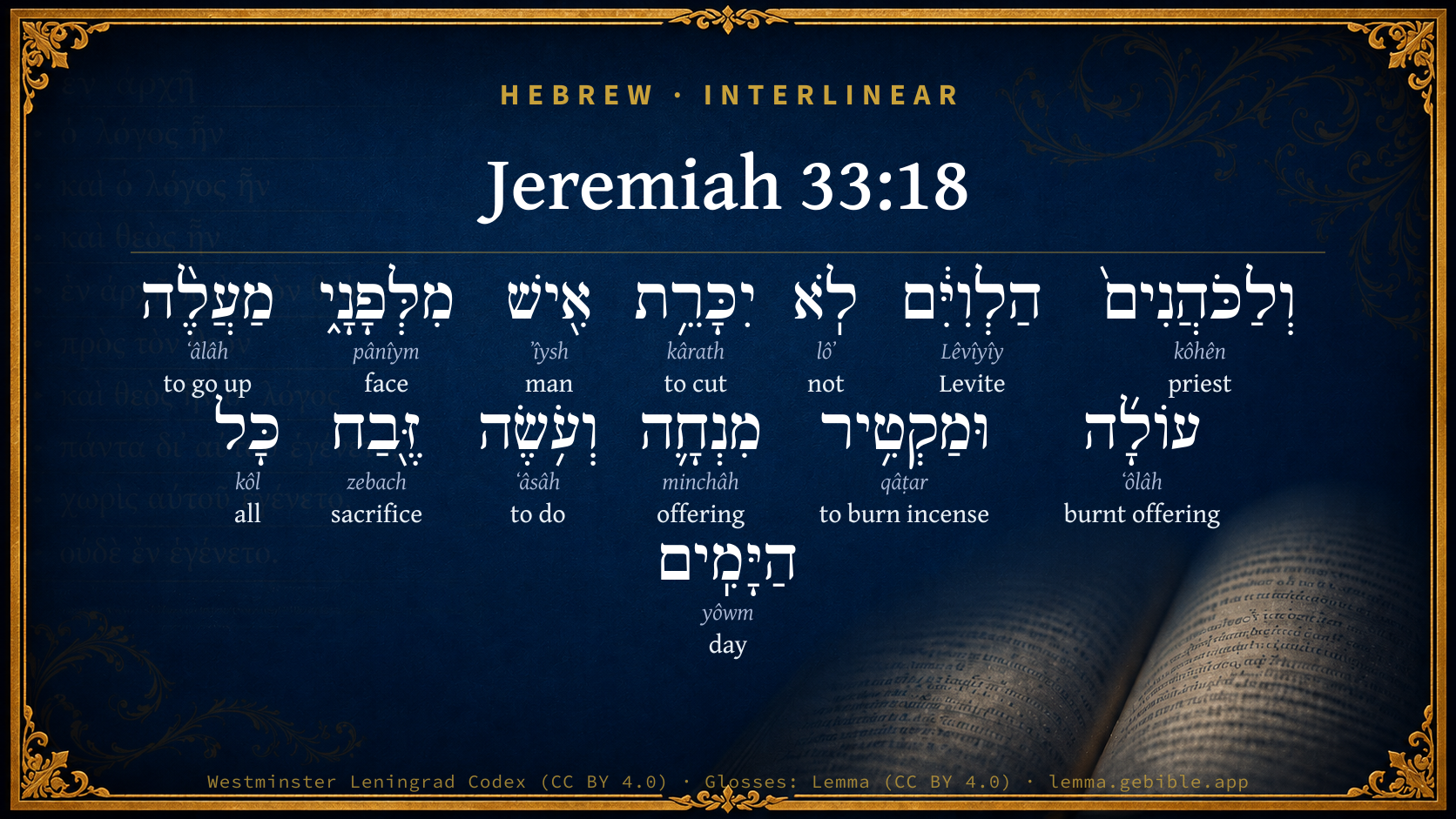
  1. וְלַכֹּהֲנִים֙ kôhên H3548 “and · to/for the · priests” Conjunction + Preposition, Determined + Noun, Common, Masculine, Plural, Absolute
  2. הַלְוִיִּ֔ם Lêvîyîy H3881 “the · Levites” Particle, Definite Article + Noun, Gentilic, Masculine, Plural, Absolute
  3. לֹֽא lôʼ H3808 “not” Particle, Negative
  4. יִכָּרֵ֥ת kârath H3772 “to cut” Verb, Niphal, Imperfect, 3rd Person, Masculine, Singular
  5. אִ֖ישׁ ʼîysh H376 “man” Noun, Common, Masculine, Singular, Absolute
  6. מִלְּפָנָ֑י pânîym H6440 “from · to/for · face(s) · my” Preposition + Preposition + Noun, Common, Both, Plural, Construct + Suffix, Personal, 1st Person, Common, Singular
  7. מַעֲלֶ֨ה ʻâlâh H5927 “going up” Verb, Hiphil, Participle Active, Masculine, Singular, Absolute
  8. עוֹלָ֜ה ʻôlâh H5930 “burnt offering” Noun, Common, Feminine, Singular, Absolute
  9. מִנְחָ֛ה minchâh H4503 “offering” Noun, Common, Feminine, Singular, Absolute
  10. וְעֹ֥שֶׂה ʻâsâh H6213 “and · doing” Conjunction + Verb, Qal, Participle Active, Masculine, Singular, Absolute
  11. זֶּ֖בַח zebach H2077 “sacrifice” Noun, Common, Masculine, Singular, Absolute
  12. כָּל kôl H3605 “all of” Noun, Common, Masculine, Singular, Construct
  13. הַיָּמִֽים yôwm H3117 “the · days” Particle, Definite Article + Noun, Common, Masculine, Plural, Absolute

About this verse

These counts appear in no published source. They are computed here, from the morphology-tagged text and Lemma’s own curated glosses. What Lemma adds →

14
words
14
distinct lemmas
Prophets
section

Grammatical profile

  • 4 verbs
  • 9 nouns
  • 1 particle

Verb forms

  • יִכָּרֵ֥ת Niphal · Imperfect
  • מַעֲלֶ֨ה Hiphil · Participle Active
  • וּמַקְטִ֥יר Hiphil · Participle Active
  • וְעֹ֥שֶׂה Qal · Participle Active

Cross-references

13

Topical passages linked to Jeremiah 33:18 in the Treasury of Scripture Knowledge — connected by theme and wording, ordered by reader-vote popularity; previews shown in the World English Bible.

  • Isaiah 56:7 even them will I bring to my holy mountain, and make them joyful in my house of prayer: their burnt offerings and their sacrifices shall be accepted on my altar; for my house shall be called a house of prayer for all peoples.
  • Deuteronomy 18:1 The priests the Levites, [even] all the tribe of Levi, shall have no portion nor inheritance with Israel: they shall eat the offerings of Yahweh made by fire, and his inheritance.
  • Isaiah 61:6 But you shall be named the priests of Yahweh; men shall call you the ministers of our God: you shall eat the wealth of the nations, and in their glory shall you boast yourselves.
  • Ezekiel 43:19–27 You shall give to the priests the Levites who are of the seed of Zadok, who are near to me, to minister to me, says the Lord Yahweh, a young bull for a sin-offering.
  • Ezekiel 44:9–11 Thus says the Lord Yahweh, No foreigner, uncircumcised in heart and uncircumcised in flesh, shall enter into my sanctuary, of any foreigners who are among the children of Israel.
  • Ezekiel 45:5 Twenty-five thousand in length, and ten thousand in breadth, shall be to the Levites, the ministers of the house, for a possession to themselves, [for] twenty chambers.
  • Romans 1:21 Because, knowing God, they didn't glorify him as God, neither gave thanks, but became vain in their reasoning, and their senseless heart was darkened.
  • Romans 15:16 that I should be a servant of Christ Jesus to the Gentiles, ministering as a priest the Gospel of God, that the offering up of the Gentiles might be made acceptable, sanctified by the Holy Spirit.
  • Hebrews 13:15–16 Through him, then, let us offer up a sacrifice of praise to God continually, that is, the fruit of lips which make confession to his name.
  • 1 Peter 2:5 You also, as living stones, are built up as a spiritual house, to be a holy priesthood, to offer up spiritual sacrifices, acceptable to God through Jesus Christ.
  • 1 Peter 2:9 But you are a chosen race, a royal priesthood, a holy nation, a people for God's own possession, that you may show forth the excellencies of him who called you out of darkness into his marvelous light:
  • Revelation 1:6 and he made us to be a Kingdom, priests to his God and Father; to him be the glory and the dominion forever and ever. Amen.
  • Revelation 5:10 And made them kings and priests to our God, And they reign on earth."

Cross-references courtesy of OpenBible.info (CC BY 4.0).

Hebrew and Greek witnesses Masoretic Hebrew ↔ Greek Septuagint

The same verse in the two great witnesses to the Old Testament, shown verse-for-verse.

These are two independent witnesses, not word-aligned to each other, and the Septuagint is shown in lemma (dictionary) form.

Hebrew Jeremiah 33:18 Masoretic · Westminster Leningrad Codex

וְלַכֹּהֲנִים֙ הַלְוִיִּ֔ם לֹֽא יִכָּרֵ֥ת אִ֖ישׁ מִלְּפָנָ֑י מַעֲלֶ֨ה עוֹלָ֜ה וּמַקְטִ֥יר מִנְחָ֛ה וְעֹ֥שֶׂה זֶּ֖בַח כָּל הַיָּמִֽים

neither shall the priests the Levites want a man before me to offer burnt offerings, and to burn meal-offerings, and to do sacrifice continually.

World English Bible · Public Domain

Greek LXX Structure differs

In the Septuagint, Jeremiah is about an eighth shorter than the Hebrew and arranges its material differently — the Oracles Against the Nations (Hebrew chapters 46–51) appear in the middle of the Greek book, after 25:13. Because the chapter and verse boundaries do not line up, a verse-for-verse comparison with the Hebrew is not shown.

A verse-for-verse comparison isn’t shown here because the chapters and verses don’t line up. Switch to the LXX edition with the MT / LXX toggle above to read the Greek directly.

Hebrew: Westminster Leningrad Codex (CC BY 4.0). Greek: Septuagint (public domain); English from a public-domain English Septuagint. How the Septuagint differs from the Hebrew →

Targum (Aramaic paraphrase)

1

The Targum is the ancient Jewish Aramaic paraphrase of the Hebrew Scriptures — an interpretive translation, not the Hebrew text itself. Onkelos (literal) and Pseudo-Jonathan (expansive) render the Torah, and Jonathan the Prophets. Coverage is partial: where no permissively-licensed English translation exists for a verse, only the Aramaic is shown. This is verse-level text, not a word-by-word alignment to the Hebrew.

  1. Targum Jonathan Prophets (Joshua–Malachi)
    וּלְכַהֲנַיָא לֵיוָאֵי לָא יִפְסוֹק גְבַר מִן קֳדָמַי מַסִיק עֲלָוָן וּמַקְרֵיב קוּרְבָּן וְעָבֵיד נִכְסַת קוּדְשִׁין כָּל יוֹמַיָא:

    (no public-domain English translation for this verse)

    Targum Jonathan — Aramaic: “Mikraot Gedolot” (public domain). English: “Sefaria Community Translation” (CC0 1.0 (public-domain dedication)); “London "Chaldee Paraphrase," 1871” (public domain). Text via Sefaria.

Commentary

Notes on Jeremiah 33:18 from classic Christian and Jewish commentators (each source and its license shown beneath its notes). The classic Christian expositions comment on the surrounding passage and are grouped to its opening verse, so a note may address several verses; the Jewish commentaries on the Tanakh (Rashi and others) are per-verse, so they appear only where the commentator wrote on this verse.

Lemma curates 59 commentaries, every one of them public domain or Creative Commons licensed, each selected and text-cleaned for this edition rather than reprinted as found. About our sources →

Trapp's Complete Commentary

John Trapp

Jer 33:18 Neither shall the priests the Levites want a man before me to offer burnt offerings, and to kindle meat offerings, and to do sacrifice continually.

Ver. 18. Neither shall the priest want a man.] The same man Christ Jesus, who is, as a King everlasting, so a priest for ever after the order of Melchizedek; and his sacrificing of himself once is more than equivalent to the daily perpetual sacrificing. Whereunto may be added the continuance of an evangelical ministry in the Church to the world’s end. {Mat 28:20 Eph 4:11-13}

John Trapp, A Commentary or Exposition upon All the Books of the Old and New Testament (1647–1656) — public domain. Text from a community e-Sword module.

Tyndale Open Study Notes

Tyndale Open Resources

33:18 After the exiles returned to Jerusalem, Levitical priests conducted worship in the new Temple (Ezra 6:13-22).

Tyndale Open Study Notes — © Tyndale Open Resources, licensed CC BY-SA 4.0. Text via the HelloAO Bible API.

Geneva Bible (1599)

Geneva Bible translators

That is chiefly meant of the spiritual sacrifice of thanksgiving, which is left to the Church in the time of Christ, who was the everlasting Priest, and the everlasting sacrifice figured by the sacrifices of the Law.

Geneva Bible (1599) marginal notes — public domain. Text via Bolls.life.

Jamieson, Fausset & Brown

Robert Jamieson, A. R. Fausset & David Brown

Messiah's literal priesthood (Heb 7:17, Heb 7:21, Heb 7:24-28), and His followers' spiritual priesthood and sacrifices (Jer 33:11; Rom 12:1; Rom 15:16; Pe1 2:5, Pe1 2:9; Rev 1:6), shall never cease, according to the covenant with Levi, broken by the priests, but fulfilled by Messiah (Num 25:12-13; Mal 2:4-5, Mal 2:8).

Jamieson, Fausset & Brown — Commentary Critical and Explanatory on the Whole Bible (1871) — public domain (CC PDM 1.0). Text via the HelloAO Bible API.

Adam Clarke's Commentary

Verse 18. Neither shall the priests the Levites want a man] This is a repetition of the promise made to Phinehas, Nu 25:13.

Adam Clarke's Commentary on the Bible (1810–1826) — public domain. Text from a community e-Sword/MySword module.

John Calvin's Commentaries

As to the priesthood, the same difficulty might be raised, for we know that the priesthood became corrupted; nay, that for the most part the priests not only became degenerate, but altogether sacrilegious. Hence the sacerdotal name itself became nothing else but a base and wicked profanation of all sacred things. But it was God’s purpose in this manner to shew that another priest was to be expected, and that men were not to look on figures and types, but were to raise their thoughts higher, even to him who was to be the only true Mediator to reconcile God to men.

By saying, who may kindle a burnt-offering, etc., he specifies certain things, or some parts of the priest’s office, because the Prophets accommodated their discourses to men of their own age and time, and described the kingdom and priesthood of Christ under those external symbols, which were then in use. It is hence proper to take the ceremonies of the Law as denoting the reality, or what they signified. For Christ offered no calves, nor any incense, but fulfilled all these things which were then set forth to the people under symbols. And he speaks of burning, or perfuming the oblation, מנחה, meneche, for though the oblation remained entire, there was yet a perfuming made by frankincense, and a small portion of the flour was burnt. It is then a mode of speaking, when a part is stated for the whole. It now follows —

John Calvin's Commentaries (1540-1563) — public domain. Text from the Calvin Translation Society English edition (1840s-50s) via the Christian Classics Ethereal Library (ccel.org). Calvin's coverage is partial (roughly two-thirds of the Bible); uncommented books and verses are honest gaps, never fabricated. The 19th-century editor's footnotes and remarks are omitted so the notes are faithfully Calvin's own voice.

Ellicott's Commentary for English Readers

(18) Neither shall the priests the Levites want a man . . .—Here again we have a promise which received a fulfilment other than that which the words appeared to imply, and which doubtless was in the prophet’s thoughts. The Levitical priesthood passed away (Heb_7:11), but Christ was made a Priest after the order of Melchizedek; and by virtue of their union with Him, His people became a holy priesthood (Heb_10:19-22), offering, not the burnt-offerings and meat-offerings which were figures of the true, but the spiritual sacrifices of praise and thanksgiving (1Pe_2:5), the sacrifice of body, soul, and spirit, which alone was acceptable to God (Rom_12:1).

The special combination, “the priests the Levites,” is not found elsewhere in Jeremiah, but appears in Deu_17:9; Deu_18:1; Jos_3:3; 2Ch_30:27; Eze_43:19; Eze_44:15; Isa_66:21. As far as it has any special significance, it may indicate either that the priestly character, though not the specific priestly functions, extended to the whole tribe of Levi, or, more probably, that Jeremiah speaks of the Levite-priests of Judah as contrasted with the priests of the “high places,” or such as Jeroboam had made of the lowest of the people.

To kindle meat offerings.—The meat-offering, or minchah, it will be remembered, was of meal and frankincense, not of flesh (Lev_2:1-15). It was burnt with fire on the altar, and the fragrant smoke was a “sweet savour unto the Lord.”

A Bible Commentary for English Readers, edited by Charles John Ellicott (1878–1897) — public domain. Text from a community e-Sword module.

The Cambridge Bible for Schools and Colleges

gen. ed. J. J. S. Perowne

18. The making of the Levites co-extensive with the priests, while in consonance with the Deuteronomic legislation (e.g. Deu_17:9; Deu_17:18), was no longer recognised in Nehemiah’s day. Probably this passage was written after the change had in effect taken place, while yet the earlier phrase was retained.

The Cambridge Bible for Schools and Colleges (gen. ed. J. J. S. Perowne; Cambridge University Press, 1878–1918) — public domain. Text from a community e-Sword module.

John Gill's Exposition

Neither shall the priests the Levites want a man before me,.... The Levitical priesthood has been abolished long ago; that was typical of Christ's priesthood, and is succeeded by it; who is a priest for ever after the order of Melchizedek; and who, having offered up himself a sacrifice here on earth for his people, ever appears in heaven, in the presence of God, on their behalf, making intercession for them; and as long as he continues to do so, which will be always, a man shall not be wanting before the Lord:

to offer burnt offerings, and to kindle meat offerings, and to do sacrifice continually; that is, to present that sacrifice before him, and plead the efficacy and virtue of it with him, which was typified by all those sacrifices, and has superseded them, being much better than they. Some understand this of a continuance of Gospel ministers unto the end of the world, who succeeded the priests and Levites; but as they are never called priests and Levites in the New Testament; nor were they properly the successors of the priests and Levites; rather it may be applied unto all believers now, who are priests unto God, and offer up spiritual sacrifices acceptable to God through Christ; but the first sense is best.

John Gill's Exposition of the Whole Bible (1746–1763) — public domain (CC PDM 1.0). Text via the HelloAO Bible API.

Haydock's Catholic Bible Commentary

Priests. This promise relates to the Christian priesthood; which shall also continue for ever: the functions of which (more especially the great sacrifice of the altar) are here expressed, by the name of holocausts, and other offerings of the law, which were so many figures of the Christian sacrifice. (Challoner) --- The Levitical sacrifices have ceased for 17 centuries. But Christ will officiate by his ministers till the end of time. (Calmet) --- St. Hypolitus and all the fathers agree that the blessed Eucharist is the complement of all the ancient sacrifices. (Worthington)

George Leo Haydock (1774–1849), Haydock's Catholic Family Bible and Commentary, 1859 edition — public domain. Excludes Psalms (Douay-Rheims chapter numbering differs from Protestant) and Deuterocanonical books (Catholic canon only).

Matthew Poole's English Annotations

The best interpreters understand this of a ministry to abide in the church to the end of the world, according to Mat 28:20; nor is it unusual for God in the Old Testament to express promises relating to, and to be fulfilled under, the gospel by expressions and terms proper to the Old Testament, as Isa 66:23; and in this sense it must be expounded, or restrained to the times immediately following the captivity; but it is generally understood as a promise for a gospel ministry to succeed the ministry in the Jewish church, and to abide to the end of the world.

Matthew Poole's English Annotations on the Holy Bible (1683–1685) — public domain. Text from a community e-Sword/MySword module.

The Pulpit Commentary

Neither shall the priests the Levites, etc. It has Been thought that this passage is inconsistent with the prophecies of a time when the ark should no more be remembered, (Jer_3:16) and when all should know Jehovah from the least to the greatest. (Jer_31:34) But though sin offerings would in this glorious time become things of the past, yet thank offerings are expressly excepted from abolition (ver. 11), and in Jer_31:14 a special latter-day promise is given to the priests. Moreover, Ezekiel, who repeats the prophecy of the new spiritual covenant, (Eze_11:19 Eze_36:26 Eze_37:26) gives an elaborate sketch of a new temple with a sacrificial system; (Jer 40, etc.) and, if there is any inconsistency, we find the same one in the latter part of Isaiah. In Isa_61:6 the whole regenerate people of Israel is called "the priests of Jehovah;" but in Isa_66:21 the prophet distinctly states that there will be, in some sense, a priestly class within the chosen people.

The Pulpit Commentary (1880–1919), ed. H.D.M. Spence-Jones & Joseph S. Exell — public domain. Text from a community e-Sword module.

John Wesley's Explanatory Notes

A man - That is, a ministry to abide in the church to the end of the world, nor is it unusual for God in the Old Testament to express promises to be fulfilled under the gospel by expressions proper to the Old Testament.

John Wesley, Explanatory Notes Upon the Whole Bible (1754–1765) — public domain. Text via the GEBible commentary corpus.

Rashi

Rabbi Shlomo Yitzchaki (Rashi)

for all time There shall not be cut off from them seed fit to offer up a burnt-offering or to burn a meal-offering.

Rashi on the Tanakh — English translations: “The Judaica Press complete Tanach with Rashi, translated by A. J. Rosenberg” (CC BY 4.0); “Pentateuch with Rashi's commentary by M. Rosenbaum and A.M. Silbermann, 1929-1934” (public domain); “The Metsudah Tanach series, Lakewood, N.J” (CC BY 4.0); and “The Book of Joshua, Metsudah Publications, 1997” (CC BY 4.0). Text via Sefaria.

Lesson kit

Teaching starters — assembled from the data on this page, not authored interpretation. Every prompt links to the verse data it draws on. Edit before teaching.

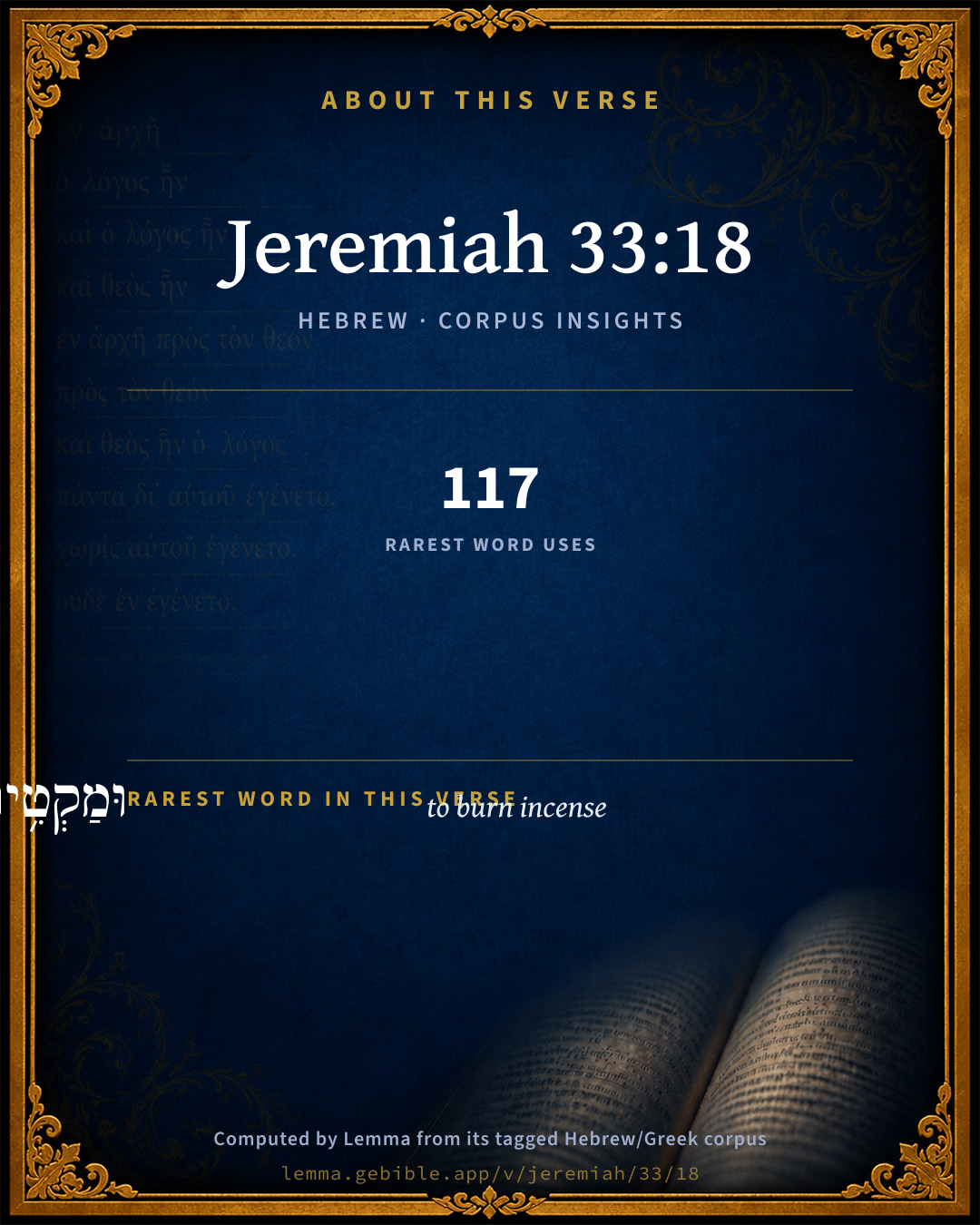
Jeremiah, in the Prophets, opens this verse with 14 words (14 distinct Hebrew lemmas). Its most distinctive word is qâṭar (“to burn incense”). A historical commentator’s framing appears above. Read the whole chapter for the surrounding context.

Discussion questions

  1. The word qâṭar carries the sense “to burn incense.” How does it shape the verse?
  2. Isaiah 56:7 shares this passage’s theme. How do the two illuminate each other?
  3. The translations on this page render this verse differently — a whole-verse word diff, not a word-by-word alignment. What might account for the different wordings?
  4. The verb «יִכָּרֵ֥ת» is Niphal Imperfect. How does its form color the action?
  5. Reading how Trapp's Complete Commentary and Tyndale Open Study Notes read this verse, where do the two commentators agree and where do they part?

Things to notice

Reading settings

Reading text

Shown beneath each verse's original-language words.

Old Testament
Old Testament edition

Read the OT as the Masoretic Hebrew (MT) or the Greek Septuagint (LXX).

English shown for the Greek Septuagint (in the Hebrew ↔ Greek comparison).

Comparing translations? Open the Compare panel on any verse page to stack up to four side by side.