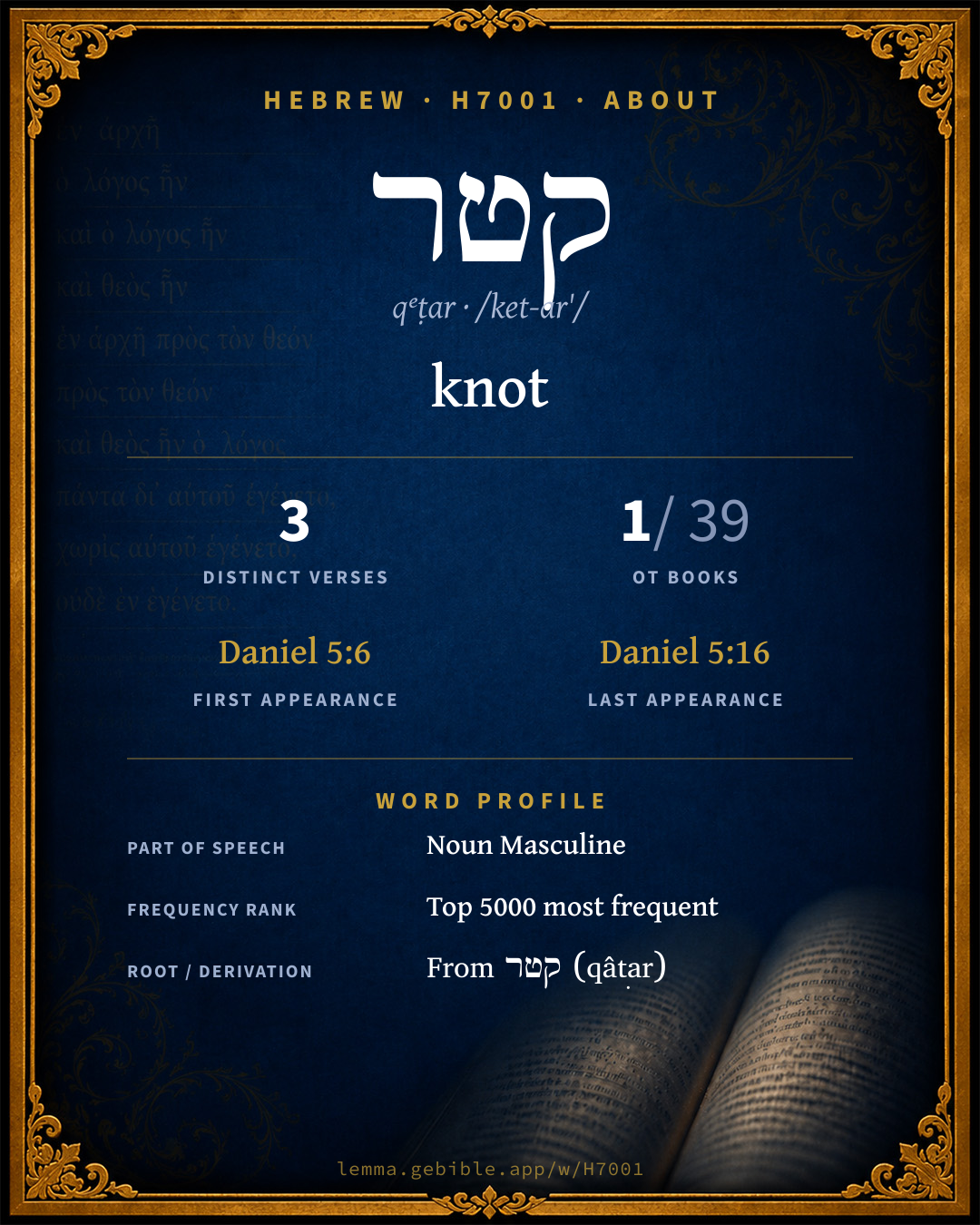
קְטַר
knot
also: joint, problem fuller range ↓
Full lexicon entry — Brown-Driver-Briggs (BDB)
From Brown-Driver-Briggs (BDB)
Where this word appears
See every Absolute-state word in the Hebrew Bible →
Grammar key — what these labels mean
Part of speech
- Noun
- A naming word — a person, place, thing, or idea.
Noun type
- Common
- A common noun — a general class of person, place, or thing (“king,” “city,” “water”), not a specific name.
State
- Absolute
- The independent form of a noun, not bound to a following word.
- Construct
- A noun bound to a following noun in a possessive / “of” relationship (the construct chain).
Gender
- Masculine
- Grammatically masculine.
Number
- Plural
- More than one (in Hebrew, generally three or more).
Grammatical forms
- Noun, Common, Masculine, Plural, Absolute 2 times (67%)
- Noun, Common, Masculine, Plural, Construct 1 time (33%)
Parsed forms decoded from the imported morphology (morphhb / Westminster Leningrad Codex — WLC text public domain, morphhb tagging CC BY 4.0), counted across 3 parsed occurrences — not distinct verses.
Every verse where H7001 appears — 3 distinct verses across 1 book. Click any verse to open its interlinear word-by-word view. Verse text shown in the World English Bible for context — . Each verse’s Hebrew form is shown with its reference; the English is not keyword-highlighted, since the data carries no word-level English alignment. Use “Compare translations” on any verse to read it across multiple English versions. This concordance covers the Hebrew Bible; Septuagint (Greek Old Testament) occurrences are not indexed here.
Daniel 3 verses
- Daniel 5:6 וְ/קִטְרֵ֤י conj + n c mp cs Then the king's face was changed in him, and his thoughts troubled him; and the joints of his loins were loosened, and his knees struck one against another.
- Daniel 5:12 קִטְרִ֗ין n c mp because an excellent spirit, and knowledge, and understanding, interpreting of dreams, and showing of dark sentences, and dissolving of doubts, were found in the same Daniel, whom the king named Belteshazzar. Now let Daniel be called, and he will show the interpretation.
- Daniel 5:16 וְ/קִטְרִ֣ין conj + n c mp But I have heard of you, that you can give interpretations, and dissolve doubts; now if you can read the writing, and make known to me the interpretation of it, you shall be clothed with purple, and have a chain of gold about your neck, and shall be the third ruler in the kingdom.
About this entry
At a glance — auto-summarized from this page’s data, not written by a person. Every figure links to its source below. This summary describes the numbers; it doesn’t interpret them.
קטר (qᵉṭar) is a Hebrew noun most often rendered “knot.” With only 3 verses it sits in the long tail of Hebrew Bible vocabulary. It clusters heavily in Daniel, which alone accounts for 100% of its uses. It first appears in Daniel 5:6. Ranging over 3 senses, its meaning includes “joint” and “problem”. For the data behind this summary, explore the sense tree and the renderings breakdown below.
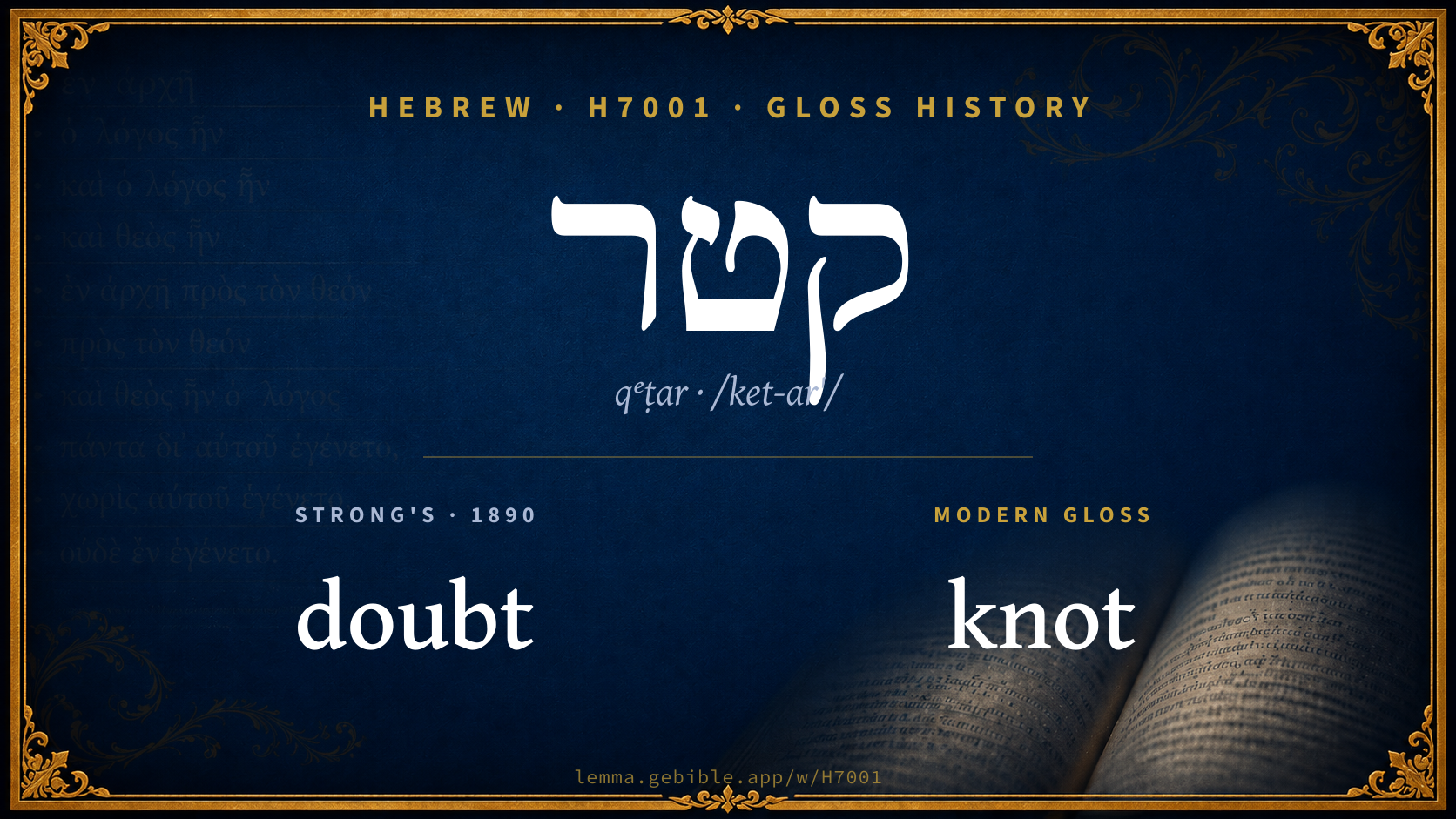
Gloss history
Strong's 1890 vs modern scholarship
About this word
Strong's H7001 catalogs a Hebrew word from the Hebrew Old Testament.
These counts are not copied from any lexicon or concordance. They are computed here, from the morphology-tagged Hebrew Old Testament. What Lemma adds →
- 3
- distinct verses
- The word appears in 3 distinct verses.
- 1 / 39
- OT books
- The word appears in 1 of 39 Old Testament books.
- #4,179
- by frequency
- Top 5000 most frequent Hebrew words (rank 4,179 of 8,640 Hebrew words by occurrence).
View all 3 occurrences in the concordance →
Most concentrated in
- Daniel 3 verses 100%
By section of the Old Testament
By traditional corpus
Conventional, traditional groupings — biblical authorship is debated, so this is a traditional corpus grouping, not an authorship claim. Each share is this word’s portion of its verses in that division of the Hebrew canon. Each figure is a share of the word’s 3 distinct verses.
- Writings (Ketuvim) 3 verses · 100%
How translations render this word
Counts come from each version’s own published word-to-Strong’s tagging or interlinear alignment — an approximate guide to how each version renders this word, not a word-level alignment the data otherwise carries. Because each total is that version’s own tagged count, the per-version totals vary from one another and need not match the appearance or distinct-verse counts above. These counts may also differ from a printed concordance because Lemma counts each distinctly tagged rendering and does not collapse phrase taggings into a single head-word total. This is a fixed set of word-tagged versions (KJV, ASV, BSB, ULT) and does not change with the reading translation you choose elsewhere. Each version’s license is shown beside its name below (and on Sources).
- King James Version: Doubts 2×
- American Standard Version: Doubts 2×
- Berean Standard Bible: Difficult problems 2×
- unfoldingWord Literal Text: Problems 2×
King James Version Public Domain
Renders H7001 across 3 tagged occurrences — most commonly:
Plus 1 rendering that appears only once — usually multi-word phrases or single function words the recovered tagging swept in, not distinct renderings.
American Standard Version Public Domain
Renders H7001 across 3 tagged occurrences — most commonly:
Plus 1 rendering that appears only once — usually multi-word phrases or single function words the recovered tagging swept in, not distinct renderings.
Berean Standard Bible Public Domain
Renders H7001 across 2 tagged occurrences — most commonly:
Not rendered by a distinct English word in 1 further occurrence.
unfoldingWord Literal Text CC BY-SA 4.0
Renders H7001 across 4 tagged occurrences — most commonly:
Plus 2 renderings that appear only once — usually multi-word phrases or single function words the recovered tagging swept in, not distinct renderings.
Senses in BDB
The 3 senses BDB distinguishes for this word, in lexicon order (not ranked by frequency or importance). The full entry — with sub-senses — is in the Lexicon Entry tab.
- knot, joint, problem
- joints (of the hip)
- difficulties, doubts (figuratively)
Word origin
[ קְטַר ] n.m. joint, knot
— Brown-Driver-Briggs (Oxford 1906, public domain), digitized via Sefaria, supplemented by the OpenScriptures HebrewLexicon (CC BY 4.0). See Sources.
Derived from קטר (qâṭar) (H7000) — enclosed.
Jastrow Dictionary
A second Hebrew/Aramaic lexicon for comparison, covering Aramaic and post-biblical (Talmudic, Targumic, Midrashic) usage that the biblical-Hebrew BDB does not. Matched by lemma rather than by Strong’s number, so a lemma may carry more than one Jastrow headword (shown separately below), and the entries cover usage well beyond the Bible.
קָטַר I
- [to circle,] to rise in circles, to smoke. Ker. 6ᵇ דבר שקוֹטֵר ועולה וריחו וכ׳ (not שקיטר) something which circles and rises, and whose savor spreads. Ib. מה לשון קטרת דבר שקוטר ועולה ḳ’ṭoreth means something which circles &c.
- to offer incense (mostly with ref. to idolatrous rites). Tosef. Snh. X, 2 אחד העובד … ואחד המְקַטֵּר וכ׳ whether one worships (an idol), or sacrifices, or offers incense &c.; Ker. 3ᵇ. Ib. מקטר לשד וכ׳ who makes incense rise to a demon in order to exorcise him; Snh. 65ᵃ. Ber. 53ᵃ, v. כֶּשֶׁף. Lev. R. s. 7, v. infra; a. fr.—Part. pass. מְקוּטָּר; f. מְקוּטֶּרֶת perfumed. Pirké d’R. El. ch. XXX (play on קטורה) שהיתה מק׳ מכל וכ׳ she was (through her good deeds) more savory than all kinds of spices; Gen. R. s. 61 שמק׳ מצות וכ׳ she was perfumed with godly deeds and good works (v. קָטַר II).
- same (mostly with ref. to the Lord). [Tosef. Snh. X, 3 והמקטיר, prob. to be read: והמְקַטֵּיר.] Men. 110ᵃ (ref. to Mal. I, 11) אלו … כאילו מַקְטִירִין וכ׳ this refers to the students engaged in the Law; wherever it be, I account it to them as if they were offering incense and bringing sacrifices to my Name. Lev. R. s. 7 (ref. to מקטר קטרת, Ex. XXX, 1) מִתְקַטֵּר בקטרת אין כתיב כאן אלא מְקטֵּר … המזבח היה מַקְטִיר וכ׳ it says not ‘being perfumed with incense’, but ‘perfuming with incense’, the altar gave forth incense of itself. Ber. 7ᵃ פעם … לְהַקְטִיר קטרת וכ׳ once I entered to let incense rise in the Holy of Holies; a. fr. e.g. Malachi 1:11
- to be perfumed, v. supra.
קְטַר
- v. infra.
- to let incense rise. Targ. O. Ex. XXX, 1. Ib. 7 (Y. some ed. Pe.). Targ. O. ib. XL, 27; a. e.
קָטַר II
- v. preced.) to wreathe, tie. Gen. R. s. 61 (play on קטורה) קָטְרָה מצות וכ׳ Ar. (ed. שמקוטרת, v. קָטַר I) she wreathed (made a crown of) godly deeds &c.; Yalk. ib. 109; Yalk. Chr. 1073.—[Gen. R. l. c. מן קטר, a grammatical gloss, v. Yalk. Gen. l. c., and Ar. s. v. קטר 2.]—Part. pass. קָטוּר; f. קְטוּרָה &c. Midd. II, 5 (ref. to קְטֻרוֹת, Ez. XLVI, 22) אין קְטוּרוֹת אלא שאינן מקורות ‘fenced in’ means that they were not roofed; Yalk. Ez. 381. e.g. Ezekiel 46:22
קְטַר ²
- , to tie. Targ. Jud. XV, 4. Targ. Gen. XXXVIII, 28; a. fr.—Part. pass. קְטִיר; f. קְטִירָא, קְטִירַת &c. Targ. Y. ib. XXII, 4 (ed. Amst. קָטֵר, read: קָטִר). Targ. Prov. XXII, 15; a. fr.—Koh. R. to III, 2 [read:] הן דאת קָטֵיר לולבך קְטֹר אלפך when thou tiest thy Lulab, tie thy ship; Gen. R. s. 6, a. e., v. לוּלָבָא. Ber. 16ᵃ, v. גְּנוּנָא. Bekh. 31ᵃ דאתו קטיר, v. תַּכְתַּקָּא. Koh. R. to IX, 10 אייתון … וקַטְרוּ ברגלי get a rope and tie it to my feet. Y. Erub. X, 26ᶜ top קטיר בגמי (not קטר) tied with reed-grass. Y. Gitt. IV, 46ᵃ (we must not help captives to escape) מפני … דלא יהוון קַטְרִינוֹן this law is made for the benefit of the (remaining) captives, that they (the captors) may not chain them; a. fr.—2) (v. קָשַׁר) to gather, be covered. Ber. 59ᵃ, v. עֵיבָא a. עֲנָנָא.
- same. Part. pass. מְקַטַּר, מְקַטְּרָא &c. Targ. Ez. XLVI, 22 מְקַטְּרָן fenced in (v. preced.).—Y. Ned. VI, 39ᵈ top חלבא מקטרא bound (curdled) milk, v. קוֹם.
A Dictionary of the Targumim, the Talmud Babli and Yerushalmi, and the Midrashic Literature (Marcus Jastrow; London, Luzac, 1903) — Public Domain. Digitized via Sefaria. Digitized via Sefaria. Full attribution on Sources.
Forms in the corpus
The 3 distinct written forms H7001 takes in the Hebrew Bible, most frequent first — each parse links to that state’s occurrences in the concordance. Hebrew forms include their vowel points and cantillation, so a single lemma takes many written forms.
| Form | Parsing | Example | Uses |
|---|---|---|---|
| וְ/קִטְרִ֣ין | Noun, Common, Masculine, Plural, Absolute | Daniel 5:16 | 1 |
| וְ/קִטְרֵ֤י | Noun, Common, Masculine, Plural, Construct | Daniel 5:6 | 1 |
| קִטְרִ֗ין | Noun, Common, Masculine, Plural, Absolute | Daniel 5:12 | 1 |
Same root — word family
Other BDB entries built from the same root as H7001, grouped by Strong’s listed origin. These share a root / origin per the lexicon — not necessarily a shared meaning. Each links to that word’s own entry.
Derives from
Shares the same root
Compare all same-root words → They share a root, not necessarily a meaning.
Septuagint verse parallels
This word appears in 3 verses that also exist in the Greek Old Testament (Septuagint), out of the 3 Hebrew verses it occurs in. You can read those verses in Greek by switching the Old Testament edition to the Septuagint.
Read these verses in the Septuagint
This is a verse-level parallel only — the same verses exist in both the Hebrew and Greek Old Testaments. No word-level Hebrew↔Greek correspondence is claimed: the data carries no such alignment, so no Greek word is shown as this Hebrew word’s translation. Coverage is not total — the Septuagint omits the deuterocanon and renumbers the Psalms, so some Hebrew verses have no direct Greek parallel.