
Jeremiah 44:25

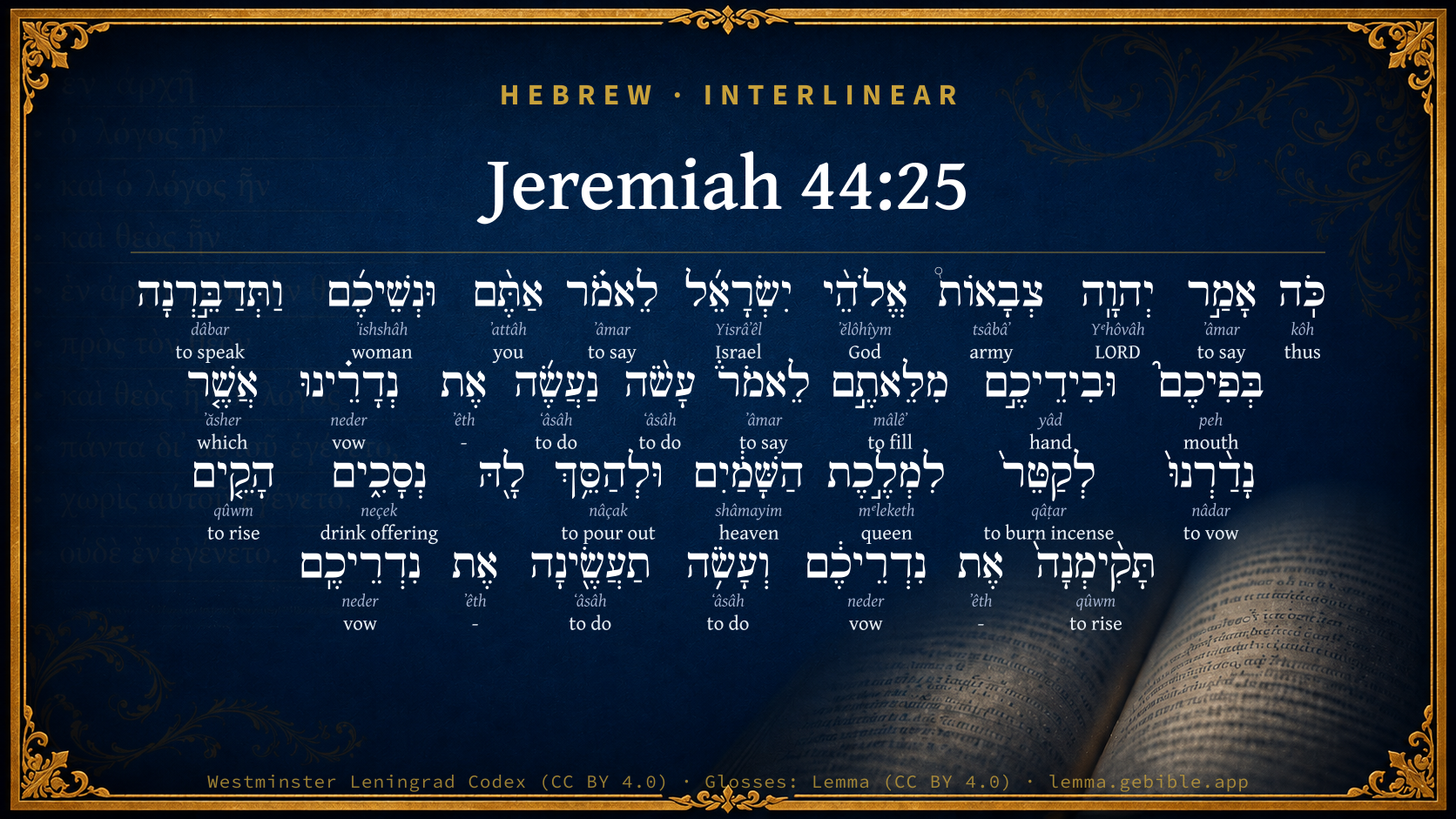
Hebrew (Westminster Leningrad Codex) Jeremiah 44:25 appears in the Hebrew Old Testament. The text above is from the Westminster Leningrad Codex. Each word links to its Strong’s number, a concise gloss, and parsing drawn from the Open Scriptures Hebrew Bible morphology. Click any word for its full Brown-Driver-Briggs (BDB) entry.
Download image
Cite this verse

Jeremiah 44:25 (World English Bible). Public Domain. Lemma interlinear Bible study tool, https://lemma.gebible.app/v/jeremiah/44/25.

Show BibTeX & RIS
BibTeX
RIS
English Translation
Thus says Yahweh of Hosts, the God of Israel, saying, You and your wives have both spoken with your mouths, and with your hands have fulfilled it, saying, We will surely perform our vows that we have vowed, to burn incense to the queen of the sky, and to pour out drink-offerings to her: establish then your vows, and perform your vows.
World English Bible · Public Domain
Download a study sheet

One document with this verse’s original text, its word-by-word gloss line, the meaning frame, cross-references with their text, attributed commentary, and full source and license credits — printable, and it pastes into notes with its structure intact.

This verse Autodidact and up

Study sheet (.html) Plain text (.txt)

A passage Seminary Student

Up to 50 verses in one chapter. A passage sheet keeps up to 6 commentary sources and 12 cross-references per verse, in the order this page ranks them, and says so on the sheet whenever that leaves anything out. Ask for a single verse and you get the Autodidact verse sheet above.

Everything on this page stays free to read, with no account — the sheet is a download of what is already on screen, not access to it.

Want to remove ads? Support Godless Engineer
Compare translations 3

The same verse in 3 English versions, stacked beneath the original-language interlinear above. Click any original word for its lexicon entry.

Each is an independent rendering of the whole verse — the interlinear is not word-aligned to these translations.

Highlighted words mark where these versions differ — a whole-verse word diff, not a word-by-word alignment.

  • World English Bible Public Domain
    Thus says Yahweh of Hosts, the God of Israel, saying, You and your wives have both spoken with your mouths, and with your hands have fulfilled it, saying, We will surely perform our vows that we have vowed, to burn incense to the queen of the sky, and to pour out drink-offerings to her: establish then your vows, and perform your vows.
  • King James Version Public Domain
    Thus saith the LORD of hosts, the God of Israel, saying; Ye and your wives have both spoken with your mouths, and fulfilled with your hand, saying, We will surely perform our vows that we have vowed, to burn incense to the queen of heaven, and to pour out drink offerings unto her: ye will surely accomplish your vows, and surely perform your vows.
  • unfoldingWord Literal Text CC BY-SA 4.0
    Yahweh of hosts, God of Israel, says this, ‘You and your wives both have said with your mouths and carried out with your hands what you said, “We will certainly carry out the vows that we made to worship the queen of heaven, to pour out drink offerings to her.” Now fulfill your vows; carry them out.’

unfoldingWord Literal Text — © unfoldingWord, licensed CC BY-SA 4.0. Word-aligned USFM3 via Door43 (git.door43.org/unfoldingWord/en_ult).

Versions to compare (up to 4)

3 of 4 selected

Show all 18 translations

Every available English version of this verse, each an independent rendering of the whole verse.

  • World English Bible Public Domain
    Thus says Yahweh of Hosts, the God of Israel, saying, You and your wives have both spoken with your mouths, and with your hands have fulfilled it, saying, We will surely perform our vows that we have vowed, to burn incense to the queen of the sky, and to pour out drink-offerings to her: establish then your vows, and perform your vows.
  • Berean Standard Bible Public Domain
    This is what the LORD of Hosts, the God of Israel, says: As for you and your wives, you have spoken with your mouths and fulfilled with your hands your words: ‘We will surely perform our vows that we have made to burn incense to the Queen of Heaven and to pour out drink offerings to her.’ Go ahead, then, do what you have promised! Keep your vows!
  • Majority Standard Bible Public Domain
    This is what the LORD of Hosts, the God of Israel, says: As for you and your wives, you have spoken with your mouths and fulfilled with your hands your words: ‘We will surely perform our vows that we have made to burn incense to the Queen of Heaven and to pour out drink offerings to her.’ Go ahead, then, do what you have promised! Keep your vows!
  • King James Version Public Domain
    Thus saith the LORD of hosts, the God of Israel, saying; Ye and your wives have both spoken with your mouths, and fulfilled with your hand, saying, We will surely perform our vows that we have vowed, to burn incense to the queen of heaven, and to pour out drink offerings unto her: ye will surely accomplish your vows, and surely perform your vows.
  • American Standard Version (1901) Public Domain
    Thus saith Jehovah of hosts, the God of Israel, saying, Ye and your wives have both spoken with your mouths, and with your hands have fulfilled it, saying, We will surely perform our vows that we have vowed, to burn incense to the queen of heaven, and to pour out drink-offerings unto her: establish then your vows, and perform your vows.
  • Revised Version (1885) Public Domain
    Thus saith the LORD of hosts, the God of Israel, saying: Ye and your wives have both spoken with your mouths, and with your hands have fulfilled it, saying, We will surely perform our vows that we have vowed, to burn incense to the queen of heaven, and to pour out drink offerings unto her: establish then your vows, and perform your vows.
  • Geneva Bible (1599) Public Domain
    Thus speaketh the Lord of hosts, the God of Israel, saying, Ye and your wiues haue both spoken with your mouthes, and fulfilled with your hande, saying, We will performe our vowes that we haue vowed to burne incense to the Queene of heauen, and to powre out drinke offerings to her: yee will perfourme your vowes and doe the things that yee haue vowed.
  • Douay-Rheims (1899) Public Domain
    Thus saith the Lord of hosts the God of Israel, saying: You and your wives have spoken with your mouth, and fulfilled with your hands, saying: Let us perform our vows which we have made, to offer sacrifice to the queen of heaven, and to pour out drink offerings to her: you have fulfilled your vows, and have performed them indeed.
  • Young's Literal Translation Public Domain
    Thus spake Jehovah of Hosts, God of Israel, saying: Ye and your wives both speak with your mouth, and with your hands have fulfilled, saying: We certainly execute our vows that we have vowed, to make perfume to the queen of the heavens, and to pour out to her libations, ye do certainly establish your vows, and certainly execute your vows.
  • Literal Standard Version CC BY-SA 4.0
    Thus spoke YHWH of Hosts, God of Israel, saying, You and your wives both speak with your mouth, and with your hands have fulfilled, saying, We certainly execute our vows that we have vowed, to make incense to the queen of the heavens, and to pour out drink-offerings to her. You certainly establish your vows, and certainly execute your vows.
  • Unlocked Literal Bible CC BY-SA 4.0
    Yahweh of hosts, God of Israel, says this, 'You and your wives both have said with your mouths and carried out with your hands what you said, “We will certainly carry out the vows that we made to worship the queen of heaven, to pour out drink offerings to her.” Now fulfill your vows; carry them out.'
  • unfoldingWord Literal Text CC BY-SA 4.0
    Yahweh of hosts, God of Israel, says this, ‘You and your wives both have said with your mouths and carried out with your hands what you said, “We will certainly carry out the vows that we made to worship the queen of heaven, to pour out drink offerings to her.” Now fulfill your vows; carry them out.’
  • Darby Bible Public Domain
    Thus saith Jehovah of hosts, the God of Israel, saying, Ye and your wives have both spoken with your mouths, and fulfilled with your hands, saying, We will certainly perform our vows which we have vowed, to burn incense to the queen of the heavens, and to pour out drink-offerings unto her. Ye will certainly establish your vows, and entirely perform your vows.
  • World Messianic Bible Public Domain
    The LORD of Hosts, the God of Israel, says, ‘You and your wives have both spoken with your mouths, and with your hands have fulfilled it, saying, “We will surely perform our vows that we have vowed, to burn incense to the queen of the sky, and to pour out drink offerings to her.” “‘Establish then your vows, and perform your vows.’
  • Webster's Bible Public Domain
    Thus saith the LORD of hosts, the God of Israel, saying; Ye and your wives have both spoken with your mouths, and fulfilled with your hand, saying, We will surely perform our vows that we have vowed, to burn incense to the queen of heaven, and to pour out drink-offerings to her: ye will surely accomplish your vows, and surely perform your vows.
  • Free Bible Version CC BY-SA 4.0
    This is what the Lord Almighty, the God of Israel, says: You and your wives, you've said what you're going to do, and you've done what you said! You said, ‘We're going to keep our promise to burn incense to the Queen of Heaven and to pour out drink offerings to worship her.’ So go ahead! Do what you've said! Keep your promises!
  • Bible in Basic English Public Domain
    This is what the Lord of armies, the God of Israel, has said: You women have said with your mouths, and with your hands you have done what you said, We will certainly give effect to the oaths we have made, to have perfumes burned to the queen of heaven and drink offerings drained out to her: then give effect to your oaths and do them.
  • JPS Tanakh (1917) Public Domain
    Thus saith the LORD of hosts, the God of Israel, saying: Ye and your wives have both spoken with your mouths, and with your hands have fulfilled it, saying: We will surely perform our vows that we have vowed, to offer to the queen of heaven, and to pour out drink-offerings unto her; ye shall surely establish your vows, and surely perform your vows.

Literal Standard Version (2020), Covenant Press — licensed CC BY-SA 4.0. Text via the HelloAO Bible API (eBible.org). Unlocked Literal Bible (unfoldingWord) — licensed CC BY-SA 4.0. Text via the HelloAO Bible API (eBible.org). unfoldingWord Literal Text — © unfoldingWord, licensed CC BY-SA 4.0. Word-aligned USFM3 via Door43 (git.door43.org/unfoldingWord/en_ult). Free Bible Version, Dr. Jonathan Gallagher — licensed CC BY-SA 4.0. Text via the HelloAO Bible API (eBible.org).

Word by word

More ways to search: Search by grammar → Find every occurrence → Compare this word →

Practice this passage: Drill this verse → Learn its vocabulary →

לִמְלֶ֣כֶת
mᵉleketh
H4446
“to/for · queen of”
Preposition + Noun, Common, Feminine, Singular, Construct
Part of Speech
Preposition + Noun
Type
Common
Gender
Feminine
Number
Singular
State
Construct
Full BDB Definition

Origin: from H4427

TWOT: 1199c

queen
  1. כֹּֽה kôh H3541 “thus” Adverb
  2. אָמַ֣ר ʼâmar H559 “to say” Verb, Qal, Perfect, 3rd Person, Masculine, Singular
  3. יְהוָֽה Yᵉhôvâh H3068 “LORD” Noun, Proper
  4. צְבָאוֹת֩ tsâbâʼ H6635 “armies” Noun, Common, Both, Plural, Absolute
  5. אֱלֹהֵ֨י ʼĕlôhîym H430 “God(s) of” Noun, Common, Masculine, Plural, Construct
  6. יִשְׂרָאֵ֜ל Yisrâʼêl H3478 “Israel” Noun, Proper
  7. לֵאמֹ֗ר ʼâmar H559 “to say” Preposition + Verb, Qal, Infinitive Construct
  8. אַתֶּ֨ם ʼattâh H859 “you” Pronoun, Personal, 2nd Person, Masculine, Plural
  9. וּנְשֵׁיכֶ֜ם ʼishshâh H802 “and · women · your” Conjunction + Noun, Common, Feminine, Plural, Construct + Suffix, Personal, 2nd Person, Masculine, Plural
  10. וַתְּדַבֵּ֣רְנָה dâbar H1696 “and · to speak” Conjunction + Verb, Piel, Sequential Imperfect, 3rd Person, Feminine, Plural
  11. בְּפִיכֶם֮ peh H6310 “in/at · mouth · your” Preposition + Noun, Common, Masculine, Singular, Construct + Suffix, Personal, 2nd Person, Masculine, Plural
  12. וּבִידֵיכֶ֣ם yâd H3027 “and · in/at · hands · your” Conjunction + Preposition + Noun, Common, Both, Dual, Construct + Suffix, Personal, 2nd Person, Masculine, Plural
  13. מִלֵּאתֶ֣ם mâlêʼ H4390 “to fill” Verb, Piel, Perfect, 2nd Person, Masculine, Plural
  14. לֵאמֹר֒ ʼâmar H559 “to say” Preposition + Verb, Qal, Infinitive Construct
  15. עָשֹׂ֨ה ʻâsâh H6213 “to do” Verb, Qal, Infinitive Absolute
  16. נַעֲשֶׂ֜ה ʻâsâh H6213 “to do” Verb, Qal, Imperfect, 1st Person, Common, Plural
  17. אֶת ʼêth H853 “-” Particle, Direct Object
  18. נְדָרֵ֗ינוּ neder H5088 “vows · our” Noun, Common, Masculine, Plural, Construct + Suffix, Personal, 1st Person, Common, Plural
  19. אֲשֶׁ֤ר ʼăsher H834 “which” Particle, Relative
  20. נָדַ֨רְנוּ֙ nâdar H5087 “to vow” Verb, Qal, Perfect, 1st Person, Common, Plural
  21. לְקַטֵּר֙ qâṭar H6999 “to burn incense” Preposition + Verb, Piel, Infinitive Construct
  22. הַשָּׁמַ֔יִם shâmayim H8064 “the · heaven(s)” Particle, Definite Article + Noun, Common, Masculine, Plural, Absolute
  23. וּלְהַסֵּ֥ךְ nâçak H5258 “and · to pour out” Conjunction + Preposition + Verb, Hiphil, Infinitive Construct
  24. נְסָכִ֑ים neçek H5262 “drink offerings” Noun, Common, Masculine, Plural, Absolute
  25. הָקֵ֤ים qûwm H6965 “to rise” Verb, Hiphil, Infinitive Absolute
  26. תָּקִ֨ימְנָה֙ qûwm H6965 “to rise” Verb, Hiphil, Imperfect, 2nd Person, Feminine, Plural
  27. אֶת ʼêth H853 “-” Particle, Direct Object
  28. נִדְרֵיכֶ֔ם neder H5088 “vows · your” Noun, Common, Masculine, Plural, Construct + Suffix, Personal, 2nd Person, Masculine, Plural
  29. וְעָשֹׂ֥ה ʻâsâh H6213 “and · to do” Conjunction + Verb, Qal, Infinitive Absolute
  30. תַעֲשֶׂ֖ינָה ʻâsâh H6213 “to do” Verb, Qal, Imperfect, 2nd Person, Feminine, Plural
  31. אֶת ʼêth H853 “-” Particle, Direct Object
  32. נִדְרֵיכֶֽם neder H5088 “vows · your” Noun, Common, Masculine, Plural, Construct + Suffix, Personal, 2nd Person, Masculine, Plural

About this verse

These counts appear in no published source. They are computed here, from the morphology-tagged text and Lemma’s own curated glosses. What Lemma adds →

34
words
23
distinct lemmas
Prophets
section

Notable vocabulary

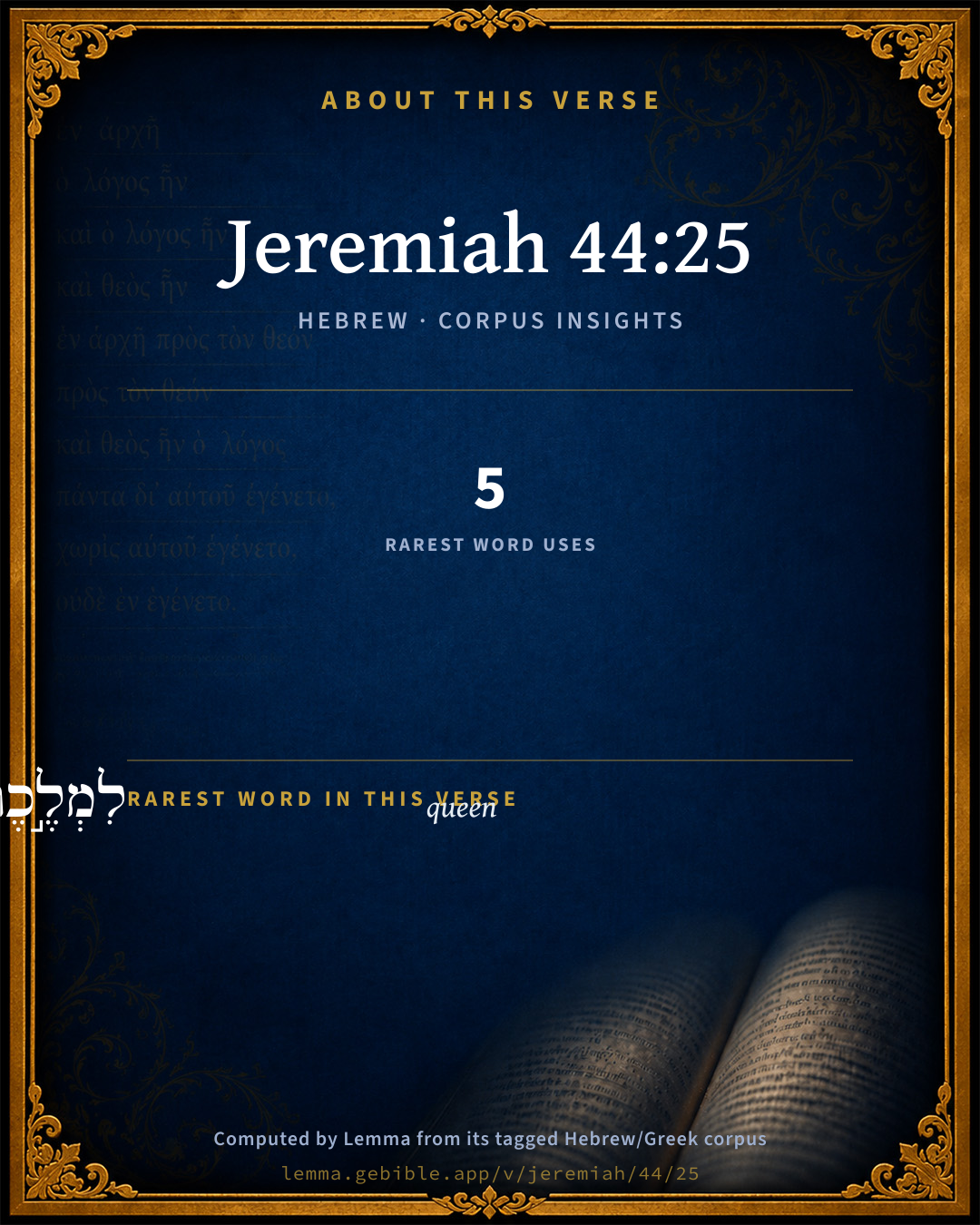
The rarest word here is לִמְלֶ֣כֶת queen H4446 — appearing just 5 times in the whole Hebrew Bible.

Shared distinctive vocabulary

לִמְלֶ֣כֶת queen H4446 occurs in 5 verses of the Hebrew Bible. Also found in:

Grammatical profile

  • 14 verbs
  • 13 nouns
  • 1 pronoun
  • 1 preposition
  • 1 adverb
  • 4 particles

Verb forms

  • אָמַ֣ר Qal · Perfect
  • לֵאמֹ֗ר Qal · Infinitive Construct
  • וַתְּדַבֵּ֣רְנָה Piel · Sequential Imperfect
  • מִלֵּאתֶ֣ם Piel · Perfect
  • לֵאמֹר֒ Qal · Infinitive Construct
  • עָשֹׂ֨ה Qal · Infinitive Absolute
  • נַעֲשֶׂ֜ה Qal · Imperfect
  • נָדַ֨רְנוּ֙ Qal · Perfect
  • לְקַטֵּר֙ Piel · Infinitive Construct
  • וּלְהַסֵּ֥ךְ Hiphil · Infinitive Construct
  • הָקֵ֤ים Hiphil · Infinitive Absolute
  • תָּקִ֨ימְנָה֙ Hiphil · Imperfect
  • וְעָשֹׂ֥ה Qal · Infinitive Absolute
  • תַעֲשֶׂ֖ינָה Qal · Imperfect

Repetition

Words recur within this verse — often emphatic in Hebrew:

  • עָשֹׂ֨ה to do H6213 ×4
  • אָמַ֣ר to say H559 ×3
  • נְדָרֵ֗ינוּ vow H5088 ×3
  • הָקֵ֤ים to rise H6965 ×2

Cross-references

8

Topical passages linked to Jeremiah 44:25 in the Treasury of Scripture Knowledge — connected by theme and wording, ordered by reader-vote popularity; previews shown in the World English Bible.

  • Matthew 14:9 The king was grieved, but for the sake of his oaths, and of those who sat at the table with him, he commanded it to be given,
  • Job 34:22 There is no darkness, nor thick gloom, Where the workers of iniquity may hide themselves.
  • Isaiah 28:15 Because you have said, We have made a covenant with death, and with Sheol are we at agreement; when the overflowing scourge shall pass through, it shall not come to us; for we have made lies our refuge, and under falsehood have we hid ourselves:
  • Jeremiah 44:15–19 Then all the men who knew that their wives burned incense to other gods, and all the women who stood by, a great assembly, even all the people who lived in the land of Egypt, in Pathros, answered Jeremiah, saying,
  • Ezekiel 20:39 As for you, house of Israel, thus says the Lord Yahweh: Go you, serve everyone his idols, and hereafter also, if you will not listen to me; but my holy name shall you no more profane with your gifts, and with your idols.
  • Acts 23:12–15 When it was day, some of the Jews banded together, and bound themselves under a curse, saying that they would neither eat nor drink until they had killed Paul.
  • James 1:14–15 But each one is tempted, when he is drawn away by his own lust, and enticed.
  • Jude 1:13 wild waves of the sea, foaming out their own shame; wandering stars, for whom the blackness of darkness has been reserved forever.

Cross-references courtesy of OpenBible.info (CC BY 4.0).

Hebrew and Greek witnesses Masoretic Hebrew ↔ Greek Septuagint

The same verse in the two great witnesses to the Old Testament, shown verse-for-verse.

These are two independent witnesses, not word-aligned to each other, and the Septuagint is shown in lemma (dictionary) form.

Hebrew Jeremiah 44:25 Masoretic · Westminster Leningrad Codex

כֹּֽה אָמַ֣ר יְהוָֽה צְבָאוֹת֩ אֱלֹהֵ֨י יִשְׂרָאֵ֜ל לֵאמֹ֗ר אַתֶּ֨ם וּנְשֵׁיכֶ֜ם וַתְּדַבֵּ֣רְנָה בְּפִיכֶם֮ וּבִידֵיכֶ֣ם מִלֵּאתֶ֣ם לֵאמֹר֒ עָשֹׂ֨ה נַעֲשֶׂ֜ה אֶת נְדָרֵ֗ינוּ אֲשֶׁ֤ר נָדַ֨רְנוּ֙ לְקַטֵּר֙ לִמְלֶ֣כֶת הַשָּׁמַ֔יִם וּלְהַסֵּ֥ךְ לָ֖הּ נְסָכִ֑ים הָקֵ֤ים תָּקִ֨ימְנָה֙ אֶת נִדְרֵיכֶ֔ם וְעָשֹׂ֥ה תַעֲשֶׂ֖ינָה אֶת נִדְרֵיכֶֽם

Thus says Yahweh of Hosts, the God of Israel, saying, You and your wives have both spoken with your mouths, and with your hands have fulfilled it, saying, We will surely perform our vows that we have vowed, to burn incense to the queen of the sky, and to pour out drink-offerings to her: establish then your vows, and perform your vows.

World English Bible · Public Domain

Greek LXX Structure differs

In the Septuagint, Jeremiah is about an eighth shorter than the Hebrew and arranges its material differently — the Oracles Against the Nations (Hebrew chapters 46–51) appear in the middle of the Greek book, after 25:13. Because the chapter and verse boundaries do not line up, a verse-for-verse comparison with the Hebrew is not shown.

A verse-for-verse comparison isn’t shown here because the chapters and verses don’t line up. Switch to the LXX edition with the MT / LXX toggle above to read the Greek directly.

On this verse, The Cambridge Bible for Schools and Colleges discusses the Septuagint’s reading. Read the note in Commentary ↓

Hebrew: Westminster Leningrad Codex (CC BY 4.0). Greek: Septuagint (public domain); English from a public-domain English Septuagint. How the Septuagint differs from the Hebrew →

Targum (Aramaic paraphrase)

1

The Targum is the ancient Jewish Aramaic paraphrase of the Hebrew Scriptures — an interpretive translation, not the Hebrew text itself. Onkelos (literal) and Pseudo-Jonathan (expansive) render the Torah, and Jonathan the Prophets. Coverage is partial: where no permissively-licensed English translation exists for a verse, only the Aramaic is shown. This is verse-level text, not a word-by-word alignment to the Hebrew.

  1. Targum Jonathan Prophets (Joshua–Malachi)
    כִּדְנַן אֲמַר יְיָ צְבָאוֹת אֱלָהָא דְיִשְׂרָאֵל לְמֵימָר אַתּוּן וּנְשֵׁיכוֹן וּגְזַרְתּוּן בְּפוּמְכוֹן וּבִרְעוּתְכוֹן קַיֵמְתּוּן לְמֵימָר מֶעְבַּד נַעְבֵּיד יַת נִדְרָנָא דִי נְדַרְנָא לְאַסָקָא בּוּסְמִין לְכוֹכְבַת שְׁמַיָא וּלְנַסְכָא לָהּ נִסְכִּין אַקָמָא תְקִימוּן יַת נִדְרֵיכוֹן וּמֶעְבַּד תַּעְבְּדוּן יַת נִסְכֵּיכוֹן:

    (no public-domain English translation for this verse)

    Targum Jonathan — Aramaic: “Mikraot Gedolot” (public domain). English: “Sefaria Community Translation” (CC0 1.0 (public-domain dedication)); “London "Chaldee Paraphrase," 1871” (public domain). Text via Sefaria.

Commentary

Notes on Jeremiah 44:25 from classic Christian and Jewish commentators (each source and its license shown beneath its notes). The classic Christian expositions comment on the surrounding passage and are grouped to its opening verse, so a note may address several verses; the Jewish commentaries on the Tanakh (Rashi and others) are per-verse, so they appear only where the commentator wrote on this verse.

Lemma curates 59 commentaries, every one of them public domain or Creative Commons licensed, each selected and text-cleaned for this edition rather than reprinted as found. About our sources →

Trapp's Complete Commentary

John Trapp

Jer 44:25 Thus saith the LORD of hosts, the God of Israel, saying; Ye and your wives have both spoken with your mouths, and fulfilled with your hand, saying, We will surely perform our vows that we have vowed, to burn incense to the queen of heaven, and to pour out drink offerings unto her: ye will surely accomplish your vows, and surely perform your vows.

Ver. 25. Ye and your wives.] Who ought to be the better, but are much worse the one for the other, the devil having broken your head with your own rib.

We will surely perform our vows.] A little better than many Popish votaries (and others also not a few) do today; not unlike him in Erasmus, who in a storm promised the Virgin a picture of wax as big as St Christopher, but when he came to shore would not give a tallow candle. {a}

{a} Erasm. Col. in Naufr.

John Trapp, A Commentary or Exposition upon All the Books of the Old and New Testament (1647–1656) — public domain. Text from a community e-Sword module.

Geneva Bible (1599)

Geneva Bible translators

You have committed double evil in making wicked vows, and in performing the same.

Geneva Bible (1599) marginal notes — public domain. Text via Bolls.life.

Jamieson, Fausset & Brown

Robert Jamieson, A. R. Fausset & David Brown

Ye . . . have both spoken with . . . mouths, and fulfilled with . . . hand--ironical praise. They had pleaded their obligation to fulfil their vows, in excuse for their idolatry. He answers, no one can accuse you of unsteadiness as to your idolatrous vows; but steadfastness towards God ought to have prevented you from making, or, when made, from keeping such vows.

ye will surely accomplish . . . vows--Jeremiah hereby gives them up to their own fatal obstinacy.

Jamieson, Fausset & Brown — Commentary Critical and Explanatory on the Whole Bible (1871) — public domain (CC PDM 1.0). Text via the HelloAO Bible API.

John Calvin's Commentaries

Jeremiah pursues the same subject, and not only bitterly reproves the ungodly men who so pertinaciously despised his doctrine, but also shews that they could gain nothing by their audacity, because they would at length be violently broken down, as they could not bear to be corrected, he says at the beginning, Ye and your wives have spoken; the men are also included, Ye have spoken both men and women, and with your hands have fulfilled it; that is, your obstinacy is complete, for, as you have spoken insolently against God, so there has been a performance; for by hands he designates the work done. he then shews that they had advanced to the highest pitch of impiety, for they hesitated not to vomit forth these impious words, We will not obey God, and they joined their hands to their mouth, for they strenuously executed what they had said. The thought itself was sufficient to condemn them; but when they thus spoke with their tongues, and then employed their hands against God, it was a proof of desperate audacity, as though they willfully designed to provoke him.

But he shews what issue awaited these impious men, who so presumptuously rebelled against God. When he bids them to hear what God on the other hand had sworn, he compares God with themselves, as though he had said, “You may a hundred times increase in your madness, yet God will be the conqueror; for he is an adversary who will surely subvert all schemes and efforts.” But before he comes to this, he mentions what they said, Doing we shall do our vows which we have vowed, to burn incense, etc. Here Jeremiah relates what we have before seen, that the Jews, under the pretext of doing what had been before done, continued thus rebellious against God. We perceive this by the word vows; and the superstitious, when they are pressed, are wont always to flee to this pretext, that to persevere in one’s resolution is a great virtue. While, then, they avoid the charge of fickleness, they harden themselves against God.

The same thing we see at this day under the Papacy: The older any one is, the more obstinate he is. “What! have I not learned during forty or fifty years what religion is, and how to worship God? I have been thus taught from a child, and have by a long habit followed this way: it would be now a disgraceful thing for me to change my course and to relinquish the faith which I have professed for so many years.”

There is, then, no doubt but the Jews made a pretense of this kind against Jeremiah, when they said that they had vowed. For hypocrites make no distinction when they vow anything, but indiscriminately obtrude on God whatever comes to their minds; they afterwards stand fixed in their foolish fancies, and say that a. vow is inviolable, a sacred thing. Such was the excuse of the people. But we see from the Prophet’s answer how vainly they did bring forward in opposition to God their vows, which had been made without judgment and without reason.

And this passage ought to be carefully noticed; so that we may especially know, that it is a folly in no way pleasing to God, when men indiscriminately vow whatever they may dream according to their own fancies. God then would have sobriety and regard to his will to be observed as to vows. But when any one has made an inconsiderate vow, pertinaciously to persist in it is no less displeasing to God than the vow itself. The Jews had vowed; the warning of the Prophet ought to have constrained them to change their resolution. But while they avoided every kind of fickleness, we see that instead of constancy they set up their own perverseness and diabolical obstinacy in opposition to God. When, therefore, we rashly make vows, disapproved by God, nothing is better than immediately to retract them; for we have already sinned more than enough in having abused the holy name of God. For this reason the Prophet says, that the Jews spoke thus, Doing we shall do the vows we have vowed; and what were these? To offer incense to the stars and to hosts of Heaven. Had they vowed anything to God, they ought not to have broken their pledged faith; but they had made vows to the devil; then they ought to have immediately changed their purpose. When I say that vows made to God ought to be performed, I mean lawful vows; for he who makes a vow without judgment, does not vow to God; but those vows which God sanctions ought to be deemed sacred; and whatever vows God repudiates, ought to be counted as nothing. We hence see that the Jews were justly condemned, for they pertinaciously paid their vows to their own idols.

He adds by way of irony, Confirming ye will confirm your vows, doing ye will do your vows Here the Prophet sharply checks their insolence, because they thus set up themselves against God, as though it were a great virtue to persevere in their wicked purpose; ye cannot change, he says, but confirming ye will confirm your vows!

John Calvin's Commentaries (1540-1563) — public domain. Text from the Calvin Translation Society English edition (1840s-50s) via the Christian Classics Ethereal Library (ccel.org). Calvin's coverage is partial (roughly two-thirds of the Bible); uncommented books and verses are honest gaps, never fabricated. The 19th-century editor's footnotes and remarks are omitted so the notes are faithfully Calvin's own voice.

The Cambridge Bible for Schools and Colleges

gen. ed. J. J. S. Perowne

25. Ye and your wives] better, with LXX, Ye women.

with your hands have fulfilled it] have carried out your determination. For the expression cp. 1Ki_8:15; 1Ki_8:24.

establish then, etc.] ironically spoken. If ye will persist in spite of all my warnings, then be it so.

The Cambridge Bible for Schools and Colleges (gen. ed. J. J. S. Perowne; Cambridge University Press, 1878–1918) — public domain. Text from a community e-Sword module.

John Gill's Exposition

Thus saith the Lord of hosts, the God of Israel,.... Which is an usual preface to prophecies coming from him:

saying; as follows:

ye and your wives have both spoken with your mouths, and fulfilled with your hand; they had said they would burn incense to the queen of heaven, and they had done it; they had been as good as their word, true to it, though in a bad thing: their words and works agreed, and so did the men and their wives: the women had before said they did not perform worship to the queen of heaven without their men; this is acknowledged by the Lord, and their confession is improved against them:

saying, we will surely perform our vows that we have vowed, to burn incense to queen of heaven, and to pour out drink offerings unto her; they thought, because they made a vow that they would do it, that it was therefore obligatory upon them, and this would be sufficient to justify them before God, and excuse it to him; whereas nothing that is sinful ought to be vowed or performed; and to vow and perform in such a case is doubly criminal: a vow cannot make that lawful which is unlawful; and the performance of it can never be a laudable action:

ye will surely accomplish your vows, and surely perform your vows; they were resolutely set upon it, and nothing would hinder their performance of it; this shows the obstinacy and firmness of their minds: though some think these words are spoken ironically.

John Gill's Exposition of the Whole Bible (1746–1763) — public domain (CC PDM 1.0). Text via the HelloAO Bible API.

Matthew Poole's English Annotations

Those words

have spoken are in the Hebrew of the feminine gender, which giveth good reason to some interpreters to conclude the women were first and principal in this idolatry, and the men’s guilt lay in conniving at them, and suffering themselves to be seduced by them. Ye, saith the prophet, have spoken it, and ye have been as big as your words, and for a cover you pretend the religion of a yew, as if a vow could be a bond of iniquity, and it were possible by a vow to oblige yourselves to a forsaking of the true God, and a committing of idolatry. The latter words seem ironical, so as to have this sense, You are resolved upon it, and there is no moving you from your resolution; God hath resolved too.

Matthew Poole's English Annotations on the Holy Bible (1683–1685) — public domain. Text from a community e-Sword/MySword module.

Whedon's Commentary on the Bible

Daniel D. Whedon

JEREMIAH PREDICTS FURTHER DISTRESS, Jer_44:24-30.

25. Fulfilled with your hand — Literally, hands, alluding to the making of the sacrificial cakes.

Perform our vows — How many think it good to fulfil a promise to do evil! To keep a vow they had never any right to make, is with them meritorious.

Daniel D. Whedon (gen. ed.), Commentary on the Old and New Testaments (1874–1909) — public domain. Text from a community e-Sword module.

The Pulpit Commentary

With your hand; rather, with your hands. Ye will surely accomplish, etc.; rather, ye shall, etc., by all means perform your vows, and take the consequence. The irony of the passage is lost by the "will" of the Authorized Version.

Sinful vows.

I SINFUL VOWS ARE AMONG THE MOST WICKED OF SINS. Some sins are committed hastily and in passion, these with more deliberation; some without strong desire, these most earnestly.

II IT IS A SIN TO PERFORM SINFUL VOWS. If we were not at liberty to make the vows, we are not at liberty to perform them. We cannot be bound to do that which we have no right to do. If we have promised to do an unlawful act, we should not consider that promise binding upon us, since our word cannot abrogate the law that forbids the act.

III GOD LEAVES MEN FREE TO EXECUTE THEIR EVIL INTENTIONS. The Jews in Upper Egypt were to be left to the performance of their vows to the queen of heaven. This implied no sanction; it was only the withholding of forcible restraints. What a solemn responsibility lies in the fact that we have this large liberty after we have chosen an evil way, and before we are called to judgment for it!

IV GOD SOMETIMES CEASES TO WARN MEN OF THE DANGER OF THEIR WICKED COURSES. They are then left to themselves till their sin ripens. It is a terrible fate, but consistent with the goodness of God, as we may be sure that, if God deliberately ceases to warn a man, it is because warnings are lost on him or simply harden him. We may so sin as to become "seared in our own conscience with a hot iron". (1Ti_4:2)

V THE FRUIT OF THE WICKED COURSES WHICH MEN HAVE CHOSEN FOR THEMSELVES WILL BE THE WORST PUNISHMENT OF THEM. They need no external penalties performed by executioners of justice. Sin is its own executioner, the natural effect of sin its own punishment. In the natural results that followed the performance of their wicked vows the idolatrous Jews will reap the bitterest harvest of retribution. "The sin, when it is full grown, bringeth forth death". (Jam_1:15)

The Pulpit Commentary (1880–1919), ed. H.D.M. Spence-Jones & Joseph S. Exell — public domain. Text from a community e-Sword module.

Lesson kit

Teaching starters — assembled from the data on this page, not authored interpretation. Every prompt links to the verse data it draws on. Edit before teaching.

Jeremiah, in the Prophets, opens this verse with 34 words (23 distinct Hebrew lemmas). Its most distinctive word is mᵉleketh (“queen”). A historical commentator’s framing appears above. Read the whole chapter for the surrounding context.

Discussion questions

  1. How does “queen” (mᵉleketh) shape what this verse is saying?
  2. Jeremiah 7:18 shares the word «queen» with this verse. How do the two illuminate each other?
  3. “to do” occurs 4× in this one verse. What is the effect of the repetition?
  4. These translations render this verse differently; the difference is in the English rendering, not the original. What questions does that raise?
  5. The verb «אָמַ֣ר» is Qal Perfect. How does its form color the action?
  6. Reading how Trapp's Complete Commentary and Geneva Bible (1599) read this verse, where do the two commentators agree and where do they part?

Things to notice

Reading settings

Reading text

Shown beneath each verse's original-language words.

Old Testament
Old Testament edition

Read the OT as the Masoretic Hebrew (MT) or the Greek Septuagint (LXX).

English shown for the Greek Septuagint (in the Hebrew ↔ Greek comparison).

Comparing translations? Open the Compare panel on any verse page to stack up to four side by side.