
1 Kings 11:8

Hebrew (Westminster Leningrad Codex) 1 Kings 11:8 appears in the Hebrew Old Testament. The text above is from the Westminster Leningrad Codex. Each word links to its Strong’s number, a concise gloss, and parsing drawn from the Open Scriptures Hebrew Bible morphology. Click any word for its full Brown-Driver-Briggs (BDB) entry.
Download image
Cite this verse

1 Kings 11:8 (World English Bible). Public Domain. Lemma interlinear Bible study tool, https://lemma.gebible.app/v/1-kings/11/8.

Show BibTeX & RIS
BibTeX
RIS
English Translation
So did he for all his foreign wives, who burnt incense and sacrificed to their gods.
World English Bible · Public Domain
Download a study sheet

One document with this verse’s original text, its word-by-word gloss line, the meaning frame, cross-references with their text, attributed commentary, and full source and license credits — printable, and it pastes into notes with its structure intact.

This verse Autodidact and up

Study sheet (.html) Plain text (.txt)

A passage Seminary Student

Up to 50 verses in one chapter. A passage sheet keeps up to 6 commentary sources and 12 cross-references per verse, in the order this page ranks them, and says so on the sheet whenever that leaves anything out. Ask for a single verse and you get the Autodidact verse sheet above.

Everything on this page stays free to read, with no account — the sheet is a download of what is already on screen, not access to it.

Want to remove ads? Support Godless Engineer
Compare translations 3

The same verse in 3 English versions, stacked beneath the original-language interlinear above. Click any original word for its lexicon entry.

Each is an independent rendering of the whole verse — the interlinear is not word-aligned to these translations.

Highlighted words mark where these versions differ — a whole-verse word diff, not a word-by-word alignment.

  • World English Bible Public Domain
    So did he for all his foreign wives, who burnt incense and sacrificed to their gods.
  • King James Version Public Domain
    And likewise did he for all his strange wives, which burnt incense and sacrificed unto their gods.
  • unfoldingWord Literal Text CC BY-SA 4.0
    And thus he did for all of his foreign wives burning incense and sacrificing to their gods.

unfoldingWord Literal Text — © unfoldingWord, licensed CC BY-SA 4.0. Word-aligned USFM3 via Door43 (git.door43.org/unfoldingWord/en_ult).

Versions to compare (up to 4)

3 of 4 selected

Show all 18 translations

Every available English version of this verse, each an independent rendering of the whole verse.

  • World English Bible Public Domain
    So did he for all his foreign wives, who burnt incense and sacrificed to their gods.
  • Berean Standard Bible Public Domain
    He did the same for all his foreign wives, who burned incense and sacrificed to their gods.
  • Majority Standard Bible Public Domain
    He did the same for all his foreign wives, who burned incense and sacrificed to their gods.
  • King James Version Public Domain
    And likewise did he for all his strange wives, which burnt incense and sacrificed unto their gods.
  • American Standard Version (1901) Public Domain
    And so did he for all his foreign wives, who burnt incense and sacrificed unto their gods.
  • Revised Version (1885) Public Domain
    And so did he for all his strange wives, which burnt incense and sacrificed unto their gods.
  • Geneva Bible (1599) Public Domain
    And so did he for all his outlandish wiues, which burnt incense and offered vnto their gods.
  • Douay-Rheims (1899) Public Domain
    And he did in this manner for all his wives that were strangers, who burnt incense, and offered sacrifice to their gods.
  • Young's Literal Translation Public Domain
    and so he hath done for all his strange women, who are perfuming and sacrificing to their gods.
  • Literal Standard Version CC BY-SA 4.0
    and so he has done for all his strange women, who are perfuming and sacrificing to their gods.
  • Unlocked Literal Bible CC BY-SA 4.0
    He also built high places for all his foreign wives, who burned incense and sacrificed to their gods at them.
  • unfoldingWord Literal Text CC BY-SA 4.0
    And thus he did for all of his foreign wives burning incense and sacrificing to their gods.
  • Darby Bible Public Domain
    And so he did for all his foreign wives, who burned incense and sacrificed to their gods.
  • World Messianic Bible Public Domain
    So he did for all his foreign wives, who burned incense and sacrificed to their gods.
  • Webster's Bible Public Domain
    And likewise did he for all his foreign wives, who burnt incense and sacrificed to their gods.
  • Free Bible Version CC BY-SA 4.0
    He built places of worship for all his foreign wives where they burned incense and sacrificed to their gods.
  • Bible in Basic English Public Domain
    And so he did for all his strange wives, who made offerings with burning of perfumes to their gods.
  • JPS Tanakh (1917) Public Domain
    And so did he for all his foreign wives, who offered and sacrificed unto their gods.

Literal Standard Version (2020), Covenant Press — licensed CC BY-SA 4.0. Text via the HelloAO Bible API (eBible.org). Unlocked Literal Bible (unfoldingWord) — licensed CC BY-SA 4.0. Text via the HelloAO Bible API (eBible.org). unfoldingWord Literal Text — © unfoldingWord, licensed CC BY-SA 4.0. Word-aligned USFM3 via Door43 (git.door43.org/unfoldingWord/en_ult). Free Bible Version, Dr. Jonathan Gallagher — licensed CC BY-SA 4.0. Text via the HelloAO Bible API (eBible.org).

Word by word

More ways to search: Search by grammar → Find every occurrence → Compare this word →

Practice this passage: Drill this verse → Learn its vocabulary →

הַנָּכְרִיּ֑וֹת
nokrîy
H5237
“the · foreign”
Particle, Definite Article + Adjective, Adjective, Feminine, Plural, Absolute
Part of Speech
Particle + Adjective
Type
Adjective
Gender
Feminine
Number
Plural
State
Absolute
Full BDB Definition

Origin: from H5235 (second form)

TWOT: 1368c

foreign, alien - foreign - foreigner (substantive) - foreign woman, harlot - unknown, unfamiliar (figuratively)
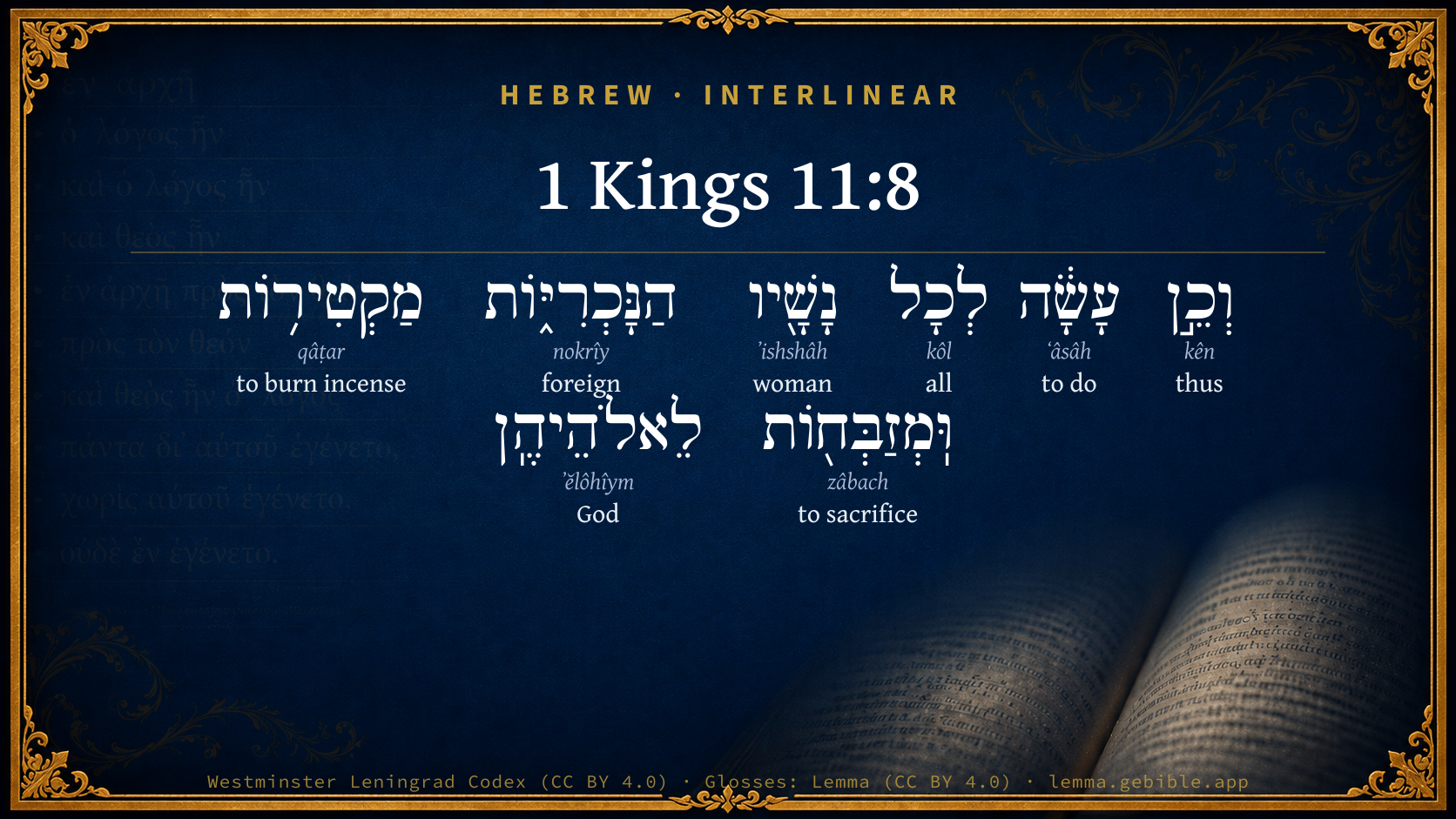
  1. וְכֵ֣ן kên H3651 “and · thus” Conjunction + Particle, Demonstrative
  2. עָשָׂ֔ה ʻâsâh H6213 “to do” Verb, Qal, Perfect, 3rd Person, Masculine, Singular
  3. לְכָל kôl H3605 “to/for · all of” Preposition + Noun, Common, Masculine, Singular, Construct
  4. נָשָׁ֖יו ʼishshâh H802 “women · his” Noun, Common, Feminine, Plural, Construct + Suffix, Personal, 3rd Person, Masculine, Singular
  5. מַקְטִיר֥וֹת qâṭar H6999 “burning incense” Verb, Hiphil, Participle Active, Feminine, Plural, Absolute
  6. וּֽמְזַבְּח֖וֹת zâbach H2076 “and · sacrificing” Conjunction + Verb, Piel, Participle Active, Feminine, Plural, Absolute
  7. לֵאלֹהֵיהֶֽן ʼĕlôhîym H430 “to/for · God(s) · their” Preposition + Noun, Common, Masculine, Plural, Construct + Suffix, Personal, 3rd Person, Feminine, Plural

About this verse

These counts appear in no published source. They are computed here, from the morphology-tagged text and Lemma’s own curated glosses. What Lemma adds →

8
words
8
distinct lemmas
Historical
section

Shared distinctive vocabulary

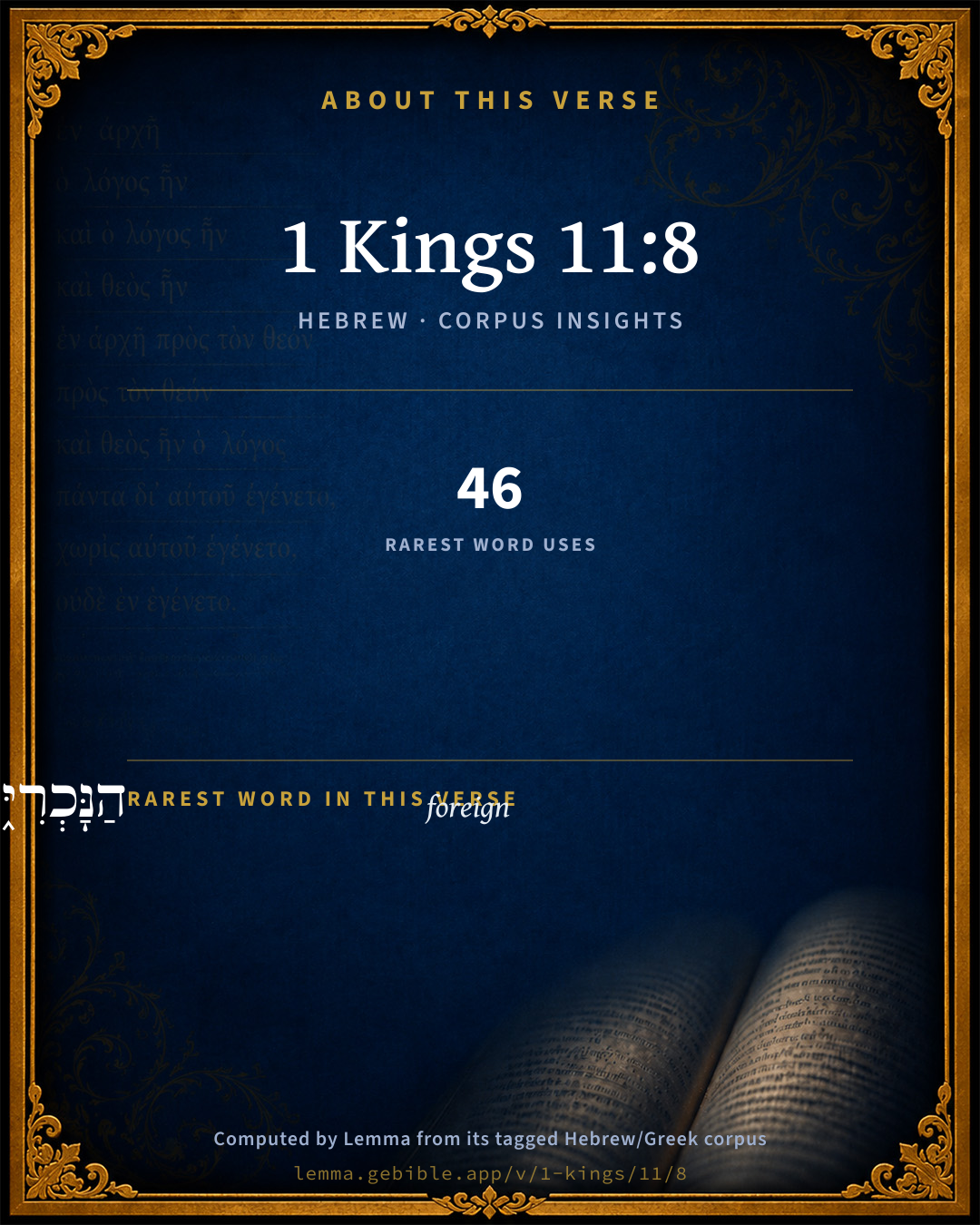
הַנָּכְרִיּ֑וֹת foreign H5237 occurs in 45 verses of the Hebrew Bible. Also found in:

Grammatical profile

  • 3 verbs
  • 3 nouns
  • 1 adjective
  • 1 particle

Verb forms

  • עָשָׂ֔ה Qal · Perfect
  • מַקְטִיר֥וֹת Hiphil · Participle Active
  • וּֽמְזַבְּח֖וֹת Piel · Participle Active

Cross-references

5

Topical passages linked to 1 Kings 11:8 in the Treasury of Scripture Knowledge — connected by theme and wording, ordered by reader-vote popularity; previews shown in the World English Bible.

  • 1 Kings 11:1 Now king Solomon loved many foreign women, together with the daughter of Pharaoh, women of the Moabites, Ammonites, Edomites, Sidonians, and Hittites;
  • Ezekiel 16:22–29 In all your abominations and your prostitution you have not remembered the days of your youth, when you were naked and bare, and was weltering in your blood.
  • Hosea 4:11–12 Prostitution, wine, and new wine take away understanding.
  • 1 Corinthians 10:11–12 Now all these things happened to them by way of example, and they were written for our admonition, on whom the ends of the ages have come.
  • 1 Corinthians 10:20–22 But I say that the things which the Gentiles sacrifice, they sacrifice to demons, and not to God, and I don't desire that you would have communion with demons.

Cross-references courtesy of OpenBible.info (CC BY 4.0).

Hebrew and Greek witnesses Masoretic Hebrew ↔ Greek Septuagint

The same verse in the two great witnesses to the Old Testament, shown verse-for-verse.

These are two independent witnesses, not word-aligned to each other, and the Septuagint is shown in lemma (dictionary) form.

Hebrew 1 Kings 11:8 Masoretic · Westminster Leningrad Codex

וְכֵ֣ן עָשָׂ֔ה לְכָל נָשָׁ֖יו הַנָּכְרִיּ֑וֹת מַקְטִיר֥וֹת וּֽמְזַבְּח֖וֹת לֵאלֹהֵיהֶֽן

So did he for all his foreign wives, who burnt incense and sacrificed to their gods.

World English Bible · Public Domain

Greek LXX 1 Kings 11:8 Septuagint · lemma form

καί ποιέω σαλωμών ὁ πονηρός ἐνώπιον κύριος οὐ πορεύομαι ὀπίσω κύριος ὡς δαυίδ ὁ πατήρ αὐτός

No English rendering of this Greek verse — the small residue in the structurally divergent books.

On this verse, The Cambridge Bible for Schools and Colleges discusses the Septuagint’s reading. Read the note in Commentary ↓

Hebrew: Westminster Leningrad Codex (CC BY 4.0). Greek: Septuagint (public domain); English from a public-domain English Septuagint. How the Septuagint differs from the Hebrew →

Targum (Aramaic paraphrase)

1

The Targum is the ancient Jewish Aramaic paraphrase of the Hebrew Scriptures — an interpretive translation, not the Hebrew text itself. Onkelos (literal) and Pseudo-Jonathan (expansive) render the Torah, and Jonathan the Prophets. Coverage is partial: where no permissively-licensed English translation exists for a verse, only the Aramaic is shown. This is verse-level text, not a word-by-word alignment to the Hebrew.

  1. Targum Jonathan Prophets (Joshua–Malachi)
    וְכֵן עֲבַד לְכָל נְשׁוֹהִי בְּנַת עַמְמַיָא מַסְקִין בּוּסְמִין וּמְדַבְּחַן לְטַעֲוַתְהוֹן:

    (no public-domain English translation for this verse)

    Targum Jonathan — Aramaic: “Mikraot Gedolot” (public domain). English: “Sefaria Community Translation” (CC0 1.0 (public-domain dedication)); “London "Chaldee Paraphrase," 1871” (public domain). Text via Sefaria.

Commentary

Notes on 1 Kings 11:8 from classic Christian and Jewish commentators (each source and its license shown beneath its notes). The classic Christian expositions comment on the surrounding passage and are grouped to its opening verse, so a note may address several verses; the Jewish commentaries on the Tanakh (Rashi and others) are per-verse, so they appear only where the commentator wrote on this verse.

Lemma curates 59 commentaries, every one of them public domain or Creative Commons licensed, each selected and text-cleaned for this edition rather than reprinted as found. About our sources →

Trapp's Complete Commentary

John Trapp

1Ki 11:8 And likewise did he for all his strange wives, which burnt incense and sacrificed unto their gods.

Ver. 8. And likewise did he for all, &c.] After that he had once gratified his mistresses of Moab, the rest of his women would needs have the like courtesy done them.

John Trapp, A Commentary or Exposition upon All the Books of the Old and New Testament (1647–1656) — public domain. Text from a community e-Sword module.

Joseph Benson's Commentary

1Ki 11:8. And likewise did he for all his strange wives — For what he granted to one, the others would be disposed to claim, or else complain of his unkindness to them. One would have expected from his wisdom and piety rather to have found him instrumental in converting them all to his religion, than to be himself seduced to theirs! But, alas! he does not appear to have taken any pains with them for any such purpose, being too much given up to his pleasures, and thinking, perhaps, that he could reconcile his religion with theirs, and find a good meaning in all their superstitious. And sacrificed unto their gods — See what need those have to stand upon their guard, who have been eminent for religion. The devil will set upon them most violently; and if they miscarry, the reproach is the greater. It is the evening that commends the day. Let us therefore fear, lest, having run well, we come short.

Joseph Benson's Commentary on the Old and New Testaments (1811–1818) — public domain. Text from a community e-Sword module.

Jamieson, Fausset & Brown

Robert Jamieson, A. R. Fausset & David Brown

burnt incense and sacrificed unto their gods--The first was considered a higher act of homage, and is often used as synonymous with worship (Kg2 22:17; Kg2 23:5).

Jamieson, Fausset & Brown — Commentary Critical and Explanatory on the Whole Bible (1871) — public domain (CC PDM 1.0). Text via the HelloAO Bible API.

Ellicott's Commentary for English Readers

(8) Which had appeared unto him twice.—See 1Ki_3:5; 1Ki_9:2.) Stress is laid on these direct visions of the Lord to Solomon, as contrasted with the usual indirect revelation through the prophets, and so carrying with them peculiar privilege and responsibility.

A Bible Commentary for English Readers, edited by Charles John Ellicott (1878–1897) — public domain. Text from a community e-Sword module.

The Cambridge Bible for Schools and Colleges

gen. ed. J. J. S. Perowne

8. and likewise did he for all his strange wives] i.e. For such of them as desired a special place for their worship. Ashtoreth, Chemosh and Moloch would suffice for the greater number, but we know of other gods among the nations round about, and the text implies that all were equally regarded. In the LXX. (Vat.) the order of these eight verses is considerably varied from the Hebrew text, and the narrative commences somewhat differently, thus: ‘And king Solomon was a lover of women, and he had 700 wives, princesses, and 300 concubines.’

The Cambridge Bible for Schools and Colleges (gen. ed. J. J. S. Perowne; Cambridge University Press, 1878–1918) — public domain. Text from a community e-Sword module.

John Gill's Exposition

And the Lord was angry with Solomon, because his heart was turned from the Lord God of Israel,.... Or from the fear of him, as the Targum, which must in a great measure be cast off, or he could not have given in to idolatry in any shape as he did; for it was for that the Lord was displeased, the which nothing is more provoking to him, as may be often observed:

which had appeared unto him twice; once at Gibeon, and again after his prayer at the dedication of the temple, Kg1 3:5, which is mentioned here as an aggravation of his sin, that he should fall into it, when the Lord had condescended to appear to him so graciously.

John Gill's Exposition of the Whole Bible (1746–1763) — public domain (CC PDM 1.0). Text via the HelloAO Bible API.

Matthew Poole's English Annotations

Having once given way to some few of most beloved wives, he was forced to comply with the rest.

Matthew Poole's English Annotations on the Holy Bible (1683–1685) — public domain. Text from a community e-Sword/MySword module.

Whedon's Commentary on the Bible

Daniel D. Whedon

8. Likewise did he for all — He may have erected altars to other idols than the ones here named, but probably the national deities of the Zidonians, Ammonites, and Moabites were sufficient for the religions of all the strange wives; and in building altars for these three he made provision for his Edomite and Hittite wives as well as the rest. Certain it is that no mention is anywhere made of Solomon erecting altars to any other gods than these.

Daniel D. Whedon (gen. ed.), Commentary on the Old and New Testaments (1874–1909) — public domain. Text from a community e-Sword module.

The Pulpit Commentary

And likewise did he for all having done it for one, he must needs do it for all. "No hill about Jerusalem was free from a chapel of devils" (Hall) his strange wives, which burnt Heb. burning, Ewald, 335 an incense and sacrificed unto their gods. Observe, as bearing on the question of Solomon"s apostasy, that Solomon built the altars; his wives sacrificed, etc. According to Keil, incense is here mentioned before sacrifice, because vegetable took precedence of animal offerings in the nature worship of Western Asia (Bahr, Symbolik, 2 pp; 237 sqq.) But it is very doubtful whether this idea was in the mind of the writer.

The Pulpit Commentary (1880–1919), ed. H.D.M. Spence-Jones & Joseph S. Exell — public domain. Text from a community e-Sword module.

John Wesley's Explanatory Notes

And sacrificed, &c. - See what need those have to stand upon their guard, who have been eminent for religion. The devil will set upon them most violently: and if they miscarry, the reproach is the greater. It is the evening that commends the day. Let us therefore fear, lest having run well, we come short.

John Wesley, Explanatory Notes Upon the Whole Bible (1754–1765) — public domain. Text via the GEBible commentary corpus.

Lesson kit

Teaching starters — assembled from the data on this page, not authored interpretation. Every prompt links to the verse data it draws on. Edit before teaching.

1 Kings, in the Historical, opens this verse with 8 words (8 distinct Hebrew lemmas). Its most distinctive word is nokrîy (“foreign”). A historical commentator’s framing appears above. Read the whole chapter for the surrounding context.

Discussion questions

  1. How does “foreign” (nokrîy) shape what this verse is saying?
  2. How does Genesis 31:15, which shares the word «foreign», read alongside this verse?
  3. These translations render this verse differently; the difference is in the English rendering, not the original. What questions does that raise?
  4. «עָשָׂ֔ה» is a Qal Perfect verb. How does that grammatical form shape the action described?
  5. Compare how Trapp's Complete Commentary and Joseph Benson's Commentary read this verse. Where do they agree or differ?

Things to notice

Reading settings

Reading text

Shown beneath each verse's original-language words.

Old Testament
Old Testament edition

Read the OT as the Masoretic Hebrew (MT) or the Greek Septuagint (LXX).

English shown for the Greek Septuagint (in the Hebrew ↔ Greek comparison).

Comparing translations? Open the Compare panel on any verse page to stack up to four side by side.