Leviticus 6:22

Hebrew (Westminster Leningrad Codex) Leviticus 6:22 appears in the Hebrew Old Testament. The text above is from the Westminster Leningrad Codex. Each word links to its Strong’s number, a concise gloss, and parsing drawn from the Open Scriptures Hebrew Bible morphology. Click any word for its full Brown-Driver-Briggs (BDB) entry.
Download image
Cite this verse

Leviticus 6:22 (World English Bible). Public Domain. Lemma interlinear Bible study tool, https://lemma.gebible.app/v/leviticus/6/22.

Show BibTeX & RIS
BibTeX
RIS
English Translation
The anointed priest that will be in his place from among his sons shall offer it. By a statute forever, it shall be wholly burnt to Yahweh.
World English Bible · Public Domain
Download a study sheet

One document with this verse’s original text, its word-by-word gloss line, the meaning frame, cross-references with their text, attributed commentary, and full source and license credits — printable, and it pastes into notes with its structure intact.

This verse Autodidact and up

Study sheet (.html) Plain text (.txt)

A passage Seminary Student

Up to 50 verses in one chapter. A passage sheet keeps up to 6 commentary sources and 12 cross-references per verse, in the order this page ranks them, and says so on the sheet whenever that leaves anything out. Ask for a single verse and you get the Autodidact verse sheet above.

Everything on this page stays free to read, with no account — the sheet is a download of what is already on screen, not access to it.

Want to remove ads? Support Godless Engineer
Compare translations 3

The same verse in 3 English versions, stacked beneath the original-language interlinear above. Click any original word for its lexicon entry.

Each is an independent rendering of the whole verse — the interlinear is not word-aligned to these translations.

Highlighted words mark where these versions differ — a whole-verse word diff, not a word-by-word alignment.

  • World English Bible Public Domain
    The anointed priest that will be in his place from among his sons shall offer it. By a statute forever, it shall be wholly burnt to Yahweh.
  • King James Version Public Domain
    And the priest of his sons that is anointed in his stead shall offer it: it is a statute for ever unto the LORD; it shall be wholly burnt.
  • unfoldingWord Literal Text CC BY-SA 4.0
    And the anointed priest under him from his sons shall do it. A statute of eternity: to Yahweh, a whole shall be made to become smoke.

unfoldingWord Literal Text — © unfoldingWord, licensed CC BY-SA 4.0. Word-aligned USFM3 via Door43 (git.door43.org/unfoldingWord/en_ult).

Versions to compare (up to 4)

3 of 4 selected

Show all 18 translations

Every available English version of this verse, each an independent rendering of the whole verse.

  • World English Bible Public Domain
    The anointed priest that will be in his place from among his sons shall offer it. By a statute forever, it shall be wholly burnt to Yahweh.
  • Berean Standard Bible Public Domain
    The priest, who is one of Aaron’s sons and will be anointed to take his place, is to prepare it. As a permanent portion for the LORD, it must be burned completely.
  • Majority Standard Bible Public Domain
    The priest, who is one of Aaron’s sons and will be anointed to take his place, is to prepare it. As a permanent portion for the LORD, it must be burned completely.
  • King James Version Public Domain
    And the priest of his sons that is anointed in his stead shall offer it: it is a statute for ever unto the LORD; it shall be wholly burnt.
  • American Standard Version (1901) Public Domain
    And the anointed priest that shall be in his stead from among his sons shall offer it: by a statute for ever it shall be wholly burnt unto Jehovah.
  • Revised Version (1885) Public Domain
    And the anointed priest that shall be in his stead from among his sons shall offer it: by a statute for ever it shall be wholly burnt unto the LORD.
  • Geneva Bible (1599) Public Domain
    And the Priest that is anointed in his steade, among his sonnes shall offer it: It is the Lordes ordinance for euer, it shall be burnt altogether.
  • Douay-Rheims (1899) Public Domain
    And the priest that rightfully succeedeth his father, shall offer it hot, for a most sweet odour to the Lord, and it shall be wholly burnt on the altar.
  • Young's Literal Translation Public Domain
    `And the priest who is anointed in his stead, from among his sons, doth make it, -- a statute age-during of Jehovah: it is completely perfumed;
  • Literal Standard Version CC BY-SA 4.0
    And the priest who is anointed in his stead, from among his sons, makes it; [it is] a continuous statute of YHWH; it is completely burned as incense;
  • Unlocked Literal Bible CC BY-SA 4.0
    The son of the high priest who is becoming the new high priest from among his sons will offer it. As commanded forever, all of it shall be burned to Yahweh.
  • unfoldingWord Literal Text CC BY-SA 4.0
    And the anointed priest under him from his sons shall do it. A statute of eternity: to Yahweh, a whole shall be made to become smoke.
  • Darby Bible Public Domain
    And the priest who is anointed of his sons in his stead shall prepare it: [it is] an everlasting statute; it shall be wholly burned to Jehovah.
  • World Messianic Bible Public Domain
    The anointed priest that will be in his place from among his sons shall offer it. By a statute forever, it shall be wholly burned to the LORD.
  • Webster's Bible Public Domain
    \\6:29\\All the males among the priests shall eat of it: it is most holy.
  • Free Bible Version CC BY-SA 4.0
    It is to be cooked by the priest who is one of Aaron's descendants and who is to be anointed to take his place. In this case since it is permanently allocated to the Lord, it must be burned completely.
  • Bible in Basic English Public Domain
    Every male among the priests may take it for his food: it is most holy.
  • JPS Tanakh (1917) Public Domain
    (6-15) And the anointed priest that shall be in his stead from among his sons shall offer it, it is a due for ever; it shall be wholly made to smoke unto the LORD.

Literal Standard Version (2020), Covenant Press — licensed CC BY-SA 4.0. Text via the HelloAO Bible API (eBible.org). Unlocked Literal Bible (unfoldingWord) — licensed CC BY-SA 4.0. Text via the HelloAO Bible API (eBible.org). unfoldingWord Literal Text — © unfoldingWord, licensed CC BY-SA 4.0. Word-aligned USFM3 via Door43 (git.door43.org/unfoldingWord/en_ult). Free Bible Version, Dr. Jonathan Gallagher — licensed CC BY-SA 4.0. Text via the HelloAO Bible API (eBible.org).

Word by word

More ways to search: Search by grammar → Find every occurrence → Compare this word →

Practice this passage: Drill this verse → Learn its vocabulary →

כָּלִ֥יל
kâlîyl
H3632
“whole”
Adjective, Adjective, Masculine, Singular, Absolute
Part of Speech
Adjective
Type
Adjective
Gender
Masculine
Number
Singular
State
Absolute
Full BDB Definition

Origin: from H3634

TWOT: 985b

entire, all, perfect (adjective) - entirety (substantive) - whole, whole burnt offering, holocaust, entirety (substantive)
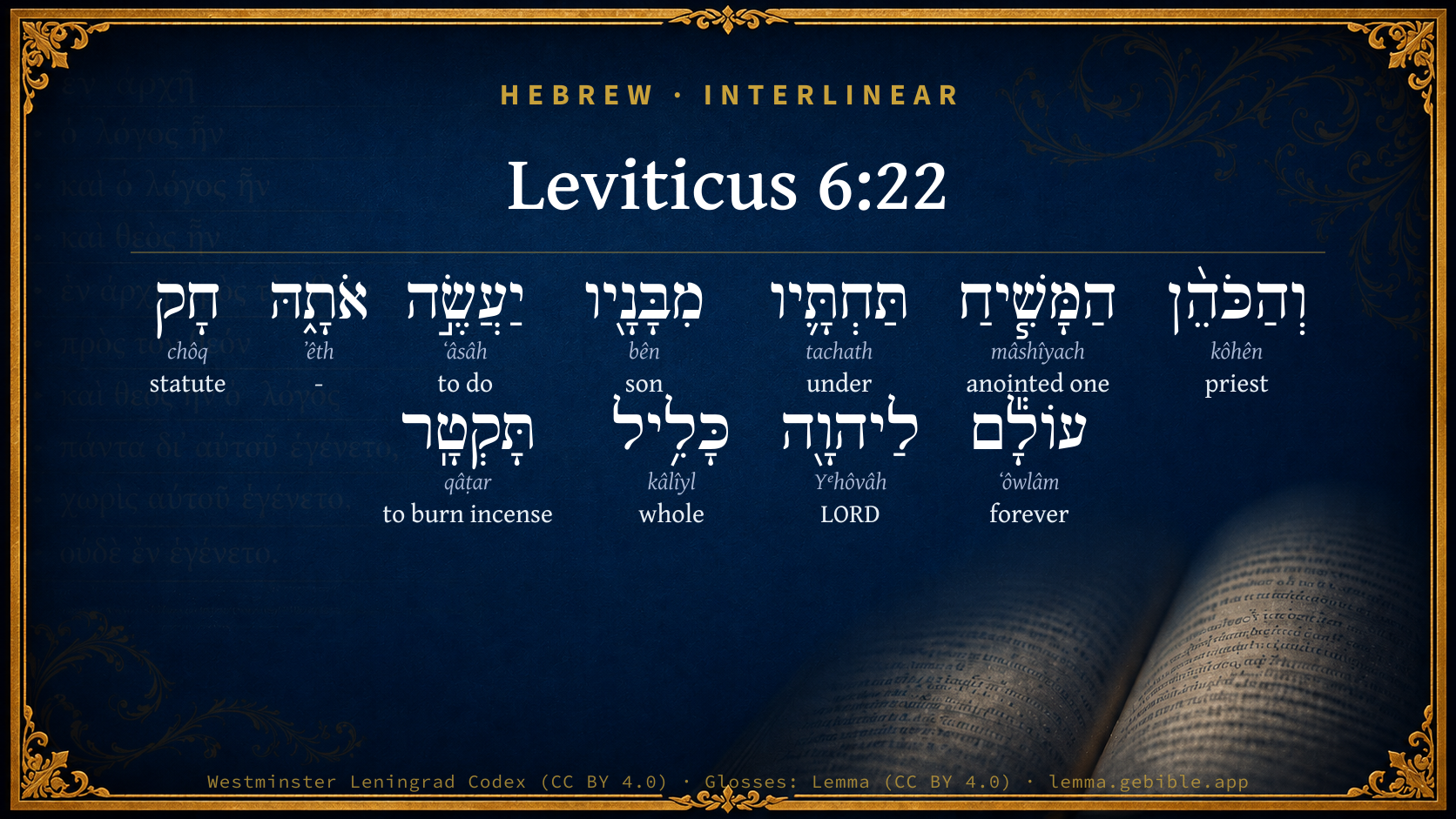
  1. וְהַכֹּהֵ֨ן kôhên H3548 “and · the · priest” Conjunction + Particle, Definite Article + Noun, Common, Masculine, Singular, Absolute
  2. הַמָּשִׁ֧יחַ mâshîyach H4899 “the · anointed one” Particle, Definite Article + Noun, Common, Masculine, Singular, Absolute
  3. תַּחְתָּ֛יו tachath H8478 “under · him” Preposition + Suffix, Personal, 3rd Person, Masculine, Singular
  4. מִבָּנָ֖יו bên H1121 “from · sons · his” Preposition + Noun, Common, Masculine, Plural, Construct + Suffix, Personal, 3rd Person, Masculine, Singular
  5. יַעֲשֶׂ֣ה ʻâsâh H6213 “to do” Verb, Qal, Imperfect, 3rd Person, Masculine, Singular
  6. אֹתָ֑הּ ʼêth H853 “- · her” Particle, Direct Object + Suffix, Personal, 3rd Person, Feminine, Singular
  7. חָק chôq H2706 “statute of” Noun, Common, Masculine, Singular, Construct
  8. עוֹלָ֕ם ʻôwlâm H5769 “forever” Noun, Common, Masculine, Singular, Absolute
  9. לַיהוָ֖ה Yᵉhôvâh H3068 “to/for · LORD” Preposition + Noun, Proper
  10. תָּקְטָֽר qâṭar H6999 “to burn incense” Verb, Hophal, Imperfect, 3rd Person, Feminine, Singular

About this verse

These counts appear in no published source. They are computed here, from the morphology-tagged text and Lemma’s own curated glosses. What Lemma adds →

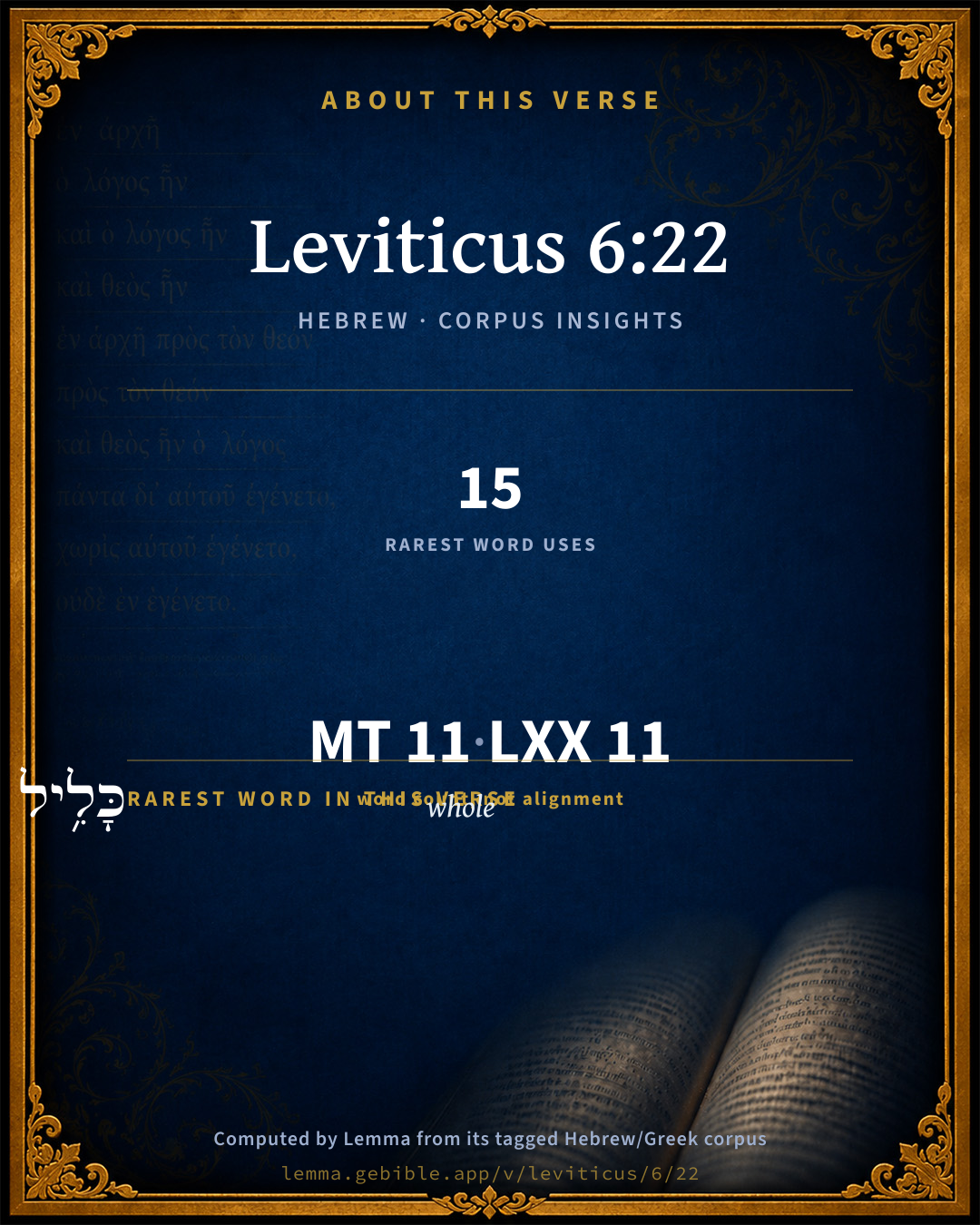
11
words
11
distinct lemmas
Pentateuch
section

Notable vocabulary

The rarest word here is כָּלִ֥יל whole H3632 — appearing just 15 times in the whole Hebrew Bible.

Shared distinctive vocabulary

כָּלִ֥יל whole H3632 occurs in 15 verses of the Hebrew Bible. Also found in:

Grammatical profile

  • 2 verbs
  • 6 nouns
  • 1 adjective
  • 1 preposition
  • 1 particle

Verb forms

  • יַעֲשֶׂ֣ה Qal · Imperfect
  • תָּקְטָֽר Hophal · Imperfect

Hebrew & Septuagint length

In English translation the verse runs 27 words from the Hebrew and 25 from the Septuagint (LXX English) — closely comparable.

A rough comparison of the two English renderings, which tokenize alike — not a word-level alignment.

Word counts can differ between the Hebrew and the Greek without any difference in meaning — e.g. the Hebrew direct-object marker אֵת has no separate Greek word, and Greek often adds the article ὁ.

In the original languages it is 11 Hebrew tokens and 11 Greek tokens — but the two are counted differently (Hebrew bundles its prefixes and suffixes into one token; the Greek is in lemma form), so that isn’t a like-for-like length.

Cross-references

6

Topical passages linked to Leviticus 6:22 in the Treasury of Scripture Knowledge — connected by theme and wording, ordered by reader-vote popularity; previews shown in the World English Bible.

  • Isaiah 53:10 Yet it pleased Yahweh to bruise him; he has put him to grief: when you shall make his soul an offering for sin, he shall see [his] seed, he shall prolong his days, and the pleasure of Yahweh shall prosper in his hand.
  • Hebrews 7:23 Many, indeed, have been made priests, because they are hindered from continuing by death.
  • Exodus 29:22–25 Also you shall take some of the ram's fat, the fat tail, the fat that covers the innards, the cover of the liver, the two kidneys, the fat that is on them, and the right thigh (for it is a ram of consecration),
  • Leviticus 4:3 if the anointed priest sins so as to bring guilt on the people, then let him offer for his sin, which he has sinned, a young bull without blemish to Yahweh for a sin offering.
  • Leviticus 8:21 He washed the innards and the legs with water; and Moses burned the whole ram on the altar. It was a burnt offering for a sweet savor. It was an offering made by fire to Yahweh; as Yahweh commanded Moses.
  • Deuteronomy 10:6 (The children of Israel traveled from Beeroth Bene Jaakan to Moserah. There Aaron died, and there he was buried; and Eleazar his son ministered in the priest's office in his place.

Cross-references courtesy of OpenBible.info (CC BY 4.0).

Hebrew and Greek witnesses Masoretic Hebrew ↔ Greek Septuagint

The same verse in the two great witnesses to the Old Testament, shown verse-for-verse.

These are two independent witnesses, not word-aligned to each other, and the Septuagint is shown in lemma (dictionary) form.

Hebrew Leviticus 6:22 Masoretic · Westminster Leningrad Codex

וְהַכֹּהֵ֨ן הַמָּשִׁ֧יחַ תַּחְתָּ֛יו מִבָּנָ֖יו יַעֲשֶׂ֣ה אֹתָ֑הּ חָק עוֹלָ֕ם לַיהוָ֖ה כָּלִ֥יל תָּקְטָֽר

The anointed priest that will be in his place from among his sons shall offer it. By a statute forever, it shall be wholly burnt to Yahweh.

World English Bible · Public Domain

Greek LXX Leviticus 6:22 Septuagint · lemma form

πᾶς ἄρσην ἐν ὁ ἱερεύς ἐσθίω αὐτός ἅγιος ἅγιος εἰμί κύριος

The anointed priest who is in his place, one of his sons, shall offer it: it is a perpetual statute, it shall all be consumed.

LXX2012 (modern English Septuagint) · Public Domain

On this verse, Haydock's Catholic Bible Commentary discusses the Septuagint’s reading. Read the note in Commentary ↓

Hebrew: Westminster Leningrad Codex (CC BY 4.0). Greek: Septuagint (public domain); English from LXX2012 (modern English Septuagint) (Public Domain). How the Septuagint differs from the Hebrew →

Targum (Aramaic paraphrase)

2

The Targum is the ancient Jewish Aramaic paraphrase of the Hebrew Scriptures — an interpretive translation, not the Hebrew text itself. Onkelos (literal) and Pseudo-Jonathan (expansive) render the Torah, and Jonathan the Prophets. Coverage is partial: where no permissively-licensed English translation exists for a verse, only the Aramaic is shown. This is verse-level text, not a word-by-word alignment to the Hebrew.

  1. Targum Onkelos Torah (Genesis–Deuteronomy)
    כָּל דְכוּרָא בְּכַהֲנַיָא יֵכוּל יָתַהּ קֹדֶשׁ קוּדְשִׁין הִיא

    (no public-domain English translation for this verse)

    Targum Onkelos — Aramaic: “Onkelos Genesis” (public domain); “Onkelos Exodus” (public domain); “Onkelos Leviticus” (public domain); “Onkelos Numbers” (public domain); “Onkelos Deuteronomy” (public domain). English: “Sefaria Community Translation” (CC0 1.0 (public-domain dedication)); “J.W. Etheridge. The Targums of Onkelos and Jonathan Ben Uzziel on the Pentateuch. London: Longmans, Green, 1862” (public domain). Text via Sefaria.

  2. Targum Pseudo-Jonathan Torah (Genesis–Deuteronomy)
    כָּל דְכוּרָא בְּכַהֲנַיָיא יֵיכוּל יָתָהּ קוֹדֶשׁ קוּדְשִׁין הוּא

    Every man of the priests may eat thereof; it is most sacred.

    Targum Pseudo-Jonathan — Aramaic: “Targum Jonathan on Genesis” (public domain); “Targum Jonathan on Exodus” (public domain); “Targum Jonathan on Leviticus” (public domain); “Targum Jonathan on Numbers” (public domain); “Targum Jonathan on Deuteronomy” (public domain). English: “The Targum of Jonathan ben Uzziel, trans. J. W. Etheridge, London, 1862” (public domain). Text via Sefaria.

Commentary

Notes on Leviticus 6:22 from classic Christian and Jewish commentators (each source and its license shown beneath its notes). The classic Christian expositions comment on the surrounding passage and are grouped to its opening verse, so a note may address several verses; the Jewish commentaries on the Tanakh (Rashi and others) are per-verse, so they appear only where the commentator wrote on this verse.

Lemma curates 59 commentaries, every one of them public domain or Creative Commons licensed, each selected and text-cleaned for this edition rather than reprinted as found. About our sources →

Trapp's Complete Commentary

John Trapp

Lev 6:22 And the priest of his sons that is anointed in his stead shall offer it: [it is] a statute for ever unto the LORD; it shall be wholly burnt.

Ver. 22. Of his sons,] i.e., The eldest, if he have no deformity or impediment, to make him incapable of the priesthood.

John Trapp, A Commentary or Exposition upon All the Books of the Old and New Testament (1647–1656) — public domain. Text from a community e-Sword module.

Tyndale Open Study Notes

Tyndale Open Resources

6:22 Only the high priest could represent the priesthood as an institution, with all its constituent priests.

Tyndale Open Study Notes — © Tyndale Open Resources, licensed CC BY-SA 4.0. Text via the HelloAO Bible API.

Geneva Bible (1599)

Geneva Bible translators

His son that shall succeed him.

Geneva Bible (1599) marginal notes — public domain. Text via Bolls.life.

Ellicott's Commentary for English Readers

(22) And the priest of his sons.—That is, any one of his descendants who succeeds to the high priesthood is to do the same in all times to come, since it is a statute to last as long as the priesthood continues.

It shall be wholly burnt.—Unlike the ordinary meat offerings brought by the laity, which, with the exception of a handful, was the perquisite of the officiating priest (see Lev_2:2-3), the high priest could not eat of this mincha because he presented it himself, since it would be unseemly both to offer it to God and at the same time eat it himself. Nor was an ordinary priest allowed to eat it, because he was subordinate in rank to the officiating high priest.

A Bible Commentary for English Readers, edited by Charles John Ellicott (1878–1897) — public domain. Text from a community e-Sword module.

The Cambridge Bible for Schools and Colleges

gen. ed. J. J. S. Perowne

22. the anointed priest that shall be in his stead] The successors of Aaron in the high priestly office are to be anointed. In the ceremonial of Lev_8:12 f. (Exo_29:7 f.) Aaron only is anointed; ‘the high priest among his brethren’ is distinguished as the one ‘upon whose head the anointing oil is poured’ (Lev_21:10); ‘the anointed priest’ officiates in the first and second of the four Sin-Offerings prescribed in Lev_4:3-21 (Lev_6:3; Lev_6:16). Other passages (Exo_28:41; Exo_30:30; Exo_40:15; Lev_7:36; Lev_10:7; Num_3:3) either contain instructions to anoint the sons of Aaron, as well as their father, or refer to them as anointed.

The Cambridge Bible for Schools and Colleges (gen. ed. J. J. S. Perowne; Cambridge University Press, 1878–1918) — public domain. Text from a community e-Sword module.

John Gill's Exposition

For every meat offering for the priest shall be wholly burnt,.... Wherefore the priest that offered this for the high priest got nothing by it: he served him gratis:

it shall not be eaten; neither by himself, nor any other priest. The priests by eating the offerings of the people bore their iniquities, and made atonement for them, Lev 10:17 but the priests might not eat their own sacrifices, to show that they could not bear their own sins, and make atonement for them; and this proves the insufficiency of the legal sacrifices, and the need there was for one to arise of another order to take away sin; and it is thought by some to be typical of the active obedience of Christ (w), every day yielded to the law and will of God, and is perfect, as the word here signifies, and to be distinguished from "a burnt offering".

(w) Vid. Michaelis Observ. Sacr. Exercitat. 6. p. 57. & Mede in ib. p. 58.

John Gill's Exposition of the Whole Bible (1746–1763) — public domain (CC PDM 1.0). Text via the HelloAO Bible API.

Albert Barnes' Notes on the Bible

It shall be wholly burnt - literally, “it shall ascend in fire as a whole burnt-offering.”

Albert Barnes' Notes on the Bible (1834–1885) — public domain. Text from a community e-Sword/MySword module.

Haydock's Catholic Bible Commentary

Rightfully. According to the law, which decides that, if the first-born be deformed, the next shall succeed, chap. xxi. 18. Hebrew, "the priest, of his sons, who is anointed in his stead, shall offer it." No mention is made of its being hot, either here or in the Septuagint. (Haydock)

George Leo Haydock (1774–1849), Haydock's Catholic Family Bible and Commentary, 1859 edition — public domain. Excludes Psalms (Douay-Rheims chapter numbering differs from Protestant) and Deuterocanonical books (Catholic canon only).

Whedon's Commentary on the Bible

Daniel D. Whedon

22. The priest of his sons — This justifies our note on Lev_6:20, limiting the expression “his sons” to Aaron’s successors in the office of high priest as heads of the hierarchy. They had no technical designation in the Pentateuch — the word gadhol, great, in Lev_21:10, is not yet wholly technical — but were defined by the definite article the and the following relative clause.

That is anointed — In the books subsequent to the Pentateuch we find the high priest indicated by the Hebrew words for great, or head. All the priests were anointed, but the high priest received a more copious unction. Lev_16:32; Psa_133:1.

Daniel D. Whedon (gen. ed.), Commentary on the Old and New Testaments (1874–1909) — public domain. Text from a community e-Sword module.

Rashi

Rabbi Shlomo Yitzchaki (Rashi)

כל זכר בכהנים יאכלנה ALL MALES AMONG THE PRIESTS SHALL EAT THEREOF — Thus you learn that the statement “[the priest] that offers it for a sin-offering [shall eat it]” made above (v. 19) is not intended to exclude other priests (i. e. such as did not actually perform the rites of that sacrifice), but only to exclude from eating it those priests who were at that time unfit to bring it as a sin-offering (cf. Rashi on v. 19).

Rashi on the Tanakh — English translations: “The Judaica Press complete Tanach with Rashi, translated by A. J. Rosenberg” (CC BY 4.0); “Pentateuch with Rashi's commentary by M. Rosenbaum and A.M. Silbermann, 1929-1934” (public domain); “The Metsudah Tanach series, Lakewood, N.J” (CC BY 4.0); and “The Book of Joshua, Metsudah Publications, 1997” (CC BY 4.0). Text via Sefaria.

Lesson kit

Teaching starters — assembled from the data on this page, not authored interpretation. Every prompt links to the verse data it draws on. Edit before teaching.

Leviticus, in the Pentateuch, opens this verse with 11 words (11 distinct Hebrew lemmas). Its most distinctive word is kâlîyl (“whole”). A historical commentator’s framing appears above. Read the whole chapter for the surrounding context.

Discussion questions

  1. How does “whole” (kâlîyl) shape what this verse is saying?
  2. Exodus 28:31 shares the word «whole» with this verse. How do the two illuminate each other?
  3. These translations render this verse differently. What is at stake in choosing one wording over another?
  4. The verb «יַעֲשֶׂ֣ה» is Qal Imperfect. How does its form color the action?
  5. Reading how Trapp's Complete Commentary and Tyndale Open Study Notes read this verse, where do the two commentators agree and where do they part?

Things to notice

Reading settings

Reading text

Shown beneath each verse's original-language words.

Old Testament
Old Testament edition

Read the OT as the Masoretic Hebrew (MT) or the Greek Septuagint (LXX).

English shown for the Greek Septuagint (in the Hebrew ↔ Greek comparison).

Comparing translations? Open the Compare panel on any verse page to stack up to four side by side.