
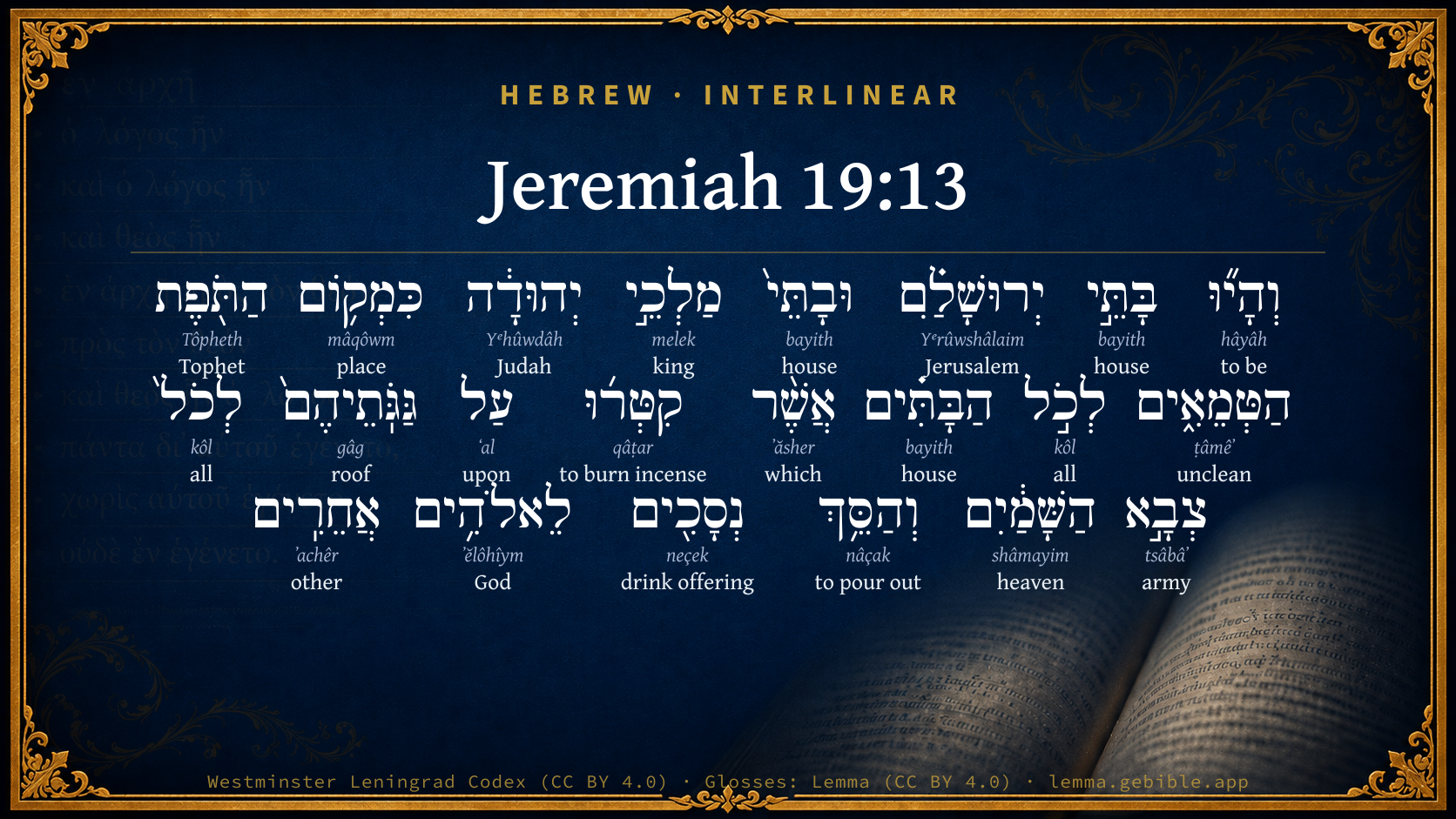
Jeremiah 19:13

Hebrew (Westminster Leningrad Codex) Jeremiah 19:13 appears in the Hebrew Old Testament. The text above is from the Westminster Leningrad Codex. Each word links to its Strong’s number, a concise gloss, and parsing drawn from the Open Scriptures Hebrew Bible morphology. Click any word for its full Brown-Driver-Briggs (BDB) entry.
Download image
Cite this verse

Jeremiah 19:13 (World English Bible). Public Domain. Lemma interlinear Bible study tool, https://lemma.gebible.app/v/jeremiah/19/13.

Show BibTeX & RIS
BibTeX
RIS
English Translation
and the houses of Jerusalem, and the houses of the kings of Judah, which are defiled, shall be as the place of Topheth, even all the houses on whose roofs they have burned incense to all the host of the sky, and have poured out drink-offerings to other gods.
World English Bible · Public Domain
Download a study sheet

One document with this verse’s original text, its word-by-word gloss line, the meaning frame, cross-references with their text, attributed commentary, and full source and license credits — printable, and it pastes into notes with its structure intact.

This verse Autodidact and up

Study sheet (.html) Plain text (.txt)

A passage Seminary Student

Up to 50 verses in one chapter. A passage sheet keeps up to 6 commentary sources and 12 cross-references per verse, in the order this page ranks them, and says so on the sheet whenever that leaves anything out. Ask for a single verse and you get the Autodidact verse sheet above.

Everything on this page stays free to read, with no account — the sheet is a download of what is already on screen, not access to it.

Want to remove ads? Support Godless Engineer
Compare translations 3

The same verse in 3 English versions, stacked beneath the original-language interlinear above. Click any original word for its lexicon entry.

Each is an independent rendering of the whole verse — the interlinear is not word-aligned to these translations.

Highlighted words mark where these versions differ — a whole-verse word diff, not a word-by-word alignment.

  • World English Bible Public Domain
    and the houses of Jerusalem, and the houses of the kings of Judah, which are defiled, shall be as the place of Topheth, even all the houses on whose roofs they have burned incense to all the host of the sky, and have poured out drink-offerings to other gods.
  • King James Version Public Domain
    And the houses of Jerusalem, and the houses of the kings of Judah, shall be defiled as the place of Tophet, because of all the houses upon whose roofs they have burned incense unto all the host of heaven, and have poured out drink offerings unto other gods.
  • unfoldingWord Literal Text CC BY-SA 4.0
    And the houses of Jerusalem and the houses of the kings of Judah shall be like the defiled place of Topheth, because of all of the houses where they have burned incense on their roofs to all of the host of the heavens and poured out drink offerings to other gods.’”

unfoldingWord Literal Text — © unfoldingWord, licensed CC BY-SA 4.0. Word-aligned USFM3 via Door43 (git.door43.org/unfoldingWord/en_ult).

Versions to compare (up to 4)

3 of 4 selected

Show all 18 translations

Every available English version of this verse, each an independent rendering of the whole verse.

  • World English Bible Public Domain
    and the houses of Jerusalem, and the houses of the kings of Judah, which are defiled, shall be as the place of Topheth, even all the houses on whose roofs they have burned incense to all the host of the sky, and have poured out drink-offerings to other gods.
  • Berean Standard Bible Public Domain
    The houses of Jerusalem and the houses of the kings of Judah will be defiled like that place, Topheth—all the houses on whose rooftops they burned incense to all the host of heaven and poured out drink offerings to other gods.”
  • Majority Standard Bible Public Domain
    The houses of Jerusalem and the houses of the kings of Judah will be defiled like that place, Topheth—all the houses on whose rooftops they burned incense to all the host of heaven and poured out drink offerings to other gods.”
  • King James Version Public Domain
    And the houses of Jerusalem, and the houses of the kings of Judah, shall be defiled as the place of Tophet, because of all the houses upon whose roofs they have burned incense unto all the host of heaven, and have poured out drink offerings unto other gods.
  • American Standard Version (1901) Public Domain
    and the houses of Jerusalem, and the houses of the kings of Judah, which are defiled, shall be as the place of Topheth, even all the houses upon whose roofs they have burned incense unto all the host of heaven, and have poured out drink-offerings unto other gods.
  • Revised Version (1885) Public Domain
    and the houses of Jerusalem, and the houses of the kings of Judah, which are defiled, shall be as the place of Topheth, even all the houses upon whose roofs they have burned incense unto all the host of heaven, and have poured out drink offerings unto other gods.
  • Geneva Bible (1599) Public Domain
    For the houses of Ierusalem, and the houses of the Kings of Iudah shalbe defiled as the place of Topheth, because of al the houses vpon whose roofes they haue burnt incense vnto all the host of heauen, and haue powred out drinke offerings vnto other gods.
  • Douay-Rheims (1899) Public Domain
    And the houses of Jerusalem, and the houses of Juda shall be unclean as the place of Topheth: all the houses upon whose roots they have sacrificed to all the host of heaven, and have poured out drink offerings to strange gods.
  • Young's Literal Translation Public Domain
    and the houses of Jerusalem, and the houses of the kings of Judah, have been -- as the place of Tophet -- defiled, even all the houses on whose roofs they have made perfume to all the host of the heavens, so as to pour out oblations to other gods.'
  • Literal Standard Version CC BY-SA 4.0
    and the houses of Jerusalem, and the houses of the kings of Judah, have been as the place of Tophet—defiled, even all the houses on whose roofs they have made incense to all the host of the heavens, so as to pour out oblations to other gods.”
  • Unlocked Literal Bible CC BY-SA 4.0
    so the houses of Jerusalem and of the kings of Judah will become like Topheth—all the houses on whose rooftops the unclean people worship all the stars of the heavens and pour out drink offerings to other gods.'”
  • unfoldingWord Literal Text CC BY-SA 4.0
    And the houses of Jerusalem and the houses of the kings of Judah shall be like the defiled place of Topheth, because of all of the houses where they have burned incense on their roofs to all of the host of the heavens and poured out drink offerings to other gods.’”
  • Darby Bible Public Domain
    And the houses of Jerusalem and the houses of the kings of Judah shall be as the place of Topheth, defiled, all the houses upon whose roofs they have burned incense unto all the host of the heavens, and have poured out drink-offerings unto other gods.
  • World Messianic Bible Public Domain
    The houses of Jerusalem and the houses of the kings of Judah, which are defiled, will be as the place of Topheth, even all the houses on whose roofs they have burned incense to all the army of the sky and have poured out drink offerings to other gods.”’”
  • Webster's Bible Public Domain
    And the houses of Jerusalem, and the houses of the kings of Judah, shall be defiled as the place of Tophet, because of all the houses upon whose roofs they have burned incense to all the host of heaven, and have poured out drink-offerings to other gods.
  • Free Bible Version CC BY-SA 4.0
    All the houses of Jerusalem and the palaces of the kings of Judah will become unclean just like Topheth, because they are all the houses on whose rooftops they used to burn incense to the sun, moon, and stars, and poured out drink offerings to other gods.
  • Bible in Basic English Public Domain
    And the houses of Jerusalem, and the houses of the kings of Judah, which they have made unclean, will be like the place of Topheth, even all the houses on whose roofs perfumes have been burned to all the army of heaven, and drink offerings drained out to other gods.
  • JPS Tanakh (1917) Public Domain
    and the houses of Jerusalem, and the houses of the kings of Judah, which are defiled, shall be as the place of Topheth, even all the houses upon whose roofs they have offered unto all the host of heaven, and have poured out drink-offerings unto other gods.

Literal Standard Version (2020), Covenant Press — licensed CC BY-SA 4.0. Text via the HelloAO Bible API (eBible.org). Unlocked Literal Bible (unfoldingWord) — licensed CC BY-SA 4.0. Text via the HelloAO Bible API (eBible.org). unfoldingWord Literal Text — © unfoldingWord, licensed CC BY-SA 4.0. Word-aligned USFM3 via Door43 (git.door43.org/unfoldingWord/en_ult). Free Bible Version, Dr. Jonathan Gallagher — licensed CC BY-SA 4.0. Text via the HelloAO Bible API (eBible.org).

Word by word

More ways to search: Search by grammar → Find every occurrence → Compare this word →

Practice this passage: Drill this verse → Learn its vocabulary →

הַתֹּ֖פֶת
Tôpheth
H8612
“the · Tophet”
Particle, Definite Article + Noun, Proper
Part of Speech
Particle + Noun
Type
Proper
Full BDB Definition

Origin: the same as H8611

TWOT: 2539

Tophet or Topheth = "place of fire"
  1. וְהָי֞וּ hâyâh H1961 “and · to be” Conjunction + Verb, Qal, Sequential Perfect, 3rd Person, Common, Plural
  2. בָּתֵּ֣י bayith H1004 “houses of” Noun, Common, Masculine, Plural, Construct
  3. יְרוּשָׁלִַ֗ם Yᵉrûwshâlaim H3389 “Jerusalem” Noun, Proper
  4. וּבָתֵּי֙ bayith H1004 “and · houses of” Conjunction + Noun, Common, Masculine, Plural, Construct
  5. מַלְכֵ֣י melek H4428 “kings of” Noun, Common, Masculine, Plural, Construct
  6. יְהוּדָ֔ה Yᵉhûwdâh H3063 “Judah” Noun, Proper
  7. כִּמְק֥וֹם mâqôwm H4725 “like/as · place of” Preposition + Noun, Common, Masculine, Singular, Construct
  8. הַטְּמֵאִ֑ים ṭâmêʼ H2931 “the · unclean” Particle, Definite Article + Adjective, Adjective, Masculine, Plural, Absolute
  9. לְכֹ֣ל kôl H3605 “to/for · all of” Preposition + Noun, Common, Masculine, Singular, Construct
  10. הַבָּתִּ֗ים bayith H1004 “the · houses” Particle, Definite Article + Noun, Common, Masculine, Plural, Absolute
  11. אֲשֶׁ֨ר ʼăsher H834 “which” Particle, Relative
  12. קִטְּר֜וּ qâṭar H6999 “to burn incense” Verb, Piel, Perfect, 3rd Person, Common, Plural
  13. עַל ʻal H5921 “upon” Preposition
  14. גַּגֹּֽתֵיהֶם֙ gâg H1406 “roofs · their” Noun, Common, Masculine, Plural, Construct + Suffix, Personal, 3rd Person, Masculine, Plural
  15. לְכֹל֙ kôl H3605 “to/for · all of” Preposition + Noun, Common, Masculine, Singular, Construct
  16. צְבָ֣א tsâbâʼ H6635 “army of” Noun, Common, Both, Singular, Construct
  17. הַשָּׁמַ֔יִם shâmayim H8064 “the · heaven(s)” Particle, Definite Article + Noun, Common, Masculine, Plural, Absolute
  18. וְהַסֵּ֥ךְ nâçak H5258 “and · to pour out” Conjunction + Verb, Hiphil, Infinitive Absolute
  19. נְסָכִ֖ים neçek H5262 “drink offerings” Noun, Common, Masculine, Plural, Absolute
  20. לֵאלֹהִ֥ים ʼĕlôhîym H430 “to/for · God(s)” Preposition + Noun, Common, Masculine, Plural, Absolute
  21. אֲחֵרִֽים ʼachêr H312 “other” Adjective, Adjective, Masculine, Plural, Absolute

About this verse

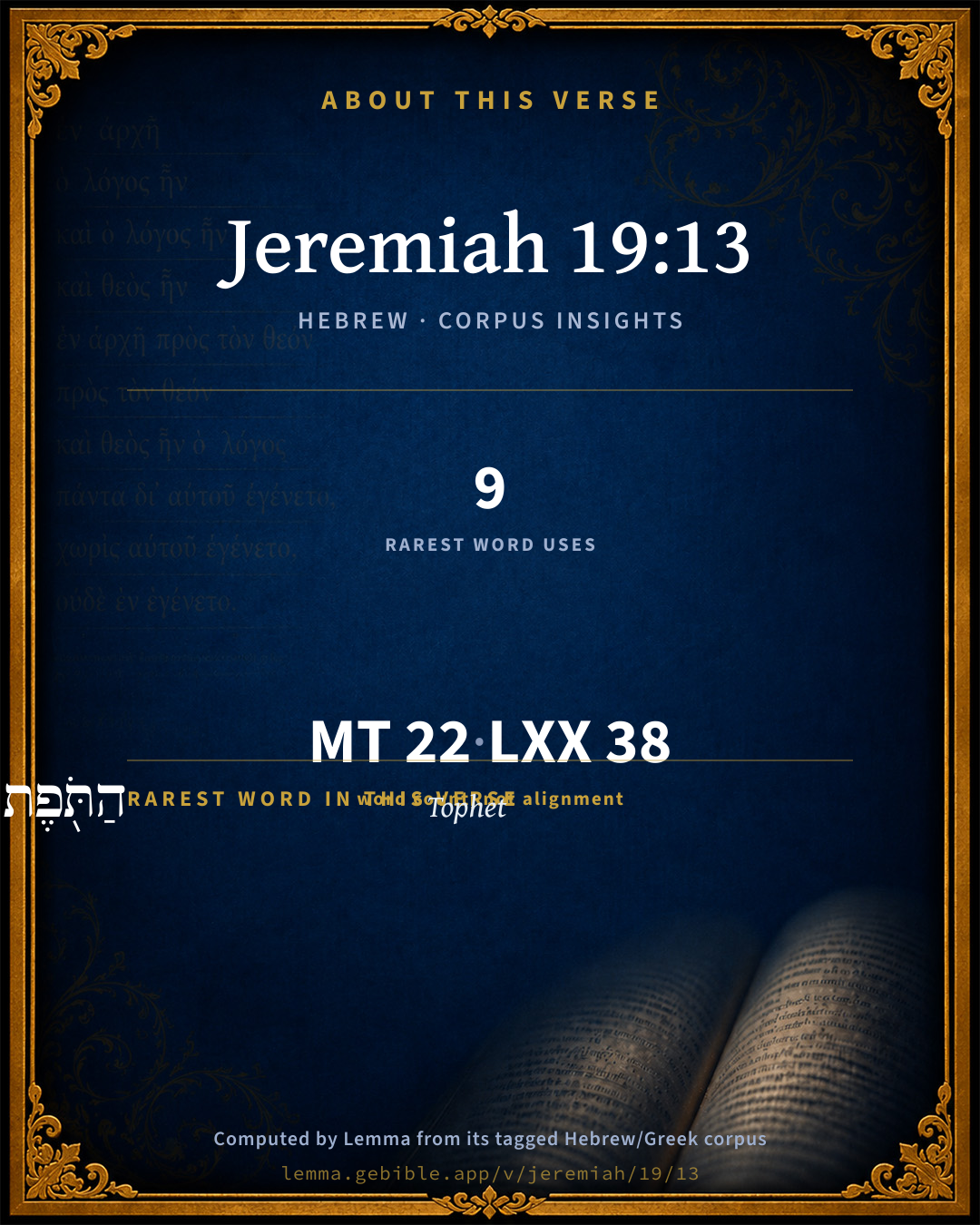
These counts appear in no published source. They are computed here, from the morphology-tagged text and Lemma’s own curated glosses. What Lemma adds →

22
words
19
distinct lemmas
Prophets
section

Notable vocabulary

The rarest word here is הַתֹּ֖פֶת Tophet H8612 — appearing just 9 times in the whole Hebrew Bible.

Shared distinctive vocabulary

הַתֹּ֖פֶת Tophet H8612 occurs in 8 verses of the Hebrew Bible. Also found in:

Grammatical profile

  • 3 verbs
  • 15 nouns
  • 2 adjectives
  • 1 preposition
  • 1 particle

Verb forms

  • וְהָי֞וּ Qal · Sequential Perfect
  • קִטְּר֜וּ Piel · Perfect
  • וְהַסֵּ֥ךְ Hiphil · Infinitive Absolute

Repetition

Words recur within this verse — often emphatic in Hebrew:

  • בָּתֵּ֣י house H1004 ×3
  • לְכֹ֣ל all H3605 ×2

Hebrew & Septuagint length

In the original languages it is 22 Hebrew tokens and 38 Greek tokens — but the two are counted differently (Hebrew bundles its prefixes and suffixes into one token; the Greek is in lemma form), so that isn’t a like-for-like length.

Cross-references

14

Topical passages linked to Jeremiah 19:13 in the Treasury of Scripture Knowledge — connected by theme and wording, ordered by reader-vote popularity; previews shown in the World English Bible.

  • 2 Kings 23:12 The altars that were on the roof of the upper chamber of Ahaz, which the kings of Judah had made, and the altars which Manasseh had made in the two courts of the house of Yahweh, did the king break down, and beat [them] down from there, and cast the dust of them into the brook Kidron.
  • Jeremiah 32:29 and the Chaldeans, who fight against this city, shall come and set this city on fire, and burn it, with the houses, on whose roofs they have offered incense to Baal, and poured out drink-offerings to other gods, to provoke me to anger.
  • Jeremiah 7:18 The children gather wood, and the fathers kindle the fire, and the women knead the dough, to make cakes to the queen of the sky, and to pour out drink-offerings to other gods, that they may provoke me to anger.
  • Zephaniah 1:5 those who worship the host of the sky on the housetops, those who worship and swear by Yahweh and also swear by Malcam,
  • Deuteronomy 4:19 and lest you lift up your eyes to the sky, and when you see the sun and the moon and the stars, even all the host of the sky, you are drawn away and worship them, and serve them, which Yahweh your God has allotted to all the peoples under the whole sky.
  • 2 Kings 23:10 He defiled Topheth, which is in the valley of the children of Hinnom, that no man might make his son or his daughter to pass through the fire to Molech.
  • Psalms 74:7 They have burned your sanctuary to the ground. They have profaned the dwelling-place of your Name.
  • Psalms 79:1 God, the nations have come into your inheritance. They have defiled your holy temple. They have laid Jerusalem in heaps.
  • Jeremiah 44:18 But since we left off burning incense to the queen of the sky, and pouring out drink-offerings to her, we have wanted all things, and have been consumed by the sword and by the famine.
  • Ezekiel 7:21–22 I will give it into the hands of the strangers for a prey, and to the wicked of the earth for a spoil; and they shall profane it.
  • 2 Kings 23:14 He broke in pieces the pillars, and cut down the Asherim, and filled their places with the bones of men.
  • Jeremiah 52:13 and he burned the house of Yahweh, and the king's house; and all the houses of Jerusalem, even every great house, burned he with fire.
  • Ezekiel 20:28 For when I had brought them into the land, which I swore to give to them, then they saw every high hill, and every thick tree, and they offered there their sacrifices, and there they presented the provocation of their offering; there also they made their sweet savor, and they poured out there their drink-offerings.
  • Acts 7:42 But God turned, and gave them up to serve the host of the sky, as it is written in the book of the prophets, 'Did you offer to me slain animals and sacrifices Forty years in the wilderness, O house of Israel?

Cross-references courtesy of OpenBible.info (CC BY 4.0).

Hebrew and Greek witnesses Masoretic Hebrew ↔ Greek Septuagint

The same verse in the two great witnesses to the Old Testament, shown verse-for-verse.

These are two independent witnesses, not word-aligned to each other, and the Septuagint is shown in lemma (dictionary) form.

Hebrew Jeremiah 19:13 Masoretic · Westminster Leningrad Codex

וְהָי֞וּ בָּתֵּ֣י יְרוּשָׁלִַ֗ם וּבָתֵּי֙ מַלְכֵ֣י יְהוּדָ֔ה כִּמְק֥וֹם הַתֹּ֖פֶת הַטְּמֵאִ֑ים לְכֹ֣ל הַבָּתִּ֗ים אֲשֶׁ֨ר קִטְּר֜וּ עַל גַּגֹּֽתֵיהֶם֙ לְכֹל֙ צְבָ֣א הַשָּׁמַ֔יִם וְהַסֵּ֥ךְ נְסָכִ֖ים לֵאלֹהִ֥ים אֲחֵרִֽים

and the houses of Jerusalem, and the houses of the kings of Judah, which are defiled, shall be as the place of Topheth, even all the houses on whose roofs they have burned incense to all the host of the sky, and have poured out drink-offerings to other gods.

World English Bible · Public Domain

Greek LXX Structure differs

In the Septuagint, Jeremiah is about an eighth shorter than the Hebrew and arranges its material differently — the Oracles Against the Nations (Hebrew chapters 46–51) appear in the middle of the Greek book, after 25:13. Because the chapter and verse boundaries do not line up, a verse-for-verse comparison with the Hebrew is not shown.

A verse-for-verse comparison isn’t shown here because the chapters and verses don’t line up. Switch to the LXX edition with the MT / LXX toggle above to read the Greek directly.

On this verse, Haydock's Catholic Bible Commentary discusses the Septuagint’s reading. Read the note in Commentary ↓

Hebrew: Westminster Leningrad Codex (CC BY 4.0). Greek: Septuagint (public domain); English from a public-domain English Septuagint. How the Septuagint differs from the Hebrew →

Targum (Aramaic paraphrase)

1

The Targum is the ancient Jewish Aramaic paraphrase of the Hebrew Scriptures — an interpretive translation, not the Hebrew text itself. Onkelos (literal) and Pseudo-Jonathan (expansive) render the Torah, and Jonathan the Prophets. Coverage is partial: where no permissively-licensed English translation exists for a verse, only the Aramaic is shown. This is verse-level text, not a word-by-word alignment to the Hebrew.

  1. Targum Jonathan Prophets (Joshua–Malachi)
    וִיהוֹן בָּתֵּי יְרוּשְׁלֵם וּבָתֵּי מַלְכַיָא דְבֵית יְהוּדָה בַּאֲתַר תּוֹפֶת דִמְסָאָב לְכָל בָּתַּיָא דְאַסִיקוּ בּוּסְמִין עַל אֱגוֹרֵיהוֹן לְכָל חֵילֵי שְׁמַיָא וּנְסִיכוּ נִסְכִין לְטַעֲוַת פַּלְחֵי כּוֹכְבַיָא:

    (no public-domain English translation for this verse)

    Targum Jonathan — Aramaic: “Mikraot Gedolot” (public domain). English: “Sefaria Community Translation” (CC0 1.0 (public-domain dedication)); “London "Chaldee Paraphrase," 1871” (public domain). Text via Sefaria.

Commentary

Notes on Jeremiah 19:13 from classic Christian and Jewish commentators (each source and its license shown beneath its notes). The classic Christian expositions comment on the surrounding passage and are grouped to its opening verse, so a note may address several verses; the Jewish commentaries on the Tanakh (Rashi and others) are per-verse, so they appear only where the commentator wrote on this verse.

Lemma curates 59 commentaries, every one of them public domain or Creative Commons licensed, each selected and text-cleaned for this edition rather than reprinted as found. About our sources →

Trapp's Complete Commentary

John Trapp

Jer 19:13 And the houses of Jerusalem, and the houses of the kings of Judah, shall be defiled as the place of Tophet, because of all the houses upon whose roofs they have burned incense unto all the host of heaven, and have poured out drink offerings unto other gods.

Ver. 13. And the houses of Jerusalem.] Wherein they had their "chambers of imagery," and their private chapels for idolatrous uses, as Papists also have. {Eze 8:12 Zep 1:1-18}

Because all the houses upon whose roofs.] See on Zep 1:4.

John Trapp, A Commentary or Exposition upon All the Books of the Old and New Testament (1647–1656) — public domain. Text from a community e-Sword module.

Geneva Bible (1599)

Geneva Bible translators

He noteth the great rage of the idolaters, which left no place free from their abominations, insomuch as they polluted their own houses therewith, as we see yet among the Papists.

Read Deut. 22:8.

Geneva Bible (1599) marginal notes — public domain. Text via Bolls.life.

Jamieson, Fausset & Brown

Robert Jamieson, A. R. Fausset & David Brown

shall be defiled--with dead bodies (Jer 19:12; Kg2 23:10).

because of all the houses--Rather, (explanatory of the previous "the houses . . . and . . . houses"), "even all the houses," &c. [CALVIN].

roofs--being flat, they were used as high places for sacrifices to the sun and planets (Jer 32:29; Kg2 23:11-12; Zep 1:5). The Nabateans, south and east of the Dead Sea, a nation most friendly to the Jews, according to STRABO, had the same usage.

Jamieson, Fausset & Brown — Commentary Critical and Explanatory on the Whole Bible (1871) — public domain (CC PDM 1.0). Text via the HelloAO Bible API.

John Calvin's Commentaries

He describes, as I have said, more at large what he had briefly expressed, for he had spoken of the city; but as the belief of that was difficult, he now enumerates particulars, as though he had said, that Jerusalem was a wide city and splendidly built, for there were there many large and elegant houses, and the royal palaces, yet he says, that all these things would not prevent God to demolish the whole city. And this deserves particular notice, for we know that Satan dazzles our eyes whenever he suggests anything that gives a hope of defense, but what God threatens we think is vain, and as it were fabulous, or at least produces no effect on us. Since then so gross an hypocrisy prevailed in the hearts of the people, the Prophet rightly tried to shake off from them whatever might deceive them.

Hence he says, The houses of Jerusalem, etc. — these were many and splendid — and the houses of the kings of Judah, their palaces either within or without the city shall be as the place of Tophet; that is, no house shall be exempt from slaughter, and no palace shall protect its inhabitants. They shall be unclean, he says, that is, on account of dead bodies, for men slain would be found everywhere; and this is, as it is well known, often mentioned in Scripture as a pollution or defilement. With regard to all the houses; some read, “On account of all the houses,” and ל lamed, is often a causal preposition. But it seems rather to be taken here as explanation; and hence I render the words, With regard to all the houses, so that the Prophet speaks of all the houses in, which they made incense. As then there was no house free from sacrilege, he says that God’s vengeance would penetrate into all houses without any exception.

He says also, On the roofs, with the view of condemning them for their effrontery; for they raised their baseness as a standard, that it might be seen at a distance. They indeed thought that God was delighted with such a service; but how came they to entertain such a foolish persuasion, except through their neglect and contempt of the law, and also through a mad presumption in giving more credit to their own fictions than to certain truth. The Prophet then justly condemns them, for they had cast off all shame, and went up to the roofs of their houses, that their doings might be more open. Then he mentions the whole host of heaven; and says further, that they had poured a libation to foreign gods. We see that many kinds of superstitions prevailed among the people; for he spoke of Baal in the singular number, he mentioned also Baalim, patrons, and he now adds, the whole host of heaven; that is, the sun, the moon, and all the stars.

We hence see that the Jews kept no limits as to their sacrileges, which is usually the case with all the ungodly; for as soon as men begin to turn aside from the pure and genuine worship of God, they sink into the lowest depths. It is then this wantonness that the Prophet now refers to, when he intimates that their various forms of worship were so increased, that they had devised as many gods as there are stars in heaven; which is similar to what is said elsewhere,

“According to the number of thy cities, O Judah, are thy gods,” (Jeremiah 2:28; Jeremiah 11:13.)

John Calvin's Commentaries (1540-1563) — public domain. Text from the Calvin Translation Society English edition (1840s-50s) via the Christian Classics Ethereal Library (ccel.org). Calvin's coverage is partial (roughly two-thirds of the Bible); uncommented books and verses are honest gaps, never fabricated. The 19th-century editor's footnotes and remarks are omitted so the notes are faithfully Calvin's own voice.

Ellicott's Commentary for English Readers

(13) Defiled as the place of Tophet.—A difficulty affecting the construction, but not the sense, of the passage, makes the rendering as the place of Tophet the defiled preferable.

Upon whose roofs they have burned incense.—The flat roofs of Eastern houses were used, as for exercise (2Sa_11:2) so also, as in Peter’s vision at Joppa (Act_10:9), for prayer and meditation, and seem from Zep_1:5 to have been specially chosen, as was natural, for worship addressed to the host of heaven. The two altars “on the top of the upper chamber of Ahaz” (2Ki_23:12) were probably so situated. Where men had been wont to keep the holy days of the Feast of Tabernacles (Neh_8:16) they had celebrated their idolatrous rites. (See Jer_32:29.) So Strabo (xvi. p. 1, 131) describes the Nabathœans as worshipping the sun, and offering incense on an altar on the roof of their houses.

A Bible Commentary for English Readers, edited by Charles John Ellicott (1878–1897) — public domain. Text from a community e-Sword module.

The Cambridge Bible for Schools and Colleges

gen. ed. J. J. S. Perowne

13. upon whose roofs] Cp. Jer_32:29; 2Ki_23:12 (in which place the meaning probably is “on the roof [of the Temple]”); Zep_1:5. These were used for festivals (Jdg_16:27), for conference (1Sa_9:25 f.), for exercise (2Sa_11:2), for booths at the feast of tabernacles (Neh_8:16), for public announcements (Mat_10:27), and for prayer (Act_10:9).

14–20:6. See introd. summary to section.

The Cambridge Bible for Schools and Colleges (gen. ed. J. J. S. Perowne; Cambridge University Press, 1878–1918) — public domain. Text from a community e-Sword module.

John Gill's Exposition

Then came Jeremiah from Tophet,.... When he had broke his earthen bottle, and delivered his prophecy before the elders of the people and priests: or, "from that Tophet" (t),

whither the Lord had sent him to prophesy; and whither he went and prophesied, according to his command; but now returned from thence, it being no doubt signified to him, in some manner or other, that it was the will of God he should;

and he stood in the court of the Lord's house, and said to all the people; this was the court of the temple, called the outward court, or the court of the Israelites, where all the people met; for into other courts they might not enter; here the prophet placed himself, on purpose to deliver his prophecy to all the people; even the same as he had delivered at Tophet to the ancients of the people and the priests; but lest they should not faithfully represent it to the people, and that they might not be without it, he delivers it openly and publicly to them all, in the following words; which both declare their punishment, and the cause of it.

(t)

John Gill's Exposition of the Whole Bible (1746–1763) — public domain (CC PDM 1.0). Text via the HelloAO Bible API.

Albert Barnes' Notes on the Bible

Because of all - literally, “with reference to all,” limiting the denunciation to those houses whose roofs had been defiled with altars.

Upon whose roofs they have burned incense - See 2Ki 23:12, note.

Albert Barnes' Notes on the Bible (1834–1885) — public domain. Text from a community e-Sword/MySword module.

Haydock's Catholic Bible Commentary

Topheth. This sentence was not in St. Jerome’s Hebrew copy, but in the Septuagint (Calmet) with some variations: (Haydock) "All the houses of the kings of Juda, like the place of Topheth," is added by the Septuagint. (St. Jerome) --- In Grabe they agree with the present Hebrew and Chaldean only rendering, "shall be as a place in ruin, for the defilements in all," &c. (Haydock) --- Of heaven: the moon, &c., 4 Kings xxiii. 12. Josias could not entirely root out this impiety, chap. xxxii. 29. His wicked son Joachaz or Sellum, was probably now on the throne, when the prophet went to the potter, &c., chap. xviii. to xxi.

George Leo Haydock (1774–1849), Haydock's Catholic Family Bible and Commentary, 1859 edition — public domain. Excludes Psalms (Douay-Rheims chapter numbering differs from Protestant) and Deuterocanonical books (Catholic canon only).

Matthew Poole's English Annotations

Under the Judaic law, persons and places were defiled by touching dead bodies, or any unclean, filthy thing: God threateneth in this sense to defile Tophet, as it was said before it should be filled with dead bodies which should be buried or lie unburied there. He showeth that the aforementioned judgment of filling places with dead bodies should not be restrained to Tophet in the valley of Hinnom, but reach to the dwelling-houses in Jerusalem, both their kings’ houses, and the meaner subjects; the provoking cause of which should be their idolatry, which they had also brought into their dwelling-houses, for they having flat roofs, had upon them, though not burnt children in sacrifice to idols, yet poured out drink-offerings to the sun, moon, and stars, and to other idols.

Matthew Poole's English Annotations on the Holy Bible (1683–1685) — public domain. Text from a community e-Sword/MySword module.

Whedon's Commentary on the Bible

Daniel D. Whedon

13. Defiled, etc. — Literally, as Tophet the defiled. The article, with the word “defiled,” seems to fix this construction, though “defiled” is plural, while Tophet, its subject, is singular. This is to be explained as a case of attraction to the leading subject, houses. Upon whose roofs, etc. — On the worship of the stars from the housetops, see Zep_1:5; 2Ki_21:3; 2Ki_23:12.

JEREMIAH’S MESSAGE IN THE TEMPLE, 14, 15.

Daniel D. Whedon (gen. ed.), Commentary on the Old and New Testaments (1874–1909) — public domain. Text from a community e-Sword module.

The Pulpit Commentary

The houses of the kings of Judah; i.e. the palaces and other buildings which together made up the king"s house. (Jer_22:6) Shall he defiled as the place of Tophet. This is one of the few places in which the Authorized Version has allowed itself to interfere with the received text; for the Hebrew has "which are defiled," etc. The common reading, in fact, seems untranslatable. Because of all the houses; rather, even all the houses.

The Pulpit Commentary (1880–1919), ed. H.D.M. Spence-Jones & Joseph S. Exell — public domain. Text from a community e-Sword module.

Lesson kit

Teaching starters — assembled from the data on this page, not authored interpretation. Every prompt links to the verse data it draws on. Edit before teaching.

Jeremiah, in the Prophets, opens this verse with 22 words (19 distinct Hebrew lemmas). Its most distinctive word is Tôpheth (“Tophet”). A historical commentator’s framing appears above. Read the whole chapter for the surrounding context.

Discussion questions

  1. How does “Tophet” (Tôpheth) shape what this verse is saying?
  2. How does 2 Kings 23:10, which shares the word «Tophet», read alongside this verse?
  3. What does the repetition of “house” (3× in this one verse) do in this verse?
  4. These translations render this verse differently; the difference is in the English rendering, not the original. What questions does that raise?
  5. «וְהָי֞וּ» is a Qal Sequential Perfect verb. How does that grammatical form shape the action described?
  6. Compare how Trapp's Complete Commentary and Geneva Bible (1599) read this verse. Where do they agree or differ?

Things to notice

Reading settings

Reading text

Shown beneath each verse's original-language words.

Old Testament
Old Testament edition

Read the OT as the Masoretic Hebrew (MT) or the Greek Septuagint (LXX).

English shown for the Greek Septuagint (in the Hebrew ↔ Greek comparison).

Comparing translations? Open the Compare panel on any verse page to stack up to four side by side.